The Mystery of Jack Waer

by James Scott Bell
@jamesscottbell

It’s no secret that I love the paperback era of the 1950s. Most of it is eminently entertaining, and almost always well written. Why? Because the writers in those days had been through the classic American schooling that drummed the structure of the English sentence into their heads. Then they paid their dues writing for newspapers, where grizzled editors would scream at them to write more clearly.

The result was sharp and grammatical prose, unlike so much of what’s produced today, even in once respected newspapers. I recently saw the word anyways in an actual news column trying to make an actual point.

But I digress.

I recently purchased The Noir Novel Megapack—four 1950s novels for only 55¢! A few days ago I started reading one of them: Murder in Las Vegas by Jack Waer.

It’s terrific. A solid noir set up: After a night of drinking and getting into a fight, a guy wakes up in his apartment, not knowing how he got there. He finds his .38 on the floor and picks it up. Then he spots a dead body on his bed just as his cleaning lady comes in and, seeing the gun in his hand and the body on the bed, screams and runs out. It isn’t long before he’s on the lam and hiding out in L.A.

Excellent hardboiled prose, as in:

His fist came up into my face and it was like having a stick of dynamite exploding inside my head. That was the end of the line. After that there was nothing but the black velvet road that led me through insane dreams.

***

Slowly, I crossed around the bed. I went just so far, then stopped, although the thing inside my gut sprang forward, clawing and spitting. I wanted to yell, to scream out all the filthy things I’d ever learned in all those years on the way up. I wanted to yell until the noise drove away the sight in front of me.

Somebody had been at her throat with a knife.

***

I grabbed the threadbare huck towel off the rack and splashed some water on my face. After I’d dried off I took a look at myself in the mirror and decided never to do it again.

***

The Vanguard was the address where the high tone and six-figure sports kept their private doxies in the manner to which their wives had never been accustomed.

***

The place reminded me of my happy childhood. It was like Old Home Week to enter the dark interior and smell the sweetish odor of stale beer, dampness and despair.

So I found myself wondering, who was Jack Waer? But my initial searches hit a cul-de-sac.

On Amazon, there are only three titles listed for him, as used paperbacks. Murder in Las Vegas, Sweet and Low-Down and 17 and Black. 

Who was this guy? I didn’t find any biography of him on the usual noir sites. He was not listed in my go-to reference on this era, Paperback Confidential: Crime Writers of the Paperback Era. I even emailed an MWA Grand Master who is an expert in the pulps. He’d never heard of the guy.

I began to formulate a theory. Because the writing in Murder in Las Vegas is so sharp and spot-on, I thought “Jack Waer” might be a pseudonym for a mainstream novelist. In those days, literary writers often went “slumming” in paperback originals in order to make some dough on the side, all while protecting their “good name.” Evan Hunter did that under the pseudonym Ed McBain. It was McBain who became rich and famous. I don’t know if Hunter ever forgave his alter ego for that.

So that was my theory. Only three books. (It turns out it’s only two, for Sweet and Low-Down is a reissue of 17 and Black with a new title.)

Did he die? Or did the literary author simply move on?

It turns out I could not have been further off.

I did another search on Google and saw an old black and white photo:
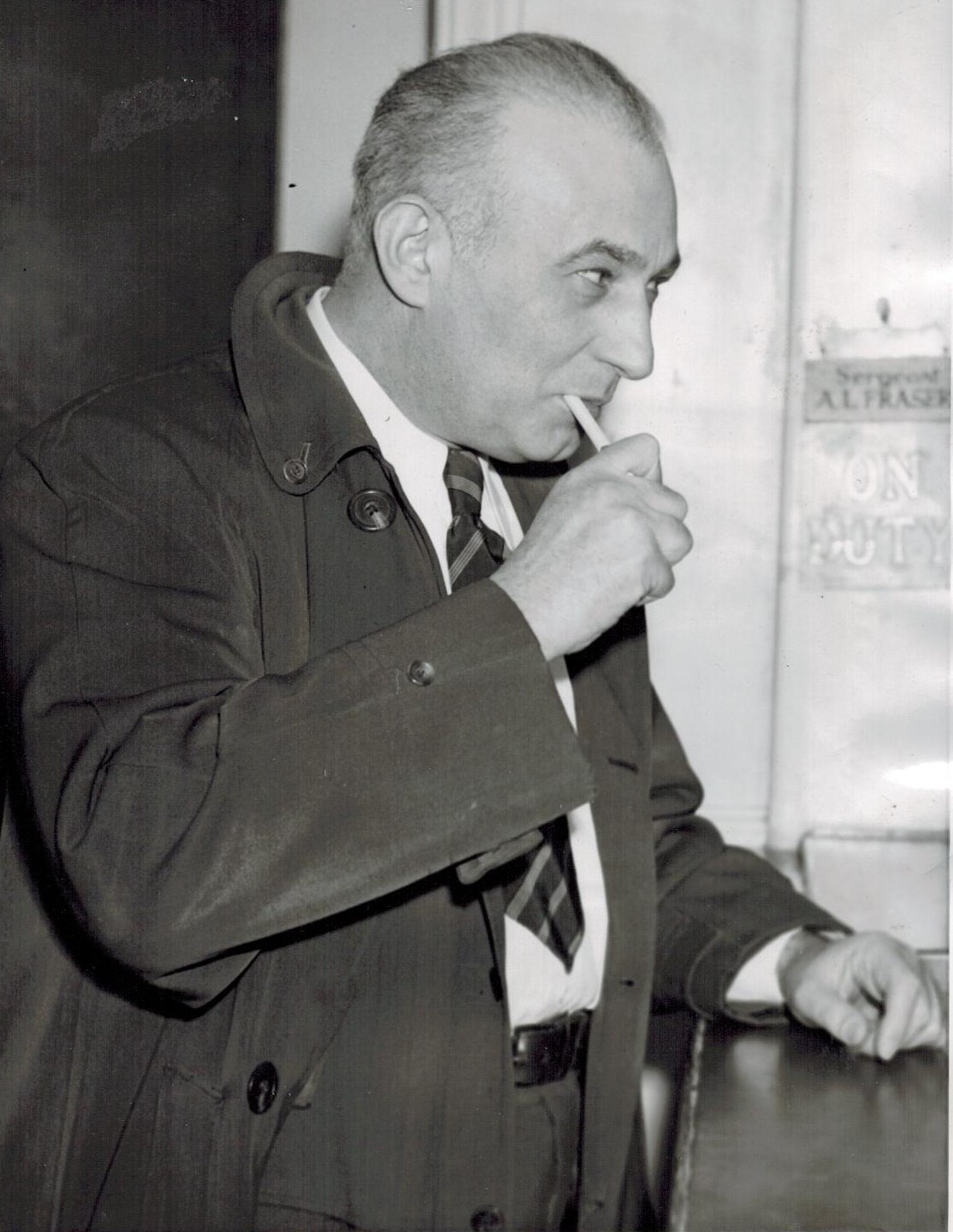
So I went to the page, which turned out to be the blog of L.A. mystery writer J. H. Graham. Ms. Graham is, like me, third-generation Angeleno, and we both love the crime lore of the 50s. I am indebted to her for solving the Jack Waer mystery.

Turns out Waer was a gambler running in the same circles as Mickey Cohen, the underworld king of Los Angeles. Says Graham:

Waer, who is also used the name Alexander John Warchiwker according to his naturalization forms, was born in Warsaw Poland in February 1896. He came to Los Angeles sometime after 1930, having previously lived in Detroit. In 1942 he listed Eddie Nealis as his employer on his WWII draft registration card; his job description was not specified. However, he was arrested on gambling charges in July 1943, when D.A. investigators raided an office in the Lissner Building at 524 S. Spring St. and found Waer running a dice game.

The [Los Angeles] Times had called Waer a writer after the NYE 1945 hold-up. He may well have been one; In any case, he became a writer for sure by 1954 with publication of his novel 17 and Black (later issued in paperback as Sweet and Lowdown).

So there you have it. A habitué of the illegal gambling dens of 1950s Los Angeles wrote a couple of books on the side, one of which is pretty doggone good!

Even if your beat is the underbelly of society, it helps if you can write.

Waer, according to Graham. died in Las Vegas in 1966.

And if you are interested in crime fiction that takes place in Los Angeles back in those days, check out J. H. Graham’s mysteries.

What obscure writers have you come across who should be better remembered?

From Cool to Heat

Photo courtesy Eddie Howell on unsplash.com

The weather has turned cool since last we met. Each area of the United States has its identifiable seasons, from the Deep South (where New Orleans has two, those being “summer” and “February”) to the West (where, as Mark Twain is reputed to have said, “The coldest winter I’ve ever spent was a summer in San Francisco”). Ohio has a more severe line of demarcation. The heat of summer at this time of year sinks into the chill of fall. Leaves drop. One can’t um, leave them go without raking or mulching for too long, as snow will almost inevitably fall by November. One sets the thermostat from “cool” to “warm” and calls for the furnace check-up, even as it seems as if but a few weeks ago it was the air conditioning system that was being checked out. The circle, it seems, moves faster and faster.

I’ve of late been feeling the rapidity of the turning of my own seasons. I came across a passage in a new book entitled THE DARKNESS by Ragnar Jonasson. The protagonist is a police inspector who is being involuntarily retired as she approaches the age of sixty-five, muses that she feels little different than she did in her forties, other than for perhaps some minor fatigue. Just so. I’m waking up at 3 AM much too frequently but I’m doing it in my bed in my house and know where I am. There are no real complaints there. Still, I am increasingly aware that the miles in the rear view mirror are substantially greater than those between me and the final destination, and I increasingly doubt whether I’m going to get there before the warranty expires. Most of my close friends are a few years older than I — in their early to mid-seventies — and seem to be hitting a wall. One of them,  who I have known for well over fifty years, advised me yesterday that he was not up to making the two-hour drive to visit me this weekend due to vision problems. He reminded me that when we lived on the west coast he would call me and say, “Tahoe!” and off we would go, making the six-hour round trip to Nevada and back on the same day as if we had not a care in the world. We didn’t. Not then. It was high noon. We are well past that. The sun hasn’t kissed the horizon, but the lengthening shadows hint that, from our landlubber perspective, it is well-nigh approaching the yardarm. Sunset occurred for another friend last week. His body mercifully slipped loose of its moorings last week and followed his essence, which had been stolen by Alzheimer’s Disease, piece by piece, over the past two years. It’s not the way I want to go — I would prefer to pass either while writing at my desk or at the hands of an irate husband — but we don’t always get a choice. Shakespeare’s untimely frost follows no calendar. 


Photo courtesy Eddie Howell on unsplash.com

What more to do? I have four wonderful children, each accomplished in their individual ways, and a terrific granddaughter. There might be time for one more dog. I think I’ve made more people smile than otherwise which is something that not everyone can truthfully claim. It’s been a good ride and there are many more miles and adventures to come. I hope. The lesson I’ve learned, and which I am making so bold as to impart to you —particularly those of you here who are younger — is don’t waste a day, or even an hour. Decide what you want to do and work toward it, whether it is writing the Great American Novel — someone will do it, so why not you? — adopting a stretch of highway, or visiting every Sonic, Tim Horton’s, and Cracker Barrel in the country. Regardless of what you want to do, there are only a finite number of times that you get to switch from cool to heat and back again. Cherish each one, and enjoy them.

Photo courtesy Pathecho Grid on unsplash.com


Valet de Poulet – Some Thoughts on Self-Care (Guest: Bill Cameron)

Jordan Dane
@JordanDane

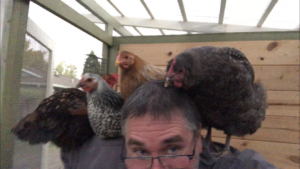
A man and his chicken

It’s my pleasure to have my friend, Bill Cameron, join us today. I’m a big fan of his writing ever since I read his debut book LOST DOG. Bill was in my debut authors group for the International Thriller Writers (ITW) in 2008. That book featured an unlikely kleptomaniac anti-hero smart ass, Peter McKrall, with his unique voice that has always stuck with me. It launched Bill’s detective series that features Detective Skin Kardash.

I also follow/harass Bill on Instagram (@bcmystery) where he posts pics of his urban chickens. His daily videos and pics of his chicken drama are tons of fun and addictive, like his writing. Thanks for being our guest, Bill. Shake a tail feather and take it away.

***

Much of my day was spent chasing chickens around my yard—an act of pure slapstick if there ever was one. Usually the ladies will come right up to me (probably because I often have treats), but today they sensed I had something else in mind. So they fled, making comical “bock-bock-bock” sounds as they went. I was no doubt equally comical, trying to both run and scoop up indignant chickens simultaneously. The result was a kind of bow-legged lurch with my hands flapping around near ground level. I may have fallen, but if you don’t have video you can’t prove anything.

My problem, or rather the chickens’ problem, was a possible infestation of scale mites. These awful little bugs burrow under the skin of a chicken’s legs, drink blood, and can wreak havoc on the well-being of a flock. (Do not image search for “chicken scale mites” unless you want to see true horror.)

Now, I say possible infestation because until the the situation gets really bad, the vermin are difficult to see. Some discoloration on the legs of our oldest hen, Hinie, was the only indication something might be amiss. That discoloration could also mean nothing at all, but since we don’t want the mites to get a leg-hold, I decided to address the problem proactively.

The treatment is basically Chicken Spa Day, which probably sounds nice to you and me. And in fact some chickens enjoy a soak in a warm bath and maybe a massage. (Do image search for “chicken taking a bath” for some entertaining pics.) Not so much our ladies. But I was not deterred.

In advance, I’d prepared a warm Epsom salts bath with a little mild soap. As I caught them, the girls each got a soak and a mild scrub to clean off any mite eggs or mites that hadn’t yet burrowed. Then, after they were dried off, I coated each hen’s legs with Bag Balm to suffocate the pestilent buggers who remained.

The good news is all went relatively as planned, though it took me more than an hour to get all four into the tub. (Farm Fact: chickens are fast.) The girls had a lot to say about it, probably in the form of chicken swearing. But the endeavor was a success—though I got wetter than the girls did.

So what does this shenanigan have to do with self-care?

Well, for me, taking care of chickens is a lot like writing. It can be rewarding, fun, challenging—and also a source of heartbreak. Right now we have four girls: the aforementioned Hinie, plus Cheeks, Tuchus, and Buns. (Do you detect a theme? Guess what!) Earlier this summer, one of our first hens, Fanny, died unexpectedly. And last year, two others (Moon and Patootie) turned out to be roosters, which are verboten within city limits. That’s the heartbreak side of things. But the rest of the time there’s the slapstick comedy and the reward of eggs and affection from smart, engaged birds who each have their own personality.

When I’m away from the keyboard, I find chicken care is a good way for me to get my “I’m not an incompetent buffoon” fix—something that can be rare in my writing life. On days when things seem especially dire (“wait, did you say there’s no market for that manuscript I spent five years on?”), time with the chickens can give me a sense of worth. They need me—for food and water and spa days, and for a lap or shoulder to cluck on. And I’m up to the task.

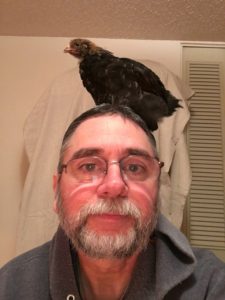
The day Hinie pooped on Bill’s head

But as with writing, there’s no guarantee of success. They might get scale mites, and while I’m confident I have that problem in hand, the next problem might cost me a beloved pet. In the morning, I might get a manuscript rejection, but in the afternoon I might get a fresh egg and a nuzzle from a bird named after a butt.

Chicken Tending (think about it) isn’t the only thing I do for self-care. But the ways it’s like writing helps me deal with the tribulations of my writing life. Sometimes we just need a little success. For me, chasing birds around the yard goes a long way toward keeping me grounded and believing I can make a difference—on the page as much as in the coop.

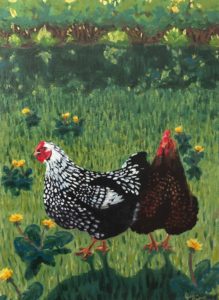
Fanny (RIP) & Hinie by Bill’s daughter, Jessica

FOR DISCUSSION:

What do you do to take care of yourself?


Bill Cameron BIO

Bill Cameron is the critically-acclaimed author of gritty, adult mysteries featuring Skin Kadash. His short stories have appeared in Alfred Hitchcock’s Mystery MagazineKiller YearPortland NoirFirst ThrillsDeadly Treats, and West Coast Crime Wave. In 2012, his novel County Line received the Spotted Owl for Best Northwest Mystery. His latest book, the young adult mystery Property of the State, was named one of Kirkus Reviews Best Books of 2016: Teen.

Bill is currently at work on a mystery set in the Oregon High Desert.

Bill’s Books

Twitter

Facebook

25 Ways To Avoid Writer’s Butt*


Credit: Go Daddy Stock Photo

A handy list for your writing day:

  1. Don’t write.
  2. If you choose to write, don’t eat while you’re writing.
  3. Chain yourself to your desk to keep from going to the kitchen.
  4. If your desk is in the kitchen, you need to move your desk.
  5. Don’t write about food unless you’ve just eaten. It will make you hungry.
  6. A candy treat is a fine reward for a potty-training toddler, not grown-up writers who’ve squeaked out 100 words in three hours.
  7. A single glass (not bottle!) of wine, spirits or beer is a fine reward for finishing your work for the day.
  8. Take your dog or cat for a walk. Bonus points if you’re not staring at your phone.
  9. Exercise before you write. Let writing be your reward. (Hey! Stop laughing!)
  10. When you get stuck while writing and find yourself headed for the kitchen, scream DON’T DO IT at the top of your lungs and do 10 push-ups. Knee push-ups count.
  11. If you’re on the phone kvetching with another writer about the sad state of publishing, your life, your advance, or your Writer’s Butt, wear a headset and walk around and around your office, living room, front yard. Bonus points for each 1K steps you take.
  12. Keep your fridge and cabinets stocked with food you hate, or food that takes preparation.
  13. Get a standing desk and a good mat on which to stand.
  14. Nap, at your desk, or napping place of your choice.
  15. Take your dog or cat for another walk.
  16. When you temporarily forget how to write, listen to an audiobook by a writer who inspires you as you walk, jog, etc.
  17. Don’t write when you’re exhausted. Exhausted writers are hungry writers.
  18. When you’re not writing, make your diet as carb-loaded and awful as possible. Then you’ll have acid-reflux the whole time and won’t be tempted to eat.
  19. Take a dance break.
  20. Write stomach-churning prose.
  21. Wear pants that are already uncomfortably tight instead of yoga pants.
  22. Use the Pomodoro method. This one is online, but you can get yourself an actual timer for your desk.
  23. Write at the library and leave your money in the car so you can’t use the vending machines. Bonus points for parking far away.
  24. When you’re reading, walk around the house. You know you did it as a kid. Watch out for the dog.
  25. During your writing time, turn off the Internet, have a tall glass of water on hand, and write like a demon. You’ll feel so good and accomplished when you look at those pages that you’ll either not care if you have Writer’s Butt (always an option!), or you’ll feel so virtuous that you’ll make yourself a healthy dinner, have a glass of wine (or not), take the dog for a walk, get a good night’s sleep, and do it again tomorrow.

*Disclaimer: I have used all 25 methods at various times, and my Writer’s Butt comes and goes. As to number 3, I have gotten so tangled up in the huge number of power cords around my desk that I may as well have been chained because it was a real pain to try to get away from my chair and go to the kitchen.

Okay TKZ-ers! Please share your Avoiding-Writer’s-Butt strategies. We’re listening…

Throw Away Your Shoehorn

My adopted mother adored pretty shoes. She used to say if she won the lottery, she’d spend the money on shoes. A great pleasure in her life was dressing up for church on Sunday morning in a beautiful outfit with a fancy hat and matching shoes.

However, her feet were size 10 ½, limiting her choice of stylish footwear, always geared for women who wear size 6AA.

For her birthday, I often took her shopping for new shoes. The salesperson would use a shoehorn to jam, pummel, and squash her poor feet into lovely pumps that were at least two sizes too small.

Her pain made me cringe. I wondered how she could even walk. The ordeal brought to mind Lisa See’s brilliant book, Snowflower and the Secret Fan, about Chinese foot-binding.

By now, you’re wondering what shoes have to do with writing. Glad you asked…

A critique partner is rewriting her first novel. Her subject—a teenager struggling with a compulsive disorder that badly affects her appearance—is fresh and compelling. Her voice is wry and funny. For a relatively new writer, she has a strong grasp of how to write good scenes, from heart-rending to laugh-out-loud hysterical.

But, as good as they are, many of them don’t move the story forward.

No matter how hard we critiquers try to shoehorn these wonderful (but unnecessary) scenes into her plot, they don’t fit.

How do you determine if a scene is needed?

Novelist and writing instructor Dennis Foley identifies four major functions of a scene:

  1. Reveal character;
  2. Move the story forward;
  3. Create or increase tension;
  4. Foreshadow.

To test if a scene is needed, figure out what functions it performs. Today’s fast-paced fiction generally requires scenes that multitask, accomplishing two, three, or all four functions.

Revelations about a character can occur on the fly, while the character is taking action that moves the plot forward.

A scene may foreshadow lurking disaster, which increases tension for the reader at the same time it drives the story closer to that disaster.

Dennis offers another tip to determine if a scene is needed: remove the scene. Does the story still make sense? Can the scene easily be plunked down somewhere else in the story?

If so, it’s not part of the causal linkage that moves the story forward.

Causal linkage means something happens in A that leads to B where something else happens that leads to C, and so on. Each scene builds on the ones that precede it.

This tip is easy when stories are told in chronological order with limited characters.

However, what if you’re writing a Ken Follett-style saga or an epic fantasy with multiple plotlines and a large cast of characters? Such stories may jump around to different locations and time periods. That makes it tougher to determine whether or not a scene is necessary.

Even in “big” books, causal linkage can still be determined. Separate each plotline and string its scenes together. You can do this with color-coded index cards, plotting on a spreadsheet, or using Scrivener. After you’ve put all scenes from one plotline together, read them.

Does each scene link causally with the scene before and after it?  If a scene could fit anywhere, it may not be needed.

“But,” the writer protests, “if I cut those scenes, my book will be too short.” 

That leads to the question: how long should a book be? Lee Masterson at Writing-World.com offers guidelines for various genres but his main point is: a book needs to be as long as it takes to tell the story.

Better to write a concise, effective story than one that’s bloated and boring because of unnecessary verbiage added to reach an arbitrary number of pages.

If the story is “too short” as a novel, consider recasting it as a novella, a short story, or a screenplay. In a screenplay, one page equals approximately one minute of screen time. One-hundred-twenty pages is a two-hour movie.

The problem of excess scenes is not limited to newer writers. I just went through it with my current work in progress. About two-thirds of the way into the first draft, I hit a wall. A critique buddy suggested an abrupt, unexpected turn in the plot that punched a hole right through that pesky wall. Her idea was brilliant!

However, that change meant going back to the beginning and rewriting 200+ pages.

I’d worked diligently to hone certain scenes to the height of emotional resonance. As proud as I was of my darlings, they were now dead ends, irrelevant to the new plot direction.

So I used a trick TKZ authors taught me: cut those parts and stick them in an “outtakes” file.

You’re not killing your beloved children but instead sending them to a time-out.

A funny thing happened. Those scenes waited patiently, out of sight and out of mind. When critiquers and beta readers went through the revised draft, they didn’t notice their absence.

Those deleted scenes almost never get put back into the story. As wonderful as I thought they were at the time, those size 10 ½ scenes just plain didn’t fit the size 6AA plot. To shove them back in would require serious shoehorning.

And that just makes my feet hurt!

TKZers, how do you decide if a scene is needed? Do you have hints to chop the excess?


Debbie Burke’s thriller Instrument of the Devil is on sale in October for $1.99 or FREE on Amazon Prime. Here’s the link.

First Page Critique: A Plan of Change

Happy Monday! Today’s First Page Critique is entitled ‘A Plan of Change’. I think this page provides a good illustration of some common challenges when it comes to foreshadowing. My comments follow.

A Plan of Change

Jenny Holland never intended to go through with her plan. Plotting revenge against them was just something to ease her anger and pain. Then she opened the newspaper, and a mini-headline on page two ignited a whole new round of hate:

“Dean Decker Honored at Banquet.”

She laid the paper on her work table.

Dean and a group of VIPs smiled in a photograph below the bold type.  All the men wore tuxedos, except Dean.  He had on a gray suit and striped tie.  He was the center of attention and yet he found a way to make himself stand out even more.  In another photo, Carolyn stood beside him, her head tilted demurely toward his. Her coyness made Jenny want to stab her in the throat.

Jenny read the article.  Each line of praise tightened the muscles in her neck a little more.  The last accolade was too much:

“Without him, our charity wouldn’t be able to help as many clients as we do.  Dean is so giving.”

Giving?

Her heart pounded double-time.

“He doesn’t give!  He steals!”

Remember, Jenny.  Dean’s only power is the one you grant him.

She sat back in her chair. “I know.”

She looked out the window of her home office as she tried to calm herself.

Under the maple tree a thrasher foraged for food.  It tossed dead leaves aside, again and again. Usually bird-watching made her smile.  Not today.  Dean killed any chance of that.

Soon the thrasher began hammering the ground with its bill.  She envied the way it jabbed and punched.  The only punching she ever did was in her imagination. It flew away when Mrs. Moon jogged up the sidewalk.  Sarah waved, like most mornings.  Mrs. Moon did the same.

Once their neighborly routine was over, Sarah dropped her hand on top of Dean and Carolyn’s photo.  Dean’s face peeked between her fingers.

It wasn’t right that Dean and Carolyn enjoyed life while Bobby couldn’t.  If she went ahead with her plan, neither would smile ever again.

Dean’s eyes said “I dare you, Jenny.”

It was like the words were whispered in her ear.

Comments:

Overall

Although I enjoyed reading this first page, I think one of the major issues is one of foreshadowing – namely too much is disclosed up front about Jenny’s plan when it comes to Dean and Carolyn. It’s a good example of how a little can go a long way, especially in the first paragraph where we are already told that she is plotting revenge. There is also a great deal of extraneous information in this first page which really doesn’t pull the reader in – like the observations about the thrasher (a little too heavy-handed) and the exchange of waves with Mrs. Moon (unless it provides a sharp contrast to Jenny’s current thoughts, do we really need to know the neighborly routine right here?).

There is also the question of who exactly is in the room on this first page. We start and end with Jenny Holland, yet about three quarters of the way into this first page we are suddenly introduced to Sarah ( “Sarah waved”, “Sarah dropped her hand”). I’m proceeding on the assumption that there aren’t actually two female characters in the scene, but rather the author changed the name of the protagonist from ‘Sarah’ to ‘Jenny’ at some point and that ‘Sarah’ is now a typographical error. Here at TKZ we’ve emphasized the importance of proof reading your first page to the nth degree – an error like this would turn off an editor immediately.

When it comes to the issue of foreshadowing, my recommendation would be to cut most of the explanatory sentences and leave the reader intrigued as to what Jenny is planning. This first page should set up the key questions the novel will address (why is Jenny so angry? What did Dean do? Who is Bobby and what happened to him?) and provide intrigue and tension (what exactly is Jenny planning – can she go through with it?). Telling the reader in the first paragraph that: “Plotting revenge against them was just something to ease her anger and pain” robs this first page of dramatic tension. Similarly, sentences like “If she went ahead with her plan, neither would smile ever again” seem unnecessary as well as cliched. Far better, I think to keep the reader in suspense about Jenny’s plan (as well as her mental state).

To this end I would also urge the author to reconsider the inner monologue/dialogue as it sounds confusing and a little childish at the moment (especially “He doesn’t give! He steals!”). While I don’t mind the idea of Jenny having an exchange that sounds like she’s speaking to a therapist that isn’t there – this would have to be executed with more finesse (and possibly raising the question of an unreliable narrator, which is tricky to pull off).

I suggest a rewrite that reduces the exposition/foreshadowing and removes the extraneous information that drains the page of dramatic tension. Here’s my initial suggestion (apologies for the presumption, but I think it illustrates the points I’m trying to make):

Jenny Holland never intended to go through with her plan, then she opened the newspaper, and the headline on page two ignited a whole new round of hate.

“Dean Decker Honored at Banquet.”

Dean and a group of VIPs smiled in a photograph below the bold type. Carolyn stood beside him, her head tilted demurely toward his. Her coyness made Jenny want to stab her in the throat.

 Each line of praise tightened the muscles in Jenny’s neck a little more.  The last accolade was too much: “Without him, our charity wouldn’t be able to help as many clients as we do.  Dean is so giving.”

Giving?

Her heart pounded double-time.

It wasn’t right that Dean and Carolyn enjoyed life while Bobby couldn’t.  But could she really go ahead with her plan?

Dean’s eyes said “I dare you, Jenny.”

It was like the words were whispered in her ear.

This is by no means a great rewrite but I’m hoping it illustrates my point. Overall, I think this page could work well with some heavy revision. TKZers, what advice would you offer our brave submitter?

How to Mess Up Your Lead Character’s Ordinary Day

by James Scott Bell
@jamesscottbell

On the first page (preferably in the first paragraph or even first line) of a novel, I want to see a disturbance to a character’s ordinary world. It can be subtle, like a midnight knock on the door (The Pilot’s Wife by Anita Shreve). Or extreme, like a ticking bomb (Final Seconds by John Lutz and David August).

What I don’t want is “Happy People in Happy Land” (HPHL). I’ve seen a few of these openings in my time, mainly in domestic settings. The happy family getting ready for the day, etc. The author thinks: If I show these really nice people being really nice, the reader will care about them when the trouble starts.

But we don’t. We start to care about characters when trouble—or the hint of it—comes along, which is why, whenever I sign a copy of Conflict & Suspense, I always write, Make trouble!

Now, there are two ways to disturb HPHL in the opening. One is something happening that is not normal, as I mentioned above. It’s an “outside” disturbance, if you will.

But there’s another way, from the “inside.” You can give us a character’s ordinary day as it unfolds—while finding a way to mess it up.

That’s the strategy Michael Crichton uses in his 1994 novel, Disclosure (made into a movie with Michael Douglas and Demi Moore).

The plot centers around Tom Sanders, an mid-level executive at a thriving digital company in Seattle. He’s married to a successful lawyer named Susan. They live in a nice house on Bainbridge Island, with their four-year-old daughter and nine-month-old son.

As the book opens, we learn that Sanders expects this to be a good day. He’s sure he’s going to be promoted to head of his division, which will set him up for a windfall of millions after an expected merger and IPO. So it’s essential he get to the office on time.

Crichton is not going to let that happen. Here’s the first paragraph:

Tom Sanders never intended to be late for work on Monday, June 15. At 7:30 in the morning, he stepped into the shower at his home on Bainbridge Island. He knew he had to shave, dress, and leave the house in ten minutes if he was to make the 7:50 ferry and arrive at work by 8:30, in time to go over the remaining points with Stephanie Kaplan before they went into the meeting with the lawyers from Conley-White.

So Tom is in the shower when—

“Tom? Where are you? Tom?”

His wife, Susan, was calling from the bedroom. He ducked his head out of the spray.

“I’m in the shower!”

She said something in reply, but he didn’t hear it. He stepped out, reaching for a towel. “What?”

“I said, Can you feed the kids?”

His wife was an attorney who worked four days a week at a downtown firm.

So now he’s got to feed the kids? He hasn’t got time! But that’s life with two working parents, so he quickly begins to shave. Outside the bathroom, he hears his kids starting to cry because Mom can’t attend their every need. Crichton stretches out this sequence. Even something as innocuous as shaving can be tense when the kids are wailing.

Tom finally emerges from the bathroom, with only a towel around him, as he scoops up the kids to feed them.

Susan called after him: “Don’t forget Matt needs vitamins in his cereal. One dropperful. And don’t give him any more of the rice cereal, he spits it out. He likes wheat now.”

She went into the bathroom, slamming the door behind her.

His daughter looked at him with serious eyes. “Is this going to be one of those days, Daddy?”

“Yeah, it looks like it.”

Exactly!

He mixed the wheat cereal for Matt, and put it in front of his son. Then he set Eliza’s bowl on the table, poured in the Chex, glanced at her.

“Enough?”

“Yes.”

He poured the milk for her.

“No, Dad!” his daughter howled, bursting into tears. “I wanted to pour the milk!”

“Sorry, Lize—”

“Take it out— take the milk out—” She was shrieking, completely hysterical.
“I’m sorry, Lize, but this is—”

I wanted to pour the milk!” She slid off her seat to the ground, where she lay kicking her heels on the floor. “Take it out, take the milk out!”

Every parent knows how true to life this is. A four-year old has definite ideas on their routine, and what they want to control!

“I’m sorry,” Sanders said. “You’ll just have to eat it, Lize.”

He sat down at the table beside Matt to feed him. Matt stuck his hand in his cereal and smeared it across his eyes. He, too, began to cry.

Can’t you just picture this?

Sanders got a dish towel to wipe Matt’s face. He noticed that the kitchen clock now said five to eight. He thought that he’d better call the office, to warn them he would be late. But he’d have to quiet Eliza first: she was still on the floor, kicking and screaming about the milk.

“All right, Eliza, take it easy. Take it easy.” He got a fresh bowl, poured more cereal, and gave her the carton of milk to pour herself. “Here.”

She crossed her arms and pouted. “I don’t want it.”

“Eliza, you pour that milk this minute.”

Throughout the scene he’s looking at the clock, trying to gauge how late he will be. At the end of the chapter, Susan has finally come to Tom’s rescue, and says—

“I’ll take over now. You don’t want to be late. Isn’t today the big day? When they announce your promotion?”

“I hope so.”

“Call me as soon as you hear.”

“I will.” Sanders got up, cinched the towel around his waist, and headed upstairs to get dressed. There was always traffic before the 8:20 ferry. He would have to hurry to make it.

End of chapter. We want to read on. After what this guy’s been through just to get ready for work, we hope he’s day’s going to get better.

It’s not, of course. This is Michael Crichton. Things are about to get a whole lot worse for Mr. Tom Sanders.

This strategy will work whether you open in a home or office; in a car or on a boat; in a coffee house or Waffle House.

Just decide to be mean. Mess up your character’s day.

Do you have happy people at the beginning of your manuscript? What can you do on page one to make sure they don’t stay happy?

First Page Critique: Dearest Executioner

By Elaine Viets

Today’s entry by an anonymous Brave Author has the intriguing title “Dearest Executioner.” Read this first chapter, and then I’ll give my critique. I look forward to your comments, readers.

Dearest Executioner

Mara sat atop the splintered bench between the oarsman and executioner, hysterical laughter bubbling in her throat. Her hands were bound behind her back, heavy rusted shackles rubbing her wrists raw. The moon hung low. Lights of the distant manor dwindling into darkness. Would the souls wandering those warm halls shudder at the echoes of screams? Or close the shutters, certain they heard nothing more than howling winds? As it was, no breeze rustled her hair.

Mist sat stagnant over the fetid bog. Insects hidden in the reeds chattered their solemn eulogy. The oarsman guided the decaying ferry through the thick muck with practiced rhythm. His rows slow, steady. As though allowing his passengers time for morbid reflection of their sins. Ought she contemplate her own? Perhaps no. No journey would be long enough. The urge to laugh intensified.

Her gaze flicked to the other man aboard. Shrouded in a fine black tunic and gloves, hood hiding his face. A grin split her chapped lips.

“Did someone tell you executioners wear black, or had you read it in a silly book?”

His shadowed visage angled away from her.

“Yes, surely the marsh is more fascinating than your soon-to-be victim.” She leaned closer to him, the wood creaking beneath her. “Don’t you wish to hear my crimes, dearest executioner?”

“Your crimes are against Lord and Lady Loch. That is all I need know.”

She nodded her head several times. “A sensitive family. Easy to offend. And quick to punish. Murder seems rather disproportional a sentence for honest speaking, but who am I to decide what’s fair?” She tipped her head. “How have you offended them?”

His attention snapped to her. Voice cruel. “I’ve done nothing.”

“Oh, but you have, you have. Perhaps murdering me is how you atone? A dark gesture of loyalty and all is forgiven? I think, no. Evil things haunt this marsh. Hungry things. Oh, dearest executioner, you’re as dead as I.”

He stared at her a long moment. “You’re mad.”

“Perhaps a giddy spirit has taken claim of my wits. They’re about in this unholy marsh, don’t you know? Others, too. Others dead, but not.”

“There are no unnatural beings here,” he said. “Only we three.”

The little bubbles rose, coming out as tremulous giggles. “You’re a sure man. A sure, sure man. A man who will not survive this night.”

______________________________________________________________________
Elaine’s Critique

You’ve done a fine job of setting the mood here, Brave Author. This is an impressive piece of writing. While you’ve painted an eerie scene, it doesn’t go anywhere. A first chapter is supposed to deliver three things: Time, Place and Point of View.
Your POV is quickly established: This is third-person omniscient, a good choice for storytellers. First-person would be too limiting.
But this first chapter is floating in time and space. What century are we in?
What season is it? I’m guessing, from the sounds of the insects, that it’s either summer or fall, but let us know.
Where are we? What country? I’m guessing it’s either Scotland or Ireland, but tell us.
Mara is a little too mysterious. What has she done that’s condemned her to this lonely death? Did she commit treason? Is she a witch? What she part of a plot?
Please tell us.
Who and what are Lord and Lady Loch? Are they powerful land owners? Rulers of the county? We need to know this.
These issues can be quickly fixed. Most of this information could be added in the third sentence. Something like:
“The witch (or traitor or rebel) watched the moon hang low over the Scottish highlands . . . .”.
There’s fine writing here, Brave Author.
The title immediately captures my interest.
I’m impressed that you didn’t need to tell us that Mara was in a boat. Instead you said:
“Mara sat atop the splintered bench between the oarsman and executioner, hysterical laughter bubbling in her throat.”
That not only says where she is and that she’s on her way to her death, it establishes her own mood.
I admire the death images in the second paragraph:
“Mist sat stagnant over the fetid bog. Insects hidden in the reeds chattered their solemn eulogy. The oarsman guided the decaying ferry through the thick muck with practiced rhythm. His rows slow, steady. As though allowing his passengers time for morbid reflection of their sins. Ought she contemplate her own? Perhaps no. No journey would be long enough. The urge to laugh intensified.”
One small quibble. It should be reflection “on” their sins, not “of.”
There’s foreshadowing, too, as Mara warns the executioner: “You’re a sure man. A sure, sure man. A man who will not survive this night.”
Good job, Brave Author. A few small changes and you’ll have a first-rate story. I can’t wait to read it. What about you, TKZers?

_________________________________________________________________

Win the new e-book version of Catnapped!, my 13th Dead-End Job mystery, set in the strange world of show cats. Click Contests at www.elaineviets.com