The Edgars…In Absencia

By PJ Parrish

The cruel irony of our awful time is that we have all the time in the world and little will to bend it to our means.

Okay, that’s just me talking. I hope it’s not you. I hope you are using this time of isolation to dig deep and find good stories inside you, and that these stories are finding form on your computers and note pads.  I know, from talking to friends, that this is happening. That gives me comfort.

I’m having problems staying focused. I’ve got a lot to be grateful for, that I am retired with some money in the bank (last time I looked), so I don’t worry about basic human needs. That I am not a front-line worker who carries their day into their nightmares. I am among the very lucky.

Still, I am distracted. I have not written anything in weeks.

I can barely concentrate to read.  The papers, yes, I devour them every morning. (After I spray them with Lysol). I spent too much time on Facebook, clicking on links that give me hope or cast me into despair. By venting on FB, I made a new friend who is a hard Republican. I lost a friend who is a Democrat. There is no playbook for this.

Einstein was right — time stretches and bends. April lasted 97 days and today, if it weren’t for the fact that my phone alerted me that my blog was due, I would not have known it was Monday.

Thank God for the Edgar awards. At least I have that.

If you didn’t hear, the winners were announced last week. But the banquet — that grand black-tie atta-boy-atta-girl affair — it was cancelled, of course. The Edgars are always a fun time for me because I am the banquet chair and I love my gig. I edit the program book, which means working with great writers who contribute essays. (Who else can say they have edited Stephen King, Sara Paretsky, Walter Mosley, Robert Block, Michael Connelly to name-drop just a few). I produce the Powerpoint that displays the nominees as their names are announced, and it’s really cool seeing your cover on a forty-foot screen in the ballroom of the Grand Hyatt while 450 people applaud.
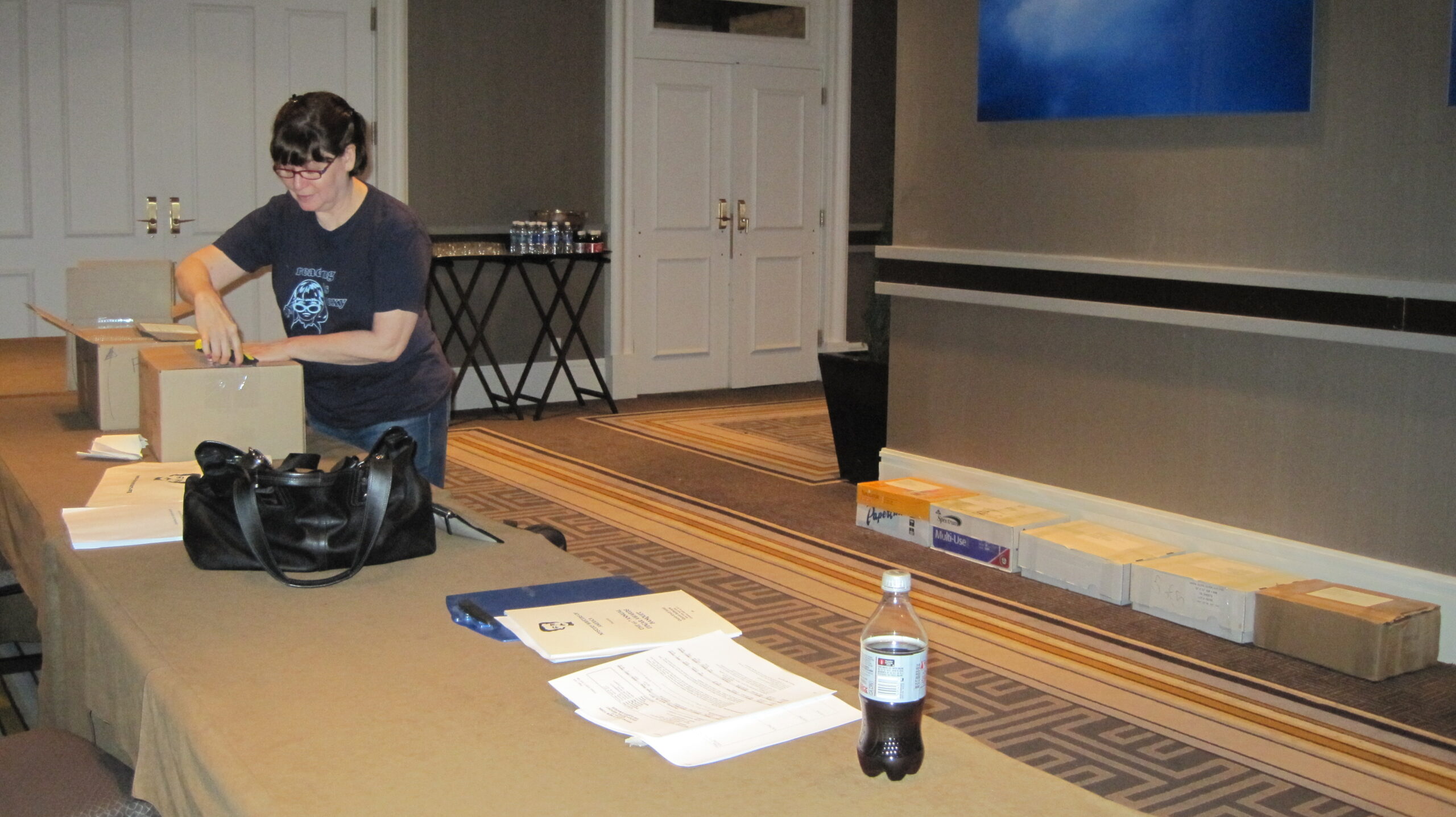
Margery hard at work setting up banquet.

Second, I help MWA’s Executive Director Margery Flax, who is the real force behind all things Edgar, prepare the ballroom, which entails setting out registration tables and name tags, testing the sound systems and unpacking the Edgar awards. (Margery puts tape on the nameplates so, no, I don’t know who wins ahead of time).
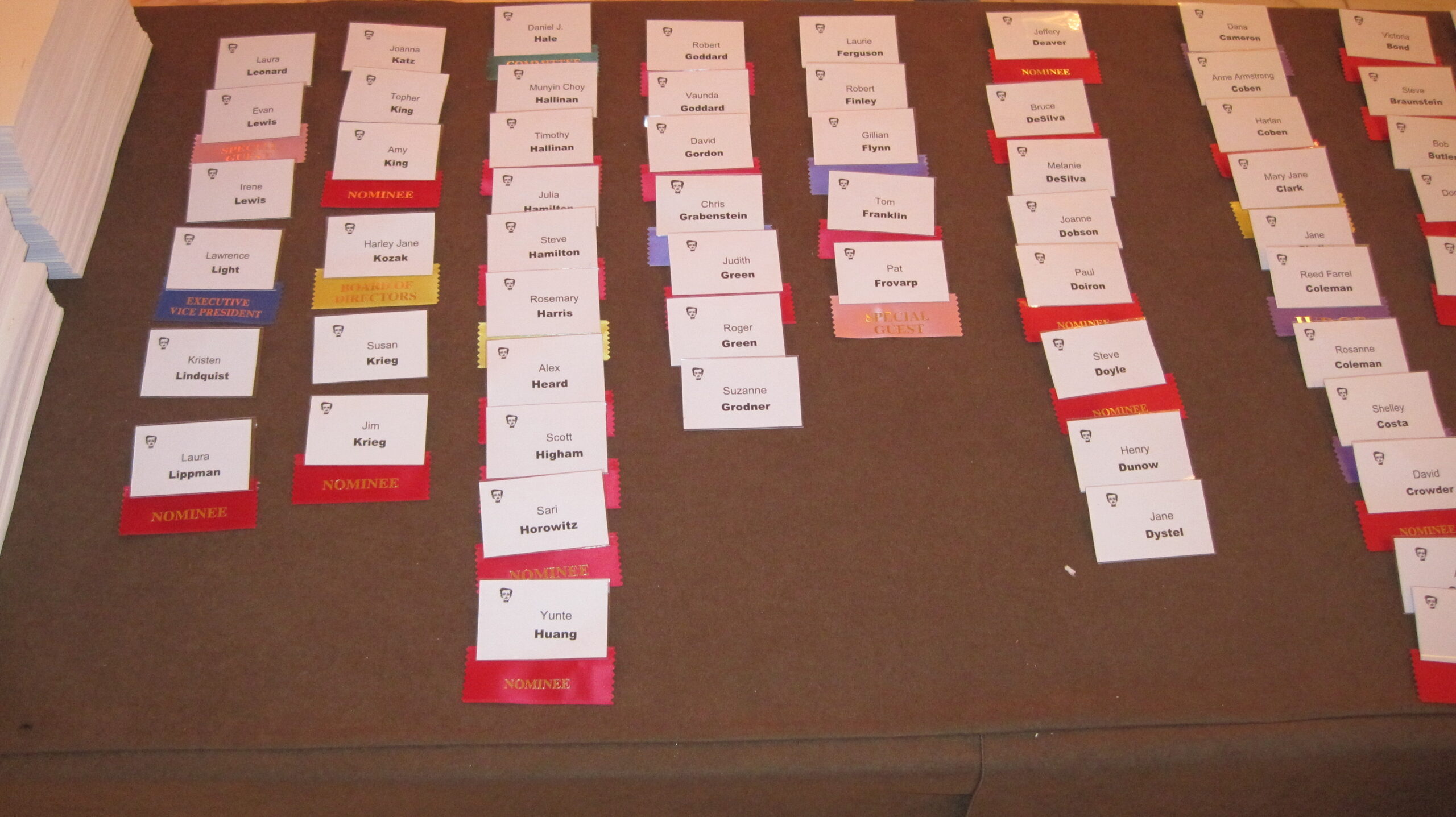
Once things are set up, I grab a quick shower, slap on some makeup, dress and heels and head down to man the nominee check in.  I love this part. Some writers are old hands at this but most sidle up to the table and politely ask, “Is this where I’m supposed to be?” It feels great to hand them their ribboned badge and shepherd them to the nominee champagne reception.  When everyone’s checked in, I get to go in and mingle. I am not shy about asking for fan pictures.
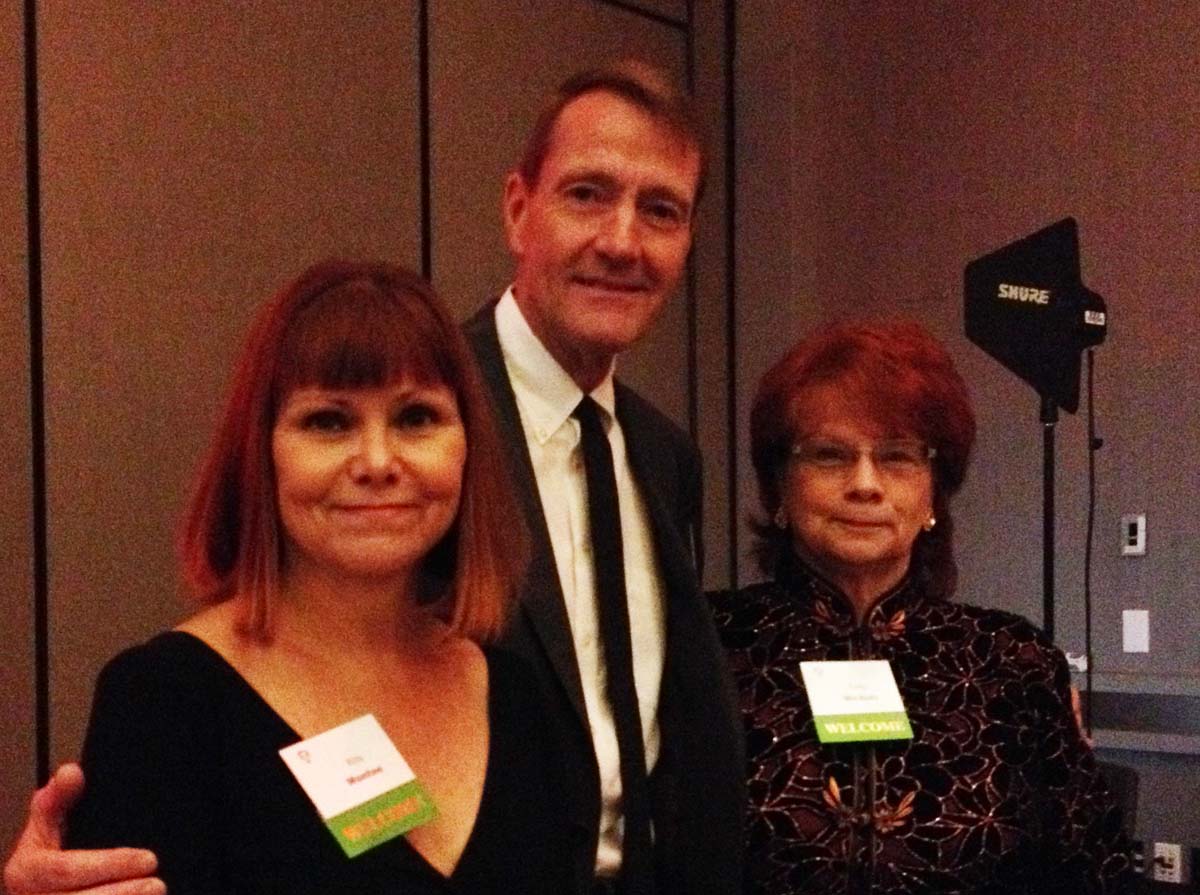
Kelly and me with some British guy who was hanging around.

Although I’ve been doing this for more than a decade, I still get nervous that things could go wrong. They have. Dave Barry screwed up and tried to introduce Grand Master Stephen King when it was supposed to be Don Westlake’s job. We had to wave King away and get Westlake on stage, whose first words where, “What am I? Chopped Liver?” And there was the time one of the porcelain Edgar heads arrived in two broken parts but Sandra Brown didn’t miss a beat and said, “And both pieces of the Edgar go to…”

I get  to go to New York, see old writer friends, enjoy the giddiness of the winners. The food is pretty good for hotel fare.
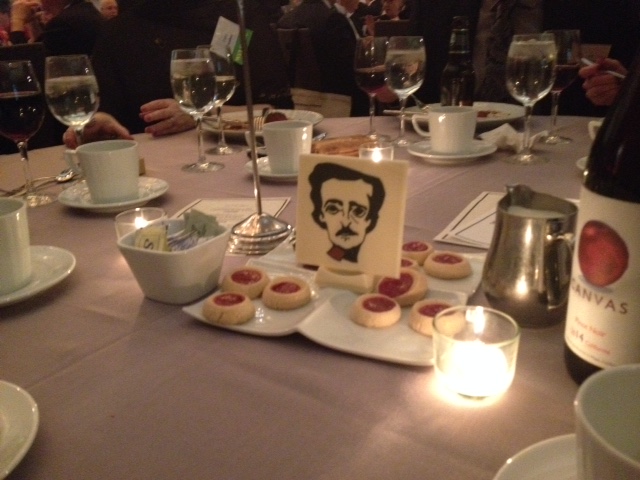
So, how do you hold an Edgar Awards in our times of social distancing? It wasn’t easy. Margery led a great team who live streamed the event as the awards were announced. You can find the winner’s lovely acceptance speeches on YouTube if you type in Edgars 2020.

My sister Kelly, who produces the videos every year, put together a touching tribute to Mary Higgins Clark. Click here to see it.

We are in the process of putting together a special edition program book that will be mailed out to nominees, winners and MWA members.

The only thing missing was…us. I missed the human touch. I missed seeing friends. I missed seeing the faces of the nominees. I missed hearing the tribute to this year’s Grand Master Barbara Neely. I missed hearing the winners’ speeches. I didn’t miss the high heels.

We’ll all be back with each other next year. For now, go here to read the Edgar Award nominees and winners. Buy their books. Then, get busy on writing your own. I am going to try very hard to do that.

 

What Really Goes On In The Morgue

I invited my buddy, Garry Rodgers, back to TKZ for a fascinating behind-the-scenes trip to the morgue. He’ll hang around for questions/comments, so don’t be shy. Now’s your chance to ask an expert something you might need for your WIP. Enjoy!

Most living people never visit the morgue.

Most never think of the morgue except when watching TV shows like CSI or some new Netflix forensic special. The screen may show in hi-def and tell in surround sound, but it can’t broadcast smell. That’s a good thing because no one would tune in and the actors would be looking for real-life morgue jobs like homicide cops, coroners and forensic pathologists.

I did two of those real-life morgue jobs for a long time. I’m a retired murder cop and field coroner who spent a lot of hours in that windowless place. Now, I’m a crime writer and thought I’d share a bit of what really goes on in the morgue with my crime-writing colleagues.

The morgue is strictly off-limits for anyone not having a specific reason to be there. That’s for a few reasons. One is the place can hold sensitive court evidence. Two is that it’s a somewhat disagreeable place due to the odor, temperature and the continual chance of contracting a contagious disease. The third reason is dignity. Even though the majority of the morgue occupants are no longer alive, they’re still human entities and not some sort of a morbid exhibit.

The morgue is a place of business. It’s a medical environment where the deceased are stored, processed and released to their final disposition. The morgue operates 24/7/365 as death pays no attention to the clock or the calendar. But, the morgue is busiest between 8:00 am and 4:30 pm Monday to Friday—holidays exempted. Morgue workers need time off like anyone else.

A city morgue, like I worked at in Vancouver, British Columbia, is an active environment. It has a dedicated shipping and receiving area with a loading dock much like a typical warehouse. Bodies arrive by black-paneled coroner vans or on sheet-covered gurneys brought down from the wards. They’re booked into a ledger, assigned a crypt and, yes, marked with a personalized toe tag.

Vancouver General Hospital’s morgue is like Costco for the dead. Stainless steel refrigeration crypts, stacked three-high in two rows of nine, have shelving for fifty-four. The freezer unit stores eight and isolation, for the stinkers, can take six sealed aluminum caskets or “tanks” as we called them. These tanks are also used for homicide cases, locked to preserve forensic evidence.

A grindy overhead hoist shifts cadavers from wheeled gurneys that squeak about fluorescent-lit rooms, touring them to and from roll-out metal drawers. Refrigeration temperatures are ideally set at 38-degrees Fahrenheit (4-degrees Celsius) while the ambient range in the autopsy suites is held at a comfortable 65 / 18. The storage rooms, laboratory and administration areas are normal office temperature, and they’re set apart from the main morgue region. Support staff, for the most part, have no sense of being so near to the dead.

Operational personnel in the morgue are highly-trained professionals. The workhorse of the morgue is the autopsy technician or attendant called the “Diener”. It’s a term originating from German that translates to “Servant of the Necromancer”. Dieners have the primary corpse handling and general dissection responsibility. They do most of the cutting.

Hospital pathologists are primarily disease specialists. They spend the majority of their day in the laboratory peering into microscopes and dictating reports. It’s a rare general pathologist who stays with an autopsy procedure from incision to sew-up. Usually, hospital pathologists come down to the morgue once the diener has removed the organs and has them ready for cross-section.

A hospital pathologist takes a good look for what might be the anatomical cause of a sudden or unexplained death. The main culprits are usually myocardial infarctions, or “jammers” as they called in the heart attack word. Aneurisms are another leading cause of dropping dead, and they’re often found in the brain.

Hospital pathologists sometimes do partial autopsies when they want to confirm an antemortem diagnosis. That might be a certain tumor or the extended effects of a runaway respiratory disease like Covid19. Sometimes, there’s no clear cause of death such as in a heart arrhythmia or a case of toxic shock.

Forensic pathologists are an entirely different animal. These are meticulous medical examiners with a tedious touch. It takes years of specialized training and understudy to become a board-certified forensic pathologist qualified to give expert evidence in criminal cases.

Forensic autopsies are peak-of-the-apex procedures inside the morgue. In a setting like Vancouver General Hospital (VGH), there are six autopsy stations in one open room. At any given time, the slabs are occupied and there more in the pipe. Not so with a forensic procedure.

There are two segregated and dedicated suites for forensic autopsies at VGH. Protection of the corpse, which is the best evidence in homicide cases, is paramount. So is maintaining continuity of possession, or the chain of evidence, that ends up in court. In a forensic autopsy, there’s utmost care to ensure the body is not compromised by contaminating it with foreign matter like DNA or losing critical components like bullets or blades.

In a homicide case, the body is taken from the crime scene in a sterilized shroud and locked in a tank. There’s an officer or coroner appointed to maintain continuity from the time the cadaver is bagged until the corpse is laid out on the slab. This is a critical element in forensic cases and one that is treated as gospel.

A forensic pathologist stays with the autopsy from the time the body is unlocked from its tank till the time the pathologist feels there is no more evidentiary value to glean. This is usually a full-day event but sometimes the body is put back in the tank, held overnight, and the process goes on the next day. This completely depends on the case nature such as multiple gunshot or knife wounds.

There are police officers at every forensic autopsy. Those are the crime scene examiners who photograph the procedure and pertinent physical properties. Detectives receive evidentiary exhibits like foreign objects such as fired bullets or organic particulates. There might be semen samples or other questionable biological matter. Then, there are usual suspects for toxicology examination like blood, urine, bile, stomach contents and vitreous fluid.

Radiography is done in almost all forensic autopsy cases. A portable X-ray machine scans the body as it lies on the table. In some situations, MRI / CT technology is helpful.

But, nothing beats the eye and experience of a seasoned forensic pathologist. They observe the slightest details that even a general pathologist would miss. However, don’t dismiss what a good diener can spot. It’s a treat to watch a forensic pathologist and a diener work when they’re in synch.

At day’s end, folks in the morgue are much like anyone else. They have a market to serve and they do it well. They’re also prone to talk shop in a social setting. There’s nothing like having drinks with a diener who’s into black humor.


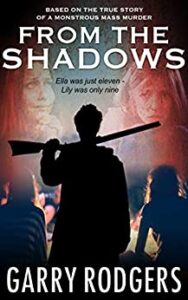
What if six members—three generations—of your family were slain in a monstrous mass murder?

FROM THE SHADOWS is part of Garry’s “Based on True Crime” series. Available on Amazon and Kobo.


I couldn’t write a piece about what really goes on in the morgue without a few war stories. In my time as a cop and a coroner, I’ve been around hundreds of cadaver clients. Maybe more like thousands, but I never kept track. There were a few, though, that I’ll never forget.

One was “Mister Red Pepper Paste Man”. My friend Elvira Esikanian, a seasoned forensic pathologist of Bosnian descent who cut her teeth by exhuming mass graves, is a gem. She also has a wicked eye for detail.

I brought this old guy into the morgue after finding him dead in his apartment. Neighbors reported him screaming like someone was skinning a live cat. They rushed in and found him collapsed on the floor. No idea what killed him, but no sign of foul play.

Elvira opened his stomach and it was positively crawling. She knew what it was—botulism. Elvira told me to go back to the scene and look to see what he’d been eating. I found it. It was a jar of red pepper paste that was years past its expiry date, and the inside was a mass of organic activity.

Then, there was Kenny Fenton. He was found dead after being dumped beside a rural road and left to rot for a week in hot weather. I brought him into the morgue as intact as possible but it wasn’t easy. Kenny went into a stinker tank before Dr. Charlesworth could take him on.

As a routine, Kenny had a radiography session before his dissection. It showed a bullet in his gut. Not a run-of-the-mill bullet, of course. It was a .22 short with no rifling engraved on its sides.

Turns out, Kenny was accidentally shot in the neck by a Derringer dueling pistol. The bullet cut his carotid, hit his spinal cord, bounced back to his esophagus and he swallowed the dammed thing before bleeding out and dying fast. The crew he was with thought it was better to dump Kenny than report it.

And I can’t wrap up without a bit of spring foolishness that went on in the morgue. It involved my buddy—Dave the Diener.

Dave had about thirty years in the crypt before he met me. In fact, Dave had something to do with me getting hired by the coroner’s office because he thought I might be a good fit. Dave may, or may not, have been right.

It was the First of April and a Friday morning. Dave liked Fridays because he usually left early once his cutting was done. I don’t think there’s anything wrong with that, and I’ve done it myself.

But this Friday was different—probably had something to do with the date. I snuck into the morgue real early and prepared Dave’s first case. I needed some weight so he wouldn’t suspect anything off the bat. I put a bunch of concrete patio blocks on the crypt’s drawer base. Then, I placed my cadaver inside a shroud and laid it on top. I even attached a toe tag and made the right entries in the ledger.

I wasn’t there but sure heard from the other staff who were in on it. Dave rolled-out his first subject-for-the-day and unzipped the shroud. Smiling at Dave was the puckering face of a blow-up sex doll.

That’s the kind of stuff that really goes on in the morgue.

Garry Rodgers has lived the life he writes about. Garry is a retired homicide detective and forensic coroner who also served as a sniper on British SAS-trained Emergency Response Teams. Today, he’s an investigative crime writer and successful author with a popular blog at DyingWords.net as well as the HuffPost.

Garry Rodgers lives on Vancouver Island in British Columbia at Canada’s west coast where he spends his off-time around the Pacific saltwater. Connect with Garry on Twitter and Facebook and sign up for his bi-monthly blog.


Your Imagination Needs Regular Play Time

by James Scott Bell
@jamesscottbell

Children are not meant to be cooped up. They need sunlight and play and jungle gyms and interaction with other kids. They need dirt and sticks (that are really swords, you see), so their bodies can begin to develop the immunities they need for a healthy life.

In the same way, a writer’s imagination needs to get out and play and mess around. It needs to occasionally skin a knee or fall out of a tree. Risk is part of life. It’s also integral to growing as a writer.

I was thinking about this the other day in yet another lockdown moment that usually begins with the thought When in the Sam Hill is this going to end? I pondered the many writers who have expressed, via blog or social media, that they are struggling with their WIPs, or with getting started on a new project, or even with the desire to type another sentence.

This creative ennui, if it goes on too long, can atrophy the imagination. Your imagination will, if allowed, kick back on an old sofa in your brain, eating Funyuns and watching episodes of Gilligan’s Island on an endless loop.

Then, when you finally do call on it to get to work, it may belch and tell you just what you can do with your WIP.

Don’t let that happen.

Especially when, due to circumstances beyond your control, you’ve lost the cheer and the joy of writing. You can overcome this by giving your imagination some daily play time. Just ten minutes a day will make all the difference.

So let me give you three exercises for your creativity muscles. In the comments, feel free to add suggestions of your own.

  1. Morning Bites

In the introduction to his collection of short stories, Ray Bradbury writes, “But, you see, my stories have led me through my life. They shout, I follow. They run up and bite me on the leg — I respond by writing down everything that goes on during the bite. When I finish, the idea lets go, and runs off.”

In the first groggy moments of wakefulness, pay attention to what’s going on in your mind. It will most likely have no discernable pattern. That’s okay. Get your first cup of coffee and before you do anything else (e.g., email, Facebook) take a couple of minutes to write down whatever it is you see happening in your mind. Just the act of writing and following those bites gets the imagination chugging away.

It’s very close to what Julia Cameron describes as “morning pages” in her book, The Artist’s Way.

Morning Pages are three pages of longhand, stream of consciousness writing, done first thing in the morning. There is no wrong way to do Morning Pages–they are not high art. They are not even “writing.” They are about anything and everything that crosses your mind– and they are for your eyes only. Morning Pages provoke, clarify, comfort, cajole, prioritize and synchronize the day at hand. Do not over-think Morning Pages: just put three pages of anything on the page…and then do three more pages tomorrow.

As a fiction writer, keep watching your morning words for story ideas or suggestions for your WIP. Ask your imagination to be intentional about it.

  1. Flash Fiction

One step up from Morning Bites is Flash Fiction. That’s a story under 1,000 words. It is the ultimate pantser’s paradise, for you get an idea and start writing and go wherever you please. Will you end up with a story that works? Probably not. You’ll most likely be painted into a corner or lost in a dark forest.

But that’s okay! The benefit of flash fiction is that it’s a workout for your story muscles, and they’ll grow stronger even if the story itself doesn’t pan out.

Every now and then, of course, you will come up with something solid, and that will bring you tremendous joy.

Heck, there are even places you can submit your flash fiction. You could publish it yourself on your blog. Or you could make it part of an alternative market for your work, as I’ve done with my Patreon page.

Where do you get flash fiction ideas? If your sodden imagination doesn’t have one (it’s been on the sofa, remember?) hop over to the Writer Igniter and get one.

  1. Creative Lifting

You lift weights to strengthen your body. To do it right, you alternate the exercises—curls for the biceps, bench press for the chest and shoulders, squats for the glutes and hamstrings, and so on.

So how about strengthening your style by lifting fiction from great writers? And by lifting I mean copying. The idea is not to try to imitate these masters, but to “feel” what they do, ingest their palette of literary colors so you can expand your own.

One of the great stylists of all time was Ray Bradbury. You simply can’t go wrong copying a page from his work. Here’s a clip from Dandelion Wine that I typed out:

Douglas Spaulding, twelve, freshly wakened, let summer idle him on its early-morning stream. Lying in his third-story cupola bedroom, he felt the tall power it gave him, riding high in the June wind, the grandest tower in town. At night, when the trees washed together, he flashed his gaze like a beacon from this lighthouse in all directions over swarming seas of elm and oak and maple. Now . . .

“Boy,” whispered Douglas.

A whole summer ahead to cross off the calendar, day by day. Like the goddess Siva in the travel books, he saw his hands jump everywhere, pluck sour apples, peaches, and midnight plums. He would be clothed in trees and bushes and rivers. He would freeze, gladly, in the hoarfrosted icehouse door. He would bake, happily, with ten thousand chickens, in Grandma’s kitchen.

Love it.

Don’t limit yourself to one author or genre, or even to fiction. Indeed, the finest opening of any book I’ve ever read is in William Manchester’s The Last Lion. Here it is as I copied it:

The French had collapsed. The Dutch had been overwhelmed. The Belgians had surrendered. The British army, trapped, fought and fell back toward the Channel ports, converging on a little fishing village whose name was then spelled Dunkerque.

Behind them lay the sea.

It was England’s greatest crisis since the Norman conquest, vaster than those precipitated by Philip II’s Spanish Armada, Louis the XIV’s triumphant armies, or Napoleon’s invasion barges. This time Britain stood alone. If the Germans crossed the Channel and established uncontested beachheads, all would be lost, for it is a peculiarity of England’s island that its southern region is indefensible against disciplined troops. . . .

Now the 220,000 Tommies at Dunkirk, Britain’s only hope, seemed doomed. On the Flanders beaches they stood around like souls in purgatory, awaiting disposition. There appeared to be no way to bring more than a handful of them home. The Royal Navy’s vessels were inadequate. King George VI had been told they would be lucky to save 17,000. The House of Commons was warned to prepare for “hard and heavy tidings.”

Then, from the streams and estuaries of Kent and Dover, a strange fleet appeared: trawlers and tugs, scows and fishing sloops, lifeboats and pleasure craft, smacks and coasters, the island ferry Gracie Fields; Tom Sopwith’s America’s cup challenger Endeavor; even the London fire brigade’s fire-float Massey Shaw–all of them manned by civilian volunteers: English fathers, sailing to rescue England’s exhausted and bleeding sons.

Even today what followed seems miraculous. Not only were Britain’s soldiers delivered; so were French support troops: a total of 338,000 men.

But wars are not won by fleeing from the enemy. And British morale was still unequal to the imminent challenge. These were the same people who, less than a year earlier, had rejoiced in the fake peace brought by the betrayal of Czechoslovakia at Munich. Most of their leaders and most of the press remained afraid. It had been over a thousand years since Alfred the Great had made himself and his countrymen one and sent them into battle transformed. Now in this new crisis, confronted by the mightiest conqueror Europe had ever known, England looked for another Alfred, a figure cast in a mold which, by the time of the Dunkirk deliverance, seemed to have been forever lost.

England’s new leader, were he to prevail, would have to stand for everything England’s civilized Establishment had rejected. They viewed Adolf Hitler as the product of complex social and political forces. Their successor would have to be a passionate Manichean who saw the world as a medieval struggle to the death between the powers of good and the powers of evil, who held that individuals are responsible for their actions and that the German dictator was, therefore, wicked.

An embodiment of fading Victorian standards was wanted: a tribune for honor, loyalty, duty and the supreme virtue of action. One who would never compromise with iniquity, who could create a sublime mood and thus give men heroic visions of what they were and what they might become….He would have to be a leader of intuitive genius, a believer in the supremacy of his people and his national destiny, an artist who knew how to gather the blazing light of history into his prism and refract it to his ends, a man of inflexible resolution who could impose his will and his imagination on his people—a believer in military glory was required, one who could rally a nation to brave the coming German fury.

Such a man, if he existed, would be England’s last chance.

In London there was such a man.

Now…go play.

Don’t Forget the Mask

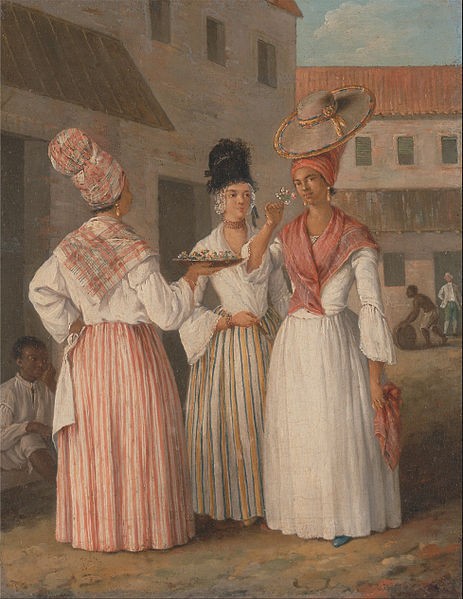
Brunias, Agostino, A West Indian Flower Girl and Two Other Free Women of Color, 1769, Public Domain

You may be familiar with the tignon laws which were applied to free women of color in Louisiana in the late eighteenth century. A “tignon” is a scarf worn to cover the hair. The purposes of the laws were 1) to infer that the women to whom they were applied belonged to the slave class and 2) to make the women unattractive to white men. 

What the women who were selectively targeted by the law did was ingenious. They observed the letter of the law by wearing scarves, but arranged them in elaborate patterns and accessorized them with jewels, beads, and feathers, among other things. The tignon laws were abolished after the United States purchased Louisiana, but the style continued. You can still encounter proponents of the fashion — primarily women of Creole descent — in present-day New Orleans.

The evolution of the tignon laws is an interesting research topic but is a little off the track of my visit today. I suggest that you do a deep research dive into the topic on your own. You won’t be sorry. My purpose for mentioning them, however, is that we are seeing somewhat the same thing — in practice though not purpose — occurring with government-mandated face coverings. While the majority of folks around me (and my age group) seem to be eschewing fashion for the familiar white or generic medical mask look, others are taking it a step or three further, utilizing designs, colors, and the like when they go stepping down Aisle 4 of the local supermarket. What started as a safety precaution has become a fashion statement. Some companies have begun selling entire outfits that coordinate with a face covering. Or is it vice versa? You can see some examples of this here, and they are interesting, to say the least. 

My purpose in mentioning this during our regularly scheduled Saturday morning visit is aimed at those of you who find writing fodder within our current collective experience.  If you are working on your dystopian novel using the coronavirus pandemic as a backdrop (as Mark Alpert encouraged you to do in his “Turning Crisis into Fiction” post last week) you might want to utilize the prevalence of masks or facial coverings as a plot element, particularly if you want to straddle genres and insert a crime of some sort into the proceedings. You need only peruse your local newspaper to discover that crimes of all sorts are still occurring in spite of or perhaps because of the secondary effects of the pandemic.

A mask as a general rule is an instrument of concealment. In the now, when most people in public places are wearing face coverings either by decree or due to being “strongly encouraged” to do so. This is fine as far as people with good intentions are concerned, but it gives the wolf in your story an opportunity to stalk unnoticed among the sheep since he is “dressed” pretty much like anyone else.  A mask can also distract, however, particularly if it is accessorized or otherwise made different from those worn by others in the immediate vicinity. Witnesses to crimes tend to remember, to the exclusion of much (if not most, or all) else, a mask, particularly a distinctive or memorable one. A mask or face covering can also with a bit of planning be quickly removed, disposed of, or changed to another more generic type to confuse things further, should such be advisable.   There is also a romantic and/or erotic element that the anonymity of a mask can occasionally spark. Ask anyone who has been to Mardi Gras or a costume party. 

It is a small detail, but conflagrations can result from tiny flames. I hope that your creative one burns long and bright as you hopefully take advantage of the free time created by the current impromptu gardening leave.

Enjoy and be well.


Reader Friday: BOSCH

Photo credit: tvguide.com

We recently finished binging Season 6 of BOSCH. After so many seasons, Titus Welliver is Harry Bosch in my mind, even though the fictional Harry isn’t covered in ink. Somehow, the tattoos work for the character. BTW, did you know they’re real?

If Hollywood called to turn your latest novel into a series or movie, who would you want to play lead? Give us a little context to understand your choice.

If Titus Welliver never played Harry Bosch, who would you want to step into that role?

True Crime Thursday – Invasion of the Body

By Debbie Burke

@burke_writer

Photo credit: atimedia – Pixabay

What if a device measures your heart and respiration rate, body temperature, and blood pressure from almost 200 feet away without you ever knowing it? What if that intimate information is collected into a database? Who uses that information and what do they do with it?

Is this the premise for a dystopian/sci-fi/horror story?

Nope. It’s reality.

Pandemic drones created by the Canadian company Draganfly can do all that and more. In a video interview here, Draganfly CEO Cameron Chell claims the software will help public safety officials (in other words, law enforcement) track and prevent spread of disease.

Huh? Cops are now in charge of public health?

On April 21, 2020, Westport, Connecticut police announced implementation of pandemic drones that measure people’s body temperature, heart and respiration rate, and coughing and sneezing. Drones are already being used for enforcement of social distancing in New Jersey, Florida, and elsewhere.

The next day, the ACLU filed a protest statement saying, “Towns and the state should be wary of self-interested, privacy-invading companies using COVID-19 as a chance to market their products and create future business opportunities.”

Following public outcry, on April 23, Westport reversed its decision to use pandemic drones.

Is sneezing, coughing, or running a temperature a crime?

Does invasion of a person’s body by technology constitute unreasonable search and seizure under the Fourth Amendment?

TKZers: What do you think?


~~~


Drones play a sinister role in Debbie Burke’s thriller Eyes in the Sky, available here

Focusing on the Writing

Focusing on the Writing
by Terry Odell

Focus on the Writing

Image by Pexels from Pixabay

I was supposed to be on a photo tour in Croatia today, but that’s been put on hold, so let’s talk about dealing with writing routines in times of distraction.

I’ve talked to a lot of people about how they’re having trouble focusing on their writing. Distractions abound, and the writing gets set aside. Guilt sets in.

It’s okay to be distracted, to flounder about. Writing less is acceptable. For me, I find the following techniques helpful. I’ve used them when coming back from vacations, when it takes a while to find my writing groove, and they work as well for me in these crazy times.

Get rid of chores that will nag.
If you are going to worry about cleaning house, paying bills, going through email, take the time to get the critical things dealt with. Otherwise you’re not going to be focused on your writing. If you’re a ‘write first’ person, don’t open anything other than your word processing program.

Do critiques for my crit group.
This might seem counterproductive, but freeing your brain from your own plot issues and looking at someone else’s writing can help get your brain into thinking about the craft itself.

Work on other ‘writing’ chores.
For me, it can be blog posts, or forum participation. Just take it easy on social media time.

Deal with critique group feedback.
Normally, I’m many chapters ahead of my subs to my crit group. If I start with their feedback on earlier chapters, I get back into the story, but more critically than if I simply read the chapters. And they might point out plot holes that need to be dealt with. Fixing these issues helps bring me up to speed on where I’ve been. It also gets me back into the heads of my characters.

Read the last chapter/scene you wrote.
Do basic edits, looking for overused words, typos, continuity errors. This is another way to start thinking “writerly” and it’s giving you that running start for picking up where you left off.

Consult any plot notes.
For me, it’s my idea board, since I don’t outline. I jot things down on sticky notes and slap them onto a foam core board. Filling in details in earlier chapters also helps immerse you in the book.

Figure out the plot points for the next scene.
Once you know what has to happen, based on the previous step, you have a starting point.

Write.
And don’t worry if things don’t flow immediately. Get something on the page. Fix it later.

What about you? Any tips and tricks you’ve found when outside world distractions keep you from focusing?

And one more thing. On Friday, May 1st, you have a chance to Ask Me Anything. I’ll be on a Draft2Digital Spotlight podcast talking with Mark Leslie Lefevbre. It’ll be broadcast on YouTube and Facebook. You can bookmark the links and you might be able to set up a reminder.
Time: 10 Pacific, 11 Mountain, 12 Central, Noon Eastern. It’ll be my first video appearance. Yikes!  The program is 45 minutes long, with the last 15 minutes for Q&A. I hope to meet you there.


Terry Odell is an award-winning author of Mystery and Romantic Suspense, although she prefers to think of them all as “Mysteries with Relationships.” Follow her on Facebook and Twitter.

My Brief Life and Tragic Death – First Page Critique  

 By Debbie Burke

@burke_writer


Photo credit: Wikimedia Commons

Please welcome another Brave Author who’s submitted a first page for a story entitled:

My Brief Life and Tragic Death

Chapter 1. Purple Pumpkins

I met Frank and survived an assassination attempt between lunch and teatime.

I suppose it started with the whistling. I had the palace library all to myself, as usual. The hush was shattered when a boy walked in, whistling. He caught sight of me and approached. It’s hard to smirk and whistle at the same time, but he managed it. When he reached my table, he stopped whistling and stood smiling at me. It was a good smile. It invited me to smile back, which I didn’t, of course.

He was a handsome boy of about thirteen, a year older than myself, with a haircut from the California side of the gateway. I liked him at once, which annoyed me. I didn’t get along with my fellow children.

His smile and likability made me uncomfortable. I gave him a cold stare. “This is a library, you know.”

He looked around in pretended astonishment.

I added, “You can tell from all the books? At least, I hope you can.”

“I’ll take your word for it. Hey, maybe you can help me. I’m looking for a sweet little girl named Flavia.”

I placed a bookmark and closed my book. “Are you being irritating on purpose?”

“Of course I am. How about you?”

I was taken aback. “Why?”

“Look, babe, do you know where Flavia is or not?”

“I’m Princess Flavia.”

“Then your portraits don’t do you justice. I like the freckles especially. A freckle is a beacon of honesty in a mendacious world. Allow me to introduce myself. Frank Barron, at your service.” He stuck out his hand.

If you ignored his actual words, he was wonderfully well-spoken, especially for his age. He had that command of language which only an intelligent person who reads a great many books develops, but without the stiff delivery of someone like me, for whom books are their only friends. I was a bit regretful when I said, “Princesses don’t shake hands.”

“Oh, that’s all right. I’m not a princess.”

I rolled my eyes. “But I am.”

~~~

First impressions:

Let’s start with the title: My Brief Life and Tragic Death.

It implies the first-person narrator, 12-year-old Princess Flavia, is apparently already dead. Is this fantasy? Magic realism? Is it similar to Alice Sebold’s The Lovely Bones, told by a murdered teenager watching her family deal with the repercussions of her death?

I’m not sure what’s happening but I’m intrigued.

The first line drops a provocative bomb about an assassination attempt. That definitely qualifies as a disturbance in anyone’s life. But the tone struck me as too casual and matter-of-fact. I can’t imagine a 12-year-old girl, even a self-possessed princess, being this blasé about someone trying to kill her.

Next, the scene flips back to earlier that day. Flavia is alone in the palace library when her reading is interrupted by the entrance of a whistling boy who’s looking for her. This also qualifies as a disturbance, although on a much smaller scale than an assassination attempt.

Foreshadowing and disturbances, major and minor, kick off a good start, enticing the reader into the plot. Nice job, Brave Author.

Setting and Time:

The mention of teatime suggests the locale is the British Isles, so a haircut from the California side of the gateway sounds exotic and faraway to the cloistered Flavia. Although the haircut and the gateway aren’t clearly defined yet, that’s okay. Longer descriptions could bog down the forward momentum at this point. I’m willing to wait for more explanation.

The time period isn’t defined. Physical books in a library could be contemporary but might also indicate a past before digital books. Again, I’m willing to wait to find out.

Characterizations:

Right away, Flavia’s character interests me. She sounds much older than her age. She’s alienated from people and may be lonely but won’t admit it: I didn’t get along with my fellow children.

She doesn’t react in predictable ways: His smile and likability made me uncomfortable.

And she’s irritated by her reactions, as if she can’t control her own mind: I liked him at once, which annoyed me.

The author raises questions: Why does Flavia react like this? Why does she expect herself to be detached from normal human emotions? As a princess, is she pressured to behave a certain way? Does she secretly want to rebel against those conventions?

Flavia is a character in conflict with herself. Already she’s presented enough complicated psychology to make a reader want to learn more about her. Well done.

Her observation of Frank is not superficial. Like a normal adolescent girl, she notices he is handsome but she also digs deeper, probing into his character.

Frank is brash, cocky, yet charming. She’s interested but, for some unknown reason, can’t allow herself to like him.

Brave author, in a very few lines, you’ve skillfully painted a picture not only of Frank’s appearance but also his personality. 

Flavia quickly sets Frank straight that she is a princess who won’t tolerate being called “babe.” Frank isn’t at all fazed by being put in his place and goes on to eloquently charm her, while at the same time giving readers a quick sketch of what Flavia looks like: Then your portraits don’t do you justice. I like the freckles especially. A freckle is a beacon of honesty in a mendacious world. 

In first person, it’s difficult to find effective ways for a character to describe herself without resorting to cliches like looking in a mirror. This was a nice blending of dialogue and description that didn’t sound forced. 

Voice:

The humor works well. The banter between aloof Flavia and smartass Frank is entertaining. They keep trying to one-up each other, competing over who gets the last word. That creates ongoing tension between them. The reader wants to find out who wins the verbal jousting.

The author also nicely juxtaposes that humor with Flavia’s wistful longing for connection with another human.

The following is my favorite sentence:

He had that command of language which only an intelligent person who reads a great many books develops, but without the stiff delivery of someone like me, for whom books are their only friends.

That really pins down both personalities and poignantly conveys Flavia’s loneliness.

Audience:

Flavia’s age indicates the target audience may be Young Adult. Overall, I like her voice, even though she sounds much more mature than an average 12-year-old. I know intelligent, articulate, well-read kids like her so she comes across as unusual but still realistic.

Line editing:

What if you rearrange the order of the first sentence like this?

Between lunch and teatime, I met Frank Barron and survived an assassination attempt.

Switching the assassination attempt to the end of the sentence creates a more dramatic punchline. 

Another thought about the first line: it could come off as a gimmicky ploy unless the author delivers a payoff within a few pages.

Is Frank the savior who thwarts the attempt on her life? That creates a compelling reason for an ongoing relationship between them.

Or is he the would-be assassin?

Because Flavia already knows what happens (even though the reader doesn’t), she could foreshadow a little more.To raise tension, perhaps she wonders how he got past security into the palace library.

The phrase If you ignored his actual words confused me.

Here’s what Frank says: “Then your portraits don’t do you justice. I like the freckles especially. A freckle is a beacon of honesty in a mendacious world. Allow me to introduce myself. Frank Barron, at your service.”

His “actual words” show a sophisticated command of language so I don’t understand why Flavia talks about ignoring them. Maybe delete the phrase: If you ignored his actual words, 

~~~

Overall, this first page works well. The characters are likable, multi-dimensional, and complex. There’s conflict, tension, and suspense.

Additionally, the author proof-read and submitted a clean page without typos, misspellings, or grammatical errors.

YA, fantasy, and magic realism are not genres I’m terribly familiar with. But the Brave Author did a good job of pulling me into this intriguing submission. Thank you for sharing it!

~~~

TKZers: What do you think of Flavia and Frank? Are you interested in the premise? Any suggestions for our Brave Author?

First Page Critique: Manuel’s Revenge

Happy Monday! (even though it’s starting to feel like everyday is like Sunday…)
Today I have a first page critique which illustrates the challenges in grounding a reader right from the start. My comments, and recommendations follow.  I also look forward to getting you input for our brave submitter after this first page submission.
Manuel’s Revenge

They wouldn’t understand, especially the little ones.

“Daddy’s gone to heaven,” she would say. They would cry and grieve and she would find someone else.

When he opened the door, the apartment smelled of greasy chicken and diapers. Earlier in the evening he told her he’d be at Jerry’s Bar and Grill. Julie was furious, of course, so she and the kids had gone to visit her sister for a few days. He and his wife had exchanged harsh words, but Manuel felt relief. She and the kids wouldn’t be home. They wouldn’t see the carnage.

The scotch having fixed his resolve, Manuel made the call.

As his eyes adjusted to the dark, he crossed the frayed carpet, opened the closet door and removed a plank near the back wall. He hadn’t used the weapon in years, a nine millimeter Smith and Wesson that felt strangely familiar. From years on the streets he knew how to use the gun, but only killed when necessary, always in self defense, never for pleasure—unlike the monster who murdered his brother.

After prison, Manuel truly believed he could change, but his mind never stopped playing that endless loop. His brother’s face—the pleading, the tears, the anguish—would never disappear. Graven into his memory like etchings on a gravestone was the leering face of the thug who pulled the trigger.

Tonight that man would die, and Manuel would die with him.

Replacing the plank, Manuel eased along the wall to observe the rendezvous point from his perch three stories up. On the street below, his brother’s killer would step into the alley expecting an easy exchange. Bills for baggies. No problem.

But when Manuel looked down on the scene, his fists tightened around the pistol. Cops were erecting a barrier and a tarp-covered body lay in the middle of the alley.

A crime scene.

Two uniforms conversed under a streetlight. The lights of a patrol vehicle rotated across the dark bricks of nearby tenements.  In the shadows something moved, something barely perceptible. Even from this distance, the thick man in the sideways baseball cap shifted easily from light to darkness, watching.

Then into the shadows the thug disappeared. The meeting would be aborted. The man who killed his brother would flee. Then, as it had so many nights before, Manuel’s cowardice would seize his thoughts and haunt another sleepless night.

Main Comments

This first page had some good things going for it, right from the get go. It was written in clear, direct prose, and was immediately personal. The reader could easily grasp that the stakes, at least for the main protagonist, were going to be high and that this story was going to be about avenging the murder of the protagonist’s brother. That helped create some nice tension right from the start, but for me, this first page suffered from a lack of specificity and grounding, that made the story, even though it was going to be high stakes and personal, feel almost generic.

In terms of lack of specificity, I wanted more detail about the main protagonist to set him apart. I wanted to be able to picture him, get a hint of intrigue (why had he been in prison for example?) and to hear a more realistic internal dialogue that made him feel like a real person – one I immediately felt sympathy for, and whose story created the kind of dramatic tension that could sustain a novel.

In terms of grounding, I wanted more details to be able to picture the apartment and the building – especially as it seemed such an easy vantage point from which he could have killed the ‘thug’ in the past (had he tried before? – this wasn’t clear).

Specific Comments/Feedback

Having mused over the best way to provide constructive feedback regarding this first page, I decided that providing further comments/notes in bullet form as I read the first page was probably the most useful. So here goes:

  • First line – ‘They wouldn’t understand, especially the little ones’ had me intrigued. But then, just as I was thinking about the children (and we never find out how many or their names, or ages), the comment ‘they would cry and grieve and she would find someone else’ suddenly seemed cold and rather flippant. I wanted to know more about his relationship with his children and their mother (who was, I assumed his wife) but was a little put off already.
  • We get a brief description of the apartment but nothing more. I wanted to be able to visualize the place, and feel grounded in the surroundings. Where are we? What is the socio-economic background of this family? (they sound poor but then he drinks scotch in the next paragraph which doesn’t seem consistent with this initial impression). I’m assuming Julie is his wife but why had they exchanged harsh words – was it because he was always at Jerry’s Bar and Grill (and here, the name is specific but seems unnecessary since I have no other information or context regarding all the other surroundings). Also ‘carnage’ is a very strong word and it makes me think of a large scale, mass killing.
  • Now Manuel makes the call – but I’m not sure what this means as we haven’t got the backstory or context yet – but I’m willing to go with it.
  • Then we have a paragraph about him getting his weapon out and again, we get specifics about it (9 millimeter Smith & Weston) but few specifics about his past. He always killed in self-defense? Why? How did he know the monster who murdered his brother killed for pleasure? I need more here to be invested in this story.
  • ‘After prison’ – again, we get a hint of a past/backstory but no details, except about his brother (who, as yet, remains nameless). The line ‘graven into his memory…” would work better if I had more details so I could really visualize the scene.
  • ‘Tonight that man would die, and Manuel would die with him’ – Why, if he’s shooting the man from the vantage point of a window three stories up, would Manuel have to die? This didn’t quite make sense without more context and information on what Manuel was planning. It sounds like he wasn’t going to be the one going to make the exchange below (as he is upstairs) but how is the exchange supposed to work exactly (?) – and how did Manuel know all this (had he set it up? I couldn’t tell by the end if he had, or if these kind of exchanges were just a frequent occurrence in the alley and Manuel had finally got the courage to try and kill the ‘thug’ this time (?) (again, this reveals lack of grounding and specificity to me).
  • Now, when Manuel looks down on the scene he sees cops…but didn’t he hear sirens or see the flashing lights as he walked across the dark room towards the closet in the previous paragraph?
  • So it’s a crime scene, but we have no context for it – and now a man is watching from the shadows but the police are clueless(?) There’s a reference to nearby tenements but again I can’t picture the scene, as I haven’t got any description or point of reference for where we are.
  • The final paragraph has the ‘thug’ disappear (which seems too easy given the police presence), and ‘then, as it had so many nights before, Manuel’s cowardice would seize his thoughts and haunt another sleepless night’. I really liked this last line, but it still confused me as I don’t have context for his previous attempts or the past that links him to the thug and the circumstances surrounding his brother’s murder.

As all these comments reveal, this first page really needs more specific details and a clear description of place, backstory, and characters to come to life for me, and to create the tension needed for me to turn the page and keep reading. That being said, the scene itself is a compelling one – a man risking everything to avenge his brother’s death – and our brave submitter no doubt knows all the details that could easily be added to bring color and tension to this story. Overall, most of my comments/recommendations are a relatively easy fix and I think once we get the specificity and grounding we need as readers, this first page could be the start of a something good.

So, TKZers, what comments or feedback do you have for our brave submitter?


A Lot Has Changed, But Reading Remains

by James Scott Bell
@jamesscottbell

The other day I woke up and felt like I was in Groundhog Day. Truly. When I tweeted about it, someone replied I should add I Am Legend and Swiss Family Robinson to the mix. That was brilliant. The streets of my city—Los Angeles—do look like the zombie apocalypse. And our homes are like tree houses in this urban archipelago.

And it’s like that every dang day.

Maybe you’re feeling something similar, wondering what to do next within the confines of your domicile.

Or what to read next. If that’s the case, I’ve got your back.

First off, ebooks are suddenly the coin of the realm for readers. With bookstores shuttered, print purchases have slowed considerably. I’ve also heard that audiobooks, once the growth slice of the publishing pie, have stalled. Why? Because no one is commuting to work!

So for homebound readers hungry for entertainment and escape, the ebook is fast and reasonably priced. As a recent BookBub post put it:

This is a turbulent time for the publishing industry. Many bookstores, publishers, and authors are facing significant challenges due to the impact on their print sales from store closures. However, one thing that seems clear is that people are still seeking out your books to help them learn, escape, find solace, and cope at this time. 

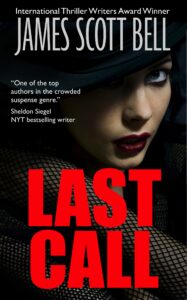
In that regard, I give you some new pulp fiction of my own — LAST CALL:


For call girl Keely Delmonico, having a client die was a new one. Now she has to avoid the cops and all their nasty questions. She manages to get out of the fancy hotel free and clear. But lurking in the shadows is another danger, a deadly one—a killer who is determined to make Keely’s next step her last call.


What possessed me to write a book from (mostly) the point of view of a call girl?

The challenge! Writers need to stretch if they’re going to stay on top of their game. As Kris so eloquently explained in her post on Tuesday, sometimes you just have to take a risk, knowing that at the very least the resulting book will:

  • Help you grow as a writer.
  • Make you stronger.
  • Help you find your way to your next story.

This book actually started some time ago when I sat down before a blank screen and asked myself what sort of book would I probably never write? A book about a call girl came immediately to mind. So what did I do? I wrote a first chapter. And liked it. I liked the character that was forming in my mind. Naturally I had to add a killer. From there I plotted and planned, and eventually wrote the thing.

Now, some of my loyal readers may be wondering if a) I’m off my rocker; and b) if the book has, um, well, racy parts.

As to a), I’m a writer. Of course I’m off my rocker.

And b), heck no. The content of the book is what would have been acceptable in a 1960s episode of Mannix or Mod Squad or Hawaii Five-O. The action takes place in L.A. and Las Vegas. Pre-pandemic. But I felt I had to handle that issue in the book. How did I do it? With a couple of Easter eggs I will not reveal here.

What a rat!

I know, but I want you to have the book as pure, lockdown reading pleasure. That’s why I’ve priced it at the lowest end of the Amazon scale—99¢—and will keep it there for the next few weeks. You can order in here.

So here we are, friends, deep into the shutdown. Lots of things have changed, but reading remains. I wonder, though, have you noticed any changes in your reading habits and/or preferences over the last six weeks? Do you think they will carry over when we get, finally, to the “new normal”?