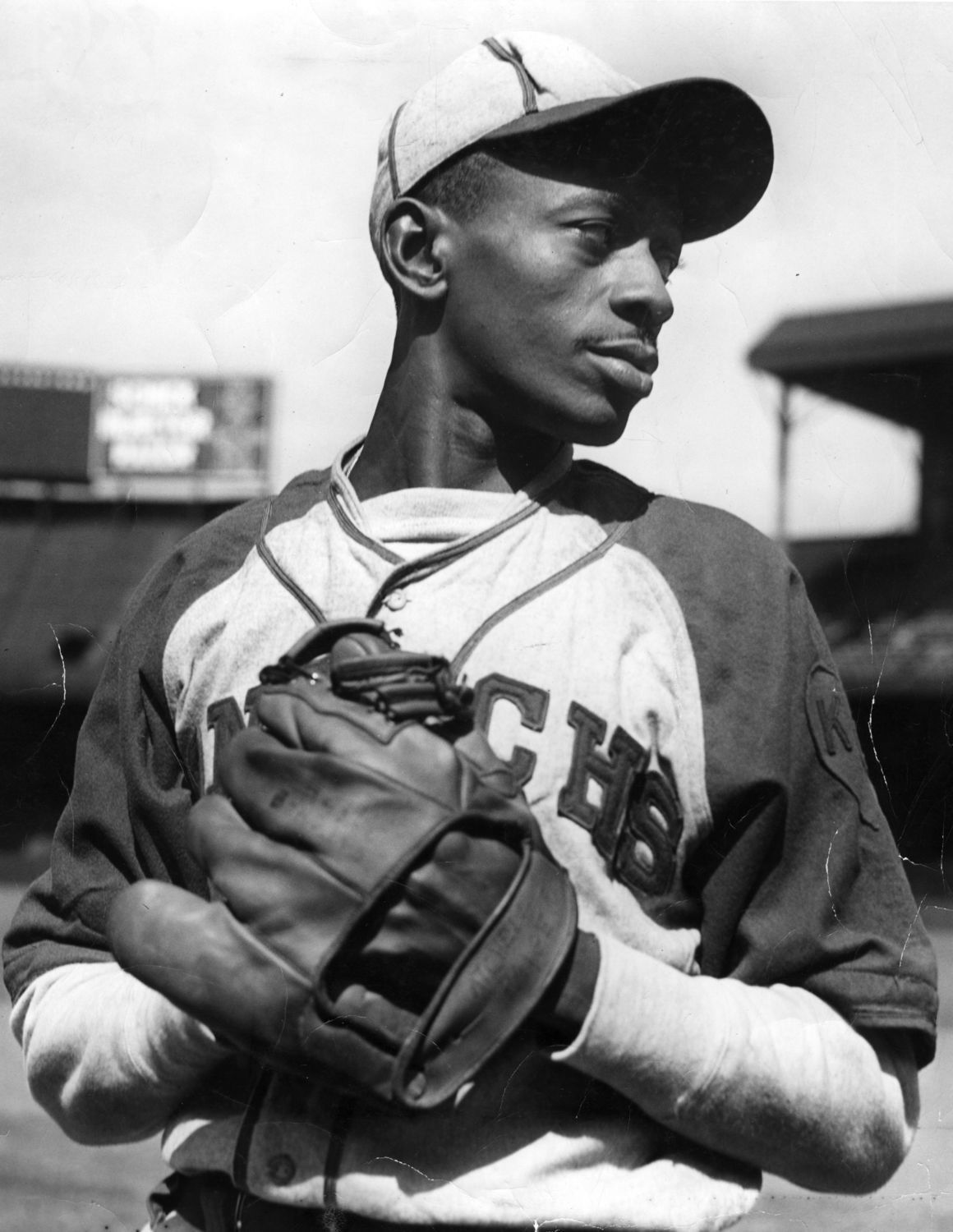
On July 9, 1948, the oldest rookie ever to make the big leagues took the mound for the Cleveland Indians. He also happened to be one of the greatest pitchers of all time.
Leroy “Satchel” Paige was forty-two years old. The Indians were in a pennant race that July, and their acquisition helped get them to the World Series. Paige finished the season with a 6-1 record, a 2.48 ERA and 43 strikeouts.
It was a bittersweet achievement. Paige, one of the immortals of the old Negro Leagues (and thus kept out of the Majors by the color barrier) showed the large crowds who came to see him what he was capable of. Indeed, Joe DiMaggio once hit against Paige in his prime, in an exhibition game, and called Paige the greatest pitcher he ever faced.
After a disappointing 1949 season, the Indians dropped Paige, but he wasn’t through. He came back with the St. Louis Browns in 1951. In 1952 he was so effective he was named to the American League All-Star team.
Amazingly, Paige’s career continued. He bounced around on barnstorming teams and in the minors, still showing occasional flashes of brilliance. At the age of 56 he pitched for a minor league team in the Pacific Coast League. And then, at 59 (that’s five-nine!) on a whim from the colorful promoter Charles O. Finley, Paige came out to pitch in one game for the old Kansas City Athletics, facing the Boston Red Sox.
Satchel Paige faced ten batters that day in 1965, allowing only one hit (a double by Carl Yastrzemski) and getting his last major league strikeout. Astonishing!
Satchel Paige was elected to baseball’s Hall of Fame in 1971.
In addition to his pitching prowess, Paige was something of a down-home philosopher. He handed out advice like, “If your stomach disputes you, lie down and pacify it with cool thoughts.” Now who can argue with that?
Paige never made a lot of money, yet he kept pitching. Why? Simply because he loved baseball.
You’ve got to love what you do to keep on doing it. We had an intriguing discussion some time ago on whether a writer should think about quitting. Our own Kris (P.J. Parrish) said the only valid reason should be that “the whole process of writing has become something of a chore, a duty rather than a delight.”
Every writer feels that way from time to time. Last year (the late, unlamented, atrocious, and altogether train-wreck known as 2020) induced quite a wave of such feelings. I wrote about why that is here.
So we need to fight back with delight. We need to keep in touch with our inner Satchel Paige and keep writing because we love it.
To rekindle that romance:
Remember the good times
“We’ll always have Paris,” Bogart tells Ingrid Bergman in Casablanca. Think back to the best times you’ve had as a writer. When did you feel the most joy? When did somebody tell you something that made you feel good about your writing? Dwell on that. You can do it again.
Write something you might throw away
Almost always we write with the goal of having readers pitch us some dough and become fans. When you have that in mind, it can sometimes sit there like Poe’s raven, mocking you. The way to chase that bird away is to write something just for you, for fun. I like flash fiction (under 1k words) for this. It doesn’t take long, and if I don’t ever publish it anywhere, no big deal. It frees me up to write just as I wish. And sometimes that turns into the germ of a full-length idea.
Re-read favorite passages
For me, nothing gets me back into the writing mood like re-reading select passages from favorite novels. Like this from Ask the Dust, John Fante’s 1939 novel about a young writer longing for success:
Los Angeles, give me some of you! Los Angeles come to me the way I came to you, my feet over your streets, you pretty town, I loved you so much, you sad flower in the sand, you pretty town. A day and another day and the day before, and the library with the big boys in the shelves, old Dreiser, old Mencken, all the boys down there, and I went to see them, Hya Dreiser, Hya Mencken, Hya, hya: there’s a place for me, too, and it begins with B, in the B shelf. Arturo Bandini, make way for Arturo Bandini, his slot for his book, and I sat at the table and just looked at the place where my book would be, right there close to Arnold Bennett, not much that Arnold Bennett, but I’d be there to sort of bolster up the B’s, old Arturo Bandini, one of the boys, until some girl came along, some scent of perfume through the fiction room, some click of high heels to break up the monotony of my fame. Gala day, gala dream!
How’s your (writing) love life these days? What do you do to romance it?
Happy New Year! Thank you for being here. I will apologize in advance for the length of what follows.
Between the economic impact resulting from restrictions imposed on businesses in reaction to COVID-19 as well as other factors — the term “starving writer” wasn’t pulled out of thin air — those of us who labor in the grammar mine might be having some problems making ends meet. What follows is a shopping hack called “Dollar Tree.”
I had never been in a Dollar Tree until early October 2020, having until that time succumbed to what was and is a certain negative cache attached to dollar stores in general. To my surprise I learned last year that one was going to occupy the last remaining storefront in a retail center a few blocks from my home. My invitation to the grand opening in April 2020 was apparently lost in the mail and as a result I didn’t learn until a few weeks before Halloween that it had been open for months, yet another reminder that behavior resulting in getting fitted with an ankle monitor can really cramp one’s style.
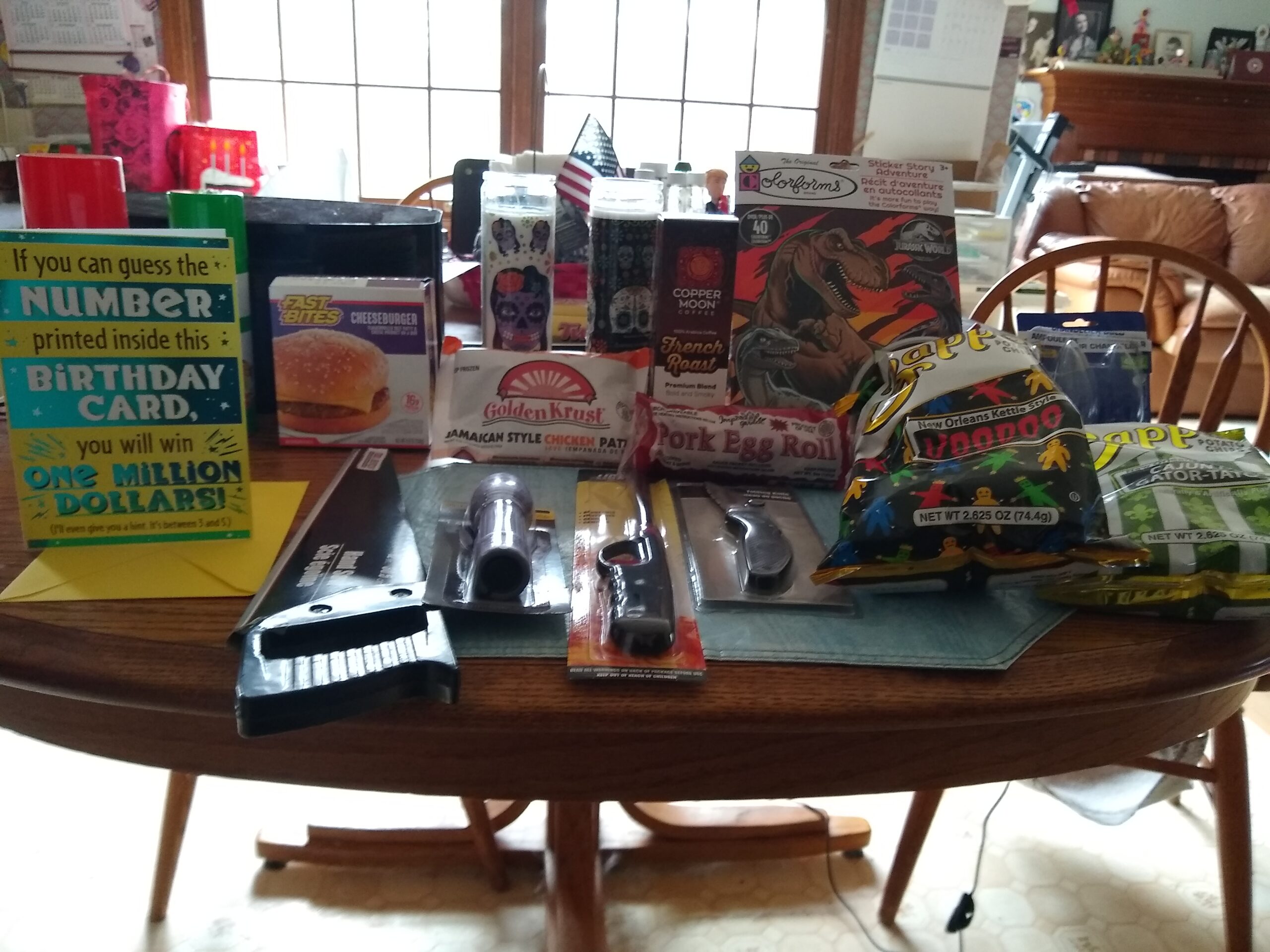
Dollar Tree has apparently been upping their game with new and larger stores located in (somewhat) better neighborhoods. The one near me has everything one could want or need, or a variation thereof. It has cleaning products,toys, school supplies, canned and paper goods, health and beauty aids, and automotive and tool products. The newer stores have a card section, a “Snack Zone,” and a refrigerated/frozen food case. The best part of Dollar Tree is that, unlike many stores with the word “dollar” in the name, Dollar Tree means what it says. Everything in the store can be had for a dollar. Period. Actually, that’s not quite accurate. Greeting cards are two for a dollar. There is also a shopping cart at the front of the store full of reduced-price — fifty cents — items that have been closed out. Everything else? One buck. This includes the Snack Zone where, in addition to chips, candy, and Little Debbie cakes, one can purchase fruits and vegetables (just kidding) (unless pork rinds count). The frozen food case features microwaveable breakfast, lunch, and dinner items as well as ice cream novelties (which of course can be eaten for breakfast, lunch, and dinner).
Not everything in Dollar Tree is a terrific deal. A box of baking soda is a dollar, but one can buy that in a supermarket for almost half the price. Boxes of theater candy are pretty much a dollar everywhere (except, interestingly enough, at a theater, even before they all closed), as are Arizona teas. There are, however some interesting finds in a Dollar Tree. The stores also now seem to be just about everywhere so if you want to read this as you walk through the aisles of one near you, please do so. What follows is a random sampling and review of what you can find, and what you should get or avoid, at a newer Dollar Tree.
— Golden Crust Jamaican Style Puffshell sandwiches:
The good: Everything. I’ve never seen these in a store outside of corner markets in New York until now.
The bad: Absolutely nothing at all.
Bottom line: Dollar Tree sells a few different varieties of these which, like Imperial Garden Egg Rolls (see below) all taste somewhat similar. That said, the Jerk Chicken is my favorite. Microwave it for two minutes and you can call it lunch or dinner, or both. Caveat: I don’t recommend eating one within twelve hours of a first date, second date, assignation, job interview. wedding, or any anniversary celebration before the tenth one.
— Motor oil:
The good: If your ex- asks you to top off their oil when they come over to pick up their stuff, this is what you want to use.
The bad: You don’t want to use motor oil that costs a dollar in your own auto unless you have a car like Fred Flintstone’s.
Bottom line: No.
— Zapp’s Potato Chips(!):
The good: My favorite potato chips! Voodoo Style! For a dollar! And I didn’t have to drive to Louisiana to get them!
The bad: None!
Bottom line: Life is good!
— Power steering fluid:
See Motor oil, above.
— Colorform playsets(!!!):
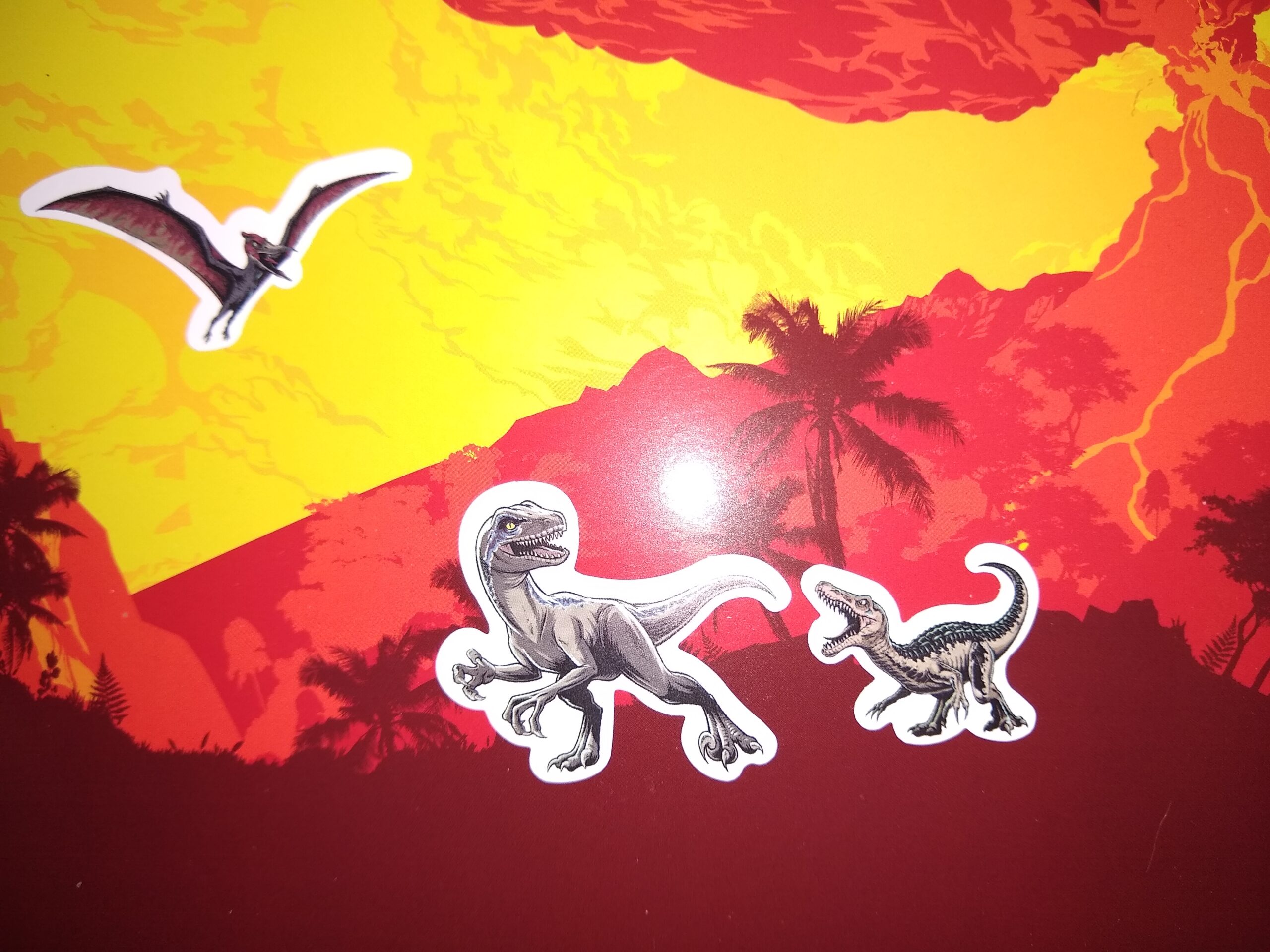
The good: COLORFORMS! For a buck! I didn’t even know Colorforms sets were still made. If Dollar Tree had a security guard, he would have been called to Aisle 3 when I initially found them. The discovery caused me to break out into my James Brown “goodfoot” dance. “YOWWW! HUNH! GOOD GAWD!”
The bad: Colorforms doesn’t make a Bettie Page set, but that isn’t the fault of Dollar Tree.
Bottom line: Colorforms! What more can I say
— Folding Knife:
The good: It is very sharp and surprisingly smooth when opening and closing.
The bad: The blade is short.
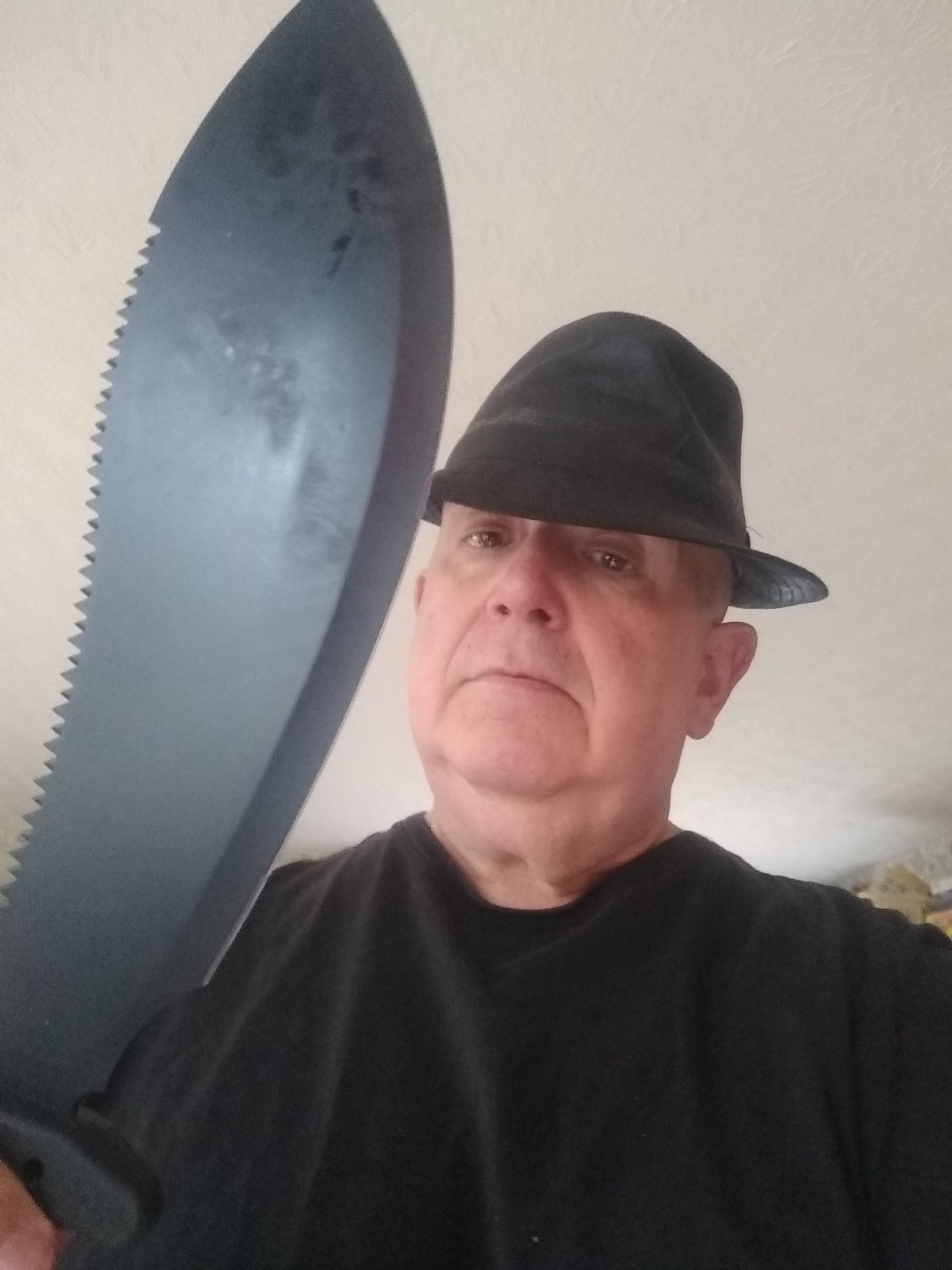
Bottom line: That isn’t a knife!
Now…THAT’S a knife!
— Copper Moon French Roast Coffee (Four K-cups):
The good: Everything.
The bad: Nothing.
Bottom line: I’m kind of a coffee snob. I usually only drink the Cafe du Monde, Community Coffee, or Bustelos brands. This, however, was surprisingly good. It has a rich, smooth flavor and, if you melt a Hershey’s kiss in it, a deep chocolate profile.
— Healthy Chef Canola No-Stick Cooking Spray:
The good: I wasted only one dollar on it.
The bad: I wasted a whole dollar on it.
Bottom line: It didn’t work at all. I actually thought about taking it back and getting a refund, but I would have looked like a cheap***.
— Assured Men’s Shave Cream Regular:
The good: It didn’t make my face fall off.
The bad: It didn’t make my face fall off.
Bottom line: I intended to buy a five-ounce can of Barbesol but the 12 ounce can of Dollar Tree’s house brand for the same price was too good to resist. It has a nice scent to it but the lather is a little thin. It’s good enough, however, that I might buy it again.
—”Tactical” flashlight:
The good: It is actually bright enough to use for ordinary purposes.
The bad: It is not a tactical flashlight.
Bottom line: It fails to meet the definition of a tactical flashlight in durability, size, ability to be dual-purposed as a self-defense instrument, and luminosity.Throw it in the glove box of your car as a substitute for one that should already be in there. Batteries — 3 “AAA” — are not included. The batteries actually cost more than the flashlight, unless you buy the batteries at Dollar Tree.
— Imperial Garden Egg Rolls:
The good: They are big and they are very tasty. Get a jar of Chinese hot mustard (not sold at Dollar Tree) and you’ll be all set to bypass Uber Eats for the night.
The bad: all of the flavors — chicken, pork, shrimp, and lobster — kind of taste the same.
Bottom line: These are not foodie quality but they get the job done. Dollar Tree could probably open stores near college campuses and turn a profit just on the sale of the egg rolls to drunken students on weekend nights or during exam week.
— Croc’s Refillable Butane Candle Lighters:
The good: The price.
The bad: None.
Bottom line: I learned recently that it is perfectly legal to buy and possess a flamethrower in forty-nine states (Maryland is the only poody-pants). While I am waiting for mine I can practice with this lighter which is as good if not better than the ones that cost two dollars and up at other stores. It eschews the two-step operation that most use, utilizing instead the equivalent of a double-action trigger pull that you’ll find on your better .38 Special revolvers. I thought about buying a bunch of them (the lighters) as Christmas stocking stuffers for the neighborhood children but tamped down the urge.
— Handsaw:
The good: It’s great if you need one just to trim a couple of tree branches and don’t own a chainsaw.
The bad: At the price of one dollar it should not be considered as a long-term tool for you. It can, however, be replaced rather easily and inexpensively.
Bottom line: This is part of “Tool Bench,” Dollar Tree’s in-house tool line. The irony is that the Dollar Tree where I purchased the saw is located in the former storefront of a Sears Hardware store.
— Greeting cards:
The good: Hallmark actually makes a line of greeting cards branded “Heartline” (I wonder if I could collect a quick settlement for trademark infringement using a “confusion in the marketplace” argument?) that 1) are two for a dollar and 2) don’t have the price on the back. They’re nice, too. None of my children could tell the difference this Christmas.
The bad: Your in-laws might buy you the same card you bought them and thus will know how much you paid for it.
Bottom line(s): 1) It actually costs more to mail the card than to buy it.
2) Sending your ex- a birthday card from Dollar Tree is like saying “God bless you!” in Nashville or “Have a magical day!” at Disney World.
DVDs:
The good: Cardboard boxes of obscure horror and thriller movies on DVD.
The bad: Cardboard boxes of obscure horror and thriller movies on DVD.
Bottom line: I had not heard of most of the movies or of the actors in them. If you are a fan of schlock horror I would recommend going to Dollar Tree for no other reason than to pour over what they have for sale. The boxes are usually in the school supply and toy aisles.
I invite you to visit and walk around Dollar Tree to see what else they have. Heck, if you find yourself at the one at Sunbury Road in Westerville, email me. I’ll drive over and give you a personal tour. I am willing to wager that you cannot walk out without spending at least ten dollars while delighting in doing so. A number of major brands, including Colorforms and Hallmark, seem to be offering products of a size that can be sold at the Dollar Tree price point. A Pepsi salesman was in the store during one of my (daily) visits and advised that the chain is one of their major clients. I also read somewhere that the folks who run Dollar Tree want their customers to be surprised by what they find every time they walk in the store. Mission accomplished. I found within their book section a couple of mass market paperback collections of Elmore Leonard western short stories. They were priced at a dollar each. They were not marked down or remaindered or anything. They are part of a small but growing line of HarperCollins paperbacks targeted for Dollar Tree customers.
Oh. I also have to compliment the store associates. They actually seem glad to see customers walk in and are familiar with the inventory and where it is located. One of them was interested when I told her that I was going to post a blog about Dollar Tree. She has asked me a couple of weeks why she hasn’t seen it yet. Here it is (Hi, Holly!). Another laughs at my jokes on a regular basis and on cue (Hi, Maribeth!). They treat me so well that I may go there for my birthday this year. After all, party supplies such as tablecloths, hats, those packs of ever-important “thank you” notes, and Dolly Madison Zingers are just a dollar. I even put a visit to Dollar Tree into my WIP, once I was able to tear myself away from playing with my Jurassic World Colorform set long enough to get some writing done. The best part of all is that, even after you get that huge publishing advance and license your work for a Netflix project, you will still want to shop at Dollar Tree.
If so inclined, please tell us your favorite store(s), why they are your favorite, and whether you plan to insert them into your stories. Thanks again for being here. Be well.
“Don’t read your reviews.” “Don’t read your reviews.” I had the same advice given to me twice by two different writer acquaintances. Both are million-plus sellers, and both are people I highly respect. Despite their experience and financial success, I don’t necessarily know if they’re right about this. That leads me to this rant post about book reviews and the question of ‘are they useful to writers’.
At their core, book reviews are sales tools. Publishers have long promoted good reviews as social proof of a book’s value. They want to positively influence readers to buy a copy. That leads to the issue of why expose negative reviews when they probably hurt sales, but that’s for a different philosophical discussion.
The problem with book reviews, as I see it, is subjectivity. Reviews are based on the reviewer’s opinion. Reviewers are readers, and readers have an enormous variety of takes, tastes, and tolerances. What is a good read to one may be bad to another.
I suppose an objective review would be thoughtful and helpful. It does no good for a writer to be lavishly praised or mercilessly trashed without the reviewer stating why they liked or disliked the work. We, as writers, learn from our work, and constructive criticism or accurate feedback is a wonderful learning tool.
I have to say I’m a bad reviewer. I don’t mean I leave bad reviews. (I won’t write a review if I can’t say something positive—that’s my nice guy nature). I mean, I rarely leave even a good review after I finish a book, and that makes me a hypocrite when I ask readers to leave a review on my publications.
Back to subjectively. We writers are readers, too, with personal likes and dislikes. When it comes to reading genre fiction, I’m on Team King, not Team Patterson. In my subjective opinion, Stephen King blows James Patterson out of the water when it comes to talented storytelling. However, I understand Patterson makes more money selling books than King, so who’s the better writer?
Not everybody likes J.K. Rowling and the Harry Potter series. I read there are nearly 200,000 one-star Harry Potter reviews on GoodReads. Twilight apparently got eviscerated over there. So did Fifty Shades. Even Garry Rodgers takes the odd dart in the eye on the GR site.
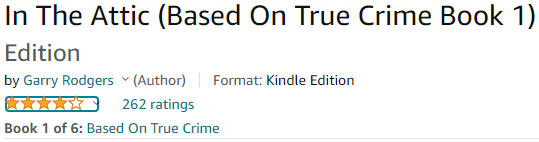
Speaking of me, let’s see how I’ve fared on Amazon. I’ve worn everything from the crown of honor to the cone of shame. Here’s a review snapshot of my book In The Attic which has 262 Amazon reviews (ratings) that average 4.2 on the 5-Star scale. 51% are 5, 29% are 4, 15% are 3, 1% are 2, and 4% of my reviewers (raters or haters) think I suck and awarded me a 1-Star.
But what do these Amazon stars actually mean? GoodReads uses a 5-Star rating system, too. I haven’t looked under that bridge in over two years, but out of curiosity for this post, I checked the Amazon-affiliate site. GoodReads has 184 hits on In The Attic, and they give it an average of 3.77 out of a possible 5.0.
I Googled around and found a subjective article titled How Are Product Star Ratings Calculated? The author tells me that Amazon is more generous than GoodReads when it comes to the stars aligning. Here’s how the writer says Amazon and GoodReads interpret ratings:
5 Stars — On AZ “I love it.” On GR “It was amazing.”
4 Stars — On AZ “I like it.” On GR “Really like it.”
3 Stars — On AZ “It’s okay.” On GR “Liked it.”
2 Stars — On AZ “I don’t like it.” On GR “It was okay.”
1 Star — On AZ “I hate it.” On GR “Did not like it.”
I found another piece where the contributor equated star rating to a school report:
5 Stars — B+ to A
4 Stars — C+ to B
3 Stars — C to C-
2 Stars — D or D-
1 Star — F for Fail
Fair enough. The star rating is obviously subjective. What about written reviews? Is this where the rubber meets the road and we writers can find useful criticism? Let’s look at In The Attic again and take the ice cream with the ugly sweaters. At least the way Amazon sees it.
Reviewed in the United Kingdom on November 25, 2020 *****Brilliant story.
Reviewed in the United States on January 5, 2020 *Horrible. The worst book I have ever read, I tried to like it but could not get past the first few chapters. This is the only book (in my life) I could not finish.
Reviewed in the United States on May 13, 2020 *****Caveat: This is not for the faint of heart. And that it is a true story just blows my mind. The author does not lie about the content being graphic. If you are prone to nightmares, this is a warning. I literally prayed last night that I would not have a nightmare (thankfully, I did not).
Reviewed in the United Kingdom on June 26, 2020 *All I can say is thank goodness I didn’t pay for this book. Author wasted many chapters on absolute rubbish. At least I know not to read any more from him. A true story but he so missed the mark and could have had a winner if told only from his perspective. Sorry but true.
Reviewed in the United States on September 10, 2020 ***Mr. Rodgers, are you are (sp) of your subject matter? And that it’s based on TRUE events? Sir, only true psychopaths would get decent entertainment value from this book. (I just needed to point this out while I remembered!).
One tool every writer needs is a hide thickener. We can’t always get ego-praising, “If I could give it 10 stars, I would” reviews as one reader left for me. We have to endure comments such as, “Never have I given a bad report on a book because it really is a huge undertaking and hard work for the author… but THIS book… OMGosh…talk about sensational drivel. I’m speechless. Most of it was hard core fluff to fill out a book that should have been 30 pages instead of 155, with sexual content jabber, sensationalism, and …well…let’s just say Do yourself a favor and pass this one by. Or…go ahead and read it and then hit yourself in the forehead for not paying attention to an honest one star rating. Sorry, author…. “I wish I hadn’t….” I’m sure your other books are better.”
The problem with reviews like these, good-neutral-bad, is they’re not particularly useful to improve my craft. I want to know why my writing is brilliant on one hand and horrible on the other. Why do I appeal to psychopaths and blow people’s minds? How is it my senseless drivel leaves a reader speechless? A little elaboration would be handy.
I know the trolls are out there. I also recognize a butt-kisser, and that goes with travelling in writing country. As an online crime writer, I’ve had everything from marriage proposals to death threats (not joking). By the way, In The Attic is 167 pages and contains no hardcore sexual stuff. The reviewer must have read a different In The Attic.
I’m still early in my writing travels. I might be a “C or D” on the popularity list, and I have no problem with honest criticism that’s meant to be helpful instead of hurtful. It’s somewhat comforting to know that A-listers who’ve gone before me have worn sweaters uglier than my driver’s license photo. Here are some slams I found on the net:
On Herman Melville and Moby Dick — Sheer moonstruck lunacy.
On J.D. Salinger and Catcher In The Rye — The greatest mind ever to stay in prep school.
On George Moore’s work — He leads his readers to the latrine and locks them in.
By Samuel Johnson to an aspiring writer — Your book is both good and original. Unfortunately, the parts that are original are not good, and the parts that are good are not original.
On James A, Michener and Chesapeake — Two recommendations. First, don’t buy the book. Second, if you do buy the book, don’t drop it on your foot.
By Randall James on a poetry book — This reads like it was written on a typewriter—by a typewriter.
By Mark Twain on Henry James — Once you’ve put down one of his books, you simply can’t pick it up again.
By Oscar Wilde on George Meredith — As a writer he has mastered everything except language; as novelist he can do everything except tell a story; as an artist he is everything except articulate.
How about you folks on the Kill Zone? Do you read your book reviews, and are book reviews useful to writers?
——
Garry Rodgers is a retired homicide detective with a second career as a coroner responsible for investigating unnatural and unexplained deaths. Now, Garry is a crime writer and indie publisher working on a based-on-true-crime series. His seventh book in the collection, Beyond The Limits, is coming out this month on Amazon, Kobo, and Nook.
Garry Rodgers lives on Vancouver Island at Canada’s left coast. When not writing, Garry putts around the Pacific Ocean and drinks boxed wine—not necessarily at the same time. Check out DyingWords.net (Garry’s blog & website) and follow him on Twitter.
First–Happy New Year, everyone, and welcome back to TKZ.
Over the break, I finished my personal edits on the manuscript of my next Mapleton Mystery, and I thought I’d share some of the tips I’ve discovered over the years for that final pass before turning the manuscript in.
We want to submit the cleanest possible manuscript to our editors, agents, or wherever you’re submitting. By the time most of us hit “The End”, we’ve been staring at the manuscript on a computer screen for months. We probably know passages by heart, we know what it’s supposed to say, and it’s very easy to miss things.
What we need to do if fool our brain into thinking it’s never seen these words before.
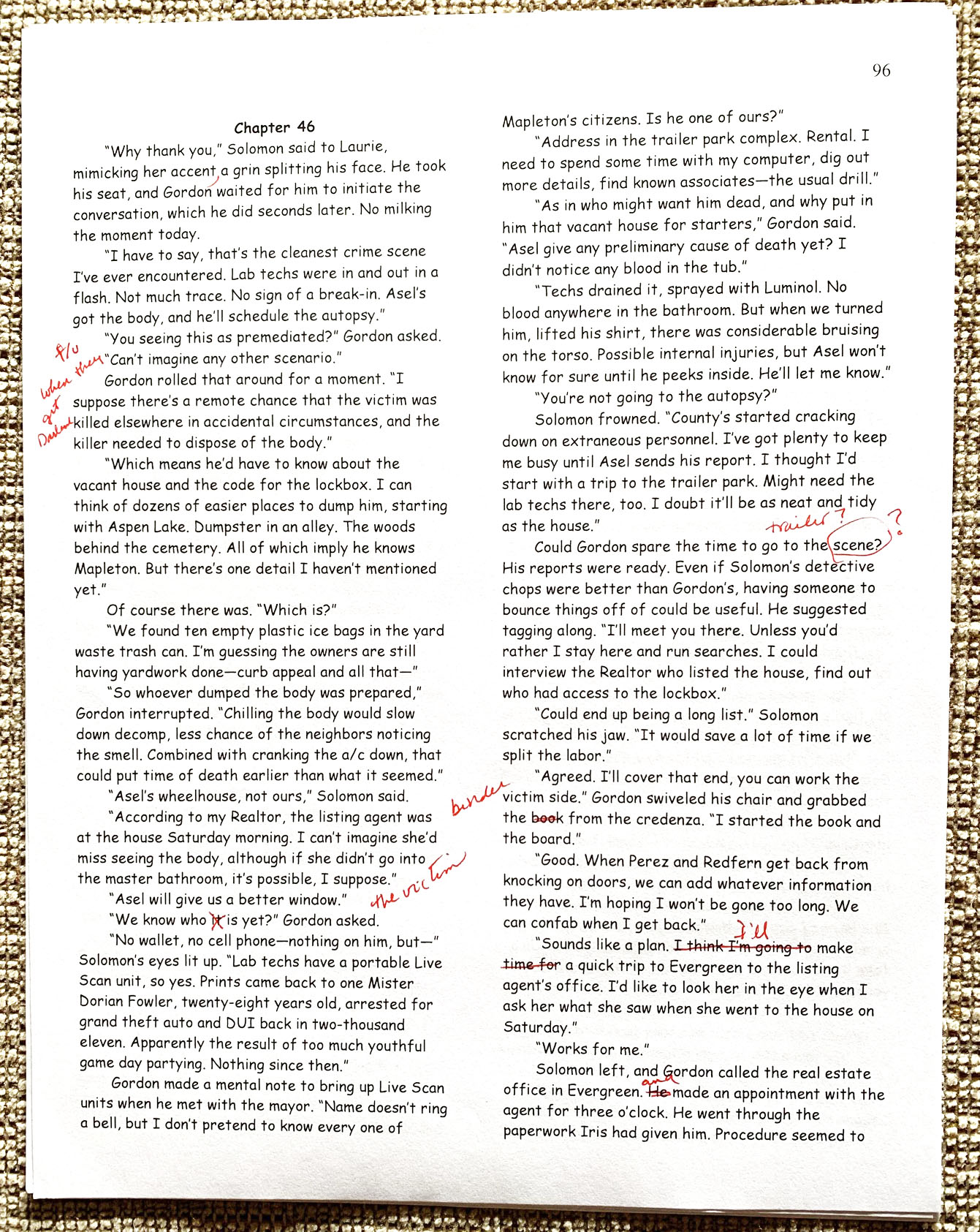
Tip #1 – Print the manuscript. It’s amazing how much different it will look on paper.
Tip #2 – Use a different font. If you’ve been staring at TNR, choose a sans-serif font. In fact, this is a good time to use the much-maligned Comic Sans.
Tip #3 – Change the format. You want the lines to break in different places. I recommend printing it in 2 columns, or at least changing the margins. That will totally change the line scan, and it’s amazing how many repeated words show up when the words line up differently.
Tip #4 – Read away from your computer. Another room, or at least the other side of the room.
The above are all “Fool the Brain” tricks. Moving on to my basic process.
Tip #5 – Read from start to finish.
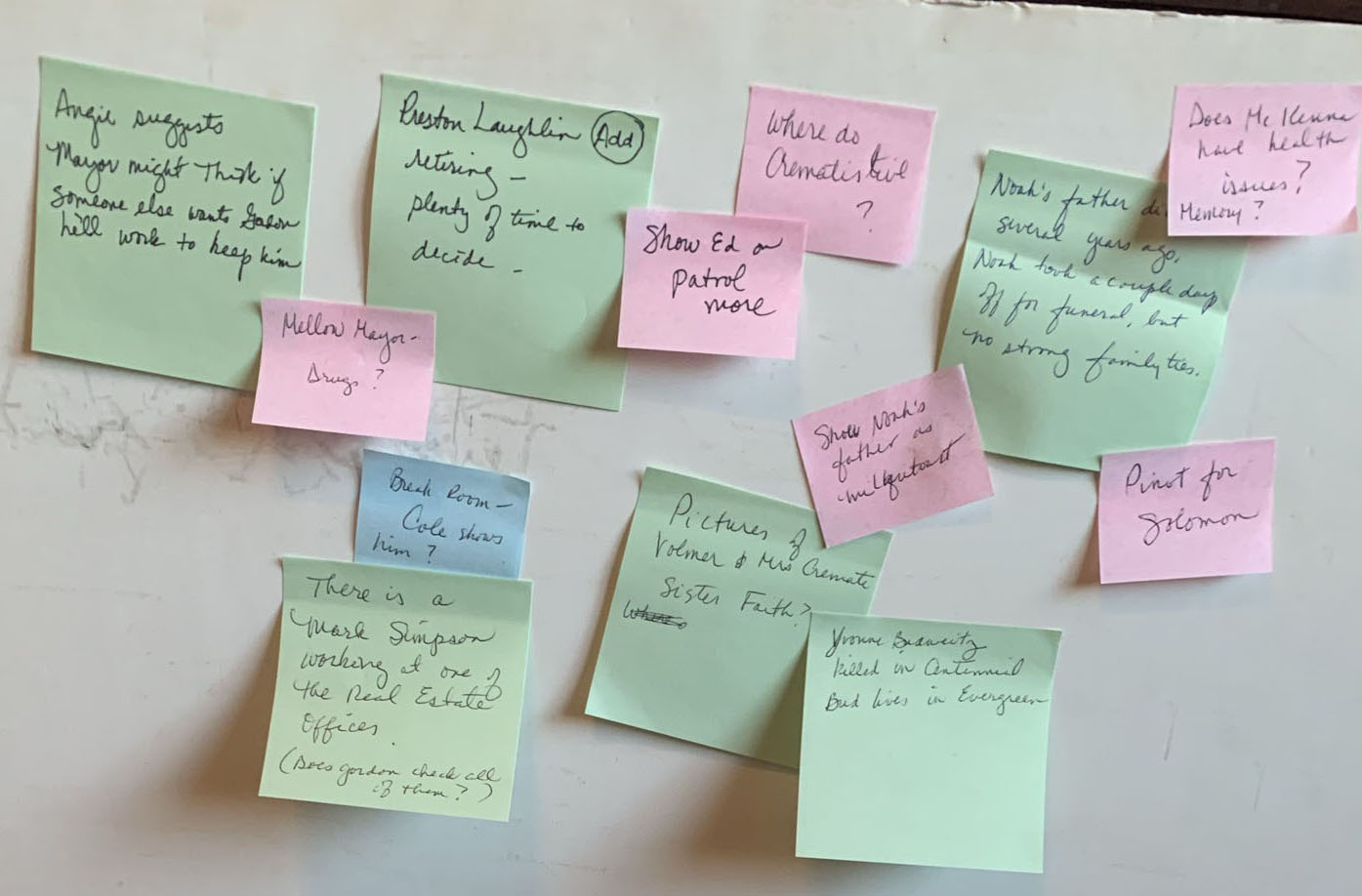
As I read, I have a notepad, highlighters, red pen, and a pad of sticky notes. This pass isn’t where I fix things; it’s where I make notes of things to fix. I don’t want to disrupt the flow of the read by stopping to check out if the character drove a red Toyota or a green Chevy. I have a foam core board by my chair, where I’ll post my sticky notes. Also, because it’s a hard copy, there’s not simple “Find” function.
When repeated words or phrases jump out, I note them on a sticky for a future search-and-destroy mission. I’ll circle or highlight words that could be stronger, or places where I might be able to come up with a metaphor that doesn’t sound writerly.
I’m also critical of “does this move the story?” as I’m reading. The beautiful prose might not be all that beautiful when reading it in the context of the entire novel. Don’t be afraid to use that red pen. On the flip side, you can also note where a scene needs more depth, or something needs foreshadowing. Are characters behaving consistently? Or do their personalities change because the author needs them to do something for the plot.
Another thing I look for is named characters. Naming a character tells the reader “this is an important person.” Do they play enough of a role in the story to earn a name? Can they be deleted, or referred to generically?
Once I’ve reached the end, I’ll go back to the computer and deal with the notes I’ve made.
The last pre-submission editing chore for me—and it’s a tedious one—is to let the computer point out all the clunkers I’ve missed. Because, despite all the ‘trickery,’ the story is still familiar enough that I don’t catch everything.
For this, I use a program called “Smart Edit.” (I might do a full post on this software another time.) I use the version that’s a Word add-on, and run its checks. I know I have my standard crutch words, but it seems that every manuscript brings a few new ones that I lean on too heavily.
Once I’m finished with the Smart Edit purges, the manuscript goes off to my editor. My work up front means she should be able to spend more time looking at the story, and less time dealing with clunky prose.
The last step for me, which comes right before I’m ready to publish, is to let Word read the manuscript to me. I’ve talked about that before, and using ears instead of eyes is another way to trick the brain into thinking the story is new. And yes, I still find things to fix.
What about you? How do you deal with whipping your manuscript into shape before submitting it?
Terry Odell is an award-winning author of Mystery and Romantic Suspense, although she prefers to think of them all as “Mysteries with Relationships.” Follow her on Facebook andTwitter.
Happy 2021 and welcome back to TKZ after the annual holiday break!
Today, we kick off the new year with the first page of Rene Out on a Limb, a humorous middle-grade mystery. Please enjoy this submission then we’ll discuss it:
Rene Out on a Limb – First 400 words
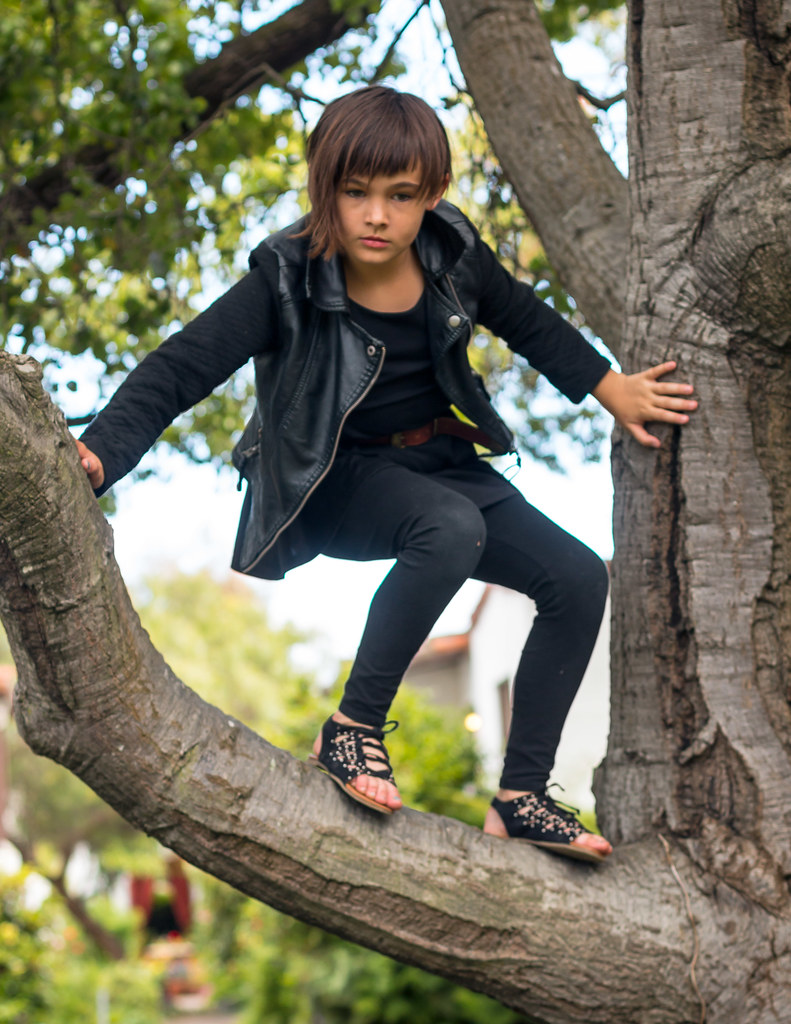
The branch of the tree makes a creaky noise when I wriggle out on it, and the ground looks really far away. I’m not worried, though. Oak tree limbs don’t break … do they?
“Psst.” My cousin Joanie tries to whisper, but it sounds more like a moose wheezing. Joanie is nine years old, but she never learned how to whisper properly. She’s sitting on a low branch like she’s glued to the trunk. A squirrel pokes its head out of a knothole and gnaws on an acorn while he stares at me. Like he’s surprised to see a girl halfway out on a limb. But this is my life. An investigative reporter knows no fear.
“Psst. Rene, stop.” Joanie’s voice gets a little louder and scaredier as I inch my way along the branch.
“Shh.” I whisper back with much better form. “I want to hear what they’re saying.” It’s good practice for a reporter to eavesdrop on possible subjects, and I’d radared in on Nate Peterson as he walked across campus with his girlfriend. They were so wrapped up in each other, they didn’t even see us. They stopped next to that big elm tree a few feet away, and the girl stood with her back against the trunk while he leaned toward her with his hand on the tree and a goofy expression on his face.
I’ll never understand adults. If Nate’s trying to impress his girlfriend, he’d do better if he stood on his head or did a couple of cartwheels. At least it would show a little talent. Maybe he could buy a yo-yo.
I creep another couple of inches forward, ease the notebook out of my pocket, and strain to hear. He calls the girl “Cassie.” I write it down.
Cassie was saying something about Reverend Newton. I know him. He’s the minister at the university chapel. She says, “He asked me to stop by today after lunch. It’s about Mr. Myet.”
Mr. Myet? Wasn’t he the librarian who died in that fire?
Cassie frowns. “Reverend Newton thinks there may have been foul play.”
Murder! My heart pounds and my ears become antennae. Maybe I can solve the mystery and expose the killer. I could be famous. I’ll be the youngest person who ever won a Pulitzer Prize!
I try to ease forward, but my foot gets caught.
~~~
This story blasts right out of the gate. In three short paragraphs, the author introduces Rene, the first-person protagonist, establishes her approximate age, and introduces her goal—she wants to be a famous investigative reporter.
By the ninth paragraph, she presents the mysterious death of the librarian, Mr. Myet. Rene’s mission grows more ambitious with that revelation. She’s determined to solve the crime.
The Brave Author includes another important detail: Rene is already in danger because the tree limb she’s clinging to could break. If that happens (and I’m fairly sure it will in the next page or two), Rene might be injured. But a more serious consequence: she will be discovered by the people she is surveilling. Her covert mission is blown.
That sense of risk propels the reader to turn the page. We need to find out Rene’s fate.
Does she survive? Once she’s discovered, can she talk her way out of her dilemma? Can she continue with her mystery-solving mission?
The Brave Author sidestepped the common problems we see on many TKZ first pages—lack of conflict, lack of action, too much backstory, difficulty with point of view (POV), unclear characterizations. In this excerpt, character, action, and conflict combine smoothly to engage the reader immediately. Effective pacing moves the story forward, inducing the reader to keep turning pages. Well done!
Humor is a bonus in writing stories for most age groups but particularly, it seems, for young readers. Rene’s voice is wry, witty, and delightful. She makes observations that sound appropriate for an intelligent child without being too advanced. Although her exact age is not mentioned, her mildly superior attitude toward her nine-year-old cousin suggests she’s perhaps a year older.
Joanie as the cautious sidekick contrasts with the fearless Rene, showing the personalities of both characters quickly and efficiently.
Rene pokes fun at Nate’s attempts to impress Cassie. Further, she inserts her own suggestions that standing on his head, turning cartwheels, or doing yo-yo tricks would be much more effective. Young readers can follow her child’s logic and older readers should find her lack of sophistication amusing and endearing.
I do suggest rearranging that paragraph a little, grouping all Rene’s suggested alternatives together and then drawing her conclusion.
I’ll never understand adults. If Nate’s trying to impress his girlfriend, he’d do better if he stood on his head or did a couple of cartwheels. If he’s super cool, he could demonstrate yo-yo tricks like The Elevator or Walking the Dog. At least that would show a little talent. Maybe he could buy a yo-yo.
The paragraph below works better if it’s split into two paragraphs. Joanie’s inability to whisper should be a separate thought from the squirrel’s action and Rene’s reaction.
“Psst.” My cousin Joanie tries to whisper, but it sounds more like a moose wheezing. Joanie is nine years old, but she never learned how to whisper properly. She’s sitting on a low branch like she’s glued to the trunk.
A squirrel pokes its head out of a knothole and gnaws on an acorn while he stares at me. Like he’s surprised to see a girl halfway out on a limb. But this is my life. An investigative reporter knows no fear.
Let’s talk about verb tense. The story begins in present tense, which is common in children’s books. That sense of immediacy appeals to young readers.
Then there’s a switch to past tense. That is understandable for events that have already happened, like this paragraph:
I’d radared in on Nate Peterson as he walked across campus with his girlfriend. They were so wrapped up in each other, they didn’t even see us. They stopped next to that big elm tree a few feet away, and the girl stood with her back against the trunk while he leaned toward her with his hand on the tree and a goofy expression on his face.
Then the tense switches back to present as Rene makes her entertaining observations about how Nateshould impress his girlfriend. Present tense is appropriate because the reader is inside her head, thinking her thoughts as they occur to her.
This is followed by Rene’s actions of creeping further out on the branch and taking notes, also in present tense.
But then, in the next paragraph, a change to past tense causes a slight clunk:
Cassie was saying something about Reverend Newton.
It might read more smoothly this way:
Cassie is saying something about Reverend Newton.
Here’s another tense change that tripped me:
Mr. Myet? Wasn’t he the librarian who died in that fire?
The thought in Rene’s head should be in present tense, in the moment that it occurs to her:
Mr. Myet? Isn’t he the librarian who died in that fire?
These nits are tiny. Yet they make a subtle difference. When the author avoids small bumps like these, the reader stays totally engaged in the story, without even a millisecond’s distraction from the fictive dream.
I had a hard time finding ways to improve on this already-excellent submission. Maybe other readers can see places to change but I was entirely caught up in the story and would read further.
A young girl who wants to become a crime-solving reporter is an appealing premise. I discovered Rene has a real-life counterpart, Hilde Lysiak.
The ambitious young lady, originally from Selinsgrove, PA, started a local newspaper when she was seven as a homeschooling assignment. By age ten, she had scooped conventional media with her coverage of a grisly murder committed with a hammer.
Because of that story, she was publicly criticized on social media.Her response to criticism from (so-called) adults was posted on You Tube and went viral.
Hilde made headlines again when the marshal in Patagonia, Arizona (where she now lives) challenged her right to shoot video, claiming she broke the law. She repeatedly asked him what law she had broken.
She did not back down despite his threats. Gutsy Hilde was acting within her First Amendment rights.
The officer’s false assertion led to a formal apology from the town mayor.
Along with her father, former NY Daily News reporter, Matthew Lysiak, Hilde scored a six-book series, along with a new Apple TV show chronicling her adventures as a kid reporter.
Judging by Hilde’s success, the appeal of a young female reporter who solves crime is certainly commercially viable.
With the excellent quality of writing and storytelling skills in Rene Out on a Limb, the Brave Author should be able to grab the attention of children’s publishers and enthusiastic young readers.
Thank you for submitting this fun piece, Brave Author. I thoroughly enjoyed it!
~~~
TKZers: Does this first page capture your interest? What suggestions can you offer the Brave Author?
Nobody tells Vietnam veteran Lou Belmonte he can’t hug his wife of 50 years. When pandemic restrictions won’t let him visit his beloved Cameo in a memory care lockdown, he busts her out, injuring two employees who try to stop him. The couple flees to a remote fire lookout in Montana’s Bob Marshall Wilderness.
With cops in pursuit, investigator Tawny Lindholm and her defense attorney husband, Tillman Rosenbaum, race to find the aging outlaws first because Lou won’t go down without a fight.
Happy New Year – and, as many may feel, good riddance to 2020!
Given the past year I thought it important to start off on a positive note – though as I am tiptoeing into the new year, I’m not quite ready to commit to any new year’s resolutions…you know, just in case… I have, however, been reflecting on what the challenges of 2020 has taught me – both personally and professionally. The TKZ community I think weathered the storm pretty well and I hope we continued to be a place where you felt encouraged and supported as writers. For me 2020 revealed both my strengths and weaknesses as a writer. I was discombobulated as well as distracted most of the year but nonetheless I did manage to finish major revisions to a novel (so there was one balloon still aloft at the end of the year:)) and I learned to be more proactive and assertive when it comes to my career (with mixed results given the year we had).
I’ve definitely spent the last few weeks wrestling with goals and plans for the coming year, but it’s been focusing on what 2020 taught me that’s helped me keep these in perspective…so in the spirit of sharing, here’s my short list of takeaways from the dumpster fire that was 2020:
I need more mental space than I realized to be creative – having a houseful of people all trying to learn and work remotely taught me that I should have prioritized this more
Manuscripts in drawers don’t sell themselves:)
I need to be braver, more assertive, and proactive as a writer (see item #2)
I shouldn’t spend all my time obsessing over the big goals, but be satisfied with achieving the smaller, more attainable ones on a daily/weekly basis (again…see item #2)
I don’t need to make lunch for everyone!!! (seriously, lunch became the most loathed meal of the day as I foolishly operated the ‘all day mum cafe’ for most of 2020)
What about you TKZers? As we look forward to 2021, what did the challenges of 2020 teach you as a writer?
One of the oldest Christmas carols, going back at least to the early 1700s, has a curious comma in it. I daresay most carolers and children who have sung this holiday favorite think the lyric is God rest ye, merry gentlemen. But if you step back a moment, an obvious question arises: if the gentlemen are already merry, what need is there for God to give them rest?
Indeed, the next verse indicates the gents are in some “dismay.” The rest of the stanza reminds them of the Savior and being saved from “Satan’s power.” These are “tidings of comfort and joy.”
The actual lyric places the comma here: God rest ye merry, gentlemen. In other words, may God grant you rest and make you merry, you gentlemen who are bustling around full of anxiety over this and that, and forgetful of the true meaning of Christmas.
Anyone out there carrying around an excess of anxiety these days? Okay, you can all put your hands down now. (Reminds me of the Drew Carey joke: “Hate your job? There’s a group for that. It’s called Everybody, and we meet at the bar.”)
We all can use some merry rest! To get practical, may I make three December suggestions:
Watch less news
None at all might be the best idea. You can catch up in January. Use the time to finally get around to that book you’ve wanted to read. Watch a holiday movie or two (yes, you can include Die Hard if you like). Mrs. B and I are listening to more classical music. We set the radio to KUSC, 91.5 FM in L.A., and leave it on in the background. So much more restful than the sniping prattle of the Fourth Estate.
Do something for someone else
Let’s bring kindness back into fashion. Go out of your way to open a door for someone. Let that car go in front of you in the fast food line. If you walk by a cop, firefighter, paramedic or soldier, say, “Thank you.”
Donate to a charity.
“At this festive season of the year, Mr. Scrooge,” said the gentleman, taking up a pen, “it is more than usually desirable that we should make some slight provision for the poor and destitute, who suffer greatly at the present time. Many thousands are in want of common necessaries; hundreds of thousands are in want of common comforts, sir.”
Write a blessings letter
Your grandmother used to tell you, “Count your blessings.” Take some time to write them down. I know it is harder for some than others. Suffering is part of our world, and always will be. But reminding ourselves of what we can be thankful for is a healing balm. Indeed, studies over the past decade have found that people who consciously count their blessings tend to be happier and less depressed. Anybody up for that?
We’ve just been through a year like no other in our lifetime, and up ahead things look foggy still. Let’s resolve to do 2021 the pulp fiction way:
Keep Calm and Type On
We now bring the curtain down on another year at Kill Zone. Can you believe it? We’ve been here since August, 2008! A pause to catch our collective breath is called for, so tomorrow we begin our annual two-week hiatus. See you right back here on January 4.
It is the time of year when we reflect on the past, give gifts during the holidays, and plan for the future. So, how does that relate to writing? Can we learn from the history of writing to plan for the future of our writing? It has been said, “Those who fail to learn from history are doomed to repeat it.” (Winston Churchill, 1948, a paraphrase from George Santayana, 1905). And from geometry we learn that it takes two points to define the trajectory of a line. Could those two points be the past and the present? And does the trajectory of that line give us any clues about the future?
The Past – Reflection
For the past, we turn to British and American literature. Now, I am out of my element on this topic. I studied math and science in college. So, those of you English and literature experts, please help me out here.
For a listing of the periods or eras in British and American literature, I turned to Wikipedia. Here is what I found:
British Literature – periods and eras
Old English lit. – 658-1100
Late Medieval – 1066-1485
Renaissance
Elizabethan era – 1588-1603
Jacobean period – 1603-1625
Late Renaissance – 1625-1660
The Restoration – 1660-1700
18th Century
Augustan age – 1701-1798
Roots of Romanticism – 1750-1798
Romanticism – 1798-1837
Victorian lit. – 1832-1900
Twentieth Century
Modernism and cultural revival – 1901-1945
Late modernism – 1946-2000
21st Century lit.
American Literature
Colonial lit.
Early prose
Revolutionary period
Post-independence
First American Novel
19th Century – Unique American style
Late 19th Century – Realist fiction
20th Century prose
1920s
1930s – Depression era
Post WWII fiction
Novel
Short story
Contemporary fiction
I have gone back and reread “classics” from the 1800s in my attempt to educate myself. I have been surprised repeatedly by how much styles have changed from then until now. Many of those books contain techniques which we are now encouraged to avoid: omniscient POV, head-hopping, author intrusion, slow pace and entry into the story, lengthy description, tell don’t show, etc.
There were many cultural, societal, and economic reasons why those styles worked then, but wouldn’t work now. What can we learn from them?
Before we move from past to present, here is a link to John Gilstrap’s post from three days ago. John’s post It is a fantastic history of the publishing industry over the past quarter century.
The Present – Giving
We give gifts in the present. Do you consider your books and stories a gift to the future? If a gift is handed down to descendants and it is considered to be of value, it is a “legacy.” Are your books a legacy? Do you want them to be a legacy?
On a side note, but still about giving, today is “Goose Day.” If you investigate the secular tradition of “The Twelve Days of Christmas” and gift giving, you discover that we start with the 12th gift on December 13th and work our way down to the 1st gift on December 24th. This is December 19th, so if you are looking for a gift for your “true love,” it’s six geese a layin’ today. And hopefully, some of those geese will be layin’ gold eggs. Now, that’s a legacy.
The Future – Planning
If we wish our books/stories/wisdom to be a legacy, of value for the future, and maybe for us if we’re still around, how do we plan for that? Does our writing, or the way we publish, need to change? Can we predict trends for the future based on what has happened in the past and what is happening now? How will writing, publishing, and reading change? And how do we best position our writing to be ready for those developments?
What era/period from the past would you choose to write in, if you could choose?
Why did you pick that era/period?
What new developments for writing/publishing/marketing/reading do you see coming in the future?
Do you plan to position yourself for coming trends? How?
Publishers Weekly says it’s about “what’s new and what’s next.” If you subscribe, what can you share about expected coming trends?