Can You Pass the 69 Test?

book-of-my-heart-1

By PJ Parrish

Now that I have your attention…

No, I am not going to talk about sex again. Not even bad sex with a limp penis, which as we writers know is a helluva lot more fun than good sex. I want to talk about finding the heart of your story. And to do that, you have to try this little exercise:

Get out your book or call up your Word doc manuscript. (For our purposes here, “book” means published or un, completed or not. “Book” is that thing that has been keeping you up lately.)

Open it to page 69. Read what is there. I don’t care if it’s a full page or the last two lines of a chapter. (If you hit a blank page, you have permission to use either 68 or 70 but that’s as much cheating as I allow.)

This page — this single page — capsulizes your entire book.

You don’t believe me, do you. I didn’t believe it either until I tried this experiment. I did it a couple years ago at the request of Marshal Zeringue, executive director for the Campaign for the American Reader. Marshal has this terrific blog wherein he promotes reading. Sez Marshal: “The goal of this blog is to inspire more people to spend more time reading books. I’ll try to do that by shining a little light on books that I like and think others might find worthy of their time and attention.” CLICK HERE to see his blog.

He also came up with the Page 69 Test. He was inspired by Marshall McLuhan’s suggestion that you should choose your reading by turning to page 69 of a book and, if you like it, read it. Zeringue tried it with Richard Dawkins’ The Ancestor’s Tale, and was so taken with the results he devised the Page 69 writers challenge.

On his blog, Zeringue has asked dozens of writers to answer the question: Is your page 69 a good place to get a sense of your book?

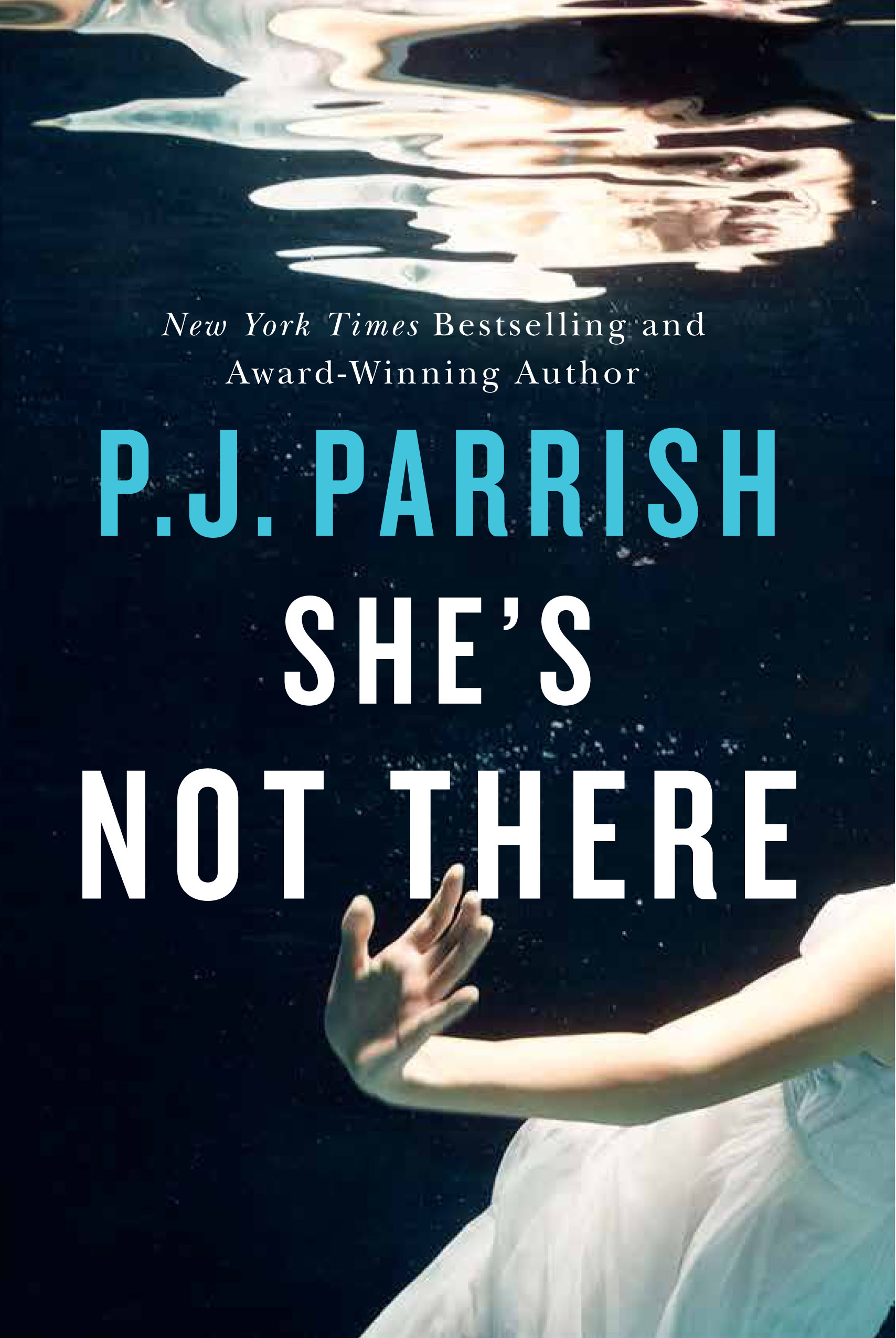
When I first picked up Marshal’s gauntlet, it was for our book AN UNQUIET GRAVE. (CLICK HERE to go read those results) But the other day, I decided to apply the test to our newest book, so I cracked open SHE’S NOT THERE, which was just released this month. Here is our page 69:

“When you call her phone, does it ring before it goes to voice mail?”
Tobias shook his head. “The police told me the phone was turned off. They said that’s why they couldn’t use the GPS to find it.”
“They can trace the phone’s last location. Have they told you anything?”
“Yes. They said her last known location of the phone was about two miles from where her car was found. But they never found the phone or her purse.”
“What about the car’s GPS?”
“It doesn’t have one.”
“And you don’t know where your wife was going?”
Tobias shook his head slowly. He picked up his glass, staring down into it for a long time, then finally took a drink.
“What do you know about the accident?”
“Not much. They said the car spun off the road in the Everglades.”
“Everglades?” What was your wife doing driving alone in the Everglades?”
Tobias stared at him for a long time, as if he were trying to figure something out. Then he shook his head. “I don’t know.”
What the hell did this guy know?
FINAL COVER

Here’s what has happened before this. A woman wakes up in a hospital, bruised and with a concussion. She has no ID and can’t remember how she got there. All she had on when she came in was a Chanel dress and a 10-carat diamond. But when she hears her husband’s voice (Tobias), she freaks and bolts from the hospital, sensing he tried to kill her. The husband has hired a skip tracer to bring her home and the tracer is interviewing the husband for the first time. Does it give a good sense of the book? Oddly enough it, does. As truncated as it seems, the passage crystalizes a main plot point. The skip tracer suspects Alex Tobias, a rich lawyer, has something to hide, and he knows that every marriage has dark currents running beneath. So the skip tracer’s final thought on that page — what did the guy know? — is the existential question behind the whole plot. This is a husband who actually knows nothing about his wife. Which is why he might have tried to kill her. Or not.

I have to say that I went into this experiment a skeptic and emerged a believer. When I first did this years ago, I thought it was a bunch of hooey. But I think it reveals a kernel of truth about both our books. Each passage, in its way, gets to the heart of our story.

Okay…back to your own page 69. How does it work for you? What is there on this one single page that somehow serves to represent the very heart of your book? Think hard. It’s there. If it’s not? Well, maybe, just maybe, you haven’t really found the heart of your book yet.

Let me know what you found out. Be brave and share your 69s here and let us be the judge!

Postscript: I am on vacation this week, roughing it in the wilds of the Loire Valley. I wrote this before I left and I think I will be able to answer. If I can’t…talk amongst yourselves! Also, our book is finally out..The South Florida Sun-Sentinel critic Oline Cogdill calls it “captivating.” Author Hank Phillippi Ryan, calls it “Taut, tense, and twisty—this turn-the-pages-as-fast-as-you-can thriller is relentlessly suspenseful.” Here’s the LINK.

Insights into the Dreaded First Page

I attended my first local Society for Children’s Book Writers and Illustrators (SCBWI) conference here in Colorado last weekend and there was a strong emphasis on the dreaded first page – one session was devoted to reading random first pages aloud to two editors (I was too chicken to enter!) and in another, more intensive session, the first 3-5 pages of a new novel were evaluated (I did bravely submit for this one!). We’ve dealt with a number of first pages here at the Kill Zone and, although this conference was focused on children’s books (ranging from picture books to middle grade and young adult), the same issues (unsurprising) reared their ugly heads, so I thought it would be helpful to distill and share some of the advice the editors and agents gave on those all important first pages.

By way of background, the two editors who conducted the first page session were Andrew Karre, executive editor at Dutton, and Stacy Whitman, founder and publisher of Tu books (Andrew also provided the novel intensive session). I also attended a session with Kristen Nelson, an agent, where the group evaluated query submissions (which in most cases focused, once again, on those dreaded first pages).

Here’s the advice, distilled and summarized as best I can:

Start with intrigue, leave explanations and extensive backstory for later

Many of the first pages evaluated fell into the trap of over-explaining (usually by way of character backstory) and succumbing to large chunks of narrative exposition before the action even got going. All the editors and agents agreed that the first pages of a novel must intrigue and raise questions in the reader – if those questions are answered too soon then there is no real payoff for the reader and, hence, no reason for them to continue to read. The difficulty comes when trying to achieve the next key point: anchoring your reader in time and place.

Anchor your reader, nonetheless in place and time

Some first pages provided a great deal of mystery and intrigue but too little in the way of ‘grounding’ so the reader felt lost before the story had really begun. Some pieces sounded contemporary only to turn out to be historical (and the reader had no way of knowing the setting or time period from the start which was disorientating). Some pages began with dialogue and no real foundation for the reader to visualize where that dialogue was taking place. Again, the editors all emphasized that a first page has to serve two purposes – to draw a reader in and hook them with the story and also to provide them with enough basic information to know where and when the story was taking place so they were willing to go along for the ride (rather than thinking ‘huh?!”) from the get go.

Overall, the editors emphasized, a balance has to be achieved between action and intrigue, questions and answers, exposition and dialogue. This is no easy task but one that enables a reader to get hooked on the story, suspend disbelief, and  want to keep turning the pages to discover the resolution to the issues raised.

Make sure you have a clearly established ‘voice’ and choice of POV from the outset

In the novel intensive program, this issue was raised a number of times as we discussed the choice of POV used in our crucial first pages. Sometimes the choice of first versus third person felt strange or forced, sometimes it was clearly the way the story needed to be told. The key element was one of deliberate choice by the author rather than lack of certainty over voice or POV (which comes through as inconsistency or uncertainty in the writing).

Avoid dialogue that sounds like it’s only for the reader’s benefit

All too often the dialogue in some first pages was too obviously providing information for the reader and so it felt forced and inauthentic. All the editors agreed that authors should avoid using dialogue as a backhanded way of introducing exposition or in a way that sounds like people are only telling each other facts or backstory for the reader to ‘overhear’. The critical element, once again, was to create a sense of authenticity and voice when using dialogue in the all important first few pages of the book.

Avoid mixed metaphors or overly ‘intellectual’ or ‘precious’ turns of phrase

As part of the editing process, the editors emphasized trying to pare down the first pages as much as possible so extraneous information is left out and readers aren’t slowed down by turns of phrase or metaphors designed to impress rather than move the story along. When we discussed this in the first pages session, the editors also emphasized that authors need to be aware of inadvertant ‘micro-agressions’ that come from using racially stereotyped or inappropriate phrasing. One of the main topics for the SCBWI conference was the issue of diversity in children’s literature (or rather the lack thereof) so this came up occasionally when dealing with the initial pages of some authors’ work.

So there you have it – further insights into the pitfalls to avoid in the first pages of your book! While there were no real surprises in terms of the feedback provided, I think it never hurts to have these issues repeated. Feel free to add your own comments or further insights…


How to Launch a Thriller Series

rocket-launch-67720_1280It’s launch week for me as I begin a brand new thriller series. I’m excited about this one, as it’s been bubbling around in my brain for some time. Now the first Mike Romeo thriller, Romeo’s Rules, is out, and two more are cooking.

So I was thinking about the steps one ought to go through when unleashing a new series. Here’s what I came up with:

  1. Create a character who grips you and won’t let go

I wanted to write about a guy who can fight, and who was admitted to Yale at age fourteen. I kept developing his backstory until he demanded to be written. That’s what you need for a series character, because you’re going to be with him a long time. In my workshops I suggest an exercise: what would your character have tattooed on his or her arm? You don’t have to put it there, of course. It’s just to dig further into character. When I figured out what tattoo Romeo would have –– and I did put it on his arm –– the character was complete. You’ll have to read the book to find out what it is. #Shameless.

  1. Come up with a twisting, turning plot for that character

The plot begins as Romeo is out for a jog … and a church blows up. He stops to help a bleeding woman, then finds a dead body in the church, and it’s not because of the blast.. The cops arrive. And that’s in the first three pages.

  1. Develop 2-3 other plots for the next books in the series

It helps your confidence to know the series will have some legs!

  1. Write the book

I believe this is an essential step.

  1. Have the book professionally edited

This is the biggest expense you’ll have in the indie-publishing process. But a good, experienced editor who knows the genre is worth every dime.

  1. Get a cover concept for the series (so the covers have a similar feel)

RomeosRules_med

  1. Write the book description copy

I tried something a little different with Romeo’s Rules. Actually, it’s a blast from the past. On many paperback originals of the 50s and 60s, the copy would contain a tag line, then some dialogue from the book (or a bit of a scene), then short, to the point sales copy after that. It’s my homage to that great era of genre fiction.

If you want to stay alive, you better know the rules …

Natalia Mayne said, “What’s the first rule?”
“Fear nothing,” I said.
“You have any more?”
“Do unto them before they do unto you.”
“Really?”
”And you don’t owe the truth to people who lie.”
“I’ve never met anybody like you.”
“I’ve heard that before.” 

Mike Romeo is an ex-cage fighter living off the grid in L.A. Running from a dark guilt that dogs him, he’s finally found a place where he can rest and even heal.

Then a church blows up. And with it all of Romeo’s hopes to be left alone. When he stops to help an injured woman whose kids are missing, someone decides to put a target on his back.

But whoever wants him dead picked the wrong guy. Because Romeo has rules. And he’s about to teach some lessons.

  1. Try to create a little pre-release buzz (e.g., post the first chapter for viewing)

I did that a few weeks ago.

  1. Publish the book to retailers

As an indie, you can create direct accounts with the main retailers, or you can use a service like Smashwords or BookBaby to do all that for you. I prefer to do it myself.

  1. Tell people it’s published.

Hey! It’s published!

Here’s where you can get it

AMAZON

BARNES & NOBLE

KOBO

A print version will be coming soon.

Bonus step: Commission a book trailer. My rule of thumb is that a trailer should be 30 – 45 seconds. Here’s mine:

Oh yes, one more step: get to work on the next book! I’m already into Romeo’s Way. 

So what do you look for in a series? What makes you read on … or stop reading?

First Page Critique – “Bird Without a Song”


“Bird Without a Song”

Prologue

       Somewhere near the end of my tour of duty in Vietnam, soon after I held the baby in my arms and felt him die, I began to imagine them. At first they were only quick movements in the corners of my tent but soon I began to see them in front of me. Some faces were clear, Corporal Terwilliger, Major Ayres, Corpsman Cooper, but there were strangers, too, ones I didn’t remember but who were familiar all the same. Some were faces from stretchers on fatigue-shattered nights when flares and panic were stabbing at us. I knew they were dead, too, even without names. There were hundreds of them. Thousands. They stood and waived to me from shadows when no one was around. They were small, and full of life.

      “I wonder if this is what heaven is like. You see all your friends again but they’re tiny. I’ll have to ask the little people,” I said to my crew chief one day while sweeping blood out of our chopper. I recognized the stare of concern he gave me. Shrugging, I laughed and pretended to be joking. I never mentioned them again. But they were real to me and, in time they began to talk. Major Ayres was the first to speak. “Tell my girlfriend I loved her,” he said.

      “Did they send my Air Medal to my mom?” Corporal Terwilliger asked.

      “You didn’t know me, but thanks for bringing my body back from the jungle,” one I didn’t remember said. I told them I would do everything I could to tell everyone they were safe and still alive. 

        When it was my time to leave, I tried to say good bye. 

      “We’re coming with you,” they told me in chorus.

      “I can’t take you back to the States. Someone would notice.”

      “They don’t see us,” Major Ayres argued. He was good at arguing. At his request, I was writing to his girlfriend’s fourth-grade classroom in Virginia to tell her students what Vietnam was like. “We will all fit quite nicely in your sea bag,” the major added.

        “Of course. That’s right, Sir. Others don’t see you. But why do you want to come with me?”

      “We want to be there when you tell our families we died with honor. When you tell them we’re still here and still love them. You must help keep us alive.”

      “But you’re dead, Sir, you all are.”

      “Not if you write about us,” a nameless ones said.

My comments and critique

It’s easy to assume that, because of the title of this Kill Zone feature – “First Page Critique,” that criticism is inevitable. That the submitted page is by definition flawed and in need of counsel.

But I’m happy to say that, in my humble opinion, this first page is on fire. It’s a fantastic launch for a novel, and while we can’t quite tell where it’s headed (not a requirement of a first page), we already know that we, like those dead guys that are attaching themselves to our hero, would like to come along for the ride.

What’s worthy of mentioning here, though, with a view of making this stellar page even better, falls more into the category of editing than it does story critique.

The second paragraph benefits from a tweak to the initial dialogue, moving the attribution to an earlier position, and then pushing the closing line (from Major Ayres) to a new paragraph. It’s a mistake to stuff lines of dialogue from different speakers into a single paragraph (not a hard and fast rule, but this one qualifies). And then, there’s another natural paragraph break in the middle, all of these edits contributing to a cleaner read.  I’ve rewritten it here:

      “I wonder if this is what heaven is like,” I said to my crew chief one day while sweeping blood out of our chopper. “You see all your friends again but they’re tiny. I’ll have to ask the little people.”

      I recognized the stare of concern he gave me. Shrugging, I laughed and pretended to be joking. I never mentioned them again. But they were real to me and, in time they began to talk. Major Ayres was the first to speak.

       “Tell my girlfriend I loved her,” he said.

The paragraphing was perfect from that point forward, as was the writing and the chill it shoots up the reader’s spine, with echoes of buried themes of war and personal loss emerging from between the lines.

I say.. bravo to this author. Keep going, this is a great start to what we can already tell will be a powerfully dark and personal story, perhaps the stuff of a bestseller someday.

What say you, KZ readers?

On Fishing For A Story

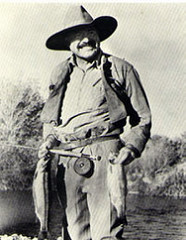
Hemingway Fishing

Ernest Hemingway working on his hook.

Analogies about writing, especially about how to write, abound. In my first writing book I beat them to death (because I love analogies), and have since been beaten senseless by some reviewers who don’t care (or know) that analogies are a proven and strategically effective way to teach.

So I was delighted to see Jim Bell’s analogy about playing basketball a couple of weeks ago (and another in the first paragraph yesterday), if nothing else than it allows me to point to him if someone reading TKZ isn’t appreciative of the analogy I am about to offer in today’s post.

Thanks, Jim, for opening that can of worms (itself an analogy, for the record).

All of the analogies I have employed – flying an airplane, playing golf, cooking, building a bridge, a few others – become a thematic chorus when considered en masse. The message is clear, and twofold: professionals can wing it and play loose with the core principles (just like when Michael Jordan shot and made a free throw in an NBA game… with his eyes closed), in a way that less experienced cannot and should not.

At the core of each of these avocations there are unimpeachable truths…

… essential physics that are not to be messed with. When a proven professional does so – and we all do it from time to time… because we can – even a little, they do so in context to an evolved storytelling sensibility and learning curve that a newbie does not yet possess.

In effect, they can do it with their eyes closed, in a way that would make the rest of us look silly.

You don’t tee off with a putter in the name of your art, you don’t under-cook the chicken in the name of table appeal, you don’t build a bridge on sand for obvious reasons, and so on.

The second thing is this: the same is true, every bit as true, for authors who are navigating, cooking up, teeing up, or building a novel. Mess with the core physics of the craft and your story will crash and burn. And when you are rejected, it will most likely be because of an ignorance (as in, to ignore) or a lack of regard (as in, to over-estimate your skills) of the core physics of storytelling.

And so we come to today’s analogy: fishing.

When I was a kid my father took me fishing several times each summer. He selected the tackle, baited the hook, threaded the line, made my casts and, when something nibbled, put his hands on mine as we played the line before setting the hook and reeling in. Then he gave me credit for landing “a big one.” The result was a few fabulous rainbow trout breakfasts and more than a few thrown-back bottom fish, not to mention some of my most precious childhood memories.

There came a point when I was a teenager too cool to fish with my father, so off I went with friends to fish on our own and talk about girls we could not catch from the bank of a river containing fish we could not catch. That period of my fishing life lasted about ten years, when that teen independence gave way to young adult cluelessness.

Over that decade, I caught exactly zero fish.  Not one.

Because I was imitating what I had seen my father do for me, and had been too proud or busy or stupid to learn those basics on my own. He smiled when he realized the life lesson to be learned from this failure, a lesson that took years to sink in for me.

I haven’t been fishing since, perhaps disqualifying me from using this analogy at all.

Except… it works.

I can’t help but think about how those fundamentals and processes of fishing are parallel in every way to the experience of learning how to write a novel. How the selection of the story, the way we set it up, the way we play the line and set the hook, are not only essential, but complex and nuanced, not remotely something that can be done without instruction or via imitation.

New writers must be excused from what they don’t yet know, because there is something noble about attempting to learn by doing. At least for a while. But when that takes place in a vacuum, without a parallel experience of learning and apprenticeship, the nobility of it fades away like a fish fleeing from a poorly tied fly.

Most writers come to the intention of writing a novel based upon their reading experience…

… usually joyous, but often riddled with a wildly uninformed belief that they can do what those authors they read can do, or worse, do anything they want – as a reader of novels. Some writers believe this is all you need, that writing is purely intuitive, a misperception reinforced because so many of the authors they’ve read made it look easy.

Logical and functional is not synonymous with easy. Just ask Michael Jordan as he lined up to shoot that free throw with his eyes shut.

Writing stories from this limited base of knowledge is no different that believing you can fly the plane after years of sitting in coach… that you can whip up a killer chicken piccata because you’ve been ordering it for years at the Cheesecake Factory (their best dish, by the way)… that you can hit a nine iron off the tee of a 205 yard par three because that’s what Tiger does… or that you can design and build a functional bridge because you’ve been driving across one for years on your way to work.

Or – I forgot perhaps my favorite analogy, so here goes: You believe that you can take out your own appendix because it took your doctor only fifteen minutes to get that job done. (I smiled when I just saw that Jim used nearly this exact analogy yesterday in the first paragraph of his terrific post; analogies are universal and eternal, and they often speak things more clearly than the direct route can achieve.)

My wife, who is an excellent cook, has for years been trying to nail a chicken piccata that holds a candle to the Cheesecake Factory’s (the recipe for which is not for public consumption), and she’s finally resigned to simply going there to enjoy this dish. Just like we can try to write like Stephen King, using his process (as described in his book, On Writing*), but until you know what he knows, that may not – probably won’t – serve you.

By implication, King is saying that all you need to do is just write. Imagine a surgeon being told, in her first year of med school, that all she needs to do is just cut.

Of course those are silly and obvious comparisons. 

And yet, so many writers attempt to write a novel from an equally consumer-focused and over-simplified learning curve (and dare I say, naive), and as a result they inevitably crash, burn, throw up and, like me, fail to catch a single fish for decades or more.

But that’s not you, you’re saying. You attend writing conferences and read all the writing books, maybe even mine and Jim Bell’s.

Which is great, keep going. But ask yourself this: are you truly and deeply internalizing the principles you read there, and are you practicing and applying them in a way that trumps the in-the-moment bliss of storytelling, which is what some writing gurus tell you is the only thing you need to pay attention to?

Do you know the difference between a concept and a premise?

Do you understand the nature of classic story structure, or even believe in it in the first place? Do you know the role of theme in a story? Do you understand what creates drama and suspense, and how to pace it over the arc of the narrative?

Do you believe you can simply make up the forms and standards and processes by which these things are made manifest in your story?

Professional writers know these things, and they just don’t do it any other way than the prescribed and proven way, no matter how they choose to describe their process.

Something to think about the next time it’s just you and a pole on a peaceful afternoon at the river, waiting for the next story to descend upon you from heaven.

*****

*In his book On Writing, King advises writers to take their initial story idea and just sit down and start writing from it, allowing an inner sense of story to help navigate the road leading to the best possible story. He omits, however, to add that this works for him, which by definition could mean that unless and until you know what he knows, the results you achieve may not compare to his, and thus, rendering this among the worst writing advice ever rendered… this being my opinion, of course. I’m no Stephen King, either, but at least I know what a writer must understand before that or any other method of writing a story will bear fruit, or not take you a decade to write, which is why I’m here.

*****

Larry’s new writing book, Story Fix: Transforming Your Novel from Broken to Brilliant” is available now in digital formats on Amazon.com and BN.com, and will be out in trade paperback within the next few weeks. Analogies kept to a minimum, he swears.  Visit Larry’s website at http://storyfix.com/.

Flickr photo from Don…The UpNorth Memories Guy… Harrison.

Little Writing Speed Bumps

traffic-sign-24338_1280There are two reasons to study the craft of fiction writing. The first is to learn tools and techniques that actually work, that have been tested over time. Some of these might be so valuable as to rise to the level of “rules.” A rule, of course, can be broken, but only if you have a very good reason to do so and know exactly what that reason is. Otherwise you’re flirting with danger, like a brain surgeon who decides on a whim to use a butter knife instead of a scalpel.

The other reason for study is to learn what doesn’t work, what trips up a story. You learn not to do certain things.

Some of these errors are relatively small. But commit too many of them and they will have a cumulative, and negative, effect on the reader. I call these errors “speed bumps.”

It’s like this. You’re enjoying a pleasant drive through a scenic part of the country. You’re relaxed, the vistas are inspiring. You forget for a moment that you’re driving and you just take pleasure in the sights.

Then you hit a speed bump. You come out of your reverie for just a moment. But if it’s the only bump you hit, you quickly get back into the nice-drive mode.

But what happens if you keep running over speed bumps? Pretty soon your nice drive is completely ruined and you vow you’ll never take this road again.

That’s the way it is with speed bumps in writing. Most readers don’t consciously analyze these. They don’t sit there and think, Wow, he should not have used an adverb there! But there is a little jolt inside that reader’s mind, back there in the subconscious zone. I contend that enough of these small bumps can ruin the reading pleasure of a book. In some cases it may mean the difference between a reader seeking out another of your titles, or deciding not to give you further consideration.

You don’t want that, do you? So un-bump your writing! That’s one sure way to elevate your craft.

I am now going to offer you an exhibit. This is from a well-regarded and bestselling writer, one whose books I have enjoyed in the past. I want you to read it over and see if you can spot the speed bump. The scene is a restaurant:

“So she didn’t talk specifically about her mother?”

“Just about the murder. The murder is very big in her life.”

The waitress brought us menus.

“My God,” he said. “Actual food.”

“No reduction of kiwi,” I said.

“No skate wings,” Paul said. “No pâté of Alsatian bluebird. No caramelized parsnip puree with fresh figs.”

The waitress took our order.

“Why do you suppose she didn’t want me to talk with her aunt?”

“Daryl’s hard to understand,” Paul said.

“She ever talk about her father?” I said.

“No. I always sort of assumed he was dead.”

“Siblings?” I said.

“She never mentioned any.”

“How long have you known her?”

“Two years,” Paul said. “We worked together in the first play I did in Chicago. When she’s up, she’s a hell of a lot of fun.”

The waitress brought smothered pork chops for Paul, spaghetti and meatballs for me.

“Why are you asking about her?”

“Because I don’t know about her.”

Paul was nodding as I spoke.

Ask yourself if there is any small thing in that scene that might cause a casual reader to feel a subconscious bump, and a more alert reader to actually stop and say, Hold on there a minute. Something’s not right!

Cue Jeopardy music:

Dum dada dum dada dum dum dah, dum dum dum dum DOT dee dada dada….

Time’s up!

Here’s my take: These two men are in a restaurant discussing a murder that took place years ago. The waitress appears and gives them menus…and then stands there while they joke around. In the real world, a waitress would leave the menus and give them time to read them. Or ask for a drink order. I waited tables, my friends!

But maybe we can let that one slide.

They continue their conversation. What they say to each other takes about 23 seconds. I timed it. And then the waitress returns with their full meals! There is no time lapse, either, because as soon as the plates are put down the conversation continues in exactly the same spot!

So either this waitress is the love child of Supergirl and The Flash, or reality has been blithely tossed out the window.

It’s a pet peeve of mine: restaurant scenes where the food timing is all off. I do see it often. In film it’s usually a bar scene where they order martinis and the bartender goes out of the scene for fifteen seconds, then comes back with two perfect martinis that could be neither shaken nor stirred. It always takes me out of the scene. And it’s so unnecessary.

Care enough about your readers to study the craft so you can root out speed bumps. Some will slip by. You just don’t want to fill the road with them. I’m here to help.

There. Off my chest. Now it’s your turn. What speed bumps to you notice in books? Pet peeves that take you out of the story? What do you have to watch for in your own writing?

READER FRIDAY: Tell Us About Your Writing Rituals

Flickr: IMG_4240.jpg By Sebastian Wallroth per Wikipedia

Flickr: IMG_4240.jpg By Sebastian Wallroth per Wikipedia

Hemingway wrote standing up. Capote called himself a “horizontal author” preferring his bed or couch to write. Victor Hugo (Les Miserables and The Hunchback of Notre Dame) wrote in the nude. He had servants hide his clothes to insure he wouldn’t leave his residence.

What about you? Do you have any MUST DO rituals when you start your writing day or when you start or end a book?

CAUTION: If you are a Victor Hugo admirer, DO NOT post photos.)

Want a book review? Try these tips

Jordan Dane
@JordanDane

The Oklahoman newspaper

The Oklahoman newspaper

It’s my pleasure to introduce someone I’ve known for a long time, an Okie friend. I first knew Ken Raymond of The Oklahoman newspaper as a crime beat and features reporter. He is a talented author as well. After he graced me with a glimpse of his work, I’ve been trying to coerce him to write a novel ever since and hope he does one day. Very talented guy. Now he’s the book review editor at the paper, a man of many hats. Please chat Ken up, TKZers.

P S – I will be traveling and in remote spots this week. I may not have access to the internet, but I will try to check in on post day.

Ken Raymond’s Post:

Last year I interviewed David Sedaris, the humorist renowned for essays such as “Santaland Diaries,” a hilarious chronicle of his days working as an elf at Macy’s one holiday season.

We didn’t have much in common, aside from our mutual appreciation of his work, but we both love books … and we share a similar problem.

Whenever Sedaris makes a public appearance, would-be authors thrust their manuscripts at him. He’s not sure why, but he thinks they hope he will read all the books, pass them on to his editors and launch the writers’ book careers.That never happens. Sometimes he says no to the manuscripts; other times he takes them out of a sense of politeness and civility.

Even if he wanted, he could never find time to read them all.

I’m not famous. I don’t make many public appearances, and when I do, they’re usually at writing conferences or classrooms. But I do get buried in books, most of them unsolicited. Dozens pile up outside my front door each week, and more still find their way to what used to be my office.

Who am I? I’m just the book editor for The Oklahoman newspaper in Oklahoma City. Book editor sounds important, but really I’m just one guy who reads and reviews books and tries to convince other people to do the same. My staff, such as it is, consists of volunteer newsroom staffers and a handful of stringers, whose only recompense is a byline and a free book. I interview authors, write about industry trends and work hard to deliver the best possible product, but I’m also a columnist and senior feature writer. There are only so many hours in the day.

Don’t get me wrong: I love my job. I’m among the fortunate few in this world who are paid to read books. The problem is that there are just so many of them, good and bad, in all genres and styles.

Given all that competition, how can you make your book stand out — to me and to the countless other reviewers out there?

There’s no guarantee of success, but these tips may help:

Be honest.

For some reason, no one wants to come across as a beginner in the writing business. I guess everyone assumes that if they’re not all polished and shiny, they won’t stand out.

Me, I’m sick of flashy. I get hundreds of emails a week from authors or publicists, and sometimes from authors pretending to be publicists. The messages are so flashy they look like old Geocities websites, with weasel words thrown in to make it seem as if the books they’re pitching are the biggest thing to hit literature since the Gutenberg Bible. Read them closely, though, and they’re largely unappealing campaigns of self-aggrandizement.

I prefer a simpler approach: the truth. Don’t try to impress me; your book should do that. Your emails should tell me who you are, what you’ve written and why you think it stands out. Talk to me like we’re eating lunch together, and I’ll listen.

I’ll also tell you what I tell everyone these days. I can never promise coverage, but I’ll give you the same chance at a review that every other author gets, including the famous ones. I’ll look at your book, and if it’s not for me, then I’ll offer it up to my review team. If anyone picks it and thinks it’s pretty good, I’ll run a review. If they don’t like it, I probably won’t run a review.

Follow up.

If you apply for a job, odds are you won’t sit by the phone for two weeks, hoping it’ll ring. Instead, you’ll follow up a few days after the interview, letting the company know you’re interested and making sure you’re remembered. You may follow up again a week later.

The same goes for book promotion. Often someone will pitch a book to me, and I’ll ask for a review copy. By the time the book arrives in the mail, I may not remember it at all; I’ve dealt with a bunch of other books in the interval.

A simple follow-up email reminds me that we communicated about the book. It tells me that I was interested enough to request it. It’ll make me take a closer look.

Don’t take it personally.

Nothing turns me against a book more than an argumentative author. Earlier this year, a guy blitzed me with phone calls and emails, demanding that I review his minor book about his favorite subject: himself.

Somehow he had browbeaten other news organizations into writing reviews, none of which were particularly flattering. When his berserk behavior persisted, I told him I wasn’t interested in interviewing him or reading his book. He promptly called my boss eight times in a two-hour period and drowned him in email.

He seemed shocked, absolutely shocked, that he couldn’t force his way into the paper.

I don’t want to be a puppet. Most people don’t seek out needless confrontation. If we all act professionally, we should get along fine, even if I can’t get to your book or publish a review. I bear you no ill will; without you, I couldn’t do my job.

Play the odds.

Major publishers release fewer books during the cold weather months. The spring, summer and fall are all pretty hectic, so those winter months are your best opportunity to contact me. You simply won’t have as much competition.

At the same time, I scramble for content around that time of year. I suspect others in my position do, too. I start pushing gift books on Black Friday and continue every week until Christmas. Even if your book came out much earlier in the year, I may use it in one of my gift guides. I generally offer a range of books in different genres.

But winter isn’t your only window. Whenever possible, people like me prefer to publish reviews proximate in time to book release dates. If I could, I would limit most of my reviews to books that are about to come out in a couple days.

In order for that to happen, I need your book about a month in advance. Some critics prefer digital copies; I like physical books, even if they’re uncorrected page proofs.

Because I am in Oklahoma, I take special interest in books with some sort of Oklahoma ties. If you live here, went to college here, set your book here, whatever, that’ll up your odds of getting reviewed. The same applies to other regional newspapers. If you’re in Alaska, pitch your book hard to Alaskan publications.

Set up book signings, too. You probably won’t get rich at a book signing, since stores take part of the haul, but I always mention local book signings in print. Many other papers do the same. It may not be as good as a full review, but at least it gets your name out there.

Best of luck, and please contact me about your upcoming books. The best way to reach me is via email at kraymond@oklahoman.com. Follow me on Twitter at @kosar1969.

Discussion: Any questions for a book review editor, TKZers? You ever wonder what a crime beat reporter sees on the job? Or maybe you want to know what was the strangest features article Ken ever wrote? Ask away!

Ken Raymond - Book Editor & writer for The Oklahoman newspaper

Ken Raymond – Book Editor & writer for The Oklahoman newspaper

Bio:
Ken Raymond is the book editor and a senior writer at The Oklahoman. He publishes a monthly column called “Purely Subjective.” A Fulbright scholar and Pennsylvania native, he covered crime for much of his career, bringing dramatic stories to life through literary nonfiction. He has won numerous national, regional and state awards. Three times he has been named Oklahoma’s best writer by the Society of Professional Journalists. He lives in Edmond with his wife, three Italian greyhounds and a Chihuahua.

Tips for Brewing Up
a Bracing Hot Manuscript

Picture2

By PJ Parrish

So here I am, sitting in my Starbuck’s auxiliary office, and suddenly I woke up and smelled the coffee.

I had this epiphany about writing. It is just like making coffee. Some folks have a natural ability to make great coffee. They can start with the cheapest Maxwell House in the supermarket, add tap water, and it comes out tasting like Starbuck’s Rwanda Blue Bourbon made in a Bunn Tiger XL Super-Automatic Espresso Machine. Others can’t boil water for a tea bag without scorching the pot.

I am in this latter category. I’ve tried every kind of bean and brewer but my coffee always comes out tasting like dishwasher residue run through yesterday’s old paper filter.
For the life of me, I don’t know where I go wrong.

Now, my sister? Her coffee is always great. Even though she has a Mr. Coffee she found at a garage sale, has Northern Michigan well water, and uses Folger’s Classic Roast. When she comes to stay with me, she uses MY coffee stuff, my filtered water, my grinder, my Braun brewer and my Fresh Market cranberry-chocolate whole beans, and it still comes out better than mine every time. If you are like me and find that your coffee is not turning out the way you want it, then maybe it is time to invest in a new coffee machine. That is what my sister did and the results are way better than before and better than mine. The best way for me to make up my mind about what coffee machine I wanted next was to look at reviews. This way how I managed to make a quick decision, otherwise I would have been there forever. If I wasn’t recommended to look into a company like Identifyr, I probably would still be drinking my poor coffee from my old machine. For anyone in this situation, I would recommend that you treat yourself to a new coffee machine, to finally get the perfect cup of coffee and guess what goes fantastically well with new coffee machines? Some high-quality coffee. I hear that Iron and Fire have some of the best coffee going. Now that I have a new coffee machine, I actually think that having other pieces of equipment like a milk frother just makes it look like you know what you’re doing, even if you don’t. With this being said, when you start learning how to make that perfect cup of coffee, it might make all the difference when it comes to the tools you use. After doing my research and coming across sites like neptune coffee, I’m considering getting one of these. Considering I am trying to improve my coffee making skills, maybe this could be the solution to create the best coffee ever. I won’t know if I don’t try! She’s gotten even better at coffee making since she went to work at Horizon Books because she sometimes has to man the espresso machine. She can even make latte art – you know, panda faces in the foam kind of thing. She’s tried to teach me to make coffee and I’m getting better. Which gives me hope. Which also might give you hope.
Because making coffee is a lot like writing. If you study the craft of successful coffee-makers, if you work at the formula and fine-tune your machinery, you can produce something others will find worth consuming.

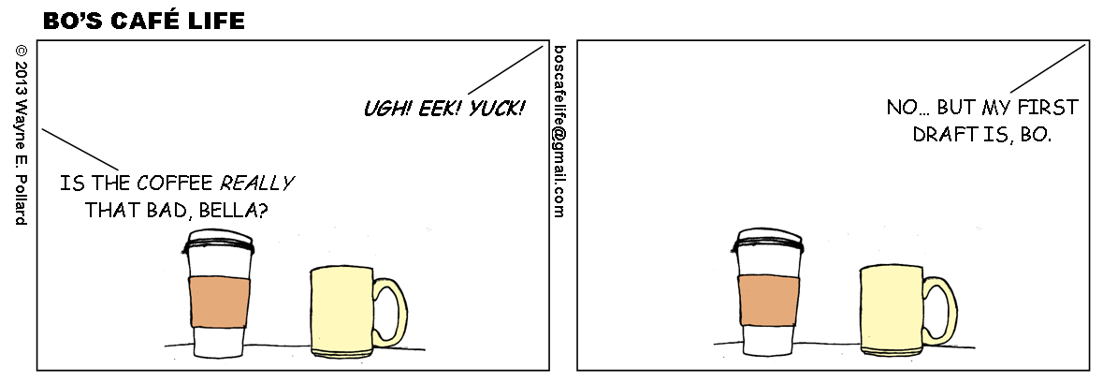
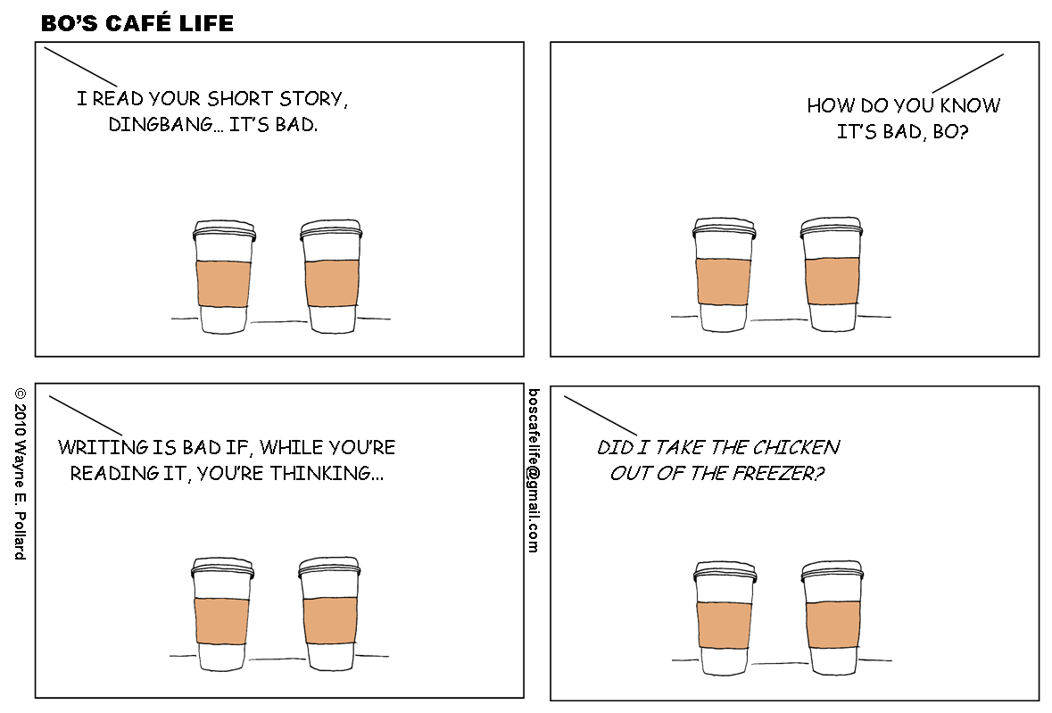
So, in an effort to help you brew a better manuscript, I am going to offer some silly but effective coffee metaphors. And thanks to Bo’s Cafe Life, one of my fave blogs about the writing life as seen through the eyes — and ink pen — of talented cartoonist Wayne Pollard. CLICK HERE to see more of Wayne’s work. His blog is worth a regular visit!

Picture10

Muddy Coffee
A common problem in manuscripts is lack of simple clarity in the writing. Who is doing what where? Have you clouded your action with too many side trips into description or backstory? Have you told the reader where the hero is in time and geography? Can we understand what he/she is doing? Do we know who is talking? (ie, is your dialogue attribution signage clear?) Can we “see” the action?

“I have trouble writing if I can’t picture how things are going to look. –Robert Kirkman

Picture8

Robust Coffee
Pay attention to your mood, imagery, description. You can put your cup of coffee in front of someone but if they can’t taste it, smell it or feel its warmth, they will pour it down the drain. One problem we often see in manuscripts is anemic or even non-existent description. No, you don’t want to lard up your beginning pages with TOO much of this. But some well-honed description can go a long way to seducing a reader into your story.

Picture3

Deep Dark Coffee
This is what we call “internal dialogue.” This is a narrative device whereby you let the reader into your characters thoughts, memories and feelings. Internal monologue can and should happen anywhere but it should complement whatever is happening in action.
In high action: Use shorter, faster, high impact words. You are inside the POV character’s brain. The words you choose to describe what he/she is feeling should amplify the mood of the scene. In slower scenes: You can use longer sentences, more thoughtful, calmer tone, softer words and a slow pace. Using a slower style in an action scene will end up giving you something like this:

He stood over the man, knife in hand. He wondered now if he could actually stab him, if he had the guts to thrust the blade into flesh. He remembered that hot day in July twenty-three ago, sitting at his mother’s knee, looking up to her with the kind of hope only a young boy could hold. Will Daddy be home soon, mama? His father had taught him…

The above cup of coffee should be tossed down the sink.

Distinctive Coffee

Dialogue is the lifeblood of your fictional brew. Keep it clean, effective and do not waste your precious beans on over brewing it or making more than your reader can drink.

Burnt Coffee
Did you “phone in” the last few chapters because you were just sick and tired of your own story or your own characters? Did you lose control of your pacing somewhere earlier in the story and as you raced toward the end and now you have too many loose ends to tie up? The ending of a book is almost as important as the opening. We talk here often about how crucial it is to concoct a grabber first couple pages. But a finely crafted, well-planned slam bang ending is also important. You have to leave the reader with a feeling of satisfaction (which isn’t the same as a “happy” ending) and a feeling that the ending has been well-earned.

kris6

Stale Coffee
Maintaining suspense is critical to crime fiction. But even if you write kid lit or historical romances, you still need to keep the reader guessing. Does what you brew taste stale? Does it make you hunger for more? Does it go cold too quickly? And pay hard attention to the “second act” of your story, what we call the “muddy middle.” This is where most stories go off the rails. Suspense does not have to a stalker lurking in the shadows. It can be as subtle as a long awaited kiss or as dramatic as a killer jumping out of the bushes. This is probably the hardest task for writers – keeping the coffee at just the right temperature and rich taste for the duration of the pot.

Picture9

Keeping Your Coffee Great For 400 Pages
• Stay focused
• Occasionally re-read your how-to books to help recognize where you’ve backslid. (Sample your own coffee every once and while)
• Read good writers to break through writer’s block and ignite your creativity. (Try other people’s coffee.)
• Read bad writers to jump-start confidence and rev up determination. (Pick up a cheap cup of coffee occasionally and force it down.)
• Continue to seek out and accept feedback as a professional.
• Know when a scene or the book is FINISHED. There’s only so much sugar, cream of cinnamon you add to a cup of coffee.

Cutting Your Chances of Your Coffee Being Rejected

Before she went into retirement, super-agent Miss Snark blogged often about what she looked for in manuscripts that crossed her desk. She said it always boiled down to three simple questions she asked of every submission she read:

  • Do you write well? (Is your coffee hot and finely brewed?)
  • Is your book premise fresh and interesting? (Have you cultivated a new bean?)
  • Is your voice compelling? (Do you have a fresh way to serve your coffee, or have you added a unique flavor?)

FINAL COVER

I hope you’ll allow me a moment of blatant self promotion. Our new book SHE’S NOT THERE is finally out! The South Florida Sun-Sentinel critic Oline Cogdill calls it “captivating.” Author Hank Phillippi Ryan, calls it “Taut, tense, and twisty—this turn-the-pages-as-fast-as-you-can thriller is relentlessly suspenseful.” Here’s the LINK.

Postscript: I am on vacation in France’s Loire Valley this month and I have wifi at my little cottage. But given the proximity of wineries, patisseries, and good books waiting to be read, I might not be here to comment. I promise to try to check in! But in the meantime, go get that second cup of joe (or a glass of Sancerre? Hey, it’s apero hour somewhere!) and watch this little video Kelly made on how to become an overnight success in this writing biz. Watch for your cameo, Nancy Cohen!