Tips for Distant Settings Redux

Tips for Distant Settings Redux
Terry Odell

Map showing a Norway Cruise RouteIf all goes as planned this time, when you’re reading this, I should be somewhere in the skies between Frankfurt and Oslo. Or Bergen, where our cruise begins. Therefore, I won’t be able to respond to comments, but I trust you’ll play nice and keep things going.

One of my retirement goals is to travel, and even though Antarctica didn’t (and probably never will) happen, I’ve been fortunate enough to see parts of the world I’d never thought I’d be visiting. A lot of this is because our son is a photographer and his “specialty” is leading photo safaris all over the world. This current trip is to Norway and beyond. I’m revisiting a post I did some time ago, with my tips for writing about distant settings, based on a trip to the British Isles.

When the Hubster and I decided to celebrate our 50th anniversary with a trip to the British Isles, of course I had “book” in the back of my mind. However, an international setting wouldn’t have worked with any of my existing series, and since I never plot in advance, I decided to enjoy our tour, taking pictures and notes of what we were seeing and doing and just wait and see what might bubble to the surface.

When we got home, I decided I’d write a short and sweet romance. Write it quickly, understanding that it’s not my true “brand” but that I had to publish something to justify writing off at least part of the trip.

Well, I soon discovered I’m not a short and sweet romance author, and mystery elements insisted on working their way into the story. What I ended up with is Heather’s Chase: an International Mystery Romance which is closer to my brand, although it’s a stand alone and still a bit of a one off. Nevertheless, it was an educational experience. Since then, I had another major trip, this one to Croatia, which led to the book Cruising Undercover.

Things I’ve learned about setting a book in real places, especially distant ones.

Less is more. My first drafts went into phenomenal detail about absolutely everything. Airports. Train stations. Hotels. Food. All the places we stopped, what we saw on the drives. Given we were traveling for well over two weeks, that would have been a LONG book. A sense of place is good. Overwhelming readers is not. I had to keep reminding myself to make sure everything related to the plot and characters. I wasn’t writing a travelogue.

Stay true to time. Readers familiar with the area will know that you can’t get from A to B in two hours, or that when you’ve had your characters on their bus for five hours, it’s really a twenty-minute drive.

You’ll always miss something. Unless you’ve got your plot mapped out before your trip, once  you start writing, you’ll have a scene to write and—lo and behold—you missed taking a picture, or didn’t take the right notes. I spent a LOT of time on the internet rechecking facts, looking at maps, and refamiliarizing myself with some of the attractions we visited. If I couldn’t find exactly what I needed, I reminded myself I was writing fiction—another reason not to name real places. On the occasions where my characters were eating in real, named places, I made sure I had pictures and menus. Same for attractions.

Don’t make up real stuff. One of the reasons I made this book a stand alone was because our trip didn’t include visits to police departments (although I snapped a picture of a vehicle in Ireland, “just in case”). Also, it would be unrealistic for my American characters to have any access to law enforcement in several different countries.

Be nice. I also opted not to name the specific hotels or restaurants (mostly). For one thing, it gave me the freedom to change the décor, layout, amenities, or the restaurant menus. And, if something “bad” happened, I wasn’t going to incur the wrath of those establishments.

It’s about flavor. Although my characters didn’t visit Northern Ireland, I did include a character from the same town we’d visited when we stayed with my daughter. I made sure she vetted all his dialogue. For example, people in Northern Ireland use the word “wee” as a meaningless adjective. I was asked for my wee credit card, given a wee receipt, offered a wee bag for my purchases. My British critique partner was very helpful with vocabulary as well.

All in all, I had a great time ‘revisiting’ my trip to the British Isles while I was writing the book, and being able to incorporate my experiences into Heather’s Chase. I did a little better with the Croatia trip, although there were lapses in my note-taking. At least, since it was a photography trip, I had plenty of pictures to nudge my memories.

Any tips to share, TKZers?


And a little BSP. I’m going to be teaching some writing craft classes via Zoom, hosted by my editor.
12 Steps to Intimacy on June 17th

Creating Armchair Adventures on July 15th

Into the Heads of Your Characters, on July 29th.

The links will provide more details.

Please spread the word. Friends, writing groups, libraries … wherever you think there might be people interested in learning more about the craft.


Cover image of Deadly Relations by Terry OdellAvailable Now
Deadly Relations.
Nothing Ever Happens in Mapleton … Until it Does
Gordon Hepler, Mapleton, Colorado’s Police Chief, is called away from a quiet Sunday with his wife to an emergency situation at the home he’s planning to sell. A man has chained himself to the front porch, threatening to set off an explosive.


Terry Odell is an award-winning author of Mystery and Romantic Suspense, although she prefers to think of them all as “Mysteries with Relationships.”

What’s The Big Deal About Was?

What’s The Big Deal About Was?
Terry Odell

When I finished my first novel, the only paths to publication were vanity presses and agents. When I found my first, last, and only agent, she returned my first chapters with every use of the word was circled in red. Everyone said “Was is passive writing. Don’t use it.” I might not have been an English major, but I knew enough to know that “was” is the past tense of “is” and there’s nothing wrong with writing in the past tense. Now, it might not be the strongest of words, and when paired with an “ing” verb, might not be the most exciting way to express something, but it’s not passive. (I wrote about the dangers of using ‘ing’ construction in another post.)

Passive voice is something else again. Consider The dog bit the boy versus the boy was bitten by the dog. The former is active voice, the latter is passive voice. (I know someone out there is saying, “But what about The dog was bitten by the boy? That’s passive voice, but unexpected, and therefore more interesting.)

The following are passages from books written by best-selling authors. I wonder if their editors circled all their “was” usages in red—and “were” as well. Yes, there are  a couple of passive voice sentences in there. Their editors didn’t cut them, either.

The body was crumpled beside a Dumpster midway down the alley, but my view was blocked by a woman in a T-shirt and shorts, and two men in dark sport coats. The woman’s T-shirt was fresh and white and made her stand out in the dingy alley as if she were on fire. The older suit was a thick man with shabby hair, and the younger detective was a tall, spike-straight guy with a pinched face.  The Forgotten Man, Robert Crais


The shooter was trained, the shooter was a killing machine, but he was still human. Now, breathing hard, he tasted blood in his mouth like you might after a tough run; and all the time, he was looking for lights, he was looking for an alarm, a cry in the dark.  Heat Lightning, John Sandford.


Sheriff Goodman was into his thirtieth hour without sleep. He was dazed and groggy and barely upright. But he kept on going. No reason to believe the abductors had stayed in the vicinity, but he had his guys out checking any and all vacant buildings, barns, huts, shelters, and empty houses. He himself was supplementing their efforts by covering the places they weren’t getting to. He had found nothing. They had found nothing. Radio traffic was full of tired and resigned negativity.  A Wanted Man, Lee Child


The general public was for the most part under the impression that the gang wars that gripped most of South L.A. and claimed victims every night of the week came down to a  Bloods versus Crips battle for supremacy and control of the streets. But the reality was that the rivalries between subsets of the same gang were some of the most violent in the city and largely responsible for the weekly body counts. The Rolling 60s and 7-Treys were at the top of that list. Both Crips sets operated under kill-on-sight protocols and the score was routinely noted in the neighborhood graffiti. A RIP list was used to memorialize homies lost in the endless battle, while a lineup of names under a 187 heading was a hit list, a record of kills. The Black Box, Michael Connelly.


Now, if you want to know a usage that bugs me, it’s using “start” where it’s not really needed. “The phone started to ring in Bob’s pocket.” What’s wrong with “The phone rang in Bob’s pocket?”

Or, “He started to walk away.” Unless he turns around and comes back, why not “He walked away.”?

What about you TKZers? Any “rules” you disagree with? Words or usages that bug you?


Cover image of Deadly Relations by Terry OdellAvailable Now in Digital, Paperback, and Audio
Deadly Relations.
Nothing Ever Happens in Mapleton … Until it Does
Gordon Hepler, Mapleton, Colorado’s Police Chief, is called away from a quiet Sunday with his wife to an emergency situation at the home he’s planning to sell. A man has chained himself to the front porch, threatening to set off an explosive.


Terry Odell is an award-winning author of Mystery and Romantic Suspense, although she prefers to think of them all as “Mysteries with Relationships.”


Tell Don’t Show

Tell Don’t Show
Terry Odell

Something we’ve all heard since we took writing seriously was “Show, Don’t Tell.” It’s been called the “Golden Rule” of writing. Showing gets readers involved with the characters. Showing connects readers to the characters. Readers will experience things along with the characters instead of just watching. All that is true enough, but as with any rule, there are exceptions.

Showing everything can be exhausting for the reader.

I was reading Michael Connelly’s Desert Star. I think the man’s earned enough kudos over the years to be considered someone we can learn from. Although I prefer reading a deeper point of view, Connelly’s an exceptional storyteller, and I don’t mind stepping back. He still draws me into the story. And you know what? He’s not afraid to TELL his readers stuff.

Michael Connelly

Image from Wikimedia Commons, by Mark Coggins

While showing might create a connection, there are times when you don’t need to show things. Times when your shouldn’t show things. As Lee Child (and probably others) said, “Write the slow parts fast and the fast parts slow.” Telling is a way to get through the slow parts. The parts where there are things the reader ought to know, but not in the same way as the action parts of the story.

Example:

Harry Bosch is looking at a cold case file. This is how Connelly writes it:

The crime scene photographer had been thorough and had taken dozens of “environmental” shots depicting the victim’s entire home—inside and out—at the time of the murder. These included shots of the contents of closets and cabinets and drawers and of photos framed and hung on the walls. All of this allowed the case investigators ready access to the entire environment of the killing location. It also allowed them to better understand the victim by seeing how she had set up her home. It gave them an idea of the things that were important to her in life.

Did we need to see every picture? See Bosch’s visceral reaction to each of them? Experience what it feels like to turn pages in a binder? How much would it add to the story? Probably very little. But now, when we see the term environmental shots later in the book, we’ll know exactly what the term means.

It’s tough to “tell” well in a close POV, because you’re deep in the head of the character, experiencing everything as though there’s a movie camera embedded in his brain. Getting information across to readers when you’ve got characters on the page who already know the terminology, or how something works, ends up being “As You Know, Bob” speech. I’ve worked my way around it by bringing in a naïve character if possible, so she can ask questions and my in-the-know characters can answer them. There’s also no rule that you can’t step back from deep POV a little when it’s necessary for pacing.

Here’s a way Connelly dealt with the issue. Ballard is bringing Bosch up to speed.

“… Back then, the ODs were leaning on the theater director, a guy named Harmon Harris, because they heard he and Wilson had an affair a year before her death. They thought maybe there was bad blood between them. Harris denied the affair and they dropped it when he offered up Beecher as an alibi.”

She knew that Bosch would know that OD was cold case lingo for original detective.

OK, so we get a quick peek into her thoughts, and we readers now know what OD means and Connelly can use the term whenever he needs to.

And another, this from Echo Park:

“I have no idea, Olivas. What?”

“Your fifty-ones from Gesto.”

He was referring to the Investigative Chronology, a master listing kept by date and time of all aspects of a case, ranging from an accounting of detectives’ time and movement to notations on routine phone calls and messages to media inquiries and tips from citizens. Usually, these were handwritten with all manner of shorthand and abbreviations employed as they were updated each day, sometimes hourly. Then, when a page became full, it was typed up on a form called a 52, which would be complete and legible when and if the case ever moved into the courts, and lawyers, judges and juries needed to review the investigative files. The original handwritten pages were then discarded.

Harry would think of this in far less time than it took me to type it, but readers can accept that the simple reference to the “fifty-ones” would send his mind to what they were. Readers have the information, and it’s presented a lot more efficiently than using “show.”

Throughout his books, Connelly gives readers a lot of information about how the police department works, and he manages to keep readers—at least this reader—willing to accept that Harry Bosch is thinking these things, be it the history of the Parker Center in LA, where the chief’s office is, or how the desks are arranged in the homicide department. And that, to me, is the skill. Get the exposition in there without the reader feeling like you’re stopping the story to tell.

What about you, TKZers? Showing? Telling? How do you balance them? Do you even notice, or can you keep things seamless?

Any authors who do telling well?


Cover image of Deadly Relations by Terry OdellAvailable Now in digital, paperback, and audio
Deadly Relations.
Nothing Ever Happens in Mapleton … Until it Does
Gordon Hepler, Mapleton, Colorado’s Police Chief, is called away from a quiet Sunday with his wife to an emergency situation at the home he’s planning to sell. A man has chained himself to the front porch, threatening to set off an explosive.


Terry Odell is an award-winning author of Mystery and Romantic Suspense, although she prefers to think of them all as “Mysteries with Relationships.”

How Critical Distance Improves Writing

The conversation about critical distance doesn’t come up often in writing circles. If someone does raise the point, critical distance is usually mentioned in passing as though other writers should inherently know what it is and why it’s important. Let’s change that today.

What is Critical Distance?

The phrase stems from researchers who lost all subjectivity in their analysis. To regain clarity (critical thinking), they had to step away from the project for a while.

Practitioner researchers have often been criticised for a lack of critical distance from their work often leading to conclusions which can be, in the field of objective research, critiqued for a lack of creditability and validity (Saunders, 2007). Also inherent in this type of research is the fact that the types of practitioners who come to this kind of research often have been thinking about the research topic for several years bringing with them a host of assumptions and ideas of what they want to find out and usually already having a theoretical stance for the project (Drake and Heath, 2011; Wellington and Sikes, 2006).

Michelle M. Appleby, University of Derby


  • Surgeons aren’t allowed to operate on family members.
  • Cops aren’t allowed to investigate a family member’s murder.
  • Judges aren’t allowed to preside over a loved one’s case.

These rules are in place because the surgeon, cop, and judge cannot be objective if a personal connection exists.

What’s more personal than writing?

While drafting, we wear love goggles. We’re so wrapped up in our characters, we lose all objectivity. It’s only after we’ve gained distance that we can view the story through the proper lens. Also, we may miss plot holes or leave threads dangling while drafting.

I’ll give you an example…

When I wrote the first draft of Restless Mayhem, one of my anti-heroes mentioned two characters from a previous book. I’d originally planned to have these two characters play a critical role in the story, but then the plot twisted and turned and my original plan changed. Well, I forgot to change the conversation at the beginning of the book. Even though I read the manuscript a few times, I still missed it. After I set it aside for a month, those two names popped right out. And I thought, gee, why are they there?

At that point, I couldn’t recall what my characters did with that information, so I left myself a note and continued on. Guess what? No one ever mentioned those two names again. Never. Whoops! I ended up changing the names to two characters who did play a vital role in the plot. But what if I hadn’t set the manuscript aside? I’d have a lot of confused readers.

Does your character have an accent in chapter two that disappears in chapter twenty?

Does someone have green eyes that turn brown by the end of the book?

Did you name the cat Henry and then change it to Harry?

Did your character have a left arm injury that moved to the right?

Even though most of the above you’ll include in your story bible—you made one, right?—we can still miss seemingly insignificant details if we forego the critical distance stage. I know you’re excited to release your new book baby, but that puppy will shine even more if you allow it to sit a while. I’m amazed by what I find once I return to the manuscript.

How can we view our creations through an objective lens?

After you’ve written the first draft, set it aside for x-amount of weeks. The length of a break varies between writers. For some, two or three weeks may be enough. Others may need a month or more. There’s no right or wrong answer here. Whenever you’ve gained enough distance that you don’t recall every scene. The best way to do that is by working on a different project while the draft cools.

Benefits of critical distance…

  • Easily fix writing tics.
  • Catch typos and grammatical errors.
  • Seal plot holes.
  • Tie-up dangling threads.
  • Swap weak verbs for strong ones.
  • Correct passive voice.
  • Fix clunky words, awkward sentences, and/or phrases.
  • Deepen characterization.
  • Better ground the reader in the setting.
  • Strengthen your theme.
  • Make your writing more expressive.
  • Paint a more vivid mental picture.
  • Infuse more emotion.
  • Change body cues (1st drafts often include obvious or less-than ideal body movements).
  • Convey emotion better.
  • Rewrite to remove some dialogue tags.

Do you let the manuscript rest once you complete the first draft? How long do you let it sit?

Amidst a rising tide of poachers, three unlikely eco-warriors take a stand to save endangered Eastern Gray Wolves—even if it means the slow slaughter of their captors.

Preorder for 99c!

*Please note: 99c sale is only available on Amazon.

Restless Mayhem releases in ebook and paperback on April 26, 2023. Can’t wait!


Becoming a Writer by Mistake, or How I Traded Needlepoint for Writing

Becoming a Writer by Mistake, or How I Traded Needlepoint for Writing.
Terry Odell

**Note: We’re having new windows installed and they’ll be doing my office today, which means moving my desk and disconnecting electronics, and I’m not sure when I’ll have connectivity to respond to comments.

At reader-focused conferences, such as Left Coast Crime, most panelists are asked the question, “How/When did you start writing?” regardless of the panel topic. Readers are interested in learning more about the person behind the book. I listen as everyone else spouts off their histories of wanting to write since before they could talk, or how they wrote their first manuscript in crayon. Then my turn rolls around, and here’s my answer.

I was a card-carrying AARP member before I considered writing anything. How did I get started? The short answer: I ran out of room on my walls for needlepoint and had to find another creative outlet. But the real answer is, “By mistake.”

I never had any dreams of being a writer. Creative writing classes weren’t my forte. I knew all the rules of grammar, got A’s in English, but I was a reader. I devoured books. I read anything, from comic books to cereal boxes. My parents tell everyone that we moved when I was 12 because I finished the library. I made up stories, but they were in my head. I never thought about writing one down. They were usually daydreams, or continuations of books I’d read, or stories about characters on television. The closest I came to writing was two pages of a story I’d had running around in my head—something featuring MacGyver. But the actual typing was a total drag. Punctuation mattered. You had to start sentences with capital letters. There were quotation marks to deal with. All that use of the ‘shift’ key was a total drag.

Years later, my son was visiting. He, as all men are wont to do, was “watching” television by flipping the remote. He stopped on a show. “This one’s cool,” he said. “It’s all about these guys who can’t die unless you cut off their heads.”

My son went back home. Being a good mother, I decided to watch the show so we’d have something “cool” to talk about. I found “Highlander” in the listings, set the recorder, and watched an episode. Okay, I’m not proud. Watching Adrian Paul was no hardship. But the show also raised questions about what these Immortals could and couldn’t do, and I got curious. There were no Yahoo groups then, or even Google (I think, anyway). There were CompuServe forums. I found one about Highlander and discovered the world of fan fiction. It seemed right up my alley. I discovered one author whose voice resonated with me. (Of course, back then I had no clue it was her “voice.”)

We hooked up via email, she connected me with some of her friends, and I did some beta reading for them. Just because I wasn’t a writer didn’t mean I wasn’t a good reader, and I definitely used all my English skills to hone their stories.

Then, one day, hubby was out of town, and I decided to see what would happen if I tried to write a story. The beauty of fan fiction is that your world and your characters are all there. You can work on the skills of the craft in small increments. I cranked out my little story—actually, sweated it out, because it still didn’t come easy, what with getting all those quotation marks in the right place—and bravely sent it to the writer I’d befriended.

I’m sure she got a good laugh, but she came back with advice and comments. What the heck was POV?

I accepted the challenge. After all, I did get all those A’s in English, and surely I could learn how to put a story on paper instead of sucking up what others wrote. She had immeasurable patience, and when I finally had her approval that it was done, she insisted I post it to one of the Highland fan fiction forums. I got positive feedback, and like any good puppy, kept trying to please. (Had I known then how low the bar was for positive feedback, I might not have kept going, but since I didn’t, I did.)

Eventually, I found another writing group at a site called iVillage, and thought I’d try writing some original fiction, just to see if I could. I recall an exercise, where we were supposed to write a “hook” in under 200 words. I sent mine in, and got lots of “Wow, what happens next?” comments. How did I know? So, I kept writing. 143,000 words later, the first draft of Finding Sarah was finished, and I’d hooked up with a local, in person, critique group who drove me to consider the “get it published” side of the writing craft. And one of my Highlander fan fiction short stories eventually provided a starting point for the next book I wrote, What’s in a Name? There’s a lot of Duncan MacLeod in Blake Windsor.

And somewhere along the line, I was talking with my son. I asked him what he thought of the writers killing off Tessa. He said, “What?” I said, “You know. Highlander. Tessa. Duncan’s girlfriend. They killed her character.”

His reply. “Oh, I never actually watched the show. I just thought it was a cool concept.”

And that’s how I became a writer by mistake. I don’t think I’ll go back to needlepoint.


Cover image of Deadly Relations by Terry OdellAvailable Now
Deadly Relations.
Nothing Ever Happens in Mapleton … Until it Does
Gordon Hepler, Mapleton, Colorado’s Police Chief, is called away from a quiet Sunday with his wife to an emergency situation at the home he’s planning to sell. A man has chained himself to the front porch, threatening to set off an explosive.


Terry Odell is an award-winning author of Mystery and Romantic Suspense, although she prefers to think of them all as “Mysteries with Relationships.”

Are you Lying or Laying Around

Are you Lying or Laying Around
Terry Odell

lie or layAnalytics from my own website/blog shows that consistently, one of the top three search terms (after my name) ended up on a basic grammar post I did a number of years ago. If that many people were searching, I thought some of our TKZ readers might find it useful. If you’ve already got a handle on the usage, enjoy the picture of the cat.

Years ago, when I was tutoring for the Adult Literacy League in Orlando, one of my students was a native Korean speaker. She’d been in the US for almost two decades, but she needed a lot of help with grammar. I relied on a book my kids had used in elementary school, Scholastic’s A+ Guide to Grammar by Vicki Tyler. I don’t think you can find it anymore, and I’m glad I kept the book. The pages are yellowing, but it’s a great quick reference, explained in easy to understand terms.

One problem my student had, and one that I still see when evaluating manuscripts, is the “Lie vs Lay” usage. So, here’s your grammar tip for today:

LIE (Not the fib-telling usage)
Means to rest or recline, and also to remain or be situated.
NEVER takes a direct object.

LAY
Means to put or place something.
Usually takes a direct object that tells what was placed

Confusion arises when you change tenses.

LIE is present tense. Past is LAY

LAY is present tense. Past is LAID.

Here are some examples in a variety of tenses which might clarify things. Or give you something to refer to.

LIE

  • If you’re tired, lie down and take a nap
  • I wonder what lies beneath the pile of clothes in my closet.
  • Your sweater is lying on the couch
  • Last summer, we lay by the pool every day after lunch
  • The envelope from my sister lay unopened for a week
  • I have lain in bed all morning

LAY

  • Lay the grocery bag on the table
  • I was laying the new hardwood floor in the dining room.
  • I laid the grocery bags on the table before I answered the phone.
  • I have laid my cards on the table.

So, in answer to the question posed in the title of this post — you’re lying around.

I don’t know if this helps. I tend to rely on the “takes an object” rule if I’m not sure. Of course, there’s always the write-around option. Use a different word!

What about you? Any grammar issues you have to stop and think about? Any you’ve noticed while reading?

Image by Mabel Amber from Pixabay


Available for Pre-Order
Paperback format available now.

Deadly Relations.
Nothing Ever Happens in Mapleton … Until it Does
Gordon Hepler, Mapleton, Colorado’s Police Chief, is called away from a quiet Sunday with his wife to an emergency situation at the home he’s planning to sell. A man has chained himself to the front porch, threatening to set off an explosive.


Terry Odell is an award-winning author of Mystery and Romantic Suspense, although she prefers to think of them all as “Mysteries with Relationships.”


Not Even More Rules

Not Even More Rules
Terry Odell

Photo from Wikimedia Commons

If there’s one “rule” of writing, especially in these days of indie publishing, it’s that there are no rules. Want to leave out quotation marks? Go for it. Want to replace them with dashes? Why not? Want to publish without any eyes but your own on the prose? Do your thing.

And, in these days of indie publishing, we can split these ‘rules’ into two basic categories. Rules of writing, which lean toward grammar conventions, and rules of publishing, which relate to what happens once the book is set loose into the world of readers.

Since there was a recent post about Heinlein’s rules, I’m following up with these from Kurt Vonnegut, which, as did Heinlein’s, relate more to the publishing side of things.

8 Rules for Writing

  1. Use the time of a total stranger in such a way that he or she will not feel the time was wasted.
  2. Give the reader at least one character he or she can root for.
  3. Every character should want something, even if it is only a glass of water.
  4. Every sentence must do one of two things—reveal character or advance the action.
  5. Start as close to the end as possible.
  6. Be a sadist. No matter how sweet and innocent your leading characters, make awful things happen to them-in order that the reader may see what they are made of.
  7. Write to please just one person. If you open a window and make love to the world, so to speak, your story will get pneumonia.
  8. Give your readers as much information as possible as soon as possible. To hell with suspense. Readers should have such complete understanding of what is going on, where and why, that they could finish the story themselves, should cockroaches eat the last few pages.

— Kurt Vonnegut: Bagombo Snuff Box: Uncollected Short Fiction (New York: G.P. Putnam’s Sons 1999), 9-10.

My personal thoughts and interpretations:

  1. The last thing I want is to hear someone saying, “well, there are XX hours I’ll never get back” after reading one of my books.
  2. Totally agree. It’s all about the characters for me, and I give readers more than one.
  3. We’ve heard this one a lot, both here at TKZ and at a myriad of other writing sites. Enough said.
  4. Need to remember this one. Wandering down Happy Lane in Happy Town doesn’t do much for book pacing.
  5. Yep, we’ve heard this one a lot, too. My self-measured progress as a writer was how much less I had to cut from the beginnings of my books.
  6. Another familiar one. Put your character up a tree and throw rocks at them. Or shoot at them.
  7. This one sits at the top of my list when I hit the editing phase. Don’t second guess yourself. Some readers will have issues with something in your book, be it a character who reminds them of their ex, or setting, or POV, or tense, or anything else. Let it go. Write your
  8. Not sure how to interpret this one. As writers focused on mysteries and suspense, we want that twist, that surprise.

Seems to me, we each make up our own rules, be it on the production side or the story side. We do what works for us, writing the best story we can by our personal standards.

Any of Vonnegut’s rules resonate with you? In either direction?

**Anyone going to Left Coast Crime in Tucson? Would love to meet!


Available for Pre-Order

Deadly Relations.
Nothing Ever Happens in Mapleton … Until it Does
Gordon Hepler, Mapleton, Colorado’s Police Chief, is called away from a quiet Sunday with his wife to an emergency situation at the home he’s planning to sell. A man has chained himself to the front porch, threatening to set off an explosive.


Terry Odell is an award-winning author of Mystery and Romantic Suspense, although she prefers to think of them all as “Mysteries with Relationships.”

What Do Ringtones Say About Your Characters?

One of my favorite ways to play with characterization is to assign my main character a ringtone.

In my Mayhem Series, Shawnee Daniels started with “You Oughta Know” by Alanis Morissette. Two books later, she switched to ZZ Ward’s “Put the Gun Down.” And now, she has “Ironic” also by Alanis.

Even without any other information, I bet you’ve already formed a visual of who she is, based on her ringtones.

If you guessed snarky and badass, you’re right. 😉

In my Grafton County Series, I used ringtones to show my main character’s emotional wellbeing. Sage Quintano has no designated ringtone for herself, but she constantly changes her Sheriff husband’s ringtone as a form of silent communication. She’s done it so many times, I doubt I could list them all, but let’s go through a few to show what she’s saying to her husband.

  • “Here Comes Goodbye” by Rascal Flatts

Considering this is a psychological thriller series, not romance, Sage used this ringtone to indicate fear.

  • “How Am I Supposed to Live Without You” by Michael Bolton

This ringtone showed Sage’s gut-wrenching devastation when their child was abducted.

  • “Just Once” by James Ingram

This ringtone showed Sage’s sadness about a rough patch in their marriage.

  • “Tonight I Wanna Cry” by Keith Urban

This ringtone indicates Sage’s sadness, too.

  • “Live Like You Were Dying” by Tim McGraw

Though this is an uplifting song, Sage used the ringtone to show a ticking clock on her life.

  • “If I Die Young” by The Band Perry

Sage used this ringtone to show fear.

  • “Let it Hurt” by Rascal Flatts

This one still gets me every time. Sage used this ringtone to show her devastation over an incident involving Ruger, one of her beloved dogs. Don’t worry. He survived. 😉

  • “All of Me” by John Legend

Sage used this ringtone to show her husband she’s feeling frisky.

  • “Only Women Bleed” by Alice Cooper

Sage used this ringtone to show her fear while being stalked by a killer. The killer also sent her this song, so it worked two-fold.

  • “Hurt” by Christina Aguilera

If you know, you know. This song shows soul-crushing sadness, and Sage used it to portray exactly that.

  • “Don’t Let the Sun Go Down on Me” by Elton John

Sage used this ringtone to show panic. If her husband didn’t hurry, she may die.

To add validity to this post, I ran a search to see how other writers might use ringtones. Couldn’t find what I was looking for, but Forbes had an interesting article.

Research indicates that people do judge mobile users based on their ringtone. In 2005, U.K.-based carrier Tesco Mobile surveyed 1,000 customers and discovered that 21% of them thought having a standard ringtone was “uncool.” The survey also concluded that people who use their own recorded voice as a ringtone are self-obsessed, and that users who constantly change their rings might be flighty and unreliable.

No rocket science, that. But there’s no doubt that ringtones have become big business because people want to say something personal about themselves. So we wondered, what does your ringtone say about you?

If your phone plays a classic rock tune, you’re showing your age, but you get points for figuring out how to change the ringer, Gramps.

If your phone is still playing “Jingle Bell Rock” in July, you’re not going to impress people with your productivity.

If your ringtone is a current hip-hop or R&B hit, you’re young at heart, but you’re not particularly original. Hip-hop ringtones accounted for more than half of the $300 million U.S. market in 2004.

If your phone plays the sound of an old mechanical phone bell, you’re not as funny as you think you are.

If your phone plays the theme song to a television show, you’re not going to impress anyone with your intellectual acumen. Perhaps a Mozart or Beethoven ringer would do some damage control.

If your phone never leaves vibrate or silent mode, you may be the kind of important person who can’t afford to waste time answering a phone call right now. Or maybe you just think you’re that important. However, you may also be considerate and respectful, the kind of person we’d like sitting behind us in a movie theater.

Unfortunately, we tend to get saddled with seatmates whose phones play the popular “Crazy Frog,” the clucking chicken, or any number of other annoying animal noises. If you’re one of these folks, you may be a sociopath.

Hope this post gives you some fun ideas on ways to use ringtones for your characters!

Have you ever used ringtones in your writing? Please explain how/why.

Do you change your own ringtone? Share the song!

If you had to choose one song to describe you, what would it be?

Automated Editing? Or Not?

Automated Editing? Or Not?”
Terry Odell

In the process of doing the final pass of the manuscript for Deadly Relations before sending it to my editor, I ran checks through several automated programs. I use SmartEdit to check for overused words and phrases, adverbs, etc. I’ve reported about that here at TKZ before. People have talked about using Grammarly (SmartEdit doesn’t check for grammar), so I tested that with a few chapters. (I used the free version. Premium mileage may vary.)

I wasn’t impressed, as almost every suggestion Grammarly made was “wrong” but I had to look at them to decide. Time suck. And, I had to know enough grammar to recognize when the suggestions were valid, optional, or off-the-wall. A while back, John Gilstrap talked about discovering an Editor function in Word, so I gave that one a shot as well. Most of the suggestions the Editor gave me dealt with commas. I agreed with some, disagreed with many—mostly about commas before “but”. Enough so I looked it up, because Mr. Holtby in HS English drilled into us that ‘but’ can connect two independent clauses, but you needed to use a comma. The Google Machine agreed. I don’t know why the Editor didn’t.

Which brings me to the main ‘flaw’ with these automated editing helpers. They’re not set up for fiction, and they can’t read in context.

Example: The jerry can sat in a spreading puddle of liquid. Both Grammarly and Word’s Editor told me that “can sat” is incorrect usage. It didn’t understand that “can” is a noun in that sentence.

And never mind dialogue, which comes from the character and many rules fly out the window because people don’t speak with perfect, rule-abiding grammar. Or jargon. Many of my characters in this book are cops, and they use “cop speak” which doesn’t follow the rules of grammar.

There’s also the case of voice, which is mine, and I’m not changing my style for any automated program.

Then there’s the section called “Inclusiveness.” Mr. Gilstrap opened a big discussion when he talked about what the Editor flagged in that category for him, so I did a deeper dive. Editor flagged several spots where it thought some people might find my word choices offensive. Not offensive in a profanity way, but rather reinforcing biases and stereotypes.

Here are some examples of what I’d written and what (and why) the Editor suggested changes. It also gave suggested words to substitute. Some made sense. Some didn’t.

“Be home soon.” Gordon put his SUV in gear—only a little white lie that he was already on his way—and headed for home.

You might consider using different language to avoid equating “black” with negative or “white” with positive. Although this term doesn’t directly refer to race, these connotations can unintentionally reinforce racial stereotypes and biases.

A high-pitched voice—Frieda’s—called to Moose. The dog, tail wagging, bounded to the front porch. “Who’s there?” Frieda clutched the dog’s collar. Moose, still eyeing Gordon warily, sat by her side. Not that the frail woman could restrain him should the dog bolt.

Some expressions may draw undue attention to age or imply negative attributes due to a person’s age. Consider removing unnecessary, negative, or condescending references to age.

The coating of dust on the three-inch wide rungs was disturbed by what Gordon interpreted as the toe end of boot prints. Man-sized.

Some terms may suggest negative attitudes or stereotypes related to gender roles or a person’s gender identity or expression. Consider avoiding expressions that may imply bias.

Other usages the Editor pointed out:

  • Gordon checks his manpower spreadsheets.
  • He refers to someone manning the front desk.
  • He searches for a character using her maiden name
  • Gordon faces a gunman.

After a little digging, I discovered you can adjust the settings so the Editor checks only for what you want it to. (Note: You should also be sure you’ve selected “Casual” rather than “Formal” or “Professional” before running any checks.) Under “Inclusiveness” I found the following options:

  • Age Bias
  • Cultural Bias
  • Ethnic Slurs
  • Gender Bias
  • Gendered Pronouns
  • Gender Specific Language
  • Racial Bias
  • Sexual Orientation Bias
  • Socioeconomic Bias

Now, I’m of a generation that remembers the addition of “Ms” to the honorific options. I remember what we referred to as “Women’s Lib.” I asked my daughters about some of the usages the Editor flagged, and they agreed with the sentiments behind them, and didn’t think the Editor was out of line. Their social and professional circles differ a great deal from mine. But they also agreed that reading a novel wasn’t the same as face to face talking to other people.

The Big Question is “How does this apply to fiction?” Word doesn’t have a setting for that. And, if you’re writing in Deep POV, everything on the page should come from the character’s voice. Will I consider the words the Editor said were biased? Yes. Will I make all the changes the Editor suggested? No. Because my characters don’t talk that way. At least now. Will they change with the times? Maybe.

**Note. We here at TKZ value our readers’ comments and discussions. Recently, we’ve been having some issues with leaving comments. If this happens to you, we hope you’ll understand. And keep trying. Our web guru is working on the issue.


Coming Soon! Deadly Relations.
Nothing Ever Happens in Mapleton … Until it Does
Gordon Hepler, Mapleton, Colorado’s Police Chief, is called away from a quiet Sunday with his wife to an emergency situation at the home he’s planning to sell. A man has chained himself to the front porch, threatening to set off an explosive.


Terry Odell is an award-winning author of Mystery and Romantic Suspense, although she prefers to think of them all as “Mysteries with Relationships.”

Writers’ Longitude

“at sea” – an idiom meaning “confused” or “lost”

* * *

I recently read a book entitled Longitude by Dava Sobel. It’s the story of an invention that first made it possible for sailors to pinpoint their location at sea. According to Sobel,

“Lines of latitude and longitude began crisscrossing our worldview in ancient times, at least three centuries before the birth of Christ. By A.D. 150, the cartographer and astronomer Ptolemy had plotted them on the twenty-seven maps of his first world atlas.”

Knowing one’s position on the face of the earth is just a matter of knowing the latitude and longitude. . (You’ll remember latitude are the horizontal lines around the earth, all parallel to the equator. Longitudinal lines (meridians) are lines drawn from the North Pole to the South Pole.)

During the Age of Exploration, roughly from the 15th to the 18th centuries, one of the major seafaring problems was the inability to establish the ship’s position on the high seas. Latitude was fairly simple to determine by the height of the sun as it progressed across the sky or by the position of certain stars, but there’s no similar way to determine longitude. Once a ship sailed out of the sight of land, it had no reference point for which to understand its east/west position.

Since longitude is a measure of time, not distance, an easy way to determine it is to compare the time of day on board ship with the time at the home port from which the ship sailed. This can be accomplished by setting a clock to the home port time before sailing and keeping that clock on the ship. The actual time aboard the ship is determined by the position of the sun and compared to the clock. Each hour of difference corresponds to fifteen degrees of longitude. Sounds easy, right? Unfortunately, there were no clocks in existence during the early days of the great explorers that would keep accurate time on board a ship. The movement of the ship and the changes in temperature, pressure, and humidity affected the clocks’ mechanisms, and the results were unreliable.

Some of the best minds of that era, including the great Sir Isaac Newton, had tried to find an astronomical solution to the problem, but the quest seemed out of reach. (Pun intended.)

It was such a big problem that in 1714 the British Parliament passed the Longitude Act which offered a lucrative prize for the first person who could deliver a practical means of determining longitude at sea.

Into this environment stepped John Harrison, a carpenter and self-taught clock maker, whose skill and determination were just the attributes needed. Harrison solved problem after problem in his dogged persistence, and finally in 1736, his first clock, unimaginatively named the H-1, sailed aboard the HMS Centurion to Lisbon and returned aboard the HMS Orford. The clock performed admirably, and the Longitude commissioners asked Harrison to continue his work.

Over the course of the next twenty-five years or so, John Harrison created a total of three more clocks. The fourth one (you can guess the name: H-4) was actually a watch, and it was the H-4 that sailed to Jamaica in 1765 and performed within the limits required by the Longitude Board for the prize. John Harrison had solved one of mankind’s thorniest problems, and he likely saved the lives of many sailors in the process.

John Harrison is revered in England for his work. All four of his sea-faring clocks reside in the Royal Observatory in Greenwich, England. In 1884, the Prime Meridian (longitude 0°) was defined as the longitudinal line that runs through the Royal Observatory in Greenwich. Hence, our definition of Greenwich Mean Time (GMT) from which all other time zones are offset. If you visit the Royal Observatory, you can have your picture taken astride the Prime Meridian, one foot in each hemisphere.

* * *

As I was reading about the longitude problem, I couldn’t help but notice the similarity to writing. PJ Parrish quoted Walter Mosley in her Kill Zone Blog post last week:

Writing a novel is like taking a journey by boat. You have to continuously set yourself on course. If you get distracted or allow yourself to drift, you will never make it to the destination.

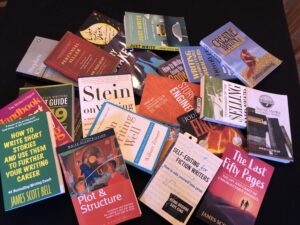
So how do we as authors keep ourselves on course? It’s easy to feel like you’re “at sea” when you’re in the second act muddle, not sure how to get to your destination, or even exactly where your destination lies. But there are experts who can help us find our writing longitude. I have a stack of craft books I love to refer to. Here are a few:

  • Plot and Structure by James Scott Bell
  • Self-editing for Fiction Writers by Renni Browne and Dave King
  • Bird by Bird by Anne Lamott
  • Fire Up Your Fiction by Jodie Renner
  • Writing Novels That Sell by Jack M. Bickham
  • Techniques of the Selling Writer by Dwight V. Swain
  • On Writing by Stephen King

 * * *

So TKZers: What resources do you use to chart your course across the great ocean of writing a novel?


And speaking of time … 

The Watch Mysteries is a box set of three complete novels in which clocks, watches, and time play an important role.


If you’re having trouble posting a comment, please be patient and keep trying. We’re sorry for the inconvenience, but we’re having technical problems and we’re working to resolve them.