Recently, I was Zoom chatting with a writer friend. She asked me how it was going with my current work-in-progress—a project titled City Of Danger. I chuckled and said, “I’m intentionally breaking all the rules.”
“What genre is it in?” she asked.
I kept chuckling. “Hard to put a finger on it. It’s kind of a dog’s breakfast. Part hardboiled/noir detective crime fiction. Part thriller and suspense. A lot of historical nostalgia from the 1920s. And some sci-fi from a dystopian future. It involves malevolent AI and time travel. I might even throw in a touch of romantic comedy.”
“Really?”
“Yeah. I’m not doing what every editor, agent, and publishing guru always says to do. ‘Strictly write to one genre.’ Nope. I gotta be different.”
“Sounds like Slipstream.”
“Slipstream? What’s that?”
“It’s a unique, hybrid fiction cross-genre. The style has been around awhile, but it’s really gaining traction. Slipstream pushes creativity boundaries. It explores the depths of human experience, the human condition, in novel ways.”
“Damm. I thought I was inventing something new.”
She laughed, and we moved on to other things. When we were done, she’d piqued my interest. I Googled “Slipstream” and asked Chat about it. Did I ever get my eyes opened, and it fit exactly with what I stumbled upon while building City Of Danger.
Among other information, I found a great article in The Write Life titled How to Write Slipstream Fiction—Full Guide and Definition. Here’s the link and the piece’s opening words which don’t need me rephrasing:
In the ever-evolving genres of fiction, Slipstream emerges as a genre that defies the traditional boundaries of storytelling, offering a unique blend of the real and the surreal. This genre, sitting at the crossroads of speculative fiction and literary fiction, challenges our perceptions of reality, inviting readers and writers alike into a world where the ordinary becomes extraordinary.
If you’re intrigued by the idea of crafting narratives that transcend conventional genres, Slipstream fiction may be the creative avenue you’ve been searching for. This article is your comprehensive guide to understanding, appreciating, and ultimately writing Slipstream fiction that captivates and resonates.
What is Slipstream fiction?
Slipstream fiction is a genre that thrives on ambiguity, challenging both writers and readers to explore the spaces between the known and the unknown. Let’s dive into the core aspects that define this intriguing genre.
Our Slipstream fiction definition
Slipstream fiction is notoriously difficult to pin down with a single definition, but at its core, it represents a narrative that straddles the line between the speculative and the literary, often blurring the boundaries of reality and the fantastic. This genre is not just about fantastical elements or futuristic settings; it’s about invoking a sense of wonder, unease, or the uncanny through stories that feel both familiar and deeply strange.
Slipstream challenges our everyday understanding of reality, pushing readers to question what they know about the world around them.
It is this unique blend of the real and the surreal that sets Slipstream apart from more conventional genres, making it a fascinating field for writers who want to explore the depths of human experience in novel ways.
What are the key characteristics of Slipstream fiction?
Before we delve into the characteristics that define Slipstream fiction, it’s important to understand that these traits work together to create a distinctive reading experience that defies easy categorization. Here are the seven most important characteristics of Slipstream fiction:
- Ambiguity: Stories often leave more questions than answers, challenging readers to find their interpretations.
- Cognitive dissonance: The narrative may combine elements that traditionally don’t coexist, creating a sense of unease or perplexity.
- Surreal atmosphere: The setting or events have an otherworldly quality, even if rooted in the familiar.
- Emotional resonance: Despite the fantastical elements, the core of Slipstream fiction lies in its ability to evoke deep emotional responses.
- Intellectual stimulation: These narratives encourage readers to think deeply about themes, ideas, and the nature of reality itself.
- Genre blending: Slipstream fiction often incorporates elements from various genres, refusing to be boxed into a single category.
- Metafictional elements: There’s often a self-awareness within the narrative, playing with literary conventions and reader expectations.
Keep in mind that Slipstream fiction is by its nature a genre that blends elements and influences from a wide range of sources. As a result, feel free to use or ignore whichever characteristics of Slipstream depending on what your story requires.
———
So, now I was really intrigued. I spent the better part of a day digging into Slipstream, and I did what I do with most things that intrigue me. I encapsulated it visually on an 11×17 inch sheet. It came out looking like this:
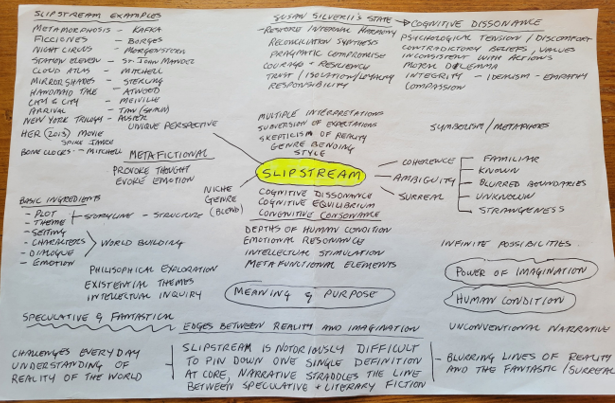
Some of the takeaways from my research were the terms cognitive dissonance, cognitive equilibrium, and cognitive consonance. I wasn’t quite sure what they meant and how they meshed with the Slipstream style. Here’s what my little AI friend said:
Combined, these three terms encompass aspects of cognitive psychology related to the harmony, conflict, and resolution of beliefs, attitudes, and behaviors:
Cognitive Dissonance highlights the discomfort that arises when there is inconsistency between beliefs, attitudes, or behaviors. It emphasizes the tension that individuals experience when they hold conflicting cognitive elements.
Cognitive Equilibrium refers to the state of mental balance or harmony that individuals strive for, wherein their beliefs, attitudes, and understanding of the world are consistent and coherent. It reflects the desire for stability and coherence in one’s cognitive processes.
Cognitive Consonance underscores the psychological comfort that individuals experience when their beliefs, attitudes, or behaviors are in agreement with one another. It signifies a state of alignment and consistency in cognitive processes.
Together, these concepts provide insights into how individuals navigate the internal conflicts and seek harmony in their cognitive processes, whether by resolving inconsistencies (cognitive dissonance), striving for balance and coherence (cognitive equilibrium), or experiencing comfort in consistency (cognitive consonance).
The concepts discussed in this thread—cognitive dissonance, cognitive equilibrium, and cognitive consonance—can intersect with the genre of Slipstream in intriguing ways.
In Slipstream literature, there’s often a deliberate blending of genres, a crossing of boundaries between the familiar and the strange, resulting in narratives that defy conventional categorization. This blending can mirror the cognitive tension of cognitive dissonance, as readers encounter elements that challenge their expectations and beliefs.
Moreover, Slipstream narratives often disrupt traditional narrative structures, creating a sense of cognitive imbalance akin to cognitive dissonance. The stories may provoke a sense of unease or uncertainty, inviting readers to question their assumptions and perspectives, much like cognitive dissonance prompts individuals to confront conflicting beliefs.
At the same time, Slipstream literature can evoke a sense of cognitive equilibrium through its exploration of the surreal and the ordinary coexisting. Just as individuals seek cognitive balance by assimilating new information into their existing frameworks (cognitive equilibrium), Slipstream narratives integrate disparate elements into a cohesive whole, inviting readers to find meaning in the juxtaposition of the familiar and the unfamiliar.
Cognitive consonance also finds resonance in Slipstream, as readers may experience a sense of satisfaction or resonance when seemingly incongruent elements in the narrative coalesce into a coherent whole. This alignment of disparate elements can evoke a feeling of harmony, akin to the psychological comfort of cognitive consonance.
In summary, the concepts of cognitive dissonance, cognitive equilibrium, and cognitive consonance offer a lens through which to explore the cognitive dynamics at play in Slipstream literature. The genre’s blending of genres, disruption of narrative conventions, and integration of disparate elements can evoke cognitive tensions and resolutions reminiscent of these psychological concepts.
———
Me — This is all well and fair, because the object of all fiction is to suspend disbelief in the reader and take them on an exciting, memorable journey. Mixing genres has been successfully done by many writers with many stories over time. Here are some of the Slipstreams that made it big:
Ficciones by Jorge Luis Borges.
The Night Circus by Erin Morgenstern
Station Eleven by Emily St, John Mandel
Cloud Atlas and The Bone Clocks by David Mitchell
The Handmaid’s Tale by Margaret Atwood
Hardboiled Wonderland and the End of the World by Haruki Murakami
The City & the City by China Mieville
The New York Trilogy by Paul Auster
The Arrival by Shaun Tan
Her — the movie by Spike Jonze
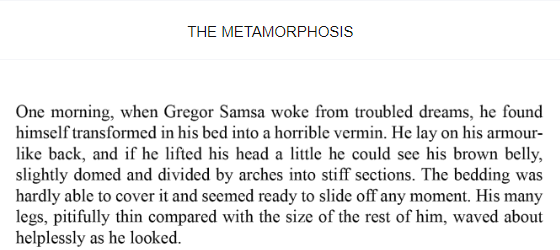
However, the granddaddy of Slipstream, and one of the early ground breakers, was The Metamorphosis by Franz Kafka. It’s about a guy who wakes up one morning and finds that he’s turned into a giant insect and has to deal with a situation that truly sucks. Here’s the opening paragraph:
Kill Zoners — Who has heard of the Slipstream style? Has anyone read Slipstream, and what do you think of wildly mixing genres? And has anyone written anything that resembles Slipstream? Let’s get a discussion going and share experiences.