The Perils of Internet Information


We all know that Bogart never said, “Play it again, Sam.” That mangled quote, which Woody Allen famously used in his stage play (and later movie) came from Casablanca,where Bogart’s character actually has this exchange with Dooley Wilson (as Sam):
Rick: You know what I want to hear.


Sam: No, I don’t.


Rick: You played it for her, you can play it for me!


Sam: Well, I don’t think I can remember––

Rick: If she can stand it, I can! Play it!
Recently, I’ve seen another bastardized quotation zapping around the internet. It’s a quote attributed to Ernest Hemingway. As a Hemingway-phile, I was quite interested. The quote goes like this: “There is nothing to writing. All you do is sit down at a typewriter and bleed.”
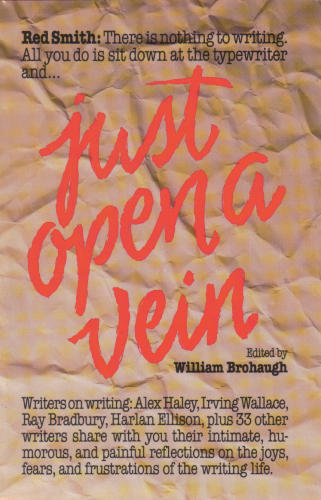
I was immediately suspicious. Something was rotten in the state of Bartlett, for it was the great sports writer Red Smith who said, “There’s nothing to writing. All you do is sit down at a typewriter and just open a vein.” (There are some variations on this, but the source is clear. You can read more here.)
This quote, in fact, became the basis of a book on writing, Just Open a Vein by William Brohaugh (Writer’s Digest Books, 1987). The Red Smith quote, with attribution, was printed right on the cover.
So how did these words get into Ernest Hemingway’s mouth, and thence to the wide world of the internet?
A TV writer did it, that’s how! As I investigated this further I came across an EW article from May 28, 2012, by Ken Tucker. It was a review of an HBO movie about Hemingway and his third wife, Martha Gellhorn. Tucker writes:
There’s a lot of dialogue that sounds as studied as Hemingway must have intended it to sound as he declaimed it (“Let me tell you about writers — the best ones are all liars”) and stuff that’s almost certainly cobbled together from various sources. (I was particularly amused when a negative review of the movie today in The New York Times made a point of ridiculing one Hemingway line — “There’s nothing to writing, Gellhorn — all you do is sit down to your typewriter and bleed” — but failed to realize it most likely derived from a New York Times sportswriter Red Smith’s wry dictum, “Writing it easy; all you have to do is open a vein and bleed.”)
So there you have it. It seemed like a good line to give to Hemingway in a biopic. But there’s another problem with having him say this (besides the fact that he never said it). The problem is he never would have said it!
Because Hemingway drafted in longhand, and he drafted standing up! He stood because of injuries sustained during his service in World War I. It was easier on him to be on his feet.
He usually only got to a max of 500 words in a single day, because he was famously trying to write “one true sentence” followed by another, and so on. (NOTE: There’s a famous author photo of Hemingway at a typewriter for the back cover of For Whom the Bell Tolls. But this was a staged photo to emphasize the Hemingway field reporter mythos).
So let’s be clear, when doing the hard work (the “bleeding”) of a first draft, Hemingway:
Did not sit.
Did not use a typewriter.
As his grandson, Sean Hemingway, once explained: “Hemingway wrote his first drafts in longhand, and you do not have to be a handwriting analyst from the FBI to appreciate his bold, fluid penmanship. Despite the author’s own comments in the book about the difficulty of the writing process and the need for revisions, many of his first drafts are remarkably clean, poignant testaments to his continued abilities as a writer later in life.”
And by the way, Hemingway never employed a secretary named Sam. Thus, he never, ever said, “Type it again, Sam.”
So here’s one instance where a reliance on what’s floating around the internet becomes a virus of error.
The irony, of course, is that I used the internet to do the research to get to the bottom of this. But this is the age we live in!
So what erroneous information have you come across in your internet surfing? What checks and balances do you use in your own research?  
‘Twas Two Weeks ‘fore Thanksgiving…

Thanksgiving is less than two weeks away, but potential Christmas gifts are appearing on the shelves already. The one that most immediately comes to mind is a library-bound, digest-sized book entitled JACK REACHER’S RULES, which provides handy suggestions should you decide so far off the grid that you have to have sunlight shipped in, or want to set a building on fire; it’s great stuff, and just in time for the holidays for that Lee Child fan on your list who thinks they have everything.  I have made a good dent in my shopping already; of course, I want nothing for myself. I believe that I have commented elsewhere that at my somewhat advanced age I am no longer interested in acquiring more possessions; rather, I seek new experiences. Alas, those that I have suggested to my spouse have been, shall we say, shot down. I will leave it to your imagination what they might be, and why they won’t happen.
So, I am asking you, since Christmas is coming…what, as far as books are concerned, are going to be looking to find under the tree in about five or six weeks or so? What do you want Santamazon to leave for you? It can be anything from the grandiose — an entire library in the basement — to the simple — a new writing journal — to something that is somewhere in between, like that slip-cased copy of MY PRETTY PONY by Stephen King that you could have picked up in a bookstore twenty-three years ago for a song and dance. What about a new tablet, the better to read DC e-comics on? Or what if Santa finishes that new novel you’ve been working on, the one that seems to be missing a hundred pages or so in the middle? What would you like?

Writing Dialogue – Tips

By Jordan Dane
@JordanDane


I’ve always loved writing dialogue. It’s the backbone to a scene for me. When I had my day job and had to sneak off to write during my lunch hour, I first fashioned the scene with dialogue, using it as a framework for the other layers. I wrote the lines like a screenplay. I usually only had time to draft a scene or two that I would work on once I got home.

The next layer would be the body language and how the scene would move between the lines, to add the nuance of the people being together to add more context. I’d also layer in setting. And the last thing I would add was internal narrative to give color to my characters. I called this method, BUILDING AN ONION FROM THE INSIDE OUT and it’s part of my FOR WRITERS resources page – the post on START WITH A BANG, IT’S ALL ABOUT PACE. I developed a sparse style that had a beginning, middle and close to each scene that usually ended with a foreshadowing or memorable image between the characters to add an element of pace. But the backbone to all of this was DIALOGUE.

Regardless whether dialogue comes easily to you or is a challenge to write, it is an essential element to a scene and a book. Internal dialogue adds color and voice to your work. And the dialogue between the characters can make each one distinctive and add rich context to the world you are building. An excellent example of memorable world building and dialogue that adds depth is Elmore Leonard.

If you have recommendations on other authors who have stood out in your mind for memorable dialogue, I would love to hear your thoughts. But here are a few four tips to start with:

DIALOGUE TIPS

1.) Make it Short & Sweet – Long, rambling dialogue can lose the reader. It’s my belief that the human eye needs the relief of the white page, otherwise you run the risk of losing the punch and pace. If you have one character with a long diatribe, I would suggest finding ways to break it up with discussion from other characters or action to give it pace and flow.

2.) Make it Real – Listen to real chatter between two people. They may use slang, contractions, or fragmented sentences. Too much slang can date the book or alienate a certain audience, so be careful not to pepper too much into your book, but learn what makes dialogue sound real by listening to others. Certain phrases, pauses, body language interludes can add depth here. Another way to listen to dialogue is focusing on the radio, the banter between DJs for example.

3.) Be Willing to Break Grammar Rules – Sticking strictly to proper grammar and the King’s English can make dialogue sound stilted and formal. Some characters demand real rule breaking, yet you may have one that is educated and proper. Seeing the contrast from that kind of character to a street kid, for example, can make the dialogue interesting, but the name of the game is to make each voice distinctive and interesting. It’s funny that I usually write dialogue without contractions, but have to go back and add them later. Not sure why that is, but it’s one of my edit reviews, to make sure the dialogue flows and sounds real.

4.) Read it aloud – I can’t stress how important I think this is. Read your dialogue aloud. If you stumble on certain words, change them. Make them roll off the tongue. You won’t regret taking the time and it will help with finding those pesky typos too.
 
DIALOGUE FORMATTING

1.) Start a new line when a new character comes on the scene. I also like to drop down lines to give more white space for the reader’s eye. So try not to embed dialogue within a paragraph of narrative.

2.) Keep tags simple but clear. With too many lines strung together, the reader can lose track of who said what. But if there is only one man and one woman, there’s no need to use their first names over and over. The generic ‘he’ or ‘she’ said will suffice. And overuse of adverbs and too many repeats of body language/movements can stick out to irritate an alert reader. For example, instead of a simple ‘he said,’ an author might make the mistake of using ‘Joe chortled mockingly.’ (Oy, the overwriting and too much repetition can wear on a reader. The basic use of ‘he said’ becomes part of the background white noise and not a distraction that could pull the reader from the story.)

3.) Pepper in a name once in a while, to remind the reader who is talking. After pages of ‘he said,’ they could forget who was speaking, especially if it’s two people of the same gender. Then, using first names becomes more important. Or use a generic description of the character to break up the pattern of first names, something like ‘the detective said.’

If you have any tips on writing dialogue and what works for you, or authors who write noteworthy dialogue, please share your thoughts with your fellow TKZers.

Kick starting your story

By Joe Moore

Have you noticed that everyone is writing a book? Whenever I disclose to someone that I’m an author, the response is pretty much the same: “I’ve always wanted to write a book.” Or “I’ve got a great idea for a novel.” Despite all the would-be authors out there, not every potential novelist actually gets to the writing stage. And even fewer produce a finished product. But for the ones who not only have an idea but are burning up with a desire to put pen to paper, I’ve put together a basic outlining technique that might help get things started—a simple list of questions to kick start a book. Answering them can give writers direction and focus, and help keep them going when the wheels sometimes come off the cart along the way. Here goes:

  • What distinguishes your protagonist from everyone else?
  • Does she have an essential strength or ability?
  • How could her strength cause her to get into trouble?
  • Most stories start with the protagonist about to do something? What is that “something” in your story, and what does it mean to her?
  • Is that “something” interrupted? By what?
  • Is there an external event or force that she must deal with throughout the length of the story?
  • How is it different from the original event?
  • How will the two events contrast and create tension?
  • Does she have a goal that she is trying to achieve during the course of the story?
  • Is it tied into the external event?
  • Why does she want or need to obtain the goal?
  • What obstacle does the external event place in her path?
  • What must she do to overcome the obstacle?
  • Does she have external AND internal obstacles and conflicts to overcome?
  • How will she grow by overcoming the obstacles?
  • What do you want to happen at the end of your story?
  • What actions or events must take place to make the ending occur the way you envision?

This outline technique has less to do with plot and more to do with character development. Building strong characters around a unique plot idea is the secret to a great book. Once you’ve answered the questions about your protagonist, use the same technique on your antagonist and other central characters. It works for everyone in the story.

These are general questions that could apply to any genre from an action-adventure thriller to a romance to a tale of horror. Answering them up front can help to get you started and keep you on track. Armed with just the basic knowledge supplied by the answers, you will never be at a loss for words because you will always know what your protagonist (and others) must do next.

Can you think of any other questions that should be asked before taking that great idea and turning it into a novel?

A room with a view

PARIS – It is a dark and stormy afternoon. Not much light in the City of Light today. When you live in South Florida, as I do, it is easy to forget how early how early night descends this far north in November.

(Note: I’ve always wanted to write something datelined Paris and when I was a reporter the most exotic dateline I ever produced was Nassau Bahamas so forgive me for being so pretentious.)

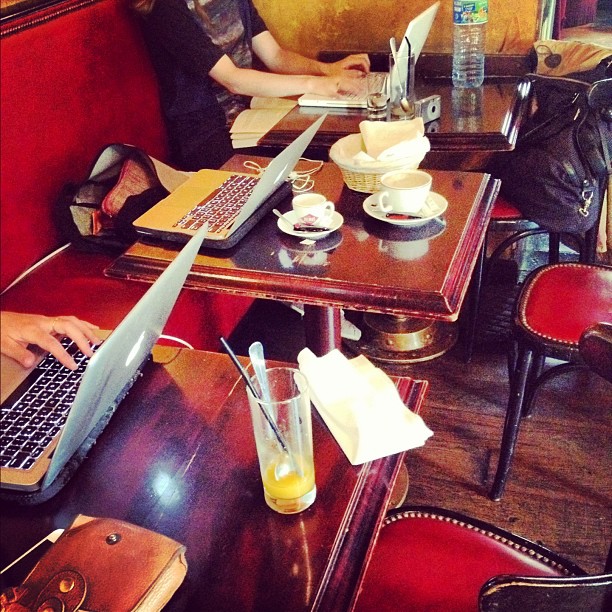
I really am writing this at a French café and it really is cold and rainy here. But I am feeling all warm inside because I just banged out 967 words on my novella in ninety minutes. (Am calculating writing time not by wristwatch but on number of empty kir glasses on my table). Now, me writing almost a thousand words at one sitting is, as my sister will tell you, a mean feat. I am easily distracted from writing –- by laundry in need of folding, dogs in need of walking — because for me writing is really hard. It never, ever, comes easy. Even with the lubrication of white wine and cassis.

So I am pretty pumped right now. (Okay, the kirs help). And I am thinking that if I could just move here to Paris and write in cafés ALL the time, I could turn out two, three, four books a year and start taking up more bookstore real estate, which James Patterson once said is the whole secret of making it in this business.

(Note: That last bit is not to be taken seriously even though I really did hear him say that once.)

I am sitting here at the Cafe Delmas, watching the rain and the little sparrows steal peanuts from my saucer and I am pondering that great seminal question that all writers do:

Do I need a nicer place to write?

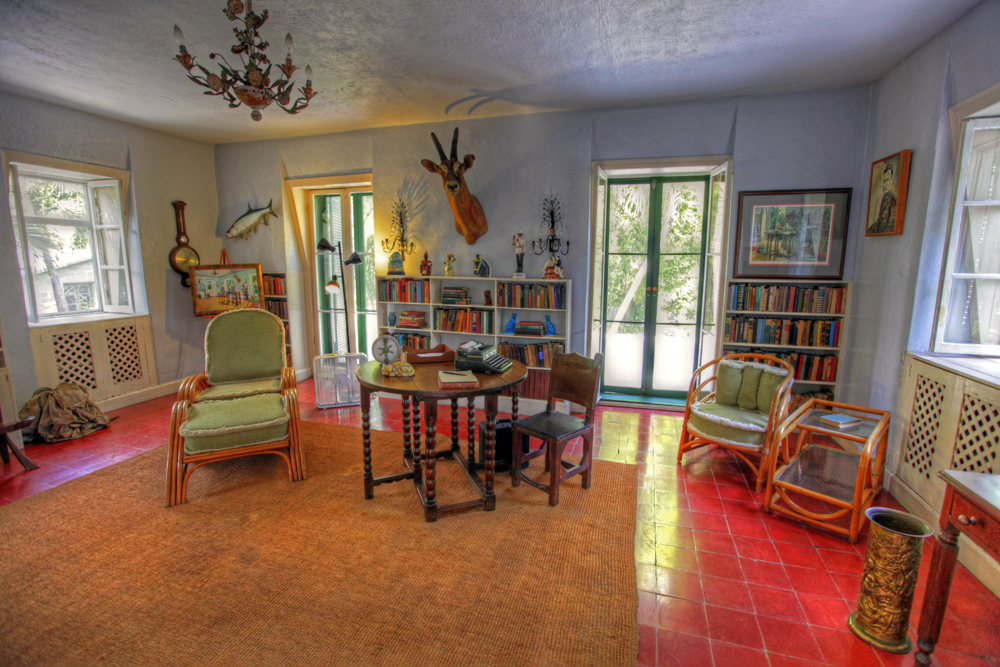
Hemingway supposedly did some writing here at Cafe Delmas, but then again, in this town he’s a little like Napolean only he didn’t sleep everywhere he just just wrote everywhere. Hemingway had some pretty cool writing places besides this one, like this little place down in Key West: 


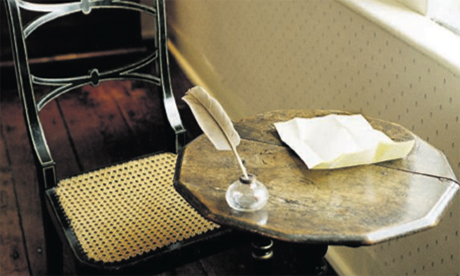
I like reading about where famous authors do their writing. (the Guardian runs a great feature called Writers Rooms; check it out.) Jane Austin wrote most her books in Chawton Cottage on her brother’s estate on  this tiny twelve-sided piece of walnut on a single tripod (below). How such big books came from such a fragile desk I can’t imagine. 
When George Bernard Shaw wanted to write, he holed up in a shed on his plain suburban property in a Hertfordshire village. It was a pretty Spartan place but boasted some nifty technology for its day — an electric heater, a typewriter, a bunk for naps and a telephone to the house to call for emergencies such as lunch. “People bother me,” Shaw confessed. “I came here to hide from them.”


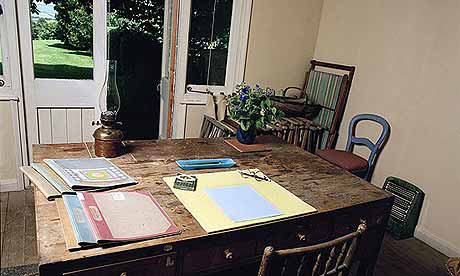
Virginia Woolf also had a thing for privacy. She wrote in a toolshed in her garden (below).  She called it her “writing lodge.” She was easily distracted —  by her husband Leonard sorting the apples over her head in the loft, by church bells, giggling schoolchildren or even her dog scratching itself and leaving paw marks on her manuscript pages. A woman after my own heart…


I dunno. Maybe a “writer’s room” is a thing of the past. After all, most of us today write on laptops and as the name implies we can carry our technology in canvas totes and park-and-plug-in anywhere we like. We move easily from our kitchen counter to a table in a Paris cafe with the flick of the WIFI wrist. Do we even need a special place dedicated to our work, a spot where, when we enter, our brains can detach from the outside world and wander the hills and valleys of the imagination?

Where do you go when you need to go to that world in your head? Where do you go when you need to get away?

Storms of the Brain

It only occurred to me recently how apt the word brainstorm truly is. Perhaps it was prompted by watching the terrible effects of Hurricane Sandy, but I’m sure it was also related to my own story problems lately.
I’m working on my fourth Tyler Locke book right now, and I’ve been having a hell of a time wrapping my head around why the plot just wasn’t working. I had a synopsis and basic outline, but the elements weren’t gelling into a cohesive story. No matter what I did with the plot I had, it wouldn’t work. It was as if I were trying to put together a jigsaw puzzle with pieces from three different boxes. The individual elements were all great, but for some reason they didn’t fit together.
It was the dreaded writer’s block. But I’ve written five novels already, so how could that be possible? Shouldn’t I have the process figured out by now? If I were a golfer, I’d curse my case of the yips. The stuff that should be an easy putt by now was suddenly impossible. The mojo was gone, and I didn’t know if it was a permanent condition or more specific to this story.
Then my wife reminded me that this happens with every book. I always reach a point where I want to chuck the whole thing and move on to something else because I can’t figure out what’s wrong with the story. She recited my familiar lamentations back to me: “This is never going to work.” “I’ll never finish the book.” “Why did I start writing this stupid thing in the first place?”
As Christopher Vogler describes in The Writer’s Journey, I had reached the deepest chamber of the Inmost Cave to face the Ordeal. And the defining element of the Ordeal is the hero’s death and rebirth.
So I had to throw out all the assumptions I had about the story up to that point. I had to look at each and every part of it and decide whether to keep it, toss it, change it, or put it somewhere else. It was time to brainstorm.
As with the most violent storms, like hurricanes and tornadoes, everything in the story was at risk: characters, scenes, settings, action, even premise. Then I unleashed the gale. Some parts were ripped away, while others right next to them remained virtually untouched. Whole swaths of the story were decimated, while others were picked up gently and set down intact in an entirely different place.
When the storm was over, many of the individual pieces were still identifiable, but the overall rearrangement gave the story a completely new life. While real storms bring tragedy, my brainstorming was as beneficial as it was difficult. Yes, there’s a lot of cleanup still to do, but I can build something long-lasting from the wreckage.
So my question for the writers out there is, how do you get out of writer’s block? Do you unleash the brainstorm, or is there a less turbulent method to dislodge the block?

Making Readers One at a Time


The other day I strapped my AlphaSmart on my back and rode my bike to Starbucks to do a little writing. I set up at a table, got my brew, started tapping away. The place was crowded, all the other tables were taken.
Presently, a gray-haired woman appeared and said, “Mind if I share your table?”
 “Only if you behave yourself,” I said.
She smiled (a good sign for a wiseacre such as myself). I motioned for her to sit. She had a coffee and an e-reader.
“So is that a Nook or a Kindle?” I asked.
“Kindle,” she said.
“You like it?”
“Love it. I’ve been reading some indie books lately.”
This surprised me. The word “indie” is rather specialized nomenclature. She knew what was going on in the self-publishing world.
Ever the opportunist, I said, “I like that. I’m also publishing my own books.”
“Well,” she said, “I’m getting very annoyed at the bad editing I’m seeing.”
Boom! Not, “Oh really? You’re a writer? I’d love to read one of your books!”
No, I was getting the boom on behalf of sloppily edited books everywhere. I had a little work to do.
I asked her what sorts of things annoyed her, and she talked about not just typos, but the misuse of words. The basic mangling of the English language. At one point she said, “Dude, open the dictionary or thesaurus.”
I started liking her then. A gray-haired lady who uses the word Dude can’t be all bad. I decided to interview her as a resource on what readers are thinking. She was a fountain of information. Here are some of the things she told me:
She doesn’t like too much info on “tertiary characters” because “I don’t want to get invested in characters that don’t do more in the novel. I get disappointed if you don’t follow through with them. Frustrating. Or they show up again in the last few pages and I think, ‘Dude, where the hell have you been for the last 300 pages?’”
Regarding reviews: “One star reviews are usually trolls.” But also: “Very few authors come up to a five-star review. I never read five-star reviews, especially with exclamation points. You see five exclamation points and I think, Please!”She looks at reviewer history and what other books they liked and reviewed, before making a purchase.
I asked her how she found books. She said:
1. Amazon mailings
           
2. Looks at the “customers also bought” books Amazon suggests on a book page
3. Sampling. “I love the free sampling.”            
4 “If I find an author I like, I read everything he’s ever written.”
That last, BTW, is in line with other surveys. The two biggest ways readers find fiction are 1) word-of-mouth from trusted sources; and 2) looking for more from a favorite author.
On opening pages:
“The first couple of chapters need to set out the story arc. Not too much slam bang boom.Where is it set? Still need the gotcha, gee whiz, but I need a sense of the larger story arc, too.”
“I like wit. I mean say something intelligent, say things that grab my attention. In that first chapter if all they’re doing is grunting and shooting each other, nothing is telling me if any of those characters has anything upstairs worth reading about.”
On style:
“Style does matter. I just read a book with a good plot, good characters, great dialogue, but the narrative portions were just subject-verb, subject-verb. Boring. Hasn’t he heard of any other parts of the language? After awhile I was dragged out of the story, almost like he wrote two books.”
She asked me about my books, and I gave her a card. As we chatted she was thumbing her Kindle, and about a minute later was ready to order one. She asked which one she should start with, and I suggested Watch Your Back.
“Done,” she said.
“You bought it?”
“How could I not?”
It was a pleasant twenty minutes, and I’d made a sale. Now I can only hope that I’ve made a reader, the kind who puts me on that favored list of authors she has discovered and wants to read everything by.
And then keep working on the one thing I can control, the actual writing, making it the best I can do each time out.
Because that’s the only way you build a writing career, Dude. 

Be Careful What You Read!!!

by Mark Alpert

 
Tom Wolfe has a new book out — Back to Blood, just reviewed in last Sunday’s Times — but I’m not going to read it right now. I enjoyed his earlier novels, especially Bonfire of the Vanities, which at the time of its publication seemed like an important cultural event, a summation of the whole Eighties-financial-boom-and-seething-inner-cities gestalt. His next book, A Man in Full, wasn’t as successful, but it had some great descriptions of prison life, which I assume are pretty realistic since Wolfe is famous for his exhaustive research. (I’m a sucker for any fiction about prison. It’s like watching a train wreck. There but for the grace of God…) And his third novel, I Am Charlotte Simmons, had some good moments too, although much of the book was cringe-inducing.

But here’s the problem: after I read Wolfe’s last book I noticed changes in my own writing! Mostly in the use of exclamation points! Wolfe uses them a lot, and I picked up the habit! They started cropping up even in the articles I edited for Scientific American!! I added exclamation points to stories about cosmology and quantum physics! The magazine’s copy chief had to institute a new rule: no more than one exclamation point per story!!!

I’m in the middle of writing my next novel, so I’ve decided to abstain from Wolfe for now. His prose is so catchy and exuberant, it can have an especially strong influence on impressionable authors like me. I can’t stop reading fiction, of course — as Woody Allen might say, it’s my second-favorite activity — but I’m more careful about what I’m reading when I’m in the throes of composition. Does anyone else out there worry about this?