Beyond The “Word Gap”: A Bridge Too Far?


imageBy Kathryn Lilley

When my daughter was in the first grade, her teacher pulled me aside one day.

“I’m learning so much by listening to the way you speak to your daughter,” she said. “It’s amazing. You talk to her like she’s an adult.”

At the time, I recall being surprised by that comment. (And to be honest, I didn’t know there was another way to talk to children.) Then I started paying attention to the way some of the other parents in the school communicated with their kids. I was struck by the simplified language they used. They used fewer, simpler words than I did. (I remember wondering briefly if I was doing something wrong in the way I communicated as a parent. If so, it was too late to switch gears, I decided. By the time my daughter was six, she already had an adult-level vocabulary).

I felt reassured by a study that came out the next year, which  indicated that children with big vocabularies tend to do better in school than children with small vocabularies. (That there was a correlation between vocabulary size and academic performance seemed intuitively obvious to me at the time. But still, it was a relief to have my personal communication style officially sanctioned by a study.)

After that study came out in the mid-nineties, early education experts and advocates jumped on board the notion of a “word gap”. They stressed the need to close that gap as a major strategy for improving the education system. But some critics are now pushing back on some of the notions fueling the word gap campaign. According to some scholars cited in a recent article in The Atlantic Monthly, merely using more words is not enough to prepare a child for school. Some linguists dismissed the campaign to close the word gap as simplistic, inadequately researched, and ineffective.

http://www.theatlantic.com/education/archive/2016/04/beyond-the-word-gap/479448/

Personally, I would like to see some research done on the opposite side of the word gap equation: I wonder whether there is a potential downside in having a big vocabulary in early childhood. Judging from my own highly unscientific, peer group study sample, younger children who have big vocabularies tend to sail through their grammar school years.  The early years are so effortless for these children, they often fail to develop the study habits they’ll need to carry them successfully through high school and college.

But he’s so bright! Another friend complains to me over the phone about her eighth grade son, who is suddenly struggling in school. Why won’t he just do his friggin’ homework?

Because he never had to work before now, I reply. Her son-of-a-professional’s precocious vocabulary let him coast along in school while some of the less “bright” kids were developing a few basic study habits.

So here’s my take on the word gap movement: it’s a little off base as an education strategy. Yes, having a decent vocabulary helps you shine in the first grade. But eventually, you’re going to have to sit down and do your friggin’ homework.

Here at TKZ, we’re all writers and avid readers, so this is an interesting group to ask: are you familiar with the “word gap” campaign? What do you think about it as an early childhood education strategy?

Concept vs. Premise: The Inherent Opportunity in Understanding the Difference

Concept and Premise are two of the most common terms used to describe a story, often within a pitch or a review, less often within the lexicon of story development.

That’s a shame, too.  Because understanding the difference between them, and harnessing that difference to raise the conceptual essence of a premise, is a powerful storytelling tool.  One that differentiates a story within its genre, whatever the genre might be.

And perhaps even more exciting, this single thing can be the difference between a mid-shelf book and a bestseller.  Or between published and unpublished.  Because agents and writers are looking for home runs, and there is no quicker way around the bases than a high concept story, a story with a premise that is fueled by concept.

Here’s a quick example, with more right around the corner:

Two people fall in love in Florida.  This is premise that is as flat and almost completely void of concept.  The only thing about it is if you find the notion of a story set in Florida compelling.  If you don’t, and you’re an agent or an editor, you are already bored.

Two people fall in love in Florida, after they find out they are brother and sister torn apart in their infancy.  Ouch.  A button has already been pushed from this alone.  Because this is highly conceptual, it lends a more specific thematic arena to the story… even before we hear about the story itself.

Pay attention to that last line, because that is one of the criteria for a compelling premise: it doesn’t require a hero and a plot to be compelling.  It stands alone as a good idea.

Too many writers begin with the vagueness of the former, too often never landing on something compelling at all, telling just another love story that doesn’t stand out.

Thrillers are inherently conceptual.  

It is the unique story proposition that attracts us, unless we are talking about an established series hero (Jack Reacher, Alex Cross, James Bond, etc.), which becomes the drawing card first and foremost.  Most of us don’t have that kind of brand equity, leaving a conceptual story proposition as our most powerful story enrichment too.

And yet, “conceptual” is always a matter of degree and personal taste.  That’s where writing in a genre serves us, we already know the general direction of the tastes of prospective readers.  With thrillers, the more conceptual the better.

Relative to story development, concept, as it relates to premise, is the contextual framework for a story.  A notion that infuses the premise with compelling energy.  A proposition.  Any of which becomes the aforementioned contextual framework for the unfolding of a premise.

Too often editors and agents don’t really grasp or acknowledge the difference between concept and premise, with little lost to that truth.  And yet, concept and premise are the first things agents and editors look for in a story, over and above characterizations and writing voice.

Which means that when we, as writers, don’t grasp that difference, we are stepping over a potential gold mine, even if a premise alone can still get the attention you seek.  Better to have both story levels working for you, even if the agent never knows what hit her/him.

Not every story needs to be high concept.  Unless, once again, you are writing a thriller.  In our genre, the higher the better.  There’s not really such a thing as a cozy thriller. 

More examples of concepts… that are not yet a premise.

These coming from the real world of published novels and produced movies.

Before succinctly defining concept and premise, let’s look at some real-world examples, all taken from stories you might recognize.  Notice how, in each of these, there is no hero yet, no plot… nothing other than the conceptual framework itself.

 “Snakes on a plane.” (bad movie, but a great example of a concept… in this case, a proposition.  Nonetheless, a deal was made for the script on this 4-word pitch alone, solely on the compelling nature of the concept)

“The world will end in three days.” (a situation)

“Two morticians fall in love.” (an arena)

“What if you could go back in time and reinvent your life?” (a proposition)

“What if the world’s largest spiritual belief system is based upon a lie, one that its church has been protecting for 2000 years?” (a speculative proposition)

“What if a child is sent to earth from another planet, is raised by human parents and grows up with extraordinary super powers?” (a proposition)

“What if a jealous lover returned from the dead to prevent his surviving lover from moving on with her life?” (a situation)

“What if a paranormally gifted child is sent to a secret school for children just like him?” (a paranormal proposition)

“A story set in Germany as the wall falls.” (a historical landscape)

“A story set in the deep South in the sixties focusing on racial tensions and norms.”  (a cultural arena)

As we move into definitions and criteria, remember: concept is not premise.  Rather, it is the reason why your premise will compel readers.  Because it is compelling.  Fascinating.  Intellectually engaging.  Emotionally rich.  Imbued with dramatic potential.  It infuses the premise with something contextually rich, even before you add characters and a plot.

The Definition of Concept

Go back and apply these facets of definition to the examples provided, this will help solidify your understanding of the difference between concept and premise.

Concept is the presence of something conceptual at the heart of the story’s essence.

A concept is a central idea or notion that creates context for a story – often for a number of stories, not just your story – built from it.  Take Superman, for example.  Ten films, four television series, hundreds of graphic novels.  All inspired by one concept.  Each film, each episode and each edition all delivering different and unique premises.

A concept becomes a contextual framework for a story, without defining the story itself.  The notion of Superman, for example, becomes the framework within which each of those unique premises is built.  Same for any series story, each installment is driven by the same concept.  Ask Harry Potter where he came from… it is always the same origin framework.

It is an arena, a landscape, a stage upon which a story will unfold.  Every medical and legal thriller comes an example of this, the concept is the arena, a place dripping with inherent drama and theme.

It can be a proposition, a notion, a situation or a condition.  The Davinci Code is the poster child of a proposition… one that sold 82 million hardcovers and counting.

It can be a time or place, or a culture or a speculative imagining.  Historical fiction, anyone?  Science fiction?  Time travel?  Ghosts, vampires, spies, serial killers… all of these are speculations within a conceptual framework.

And none of them have stories yet.  Which means the premise is not yet on the page.

The Criteria for Concept

It is inherently, before character or plot, interesting, fascinating, provocative, challenging, engaging, even terrifying.

High concepts depart from the norm, they exist at the extreme edge of imagination and possibility.

Concepts promise a vicarious ride for the reader.  Taking them somewhere, or placing them into situations, that are not possible, realistic or even something they would choose in real life.

A concept can define the story world itself, create its rules and boundaries and physics, thus becoming a story landscape. (Example: a story set on the moon… that’s conceptual in it’s own right.)

In short, a concept is simply the compelling contextual heart of the story built from it.  It imbues the story atmosphere with a given presence.

It does not include a hero… unless the hero is, by definition, a conceptual creation (like  Superman; Clark Kent is not a concept, he is a character).  A story is built around the conceptual nature of its hero is leveraging the the compelling energy of that conceptual proposition.

When we read that agents and editors are looking for something fresh and new, concept is what they mean.  When a concept is familiar and proven – which is the case in romance and mystery genres especially – then fresh and new becomes the job of premise and character, as well as voice and narrative strategy.

Concept is often genre-driven. 

Literary fiction and some romance and mysteries aren’t necessarily driven by concept, yet they are totally dependent on a premise that gives their hero’s something to do.  Which can and should be conceptual in nature.

However, the sub-genres of romance – paranormal, historical, time travel, erotica, etc. – are totally concept-dependent.  Other genres, such as fantasy and science fiction and historical, are almost totally driven by and dependent upon concept.

If your concept is weak or too familiar within these genres, you have substantially handicapped your story already.

The Definition of Premise

Premise is NOT concept.  But it can be fueled by whatever is conceptual about the story (stated separately within a pitch as the story’s concept).  Premise is the summarized description of a story.  And when that story is considered fresh and powerful, premise  emerges from a conceptual landscape.

Concept is to premise as size, strength, speed and agility are to an athlete.  Without it, the story remains undistinguished, relying almost solely on its narrative to win or lose the day.

Premise is:

A protagonist/hero whose life is interrupted, disrupted or leads toward… a specific problem, need or opportunity… launching a quest with a mission and a desired outcome, beginning with a response to the need or problem… for reasons (stakes) that compel the character to respond, then resolve the issue… in the face of opposition from an antagonistic force or person(s) with opposing goals and their own motivations… calling for higher and stronger responses and course of action… leading toward brilliant and courageous resolution resulting from the Hero’s decisions and actions… leading toward a specific outcome, returning the hero to a life that is contextually different than where the story began.

A great story almost always has both concept and premise going for it.  Armed with this higher understanding, our emerging ideas and story visions are empowered to reach for a higher bar.

Ask any agent or editor, or reader, for that matter.  Outside of literary fiction and cozy mysteries, the more conceptual our stories, which arise from our premises, the better.

Why I Teach Writing

by James Scott Bell
@jamesscottbell

Something new from Writer’s Digest Books.

Just Write cover

I got together with the great team at WD and collected some of my previous articles and posts on writing, added new material and organized everything under two parts. The first part is about kicking up your fiction writing not just one notch, but several; the second is about enjoying your writing life, making it all it can be. The book is available at your local bookstore and online:

AMAZON I BARNES & NOBLE I KOBO I iBOOKS I GOOGLE BOOKS

Sometimes I’m asked why I teach writing. Here’s my answer.

I teach because I know what it feels like to be an unpublished writer wondering if he has the stuff. For about ten years after college I was of the belief that writing fiction could not be taught. I’d been told that writers are born, not made. I was warned not to waste money on craft books.

But when I went to see Moonstruck one afternoon with my wife, the urge to MV5BMjIwMDY0NzYyMF5BMl5BanBnXkFtZTcwOTE5NDk0NA@@._V1_SX640_SY720_write hit me again with full force. That film bowled me over with its originality, characters, dialogue, and heart. I wanted so much to be able to write something that would make people feel the way I was feeling. I was a practicing lawyer then, so mostly I was making people feel irritated. But I said to myself, “Self, you learned the law by studying. Let’s just see if you can learn to write the same way, despite what those naysayers told you. At least give it a shot!”

I began with screenwriting. The seminal book was Syd Field’s Screenplay. He broke down the three-act structure, and I spent a year watching movies, timing them, figuring out what happens at various points, and why. Field, however, had a notion about the first “plot point” that was not entirely clear to me. He said it “spins the action” into a different direction. I felt there had to be something more to it than that.

So I intensified my study on that structural point. And one day it hit me. What has to happen here is some event that forces the Lead into the confrontation of Act II, and is vitally connected to the main conflict of the story. It is also a place from which the Lead cannot retreat. It was like going through a doorway of no return. I tested this against classic movies, and lo and behold, there it was.

I got so excited about this I began to share the Doorway of No Return theory with other writers. They’d stroke their chins and think about it and then say, “Yeah. I see that.” And when they saw, it made me all the more jazzed.

So I kept studying, trying things, creating techniques for myself. When something worked, I journaled about it. I was like Dr. Jekyll keeping track of all the experiments on himself. Only instead of turning into Mr. Hyde I was becoming a writer of saleable prose.

After landing a five-book contract I began to teach at conferences, and started writing articles for Writer’s Digest. Later, I was the WD fiction columnist. And all the time I had this in mind: I wanted people to know it CAN be done. You CAN learn the craft. You CAN get better. The naysayers are touting a Big Lie! Don’t believe it!

And I’d hear from folks that they were learning and growing and getting agents and contracts and hitting bestseller lists. The Big Lie was dead!

In fact, the day I wrote the above paragraph (Friday), I got this tweet:

So keep writing, friends. Keep learning. Those are parallel tracks. I keep on both of them myself and have ever since that day I walked into the sunlight after seeing Moonstruck. I still get pumped about trying things and figuring out what works, what makes my own fiction better. And I still love to share what I learn with fellow writers, as do all my blogmates here at TKZ.

That’s why I teach writing.

First Page Critique: REBORN

By Joe Moore
@JoeMoore_writer

Today’s First Page Critique is called REBORN. My comments follow. Enjoy.

Back arched, pointed ears swept backwards, Archenon knelt before the High Queen in the Great Hall of Êvina. 

“Please—I beg you. Let me go.” An intricate braid of ebony hair lay heavy along his spine. The piece of parchment crunched between his hands, folded and read so many times that it had begun to crumble.

The High Queen of Aradria, his mentor Rhonja, looked down on him. “You know I can not.” She smoothed out a fold on her silky dress, which was fitted to perfection. It hugged her slender form, mirroring the blinding hall in its purity. Her hair, shining like starlight, wafted about her shoulders.

His imploring emerald eyes met hers from the bottom of the crescent staircase leading up to the white throne. A vast mosaic of Her Majesty’s Royal Crest lay fixed in the wall behind her—four petals aligned to the cardinal points held each other under the protection of a circle representing Spirit, the High Queen’s element. 

Archenon swallowed hard. “I have given you my life, and now the last tie to my heritage is to be torn away. Is there nothing I can say to make you change your mind? I want to see my mother one final time.”

Rhonja had never reciprocated Archenon’s feelings, but he thought she cared for him enough to allow this one request. She was the epitome of hope for her subjects, yet she would crush his. 

“You do care for me, don’t you?” he asked.

“Of course. I treasure you,” she replied, her brilliant gaze a calm ocean at twilight. But her words were scant comfort. 

Shafts of light pierced between the half-drawn purple drapes hanging over the arched windows. Elegant pillars of creatures, cunningly carved, held up the vaulted ceiling. Gryphons, mermians, dragons, elves and other beings stared at him with marble eyes. It was as if they fought to keep the very building from crashing down on him. More than ever, the immensity of the white hall felt intrusive and distinctly foreign. 

Archenon was afraid he would never belong anywhere. Not here, in this land where the trees were few and the ocean lapped around every edge of the border. Not even in his first home, deep in the woods of Elfen Harrows, in the realm of fire. Not an easy thing for an elf to admit, and he shivered with a sudden fear.

—————————-

I have great admiration for anyone who writes science fiction and fantasy. The author of these genres takes on an additional burden that the rest of us rarely do—world building. While the rest of us write about a world that we all know, sci-fi and fantasy worlds usually have a whole new set of rules.

Not only does the author have to lay out the rules and landscape, but it must be done right up front—at least within the first chapter or so. AND the author must identify the protagonist, possible antagonist, conflict, fear, story question, and the hero’s “need” at the same time.

Overall, this first-page submission accomplishes those tasks. I’m not saying it’s ready for prime time, only that all the ingredients are there. Even though it reads like a first draft, it kept my interest, and I would certainly read on.

There is a fine line between underwriting and overwriting. Underwriting drops the reader into a scene and advances forward with little or no delay (Jim Bell’s “Act first, explain later”). Overwriting drops readers into a scene and bounces them around like a pinball. In the case of this submission, I feel the scene was overwritten. The writer is trying to cover as much world building as possible in a page or two. But this is the burden I mentioned before. And the skill to do so must be acquired. Bottom line: it’s hard. What this sample needs is just a good, clean rewrite to smooth things out. That should not be a problem. Here are the ingredients that I found in the first page, and why I think this is a good effort.

Protagonist: Archenon
Possible antagonist: Rhonja
Conflict: Rhonja will not let Archenon “go”.
Fear: Archenon is afraid he would never belong anywhere.
Story question: Will he be able to see his mother again.
Need: Escape.

That’s my take on REBORN having only read one page. Tell us what you think. Would you read on? Thanks to this brave writer for submitting to our Thursday First Page Critique.

Give your manuscript a running start

By Joe Moore
@JoeMoore_writer

Whenever I disclose to someone that I’m an author, the response is pretty much the same: “I’ve always wanted to write a book.” Or “I’ve got a great idea for a novel.” Despite all the would-be authors out there, not every potential novelist actually gets to the writing stage. And even fewer produce a finished product. But for the ones who not only have an idea but are burning up with a desire to put pen to paper, I’ve put together a basic outlining technique that might help get things started—a simple list of questions to kick start a book. Answering them can give writers direction and focus, and help keep them going when the wheels sometimes come off the cart along the way. To continue my Writing 101 series, here goes:

  • What distinguishes your protagonist from everyone else?
  • Does she have an essential strength or ability?
  • How could her strength cause her to get into trouble?
  • Most stories start with the protagonist about to do something? What is that “something” in your story, and what does it mean to her?
  • Is that “something” interrupted? By what?
  • Is there an external event or force that she must deal with throughout the length of the story?
  • How is it different from the original event?
  • How will the two events contrast and create tension?
  • Does she have a goal that she is trying to achieve during the course of the story?
  • Is it tied into the external event?
  • Why does she want or need to obtain the goal?
  • What obstacle does the external event place in her path?
  • What must she do to overcome the obstacle?
  • Does she have external AND internal obstacles and conflicts to overcome?
  • How will she grow by overcoming the obstacles?
  • What do you want to happen at the end of your story?
  • How do you want the reader to feel at the end?
  • What actions or events must take place to make the ending occur the way you envision?

This outline technique has less to do with plot and more to do with character development. Building strong characters around a unique plot idea is the secret to a great book. Once you’ve answered the questions about your protagonist, use the same technique on your antagonist and other central characters. It works for everyone in the story.

These are general questions that could apply to any genre from an action-adventure thriller to a romance to a tale of horror. Answering them up front can help to get you started and keep you on track. Armed with just the basic knowledge supplied by the answers, you will never be at a loss for words because you will always know what your protagonist (and others) must do next.

Can you think of any other questions that should be asked before taking that great idea and turning it into a novel?

Good Metaphors Are Like Lemmings In Suicide Vests

Suicide-Bomber-Lemmings-55505

“Do you know why teachers use me? Because I speak in tongues. I write metaphors. Every one of my stories is a metaphor you can remember. People remember these metaphors because they are so vivid you can’t get free of them .”– Ray Bradbury

By PJ Parrish

I was watching one of my favorite movies recently, Sideways. I watch it over and over, not only because I enjoy it but also because of what it teaches me about writing great dialogue. There are a handful of these movies I return to again and again – Moonstruck, Casablanca, Bull Durham, The Godfather, Chinatown, Lawrence of Arabia, The Apartment — just to try to see how the magic is done.

So I get to the scene in Sideways where erstwhile novelist Miles has just learned his latest 800-page doorstop has been rejected yet again. Miles descends into a funk fog and laments to his friend Jack:

“Half my life is over, and I have nothing to show for it. I’m a thumbprint on the window of a skyscraper. I’m a smudge of excrement on a tissue surging out to sea with a million tons of raw sewage.”

Which brings us, quite vividly, to our topic of the day – the metaphor. One of our regulars, Jim Porter, has asked us to devote a post to the subject: “I quote Bobcat, when he was Bobcat. At some point, would y’all please write about metaphors–particularly the danger of mixing metaphors. I guess one question is, when is a metaphor finished so you can use another one? We covered this in college, of course, but I would appreciate a review.”

Normally, I don’t give metaphors much thought. I’m of the mind that the metaphor (and its sister the simile) is a lot like sex. If you think about it too hard you’re not doing it right. But then I sat through a day of cable TV political news wherein I discovered that…

The goalposts had been moved…
And we need to level the playing field…
But that might lead us down a slippery slope…
Because all we’re doing is rearranging the deck chairs on the Titanic…
And the solution is just a Trojan horse…

Makes me long for the good old days of top-rate political metaphor, like when Rep. Devin Nunes called the guys trying to shut down the government “lemmings in suicide vests.”

Metaphors and similes permeate our lives. I don’t think we even realize how much because they are so ingrained in our language, a sort of shared currency of comparison that we all use. We use metaphors to make sense of the world around us, to make the abstract concrete. We eat our hearts out and are starved for affection. We shoot down arguments and bottle up our anger. We open cans of worms and close the books on things. And while all of us have gotten to the fork in the road, more than a few of us lament the road not taken.

In simplest terms, a metaphor is a figure of speech that makes a comparison between two seemingly unlike objects or concepts. By portraying a person, place, thing, or action as being something else, a metaphor gives us a more vivid description or helps us understand something better.  When done well, a metaphor also ignites some special spark of recognition in your reader, where they say to themselves, “Yes! I see that! I know exactly what he is trying to tell me.”

Pause for definition: What’s the difference between metaphor and simile? (I sometimes get this wrong, but then I can’t get the lay-lie thing right either.)

Simile: Richard is as brave as a lion. Richard has a heart like a lion. My ex-husband is like a snake in the grass. Metaphor: Richard is a lion. My ex-husband is a real snake.

So how do we take these humble parts of speech and use them to enrich our novels? How do we turn the mundane into the sublime without resorting to clichés?

Aye, there’s the rub.*

*Metaphor, archaic. Origin: in ancient game of lawn bowling, a rub is a fault in the surface of the green that stops a bowl or diverts it from its intended direction.

I’m finding this topic hard to deal with. Good metaphors are like modern art or pornography. I know it when I see it but don’t ask me to define it. Maybe I’m just not the sharpest bulb in the drawer. I think it’s time for some examples:

Good Metaphors/Similes

“The water made a sound like kittens lapping.” — The Yearling by Marjorie Kinnan Rawlings.

“Let us go then, you and I, when the evening is spread out against the sky like a patient etherized upon a table.” — TS Eliot, The Love Song of J. Alfred Prufrock.

“Life’s but a walking shadow, a poor player that struts and frets his hour upon the stage and then is heard no more. It is a tale told by an idiot, full of sound and fury, signifying nothing.” – Macbeth, Shakespeare.

“The sky above the port was the color of television, turned to a dead channel.” – Neuromancer, William Gibson.

“Her voice is full of money.” – F. Scott Fitzgerald, The Great Gatsby.

And one of my faves: “Honey, you are a regular nuclear meltdown. You’d better cool off.” ― Susan Sarandon in Bull Durham.

Here are two of Stephen King’s favorites, straight out of the great pulp tradition:
“I lit a cigarette that tasted like a plumber’s handkerchief.” – Raymond Chandler.
“It was darker than a carload of assholes.” — George V. Higgins.

Bad Metaphors/Similes

There are a couple reasons why things can go bad.

Cliches: Usually, metaphors fail because they aren’t fresh. Metaphors are at their most powerful when they are original, inciting new ways of looking at things. These are old and tired and should never appear in your novels: the elephant in the room, deader than a doornail, her hair was spun gold, his eyes were like emeralds and he had movie star teeth. No, don’t even use “Chiclet teeth” because it isn’t yours; someone got there before you.
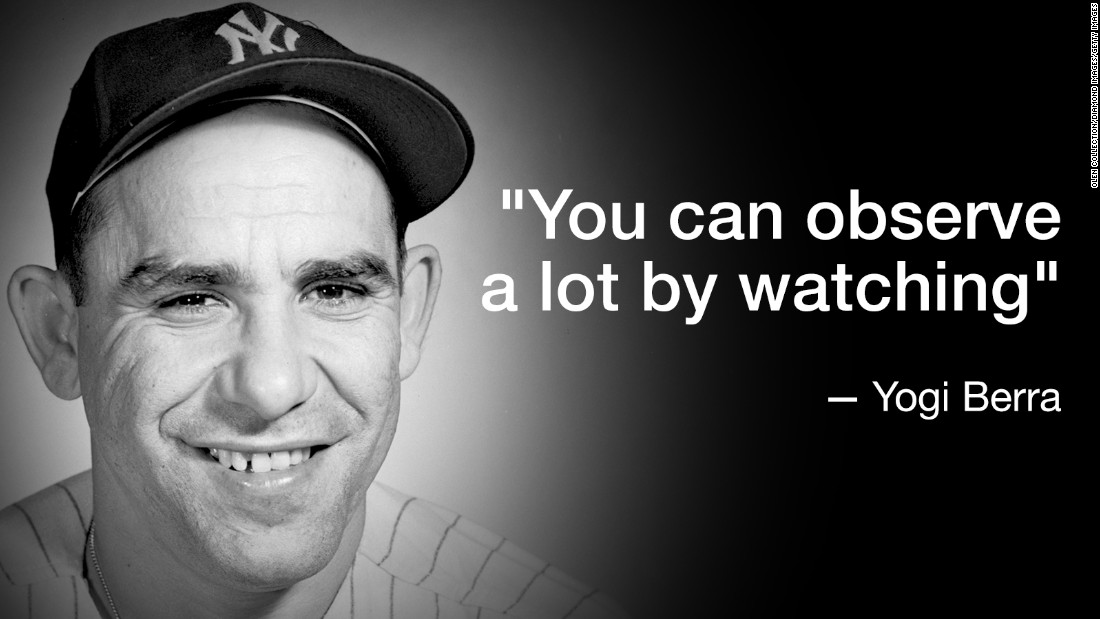
150923083253-restricted-02-berra-quote-super-169

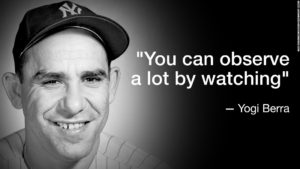
Non sequiturs. Sometimes, the metaphor just doesn’t make sense. I always think of Yogi Berra here, though he was technically the master of the malapropism. (“Texas has a lot of electrical votes.”). Lawrence Harrison, an op-ed writer for the Washington Post, came up with a  great word malaphor, which is a mash up of malapropisms and metaphors. Click here to see his hilarious blog devoted to it. The best example I found of this is from Stephen King’s On Writing, from a novel he refused to name:

“He sat stolidly beside the corpse, waiting for the medical examiner as patiently as a man waiting for a turkey sandwich.”

Why does this fail? Because what does waiting for a turkey sandwich have to do with patience? As Scooby-doo said, “huh?”

Here’s one of my favorite malaphors — and once again, it comes from politics. If you don’t get this, that’s okay. My wish for you, regardless, is that you live long and prosper:

“I’m presenting a fair deal, the fact that they don’t take it means that I should somehow do a Jedi mind-meld with these folks and convince them to do what’s right.” — President Obama

Mixed metaphors. I promised I’d get to this, Jim, so here we go. There’s a fancy name for mixed metaphors – catachresis. Who knew? This is where the writer gets his creative wires crossed and juxtaposes two unrelated comparisons in a single part of speech. Examples: She grabbed the bull by the horns of the dilemma . We have to get all our ducks on the same page. Let’s burn that bridge when we come to it. Here is a memorable one from Dan Rather: “They counted the votes until the cows had literally gone to sleep.”  And Al Gore once reminded us that “a leopard can’t change his stripes.” A couple more:

“All at once he was alone in this noisy hive with no place to roost.” -Tom Wolfe, The Bonfire of the Vanities.

“Anyone who gets in the way of this cunning steamroller will find himself on a card-index file and then in hot–very hot–water.” — Len Deighton, Winter: A Novel of a Berlin Family.

“He had that reputation. Some people thought he was over it, but old dogs rarely change their spots.” — David Baldacci, Hour Game.

And here’s a doozy from a Pentagon staffer quoted in the Wall Street Journal complaining about efforts to reform the military: “It’s just ham-fisted salami-slicing by the bean counters.”  Actually, there is something rather satisfying about this one, sort of like a Golden Corral all-you-can-eat word buffet .

Now here’s a caveat about mixed metaphors: Sometimes they can work. But you really have to know what you’re doing to pull this off. In the Len Deighton example above, I suspect he was purposely making his speaker sound obtuse. And then there are the rule-breakers, those writers who can juggle with chain-saws (don’t try this at home, kids). They mix and match metaphors to create an avalanche of style or an emotional effect:

“The moon was full. The moon was so bloated it was about to tip over. Imagine awakening to find the moon flat on its face on the bathroom floor, like the late Elvis Presley, poisoned by banana splits. It was a moon that could stir wild passions in a moo cow. A moon that could bring out the devil in a bunny rabbit. A moon that could turn lug nuts into moonstones, turn little Red Riding Hood into the big bad wolf.” — Tom Robbins, Still Life with Woodpecker.

And two lines I wish I had written:

“The voice of your eyes is deeper than all roses. Nobody, not even the rain, has such small hands.” — ee cummings.

Okay, time for some rules. Well, not rules really, because I don’t believe in rules when it comes to writing. But here are some guidelines about how to use metaphors and similes.

Keep It Simple, Stupid. Similes and metaphors should be useful, concise, and at best even memorable. If you work too hard at it, your exertions will show on the page. Like I said, it’s like sex. Bring your best technique, be creative, but relax, or it ain’t gonna happen.

Make Me Stand Up and Salute. An effective metaphor has the power to stir because it triggers a deep sense of recognition in the reader, relating to something in his experience and eliciting an emotional reaction. Often, the metaphoric connection is simplicity itself. This is a simile but it is one of my all time favorites from the late-great sportscaster Stuart Scott:

He’s cooler than the other side of the pillow.

Pure geometry!

Pure geometry!

Be Original: If a simile or metaphor doesn’t rise above the merely mundane, it won’t work. This is hard work, coming up with something that is uniquely your own. But this is where the book is made, where your voice emerges. Don’t go with what is facile, dull, easily digested.  Don’t be content to be literal and tell us someone is as “beautiful as a young Elizabeth Taylor.”  Find a new way to spark the reader’s imagination and let them fill in the gaps.  When I was struggling to describe my female protag (who I envisioned as looking like a young Charlotte Rampling), I didn’t say she had high cheekbones and hooded eyes.  I gave her a childhood memory about watching cheerleaders and what her father told her about beauty:

They’re plain arithmetic, Joey. You’re geometry. Not everyone gets it.

Here is one of my favorite bloggers Chuck Wendig on the subject. Click here for complete blog:

“Metaphors represent an authorial stamp. They’re yours alone, offering us a peek inside your mind. When a reader says, “I would have never thought to compare a sea squirt to the economic revolution of Iceland,” that’s a golden moment. The metaphor is a signature, a stunt, a trick, a bit of your DNA spattered on the page.”

Bend Me, Shape Me. Good metaphors are entertaining. They sneak up on the reader, tickling them, making them smile. Bend your images like Beckham and watch them soar and swerve. Don’t you love this one from Matt Groening:

“Love is a snowmobile racing across the tundra and then suddenly it flips over, pinning you underneath. At night, the ice weasels come.”

If you are struggling with metaphors, read some good poetry. Emily Dickinson is a great place to start. (“Hope is a thing with feathers…”) Langston Hughes is another (if dreams die, life is a broken-winged bird that cannot fly…”) But maybe this is the best metaphor ever?

The fog comes
on little cat feet.
It sits looking
over harbor and city
on silent haunches
and then moves on.

Stay in Your POV:  We hear a  lot these days about writing from an “intimate” point of view. Basically, all that means is being so firmly in your characters sensibilities that every word, gesture, thought and description is filtered through their personal prisms. So that must include whatever metaphors/similes you assign to them.  A metaphor must arise organically from the character’s experience, age, background and even geography. A woman who grows up on an Iowa farm isn’t going to produce the same metaphoric connections that a Manhattan socialite might.

In my latest book, SHE’S NOT THERE, my protag is a skip tracer but also an avid birder. That gave me many chances to extend the metaphor through the lens of bird-watching.

Whenever he was in a place like this, or any place where humans gathered, he saw himself as a big bird of prey — a peregrine falcon maybe — soaring high above and looking down at the world from all angles. He could see things that others, so intent on their little ground lives, could not. He could see the big picture.

Later, this man compares a person he is chasing to a crow because crows are the smartest animals on earth. He remembers watching a crow deposit acorns in the middle of a busy street so cars would crack them open. The crow even learned how to time the red lights to go out and safely retreat the nuts.

Pay special attention to where your character is from and look for ways to use that in metaphors. When my skip tracer notices the color of a man’s eyes, he doesn’t compare them to jade. He says they are the color of the Cumberland River on a cloudy day. Now, I bet you haven’t seen the Cumberland but I am trusting you can imagine a muddy rural river and supply the missing metaphor.

Know When to Quit

This was part of Jim’s original question to us here at TKZ and I think it is an important one: “When is a metaphor finished so you can go on to the next one?” I had a friend who did stand-up comedy and he used to talk about “layering” — taking a basic bit and milking it for a extra laughs. But he said you had to know when to stop. So it should be with metaphors. Usually, the simpler the better and you don’t want it to go on too long or it begins to feels forced, like it’s just you the writer showing off.  I had to delete a couple bird metaphors from my book because it was losing its impact. Metaphors and similes are special; they are the jewels you add for extra sparkle, something to delight.  Maybe it’s helpful to think of them as accessories and remember what Coco Chanel advised about that:

“Before you leave the house, look in the mirror and take one thing off.”

But how many per book or chapter? That’s something you just have to develop an ear for. Because writing is music, after all. And if the note feels false to you, you better believe it will be a clanger for the reader — and you don’t want a Metallica concert going on in your book. I resist the urge to insert too many metaphors — the birds! — which isn’t difficult because they come hard for me anyway.

Speaking of quitting…as my Tupelo-born friend Phillip says, I’m wiped cleaner than a blackboard. So, it you’ll excuse me, I’m off like a herd of turtles. I know we’ve barely scratched the tip of the iceberg, but it’s time to get writing. So let’s roll up our elbows, put our shoulders to the grindstone and get back to rapsodizing and metaphorizing. Now go nail one out of the park!

 

Facing Fears

As writers we all have a number of fears about our writing – most especially when facing the dreaded blank page (which I should have been overcoming this week but procrastinated instead!). I’m not often crippled by writer’s block but I am most certainly stalled by many a fear. Mostly that fear centers around writing some truly awful rubbish but I think deep down, it’s probably more the fear of being exposed as a fraud (you think you’re a writer, hah?!). I often wonder if bestselling or famous writers experience the same degree of fear or angst but, unless they suddenly morphed into arrogant, self-aggrandizing idiots, I suspect that whatever deep-seated fears they had as newbie writers still secretly plague them.

This week I found my fears became paralyzing – I wasn’t able to get back into my WIP as I have a completed project that is being digested by my agent and so my brain seemed fixated on that. No matter that the rational part of that same brain told me to cease worrying about things out of my control and to seize the pen and get down to the business of finishing the next manuscript (which, after all, is all outlined, partially written and ready for completion!!). Despite this, however, the other part of my brain – the part that harkens back to my primitive, fear-driven, ancestors – kept holding me back. As of writing this blog post, the rational part of my brain has just about reasserted control, safe in the knowledge that since I’m traveling to London this week, little can actually be accomplished writing wise (travel being the perfect excuse for further procrastination in the name of research!).

Strangely, although (as this week proves) I still get beset with writing angst, most of my initial fears regarding my writing have all but disappeared. I no longer worry that I can’t actually write a complete novel (since I’ve managed to do so numerous times, my brain has finally accepted I will be able to do so again) and I am less concerned with the crappy nature of my first drafts, as experience has told me I can usually manage to improve them with revision (even if that process sometimes seems endless). Of course, replacing these fears are many others, but at their heart they are probably more about flagging self-confidence than true, gut-wrenching fear (at least I hope so!).

In the current environment, many writers don’t have to deal with the traditional fears of not finding an agent or a publisher. These can be bypassed if a writer chooses, and indie publication is a route easily accessible for most, if not all, writers. Nonetheless, I’m sure fear for any writer never truly disappears.

So TKZers, what are your greatest fears when it comes to your writing? Do you worry about the quality of your work or finding a market for it? Do you hate facing the dreaded blank page or, for you, is there some other nagging fear about your writing that keeps you awake at night (or, like me, keeps you from getting your writing done?)


The Five Modes of A Writer’s Life

by James Scott Bell
@jamesscottbell

So I was sitting around the other day with a bout of procrastination when I had a thought (I writertry to have at least one thought per day). I find, as a writer, I am usually in one of five modes: Flow, Go, Slow, No and Pro. I thought of adding another one for residents of New York and New Jersey – Yo! – but decided five was enough

Flow

Flow is a state of hyper focus, of total immersion in one’s creative work. In this mode you experience a mix of forgetfulness, play, joy, and “time quickening.” An hour feels like five minutes. Difficult tasks seem to melt before you. You are “in the zone.”

Jack London wrote a lot about flow, in all parts of life, but especially in the life of the writer. In The Call of the Wild he compares it to the elemental ecstasy of the animal in full beast mode:

There is an ecstasy that marks the summit of life, and beyond which life cannot rise. And such is the paradox of living, this ecstasy comes when one is most alive, and it comes as a complete forgetfulness that one is alive. This ecstasy, this forgetfulness of living, comes to the artist, caught up and out of himself in a sheet of flame; it comes to the soldier, war-mad on a stricken field and refusing quarter; and it came to Buck, leading the pack, sounding the old wolf-cry, straining after the food that was alive and that fled swiftly before him through the moonlight.

There you go, writer. Hunt that book!

So how do you get into the zone when you write? I’ve found it more or less sneaks up on you, that you can’t force it. But there is a way to make it more recurrent: Know your craft!

Mihály Csíkszentmihályi (I’ll help you out. It’s pronounced MEE-high Chick-SENT-mee-high), in his seminal work Flow: The Psychology of Optimal Experience, stressed that flow most often occurs when the challenge of a task is met with an equal or greater skill level. When you know what you’re doing, and how to pull something off, you are more likely to experience flow. I love the speech in The Hustler with Paul Newman, where he describes to his girl what it’s like to play great pool:

EDDIE: Like, you know, anything can be great. Brick laying can be great, if a guy knows. If he knows what he’s doing and why and if he can make it come off.

When I’m goin’, I mean when I’m really goin’, I feel like a jockey must feel. He’s sitting on his horse, he’s got all that speed and that power underneath him, he’s coming into the stretch, the pressure’s on him, and he knows. He just feels when to let it go and how much. ‘Cause he’s got everything working for him – timing, touch. It’s a great feeling, boy, it’s a really great feeling when you’re right and you know you’re right.

It’s like all of a sudden I got oil in my arm. The pool cue’s part of me … You feel the roll of those balls and you don’t have to look, you just know. You make shots nobody’s ever made before. I can play that game the way nobody’s ever played it before.

SARAH: You’re not a loser, Eddie, you’re a winner. Some men never get to feel that way about anything.

Study your craft and write with abandon and you will experience those times when you just know. It’s the greatest mode of the writing life.

Go

The next best thing to being lost in flow is being able to write at a good pace anyway. Get the words down. Turn off the inner editor and just go.

One way to do that is the writing sprint. You set yourself a goal of, say, 250 words. You make a little plan for what you’re going to write. It might be some action, some description, some dialogue, whatever. You think about it, then write without stopping.

You can set a timer for this, or use something like Dr. Wicked’s Write or Die.

When you get to the end of your sprint you might very well find that you’re in flow. So keep going.

Otherwise, take a short break and then do another sprint.

Slow

We all know there are times when writing is a slog. There are many reasons this may be. It could be physical—you’re just tired. Or it could be a part of your manuscript you’re unclear or unexcited about.

If it’s physical, take a power nap. I recommend them! Every day, sometime between one and three o’clock, I try to nod off for fifteen or twenty minutes. You can train your body to do that. I can put my feet up on my desk and lean back in my chair, or hit the sofa, and I’m off to dreamland in a minute or two.

Another idea when it’s slow going is to take a brisk walk in the sunshine. If you live in Buffalo and it’s December, do some jumping jacks in the living room … and then don’t live in Buffalo in December anymore.

If slowness is caused by being unclear or unexcited about your WIP, try this:

Skip ahead from wherever you are and write a fresh new scene. Before you start, let the scene play in your mind and tell your imagination to come up with one surprising thing. Out of the blue. Wild. Your character could do something you never thought he would. Or another character might pop in (Chandler’s famous “guy with a gun” perhaps?). Or create some crazy lines of dialogue.

At the very least, this exercise will produce new plot possibilities and more layers of character life. And it’s fun.

No

And then there are some days when you simply do not want to write, when it almost feels like you can’t type. Your fingers rest on the keys but refuse to move.

There may be several reasons for this.

It could be that familiarity has bred contempt. You just can’t stand looking at your project anymore. Perhaps you’ve hit a wall in your story and don’t know whether to jump over, tunnel under, blow it up, or go back the way you came.

Or it could be completely unrelated to your writing, such as a life crisis that saps your mental energy.

So the first thing to do is figure out why your brain is saying No. Journaling about it helps. Write to yourself in a free-form way, asking questions, letting your thoughts pour out on the page.

But don’t beat yourself up if you have to take a break. I am all for busting through barriers, but there have been times when I’ve given myself permission to just say No. I even build a day into my week for a “writing Sabbath.” I try not to write anything on Sunday. This lets my mind rest and usually results in new ideas and fresh energy on Monday.

Pro

The pro writer writes to a quota.

Now, I know some writers think a quota stifles creativity by putting “pressure” on delicate artist sensibilities. I say hooey. It’s the exact opposite. Having a quota actually pulls you forward so flow and ideas and productivity can happen.

My standard advice: find the number of words you can comfortably produce in a normal week. Then up that by10%. Make that your weekly goal and divide it up among your days and according to your schedule. Keep track of how you do each day.

A pro also keeps up on what’s happening in the publishing world – both traditional and indie – in order to make wise career choices. Keep abreast of what’s being offered in publishing contracts (Kris Rusch is currently running a great series on this subject. Start here.) Subscribe to industry blogs like Jane Friedman and follow observers like @Porter_Anderson. Put together your own list of go-to resources … and then go to them.

And then there’s marketing, which these days falls mainly on the author’s shoulders, even in traditional publishing. So we all have to give it attention, but here’s my thing: follow the 80/20 rule. Eighty percent of your writing life should be devoted to the writing itself, the craft, the production. Twenty percent to the business and marketing side. Why? Because I’ve seen some fabulous marketers zigging and zagging all over the place, but with stinky books. That doesn’t build repeat business.

And repeat business is the name of this game for a pro. You get that when you write great books. So make that your primary focus.

For if you can deftly handle Flow, Go, Slow, No and Pro, you will greatly increase your chances of making something else – Dough.

Y’know?

So …

…what mode have you been in lately?


Write It On Spec — Guest Post by David Levien

:The-Boyz0004.jpgDavid Levien on set of Showtime’s “Billions.” Photo credit: Jeff Neumann

Today we offer a heartfelt tip of the fedora to our guest blogger David Levien. David, in addition to writing one of my favorite detective series  — the Frank Behr books — is also the creative genius behind BILLIONS, the brilliant and addicting Showtime series which has just wrapped up its first season and has been renewed for a second. David graciously took time out of an impossibly busy schedule to offer some important suggestions and advice to writers new and seasoned, and will be intermittently available to answer questions and comments throughout the day. David, thank you! — Joe Hartlaub

You sit bolt upright in the middle of the night and scrabble around the bedside table for pen and paper before the spark of a brand new idea forming in your mind blows away on the wind. Or you’re jogging, driving, taking a shower when it comes. You scratch out the initial thoughts in a desperate rush before they vanish—maybe it’s the beginning or maybe the end that has come to you first. You probably don’t even tell anyone about it for a while, because you don’t want to chase away this fragile dragonfly of a thought that’s landed on your desk, and when you do talk, it’s likely only to a trusted friend, colleague, editor or agent. Then you set about writing it, for yourself, on spec. You build it out because you have to, it’s what you do, with no guaranteed reward.

Only when it’s done, standing sturdy and complete, bearing all that you could bring to it, do you share the piece, be it novel or screenplay or teleplay or whatever the métier, with the marketplace, with the world. That’s the way it’s supposed to go anyway. But sometimes, if you’ve been fortunate enough to build a career, a name, daresay a brand, opportunities come along. A money offer is made for you to write someone else’s idea, or a project based on other source material. Sometimes you take that fledgling idea of your own out, as a proposal or a pitch, and the meetings go well and a buyer comes aboard early. What a glorious state of affairs! They’ve bought in before you’ve even done the bulk of the work. There won’t be any sweat equity on this one, there won’t be any risk that you’ve wasted your time. No, you’re on their dime, they have a vested interest…but.

But along with that money, with that deal, with that contract comes outside input. Hey, they’re your partners, they’re invested, so why shouldn’t they have some say? They dug it enough to buy in the first place. You’re reasonable. You’re collaborative. You’re living for a time on their largesse. You listen. A few of those ideas may creep in. But your piece is still weak, vulnerable, its structure and tone yet to be fully formed. The doctors advise not to take a baby outside into the world for at least the first month, until the immune system gets up and running, because the risk of contamination is too great. The same goes for your project.

Sometimes, when the work doesn’t turn out as well as it was supposed to, you go back and do a post-mortem, and with dismay you see that it was one of those seemingly benign outside creative suggestions that turned virulent and blighted the whole enterprise. You try to find your way back to the original intention, but the helix of creation is too complex to reverse engineer. Your idea was a gift in the first place and because you wanted to or had to, you sold it to the highest bidder, and it’s not pure anymore. And neither are you. For that moment you’ve been bought and paid for. You tell yourself: that’s not going to happen next time.

If you’ve managed to build a career of any length you may look back and realize the ones that really work, the ones that made you, were the ones you wrote on spec, just for yourself, the way they were meant to be. I can certainly look back and see it that way. There have been some successes that were commissioned. “Runaway Jury” and “Ocean’s 13,” were work-for-hires and turned out well. But the ones that live closest to my heart, my private investigator character Frank Behr—he was created and the first book written on spec although later books in the series were written under multi-book deals, including my latest, Signature Kill, out now in paperback—my first movie “Rounders,” and even my television show “Billions,” (both written with filmmaking partner Brian Koppelman) were created with no outside interference. The eventual buyers who came to the table wanted them as they were. Writing it on spec is the most elemental way for a writer to work, and even though it can sometimes become a luxury or a hardship to work for free, the reward outweighs the risk by plenty. You know best, so be unreasonable, and treat yourself, force yourself, trick yourself, spoil yourself but do yourself the favor and write it on spec.