Photo purchased from Shutterstock
When did you decide that you were going to become a writer? Had there been anything holding you back before you made that decision?


Another intrepid author has submitted their 400-word introduction to their work-in-progress for feedback. Please read and enjoy. Provide your constructive criticism in your comments. Thank you, my TKZ family.
***
The simple action of opening a door made Axel Chadwick an accomplice to murder.
The day of the shooting wasn’t supposed to be a normal day, but it didn’t feel like it was going to be a bad one. As usual, his eyes burned from reading a paper on his tablet titled The Further Evidence of Botanic Life Benefits on Astro-based Laboratories nearly too fast to comprehend. Striding through the busiest atrium at Invitron meant he’d bump into someone while trying to avoid someone else, and after planting on a fourteen-year old’s foot and nearly dropping his tablet, he decided to take a different route to his examination room.
Empty, he could sway without worry and delve further into his text. The soft patter of rain against the windows were interrupted by frantic bangs on the door a few feet away. A boy stood outside it. “Oi, let me in! I’m locked out!”
Axel glanced past him to see nothing but dark clouds over the beach through the window before returning back to his text. “Use the fingerprint scanner like you’re supposed to.”
“The rain—it’s short circuited it,” he cried, muffled through the glass. “I’m going to be late to my exam!”
He should have asked his name, what class he was in, which exam he had to take, and who his department head was so he could verify it, because even though no intruder had gotten onto the island before, it was the rules not to let anyone in.
A good question to ask him would have been: why on earth were you out in the pouring rain on the day of your exam instead of preparing. But he didn’t ask anything. Instead, one of his lanky arms propped up his tablet, the other pushed open the door, and his eyes were too buried in his screen to see if the boy was even a student.
The windowed-hallway was far behind him when Autumn caught up, pulling the pegs from her glasses out of her knotted hair. “Ready?”
Axel read the last sentence and then powered down his tablet, pulling its handle out of its top, and carrying it to his side. “Of course. You?”
“As much as I can be.”
***
FEEDBACK
OVERVIEW – This reads as if the story could be ripped from the headlines if the author intends this to be about a school shooting and an unauthorized entry on campus. To pull that off effectively, I would recommend the author stick to the action of the story and avoid diverging into back story or slowing the pace with actions not related to this intrusion. More details below.
FIRST TWO SENTENCES – The first sentence foreshadows what is coming, but it’s a head fake. I believe the author intended to force a compelling first line, but since it’s written in hindsight and quickly shifts into tedious details that slow the pace, it detracts rather than helps the pace and add to the intrigue. That first line might be more compelling if the author had stuck to the action and added that line to a scene ending, when Axel realizes what he’s done.
Any momentum from that first line is quickly diffused by a redirection into the POV of a student reading something on a laptop who reminiscences about the day as if he’s seeing it in hindsight with THIS line – The day of the shooting wasn’t supposed to be a normal day, but it didn’t feel like it was going to be a bad one. This line serves no purpose and is confusing. It should be deleted.
POV – I’m not sure why Axel is chosen as the POV, except that the author has probably given him a starring role as the main protag. I wonder how this intro might read if the POV came from the shooter gaining illegal access to the school, but let’s focus on Axel. If the action started with Axel racing through the school, against a clock, the author could set the stage better by focusing on Axel careening through the corridors, bumping into students and nearly dropping his laptop before he sees the kid pounding at the door in the rain. He knows he shouldn’t open the door (minimize his awareness of rules until later), but he tries to be a good guy and makes the mistake.
Give the shooter distinctive clothes that Axel realizes later is the guy he let into the building. Does the shooting start right away? Does the shooter do anything to let Axel realize he might’ve made a mistake? Does Axel see his face? There needs to be more tension in this gesture of opening a door, rather than Axel “telling” the reader that what he’d done was wrong. Following the action of Axel opening the door, he immediately gets back into his exam as he runs into Autumn. This diverts attention and adds to the slow pace.
STICK WITH THE ACTION – If the intruder to campus is a big deal, the author should focus on it as it happens and as the guy enters the premises. Instead we have Axel and Autumn talking about their test and if they studied enough.
AXEL’s AGE/STUDENT STATUS – I’m assuming that Axel is a student and not a teacher, although that is never really shown. Since Axel shows poor judgment in letting the student in and his mind sounds like the workings of a distracted teenager, but it’s not truly spelled out until he talks to Autumn. That point could be clearer, earlier.
DESCRIPTION OF ACTION – To give the illusion of pace, the author should give a better description of Axel’s scattered race through the halls. The original line below is too long. He’s also “striding” which is calm, but he is only thinking about “bumping into someone while trying to avoid someone else,” an awkward and distant way of describing the action. He comes across as too methodical in his run for his exam room.
BEFORE – Striding through the busiest atrium at Invitron meant he’d bump into someone while trying to avoid someone else, and after planting on a fourteen-year old’s foot and nearly dropping his tablet, he decided to take a different route to his examination room.
AFTER – Axel dodged bodies as he ran through the hectic atrium of Invitron. He careened through the horde of students with sweat running down his temple, Axel had one eye on the obstacles and the other on his open laptop. After he stumbled over a freshman, he nearly dropped his laptop.
“Eyes open, fish.” With his chest heaving, he darted by the bumbling kid without looking back.
Axel kept his eyes glued to the screen, studying with every second he had before his exam started.
CONTROL THE SETTING – Setting can add tension to any scene. In this intro, the author chose a soft patter of rain, against a frantic bang on the door. The sense of urgency is deflated if the rain isn’t a deluge. Since an author controls the setting, make it rain harder, where Axel feels badly for the drenched kid outside. Or have the intruder hold up his computer, saying it will be damaged, so Axel can relate to helping him.
CONTRADICTIONS – In this paragraph below, Axel is asking himself questions on why the kid is out in the “pouring rain” (that was previously described as a soft patter), but then Axel shows no regard as he lets the guy into the building without even looking at him. It’s not consistent if he has all these questions but his actions show indifference. Pick a perspective and do it for the betterment of the story.
EXAMPLE – A good question to ask him would have been: why on earth were you out in the pouring rain on the day of your exam instead of preparing. But he didn’t ask anything. Instead, one of his lanky arms propped up his tablet, the other pushed open the door, and his eyes were too buried in his screen to see if the boy was even a student.
This introduction needs work in order to make it consistent, descriptive with action, and focus on a foreshadowing of things to come. If the author’s intent is to focus on Axel and his studious world, that can be accomplished by endearing him more to the reader, so when a fake student gets him to open a security door, the reader is rooting for him. But the author would need to get deeply into Axel overachieving head and give him some traits we can identify with. Opening a door to a drenched student might be understandable if the proper groundwork is set up. Don’t foreshadow that Axel knew all the rules and still ignored them. Have him be well-meaning and let the action unfold as he is duped. That would be another way to go.
DISCUSSION:
What do you think TKZers? Would you read more? What helpful feedback would you give this author?

–Stock photo by GoDaddy
Forgive me if I’m a bit distracted today. I have Wedding Brain.
This past weekend, I dashed off to a wonderfully restful yet productive writing retreat. While there, I wrote hard. But when I woke up Monday morning in my own bed, I was nearly flooded out of it with a sea of wedding-related email. As my daughter’s wedding is Memorial Day weekend, I’ve decided to put off absolutely everything until it’s over and I’ve had a couple of days to recover. I have only one daughter, and this is my big chance to be that obsessed creature: MOTB. (That does not stand for Monster of the Bride!).
I was thinking about weddings in literature, and realized I could come up with few blissful examples. The two weddings of Jane Eyre and Edward Rochester come to mind: the first thwarted by the presence of The Mad Wife in the Attic, the second a sad little affair with a blinded groom and, I believe, a housekeeper for a witness. And don’t forget that nutty charade/tableau in which the dreaded Blanche what’s-her-name plays Bride. It’s like Charlotte Brontë used weddings like a sledgehammer. I’ve noticed that a lot of these wedding don’t take place in very unique venues. In Literature there iaren’t a lot of weddings that takes place somewhere exotic. Like in Jane Eyre they couldn’t find unique wedding venues in ayrshire, Scotland somewhere. This doesn’t mean that these wedding venues aren’t beautiful, these Wedding Venues Coventry have beautiful outdoor areas for you to remember that very special day.
Didn’t Romeo and Juliet have a quiet ceremony with the priest before they…died? At least Shakespeare’s comedies usually ended with a wedding.
Help! Please share your favourite literary wedding. Or your favourite real-life wedding story. As well as the venue you chose to go with, whether it was located in your home country like these wedding venues rugby, or you travelled abroad for the wedding! Because we’re all about storytelling here. (Happy endings not required.)
Recent blog posts by Laura Benedict and Jordan Dane here at TKZ on backlists and embracing new writing challenges, got me thinking about how writers approach the business side of being a writer. Indeed, I just finished Jane Friedman’s recent book entitled ‘The Business of Being a Writer’ (which is excellent BTW) so I’ve been ruminating on this for a few weeks.
At the moment, I am in the thick of trying to finish the first draft of my current WIP before summer hits and my boys are home from school (which, no surprise, tends to make it harder to get writing done!). My agent already has quite a few projects to juggle, but one element I’ve really not been focusing on is the business model for my writing. My principal aim over the last few years has been to focus solely on my writing (with just a bit of social media thrown in) as I’ve been exploring YA, MG as well as adult historical fiction. In doing so, however, I haven’t really been exploring new opportunities for my writing (such as Radish) or adhering to any real kind business plan or looking to save on my expenditure by looking into utility saving sites like usave.co.uk.
Now, I feel at some point I need to take a step back and evaluate issues such as author platform, branding, backlist, and identifying new opportunities as part of a longer term strategic plan. However, just thinking about it all is making me anxious as I realize how far behind I’ve probably fallen. So TKZers, perhaps you can help.
How are you approaching the business side of your writing career? How do you view author platform and branding? Do you have a long term strategic plan? How are you identifying new opportunities and outlets for your writing?
by James Scott Bell
@jamesscottbell
 First off, thank you for all your wonderful support for the launch of my new thriller, Your Son Is Alive. The print version is now available.
Launch week is usually a high for an author, though nerves can be set a-jangling as we wonder what the reception will be.
Which brings up the subject of the roller-coaster ride that is the writing life. For as we all know there are ups and downs and curves and twists. Sometimes it’s exciting. Other times you get queasy. Which is why you should never launch a book after a big Italian dinner.
Ahem.
We all know this gig is rife with opportunities for that devil disappointment. Our human condition can’t avoid it. We construct hopes for ourselves and our work knowing there are plenty of rocks and boulders ahead in the rushing waters of the marketplace.
This is not just in our professional lives, of course. It’s there in every other aspect of our existence on this good Earth. We are hopeful beings, we strive and and work and desire. Sometimes those things turn out exactly as we envisioned. Most of the time not so much.
I remember when my son began playing baseball. He developed into a pretty good pitcher at a young age, and there was one game where he gave up a home run that lost the game. It crushed him. As the other team was running onto the field cheering, he was standing on the mound trying not to cry.
I went out to the mound and put my arm around him and bucked him up as best I could. Then later, over ice cream, I tried to impart a little bit of stoic wisdom. “Most of life is about losing,” I said. “It’s how we handle the losses that make us or break us.”
I told him that in moments like this, when a home run is given up or such like, I would allow him one great big DANG IT! He could pound his glove as hard as he could. He could feel it for a moment, he could shout, “Dang it!” But after that he was to begin the task of forgetting it and getting ready for the next batter or the next game.
It’s a lesson he learned well. He went on to become one of the best pitchers in the league. During the season he had a bad inning against the strongest team. It was brutal. And they let him know it, the way little boys do. They jeered and threw shade. He pounded his glove as the coach relieved him.
Then came the championship game, and he faced that same team. As he stood on the mound they began to jeer again and try to rattle him. He proceeded to mow them down. And his team won the championship.
I consider that one of the best moments of both our lives.
This is how we should handle disappointment in our writing life. Our book goes out there and doesn’t perform as well as we would like. Or we get a scathing review. Or a rejection from an editor. Or Aunt Hildegard says, “When are you going to grow up and go to dental school?”
Give yourself a great big DANG IT! Pound your glove (but do not kick the dog). Then get back to your keyboard. One of the great truths about writing is that when we are in “the zone,” disappointments melt away. When we come out of the zone, the harshness may try to revisit, but it won’t be as strong. Lather, rinse, repeat.
Let me offer three more bits of stoic wisdom:
Comedian Tom Shillue has a great five-minute video on the perils of comparison. Here is part of what he says:
If my happiness were based on being the biggest comedian in the business, I’d be mad at whoever was getting more Netflix specials than me. (I have zero.)
If it were based on having the best TV ratings, I’d be mad at Jimmy Fallon. He beats me every night.
And if it were based on being rich, I’d be mad at a lot of people.
And even if I were rich – really rich, like #10 on the Forbes 400 rich – I’d be mad that there were nine other people richer than me. It never ends.
Comparing yourself to others creates a totally unrealistic measure for what constitutes success. And I know, because the entertainment business is all about unrealistic expectations.
He concludes: “Professional success is about making a living, pursuing excellence, and finding meaning in what you do.” (You might also be interested in this video by the redoubtable Joanna Penn on the dangers of comparing yourself to other writers … and how to get over it.)
While it’s good to set goals, make plans, and take action, watch out for letting expectations build up too much in your mind. We have this wisdom not only from ancient philosophy; there’s also recent data that suggests lowering expectations leads to greater happiness.
For example, if you get nominated for an award, don’t keep picturing your acceptance speech. Don’t dust the mantel twice a day. When you get to the banquet, sit at the table and be a good conversationalist. Try to enjoy the rubber chicken. Then, if your name is called, it’s a bonus. If it’s not, you won’t want to crawl under the table with a bottle of wine (or whine, as the case may be).
As the great John Wooden used to tell his players, “All of life is peaks and valleys. Don’t let the peaks get too high and the valleys too low.”
Epictetus said, “There is only one way to happiness and that is to cease worrying about things which are beyond the power of our will.”
You can’t control the will of agents, editors, critics, readers, awards committees or the IRS. So don’t worry about them. Instead, focus on your daily work. Get into your scene. Think about ways to make it better. That’s what you can control.
The mental aspect of writing is every bit as important as the physical act of typing. Which is why I wrote a whole book on the subject.
Friends, when you’re hit with disappointment, or on the other end with a great reward, remember the Latin phrase (which I had the audacity to make up):
Carpe Typem!
Seize the Keyboard!
What is your go-to method for handling the highs and lows of the writing life?
Welcome to today’s brave Anonymous Author with the first page entitled The New One.
THE NEW ONE
“I’m new,” the vampire said.
Of course, at the time I didn’t know she was a vampire. I didn’t even know vampires existed.
So. She’d come in off the street. My last patient of the day had just left, followed out the door by Dorinda, my receptionist. I planned to do paperwork for a while. I was standing at Dorinda’s desk flipping through messages when I looked up to see a woman silently watching me. I jumped involuntarily as she spoke.
“Dr. Gilder, I presume?”
“Yes. I’m Carrie Gilder.
“I need to talk to you.”
“Office hours are over for today. You should call the office in the morning and make an appointment.” I started around the desk. “Now, if you don’t mind—”
“Please. It’s important. I won’t be able to come back in the morning.”
I looked at her, appraising. She was striking. Tall, well dressed, elegant. She radiated power and confidence. I felt drawn in by her eyes, somehow. Maybe that’s why, almost against my better judgment, I relented, as if I had no choice. “Step into my office.”
I watched as she glanced around the room. What a contrast, I thought. My office is warm and comfortable, with its quaint country decor and fresh flowers gracing the credenza along one wall. And she’s so sleek and, what? Cold comes to mind. She bent to smell the late summer flowers, touching a petal with one long finger.
She sat in the comfortable overstuffed chair opposite mine. I was making notes. Young woman. Attractive. Blonde hair, dark eyes, almost black.
“You’re very lovely, Dr. Gilder.”
“Thank you?” I said, frowning. Not something I usually hear from my patients.
“Okay,” I said with a shrug. “First, why don’t you tell me who you are?”
The young woman leaned forward in the chair and extended her hand, which I found surprisingly cold. “I am Pica. Pica Sharp.” She then settled back in the chair.
I looked at her curiously. “Do you mind if I ask how old you are?”
“I was 27,” she replied.
“Was.” Odd way to say it, I thought, making a note.
“Yes.”
“So, Pica, why are you here?”
“It’s a long story.”
“Well, you’ve got fifty minutes.”
She frowned. “Yes. I understand. Cut to the chase, then.”
OK, let’s get to work. Upfront disclaimer: I’m not well-versed in vampire fiction. Please chime in if you’re more familiar with the genre. Suggestions are in blood red, naturally.
First, the title. While the line– “I’m new,” the vampire said.–piqued my interest, the title did not. The New One sounds vague and colorless—it gives no hint about genre, plot, character, conflict, or theme. Perhaps its significance becomes clear in the book but it doesn’t make a strong first impression on the reader.
A title must grab attention in a few short words, offering a tantalizing taste of what’s inside the book. A vivid cover may prop up a nondescript title. But in today’s competitive publishing world, authors need to make the strongest first impression possible, using every tool at their disposal. Search for keywords that relate to your plot: blood, vampire, undead, immortality, seduction, etc. Check out synonyms to trigger more ideas. Vampire fans, please add your suggestions to the list.
Anon, you quickly and clearly set up the situation: A psychiatrist or psychologist is alone in her office after hours when a vampire enters, seeking treatment. Carrie Lister’s normal world tilts.
The undercurrent of disturbance isn’t overly dramatic—no dead bodies, weapons, or explosions. Yet the reader gets the sense that Carrie’s life will undergo major changes because of her new patient. That is more than adequate to kick off an intriguing tale.
Now to the details:
“I’m new,” the vampire said.
Of course, at the time I didn’t know she was a vampire. I didn’t even know vampires existed. A short, neat summary w/o wasting time on backstory. Well done.
However, upon re-reading, I wondered about that first line. It’s not clear when Pica actually says this. Kicking off a story with an attention-grabbing first line is important but if that bit of dialogue doesn’t actually occur, it feels like a bit of a cheat. A few paragraphs below, I’ve inserted the line in a different place.
Pica is a great vampire name. I’m guessing, Anon, that you also meant to refer to the disorder–pica–of eating things that are not normally considered food, like…uh…blood.
While you establish the setting and situation clearly, modifiers like “silently” and “involuntarily” are unnecessary. Adjectives and adverbs dilute the power of strong nouns and verbs. I also rearranged the order a bit for clarity.
So. My last patient of the day had just left, followed out the door by Dorinda, my receptionist. I planned to do paperwork for a while. I and was flipping through messages at Dorinda’s desk flipping through messages when I looked up to see a woman silently watching me. I jumped. I hadn’t heard her enter. I jumped involuntarily as she spoke. She’d come in off the street.
“I need to talk to you. I’m new.” [Inserting the “new” line here may eliminate the feeling of a cheat.]>
Watch out for the proper sequence of action and reaction. In the original, it sounds as if Carrie looks up to see Pica yet it’s Pica’s voice that startles Carrie. However, Pica is “silently” watching. Choose either sight or sound as the trigger: 1) Carrie looks up and sees Pica, then jumps, followed by Pica speaking (which is how I rewrote it); or 2) Pica says, “I’m new,” causing Carrie to jump, then she sees the unexpected visitor.
“Office hours are over for today. You should call the office in the morning and make an appointment.” I started moved around the desk to escort her out. “Now, if you don’t mind—”
You follow with a nice subtle reminder that she’s a vampire: ”I won’t be able to come back in the morning.”
Chop unnecessary verbiage. Watch out for words like “was” that often indicate passages that could be rewritten in a stronger way. Cut modifiers like “almost.” Below are several ideas to tighten up the prose:
I appraised her: looked at her, appraising. She was striking, tall, well dressed, elegant.
Given two choices of how to express a thought, cut the weak and always go with the strongest: Maybe that’s why, almost against my better judgment, I relented, as if I had no choice. “Step into my office.” Suggest you delete almost against my better judgment because the latter phrase I relented, as if I had no choice does a much better job of illustrating the irresistible pull the vampire has over Carrie. It also hints at her personality (more on that in a minute).
I watched as She glanced around the room. What a contrast, I thought,. My to my warm, comfortable office is warm and comfortable, with its quaint country decor and fresh flowers gracing the credenza along one wall. You don’t need I watched as or the separate declaration My office is warm and comfortable… Instead, incorporate the description into Carrie’s ongoing thoughts.
And She’s so sleek and, what? Cold came to mind. She bent to smell the late summer flowers, touching a petal with one long finger. The petal fluttered to the floor. Italicize cold to emphasize. I also added a small detail about the petal dropping to underscore Pica’s sinister quality.
She sat in the comfortable overstuffed chair opposite mine. I made was making notes: Young woman. Attractive. Blonde hair, dark eyes, almost black.
“You’re very lovely, Dr. Gilder.”
I frowned. “Thank you?” I said, frowning. Not something I usually hear from my patients usually say. I shrugged. “Okay, ” I said with a shrug. “First, why don’t you tell me who you are?”
“Thank you” followed by a question mark makes Carrie sound uncertain, as if she’s not sure how to react. If you intend to show she lacks confidence, that works. But it struck me as odd because a psychologist has likely heard strange statements from new patients and would already have practiced responses.
The young woman leaned forward in the chair and extended her hand. , which I found It felt surprisingly cold in the warm evening. “I am Pica. Pica Sharp.” She then settled back in the chair.
Strong sensory details, especially touch, add to the mood. The reader not only sees Pica but feels her. Her cold handshake serves as more than simple description—it underscores the vampire theme and unsettling discomfort that Carrie experiences.
Choose a strong verb instead of modifying a weak one. I studied her. looked at her curiously. “Do you mind if I ask how old you are?”
She replied, “I was 27.” she replied. For more impact, place the punchline at the end of the sentence.
“Was?” Odd. I made way to say it, I thought, making a note. Nice hint of vampire immortality.
The style is minimalist and understated but maybe too understated. First person POV gives an opportunity to showcase a captivating, distinctive voice. However, Carrie’s tone sounds bland and clinically detached. I suggest you exploit the first person voice to give more hints of her personality under the professional demeanor.
Read Jim Bell’s VOICE. His terrific examples show how a character’s background colors her attitude and reactions in ways that don’t slow the story’s action.
Below are some thoughts that might trigger ideas to add depth to Carrie’s attitude.
Is she inexperienced and a little unsure? Is she a sincere healer who believes she can help patients? Or a burnout case putting in her time? Is she a seasoned old hand who’s heard it all? All, that is, except for a patient who’s a vampire.
Why does she make an exception to see an after-hours patient? Is she bored with her life and this piques her interest? Does she need the money? Maybe she has nothing to go home to. Kids are grown and moved out. Or she dreads going home to her mate because he’ll be drunk again.
Why does she succumb to the vampire’s will? What in her character makes her vulnerable to Pica’s allure?
Obviously, Carrie’s full background and experience shouldn’t appear in the first page but her voice must hint at why she is unique and why the reader should turn the page. Carrie must be interesting enough that we’re compelled to follow her journey, the same as she is compelled to listen to this mysterious patient outside normal working hours.
Anonymous Author, you did a good job of orienting the reader to your story world. You present the situation, set the scene, introduce two major characters, hint at the conflict, and raise questions. If you fully exploit the first person POV to amp up Carrie’s voice, you’ll be on your way.
Your turn, TKZers. What suggestions can you offer our brave Anonymous Author?
For a cheap thrill, my book Instrument of the Devil is on sale for $1.99 during May. 
It’s that time again. The brave writer who’s stepped into the breach for a first page critique has been waiting for way longer than s/he should have. This one was actually submitted back in December, and it got lost in the scrum of the Holidays. My apologies for that. So, here we go, hopefully better late than never. I’ll see you on the other side. (As always, the italics are mine for clarity’s sake.)
Title: When the Demons Came for Tea
The tinkling bell chimed in the teashop and I turned to see two figures, dressed smartly in velvety black business suits. They could have passed for ordinary people save for the curling ivory horns and alabaster pale skin. I picked up the rose patterned china tea pot and asked;
“Who is it this time?” For as long as I had run the tea shop, the Demons would come in for afternoon tea before they went off to claim their next soul. These were demons of death, in charge of claiming the souls of those ready to depart the earth and giving theme safe passage to… well, wherever they went next. I had no idea what had drawn them in here in the first place, by all accounts this was an ordinary tea shop. Perhaps they just liked the tea I served. That’s what I liked to believe anyway. I handed the demons a cup of tea each and repeated my question, noticing for the first time their rather uncomfortable silence. Oh God, was it one of my family?
“W-who is it?” I asked again. Kailor sipped his tea. Malariz shot Kailor a furious look before turning to me.
He cleared his throat uncomfortably, “it’s… you Ness.” The china tea pot shattered as it hit the marble floor, having fallen from my limp hand.
“M-me?” I whispered.
Kailor sighed, repairing my tea pot with a sweep of his hand. “Hennessey Kayla Jones, we Kailor and Malariz of Soul Reclamation come to you know with a choice. Come with us, to your afterlife or accept our job offer.”
Job offer? Was that a thing?
“A job?” I asked.
“You accept the job?” Malariz asked quickly.
“No, what is the job?” I said quickly. The demons exchanged a secretive look.
“We can’t tell you.” Kailor said happily. I gaped at him. Taking a deep breath, I downed my tea in one gulp and turned back to the demons.
“Let me get this straight. I’m the soul you’ve come to claim, and I can either go with you to my afterlife, or take this job offer. A job which you can’t tell me about until I’ve accepted it? Is that about right?” I asked shakily.
Malariz looked happy that I was catching on, “Yep that about covered it.” I stared at him, lost for words. Kailor looked between me and Malariz.
“I think she was being sarcastic mate.” He said. Malariz looked crestfallen. I looked back and forth between the demons for a moment before turning around to look at my beloved tea shop. Either way I would have to leave this place, I’d might as well have an adventure while I’m at it. I turned back to them.
“I’ll take the job.”
=
It’s Gilstrap again.
Truth be told, I don’t know what to make of this piece. I think I like the tone, the off-handedness of the interaction and dialogue, but I don’t understand the world. Wouldn’t those horns raise a ruckus as they wandered down the street? If they’re visible only to Ness, then that should be made clear. And if they can repair pottery with a sweep of a hand, why do they need to enter the shop through the door? Wouldn’t they just *poof* their way in?
I don’t think this scene makes a good first scene. It’s a good turning point, but I’d like to get to know Ness–and see her interacting with Kailor and Malariz on previous missions–so that we get a chance to buy into their relationships. There’s a chumminess among them that feels unearned in this sample.
I’m reminded here of the Three Kings from the Gian Carlo Menotti operetta, Amahl and the Night Visitors, where Melchior is portrayed as playing with less than a full deck. I presume that that’s what we are to believe of Malariz.
I think there’s real potential here, though angel-of-death stories have been done many, many times, and therefor pose a great risk of falling into the realm of cliche.
Brave Author, you’ll see below that I have made some specific suggestions for a re-write. You have a tendency to be redundant in your narrative, and there seems to be an addiction to -ly adverbs. Look for my comments in bold type.
And thanks for submitting!
Title: When the Demons Came for Tea
The tinkling bell chimed in the teashop and I turned to see two figures, dressed smartly in velvety black velvet business suits. They could have passed for ordinary people save for the curling ivory (really ivory—in which case could she really know that—or ivory colored?) horns and alabaster pale (redundant) skin. I picked up the rose patterned china tea pot and asked;,
“Who is it this time?” For as long (How long is that? This is an opportunity for detail.) as I had run the tea shop, these Demons (why capitalized?) of death would come in for afternoon tea before they went off to claim their next soul. These were demons of death, in charge of claiming the souls of those ready to depart the earth and giving theme safe passage to… well, wherever they went next. I had no idea what had drawn them in here in the first place. By all accounts this was an ordinary tea shop. (We will assume the ordinary, unless instructed otherwise.) Perhaps they just liked the tea I served. That’s what I liked to believe anyway. I handed the demons a cup of tea each and repeated my question, noticing for the first time their rather uncomfortable silence. Oh God, was it one of my family?
“W-who is it?” I asked again. Kailor sipped his tea. Malariz shot Kailor a furious look (This feels unearned to me. Why the furious look?) before turning to me.
He cleared his throat uncomfortably, “it’s… you Ness.” The china tea pot shattered as it hit the marble floor, having fallen from my limp hand.
“M-me?” I whispered.
Kailor sighed, repairing and repaired my tea pot with a sweep of his hand. “Hennessey Kayla Jones, we Kailor and Malariz of Soul Reclamation come to you know with a choice. Come with us, to your afterlife or accept our job offer.”
Job offer? Was that a thing?
“A job?” I asked.
“You accept the job?” Malariz asked quickly.
“No, what is the job?” I said quickly. The demons exchanged a secretive look.
“We can’t tell you.” Kailor said happily. I gaped at him. Taking a deep breath, I downed my tea in one gulp and turned back to the demons.
I think this is a place for some internal monologue as Ness sorts through her options. As written—as dialogue—it seems too glib, too for-the-reader.
“Let me get this straight. I’m the soul you’ve come to claim, and I can either go with you to my afterlife, or take this job offer. A job which you can’t tell me about until I’ve accepted it? Is that about right?” I asked shakily.
Malariz looked happy that I was catching on, “Yep that about covered it.” I stared at him, lost for words. Kailor looked between me and Malariz.
“I think she was being sarcastic mate.” He said. Malariz looked crestfallen. I looked back and forth between the demons for a moment before turning around to look at my beloved tea shop. Either way I would have to leave this place, I’d might as well have an adventure while I’m at it. I turned back to them.
“I’ll take the job,” I said.
By PJ Parrish
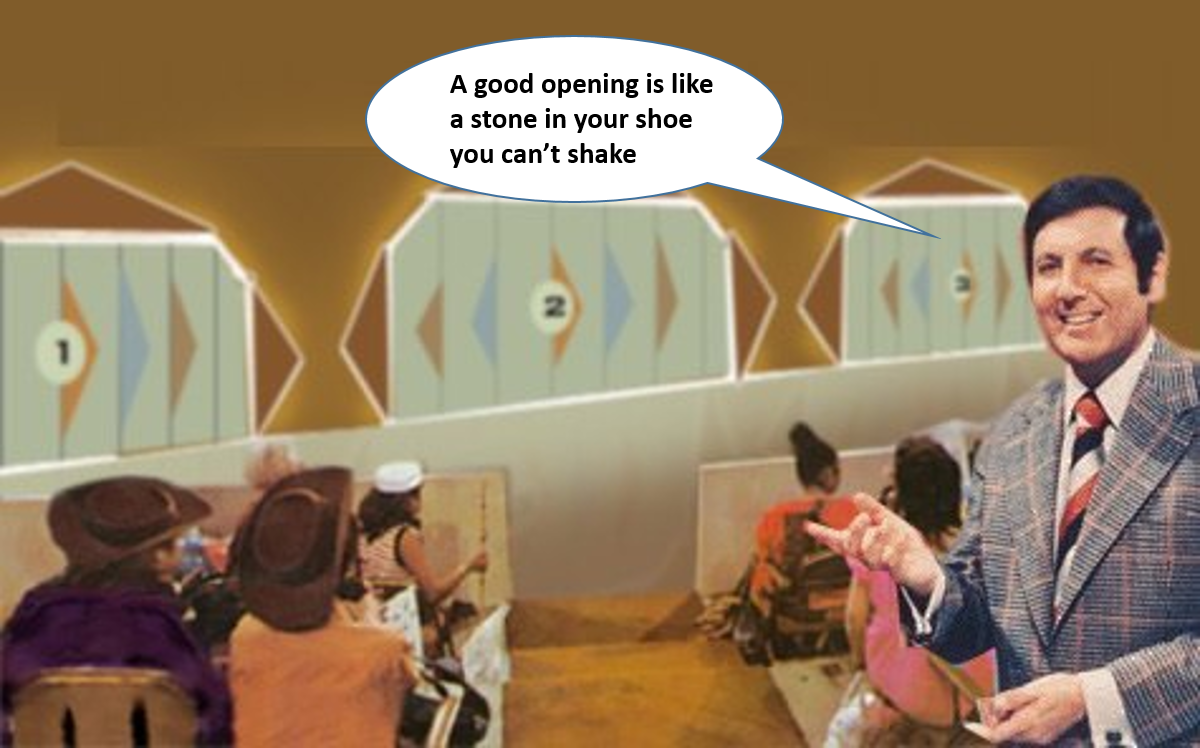
I’d give anything for a nice sharp stone in my shoe right now.
I’m trying to start over with my work in (non)progress. A while back, I threw out the first five chapters. I knew in my gut it was bad, but it took me three months and many sleepless nights to finally admit it. You know that door metaphor I use here a lot? I like to say that finding the right door through which to enter your story is maybe the most important decision a writer has to make. Well, I had entered my door — it was a very pretty writerly door — but it turned out to be a dead-end.
Which brings us to our First Page Critique today. I will let you read and then we’ll talk.
Title: Joe Blatz
Joe Blatz put his Bic pen up to his mouth and began to chew on the cap, lightly this time, because he didn’t want to ruin another one. He was thinking about what he should write on his report about his last case. He was trying to stick to the facts and not color his words too much with his attitude toward the slimy perp he had just cornered, cuffed, and stuffed into a patrol car not three hours before. These country crooks really pissed him off, and on some days he had a shorter fuse than others.
He was sitting in his basement office in his log home in the country, about 5 miles from Cannonsville, Tennessee. His basement was paneled with dark wood and had carpet on the floor. The basement was divided into two sections, one toward the back of the house where his office was, and one in the front that was more of an entertainment area that contained a leather couch, big-screen TV, a wet bar, and a full-size refrigerator. He didn’t use the entertainment area that much, preferring to relax either upstairs or on the front porch in one of his rocking chairs.
Joe pushed himself away from his desk and leaned back in his wooden desk chair, an antique he had picked up at a country estate yard sale several years before. It was made of solid oak and was scarred up enough to give it ‘character,’ as Joe put it. He liked scuffed up, half worn out things that other people seemed to shy away from. When someone said something was worn out and needed to be thrown away, he thought it was just getting broken in. He was a man of simple tastes, beer and bourbon, and simple viewpoints.
Joe turned his chair back to the desk and pulled it in and went back to writing. He was almost finished. Then he would fax his report to his client and the local police in Cannonsville, who were interested in it, too. Cannonsville’s police department was shortstaffed and had come to rely on Joe’s reports whenever he wrote them and it involved their jurisdiction. It helped them put together evidence and sometimes help them convince the local district Attorney to prosecute a case. Joe didn’t mind helping out the local police, especially since that’s where he got his dog from.
_________________
I’m back. (By the way, before I forget, that quote about the stone in the shoe is not from Monte Hall. It’s from Chuck Wendig. I just put Monte in there to get your attention.)
About Joe Blatz…
He might be an interesting guy. He might have an interesting job (though we aren’t told what he does, except push perps into cars when the local cops are too busy). He likes bourbon, has a cool old desk and a dog. But what Joe is doing here is not very interesting at all. Nothing is happening. All we’re getting is memory and thoughts. Note the sentence constructions:
“He was thinking about what he should write…”
“He was trying to stick to the facts…”
“He was sitting in his basement office…”
“He was almost finished…”
Now, there is nothing wrong with the writing here, on the surface. Gets the job done. But it is passive, and the situation itself is static. As we always say here, it is hard in a mere 400 words to see where a story is going, but when it starts in a neutral gear like this, it is hard to get excited about the journey ahead. Often, I suggest to writers that they might have entered their scene too early. Here’s an example of this that I made up:
The phone jarred Joe from his sleep and he grabbed the receiver. “Yeah?” he stammered, his voice raspy from last night’s Camels and Christian Brothers.
“We got another one. Young, pretty. Just floated up on Juno Beach.”
“Did she have the pink ribbon around her neck?”
“Yup. Just like all the others.”
“I’ll be there in fifteen minutes.” Joe hung up and swung his feet to the cold floor. He didn’t like the bad feeling that was gathering in his gut.
This is where the same scene begins, in my humble opinion:
The body, nude except for the ribbon around the neck, moved back and forth with the incoming tide. It was like the water was trying to gently rock the girl to sleep. Or back to life.
Joe stood three feet away, as close as the yellow tape would allow, staring hard at the ribbon. Pink…just like the others, all six of the other girls he had seen dead in the water during the past four months had been the same.
He turned away. Except for this one. This one he recognized.
Do we need the phone call? A case could be made for it. (See below). But I think you have a better chance of your story feeling fresh if you enter your scene at a prime moment of disturbance. Show us something happening live. Give us some emotion. Don’t waste the precious opening moments of your book clearing your throat with unimportant action. Get into a scene as late as possible.
However…
The problem with Joe Blatz is that I think the writer perhaps got into the scene too late. Three hours too late, to be exact. What is the most interesting thing mentioned? That Joe busted two creeps in his free-lance cop role. I’d much rather read about that then Joe writing his report and thinking about his old desk.
I started reading an 2018 Edgar nominee this week called Ragged Lake by Ron Corbett. He opens with a two-page omniscient description of a remote cabin in the forest built by an odd family of squatters. A forestry worker discovers the family murdered:
The boy never went inside the cabin. Peered through a window and then took off for Ragged Lake, making good time on his snowshoes, then telling the bartender at the Mattamy something bad had happened by the headwaters of Springfield. Something that shouldn’t have happened, because no cabin should have been out there on O’Hearn timber rights on O’Hearn land. Something evil-bad had happened.
They needed to phone someone.
That’s the end of chapter 1. Chapter 2 opens with a continuation of the close omniscient point of view:
The call was logged in at the and Cork’s Town detachment of the regional police at 6:17 p.m. on a Tuesday evening. An elderly dispatcher took the call, asked a few questions, then reached for an incident report form and repeated most the questions. After that, the dispatcher hit a key on his computer and a list of names and phone numbers appeared on his screen. He dialed the third on the list.
Note the natural bridge between chapters with “the call.” The next graph is the protag, Frank Yakabuski answering the call and the plot is off and running. The writing is atmospheric and spare, so I don’t mind the lack of a personal point of view and we get to the real case — a true disturbance — quickly, by page 4. The writer could have segued straight into Frank at the cabin, like I outlined in my scene above, but I think this slower move into the case works okay. Especially since it segues smoothly into Frank’s POV and all info is related almost exclusively through crisp dialogue. And we are introduced to Frank’s father, who is wheelchair bound after a freak shotgun accident, who I suspect is going to serve as Frank’s confidant, in the vein of James Garner’s dad Rocky in “The Rockford Files.”
I bring this book up just to point out that there are no hard rules — so, yes, you can ease into a scene and no, you don’t always have to use intimate point of view. But you still have to find a good door into your story. Whether the door swings open fast or creaks slowly ajar just wide enough for the reader to slip in, that’s what we call style.
Compare the measured opening of Corbett’s Ragged Lake with the opening of James Scott Bell’s latest Your Son is Alive:
Your son is alive.
A scrawl in red crayon. Messy block lettering across a piece of 8×10 white bond that had been tri-folded and placed in a blank business envelope.
It had been slipped under Dylan Reeve’s door in the middle of the night.
Dylan, holding the note, stumbled to a chair, sat heavily, his bathrobe bunched up under him. He didn’t know how long he sat there. All he knew was he hadn’t moved, except to wipe his eyes.
Finally, he got up, went to the kitchen where he phone was plugged in next to the coffee maker. He called Erin.
Boom…we’re dropped right into the central conflict of the story. James could have opened at the point when the boy disappeared ten years prior. He could have even opened with — ack ack — a prologue showing the boy getting abducted then jumped ahead to show the Reeves falling apart and getting divorced. But James picked door number 3, no backstory, no preludes. Just a nice big stone in the reader’s shoe.
The door chosen here to enter Joe’s world I don’t think is the best one. I’d bet there is a better one, maybe even later in the book that relates to the real case. I suspect the two perps mentioned have nothing to do with the actual plot. I suspect they are what I call a “false case” injected into the beginning to introduce the protag.
You have to be wary of “false case” openings. I recently beta-read a manuscript for a good friend who has published many thrillers. His chapter 1 features a fascinating protag quickly solving a case, then waiting for his superior to call him about the next one. It’s well-written and introduces his protag really well. But I questioned the wisdom of opening with a “false case” instead of going right to the real one, which begins in chapter 3. I told him that his false start could be justified because 1. It is short and juicy and 2. Its exotic locale would be a nice contrast to the rural American setting for the real case. But I still am not sure he wouldn’t be better off just letting his hero take off on the true path. Law and Order does this “false case” opening sometimes. But they always manage to link it to the real case eventually. That’s a big difference.

As I read Joe Blatz, I kept thinking of Alice in Wonderland, the part where Alice falls down the rabbit hole into the hall of doors. She’s overwhelmed trying to figure out which one to enter and in the end discovers a door behind a curtain that looks promising. But the door is too small. I think that is this writer’s problem here. The door to Joe Blatz’s world is so small, we’re getting no vision as to what’s on the other side.
Also, the passive construct has the additional problem of being all TELL and no SHOW. Rather than playing out the action “on camera” (Joe cuffing and stuffing the perps), we get his memory of it. Rather than showing us how Joe feels about these low-lifes via his actions on the scene and his live thoughts or better yet, dialogue, we have to rely on the writer telling us, “these country crooks really pissed him off, and on some days he had a shorter fuse than others.” Wouldn’t you rather see Joe’s fuse go off? I would. I want to follow a pro-active hero, not a Bic-munching muser.
One more thing. I hope the title is only a working one. This isn’t a title, it’s a label. It’s okay to use a character’s name in the title, but you have to make it mean something. It wasn’t Gatsby. It was, ironically, The Great Gatsby. He is a criminal whose real name is James Gatz, and the life he has created for himself is an illusion. T. Jefferson Parker didn’t call his Edgar-winning thriller about cop-cum-bodyguard Joe. He called it Silent Joe because Joe’s adoptive father taught him: “Mouth shut, eyes open. You might actually learn something.” The “silent” also has a poignant second meaning for Joe personally.
Yeah, I know…Emma, Jane Eyre, Rebecca, Carrie, and Lolita. But remember that Nabokov didn’t call her Lola, and for good reason. Here’s his great opening paragraph:
Lolita, light of my life, fire of my loins. My sin, my soul. Lo-lee-ta: the tip of the tongue taking a trip of three steps down the palate to tap, at three, on the teeth. Lo. Lee. Ta. She was Lo, plain Lo, in the morning, standing four feet ten in one sock. She was Lola in slacks. She was Dolly at school. She was Dolores on the dotted line. But in my arms she was always Lolita.
Now that’s a heck of a “door” — to Dolores and the havoc she wreaks on Humbert.
Try to pick the right door. You want your reward to be an engaged reader, not a lifetime supply of Turtle Wax.