Resorting to Manual Methods

By John Gilstrap

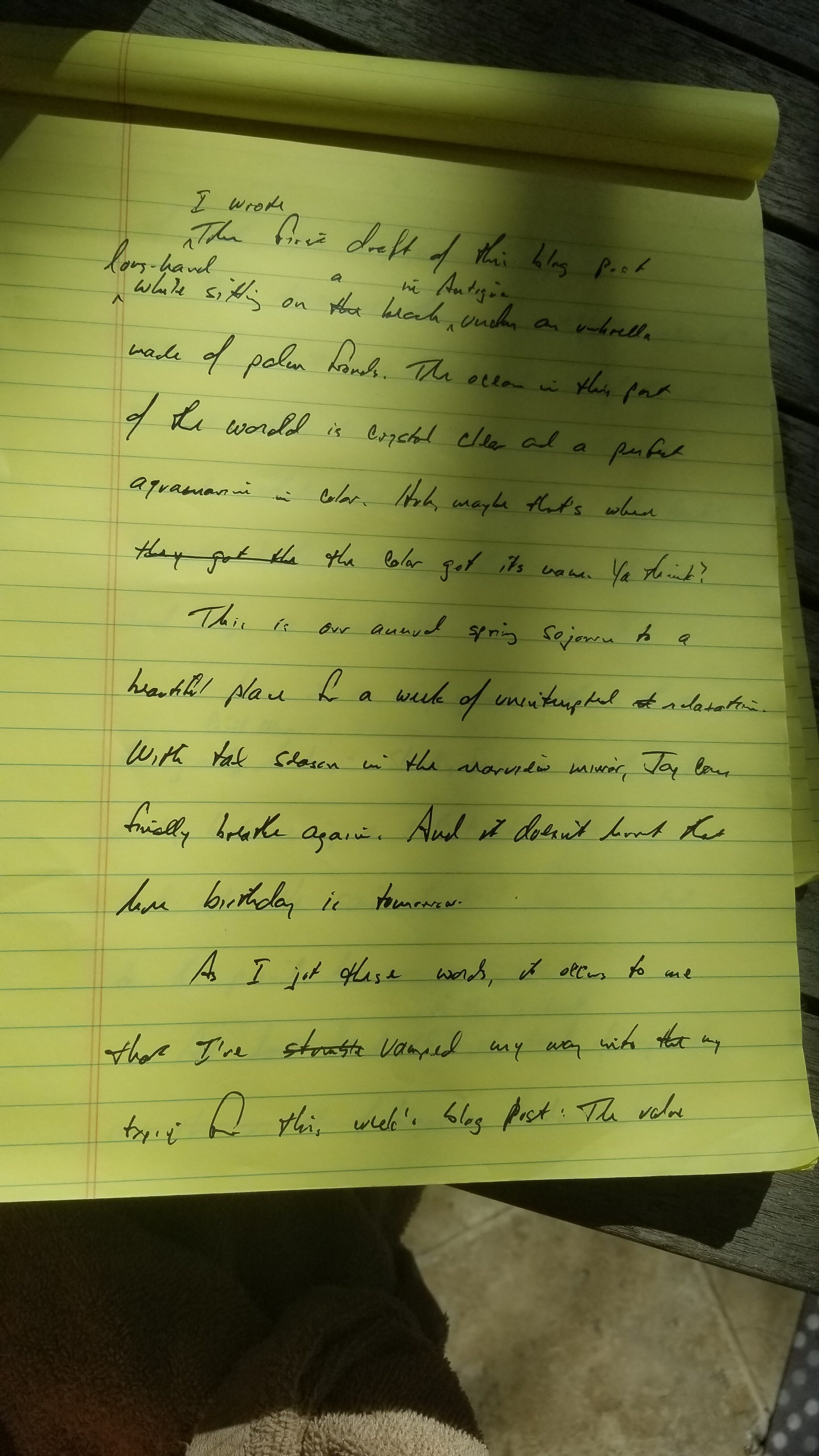
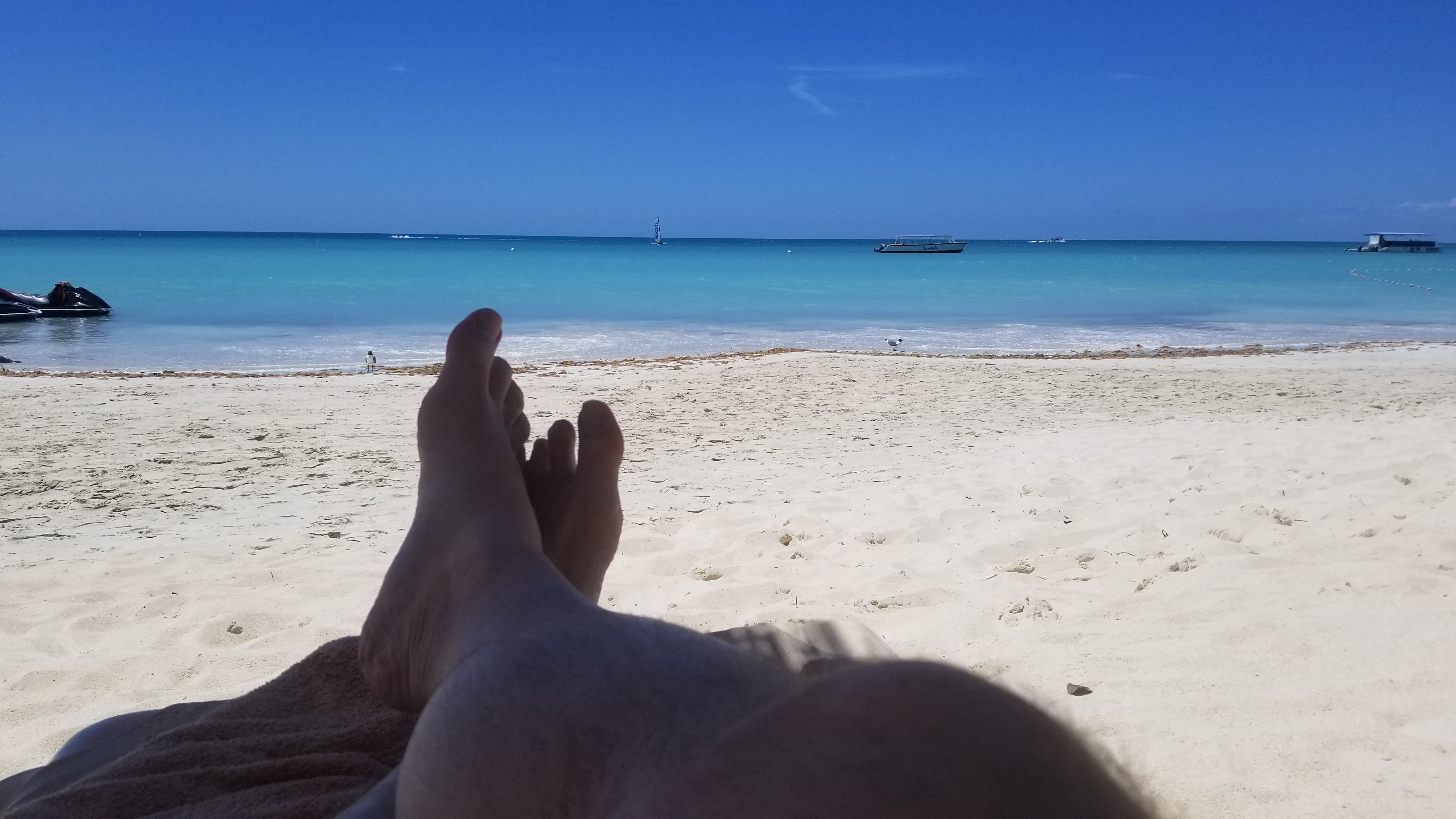
I wrote the first draft of this blog post longhand while sitting on a beach in Antigua, under an umbrella made of palm fronds.  The ocean in this part of the world is crystal clear and a perfect aquamarine in color.  Huh, maybe that’s where the color got its name.  Huh.

This is our annual spring sojourn to a beautiful place for a week of uninterrupted relaxation.  With tax season in the rear view mirror, Joy can finally breathe again.  And it doesn’t hurt that her birthday is tomorrow.  As I jot these words, it occurs to me that I’ve vamped my way in to my topic for this week’s blog post: The value of putting pen to paper–literally.

I had no idea what this week’s post would be until I started stringing words together. Then it came to me. That’s the power of picking up a pen!

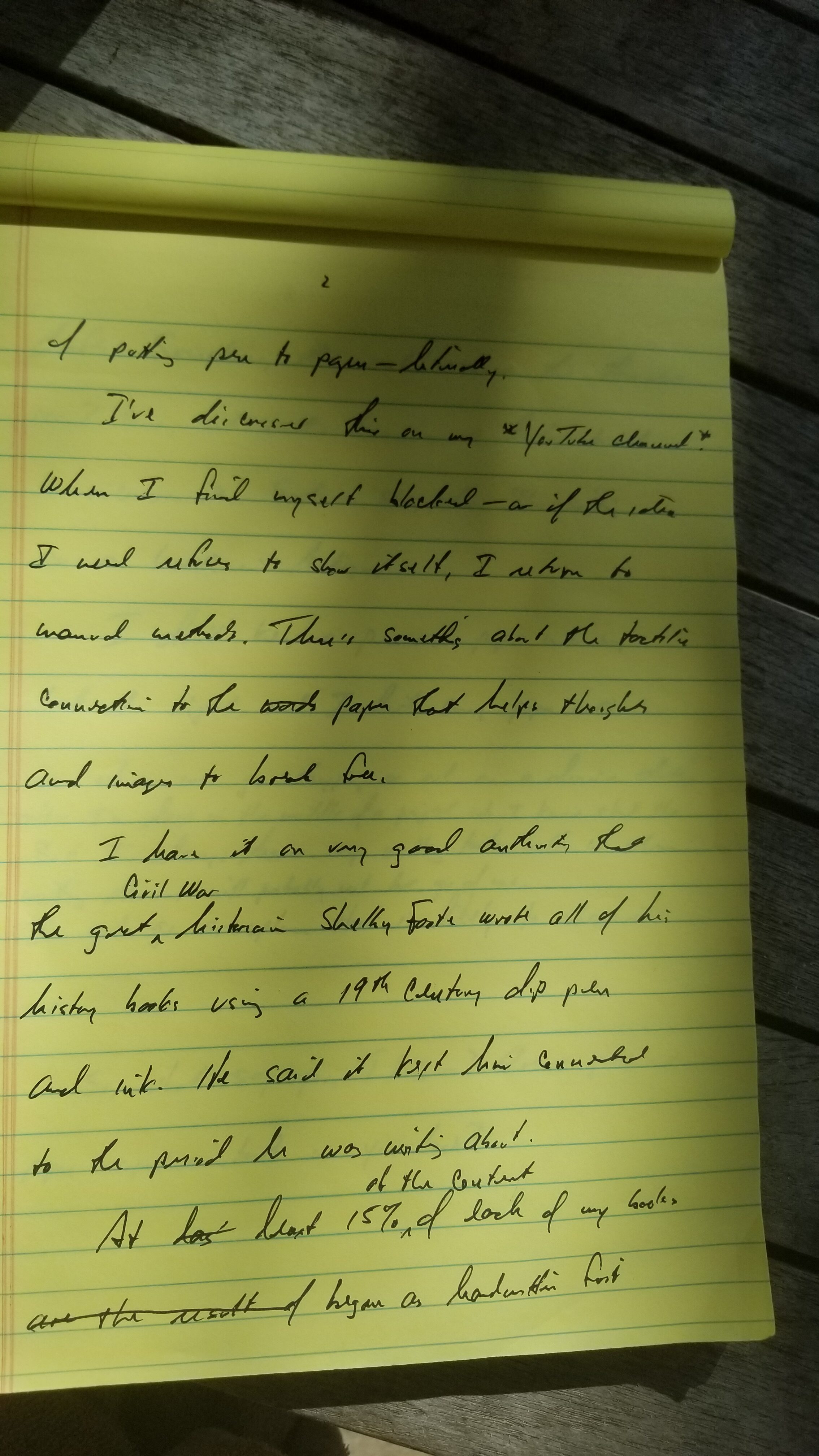
I’ve discussed this on my YouTube channel.  When I find myself blocked–or if the idea I need refuses to show itself, I return to manual methods.  There’s something about the tactile connection with the paper that helps words and images to break free.

I have it on very good authority that the great Civil War historian Shelby Foote wrote all of his history books using a 19th century dip pen and ink.  He said it kept him connected to the period he was writing about.

I always double-space handwritten drafts because it leaves room for editing as I go along.

At least 15% of the content of each of my books begin as handwritten first drafts.  Sometimes, it’s not because the thoughts won’t come, but rather because a laptop is inconvenient.  Say, for example, when I’m sitting on a beach in Antigua.

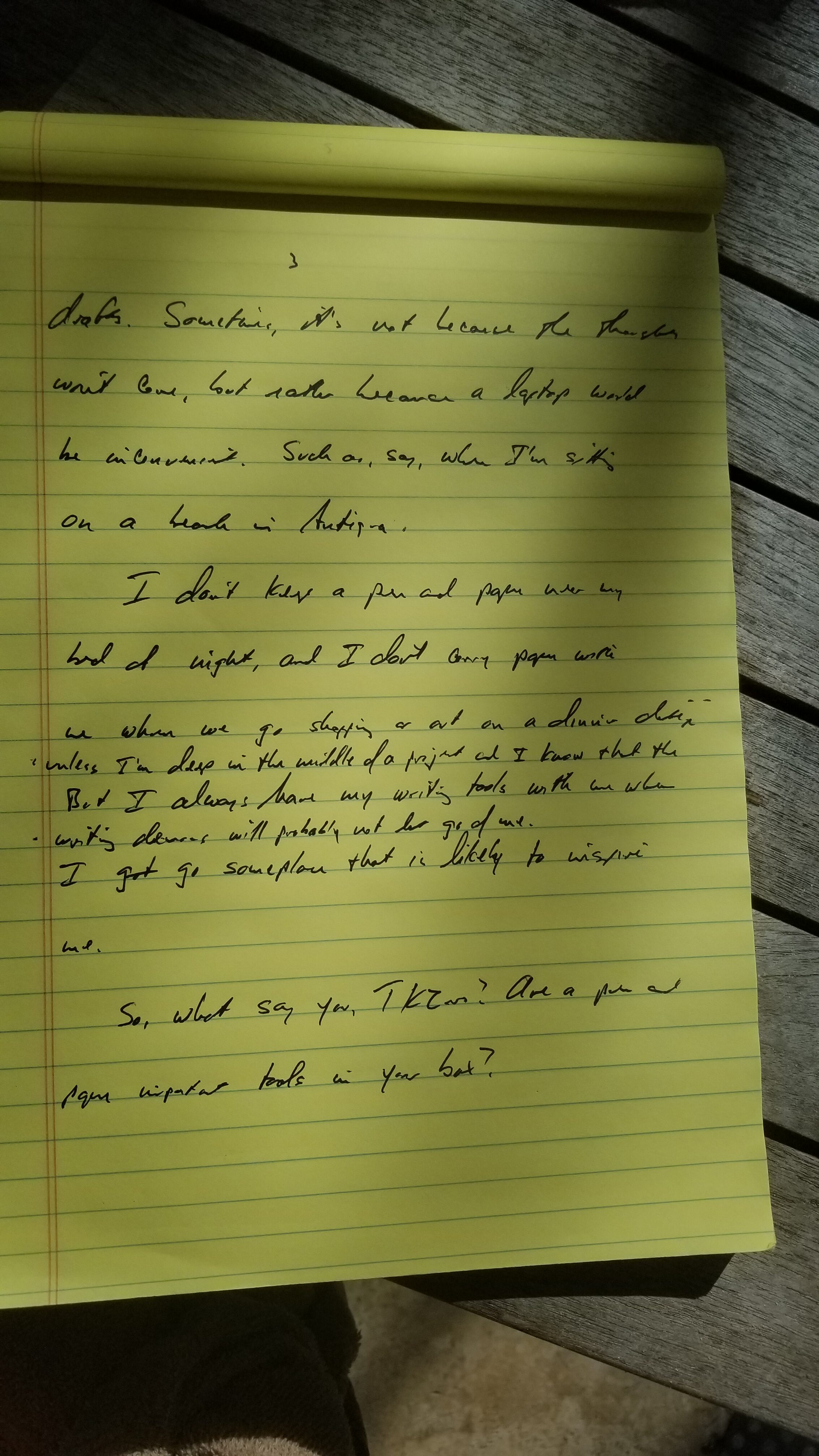
I don’t keep a pen and paper near my bed at night, and I don’t carry paper with me on routine outings such as shopping, or going out on a dinner date–unless I’m deep in the middle of a project and I know that the

It’s not uncommon for edits to run for over a page in the spaces between the lines of the original text. It can get confusing during rewrites.

writing demons will probably not let go of me.  But I always have my writing tools with me when I go someplace that is likely to inspire me.

Just as an aside, if I had been drafting a section of a book by hand, I would have included a slug line at the top that would show the date and my location at the time I was drafting it.  That has no practical rationale in real time, but now that I’ve been doing this for a couple of decades, it’s nice to remember where I was, back in the day.

So, what say you, TKZers?  Are a pen and paper important tools in your box?


First Page Critiques:
A Look At The Edgar Nominees

Edgar Awards waiting to come out of hiding last year.

By PJ Parrish

I’ll be on a plane to New York when you read this. (Or maybe sitting in Charlotte…it’s not easy getting out of Tallahassee to the rest of the world). I’m off to my annual Edgar Awards duties.  I am the chair of the banquet, which is the easy fun part.  The hard part of Edgar duties is being a judge.

I’ve never been one but I did judge best first novel for the ITW Thriller Awards one year. Hundreds of books…they just kept coming.  In the beginning, it was a trickle but by June it was a deluge. Three-hundred-plus of them by Christmas. I grew to dread the sound of the FedEx truck.  And yeah, I read every one of them.  Not always to the end, I will admit. But I always gave each book at least 100 pages to find its legs before I assigned it to the “yes” or “maybe” or “not as good as maybe” pile in my office (actually, I had to end up also using the top of my baby grand).  Then I had to winnow the “yes” pile (I think it was about thirty books) down to five nominees.

One thing I remember was that all the “yes” books had a good opening. And you know, the principles I applied then to moving a book to the “yes” pile are the same ones I use when I critique one of our First Page submissions.  Sure, the published thriller writers had more craft over the course of the entire book than some of our submissions here, but the basic principles behind a good opening were the same.

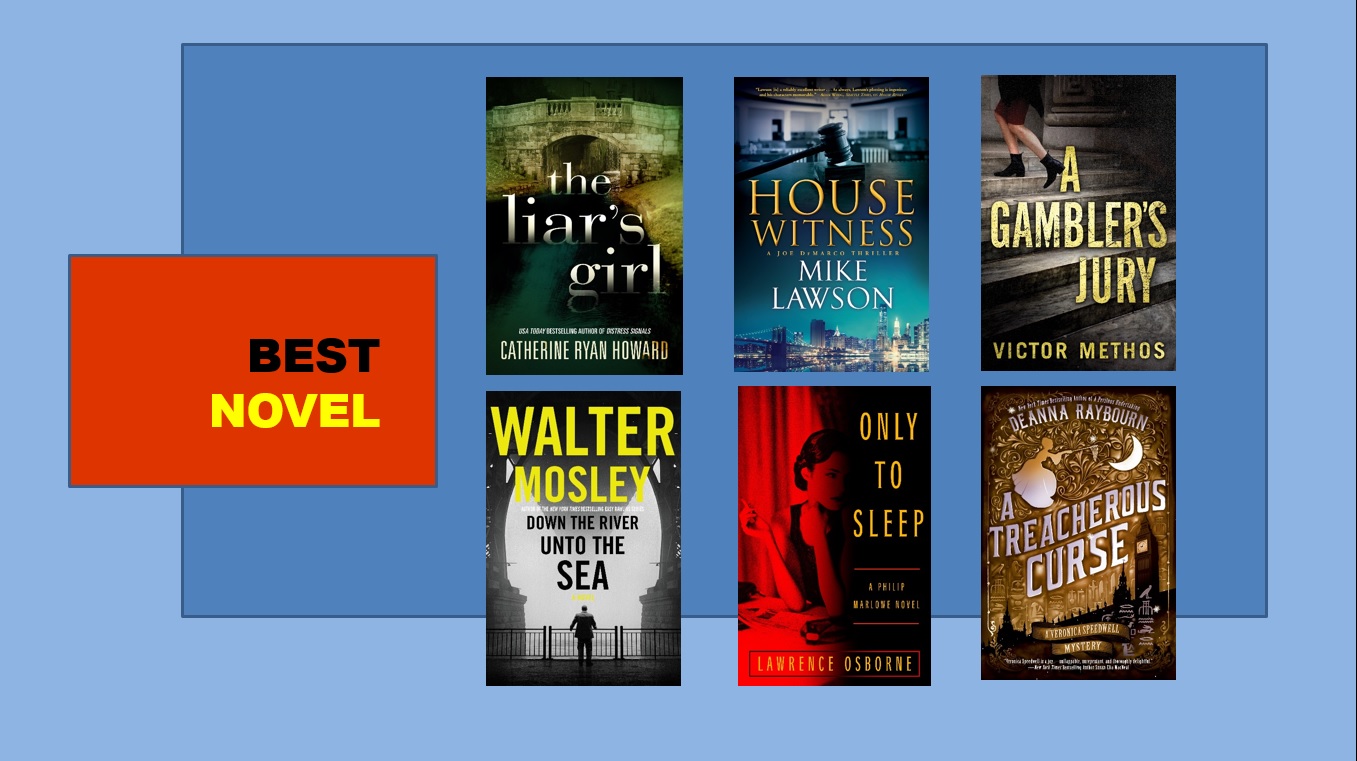
Yesterday, I was putting together the PowerPoint for the Edgars. As usual, my attention was mainly on the visuals of the covers, which we flash up on a giant screen in the Grand Hyatt ballroom as the nominees as announced.  Here is what the Best Novels look like this year:

Nice covers, right? (You can see all the covers in every category on MWA’s Edgar website here). But then I got to wondering, what are they like inside? How do these writers handle the openings of their stories? Just for fun, I thought we could take a peek here today.

The stories include a legal thriller with a tortured heroine who’s fighting the government and her own demons; an Irish thriller about a girl who falls for a convicted serial killer only to find out ten years later he’s not what he seemed; a fixer whose client is a big-time politician with secrets someone will murder to protect;  a cop-cum-PI who’s trying to find the man who framed him and cost him his badge; a resurrection of the iconic Philip Marlowe, now 72 and retired in LA; and a Victorian adventuress trying to unravel of web of intrigue at an Egyptian dig.

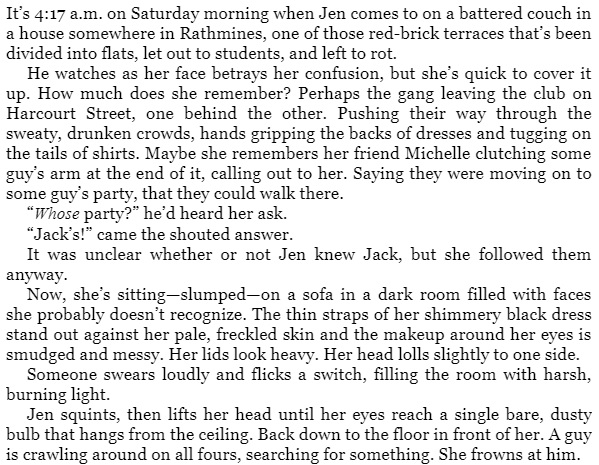
Here’s the first page (not titled chapter 1, by the way), of Catherine Ryan Howard’s The Liar’s Girl.

This is a tricky opening in that the writer is playing loose with point of view. In the first graph, it feels like we are in Jen’s POV, but by the second graph we realize we are seeing Jen coming to from the POV of the man watching her. This goes on for the whole chapter until she finally staggers out of the party room and he follows her. You just know he’s going to kill her. Or is he? There is a double-spaced scene break and then the title “will, now.” We are in the POV of a man named Will and very slowly we learn he is a patient listening to a radio broadcast about a girl who has been found dead in a canal. And he is concerned that this is related to something that happened to him ten years ago. Other chapters are titled “Alison, now” etc., which recalls the Rashomonesque structure of Gone Girl. You can read the full sample here.

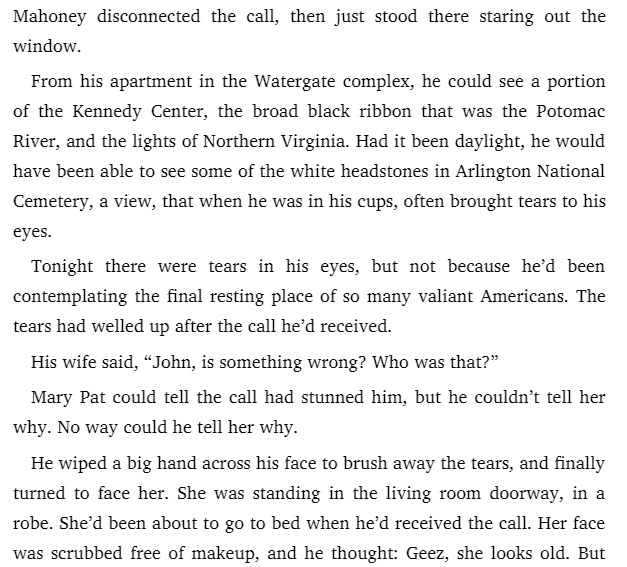
Here is the opening, labeled Prologue, of House Witness by Mike Lawson: 

We get about a page more where he says he need to take a walk and his wife tells him it’s too cold and he’s had too much to drink but he insists on going anyway. Then comes this line to end the scene:

John Mahoney had just been told that his son had been killed — and his wife didn’t know he had a son. 

Good kicker! The rest of the prologue is Mahoney on his walk, wherein we learn he is the disposed speaker of the House who had an affair years before with an aide Connie. After some extensive backstory, we learn the call was from Connie who tells him their son was shot in a Manhattan bar and berates Mahoney into making sure the dead son’s in-custody killer is convicted. Mahoney thinks about all the mistakes he has made and calls his “fixer” Joe DeMarco.  DeMarco calls back the next day and assures Mahoney the killer’s prosecution is a “slam dunk.” The last line of the prologue is “DeMarco was dead wrong.”  The chapter 1 goes back to the night the son was murder from the killer’s point of view. This is the 12th book in the Joe Demarco series. But because the Amazon sample is short, I don’t know when the protagonist DeMarco makes his entrance. Read the sample here. 

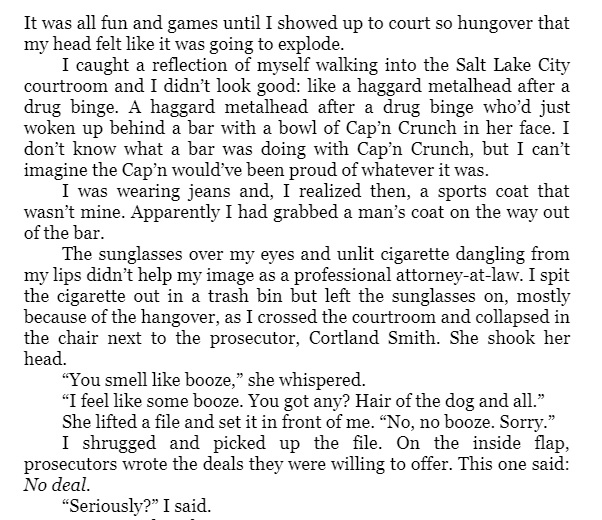
Next up is Chapter 1 of A Gambler’s Jury by Victor Methos.

This scene is a classic introduce-the-protag opening. After this, she goes to see another potential client whose future is so dim, she advises him he should just pack up and high-tail it to Mexico. A brief Chapter 2 takes us to her office, until she decides instead to detour to a bar, where we meet her friend Michelle, the owner. In Chapter 3, it’s the next morning at her apartment where we meet another friend who is concerned about Dani’s lifestyle before Dani goes to another court proceeding.  You can read the sample here.

Now take a look at Walter Mosley’s latest, Down The River Unto the Sea.

This first-person point of view narrative is from the protagonist Joe Oliver. He talks about how he’s too influenced by his sex drive and that leads us, after a double-space break to this sentence “Her name was Nathali Malcolm.”  (Nice bridge!) So with this type of opening we are firmly in intimate POV in what I suspect might be a cherchez la femme character-driven noir as only a master like Mosley can tell it.  Read the sample here. 

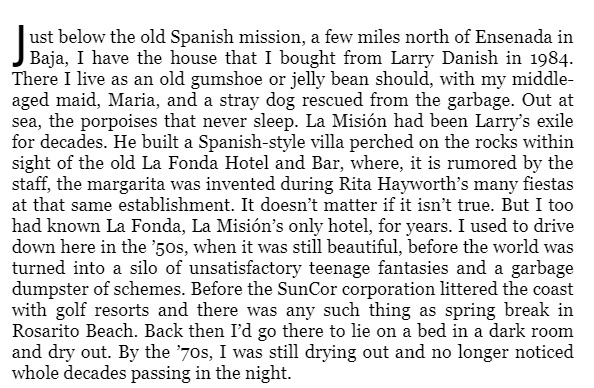
Speaking of noir, guess who’s back? Philip Marlowe himself in Lawrence Osborne’s resurrection Only To Sleep. Marlowe is 72, retired, and swilling margaritas on his patio when two men walk in with a case that has the Marlowe name written all over it. Osborne’s opening, once it gets going, is redolent of night-blooming jasmine, gin, and that signature rude Chandler wit:

It’s a bit disconcerting to find Marlowe still taking cases from men who “smile with the small contempt of company men” in Reagan-era LA. But it’s fun and the voice is assured. Take a look here. 

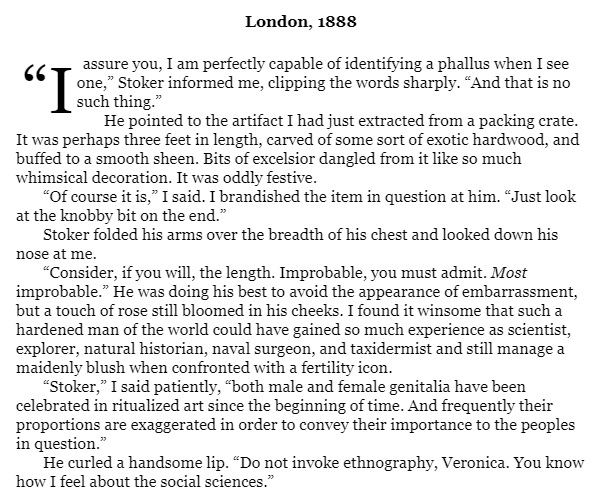
From Los Angeles in 1988 on to London in 1888. Here’s the opening of our final Edgar Best Novel nominee A Treacherous Curse by Deanna Raybourn:

Now, if you’ve read my critiques before, you know I don’t like chapters that open with dialogue. This one is, ah, rather interesting. Not just for the sexual word play but because, I think, we get a quick bead on the personalities of our protagonist Miss Veronica Speedwell and her partner-foil Stoker. The chapter continues, after some repartee, with backstory about their partnership and how they’ve come to take on their latest case. The chapter is longish and leisurely in pace. Yet I was pulled in.  And I am not a regular fan of historical crime fiction.  You can read the sample here.

As I said, I don’t envy the task of judges. There were 595 entries in the Best Novel category this year. That’s a lot of reading and thinking.

So what do you think? Any openings here that would lure you in? I haven’t the foggiest idea who will win Best Novel this year. I never do. But around 10:30 Thursday night, one of these writers is going to be very very happy, holding court in the bar of the Grand Hyatt, clutching an ugly little porcelain statue.  Congrats to all the nominees. Well done. Here’s the full list.

ELVIS PRESLEY — WHAT REALLY KILLED THE KING OF ROCK ‘N ROLL

By SUE COLETTA

I invited my dear friend Garry Rodgers — retired homicide detective with a second career as a forensic coroner — to share a fascinating post about the real cause of Elvis Presley’s death. Prepare to be wowed. Welcome to TKZ, Garry!
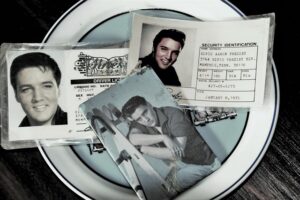
Elvis Presley suddenly dropped in the bathroom of his Graceland mansion on the afternoon of August 16, 1977. Elvis was rushed to Baptist Memorial Hospital in Memphis, Tennessee, where he was pronounced dead, then shipped to the morgue and autopsied the same afternoon. Three days later, the Memphis County coroner issued Elvis Presley’s death certificate stating the cause as hypertensive cardiovascular disease with atherosclerotic heart disease — a heart attack subsequent to high blood pressure and blocked coronary arteries.

It was a rush to judgment. Toxicology results soon identified ten pharmaceutical drugs in Elvis’s system. Codeine was at ten times the therapeutic level and the combination of other prescription drugs suggested a poly-pharmacy overdose. This revelation started immediate accusations of a cover-up and conspiracy theories quickly hinted at sinister criminal acts.

Four decades later, modern medicine and forensic science looked at the Presley case facts. The review indicated something entirely different from a heart attack or drug overdose really killed the King of Rock ‘n Roll. It said Elvis Presley accidentally died after long-term complications from earlier traumatic brain injuries (TBIs). TBIs are known as silent, stalking, and patient killers.

Looking back, it’s likely old accidental head injuries triggered events leading to Elvis Presley’s death.

From my experience investigating unexpected and unexplained sudden deaths, the accidental conclusion makes sense when you consider the totality of evidence in Elvis’ death. Setting aside media reports of gross negligence, arm-chair speculation of cover-up and fan accusations the King was murdered, there’s a simple and straightforward conclusion based on facts. But before examining the facts and knowing hindsight is 20/20, let’s first look at how coroners conduct sudden and unexplained death investigations.

Coroners are the judges of death. Their responsibilities include establishing five main facts surrounding a death. Coroners do not assign blame or fault. In the Presley case, the five facts determined at the immediate time were:

  1. Identity of Deceased — Elvis Aaron Presley
  2. Time of Death — Approximately 2:00 p.m. on Tuesday, August 16, 1977
  3. Place of Death — 3754 Elvis Presley Boulevard, Memphis, Tennessee
  4. Cause of Death — Heart attack
  5. Means of Death — Chronic heart disease

There’s a distinct difference between Cause of Death and Means of Death. Cause is the actual event. Means is the method in which death happened. Example: cause being a ruptured aorta with means being a motor vehicle crash, or cause being massive cerebral interruption with means being a gunshot wound to the head.

Once the facts are known, it’s the coroner’s duty to classify the Manner of Death. There are five universal manner of death classifications:

  1. Natural
  2. Homicide
  3. Suicide
  4. Accidental
  5. Undetermined

Elvis Presley’s death was ruled a natural event, thought at the time being an acute cardiac event from existing cardiovascular disease. If the coroner determined Elvis died from a drug overdose, the ruling would have been accidental. No one ever claimed it was suicide or homicide.

One principle of death investigation is to look for antecedent evidence—preexisting conditions which contributed to the death mechanism or was responsible for causing or continuing a chain of events that led to the death.

Another principle of death investigation is examining the cornerstone triangle of Scene—Body—History. This compiles the totality of evidence or case facts. Given that, let’s look at the evidence and case facts in Elvis Presley’s death.

Scene

Elvis was found on his bathroom floor, face down in front of the toilet. It was apparent he’d instantly collapsed from a sitting position and there was no sign of a distress struggle or attempt to summon help. When the paramedics arrived, Elvis was cold, blue, and had no vital signs. Rigor mortis had not set in, so he’d probably expired within the hour. He was transported by ambulance to Baptist Memorial Hospital where a vain attempt at resuscitation occurred because “he was Elvis”.

ER doctors declared Elvis dead at 3:16 p.m. He was then moved to the morgue where an autopsy was promptly performed. There was no suggestion of suicide or foul play, so there wasn’t a police investigation. The scene wasn’t photographed, nor preserved, and there was no accounting for what medications or other drugs might have been present at Graceland. There’s no official record of the coroner attending the scene as this was considered an in-hospital death and a routine occurrence.

Body

Elvis was in terrible health. His weight estimated at 350 pounds—gaining 50 lbs. in the last few months of his life. He was virtually non-functional at the end, being mostly bed-ridden and requiring permanent nursing care. Elvis suffered from an enlarged heart which was twice the size of normal and showed advanced evidence of cardiovascular disease in his coronary vessels, aorta, and cerebral arteries—certainly more advanced than a normal 42-year-old would be. His lungs showed signs of emphysema, although he’d never smoked, and his bowel was twice the length of normal, with a partially-impacted stool estimated to be four months old.

Elvis also suffered from hypogammaglobinemia, which is an immune disorder, as well as showed evidence of an autoimmune inflammatory disorder.

Toxicology tested positive for ten separate prescription medications but showed negative for illicit drugs and alcohol. The only alarming pharmaceutical indicator, on its own, was codeine at ten times the prescribed manner but still not in lethal range.

This is a quote from Elvis’s toxicology report:

“Diazepam, methaqualone, phenobarbital, ethchlorvynol, and ethinamate are below or within their respective ranges. Codeine was present at a level approximately 10 times those concentrations found therapeutically. In view of the polypharmacy aspects, this case must be looked at in terms of the cumulative pharmacological effect of the drugs identified by the report.”

History

Elvis was born on January 8, 1935 in Tupelo, Mississippi and had a twin brother who died at birth. As a youth, Elvis was active and healthy which continued during his time in the U.S. military and all through his early performing stage when he was a bundle of energy. He began experimenting with amphetamines, probably to enhance his performances, but shied away from alcohol as it gave him violent tendencies.

In 1967, Elvis came under the primary care of Dr. George Nichopoulos who was well-known to celebrities. Then, Elvis was 32 years old and weighed 163 pounds. His only known medical ailment was slight high blood pressure, presumably due to his high-fat diet.

Also in 1967, Elvis’s health took a sudden turn with progressive pain, insomnia, hypertension, lethargy, irrational behavior and immense weigh gain. Over his remaining years, Elvis was seen by a number of different doctors and was hospitalized a number of times, all the while resorting to self-medication with a wide assortment of drugs from dozens of sources.

Doctor Nick, as Nichopoulos was called, stayed as Elvis’s personal physician till the end. He was present at the death scene as well as during the autopsy. Doctor Nick concurred with the coroner’s immediate conclusion that the cause of death was a natural cardiac event resulting from an arrhythmia, or sudden interruption of heartbeat, and agreed that Elvis’s death was not due to a drug overdose.

When the toxicology report was released, it came with a qualifier:

“The position of Elvis Presley’s body was such that he was about to sit down on the commode when the seizure occurred. He pitched forward onto the carpet, his rear in the air, and was dead by the time he hit the floor. If it had been a drug overdose, [Elvis Presley] would have slipped into an increasing state of slumber. He would have pulled up his pajama bottoms and crawled to the door to seek help. It takes hours to die from drugs.”

Because the tox report appeared to contradict the autopsy report’s stated cardiac cause of death, a prominent toxicologist was asked to review the findings. His opinion was:

Coupled with this toxicological data are the pathological findings and the reported history that the deceased had been mobile and functional within 8 hours prior to death. Together, all this information points to a conclusion that, whatever tolerance the deceased may have acquired to the many drugs found in his system, the strong probability is that these drugs were the major contribution to his demise.”

The Tennessee Board of Health then investigated Elvis’s death, which resulted in proceedings against Doctor Nick.

Evidence showed that during the seven and a half months preceding Elvis’s death—from January 1, 1977, to August 16, 1977—Doctor Nick wrote prescriptions for Elvis for at least 8,805 pills, tablets, vials, and injectables. Going back to January 1975, the count was 19,012.

These numbers might defy belief, but they came from an experienced team of investigators who visited 153 pharmacies and spent 1,090 hours going through 6,570,175 prescriptions and then, with the aid of two secretaries, spent another 1,120 hours organizing the evidence.

The drugs included uppers, downers, and powerful painkillers such as Dilaudid, Quaalude, Percodan, Demerol and Cocaine Hydrochloride in quantities more appropriate for those terminally ill with cancer.

Doctor Nick admitted to this. His defense was because Elvis was so wired on pain killers, he prescribed these medications to keep Elvis away from dangerous street drugs, thereby controlling Elvis’s addiction—addiction being a disease.

One of the defense witnesses, Dr. Forest Torrent, a prominent California physician and a pioneer in the use of opiates in pain treatment, explained how the effects of this level of codeine would have contributed to Elvis’s death.

Central to misconduct allegations was the issue of high codeine levels in Elvis at the time of death—codeine being the prime toxicological suspect as the pharmaceutical contributor. It was established that Elvis obtained codeine pills from a dentist the day before his death and Doctor Nick had no knowledge of it.

The jury bought it and absolved Doctor Nick of negligence in directly causing Elvis Presley’s fatal event.

Continuing Investigation

Dr. Torrent was convinced there were other contributing factors leading to Elvis’s death. In preparation for Doctor Nick’s trial, Dr. Torrent had access to all of Elvis Presley’s medical records, including the autopsy and toxicology reports. Incidentally, these two reports are now the property of the Presley estate and are sealed from public view until 2027, fifty years after Elvis’s death.

Dr. Torrent was intrigued by the sudden physiological and psychological changes in Elvis starting in 1967. He discovered that while in Los Angeles filming the movie Clambake, Elvis tripped over an electrical cord, fell, and cracked his head on the edge of a porcelain bathtub. Elvis was knocked unconscious and had to be hospitalized. Dr. Torrent found three other incidents where Elvis suffered head blows, and he suspected Elvis suffered from what’s now known as Traumatic Brain Injury—TBI—and that’s what caused progressive ailments leading to his death.

Dr. Torrent released a paper entitled Elvis Presley: Head Trauma, Autoimmunity, Pain, and Early Death. It’s a fascinating read—recently published in the credible medical journal Practical Pain Management.

Dr. Torrent builds a theory that Elvis’s bathtub head injury was so severe it jarred brain tissue loose, which leaked into his overall blood circulation. Later additional head injuries exacerbated the problem. This is now known to be a leading cause of autoimmune disorder, which causes a breakdown of other organs. This progression was unknown in 1967 and Elvis went untreated. Side effects of TBIs include chronic pain, irrational behavior, and severe bodily changes such as obesity and enlarged organs like hearts and bowels.

Today, TBI is a recognized health issue in professional contact sports as well as incidental to motor vehicle accidents and workplace falls or other head injury events.

Dr. Torrent’s hypothesis holds that with a change in mental state and suffering chronic pain, Elvis Presley entered a ten year spiral towards death. He became hopelessly addicted to pain killers, practiced a terribly unhealthy diet and lethargic lifestyle, and resorted to the typical addict’s habit of sneaking a fix wherever he could. This led to early coronary vascular disease and, combined with his escalating weight and pill consumption, Elvis was a heart attack ready to burst.

Note that I used the term “antecedent,” like all coroners do when assessing a cause of death. Given Dr. Torrent’s observations—and all the facts compiled from forty years—if I were the coroner completing Elvis Presley’s death certificate today, I’d write it like this:

  1. Identity of Deceased — Elvis Aaron Presley.
  2. Time of Death — Approximately 2:00 p.m. on Tuesday, August 16th, 1977.
  3. Place of Death — 3754 Elvis Presley Boulevard, Memphis, Tennessee.
  4. Cause of Death — Cardiac arrhythmia, antecedent to hypertensive cardiovascular disease with atherosclerotic heart disease, antecedent to poly-pharmacy, antecedent to autoimmune inflammatory disorder, antecedent to traumatic brain injury/injuries.
  5. Means of Death — Cumulative head trauma.

Therefore, I’d have to classify Elvis’s death as an accident.

There’s no one to blame—certainly not Elvis. He was a severely injured and sick man. There’s no specific negligence on anyone’s part and definitely no cover-up or conspiracy of a criminal act.

If Dr. Forrest Torrent is right, there simply wasn’t a proper understanding back then to clearly determine what really killed the King of Rock ‘n Roll.

*   *   *

 

Garry Rodgers now works as an investigative crime writer with a number of publications to his credit.


In The Attic is based on a true double homicide he investigated involving a psychopathic ax-murderer. Garry also hosts a popular blog at DyingWords.net.
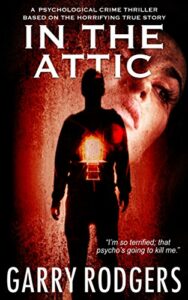
 

Note from Sue: I read IN THE ATTIC in August of 2016, and I doubt the story will ever leave me. It’s just one of those books that I’ll never forget. Visceral, raw, emotional, and true!

On Using Landmarks in Fiction

by James Scott Bell
@jamesscottbell

Happy Easter! And what better time for the reappearance of America’s favorite vigilante nun, Sister Justicia Marie of the Sisters of Perpetual Justice?

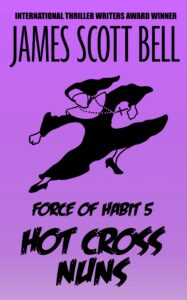
Yes, it’s finally here: FORCE OF HABIT 5: HOT CROSS NUNS. I had the title first. All I needed was the story to go with it. A hot cross … hmm … a stolen cross? But how big a deal would that be?

Then it hit me. Mrs. B and I love going to the Hollywood Bowl in the summer. We bring a picnic dinner and sit in an area that gives us a view of iconic Hollywood buildings, like Capitol Records, The Roosevelt Hotel (where, it said, the ghost of Marilyn Monroe hangs out), and the old, rugged Hollywood Cross. That was it! The perfect MacGuffin for the title.

A little L.A. history is in order:

[T] cross was conceived … as a memorial to one of Hollywood’s pioneers, Christine Wetherell Stevenson, the heiress to the Pittsburgh Paint fortune who helped arrange construction of the Hollywood Bowl. She was also an aspiring playwright who wrote “The Pilgrimage Play,” a pageant about the life and teachings of Jesus Christ.

In 1920, Stevenson chose 29 acres across the Cahuenga Pass from the Hollywood Bowl and helped carry stones from the nearby hills to build the open-air Pilgrimage Theater. She died two years later and in 1923, her admirers memorialized her by planting the cross on the hill above the theater.

Within six years, a brush fire destroyed the original theater and in 1931 Stevenson’s drama reopened in a concrete theater designed in what was described as an “ancient Judaic style.”

For many years, the cross was lighted only at Easter and during the annual “Pilgrimage Play” season. But the public’s affection for the landmark grew and soon Sunday school children were donating money to keep the cross lit. Ultimately, Southern California Edison Co. assumed that expense and bore it until 1941, when the theater and cross were donated to the county. After the county supervisors accepted the gift, they renamed the theater after Supervisor John Anson Ford, recognizing his 24 years of service to the district in which the theater is located. The play continued its annual run until 1964, when the first in a series of lawsuits triggered by the facility’s religious uses forced an end to the performances.

The cross was damaged by fire a year later. The county replaced it with a steel and Plexiglas structure and operated it routinely for years. But the tradition came under legal fire in 1978, when a California Supreme Court ruling ended Los Angeles’ 30-year practice of lighting City Hall windows to form a cross at Christmas and Easter. Two years later, a college professor successfully argued in court that the county was violating the constitutional separation of church and state by maintaining the cross…

The cross, however, remained–dark and unguarded, abused and unused. Vandals chipped away at its foundation until a windstorm knocked it over it 1984.

Afterward, a small group of crusaders began raising funds for a new cross by doing a video documentary, recording a song, “The Ballad of the Hollywood Cross” by Mindas Masiulis, and collaborating with the Hollywood Heritage preservation group.

Almost 10 years later, with little fanfare, a new cross was erected on the small hilltop patch after the group purchased the site from the county.

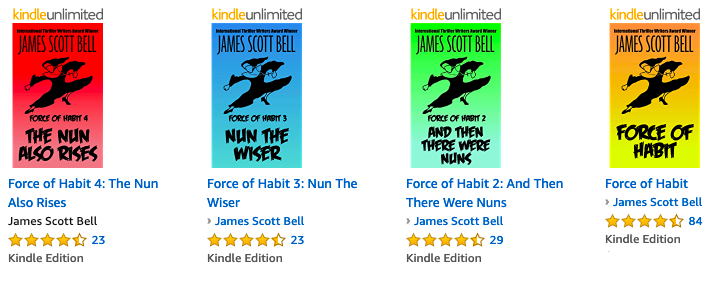
So how could this landmark possibly be stolen? Who would do such a thing? And why? Find out in FORCE OF HABIT 5: HOT CROSS NUNS, on sale now for 99¢. Like the other novelettes in the series, it can be read as a stand-alone. The other entries are:

FORCE OF HABIT

FORCE OF HABIT 2: AND THEN THERE WERE NUNS

FORCE OF HABIT 3: NUN THE WISER

FORCE OF HABIT 4: THE NUN ALSO RISES 

I love seeing landmarks in fiction and film. Who will ever forget the chase over Mount Rushmore in North by Northwest? Or King Kong atop the Empire State Building? Or the Stay Puft Marshmallow Man stepping on Holy Trinity Lutheran Church in Ghostbusters, bringing forth Bill Murray’s classic line: “Nobody steps on a church in my town!”

The landmark doesn’t even have to be world famous. For example, there’s Top Notch Hamburgers in Austin, TX. That’s where Matthew “All right, all right, all right” McConaughey made his mark in Dazed and Confused.

So what’s a landmark in your home town? You do have one, you know. Even Takoma Park, Maryland has Roscoe the Rooster. So share yours!

First Books on the Moon

April has been quite a month for scientific events. Mark Alpert last Saturday discussed the recent presentation of an image of a black hole at the center of Galaxy M87 and gave us some insight, otherwise absent from most accounts, into the importance of what was revealed. Another attempted milestone which occurred this month was not as successful as the image presentation but was not entirely a failure, either. It is also extremely relevant to what we do.

I am referring to the crash landing on Earth’s moon of the SpaceIL Beresheet Lander. Lost in the disappointment of the Lander’s failure to achieve a soft lunar arrival was that 1) the Lander carried something named “The Arch Lunar Library” which 2) may well have survived the impact.  This particular payload is the first in a planned series of lunar archives prepared and maintained by the Arch Mission Foundation, a non-profit organization that tasks itself with maintaining a billion-year history of Planet Earth (this is done, I would guess, by people who, unlike myself, do not spend their time streaming Turkish crime series on Netflix). The Arch Lunar Library was preserved on something called “Nanofiche,” which is a disc-shaped medium as opposed to those flimsy cards of a similar name that spill all over the place when you try to get them into a reader at your local library without adult supervision.  Nanofiche will apparently last for thousands of years. The medium is so indestructible that it can probably be used to crush the last cockroach. Nothing damages it except for saltwater. It can outlast everything else, however, including, apparently, a crash lunar landing at otherwise destructive speed.

So what does the payload contain? Many, many things, including millions of images of pages of books: all sorts of books, fiction, non-fiction, how-to, what have you, books. It’s an ongoing project, so maybe a book that you are writing right now will be included in the future. I don’t mean to make you choke or anything, but there you go. Keep writing. Before you resume writing again, however, I strongly urge you to read the overview of the Lunar Library which will answer many of the questions I had, such as why someone was doing this. The article is a bit long, but it’s a quick read. It’s hair-raising in spots, but in a good way.

My question: if you were to pick a book to include in a project like this, which would it be? I’m not talking about your favorite book, necessarily. I’m talking about the book that you feel would be most appropriate, most deserving, for a project like this. My choice is an easy one: From the Earth to the Moon, by Jules Verne. What say you?

Happy Easter and Chag Pesach Sameach to all of my friends As Leonard Cohen said in a very different context, it would be a real drag without you.


Tips on Writing Believable Conspiracies for Thriller Fiction

Jordan Dane
@JordanDane


www.cgpgrey.com

“Just because you’re paranoid, doesn’t mean they aren’t after you.”
– Joseph Heller, Catch-22

Conspiracy theories have captured our imaginations for many decades. With the advent of the Internet, such theories have proliferated from the comfort and anonymity of your cell phone with your fake handles. Rightly or wrongly, the anonymity of the Internet has spurred conspiracies and brought them into our homes, linked to our smart phones and other devices.

Some popular, long standing conspiracies involve:
• A secret world order that controls the globe – Illuminati/Knight Templar
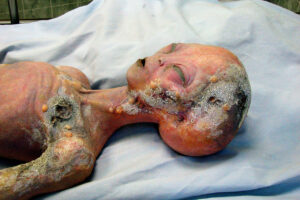
• The government secrets from Area 51/Roswell/Alien Autopsy
• Reptilian aliens walk on two legs among us
• The JFK assassination – Oswald wasn’t alone
• The moon landing was fake
• The FDA is withholding the cure for cancer

“WHAT IF” questions can generate plot ideas. Many conspiracy theories revolve around big institutions like the church, educational institutions, big oil, rogue agents operating within the CIA, a secret government agency,Wall Street, big pharma or similar organizations that touch people’s lives and make them vulnerable. Your notion of conspiracy can be domestic or foreign, localized or global, political, religious, military or big corporations.

Here are some popular movies that were based on conspiracy theories:
Wag the Dog – White House officials and a Hollywood producer create a fake war to distract the public from a sex scandal involving the US President.(1997)
All the President’s Men – Based on Watergate and secret factions operating in our government.
Manchurian Candidate – An evil corporation brainwashes US soldiers into fighting in Iraq in order to create a perfect assassin capable of eliminating undesirable political rivals. (2004)
Syriana – An energy analyst, a CIA agent, a middle-eastern prince, and a corrupt lawyer become embroiled in a high-level assassination involving Big Oil. (2005)
Network – Upon learning of his dismissal, failing news anchor Howard Beale goes on hugely popular rants quickly angering the Powers That Be. (1976)
JFK – Oliver Stone’s masterpiece documenting District Attorney Jim Garrison’s struggle to prove the involvement of a conspiracy behind the assassination of US President John F. Kennedy. (1991)
The Insider – A research chemist turns whistle blower (Jeffrey Wigand) and threatens to reveal to the world Big Tobacco’s cover up of the negative health effect of cigarette smoking. (1999)
They Live – A drifter accidentally discovers a pair of sunglasses which enables him to see Aliens among us, the true rulers of the world. (1988) (I can’t believe I actually saw this one.)

If you want to add a twist to your plot, consider combining multiple conspiracy theories that might not be related on the surface. I once combined a secret global human trafficking ring making illicit use of the dark web and combined it with a news story set in India where people were getting robbed on the street for their kidneys and other organs. I envisioned a contemptible shadowy organization that traded human flesh online and used my energy trading experience to visualize how such a group would conduct business across a network that resembled the control panels at large oil refineries (places I had seen many times).

Medical Conspiracies

Like telling a good ghost story, tap into fears people would believe. Not too far-fetched. Medical conspiracies are a great combination of personal vulnerability with a high stakes thriller plot. Think of the many ways we all accept certain medical procedures as normal. What if a covert group interferes with a “normal” procedure and hunts innocent victims without reason or a connection to the crimes? A great example of a medical thriller based on a believable fear is Michael Palmer – The 5th Vial.

Seemingly unrelated victims across the globe are targeted by a top secret cabal of medical specialists dealing in illegal organ donation. Standard blood work—and the 5th vial—put a target on their backs and seal their fate.

Robin Cook’s Coma is another classic medical thriller where certain victims are targeted and their bodies are harvested for illegal organ donation after the victims are suspended in a coma state. Innocent patients go in for standard and routine operations, only to become the latest addition to a body farm in a secret facility operated by wealthy patrons through the Jefferson Institute.

8 Key Ways to Writing Believable Conspiracies

1) Take advantage of paranoia. Mistrust and suspicion are keys to pulling off a believable conspiracy plot. Even if readers haven’t considered darker subversive motives at play during relatively routine activities, trigger their paranoia with your plot and a different way to look at it.

2) Write what you fear. If you fear it, chances are that readers will too. Convince them. Exploit common fears and highlight deeper ways that get readers thinking. In fiction, it works to grip readers in a personal way. The fears we all share—the things that wake us up in the middle of the night—can tap into a great plot.

3) Villainous motivation must feel real. You can be over the top but give your diabolical conspiracy a strong and plausible motivation. Don’t be vague. Drill down into your conspirators and justify their motives and existence from the foot soldiers on up the line.

4) Give your bad guys believable resources. Make it seem insurmountable to stop them. Think of the infrastructure it would take to plausibly pull off your thriller plot. Have them use believable technology, science and manpower to give them the appearance of Goliath when it comes to your hero/heroine fighting their diabolical acts.

5) Know organizations and your governmental jurisdictions to give your plot teeth. How do they operate in secret? Give them a plausible connection to organizations the reader may know about. Draw from organizations or systems readers will understand. If you’re too vague, readers will dismiss your plot as unlikely and a shadowy plot with no substance.

6) Make the risks personal for your hero and heroine. High stakes are important, but force your main character(s) to dig deep to fight through their fears and insurmountable odds. This is what will keep readers rooting for your characters. Make them worthy of their star role. A global phenomenon can put readers on edge, but bring the impact down to the personal stakes of real human beings for maximum impact.

7) Ripped from the headlines stories can add layers of credibility. The best fictional thrillers come from events or news that readers are familiar with.

a.) Re-imagine a well known historical event. Add your best twist to a conspiracy makes your work more interesting and forces readers to think.

b.) Or dig into a headline story for facts that are not readily known. Often that story will be deeper than most readers are aware of, especially if there are personal human stories within the big headline. I used the Mumbai terrorist attack to add bones to some of my stories. I’ve also used the National Geographic’s TV show Locked Up Abroad in my book The Echo of Violence and wrote my own version of those amazing events when a married couple (Christian missionaries) were abducted and held for ransom for a year by a small terrorist cell. It saddened me to realize that only one of the missionaries came back. They had gone to the Philippines for a second honeymoon to celebrate their wedding anniversary. I didn’t exploit their horrific story, but I re-imagined a “what if” scenario involving a nun.

FOR DISCUSSION:

1.) What conspiracies can you imagine from today’s headlines? Get crazy. Add humor or scare the hell out of us.

2.) Do you have helpful resource links for writers interested in conspiracies?

3.) What book sticks in your mind that scared you with a plausible and frightening conspiracy?

First Page Critique: Coyotes

Gentle Readers, We’re in dusty New Mexico today, at a delightfully grisly scene. Let’s go!

(Coyotes)

Three days is a long time to be dead, especially out under the intense New Mexico sun. The bodies were stacked like cord wood; if they were wood, I’d wager there was a good half a cord there. New Englanders know these things.

The smell was overwhelming; the chorus of a few thousand flies filled my ears and the half-cord sized pile shimmered with writhing maggots. I gagged but forced myself to look, to see the coyotes’ empty yellow eyes.

There were at least fifteen of them, maybe more, it was hard to be sure. Blocks of wood with a date scrawled in black marker—October 20th, three days ago—had been placed into the animals’ mouths, to what end I couldn’t imagine. Temporary markers for temporary remains, I guessed. Somehow, though, it didn’t feel like those small sections of two-by-four pressure treated wood had been placed there with any measure of respect.

The coyotes’ once sumptuous red-gray coats were matted, their fur dulled by the ever-present dust that blows across the desert, by the lack of lifeblood for nourishment. Their bodies had already begun to shrink. To flatten, sinking back into the plains where they had made their homes, where they had hunted their prey. Where they’d eaten berries and birthed their young and filled the night with their songs. No one would come to dispose of their bodies; the BLM land would simply reclaim them.

I looked away then. I didn’t understand it but, when I’d risen this morning, I couldn’t get it out of my head. I’d needed to see for myself. “Fucking hell,” I whispered and wished I had a cigarette, but they were a quarter of a mile away, in my unit—dubbed the Eunuch by my friend Ben, since my unmarked Charger “has no balls and protects divine royalty.”

Ben has a little bit of a crush on me.

“They think of it as a sport,” he’d sputtered the night before, his youthful cheeks red with righteous indignation, his prominent nose red from the beers. Ben’s half Jewish and has the shnoz to prove it. He’s also very tall and thin and his tagline, when meeting new people is, “Ben Short. All my life.”

______

Dang, there’s so much to love about this passage. I’m wild for it. We’re BANG, right into the scene of the crime, with a smart narrator showing us around. The slaughtered animals tell us this isn’t going to be a gentle story, and the grisly detail is carefully observed. Such an opening won’t be for the faint of heart, but this will find plenty of fans. And there’s humor here to leaven it. I don’t have much more than praise to offer, so I’m going to give it a line edit.

______

“Three days is a long time to be dead, especially out under the intense New Mexico sun. The bodies were stacked like cord wood; if they were wood, I’d wager there was a good half a cord there. New Englanders know these things.”

Terrific opening line. Don’t change a thing. Except maybe get rid of “out.”

Not identifying the bodies as belonging to coyotes is misleading. I assumed they were human, and felt a little confused and dopey when I learned they weren’t. Whole different story. 

__Three days is a long time to be dead, especially out under the intense New Mexico sun. The coyotes’ stiffened bodies were stacked as high as a half cord of firewood so that they appeared to be one hideous creature with way too many heads. Against my better judgement, I moved a few steps closer.__

(Okay. The “so that they appeared to be one hideous creature with way too many heads” may sound like too much, but you need something to carry forth some rhythm into the middle of the paragraph.)

Lose “New Englanders know these things.” Keep us in New Mexico for now. You’re in it for the long haul, and the confident voice needs no justification pertaining to knowledge of cords of wood.

“The smell was overwhelming; the chorus of a few thousand flies filled my ears and the half-cord sized pile shimmered with writhing maggots. I gagged but forced myself to look, to see the coyotes’ empty yellow eyes.”

I want to know more than that the smell was “overwhelming.” What does that mean? That it’s so strong that the narrator staggers and might faint? That it smells like rotting hamburger wrapped in the socks of a million sweaty feet? Be specific. Give us a sentence.

Same deal with the flies and their sound.

 __A thousand hovering flies, their electric hum vibrating in my ears, swept and dove at the pile, which already shimmered with patches of wriggling maggots. Gagging, I forced myself to look into the coyotes’ empty yellow eyes.__

“There were at least fifteen of them, maybe more, it was hard to be sure. Blocks of wood with a date scrawled in black marker—October 20th, three days ago—had been placed into the animals’ mouths, to what end I couldn’t imagine. Temporary markers for temporary remains, I guessed. Somehow, though, it didn’t feel like those small sections of two-by-four pressure treated wood had been placed there with any measure of respect.”

You’ve got an amazing visual and powerful commentary by the narrator here. Remember to keep the voice active and confident.

__I counted fifteen heads, but there may have been more that I couldn’t see. A block of wood scrawled with a date of 10/20–three days earlier–jutted from each animal’s mouth. Temporary markers for temporary remains, I guessed. Somehow, though, it didn’t feel like those small sections of two-by-four pressure treated wood had been placed there with any measure of respect.__

“The coyotes’ once sumptuous red-gray coats were matted, their fur dulled by the ever-present dust that blows across the desert, by the lack of lifeblood for nourishment. Their bodies had already begun to shrink. To flatten, sinking back into the plains where they had made their homes, where they had hunted their prey. Where they’d eaten berries and birthed their young and filled the night with their songs. No one would come to dispose of their bodies; the BLM land would simply reclaim them.”

“Matted.” Were they bloody? Were the coyotes shocked to death, or shot? Attacked by vampires/vampire bats?! The “lack of lifeblood” implies they’ve lost blood.

Call me an idiot, but I wondered at the (BLM) Black Lives Matter land reference. Further investigation suggests that it refers to Bureau of Land Management land. Adding the BLM reference dulls the poignancy of the last line. Slip it in a tad later.

__The coyotes’ once sumptuous red-gray coats were matted, their fur dulled by the ever-present dust that blows across the desert, by the lack of lifeblood for nourishment. Their bodies had already begun to shrink and flatten, sinking back into the plains where they had made their homes, where they had hunted their prey. Where they’d eaten berries and birthed their young, and filled the night with their songs. No one would come to dispose of their bodies. The land would simply reclaim them.__

“I looked away then. I didn’t understand it but, when I’d risen this morning, I couldn’t get it out of my head. I’d needed to see for myself. “Fucking hell,” I whispered and wished I had a cigarette, but they were a quarter of a mile away, in my unit—dubbed the Eunuch by my friend Ben, since my unmarked Charger ‘has no balls and protects divine royalty.'”

“I didn’t understand it but, when I’d risen this morning, I couldn’t get it out of my head. I’d needed to see for myself.”

I don’t get this at all. Are we not on the immediate scene? Had the narrator been told about the coyotes sometime earlier, and that’s why they’re now at the scene? Very confusing. If that’s the case, make that super clear and don’t drop it randomly in here–tell us at the end of the scene when they’re driving away or something. “The captain was going to be pissed as hell that I’d gone by the scene, but I’d been up all night thinking about it after Ben told me. I had to see it for myself.”

__I looked away then. “Fucking hell,” I whispered, and wished I had a cigarette. But they were a quarter of a mile away, in my unit—dubbed the Eunuch by my friend Ben, since my unmarked Charger “has no balls and protects divine royalty.”__

“Ben has a little bit of a crush on me.”

I must ask. Does our narrator identify as a man, woman, as transgender, or something else? Please make this clear, and sooner. It will matter to many readers because they’ll want to get the picture in their head.

“Ben is a bit of a comedian. He also has a crush on me.”

“They think of it as a sport,” he’d sputtered the night before, his youthful cheeks red with righteous indignation, his prominent nose red from the beers. Ben’s half Jewish and has the shnoz to prove it. He’s also very tall and thin and his tagline, when meeting new people is, “Ben Short. All my life.”

Okay. Now I see that Ben is the one who told her about the coyotes the night before. Still, the implied timeline is confusing. There’s no need to go back and forth–just tell us straight out what the narrator is doing there and at whose behest. Earlier.

Who is “they?” Maybe he can refer to them as son-of-a-bitches or bastards, etc. If he doesn’t curse, he could say “Jerks.”

The line about Ben joking about his name is cute. But given the intense scene, I think it’s one joke too many on top of the grisly coyote situation.

“Ben’s half Jewish and has the shnoz to prove it.” Really? This sounds like a line from a 1940s noir. It’s a stereotype that some people might find offensive. Use at your peril.

__“Bastards think of it as a sport,” he’d sputtered the night before, all six feet of him towering unsteadily over me. His youthful cheeks were red with righteous indignation, his prominent nose red from the beers.__

____

Again, I think this is a terrific beginning, and can be near-perfect with a small amount of thoughtfulness and editing.

What do you all think? Tell us your advice for our Brave Author!


Nancy Drew – Immortal Female Detective

by

Debbie Burke

@burke_writer


Credit: www.nancydrewsleuth.com

Nancy Drew was the original Super Girl—independent, confident, smart. She was competent to handle any challenge, fearless in the face of danger, and resourceful at solving problems decades before MacGyver came along. She drove motorboats, rode horses, and played tennis better than her boyfriend, Ned Nickerson. The girl sleuth never backed down from threats and brought villains to justice.

She is credited as an early influence on many girls who grew up to be accomplished, notable women, including Sandra Day O’Connor, Oprah Winfrey, Ruth Bader Ginsberg, Sonia Sotomayor, Hillary Rodham Clinton, and Laura Bush.

Credit: www.nancydrewsleuth.com


Nancy’s heroic adventures kept my friends and me up long past bedtime, reading with flashlights under the covers. I remember saving for weeks to buy the latest release when it hit the neighborhood toy store that carried her books. If I recall correctly, the hardbacks in the late 1950s cost around a dollar, a serious investment for a kid earning a dime a week allowance.

Credit: www.nancydrewsleuth.com


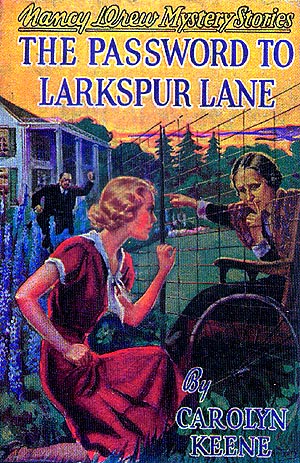
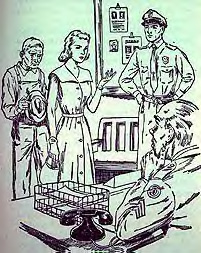
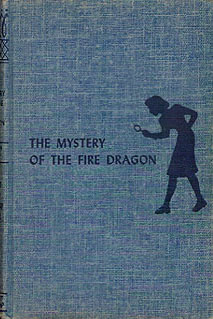
Additionally, I devoured the local library’s collection of Nancy’s earlier books published in the 1930s and ’40s, with dark blue boards and cool pen-and-ink illustrations.

The dust jackets on older editions had long since disappeared and, after thousands of check-outs, bindings were often held together by heavy tape.


I didn’t really know what a “roadster” was but I sure wanted a blue roadster convertible just like Nancy’s.

Credit: www.nancydrewsleuth.com


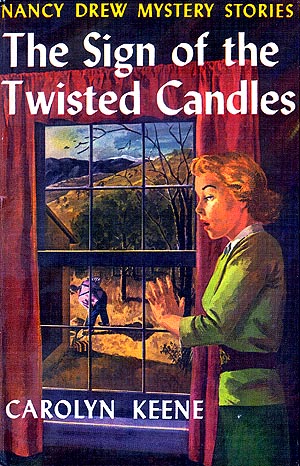
In the 1950s, the books featured lighter blue, tweed-pattern boards with dust jackets.


Credit: www.nancydrewsleuth.com

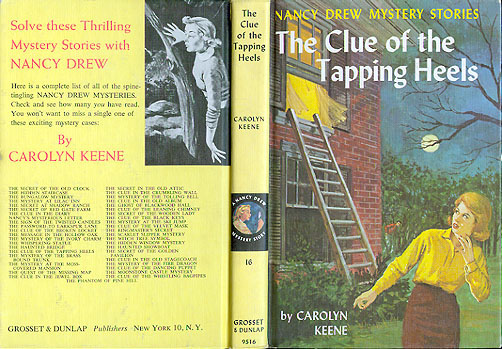
By the 1960s, the dust jackets disappeared and the spine became bright yellow with illustrations incorporated into the front hardcover.

The last one I remember reading was The Secret of the Golden Pavilion (1959) which took place in the then-exotic locale of Hawaii around the time it became the 50th state.

Throughout the 30 or so books I read, Nancy remained eternally 18-years-old (16 in earlier versions) but never attended school or college. Her successful attorney father, Carson Drew, encouraged her to pursue all kinds of dangerous adventures but no one ever got murdered.

Nancy’s only job was solving mysteries and she didn’t get paid for her efforts.

Realistic? Not very.

Fun and exciting? Yes!

Nancy solved her first mystery in 1930 (The Secret of the Old Clock) and kept unraveling puzzles in 56 classic hardcovers originally published by Grosset & Dunlap. Simon & Schuster added eight additional books in paperback. A complete set of 64 classics in hardcover sells for over $400. The classic series ended in 2003 with 175 books. Spinoffs continue to the present day, totaling more than 600 books, TV series, video games, and films.

Here’s a trailer for The Hidden Staircase, the Nancy Drew movie released in this past March.

Nancy Drew was the brainchild of publishing magnate Edward Stratemeyer. His syndicate had launched popular series with male heroes like Tom Swift and the Hardy Boys and he decided to try a strong female heroine to appeal to girl readers.

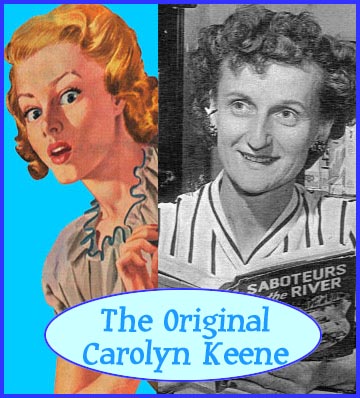
Carolyn Keene was the pseudonym for numerous ghostwriters who were paid flat fees to write books based on outlines Stratemeyer generated. The ghosts gave up all rights, received no royalties, and were sworn to secrecy. Reportedly, the flat fee had started at $125 but was lowered to $75 because of the Depression.

Credit: www.nancydrewsleuth.com

The first ghostwriter was Mildred Augustine Wirt Benson, who brought the smart, feisty, courageous Nancy to life. The series was an immediate success. For Christmas, 1933, Macy’s ordered 6,000 books that sold out in days, even in the midst of the Great Depression.

Mildred wrote 23 Nancy books, in addition to other series like the Dana Girls and Penny Parker.

As a teenager, Mildred had been determined to become a great writer. Her stories won contests and were published in high-end children’s magazines alongside authors like Louisa May Alcott. Mildred earned the first-ever master’s degree in journalism from the University of Iowa.

After her Nancy stint, Mildred wrote many more books under other pen names as well as her own. For more than a half century, she covered the crime and court beat in Toledo, Ohio and later wrote popular newspaper columns. The day she died at age 96, she was at work on an article.

Ironically, despite Nancy Drew’s profound influence on many generations of young women, Mildred wasn’t publicly acknowledged as Carolyn Keene until 1993, nine years before her death. Her archives are kept at the University of Iowa.

Nancy Drew fan conventions kicked off in 2001 and are scheduled as far ahead as 2030, Nancy’s 100th anniversary. For 2019, events will be in Toronto and Savannah.

Nancy Drew expert Jennifer Fisher has compiled vast amounts of history into a fun website that’s sure to bring back memories: http://www.nancydrewsleuth.com/   Thank you, Jenn, for your gracious assistance with this post.

Plenty of authors, including TKZ’s Kathryn Lilley, P.J. Parrish, and myself, credit Nancy with igniting their interest in writing mystery fiction. Kathryn was an ardent fan as a child and later wrote four Nancy books under the enduring Carolyn Keene pseudonym. In 2015, Kris wrote a great post on sidekicks, citing the example of Nancy’s friend, George.

Early editions, especially dust jackets, are collectors’ items. The asking price for a first edition of The Secret of the Old Clock is $2,000. Click on the bottom listing from bookbid2  to browse photos of the vintage cover and interior.

Can children’s books shape lives and careers?

Nancy Drew seduced me into a life of crime [writing]. How about you?

Credit: www.nancydrewsleuth.com


TKZers, please share your favorite memories of childhood books. What books influenced your reading preferences as an adult? Did Nancy, or another character, inspire you to become a writer?


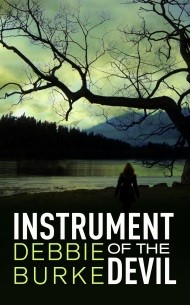
Debbie Burke’s thriller Instrument of the Devil is on sale for only 99 cents during April at this link.


First Page Critique: Unearthed

Today’s first page critique is for a mystery/thriller entitled ‘Unearthed’. My comments follow  – see you on the flip side – and I look forward to getting further feedback from the TKZ community.

UNEARTHED

The thing Rosemary said was a corpse lay against the garden wall, under the tree. Jittery from lack of sleep, Cal left her on the outside stairs leading to his flat, crossed the lawn and approached the wall, cold London air nipping at him. It wouldn’t really be a dead body, of course, whatever his landlady said. A trick, a mannequin got up in men’s clothes, or some wino passed out after wandering in off the streets, it would be. Then he saw the long coat and dirty orange hood rising out of it.

“Oh, this guy,” he said.

“What?” Rosemary was all clenched into herself, teeth at her nails. He’d never seen the old girl shaken before; he couldn’t have this.

He raised his voice. “Come on, mate. Time to go.” The man didn’t move. His hooded face was turned to the wall. Cal tapped his shoulder. His fingers met a jolting thinness under the coat. He sighed. If he gave the guy some breakfast, he’d keep coming back and Amanda’d throw a fit. Rosemary wouldn’t be any too joyful, either. “Hey. You can’t sleep here.”

“He isn’t,” Rosemary said. “I knew I shouldn’t have, but I looked. I pulled that hood up a bit. He’s bloody dead.”

Cal crouched. The man didn’t smell of alcohol. Something weird, sweetish, but not alcohol. There was no movement, either. Not even breathing. “Oh, no. Oh, God.”

Rosemary came down a few steps. “Did you say you knew him?”

“No, just saw him this morning, coming home from work. I thought he was just pissed. He must’ve been ill. I’m such a dick, I should’ve checked.”

Rosemary waved a dismissive hand. Cal saw all her sixty-three years this morning, gathered in lines on her forehead and around her mouth. “That wouldn’t have been him.”

“It was. I remember the clothes. I was coming through the park, he was headed the same direction.” Stumbling and swaying behind him as he crossed the park in winter dawn. “He was holding his head funny; maybe he was in an accident. He was quite far behind but I could’ve stopped. I should have asked if he was — Oh, shit, Rosemary, what if he was dying and I just –”

“It wasn’t the same man. Look at him.”

Cal pressed his fingers into his brow. “Didn’t see his face.”

“Just look,” she said.

MY COMMENTS

Overall, I think this first page has potential. I liked the casualness and tone of protagonist and his reaction to the possibility that the body was that of ‘wino’ he’d seen earlier (someone he’d ignored rather than helped) felt both realistic and sympathetic. For me, however, the dramatic potential of this first page is undermined by some awkward phrasing and dialogue, as well as inconsistencies in Rosemary’s character/reactions. I would also liked a bit more sense of place (more about that below). First, let’s deal with my phrasing/dialogue concerns.

Even in the first paragraph there are some awkward, clunky sentences, repetition and disjointed sentences which initially seemed jarring (at least to me). I had similar phrasing issues throughout the first page and thought the easiest way to illustrate these concerns was to mark up the page – bolding the issues/awkwardness and putting my comments in italics. While some of my comments may seem a bit petty, it is vital that this first page reads smoothly and succinctly to capture the reader’s interest. I’ve also added some comments about Rosemary’s reactions and dialogue – which I discuss in greater detail after the marked up version.

So here goes.

UNEARTHED

The thing Rosemary said was a corpse (seems a clumsy way to begin) lay against the garden wall, under the tree. Jittery from lack of sleep, Cal left her (we know it’s Rosemary but grammatically this sounds like the corpse as that’s the subject of the previous sentence) on the outside stairs leading to his flat, crossed the lawn and approached the wall (repetition), cold London air nipping at him. It wouldn’t really be a dead body, of course, whatever his landlady said (note: at this stage we don’t know Rosemary is his landlady)(Maybe a colon or dash would be better grammatically?) A trick, a mannequin got up in men’s clothes, or some wino passed out after wandering in off the streets, it would be (this is unnecessary and clunky). Then he saw the long coat and dirty orange hood rising out of it (what is it? Assume coat but sounds awkward).

“Oh, this guy,” he said.

“What?” Rosemary was all clenched into herself, teeth at her nails (sounds like she’s bent over with her teeth pushing against her nails when I think author means she has her nails in her mouth). He’d never seen the old girl shaken before; he couldn’t have this (awkward/redundant).

He raised his voice. “Come on, mate. Time to go.” The man didn’t move. His hooded face was turned to the wall. Cal tapped his shoulder. His fingers met a jolting thinness (weird description for me) under the coat. He sighed. If he gave the guy some breakfast, he’d keep coming back and Amanda’d (looks weird – I prefer Amanda would) throw a fit. Rosemary wouldn’t be any too joyful, either. “Hey. You can’t sleep here.”

He isn’t,(maybe add ‘sleeping’ to be clear – otherwise sounds a bit of an odd reply). Rosemary said. “I knew I shouldn’t have, but I looked. I pulled that hood up a bit. He’s bloody dead.”

Cal crouched. The man didn’t smell of alcohol. Something weird, sweetish, but not alcohol. There was no movement, either. Not even breathing. “Oh, no. Oh, God.”

Rosemary came down a few steps. “Did you say you knew him?” (Cal hasn’t said this…just ‘oh this guy’ – which doesn’t mean/sound like he actually knew him)

“No, just saw him this morning, coming home from work. I thought he was just pissed. He must’ve been ill. I’m such a dick, I should’ve checked.”

Rosemary waved a dismissive hand (why dismissive?? This seems inconsistent given how tense and worried she’s been). Cal saw all her sixty-three years this morning, gathered in lines on her forehead and around her mouth. “That wouldn’t have been him.” (Not sure why she says this – doesn’t make much sense as she doesn’t know who Cal saw…why would she know it wasn’t the same person?)

“It was. I remember the clothes. I was coming through the park, he was headed the same direction.” Stumbling and swaying behind him as he crossed the park in winter dawn. “He was holding his head funny; maybe he was in an accident. He was quite far behind but I could’ve stopped. I should have asked if he was — Oh, shit, Rosemary, what if he was dying and I just –”

It wasn’t the same man. Look at him.” (Again how does she know that??)

Cal pressed his fingers into his brow. “Didn’t see his face.”

Just look,” she said. (At what?? Up till now Rosemary hasn’t said she knows anything more about the corpse that Cal does…so why does it now sound like she does??)

ROSEMARY’S CHARACTER, REACTIONS AND DIALOGUE

While I was fine with Cal’s reactions and concerns, I was a little confused by Rosemary. She obviously ran to Cal to tell him she’d discovered a body and, though it was understandable that Cal didn’t believe her initially, Rosemary’s attitude then seems to shift  from tension and concern to a dismissiveness that I found very strange. First she dismisses Cal’s observations out of hand and then seems to be certain that the dead body is not the person Cal saw earlier. The rationale for this is unclear. Perhaps Rosemary saw something on the corpse’s face but, based on this first page, it seems odd that she wouldn’t have said something to Cal right away.

SENSE OF PLACE

Finally, I would have like to have got a greater sense of place in this first page. Apart from the reference to ‘London air’ nipping at him, we have only generic references to a wall, a tree, a park, and a block of flats. I would have liked a bit more specificity. For example if we knew it was an old gnarled oak tree, that Cal had been walking on Hampstead Heath, and if the block of flats was a red brick, post WWII era block – this would have all added more color/texture to the first page and helped ground the reader in time/place.

Overall, I think this page could be an interesting opening to a mystery novel set in London and the specific issues I’ve identified can easily addressed during the revision process.  So TKZers what do you think? What comments would you give to our brave submitter??