What Are We Missing?

by James Scott Bell
@jamesscottbell

The other day I did an incomprehensible, dreadful, noxious, scandalous thing—something so shocking to the conscience that it threatens the gossamer social fabric that tenuously binds us together as a people and a nation.

I left the house without my phone.

I know, I know! But hear me, please.

My daughter was visiting us from Denver. As is our tradition on such occasions, we get a meal from that Southern California institution—the envy of hamburger lovers everywhere—In-N-Out. I looked at the clock and saw it was 11:15 a.m. On a Saturday. Which meant the cars would be lining up and I’d better get going to snag our grub.

I grabbed my wallet and keys and hopped in the car. As I pulled out of the driveway I patted my pocket.

No phone!

Naked came I from my mother’s womb, and naked I will depart. (Job 1:21)

Halfway down my street I thought, Should I go back and get it? Nay, I must go get in line! Also, In-N-Out is only five minutes away from my house. What could happen in that span of time that would necessitate communication? An earthquake? Possibly! This is L.A., after all. But that was a chance I was now willing to take.

When I pulled in behind a moderate line of cars, I wondered, Now what? I couldn’t check email, scan Feedly, or play a quick game of app backgammon. Why, I could not even tweet!

What to do, what to do? Well, here you are. In line. Waiting to order. Why don’t you try something different, like observing something? 

Good idea. What did I see? A parking lot. Wait … next to the In-N-Out building itself—three lovely palm trees.

One of the things I love most about my hometown is the palm trees. You see them everywhere, often in serried rows observable from the freeway. Nothing says L.A. more than a burnt-orange sunset with palm trees silhouetted against the sky.

Okay, so what else did I see? Nearby those palms was one of the ugliest eyesores of our current landscape—a cellular transmission tower. Is there any man-made thing on earth more opposite Michelangelo’s David or the Venus de Milo than one of these dull, gray snarls of protuberant antennae and parabolic receptors?

The symbolism was not lost on me. Here was a perfect metaphor of our hyper-connected state, the loss of appreciation of beauty due to digital pervasiveness.

There! I now had irony to go with my observations!

And soon I would have grilled onions to go with my cheeseburger. I observed the young man who was tasked with taking orders from car windows. During peak times, In-N-Out uses a real live person to speed up the ordering process. It’s the toughest duty in the whole operation, especially when the sun is beating down on the asphalt, as it was that day.

But the young man could not have been more pleasant. In-N-Out trains their people well. I have not met one sourpuss there. Unlike many other places these days.

I started to ask What if about this fine fellow. What if he took an order from a guy in a black sedan, and saw a gun on the seat? What if someone passed him a sealed envelope (and what would be in it)? What if a flying saucer got in the car line and a green alien asked for a Number 2 with a Diet Coke?

Story sparkers from observation. What a concept!

Which brings up the idea of a diary or journal. I have it on no less an authority than Ward Cleaver that this is a good thing for a writer. I give you this excerpt from a Leave it to Beaver episode called “Beaver’s Secret Life.” Beaver’s 6th grade teacher asks the class what they’d all like to be when they grow up. Beaver chooses writer. That evening, the subject comes up at dinner:

JUNE
What made you decide to be a writer?

BEAVER
I think it’d be neat making up stuff and getting paid for it.

WALLY
Sure, Beav. They got guys in the publishing company that fix up your grammar and spelling and stick commas in and junk. Some writers don’t even have to write at all, they just holler their whole book into a machine.

BEAVER
Gee, Dad, that’s really neat. Can you get me one of those machines so I can start being a writer?

JUNE
I don’t think it’s quite that easy.

WARD
That’s right, Beaver. I think your first step should be to do what Somerset Maugham did.

BEAVER
Was he a writer?

WALLY
With a name like that what do you think he was? A linebacker for the Colts?

WARD
He kept a diary, Beaver. He jotted down everything that happened, you know, people he met, interesting things he did.

JUNE
Then when he was ready to write he had all that background he could get stories from.

BEAVER
Would you get me a diary so I can start making up junk?

WARD
Sure we will, Beaver.

So what about you? Do you keep a journal or diary to record interesting things and people?  

How are your powers of observation these days? Has your smartphone atrophied them?  

Do you feel naked if you don’t have your phone with you?
 

The Graveyard of Stories

Photo by Chris Liu, unsplash.com

I have at least once before mentioned in passing how what we see with respect to a published novel — or for that matter, any work of art — is but the tip of the spear, the polished, honed, and sharpened result of a whole lot of effort. I happened across something recently that everyone who labors in the arts to whatever degree of success needs to read over and over about again about getting to that tip. 

You may know of John Clarkson. He is an extremely talented author whose novels, particularly those in his current James Beck series, stand as an example of what the job of writing looks like when it is perfectly and professionally done. John intermittently blogs and recently told a story about his current work-in-progress. I will summarize it but you really need to read John’s brief dissertation to get the full flavor of what happened. John describes the process of writing what would have been the third novel in the Beck series, and realizing, upon completion, that it didn’t work (and why). He concluded that it could not be fixed so he trashed it and started over. His account is illuminating, tragic, hopeful, and ultimately inspiring. Oh, and it is very brave, too. John, in workmanlike, understated prose gives us the reasons why what would have been his latest novel didn’t come together. Ouch. How many of us would willingly and intentionally exhibit what we perceived to be a screwup on the internet town square in a forthright manner and without reservation? I know of at least one person who would pause before doing so. He’s typing these words right now. 

The truth is that John is not alone in what he went through, though he is certainly walking point when describing the experience. Not every written volume of every successful series makes it to the finish line.  They lay on the blacktop and the finish line rises up to meet them. Sometimes being successful is as much knowing what doesn’t work as what does work, and being brave enough to pull the pin, rather than hoping that no one will notice. There is a term used for these books which don’t make pass the author’s own white glove test. Such manuscripts are called “trunk novels.” I am reasonably sure that every successful author has at least one. I daresay that we will probably not walk with Jack Reacher down every mile of middle America that he traverses, or that we see the account of every mystery that Spenser or Bryant and May encounter and/or solve. What is different here is that John takes us through the process of determining whether the book goes to the agent or the trunk. It’s not a pretty sight, but it’s an informative one.

It doesn’t just happen with books.  Music? It happens all the time. I personally know of one band that was huge in the 1980s and labored for seven months on their fifth album. They spent well into six figures while doing so. There was a change of personnel at their record label and the new sheriff decided to pull the plug on the new record on the theory that the label wasn’t going to chase good money after bad. The band was informed of this in the middle of a tour. The same thing happens in the film industry. At least with books you can sometimes and to some extent control that portion of your destiny, as John has.

My best advice? Be like John. Confront the failure, embrace the suck, and try again. Oh, and you might pick up a book or five of his to see what he is striving for and will no doubt achieve once again. You won’t be sorry.

That is all I have for today. How is your summer going? Are things humming along or are you turning a project into compost and trying again? Good luck and best wishes either way. 


Reader Friday: Hard Time

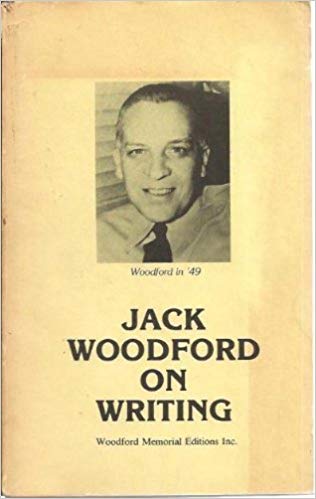
“Why shouldn’t you have a hard time? If it was easy, any little mug could chisel in on the racket, and it wouldn’t be any good for anybody. It doesn’t take brains, certainly, to be a freelance fiction racketeer… but it takes an ironclad intestinal tract.” — Jack Woodford

Discuss!

First Page Critique: Reluctant

By Elaine Viets

Here’s another first page from the prolific pens of our TKZ readers. I’ll make my comments after you read it.

Galilee Medical Center, Nahariya, Israel
11 November 1982

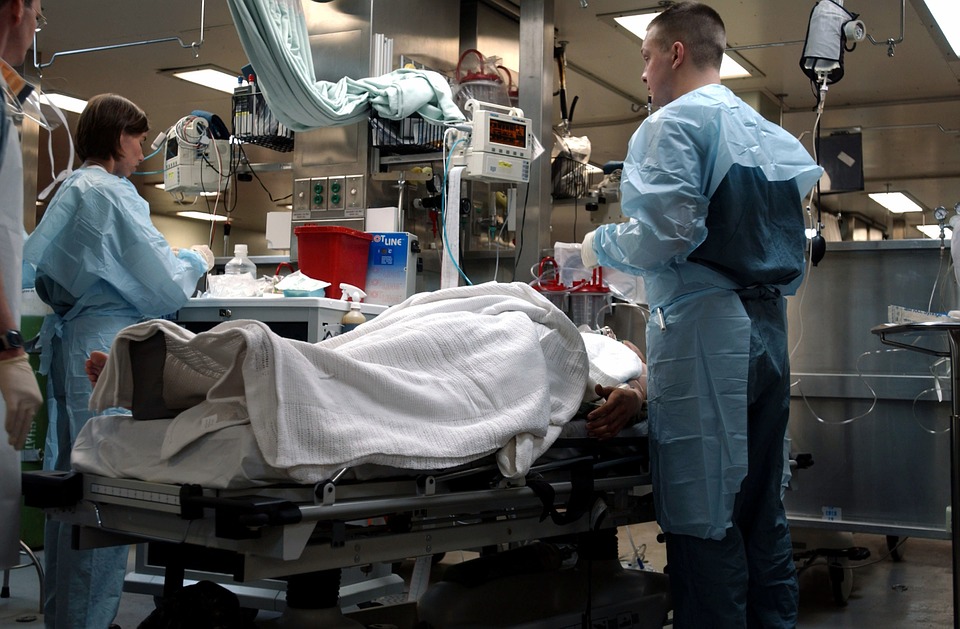
The child lay limp and pale on the gurney like a cast-off doll. Blinking hard, I terminated the unrelenting replay of a past tragic failure.

Block it out doctor! But the brutal images of another little girl clutching a Raggedy-Ann doll mocked me, and refused to give way. The little one I tried to save. The one I was forced to leave, to die, alone.

No Moshe. Not now. Save this one!

“Okay Dr. Sabin, we’re ready to go,” said Lydia, giving her a few more breaths with the ambu-bag. The self-recrimination momentarily halted, I slid the laryngoscope blade into her mouth, and gently lifted.

“Suction please.”

I cleared the tiny girl’s pharynx of bloody sputum. She smelled of smoke, dust, and something……what, urine? I was just about to pass the endotracheal tube, when the emergency-room doors burst open. Two medics exploded into the room, pushing another gurney, violently jolting the stretcher under my patient, nearly causing me to lose visual of her vocal cords.

“What the hell?” I blurted, but quickly slipped the slender tube into her trachea and removed the laryngoscope blade before glaring up at the offender. Instantly, the acrid, sharp stench of burned flesh and violence hit my nostrils.

“Burn patient doc,” grunted an IDF medic.

“Hannah!” I shouted to another nurse, “Grab the burn kit. I’ll be right there!” Commanding shouts rang out from beyond the double doors, followed by the high-pitched whine, and whop, whop, whop of an approaching helicopter.

“Huh?” I gasped, taping the ET tube to my patient’s face.

“We’re expecting more casualties, some sort of bombing.” Lydia said, as she attached the ambu-bag to the little girl’s airway. I squeezed the bag delivering a few quick breaths. A blush of pink replaced the dusky, ashen hue of the girls face, as oxygen-enriched air filled her lungs.

The doors crashed open again, and a barrage of wounded IDF soldiers cascaded through.

“You! Doctor!” barked a stocky, red-faced IDF captain, one hand holding a blood-drenched trauma pad against his neck. “Get your hands off that Palestinian dog and treat my men now!”

With that, the captain grabbed the end of the girl’s gurney and gave it a fierce yank, launching the stretcher into the back wall, and ripping the airway right out of her trachea.

Elaine Viets’ critique:
I assume, since the date is written European style, that the author is not an American. The story feels authentic and starts off with a bang. However, it quickly loses its impact when the second sentence trips over Dr. Moshe Sabin’s memories as he tries to save the life of the little girl on the stretcher. That sentence (Blinking hard, I terminated the unrelenting replay of a past tragic failure) is hard to read.

Rather than loading the action-packed beginning with extra information, why not wait until the little girl is breathing? That would be a good time to add the back story about the doctor’s previous failure.

The story is also slowed by medical jargon. Since many of us watch hospital dramas, we have a pretty good idea what an ambu bag is and we may even know where an endotracheal tube goes, but the phrase “lose visual of her vocal cords” should be in plain English.
Why not say: “nearly causing me to lose sight of her vocal cords”?

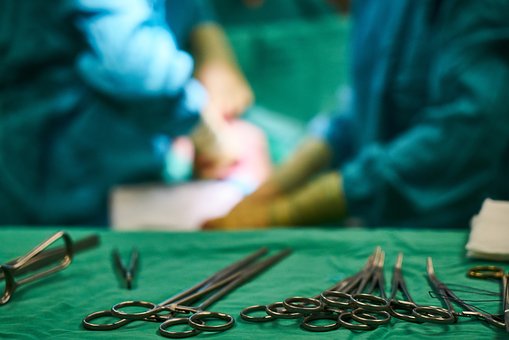
A laryngoscope is a fearsome-looking contraption. It would be a good idea to briefly describe it and the difficulties and dangers of using it – especially the blade.
What is an IDF medic? Tell us what those letters stand for.

Suppose the author began this way:
The child lay limp and pale on the gurney like a cast-off doll.

“Okay, Dr. Sabin, we’re ready to go,” said Lydia, giving the child a few more breaths with the ambu-bag.

“Suction please.”

I cleared the tiny girl’s pharynx of bloody sputum. She smelled of smoke, dust, and something . . .what, urine?

I was just about to pass the endotracheal tube (AUTHOR, TELL US WHERE ARE YOU PASSING THIS TUBE), when the emergency room doors burst open. Two medics exploded into the room, pushing another gurney, violently jolting my patient’s stretcher, nearly causing me to lose sight of her vocal cords.

“What the hell?” I blurted, but quickly slipped the slender tube into her trachea and removed the laryngoscope blade before glaring up at the offender. Instantly, the acrid, sharp stench of burned flesh and violence hit my nostrils.

“Burn patient doc,” grunted an IDF medic.

“Hannah!” I shouted to another nurse, “Grab the burn kit. I’ll be right there!”

Commanding shouts rang out from beyond the double doors, followed by the high-pitched whine, and whop, whop, whop of an approaching helicopter.

“Huh?” I gasped, taping the ET tube to my patient’s face.

“We’re expecting more casualties, some sort of bombing,” Lydia said, as she attached the ambu-bag to the little girl’s airway. I squeezed the bag delivering a few quick breaths. A blush of pink replaced the dusky, ashen hue of the girls face, as oxygen-enriched air filled her lungs.

Blinking hard, I tried to terminate the unrelenting replay of a past tragic failure.

Block it out doctor! But the brutal images of another little girl clutching a Raggedy-Ann doll mocked me, and refused to give way. The little one I’d tried to save. The one I was forced to leave, to die, alone.

No Moshe. Not now. Save this one!

The doors crashed open again, and a barrage of wounded IDF soldiers cascaded through.
“You! Doctor!” barked a stocky, red-faced IDF captain, one hand holding a blood-drenched trauma pad against his neck. “Get your hands off that Palestinian dog and treat my men now!”

With that, the captain grabbed the end of the girl’s gurney and gave it a fierce yank, launching the stretcher into the back wall, and ripping the airway right out of her trachea.


Anonymous Author, the last three paragraphs are outstanding. Congratulations on an intriguing first page. I’d really like to read this novel.
What do you think, TKZ readers?

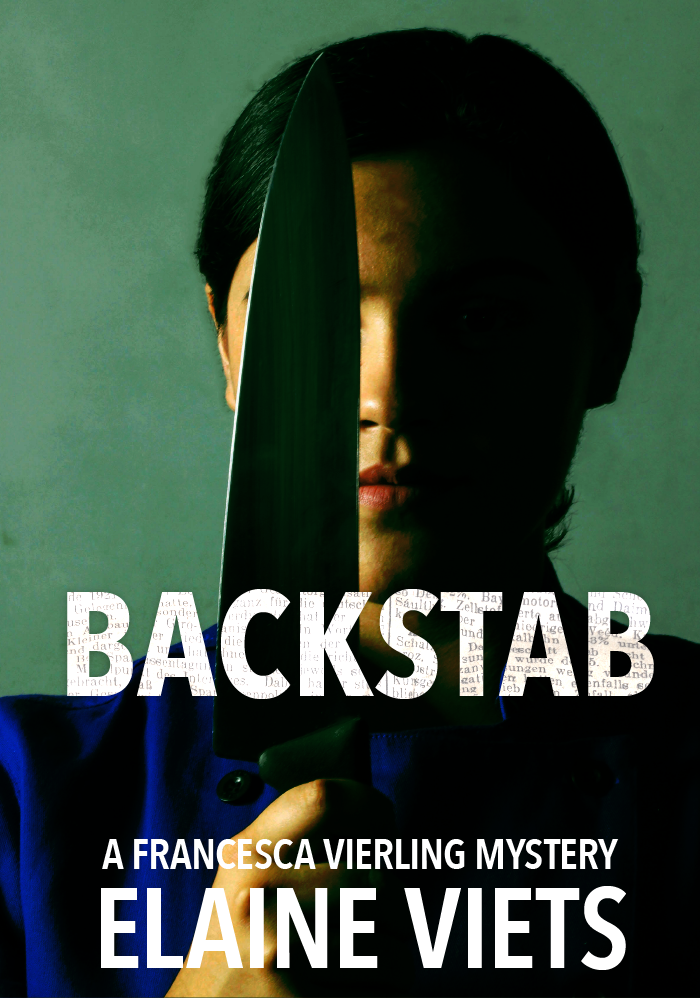
Win Backstab, the first e-book in my Francesca Vierling newspaper series. The police say the deaths of the St. Louis columnist two friends were accidental, but Francesca is searching the city for their killer — before he finds her. Click Contests at www.elaineviets.com

The Honest Epitaph

Photo: Ben Churchill [CC BY 2.0 (https://creativecommons.org/licenses/by/2.0)]

Having recently celebrated a birthday that was (once again) well past my life’s statistical half-point, I’m feeling a bit maudlin. And maudlin is so dull!

So, tell me. What would your honest epitaph be? It’s the very last bit of writing you share with the world. I’m not looking for the reverent words that loved ones will no doubt honor you with, but the words you would put on there if you didn’t mind embarrassing your kids, your partner/spouse, your mom.

Remember, it’s important to put honest bits of yourself into everything you write…

A few of mine:

“She Wasn’t Good, But She Had Good Intentions.” (via Lyle Lovett)

“Wait! That Wasn’t What I Meant to Say!”

“She Was F.I.N.E.”

“Go Away, I’m Reading”

“Of Course I’m Listening”

“She Was Late for Her Own Funeral”


Now it’s your turn, TKZers!


First Page Critique – Counting Mountains

Credit: Joshua Fuller, Unsplash

Good morning, TKZers, and let’s welcome the brave Anonymous Author of Counting Mountains. Please enjoy this first page submission then we’ll open the discussion.

~~~~~

Title- Counting Mountains

My name is Tessa Stynes, and I was witness to and involved in all the horrible things you’ve heard about the Australian Massacre in London. My name used to be associated with my family, my university, my friends, and if I’m being optimistic, maybe my photography, or my smile.People used to tell me I had a nice smile.

Now, and I think for a long time to come, my name will have a very different association in thousands of people’s minds. People think of my name and they think of murder, fear, and death. This is hatefully unwanted- but not necessarily unwarranted. I didn’t touch the Ripper’s knife, but it knew me, hunted me, found me.

I can tell you how I almost died, how parts of me most certainly did.

If I want to dig at the wounds and baby scars that tear open so easily, I can tell you how I was responsible for people dying. I dig a lot, trying to figure out which parts of me are gone forever, which parts I can resurrect with time, and which wounds deserve to lay open, festering. Even though it hurts, it’s cathartic, like pulling six-foot weeds out of the ground, or trying to reconstruct a broken clock.

I’m attempting to build my story – and the Ripper’s – from the ground up, pulling strands and dark clumps out of my head that are hiding and digging themselves in; picking out the broken parts, so that I can hope to build something new and shiny out of the rot.

Someone once said to me; there are mountains in everyone’s path. They are all different shapes and sizes, but they are all mountains, and they are all difficult to breach.

Right now, I’m counting mountains. Some I conquer, and some sit in front of me, daunting and ice covered, just like that winter.

In the beginning of our story, it was cold. I remember the cold being a constant reminder of how far I was from home. We were in the winter of 2010, the coldest winter on English record and in anyone’s memory. The feeling of cold in England seemed worse than the cold I had felt in actual cold countries like Norway, Estonia, or Finland. The cold I felt that winter in England was harsh and bone deep, like a blow I wasn’t expecting.

~~~~~

Brave Author, I found a lot to like about this first page. It doesn’t start with action or in media res. It opens with the character alone thinking—a technique that we at TKZ often caution against. However, the voice is strong and the situation is compelling, making me want to know more.

In other words, even though you take a risk by ignoring conventional wisdom, your technique works. Well done.

Why does it work? I believe it’s because of the theme.

Tessa Stynes has been the victim of “the Ripper.” She also feels responsible for other deaths evidently caused by this serial killer. She survived where others didn’t. Her name is linked to horrific crimes—she is doomed to a haunted life of guilt by association.

The theme of guilt by association works because it’s a universal plight. Most people have suffered injustice where their proximity to a person, group, or incident taints their  reputation. There’s an immediate bond between the reader and a character who reminds us of the unfair shunning we’ve experienced ourselves.

Further, the Author has set high stakes. Tessa is not the victim of everyday petty injustice. The stakes of her suffering are life and death. Others have died in a “massacre.” Although this story is being told about events that already occurred, there is a suggestion Tessa herself might die in the future from repercussions of the tragedy.

James Scott Bell talks about death stakes that can be physical, professional, or psychological.

Tessa states: I can tell you how I almost died, how parts of me most certainly did.

She has faced all three forms of death that Jim describes. First, she almost died from knife wounds (physical). Second, she apparently once had a good name as a photographer that’s now tarnished (professional). Third, her musings show an ongoing emotional struggle that prevent her from living a normal life (psychological).

The Brave Author takes another chance by addressing the reader directly. In theatre or film, this is called breaking the fourth wall when a character speaks to the audience.

This technique momentarily disrupts the fictive dream the author wants to create, which can have negative results if the reader is pulled out of the story.

However, it can also promote the sense that the author is sharing an intimate secret with the reader. This character who witnessed terrible crimes is willing to reveal knowledge no one else has. The reader wants to learn the inside truth of what really happened.

For those reasons, I believe breaking the fourth wall works here. 

The setting is London in winter of 2010. Tessa is evidently a visitor to England, a stranger in a cold, forbidding land. The mood is chilling, physically as well as emotionally. Nice job of making the setting and weather reflect the plot.

Now to the aspects that tripped me up:

The Australian Massacre in London is treated like a news event that everyone’s heard about. I googled it and didn’t find a corresponding real-life occurrence. Not a problem but it momentarily sidetracked me.

By using “the Ripper,” readers have certain automatic, ingrained reactions to Jack the Ripper, who killed victims during the 1880s. That reference started me down a historical path. However, you then say the story begins in 2010, leading to other questions: Will this be a time-travel fantasy? Or is there a new Ripper in contemporary London?

These are not necessarily problems but merely things to consider as you draw readers into the story. You want to be mindful not to lead them off onto false trails.

You write strong, active sentences but the order in which you present them could be rearranged for more dramatic effect. What do you think of this:

People used to tell me I had a nice smile.

My name used to be associated with my smile, my family, my university, my friends, and my photography.

Now, and I think for a long time to come, my name will have a very different association in the minds of thousands of people. People think of my name and they think of murder, fear, and death. This is hatefully unwanted—but not necessarily unwarranted. I didn’t touch the Ripper’s knife, but it knew me, hunted me, found me.

I can tell you how I almost died, how parts of me most certainly did.

My name is Tessa Stynes, and I was witness to and involved in all the horrible things you’ve heard about the Australian Massacre in London in 2010.

If I want to dig at the wounds and baby scars that tear open so easily, I can tell you how I was responsible for people dying. I dig a lot, trying to figure out which parts of me are gone forever, which parts I can resurrect with time, and which wounds deserve to lay open, festering.

Next, you go into a mashup of similes and metaphors about pulling weeds, repairing a broken clock, strands of hair, clumps, digging, shiny objects, and mountains. Because these figures of speech are not obviously related to each other, they got distracting. Suggest you stick with the mountain motif, since that’s your title, and delete the rest of the debris.

Regarding semicolons: I fall into the camp of never in fiction. If you do use them, use them correctly.

Delete the semicolon in: Someone once said to me; there are mountains in everyone’s path.

The sentence could be rewritten in two ways:

1. Someone once said to me: there are mountains in everyone’s path.

2. Someone once said to me there are mountains in everyone’s path.

The second option (without punctuation) is my preference since it’s not a direct quote.

The following is a nice segue from Tessa’s thoughts into the story:

Right now, I’m counting mountains. Some I conquer, and some sit in front of me, daunting and ice covered, just like that winter.

In the paragraph that follows, you use a variation of cold seven times. Even if you intentionally repeated the word for effect, it wore thin.

The line like a blow I wasn’t expecting didn’t work for me because blow is a sudden, abrupt action whereas bone-deep cold creeps in more gradually, like gangrene.

There is additional repetition and overwriting in that paragraph you might condense. How about this:

The winter of 2010 was the coldest season on English record and in anyone’s memory. I remember the harsh, bone-deep chill that felt worse than the cold I’d experienced in actual frigid countries like Norway, Estonia, or Finland. The cold was a constant reminder of how far I was from home.

Brave Author, you took risks with this opener and they paid off. Your voice, theme, and premise are all compelling and make me want to read more. Good job!


How about you, TKZers?

Did this opening draw you in?

What suggestions do you have for our Brave Author?


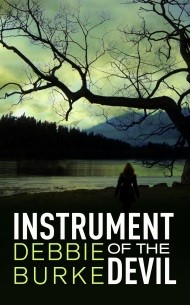
Debbie Burke’s award-winning thriller Instrument of the Devil is on sale for 99 cents from July 7-14. Here’s the link.

First Page Critique: A Goan Holiday

Happy Monday! Today’s first page review is for a novel entitled A Goan Holiday – which seems appropriate since I just got back from India (although, sadly, I’ve never visited Goa). My comments follow and I look forward to feedback from our great TKZ community. Read on!

A Goan Holiday

For the leftover hippies sunbathing nude on the beaches of Goa, drug-induced illusions were often indistinguishable from the breath-taking reality of the moss-covered cliffs and the bright blue sea. Back in the ’sixties, Vagator was one such beach few knew of until a forty-year-old American tourist with only eight fingers trudged down the mud track to the nearby village, starting a hippie stampede to the settlement. The disgruntled children of the West left the residents puzzled by adopting the matted hair, the rancid clothes, and the broken sandals of the homeless, seeking enlightenment in LSD and heroin, but there was one enterprising fellow who saw in the new arrivals a chance to make an easy buck.

Gossip had it his ramshackle shed at the far end of the beach was the designated cop-free zone where the hippies rented cots to crash at night. To the surprise of no one who knew him, the owner of the establishment disappeared one day, only to resurface the next week as the corpse found in a fishing boat adrift a few miles from the shore.

Half a century later, the shed’s owner was forgotten. Rich, young locals and backpackers from around the world still partied to trance music on the moonlit beaches of the former Portuguese colony on India’s west coast, the pungent smoke from industrial-sized rolls of charas, the home-grown weed, swirling all around. White surf frothed over rocks, tickling the feet of the stoned couples as they groped their companions for the night and made promises which wouldn’t last past daybreak.

The shed itself morphed into a hip café which served delicious seafood and fine wines for exorbitant prices. It was where the rich and the famous were frequently caught in carefully choreographed candid pictures. At least, that’s what the kaamwaali bai—the maid—employed at the Joshi vacation home a few miles away claimed. The woman showed up at her leisure and barely did any work if she could help it but always carried news of the movie stars spotted in the seaside village where her cousin lived.

None of the celebs seemed to have ventured outside this lousy night. Lucky for them, thought Anjali Joshi, skirting the group of tourists dancing to ear-splitting music on the beach despite the ominous dark clouds rolling across the half-moon. Each screech from the synthesiser thrummed across her skull. Even her eyeballs were vibrating.

Overall Comments

To be honest, this first page reads more like a travelogue at first than the start of a novel.

In my opinion it suffers from way too much data dumping about the history and clientele of the beaches of Goa and also from a lack of immediacy. Everything in this first page feels distant and third-hand to me – whereas I really wanted to be sucked into the drug scene at the beach and the ear-splitting music at the bar. I wanted to be introduced to a main character I could care about. I I wanted an inciting incident that would draw me into the story. Instead, I wasn’t sure who the book was really going to be about: Was it the forty-year-old American tourist with only eight fingers who started the hippie stampede to the settlement? Was it the enterprising fellow who saw a chance to make an easy buck and whose corpse showed up adrift a few miles from the shore? Was the maid who showed up at her leisure and barely did any work relevant to the story at all? Is Anjali Joshi who shows up in the final paragraph actually the protagonist? All of these characters have great potential but they are placed scattershot on this first page with no hint as to their relevance or importance to the story.

In this first page, nothing about the actual story is really clear and until the reader gets a handle on the story itself, the description and background to the drug culture in Goa doesn’t resonate (and, though I liked some of the detail and descriptions, most of this information could be inserted into the first chapter in discrete chunks rather than all at once).

So my main recommendation to our brave submitter is to start again – start the novel where the story really begins. Let us walk along the beach with Anjali Joshi and feel the music (I liked the image of her eyeballs vibrating BTW). Let us be drawn into the drama of an actual scene. Who is she? Why is she there? What incident is going to propel this story forward? Is it the discovery of a celebrity’s corpse? What dark events do the the ominous dark clouds suggest? Once we get these answers on the page, then, as readers, we will want to turn the page and care about the novel and its characters moving forward. Until then, this first page reads more like an interesting catalogue of the drug and hippie culture of the Goan beaches rather than the beginning of a novel.

TKZers, what advice would you provide to our brave submitter. How would you tackle the issues I’ve outlined?


Mad Magazine, RIP

by James Scott Bell
@jamesscottbell

Alfred E. Neuman

And so it ends, after 67 years. One of the great American institutions, Mad Magazine, is closing up shop. Gone but not forgotten will be the famous Mad mascot, Alfred E. Neuman, whose mysterious background is discussed here. So popular was he that he occasionally ran for president, with the slogan: “You could do worse… and always have!”

Along with my parents and my teachers, Mad played a major part in the formation of my young life. Its influence is with me still—and I hope it always will be.

My big brother bought Mad religiously, and thus I got the issues second hand. I learned about politics from Mad. I knew who Castro and Khrushchev were only because of the cartoon renditions within its pages.

In those years they had literate, educated satirists who were able to skewer sacred cows with a precise wit that appealed to adults, too. And the artists! Here I must call out two of my favorites—Mort Drucker, master caricaturist; and Don Martin, whose mind-bending cartoons blew right past the safe and predictable into uncharted realms of hilarity.

Of all the talent, though, my absolute favorite was the poet laureate of Mad, Frank Jacobs, who, at age 90, is still among us. Jacobs did the libretti for many of the Mad satires of famous movie musicals. I also have a first edition of his legendary collection, Mad For Better or Verse. The amazing thing about Jacobs is that his satirical songs always scanned perfectly along with the originals. He never hit a bad note.

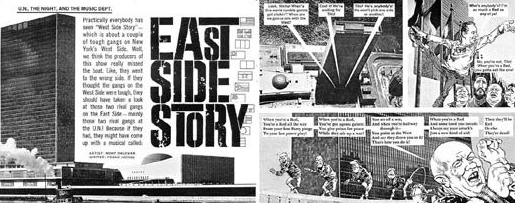
Here’s an example. One of the first political pieces I remember from Mad is East Side Story, a send-up, of course, of the Leonard Bernstein-Stephen Sondheim musical. It was Jacobs at his best, along with the fantastic caricatures of Drucker (also still alive, also 90. Comedy is healthy!)

Remember how West Side Story begins with the “The Jet Song”?

When you’re a Jet
You’re a Jet all the way
From your first cigarette
To your last, dying day!

Well, East Side Story begins outside the U.N., with all the major Communists of the day, led by Nikita Khrushchev, snapping fingers and singing:

When you’re a Red
You’re a Red all the way
From your first Party purge
To your last power play!

When you’re a Red
You’ve got agents galore;
You give prizes for peace
While they stir up a war!

You set off a test,
And when you’re halfway through it–
You point at the West
And say they drove you to it!
That’s how you do it!

We are the Reds … With a punch in the face … Which we’re aiming today … At the whole human race … At the whole–! Ever–! Trusting–! Human–! Race!

That, my friends, is genius.

Some of the other satires I recall from Mad’s golden age include Who in Heck is Virginia Wolfe?, Voyage to See What’s on the Bottom, 201 Minutes of a Space Idiocy, Botch Casually and the Somedunce Kid, and my personal favorite, Hack, Hack, Sweet Has-Been or Whatever Happened to Good Taste? This was a combo satire of the films Hush, Hush, Sweet Charlotte and Whatever Happened to Baby Jane? It featured the following cast: Olivia DeHackhand, Bette Devious, Joan Clawfoot, Joseph Cuttin, Agnes Gorehead … and Greer Garson as a headless torso.

I ask you, what child soaked in such material could fail to grow up into a happy and productive citizen?

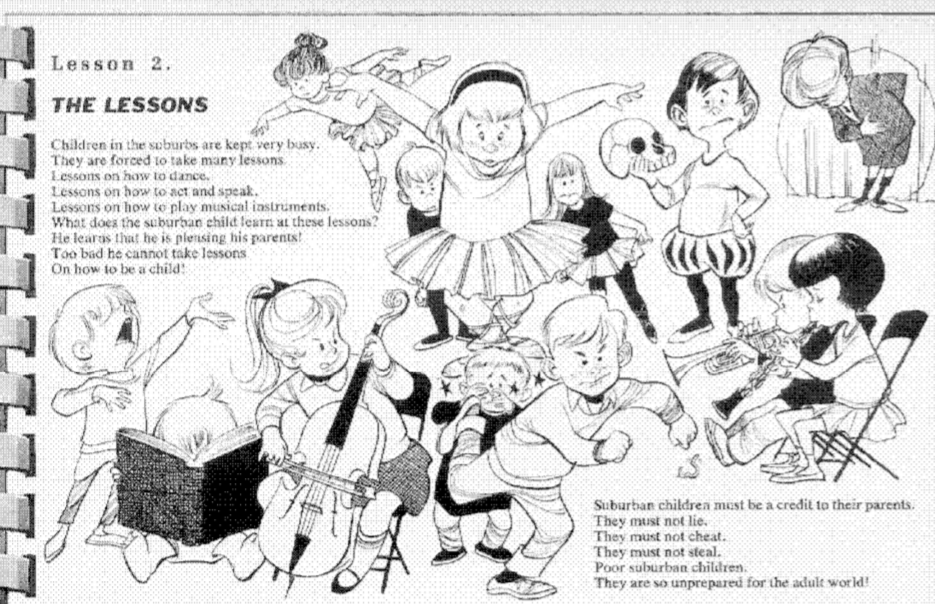
And whenever Mad turned its gimlet eye upon social structures, it skewered them with unerring insight. As in their 1961 send-up of the suburbs, titled “A Child’s-Eye View of ‘The Affluent Society.’ ” Look at the chapter called “The Lessons” and tell me it’s not still timely:

Children in the suburbs are kept very busy.
They are forced to take many lessons.
Lessons on how to dance,
Lessons on how to play musical instruments.
What does the suburban child learn at these lessons?
He learns that he is pleasing his parents!
Too bad he cannot take lessons
On how to be a child!

Suburban children must be a credit to their parents.
They must not lie.
They must not cheat.
They must not steal.
Poor suburban children,
They are so unprepared for the adult world!

So goodbye old friend. I shall remember you fondly. And whenever the kultursmog becomes thick with putridity, and the zeitgeist attempts another brain heist, I will bring to mind Alfred E. Neuman’s immortal words to live by:

“What, me worry?”

So what periodical was your favorite as a kid? How did it influence you?

An Amazing Research Resource for First Responders

Jordan Dane
@JordanDane

Happy July 4th! I’m grilling and celebrating with my family. I hope you all have plans. It’s a time to celebrate the birth of our nation. Freedom does not come free. 

***

When I think about what makes our country great, I think of emergency first responders who are on duty 24/7/365. It takes a special kind of person to protect the public-from EMTs to firefighters to police.

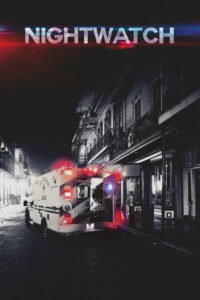
While working with another author, I found a great resource that I thought TKZ might find useful as a resource for first responders. The show primarily focuses on two EMT teams in New Orleans, but other groups come into play, too. Look on HULU for season 2 – 4 of NightWatch which follows the most dangerous shift time from 9pm to 3am. For those of you not streaming HULU, Season 1 is on A&E and those episodes are available at this LINK.

WARNING: This is graphic. I don’t think I’ve ever seen what EMTs see firsthand as they arrive on scene, for example.

From a writer’s perspective, what I found most interesting is:

1.) Fast paced action with stories well-told. Not sure who writes or directs/produces this series, but it is extremely well done. It’s a good reminder of how to show action scenes with the author craft principle of ELLE – Enter Late, Leave Early.

2.) Dialogue is tight. The scenarios are not staged so the treatment must be the first priority. Quick medical lingo between EMTs is carried on without explanation. You see the action as it happens, but when there is time to narrate, the EMTs share what’s medically happening and why they are doing it. You get to see how each case affects them.

3.) See inside first responders’ heads – EMTs (and other first responders) share their thoughts as they come onto the scene, as in what they expect to find. Often, they are surprised and have to react quickly. Dispatch details can be sketchy. The compassion of these people is striking. They are patient and calm amidst chaos and their first priority is for the patient. They calmly talk to them, reassure them, and do whatever it takes to keep them calm. Sometimes the emergency isn’t about a medical solution and more of a human resolution. It’s all there.

4.) You get to see what dispatch communicates to first responders and how they locate the scene with the GPS equipment they have on-board the vehicles.

5.) You see how the first responder teams work together. One of my favorite teams is a man and woman EMS unit. You can see the camaraderie and the banter while they are driving to a scene, but they jump into action and work intuitively with each other. You also get to witness how the other services work with them. Good stuff.

6.) New Orleans as a Venue – My newest series is set in New Orleans and this series is very helpful to get oriented. I make notes and check each location on an online map to see the streets and how it’s oriented in the city.

7.) Local Dialects & Speech Patterns for Emergency Teams – It’s been helpful for me to hear the speech patterns for first responders (especially in New Orleans) but the banter and emergency jargon and official dispatch lingo/code is authentic.

8.) Medical Lingo & Equipment – For the EMTs, they discuss what equipment they have on “the truck” and how it can assist different patients. They’re proud of their service and what they carry on-board. You also get to see what happens in an emergency and what they have to clean up after they drop the patient off at the hospital.

This series is addictive. I find it helps me get  my head into the writing I am doing, since it takes place in New Orleans, but this series is fast-paced and authentic.

DISCUSSION:

What other movie or TV resources do you use to add authenticity to your writing?

No One Heard Her Scream – Ebook Reissue Now Available (in print soon).

Publishers Weekly Best Books of 2008 – Mass Market