One Moment That Reveals Everything You Need To Know About A Character

Photo via ShutterStock

I’ve been revisiting(read: binge-watching) some favorite films recently, and started noticing how one moment or a single line of dialogue in a movie can reveal everything one needs to know about a character.

These were a couple of my favorite character-revealing moments in film:

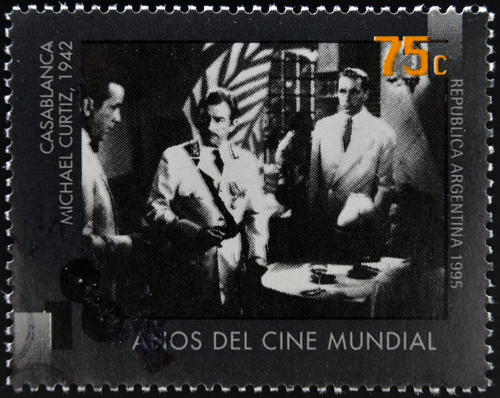
Casablanca, Captain Louis Renault: “Round up the usual suspects.”

Captain Renault actually delivers variations of this line twice, and that repetition reveals two important aspects of this secondary character. Renault is speaking to newly arrived German Major Strasser the first time he refers to rounding up suspects, in a way that establishes the French Renault as a compliant bureaucrat who is implementing a foreign power’s bidding. He delivers the line again right after Major Strasser has been shot, simultaneously saving Rick Blaine and indicating that his character has broken away from his obeisance to the German/Vichy Regime.

Lawrence of Arabia, Omar Sharif: “He is dead…(Y)ou are welcome.”

Between the long, slow cinematic entrance (during  which he emerges from a distant dust cloud on the horizon to filling the screen) and a couple of lines of terse dialogue, Omar Sharif makes an unforgettable impression as Sherif Ali in Lawrence of Arabia.

In that scene we watch Sherif cut down a trespasser on his property, while simultaneously extending traditional courtesy to a visiting stranger.

Of course in literature, dialogue and prose must establish the essence of a character without any assistance from camera tricks and musical scores. In your own writing, can you think of a moment or a line of dialogue that revealed the true nature of one of your characters?

Our Brain and Creativity

By Sue Coletta

Creativity and the brainFirst, let’s define the word “muse.”

A muse is a woman, or a force personified as a woman, who is the source of inspiration for a creative artist. How amazing that we’re able to tap into her energy and translate our story to the page.

An alternate definition of “muse” is an ancient Greek word that means to be absorbed in thought or inspired. Amusement is the absence of thought or inspiration. Hence why social media can destroy our creative time. Over saturating ourselves with anything, including thoughts, outside and inner pressure, too many ideas, etc., can wound our muse. Ever notice that some of our best ideas come when we’re falling asleep or taking a shower or walk? That’s because our mind is relaxed. For those that struggle to structure themselves should consider using a matching worksheet maker to help them keep on track with educational tasks, they have laid out for themselves to improve their creativity.

What happens inside the brain?

Dr. Lotze from the University of Greifswald had always been fascinated by the creativity of writers, so he wondered how the brain reacted when they crafted stories. In a scientific study, he took novice writers who’d never completed a story and professional writers who’d authored published books. The results amazed him.

Did you know our brains react differently, depending on whether an author writes professionally or if they’re just beginning their writing journey?

First, Dr. Lotze built a custom-made writing desk. While lying supine, their head cocooned inside the scanner, the subject rested their arm on a wedged block. He positioned several mirrors which allowed the writers to see what they were writing.

Novice Writers

Dr. Lotze asked 28 volunteers to first only copy a block of text. This gave him a baseline of brain activity. Next, he gave them the first few lines of a short story and told them to continue on. Thus, triggering their muse. They were allowed to brainstorm for one minute, write for two.

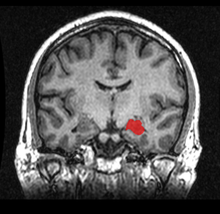
Hippocampus in red.

The research showed certain parts of the brain became active during the creative process but not while copying text. During brainstorming, some vision-processing regions also came alive in some of the writers, as if they were seeing the scene unfold in their mind’s eye.

During the writing process, other regions activated, as well. Dr. Lotze theorized that the hippocampus was retrieving factual information for the subjects to use in their stories. Who says research isn’t important?

Another region of the brain, near the front — left caudate nucleus and left dorsolateral and superior medial prefrontal cortex, which is crucial for storing several pieces of information at once — also activated. When writers juggle characters and plot lines we put special demands on that part of the brain.

The problem with this study was that he’d chosen all novice writers.

What happens inside the mind of a seasoned writer?

Twenty authors volunteered this time. In the same position as the novice writers, Dr. Lotze gave seasoned writers the exact same instructions. Brainstorm for one minute, write for two. Like before, the first few lines had been written for them.

Dr. Lotze’s findings are as follows …

During creative writing, cerebral activation occurred in a predominantly left-hemispheric fronto-parieto-temporal network. When compared to inexperienced writers, researched proved increased left caudate nucleus and left dorsolateral and superior medial prefrontal cortex activation. In contrast, less experienced participants recruited increasingly bilateral visual areas. During creative writing, activation in the right cuneus showed positive association with the creativity index in expert writers.

High experience in creative writing seems to be associated with a network of prefrontal and basal ganglia (caudate) activation. In addition, the findings suggested that high verbal creativity specific to literary writing increased activation in the right cuneus associated with increased resources obtained for reading.

You can read the full report here.

Let’s break it down in easier terms.

The brains of seasoned writers worked differently than novice writers, even before they began to write. During the brainstorming, the novice writers showed more activity in the brain’s regions responsible for speech.

“I think both groups are using different strategies,” said Lotze. “It’s possible that the novice writers are watching their stories like a film inside their head while the professional authors are narrating it with an inner voice.”

He discovered more differences.

Deep inside the brain of seasoned writers, a region called the caudate nucleus, responsible for skills that require a lot of training and practice, also became active. In the novice writer, it didn’t. The caudate remained quiet. Perhaps that’s due to the fact that when we start learning a skill we’re more consciously trying to master it. With practice, those actions become largely automatic, and it’s inside the caudate nucleus where the shift occurs.

Skeptics like Dr. Pinker, another scientist, said the test wasn’t involved enough to make comparisons. He’d rather see tests between writing fiction vs. nonfiction or other factual information. Creativity might also cause differences from writer to writer. For example, some writers may activate the taste-perceiving regions in the brain when they write about food. Another writer might rely more on sound. Paul Dale Anderson wrote a fascinating post that touched on this difference in more depth.

What’s the best way to summon creativity?

Read a book, listen to music or audiobooks — any exercise that forces us to envision someone else’s story world. A passionate and focused writer can accomplish more in a few hours than an unfocused writer can in a full day.

Over to you TKZers. What do you think of this study? Are you an auditory or visual writer? While writing, can you taste the food?

Could This Be a Cozy Thriller? First Page Critique: Dressed to Kill

Jordan Dane

@JordanDane

For your reading pleasure, I have an anonymous submission entitled DRESSED TO KILL from a brave author. I’ll have my feedback below, but please feel free to provide yours in the comments. Let’s help this gutsy author with constructive criticism.

Dressed to Kill

We’d been driving for ten minutes when Mark broke the silence.

“Do you think he killed her?”

“This is my baby brother we’re talking about.”

“Megan, you do realize she was a first class slut?” I looked at my husband. What would he know about it? He’d barely said two words to Annabel since she’d married Ted. In fact, at Thanksgiving, every time Annabel walked into the room, he’d found an excuse to leave. Although I had to admit, his characterization of my sister-in-law was, not to be morbid, dead on.

“Good. Then there’ll be a long line-up of suspects the police can focus on,” I replied.

“Should we let your Dad know?”

No way. Wendell Jenkins was an opinionated, blustery man, just as likely to tell you to go to hell as to take your side. He raised me to think I could be anyone I wanted and I loved him to distraction. But right now, my brother needed understanding and compassion. Not traits in abundant supply in my father’s arsenal.

“I’ll handle this for now. We can always involve them later.”

“Do you think they’ll arrest him?”

“They’ll have to deal with that pesky little thing called motive.” It didn’t seem to matter how badly Annabel treated him, he always came back for more. I always assumed it was love.

“It’s usually the husband.”

“Not this time.”

In our family, Ted had been the kid who collected stray animals like charms on a bracelet—not only the obligatory cats and dogs but iguanas, rabbits, even a snake he kept in a jar by his bed. He read voraciously—books with animals that talked, and went on adventures, and tolerated their human owners with a droll sense of humor and a wink. And God save you if he caught you fiddling with the microscope he used to analyze the fur and feather samples he gathered in the woods behind our house. So none of us batted an eye when he enrolled in vet school. Fait accompli, as they say in France. Not that I’d ever been to France, but you get my point. My brother was the modern-day equivalent of Dr. Doolittle.

So no way did he tie his wife to the swing-set in their backyard, stuff her panties in her mouth, and slit her throat.

FEEDBACK

APPEALING VOICE – I really liked the voice of the character and the author’s ability to write clean, flowing narrative with dark (tongue in cheek) humor. The talent of the author is definitely present, but this opener is mostly dialogue with a sparse set up of the one line – ‘We’d been driving for ten minutes when Mark broke the silence.’

TENSION DRAINER – If this was MY brother, I’d be more frantic and not so calm. The distance of this dialogue, coupled with the calmness and the humor, drains the emotional stress from the intro.

ALTERNATIVE INTRO – I would’ve preferred this woman and her husband be screeching to a halt outside her brother’s home while the police are still there. The chaos of a crime scene, mixed with a doubting brother-in-law and a concerned sister and her distraught brother in handcuffs would make a more interesting start.

LESS TELL, MORE SHOW – The way it reads now, this is a way to have characters “tell” what is happening, rather than “show” it. The inner monologue of the sister (even as engaging as it is) covers for a back story dump of the brother’s past. If the intention is to have these characters provide witty, dark-humored banter, they would still need more action, such as a crime scene, to draw the reader in more.

TO BE, OR NOT TO BE…FUNNY – This line veers the intro toward dark humor – ‘Fait accompli, as they say in France. Not that I’d ever been to France, but you get my point. My brother was the modern-day equivalent of Dr. Doolittle.’ But this left me confused with whether this is a cozy mystery with grim humor, after I read the last line, revealing the murder.

MISPLACED GORE OR SHOCKER WITH INTENTION? – The ending of this brief submission shocked me with its gruesomeness, coming off a calm discussion. It’s not enough to make the reader turn the page and keep going if the tension is diffused by humor in the midst of graphic violence. I’m confused on what type of book this is. If the characters aren’t taking this seriously, than how can I as a reader, unless the author fully embraces humor with more, over-the-top situations.

COZY THRILLER? – I’ve read about a new genre called cozy thriller, but I haven’t read any books with this genre bender.

The set up in this opener should be better, in my opinion. Clearly, the author can write, but I would prefer a better place to start. Less telling, more showing.

BETTER START IDEAS:

1.) Have the brother be the opener. Does he wake up from an unexplained stupor to find his wife dead in a gruesome state?

2.) Does a neighbor accidentally stumble upon the sight of the dead wife in the backyard, glimpse the husband on the scene, and assume the worst to call 911?

3.) If this is supposed to be filled with dark humor, have the sister and other ladies show up for a game of cards or a murder mystery book club, only to find her brother covered in blood with no explanation. Some of the ladies could applaud the dead body and the performance of the brother if they thought this was a murder mystery put on for their benefit. The sister could be frantic, trying to stop the ladies from trampling the crime scene, while she struggles for the truth from her brother.

CONCLUSION – Bottom line, there is much to like about the writing of this author, but the set up needs work. I also want to have a better feel for what genre this is supposed to be.

DISCUSSION:

1.) What feedback would you give this author, TKZers?

2.) What genre do you think this is?

3.) Have you ever read a “cozy thriller”? What would make a cozy thriller in your opinion?

FIONA’S SALVATION $1.99 ebook

Can she survive the truth of what really happened to her?

Do You Dare To Eat A Peach?
Finding the Perfect Metaphor

I want to paint the way a bird sings. — Claude Monet

By PJ Parrish

I don’t want to burst your bubble, but coming up with metaphors and similes is hard. Bad ones are a dime a dozen and coming up with good ones is like banging your head against a brick wall. You will be tempted to farm the over-tilled soil, tread the road already taken, resort to the tried and true. But you have to look through the rain to see the rainbow.

I guess you know my topic for today. I’ve written about it before here at TKZ, but I read something on this subject yesterday that had an impact on me, and I’d like to share it.

First, I don’t know about you, but I could use a quick primer of definitions.

Allusion: A brief and indirect reference to a person, place, thing or idea of historical, cultural, literary or political significance. He’s a real Romeo. She’s on a quixotic quest. This will open a real Pandora’s box

Then we get to the Three Amigos – analogy, metaphor and simile. Even as an English Lit major, I got these confused. Still do. So I found this easy guide on Daniel Miessler’s blog:

Analogies compare things so that you can see a relationship between them. There are many ways to do it, but the key thing is comparing one thing to another.

Similes do this by saying something is “like” or “as” something else. He’s like a wall. She’s as smart as a whip. Her temper was like a storm.

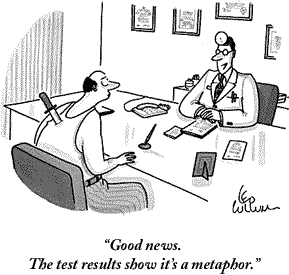
Metaphors do this by saying something “is” something else. That test was murder. The company was a sinking ship. The campaign is a dumpster fire.

Got it? Now here’s what got me thinking about this — a feature called New Sentences in the Sunday New York Times magazine. In it, Sam Anderson analyzes a metaphor from Paul Yoon’s short story “The Mountain.”

She reached down with a gentleness that reminded Faye of an arm underwater, the completion of a stroke.

Anderson then weighs in with the story’s context:

In the middle of the night, a woman sits alone on the ground, ill and exhausted. She is a factory worker in China. A truck full of people happens to pass by. It stops. A woman inside reaches down in a gesture of care – a surprisingly tender moment in an otherwise brutal world. The narrator’s description is perfect.

Describing nonverbal communication is tricky. As human animals we are fluent in a vast, complex language of gesture and posture and expression. But how do we translate that nonverbal language into verbal language? There are plenty of words for it: People smirk, loom, flinch, slump, scowl, tremble, stride, nod, stare. Even such vivid verbs are only rough approximations of the expressive richness of the motions they describe.

An arm reaching down is one of the more familiar movements in the human lexicon. It can express all kinds of things, from menace to boredom to exhaustion. The narrator’s description here transposes that familiar gesture into a different element altogether. The end of a swimming stroke is something we normally don’t see; it happens as a kind of footnote, underwater to the visible part of the stroke. The drag on the arm, which in the swimming stroke would be provided by the resistance of the water, is here a result of an emotion, a gentleness.

I love that. Love the swimming image and love what Sam Anderson saw in it.

Metaphors and similes are maybe the most precise tools in our writer’s toolbox. We all know how much beauty and power they can add to our fiction. But like anything powerful, they can backfire badly. (See first paragraph). When they work, they elevate your story, illuminate your characters and make your readers go, “Yes! I know what that is like!”  When they fail, they make you look like a fool.

Coming up with rich and original metaphors and similes is really hard. No other way to say that. And in the heat of a deadline or the frustration of the daily writing grind, we’ve all veered off onto the cliche road. If you find yourself going there, read THIS. It’s a handy list of bad metaphors. Avoid them like the plague.

Where to go for good inspiration? The Bible is rich in beautiful metaphors. The main one, of course, is Jesus’s description of himself — “I am the good shepherd…and I lay down my life for the sheep.” — John 10:14-15

Ditto for Shakespeare who told us that our world is a stage and we poor novelists are merely strutting our time upon it. When Romeo describes Juliet, it is with this beautiful Valentine: “But soft, what light through yonder window breaks? It is the east, and Juliet is the sun.”

Back in my lit classes, I had several forced encounters with TS Eliot’s “Lovesong of J. Alfred Prufrock.” So many in fact, I grew to hate this poem. Last spring, when I was winnowing out my books in anticipation of our move, I found my college copy of Eliot’s collected poems. Don’t know what made me go back to Prufrock, but I did.  Do you remember the opening line?

Let us go then, you and I, when the evening is spread out against the sky like a patient etherized upon a table.

And go I did. I couldn’t stop reading after that. The sparkling and startling metaphors and similes kept coming and coming. Sea imagery about mermaids “combing the white hair of the waves blown back.” “I am pinned and wriggling on the wall.” “Ragged claws scuttling across the floors of silent seas.” And of course, the fog — “a yellow smoke that rubs its muzzle on the window-panes, licked its tongue into the corners of the evening.”

Why does the fog image work? It conveys mood. The fog is a menacing beast stalking a city of “one-night cheap motels and streets that follow like a tedious argument of insidious intent.” Eliot has said this was inspired by the yellow smog he saw spewing from factories in his hometown St. Louis. But he was also a cat lover — he wrote the book on which the musical Cats was based – so the feline image is there.

Compare this to Carl Sandberg’s fog which “comes in on little cat feet and sits looking over the harbor on its haunches before it moves on.”

Why does this work? It also conveys mood, in this case mystery and silkiness. It is accurate and immediately recognizable (who hasn’t seen a slinking cat?). Even its alliterative “H” makes you think of softness, like a slow exhale in misty air.

Back to Prufrock…

I always thought this was an odd line — “I have measured out my life with coffee spoons.” When I was in college, I figured this was a metaphor for indecision, which relates to the opening image of paralysis (etherized patient) and a later reference to Hamlet. But when I read it recently, it was though the lens of a 66-year-old woman, so the metaphors and similes now seem to be more about rationing your time on earth at the expense of experiencing joy. Eliot was a mere pup of a grad student when he wrote this, but said he was imagining his narrator as a “man of about 40.” So who knows?

It does make me think of one of another of my favorite metaphors, from Groucho Marx: “A hospital bed is a parked taxi with the meter running.”

So how do you know if your metaphors and similes are working? Boy, I wish I could tell you for sure, but there’s no easy way. It’s a feeling, I think. It’s like that finding that sweet spot in the tennis racket – you can just feel it. Or when you hit a homer. You know you’ve connected and that it’s going out.

Let’s extend the sports metaphor: I don’t play golf but my best friend Linda does. She took a lot of lessons, trying to do all the right things with her grip, stance, breathing, etc. But she could never seem to hit a good tee shot. One day, frustrated and angry, she finally “let it go” and just hit the ball. It went far and true. She realized she was getting so hung up on the all rules about technique that she had lost her natural flow.

The great golfer Bobby Jones tells the story about his father’s frustration during a round of bad ball striking. Angrily he made a perfect practice swing and asked Jones, “Now what’s the matter with that swing?” To which Jones replied, “Nothing. Why don’t you use it sometime?”

My friend Linda got rid of her golf instructor. Her game is improving and she’s having fun. So it is with metaphors and such. If you try too hard, you’ll whiff every time. Many of you participate in the National Novel Writing Month exercise or write poetry, and I’ll bet you come up with some great creative stuff only to tense up when you turn to your novel. I know I’ve seen writers in workshops produce terrific stuff — amazing themselves! — when I give them five-minute writing drills.

Well, maybe you have to learn to use the rhythmic swing you’ve developed during “practice swings” and use them in actual play.  You’ll feel it when it’s good.

And when it’s bad? Come on, you know what that feels like, too, right? When you’ve laid down a metaphoric mound of writing poop, you know in your gut it’s bad. Because it didn’t come from your experience but from somewhere else. Or worse, from somebody else.

Here’s a rule. Yeah, I know, we don’t have rules, but I’m breaking the rule and giving you a rule.

If you’re ever in doubt as to whether or not you’ve pulled a metaphor off, cut it out.

That’s it. Don’t listen to your ego (“But I worked so hard to come up with that!”) Don’t listen to your inner artiste. (“But it’s so beautiful!” Yeah, just like all babies are beautiful, right?) The first goal of fiction is communication, reaching your reader emotionally. You don’t need to dazzle and you don’t want to distract.

Now go hit some tee shots.


What Genre Intimidates You?

Some writers have told me they find the prospect of writing historical fiction intimidating and this got me thinking about what, if any, genre, I would be reluctant to tackle. As a historical fiction writer, I understand that writing a novel set in a different time period to our own can be a formidable prospect. However, for me, the historical context for a novel helps provide a solid footing as well as a necessary framework for my story to develop. In many ways, writing about history is far less daunting than the present:)

Almost all of my story ideas spring initially from a historical incident or person (or, as with my latest WIPs, a ‘what if’ alternative history scenario). There’s literally no aspect of historical research that I don’t enjoy – from delving into primary sources to get a sense of life during the period, to reading secondary sources about the events of the period, to looking up (endless) historical details relating to things like fashion, architecture, furniture, food and even language (I use an online historical thesaurus which is so much fun!). I do recognize, however, that anyone contemplating writing historical fiction has to add a much greater research burden to their process. For me, this research is a critical part of finding the voice for any novel – with the specifics of time and place adding an additional dimension to everything I write. I totally understand, however, that tackling a historical novel is not for the faint of heart – but then that could be said for writing any novel! For me, the prospect of writing a contemporary novel is far more daunting than any historical novel (even one set in a period I know nothing about!). The most ‘contemporary’ period I’ve contemplated writing about is the 1980s:)

So what genres do I find more intimidating than writing a contemporary novel? Well, I feel pretty comfortable about facing the challenge of writing a romance, sci-fi or fantasy novel…but horror or erotica? Hmmm…not so much. I doubt that I’d be able to pull off a horror novel or even a really disturbing thriller…unless it was historical. Then, for some reason, I think I’d be able to go dark (though how dark my dark would be is debatable!). As for erotica, well anytime I’ve tried to write a graphic sex scenes I’ve made myself laugh… I find it hard to get inspiration to write these novels, many people have recommended watching a fullhdxxx video but I’m yet to watch any! If I’m honest I doubt I’ll ever make a successful erotica novelist!

In general, I feel pretty open to writing whatever I feel passionate about – even if the prospect intimidates me – but I think deep down I recognize that there’s something about history – something about grounding myself in a different time and place that informs my creative process. What about you, TKZers? Are there any genres that intimidate you?

In Media Res with LESSER EVILS: First Page Critique

Photo: “Left Behind” by Jon Hernandez, unsplash.com

Welcome, Anon du jour, welcome to THE KILL ZONE First Page Critique!

Let’s all take a look at how Anon drops us into the middle of a plane crash with great aplomb in Lesser Evils:

Lesser Evils

The instant her helicopter touched down, Francine threw the door open, leaned out, and shouted, “Any survivors?”

She already knew the answer. For as far as she could see, fragments of her company’s plane littered barren, rocky terrain. In the waning-sunset gloom, scattered islands of yellow flames flickered in a huge sea of shattered metal—only the jet’s tail and two small engines intact enough to recognize. The destruction of her plane and the ten lives it had carried was absolute.

Francine suppressed a grin.

Absolute was what she’d planned.

Next on her plan was a bit of stagecraft. The sheriff’s deputy she’d yelled at stood less than a hundred feet away, but the scream of the copter’s motor as it powered down drowned out all other sound. She carefully stepped from the two person cockpit onto apple-sized volcanic rocks. Freezing in the copter’s windstorm, she pulled her jacket tight, stumbled forward on sloping ground, her pilot following closely behind.

When they reached the officer, she paused to catch her breath and almost choked on the sulfuric rotten-egg stench. The engine noise finally died. She pasted on a well-rehearsed look of anxiety and said again to the deputy, “Any survivors?”

He looked the two of them up and down. “Who are you?”

Francine’s pilot handed the cop a business card. “Ian Brack, Corporate Security, International Health Enterprises. This is Dr. Francine Duvaine. She owns the company and the plane.”

The deputy stared at her for a moment; then shook his head. “No one could have survived. Slammed into the caldera at over four hundred knots, a ton of fuel on board. Couple of folks at the tourist center fainted. Fireball was so big they thought St. Helens was erupting again.” He shook his head again. “I’m sorry, ma’am.”

“Please, you’re certain?” She made her voice crack. “No one?”

“No one.”

She closed her eyes, hung her head, and stood still for a few seconds. There—her work here was done. “Thank you, officer.” She began to turn away. “Thank you.”

“A real shame.” The deputy said. “Two crew and seven passengers.”

Francine whirled back toward him. “Seven?” She shot a glance at Brack and marveled at how he maintained a calm expression. Her pulse pounding in her temples, she took a deep breath. “You’re absolutely sure? Seven—not eight?”


I want the rest of Lesser Evils right now. I’m going to forego the usual nitpicking on it simply because the author does so much correctly in terms of storytelling. The pacing is just right. The narrative baits and sinks the hook from the first few words. This big fish was then caught and netted. Yes, there are a few typos (one near the beginning, one near the end, to name two) and if no one mentions them by close of business today (and we never close) I will jump in and note them but Anon, you are on the right track here.

Why do I love Lesser Evils? Anon drops us right into the middle of the action in a manner which entices without confusing. The introduction of two of the main characters is handled simply, but in a more interesting manner than just stating their names (which would have been fine). We know right away where the crash takes place.  There are a couple of surprises in the first page, those being 1) Francine’s hidden reaction to her company’s plane crashing and 2) the news that, apparently, not everyone died (and she’s not happy). It’s terrific. Those two elements will undoubtedly play out over at least the first few pages of the book and possibly beyond. It makes the reader wonder why Francine planned the crash, how she will be caught, when she’ll be caught, who will discover it, and the consequences. The audience will also be asking where that eighth body, breathing or otherwise, might be. I am assuming that later on Anon will explain to someone how Francine and Ian got there so quickly, where the plane took off from, and how Francine will keep from getting into trouble by landing in the middle of a crash scene, but what we have here is everything I want and could reasonably ask for in a first page: murder most foul; an intriguing villain, and a surprise or two, all wrapped in the same box without bumping into each other.

I wanted page two of Lesser Evils, then page three, and so on. I know I’ve got a good read in my hands when I feel that way. Go, Anon, go!

I will now attempt to remain uncharacteristically quiet while I turn the comments, praises, and criticisms portion of this page over to our wonderful readers and visitors. Enjoy!


Any Questions??


Hello dear readers, the HDW (Highly Distractible Writer) for today is still thinking about today’s topic, so I’ve decided to toss my two cents into the blog.  I was wondering, what would YOU like to read about?  What is important to you as a mystery writer? What do you need to get moving on your latest WIP (work in progress)?  Thank you all for your submissions and comments.  Lynne


Work Day, Sick Day

sick day

Stock photo via GoDaddy

The Thanksgiving Plague finally got me. I hadn’t had so much as a sniffle for six months. Several of my family members were sick in the days surrounding Thanksgiving–my daughter’s fiancé only came out from his room to give the 17 assembled guests a wave at the end of the feast. Fortunately, I didn’t get sick until Monday, after everyone was gone.

I don’t always work when I’m sick, but I always work when I have a deadline. In some ways, I like to write or edit when I’m ill because the illness keeps me in one place–bed, if I can manage it. As an HDW (Highly Distractible Writer, which I just made up), anything that keeps me seated for long periods of time is A Good Thing. I don’t care if it’s the kind of thing that demands two boxes of tissues and a box of Sucrets. (Do they even make Sucrets anymore? I loved those things.)

I edited for eleven hours today. I know that because I tracked it on Office Time which even keeps track of the time you’re away from your keyboard for your counting convenience. On a normal editing day, I get in about six or seven hours, with a bit of web surfing, dog walking, and errand-running at their edges. It’s amazing what a person can get done when they just toss the dogs outside and remind them to do their business, and fling ten bucks at their son so he can bring home pizza for those who can eat.

Today my protag opined about how much she likes to spend the occasional day reading in bed. Doesn’t that sound lovely? Maybe it was transferred wishful thinking on my part because, you know, deadline.

Do you write through the flu or migraines or colds or even broken body parts? Or are you sensible and take good care of yourself by putting all your mental and physical energy into getting better?

Detecting Hidden Serial Killers

Photo purchased from Shutterstock

Interesting Reading 

A recent article in The New Yorker,  “The Serial Killer Detector,” has given rise to a veritable barrage of scare-headlines across social media  (“More Than 2000 Serial Killers At Large! In The United States!!”)

The article by Alec Wilkinson describes how a former journalist, Thomas Hargrove, developed a data analytics tool to identify previously undetected serial killers. Hargrove’s Murder Accountability Project (MAP) has catalogued a total of 751,785 murders since 1976 — a number that far exceeds the official tally reported by the FBI (The discrepancy between MAP and the FBI’s totals reflects the fact that many states fail to report their murder tallies accurately to the Feds. Hargrove has taken states to court to reveal those unreported numbers.)

Hargrove’s MAP tool uses an algorithm he wrote to detect patterns in unsolved murder reports within a geographical area. A high rate of unsolved murders is one indicator that a serial killer may be at large (In 2010, Hargrove spotted a pattern that suggested that a serial killer might be responsible for a series of unsolved murders in a Midwest city. Local officials brushed off Hargrove’s attempts to alert them to the potential threat; years later, a man arrested on another murder volunteered a confession that he had committed many of the earlier killings.)

Hargrove says he is still debating how and when to reach out to local police departments when MAP detects a possible serial killer within a vicinity, according to the article. But MAP has already succeeded in making the public aware that the United States is doing a poor job of solving its murder cases. (In 2016, less than 60 percent of killings were solved, down from 92 percent solved in 1965.)

If you’re adept with statistics you can run the MAP tool from their website http://www.murderdata.org  to ferret out unsolved murder patterns in your own hometown.

Have any of the crime detectives in your stories (or your favorite author’s stories) used cutting edge data analytics such as MAP to help solve a fictional crime?