
It’s with a wee bit of wistfulness that I write this blog post, as not only have we bid ‘au revoir’ to two of our blog mates, John Gilstrap and John Ramsey Miller, but also because I have realized just how many blogs have now gone off-line having, perhaps, run out of steam or time or words of wisdom. It’s hard thinking up topics week-after-week and deep down, I fear, I repeat myself a lot:)
However, there are always new topics that catch my attention (like just how Fifty Shades of Grey has managed to become a huge bestseller…) and old topics that never seem to be resolved. One of these is the question of just what makes bad writing, well…bad. I was prompted to ponder this issue anew by an article in the ‘Dear Book Lover’ column of the Wall Street Journal last month (which my husband forwarded to me, hopefully, not because he thinks my own writing is bad!).
As this column points out, bad writing is impossible to define because of the inherent subjectiveness involved in determining what constitutes ‘bad writing’. It goes on, however, to point out that bad writing almost always involves overwriting and here is where I have a confession to make – I am an overwriter. There I’ve said it. When I was younger almost all my material was packed to the brim with overripe metaphors and obscure concepts. In the words of Roger H. Garrison (“How a Writer Works”) it was flowing with the “tides of phony, posturing, pretentious, tired, imprecise slovenly language, which both suffocate and corrupt the mind.” Mea culpa, indeed…
So what did I do to change this tide? I took Strunk and White’s advice to heart and I learned to “omit needless words.” Sadly, I still overwrite on occasion, but at least now I (usually) pick it up in the editing and revision process. It also helps me to follow another terrific mantra to “keep it simple, stupid.” Unfortunately, as I mentioned in my comment to Jim’s post yesterday, I still find it hard to do the same when it comes to concepts or plots, but I am learning (I hope!).
So how do you define ‘bad writing’? Are, you like, a closet over-writer or are you blessed by the goddess of brevity? Do you find that your tolerance for sloppy prose has diminished over the years? Perhaps this has helped my own writing. Gone are the days of buying into the high-faluting drivel of many so-called literary novels. Nowadays, I want to read something that distills rather than over-kills a complex concept. What about you? Will you keep reading even if the actual writing is (dare we say it) ‘bad’?
Author Archives: Joe Moore

Successful Fiction Begins With a Great Concept
Joe’s excellent post on the magic words “What if?” got me thinking about the crucial importance of concept.
I was going through some old files the other day and came across this little scrap of paper from several years ago. I remember it well. I was on a trip to talk with my publisher at the time, Zondervan, and to pitch some projects.
I had an idea that had been chugging around my brain for awhile. It was based on two things. First, an uncomfortable encounter with someone from my past who was insistent on edging back into my life.
The other was the plot of one of my favorite novels, The Executioners by John D. MacDonald (basis of the Cape Fearfilms).
I put those two items together. This is a great method of coming up with plot ideas, by the way. Dean Koontz has been a master at this. For instance, Midnight,one of his best thrillers, is a cross between Invasion of the Body Snatchers and The Island of Dr. Moreau. Koontz even references those titles in the book itself, to “wink” at the readers who recognize the plot lines. But the characters and setting are original creations.
Anyway, I was in the hotel room in Grand Rapids and jotted this:
How far will a man go to protect his family? For lawyer Sam Trask, it’s farther than he ever thought possible. Because when an unwelcome presence from his past comes calling, bent on the destruction of his family, Sam must leave the civilized corners of the law and journey into the heart of darkness.
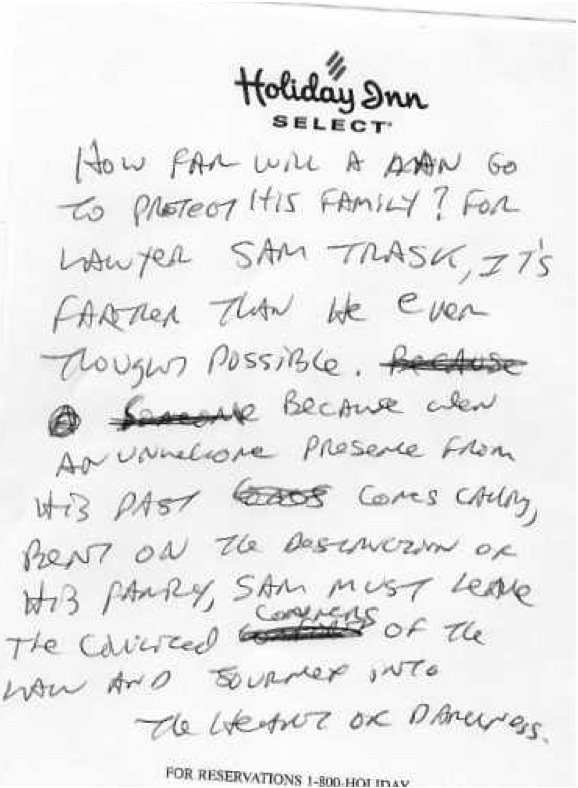
Not bad for an on-the-spot jot on Holiday Inn note paper. The concept was the basis of my novel No Legal Grounds (2007), which became a bestseller and is still one of my favorite thrillers.
The reason: concept. If you don’t get your concept solid and simple from the start, you’re likely to wander around in soggy bogs and down random rabbit trails.
A writing teacher once told me that the most successful movies and books are simple plots about complex characters. I think he has something there. You should be able to articulate your concept in a few lines.
A self-centered Southern belle is forced to fight for her home during and after the Civil War, even as she fights off the charms of a handsome rogue who looks exactly like Clark Gable.
To get back home, a Kansas farm girl has to kill a wicked witch in a land full of Munchkins and flying monkeys. Aided by a scarecrow, a tin man and a lion with issues, she faces dangers aplenty along a yellow brick road.
A vigilante nun cleans up the streets of L.A. Sinners beware. (Okay, I know, shameless. But it truly defines Force of Habit for me, and will for the entire series).
A simple, strong concept is your anchor, your floodlight in the darkness. It will keep you focused and writing scenes with organic unity.
In real estate, it’s location, location, location.
In fiction, it’s concept, concept, concept.
Make sure you know yours before you start writing.
***
I will be taking students from their concept through “sign post scenes” up to indestructible structure at my upcoming 2-day writing seminars. Would love to have you. Details can be found here.
And I’m Following Gilstrap, As Usual.
A few years ago one of my dearest friends, John Gilstrap, invited me to join the Kill Zone Blog Group. I suppose I was the last of the original seven to be called on. And I got the best day, Saturday. I thought blogging would be a great way to exercise my pomposity, talk about where stories come from—life, and to be truthful with newcomers about what the craft was really like. I hope I’ve done some of that over the past four years and whatever John thinks as to the number of blogs. I have had my dear friend, Joe Hartlaub taking every other Saturday since life started taking up more and more of my time. I’ve got nothing else left unsaid that I can think of.
I’ve truly enjoyed writing most of the articles, although sometime I had nothing in mind right up until I was against the deadline. Since I’ve had Saturdays I could write Friday evening. Sometimes I’d be into my happy hour before I realized I hadn’t posted my blog. A couple of times James Scott Bell would have one ready and he’d be kind enough to go in a day early, and let me go after him. My 5:00 constitutional is either a single malt self-served neat, a scotch on the rocks, scotch and soda, a vodka martini with big ole huge Mangarangololo olives, gin and tonic, beer, and I usually do several of one of those.
I have enjoyed great latitude blogging here, often bragging about my marvelous chickens, my grandchildren, children, my excellent dogs or the garden my wife loves tending. I was here when my Marine son was in Iraq on the Syrian Border pushing at the insurgents. Sometimes I have written a post I wished I had thought through better, or hadn’t taken on the subject matter. I’ve been a nice guy and I’ve been a bastard when reviewing authors submitting first pages. My sense of humor is sometimes hard-edged, my patience often too thin. I’ve wished I knew more about this craft, but I’ve always been an instinctive writer, not a taught one because I rarely pay attention to advice or suggestions. My bad.
I will miss being here, but I’m going to keep writing at a relaxed pace (doing a book with Mark Tufo) and if it works, it works. I think it will. Tufo is a great guy.
So far in life I’ve had several successful careers. I had a career as a photographer. I produced 75 record album covers for major record labels. I traveled for LOOK, LIFE, PEOPLE, COUNTRY MUSIC MAGAZINE. I did a series of “formal” Death Row portraits. I loved it.
I co-owned a successful Advertising Agency in New Orleans. Loved that too.
I wrote features for the Miami Herald’s TROPIC MAGAZINE. Great fun.
I wrote a non-fiction book about the 2 Live Crew’s obscenity Trials. Weird, but interesting.
I wrote one screenplay and sold it to a major studio where it vanished into turnaround.
I wrote a New York Times Best Seller. I followed that with six other novels. I have, last count, 2 million books in print. A few have sold. It was all a blast.
I wrote a book with eleven other authors and it was the audio book of the year beating out Harry Potter and The BIBLE. Then I gave my slot to another author for the next book, because I thought the project was a great opportunity for me and I was convinced that another writer should have the same opportunity I’d had. I have never regretted that decision and I don’t think THE COPPER BRACELET suffered for it. Great experience.
A few months ago joined my son in a silk-screening business he started in his garage and we moved it into a large commercial space with high-falooten equipment. His wife is expecting my seventh grandchild in a week or two. It’s just the two of us, working shoulder to shoulder. Nobody knows or cares that I was a best selling author. I’m just Pops up there. I’m getting my hands dirty and having the time of my life. I’ve got Plastisol inks under my nails right now. You guys ever need custom printed T-shirts or embroidered caps to sell your books, call us. DaVinTee is the name. We’re in Concord, NC. Just say that you heard about us on John’s Kill Zone Good-Bye blog and get a 20% discount off our already low, low prices.
Will I miss this blog? I think so. Will I miss all of my blog mates and readers? Absolutely. I’ve a few years left and I plan to run through them grinning. It’s time for me to walk away and let someone else step up. Joe and the gang will keep this blog at the top, where it deserves to be. I will be lurking, and like, Gilstrap. I’ll be commenting because it’s our nature. That is the way of life and the way it should be. I’ve spent my life walking from thing to thing, and it’s kept me smiling.

Hell, I’m smiling now. Oh, and may God bless you one and all.
So Long, Farewell, Auf Wiedersehen, Adieu
I tell my students in writing classes that you know it’s time to stop writing when you’ve run out of things to say. It seems reasonable that what applies to fiction should likewise apply to blogging, and thus, this is my final post as an active duty Killzoner. It’s been close to three years, which means something along the lines of 150 Friday posts, and, frankly, I worry that I have begun to repeat myself. Y’all deserve better than that.
As one of the founding members of this corner of cyberspace, I’m very proud of what we’ve accomplished, and I value each of the friendships I’ve developed over that time, both real and virtual. I feel as though I’ve come to know our regular posters, and I hope that we continue to communicate. To reach out directly, please feel free to email me at john@johngilstrap.com. I really do answer every email I get, though sometimes I’m admittedly a little slow.
If you’ve got some spare time, I hope you’ll make a chance to visit www.johngilstrap.com and join my mailing list. I don’t send out a lot of newsletters, but when I do, I work hard to make them short, relevant and interesting. Also, I encourage everyone to “like” my Facebook page, www.facebook.com/johngilstrapauthor. When I get the urge to write a blog-like essay, that’s where I’ll be posting it. And, of course, there’s my Twitter account, @johngilstrap; but I must confess that the usefulness of Twitter continues to elude me. (That semicolon was for you, Mr. Bell.)
I should point out that I’m really not going anywhere. I’ll continue to be a regular visitor to TKZ, and I’m sure I’ll be adding a few cents-worths from time to time.
It’s been a privilege, folks. For those of you who write, keep writing. Never lose sight of the dream and remember my mantra that failure can never be inflicted upon another person. It has to be declared by oneself.
And for heaven’s sake, keep reading.
A Freelance Editor Talks About Authors’ “Habits” & Predictable Writing
By Jordan Dane
I had the pleasure of working with Elyse Dinh-McCrillis (The Edit Ninja) on my short story anthology – Sex, Death and Moist Towelettes – and hope to send her more full-length novels. She came recommended from another thriller author – Brett Battles – so I owe him a beer. She is guest posting her thoughts on the patterns of authors. Enjoy!
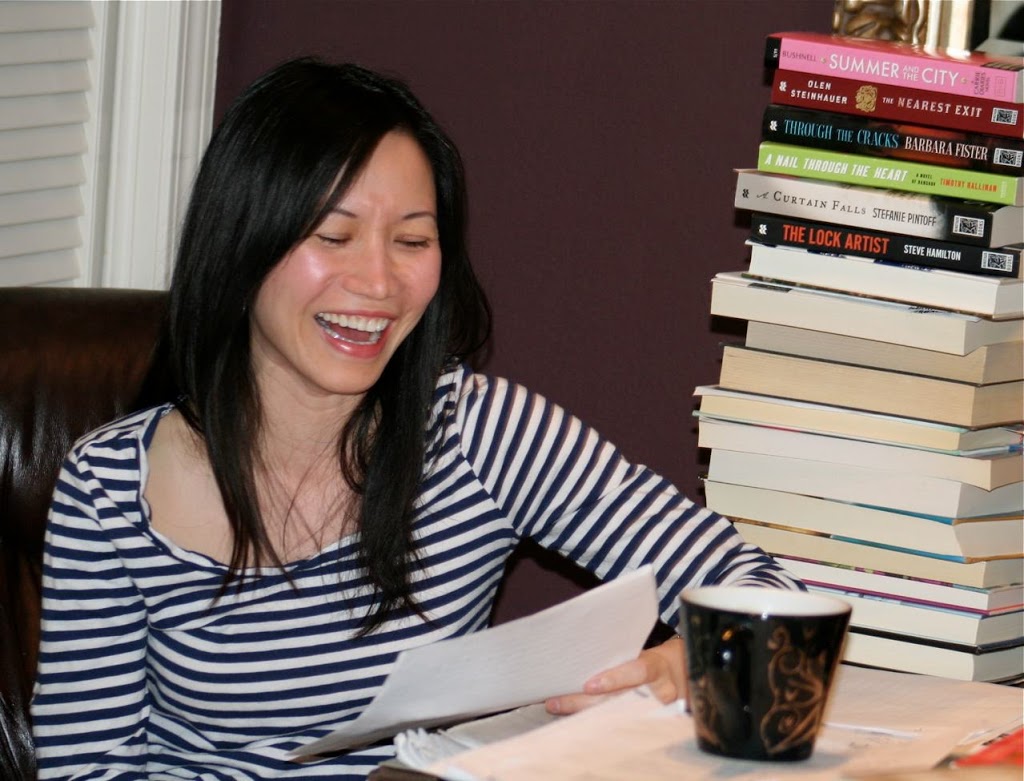
This is Elyse laughing at my anthology…I’m sure.
Patterns in Writing
When Jordan approached me about a guest post, I decided to write about the patterns I’ve noticed in my clients’—and other authors’—work. These aren’t errors, but habitual things writers do that make their writing predictable. Most of my clients are surprised when I point them out, so it’s become clear these things happen unconsciously.
I’m not talking about a signature. One of Elmore Leonard’s signatures, for example, is his hip dialogue, with specific rhythms you can almost hear while reading. But the dialogue isn’t repetitive. I’d like to discuss things that show up repeatedly, and could potentially distract readers.
Here are some of the most common patterns I’ve seen, in everything from manuscripts by first-time authors, to finished novels by Pulitzer-nominated writers.
Reusing the same atypical word.
I was a beta reader for a friend and noticed he described many things in his novel as “dank”—basement, room, weather, smell, even mood. I suggested he substitute a few synonyms. He did a search and said, “I found only thirteen mentions in the whole ms. That’s not a lot!” I asked, “But how close were they together?” He admitted that in one instance, the word showed up twice in three pages. Astute readers would notice that.
A recent thriller by a New York Times bestselling author had an overabundance of “murmured” as a dialogue tag. After a while, I thought, “Is everyone in a seance?”
We all have words we overuse. One of mine is “just,” e.g., “I just saw that recently, and thought it was just a mole.” Be aware of your favorite words, do a search for them after you’re done writing, and replace if necessary.
Using the same descriptions and mannerisms for different characters.
In this one book I read, whenever the women were nervous, they bit their lower lips, and when the men experienced stress, they ran their hands through their hair. I started counting the number of times this happened, and could see it coming if characters started feeling stressed or anxious. I got so caught up in the counting, I lost track of what was going on in the plot.
Repeating the same sentence structure.
Many writers fall into a rhythm as they write, which sometimes results in the same kind of sentence over and over: always starting or ending with a participial phrase, starting or ending a line of dialogue with a direct address, too much passive voice, multiple run-ons in the same paragraph, three short sentences in a row. (“He looks. He listens. He waits.”) All those stylistic choices are fine, but when one occurs too often, the writing becomes routine. Mix up the kinds and lengths of sentences, use them in different order, keep readers on their toes.
Different characters speaking the same way.
Sometimes writers get tied to one kind of speech pattern. I recently read a book by a well-known author in which many characters would eliminate the first words in questions: “That him?” “Help you?” “Hell you talking about?” It’s fine if one character talks like that, but I think a little old lady might say, “Is that him?”
Being attached to a favorite letter, name, number, or color.
In a novel I edited, there were characters named Linda, Lita, Lynn, Lila, Laura, Leslie, Lori (they were not related). I have a good guess as to what letter might be on the author’s monogrammed towels. In another ms, several of the names rhymed: Boris, Norris, Morris, Doris, Dolores. The thriller read like poetry.
Make a character list to see if too many names contain the same letters, or if some of your minor characters are named the same. I worked on a book in which a couple of “under fives” (a movie term for characters with under five lines) were named John, because they were less important to the author and he failed to see he’d used the same name for both.
I read a thriller by an author whose favorite color was seemingly red, because two in three characters were redheads, and different characters drove red cars, had on red dresses, and owned houses with red doors. Another time, an author was stuck on the number 9. There was a countdown to a momentous event, and every chapter had a time designation that ended in 9—3:19, 2:29, 6:39, 12:49, etc. These patterns weren’t part of a theme, merely coincidences that became distracting. Sometimes people wear beige, and things happen at 5:42.
Overuse of italics for emphasis.
This one book I read averaged one italicized sentence for every two paragraphs. So many things were important. The italics soon became mundane, which defeated their purpose.
There are other patterns I can discuss, but I may have already overstayed my welcome. Thank you to Jordan for asking me to be here, and all of you for indulging me.
What patterns have you noticed in your reading…or your writing?
Elyse’s Website: TheEditNinja.com
Magic words
By Joe Moore
WARNING: This post is not about self-publishing or gatekeeping or Amazon or e-books or all the other stuff we’ve been thrashing about over the last week or so.
It’s about magic.
Recently I was invited to speak during career week to third and fifth graders at a local elementary school on what it’s like to be a writer. Frankly, I expected only a handful of kids to show any interest while most would probably react with boredom. After all, how could I compete with the fireman and his Dalmatian that were the previous guests? I was pleasantly surprised to find classroom after classroom packed with genuinely interested kids who paid attention, asked great questions, and promised to go home and start writing their stories. I found out a few days later that some actually did.
I began my presentation by telling them that at the end I would reveal the two magic words every great writer uses to create great stories. This was my hook that kept them listening, and it worked.
The two magic words are: What if?
I’ve used them to create the premise of 6 novels, my two current works-in-progress and many short stories. Here’s a sample:
What if someone used the DNA found in the Holy Grail to clone Christ? THE GRAIL CONSPIRACY
What if a 5000-year-old relic revealed the secret to surviving Armageddon? THE LAST SECRET
What if a quantum computer could bring down all the resources of the world and throw nations into chaos? THE HADES PROJECT
What if a group of state-sponsored terrorists could deliver a lethal virus with something as innocent as a cough or sneeze? THE 731 LEGACY
What if someone was stealing the burial remains of the most infamous mass murderers in history in order to genetically regenerate them into an army of killers? THE PHOENIX APOSTLES
What if the search for an Old Testament artifact uncovered a plot to destroy a major U.S. city with a nuclear device built by the Nazis at the end of WWII? THE BLADE
 As far as I’m concerned, those two words are magical. Repeating them is like an incantation that launches a spell and sets the imagination afire. They form a seed that can start growing from the moment the question is asked: What if? The two most powerful words in the craft of writing.
I keep a list of “what if” questions and ideas that I’ve accumulated over the years. They come from everywhere; the newspaper, TV, movies, books, articles. And I’ll be a lot of you guys have a similar list.
So why am I even talking about this? After all, writers already know the magic words. What I want to suggest is that you use them like I did to ignite the imagination of future writers of all ages. If revealing those two words sends a kid home with the fire to write a story, and they do, then there’s truly something magical going on. Pass on the magic words to others as often as you can. You just might be responsible for the next future New York Times bestseller. And wouldn’t that be magic!
Becoming your own gatekeeper

I’d like to piggyback onto Clare’s topic yesterday, about the role of gatekeepers in publishing. After I posted my comment yesterday, I found myself doing an internal rant about the subject, so I thought I might as well share it here.
Here’s what I really think about gatekeepers: No matter which path you take to becoming published, legacy or indie, you must act as your own gatekeeper.
Lesson #1 I learned when I got published: You don’t get much editing.
When I first got a writing contract, I expected to have lengthy, cozy conversations with my editor about my work. Granted, we lived on opposite coasts, but I expected to get some sort of in-depth discussion about where my drafts needed overhaul. What I typically got, instead, was a one-page email of bullet points. I was amazed by how few significant changes were expected. Even a bit suspicious.
As I met and talked with other writers who worked for Big 6 publishers, I heard similar stories. Here was the bottom line: Agents and editors sign you only if they think you’re already publishable. They don’t take writers who need work.
Of course, a publisher can be wrong about your writing. Sometimes they put it out there, and it doesn’t sell. (We writers like to bemoan lousy covers or inattentive publicity departments for this failure to thrive.)
Now comes along indie publishing. Indie writers will have to become their own gatekeepers. But here’s the truth: We writers are always our own gatekeepers. We’re wasting our time if we put stuff out there that isn’t “publishable.” We have to be able to know when our work is ready for publication. And especially, when it’s not.
One thing I notice a lot in critique groups: Writers submit material before it’s ready. Sometimes a writer will turn to me with hopeful eyes and say, “Do you think my piece is ready to send out?” Most of the time I have to say (reluctantly, because I like the person) “no.” What I don’t understand is writers who can’t figure that out for themselves.
When you’re ready to self-publish (or submit to an agent or publisher), you must compare your work to what’s already on the bookshelves. Does it measure up? Are you sure? With my own work, I am extremely reluctant to submit it. Only deadlines have ever forced me to push the Send button. (Knowing when a draft is finished–that’s a blog topic for another day).
I know I’m preaching to the choir here. Most TKZ’ers visit our little blog in the cybersphere because we’re obsessive about perfecting our craft.

As Captain Picard would say, “Make it so.”
Quality Checks and Balances
As always, the hot button topic of indie/self-publishing versus traditional publishing has generated lots of comments in recent days here at TKZ and one issue that comes up time and time again is the ‘gatekeeper’ concept – basically agents and editors acting as a ‘quality sieve’ for what comes into the publishing pipeline. While I agree this is an imperfect system – there’s no doubt that agents and editors can get it horribly wrong – there does need to be some system of quality control. Doesn’t there?
Nowadays on the indie front, this typically comes from readers who are just as well-equipped to judge what makes a good book as anyone else. But from the standpoint of a writer who relies on her agent to raise the bar for her work – I do wonder how these quality checks and balances will get made in the new era of indie publishing. As a reader, I don’t want to troll through a plethora of e-books that were dashed off prematurely in my search for books to read. Though social media and reviews certainly help, the sheer number of releases makes my head spin and I still fall back on buying e-books from traditional publishers as I know the system of quality control (though imperfect) is at least in place.
As a writer I have a group of beta readers who help me enormously – but though their feedback is invaluable, none of them ever quite bring the perspective my agent does. For all the tough love I get from them, my agent manages to point out ways in which I can improve the manuscript that they never even considered. So my worry is that if I went the indie route the books I put out there would be good but not as good as they could have been….Because my agent’s 25 years of editorial experience in publishing adds a level of input that, quite frankly, none of my other beta readers can match (and they are an amazing group of people whose input I value enormously).
Many members of my writing group have used freelance editors to help polish their manuscripts but with mixed results. Many of these editors aren’t looking to dissuade a writer from publishing a manuscript and so, given that they get paid to edit, aren’t necessarily going to be as upfront about a manuscript’s shortcomings – not if it means putting themselves out of business. I’m sure they are all professionals and do their best but do they act as an objective assessor of ‘quality’ – I’m not sure they can.
Now many of you will argue that this assessment is best left to readers (who will vote with their pocket books as well as airing their online opinions) but it exhausts me to think of all the half-baked e-books that might end up out there, just as it worries me that aspiring writers are becoming ever more impatient to release material before it has been crafted into the best possible shape.
So who do you turn to for editorial guidance? Do you rely on freelance editors to give you much needed input? Are you convinced your own circle of reviewers give you the tough love you need?
Despite being published, I admit I still lack the confidence and experience to know when a manuscript is really, truly, finally ready. Most of my ‘final’ manuscripts end up being revised and reshaped based on input from my agent before they get shown to publishers, and as a result they become significantly better than the ‘best’ I originally could do (okay, so this might say more about my lack of talent…). In a world where we acknowledge the traditional system has many shortcomings, how do we view the concept of ‘quality control’? If that is still even relevant, how do we achieve it?
Writers Going Boldly
The late Ray Bradbury was a living, breathing testament to the joy of writing. He loved what he did and he did it every day. He wrote where his imagination led him. He explored his own inner universe, never quite sure where the path would lead but absolutely delighting in the journey.
His practice was to wake up and start writing and see what happened. He’d explode. “Every morning I step on a landmine,” he wrote in Zen in the Art of Writing. “The landmine is me. After the explosion, I spend the rest of the day putting the pieces together.”
That was his practice from his earliest days as a writer. Even after he was married and had mouths to feed he found a way to make income as a writer while writing what he loved.
That’s the ideal, isn’t it? Yet in the past, only a few writers ever truly realized this dream.
I remember how happy I was when I first started writing. It was love. There was something rapturous about it, even though I had a lot to learn about the craft. Maybe it was because I was in touch most directly with my imagination and passion. I was just letting it rip. I was a landmine.
I worked hard at the craft, too. I enjoyed that as well, the way a race car driver enjoys working on his engines. And then came the day I got published. And after that, contracts. And now, looking back, a career. I’ve been one of the lucky ones.
But it struck me the other day as I woke up and started the coffee going that I was more eager than ever to get to my writing chair. Because when I sit in it, I can take myself wherever I want to go. Boldly. Like Capt. James Tiberius Kirk, I am on the bridge of my own Enterprise. If a galaxy looks interesting, I can tell my inner Mr. Sulu to take me there.
So I’m writing boxing stories and zombie legal thrillers and stand alone suspense and stories about vigilante nuns. I’m writing essays on writing and soon will be releasing non-fiction booklets on a variety of topics that interest me. Plus, I know that anything I write will get to readers and make me a profit.
You know, in all the recent debating about self v. traditional publishing (both of which I continue to maintain are of value) one thing perhaps isn’t emphasized enough. Writers who write what they love, care about it, figure out how to do it better, then repeat the process all over again—those writers may be having the most fun of all.
Of course, as my blog brother Gilstrap reminded us on Friday, a certain amount of sweat equity (which he maintains is gained only by going traditional, and I maintain can be had privately) is necessary for someone to develop into a real writer.
But you can sweat and still find joy, and most of that is in the freedom to write what you want to write and letting the market itself decide what to do with it.
“The first thing a writer should be,” Bradbury wrote, “is excited. He should be a thing of fevers and enthusiasms . . . . [A writer must] look to his zest, see to his gusto.”
When you do that, it will show up on the page. And when it shows up on the page, readers will take notice.
Do you want to write? Really? Enough to work at it lovingly every day? To study the craft because you desire more than anything else to communicate with the reader in the most effective way? Enough to boldly go where no writer has gone before? Or, at least, to put your own footprints on some previously explored planet?
Then do it. And pay no attention to the naysayers. Brenda Ueland, in her classic little book If You Want to Write, says this:
“Everybody is talented, original and has something important to say. Everybody is talented because everybody who is human has something to express. Everybody is original if he tells the truth, if he speaks from himself. So work with all your intelligence and love. Work freely and rollickingly, as though talking to a friend. Mentally (at least three or four times a day) thumb your nose at all know-it-alls, jeerers, critics, doubters. Work from now on, until you die, with real love and imagination and intelligence. If you are going to write you must become aware of the richness in you and come to believe in it and know it is there.”
Persistence
It so happens that my contribution to The Kill Zone ties in a bit with an element of John Gilstrap’s excellent piece yesterday. John at one point mentioned persistence; persistence doesn’t mean working at a job for two weeks and then wondering why you’re not the manager or supervisor. Persistence means learning and working and butting your head against the wall to go through it if you can’t go over it or under it or around it. And I’ve got a story about persistence for you. It’s not about an author, either, though there are plenty of those. There are freaking lists of those on Facebook, listing authors whose names you know and the number of rejections they received before selling their first story or novel. No, this one is about a musician. His name is Scott Hartlaub and yes, he is related to me. He is my nephew.
Scott plays drums. He has played drums for almost fifteen years. Scott is a quiet and unassuming and gentle guy who disappears into a room even when he is the only one in it. But he wanted to play drums for a living. He formed bands that disbanded and joined bands that broke up and lived in crappy apartments and drove hundreds of miles to gigs that barely paid and worked jobs that most of us would regard as beneath us to support himself in the meantime. All along the way he honed his craft and kept his eye on the goal. I am sure that he got discouraged at some point(s) but he just. kept. going.
A couple of years ago Scott auditioned for a position in a band that backed up an extremely talented singer-songwriter named Jessica Lea Mayfield who at that time hardly registered on anyone’s radar. She started playing small clubs where the dressing room and rest room were on and the same. Scott was in the back of the stage pounding away, behind Jessica and a set of keyboards and a guitarist and bass player, not to mention loading and assembling and unloading his kit, and doing all of the things that drummers do and a few that they don’t normally do, either. Jessica (she has a huge story about persistence as well) got some notice, and then some more notice, and then she got signed to a major label (the equivalent of an imprint of a major publisher). She recorded a CD with Scott and the band and then one night, we turned on the television, and there was Scott, on Late Night with David Letterman, the camera in a tight shot on him as he counted off the beginning of a song before Jessica started singing. If it had been me, I would have screwed it up, but Scott didn’t. But you know what? When I called him the next day he was back on his other job, making pizzas and taking phone orders for a large pep with double cheese in the Merriman Valley area of Akron, and he never even blinked. Talk about compartmentalizing. And he stayed Scott, even though he had become SCOTT. He even gave the pizza shop two weeks’ notice before the band left on a world tour of music festivals.
Scott is living in Nashville now, in between tours and doing pretty well. He’s doing what he wants to do, after fifteen years of no’s and sorry’s and really, really tough breaks and pounding his head through the wall. But he broke through. So can you. But if you want to break through you can’t stop pounding. And don’t complain because the plaster is hard. That’s a given.