About Joe Moore

#1 Amazon and international bestselling author. Co-president emeritus, International Thriller Writers.

My Unsettling View on Self-Publishing

By John Gilstrap

On Monday, my Killzone mate Clare Langley-Hawthorne asked how prolific a writer should be, to which a commenter responded, unprovoked, “. . . you can always just go indie/self pub yourself . . . Of course, then you wouldn’t be able to post about how self-pub writers are ruining it for the ‘real’ writers.”

Oh, please.

On this, my penultimate post as a Killzone blogger, I want to dedicate my precious slice of cyberspace to a toxic trend that has really begun to bug me: the tyranny of self-righteous do-it-yourselfers. More specifically, I want to say my piece on why I continue to believe that self-publishing is an expensive road to frustration and failure, particularly for writers who do not have an established base of readers.

First, let’s define success. For me, that means thousands of books sold. If a few dozen to a few hundred is your ultimate goal, then self-publishing is your only option. No traditional publisher is going to invest their cash in such a tiny career.

Second, let’s establish the parameters of my argument: For my purposes here, my argument does not apply to anyone who has previously published books through traditional publishing. The sagas of Joe Konrath, Barry Eisler and others with established readerships have no relevance.

Charlatans Prey On Dreams

With the birth of the cheap-n-easy eBook, charlatans with dreams to sell are rising like weeds to capitalize on the desires of under-cooked writers to see their words in print(ish).

They’re all over the Internet, and they remind me of carnival barkers: “It’ll only cost you a few hundred dollars here, and a thousand there, but ladies and gentlemen, if you’ll follow my blog and buy my book and hire the editors I recommend, I guarantee that your book will be on a cyber shelf where millions of people can see it if they know to look for it. Don’t be fooled by those predatory publishers who take the lion’s share of your money! Come with me, and I’ll only take 30% for doing nothing and taking no risk.”

Deals don’t come sweeter than that. For the self-pub conduit.

Here it is for the record: 1. Not all self published books are crap. In fact, some of them are very good. Of those that are very good, the vast, vast majority are written by journeyman writers who have had experience in the traditionally-published world. 2. Not all proponents of self-publishing are hucksters, and neither are all freelance editors. Though some kind of warning label would be helpful.

I get all of that. I really do. But none of these factors make self-published freelancers any more courageous, noble or dedicated to their craft than those who do things the old fashioned way.

Desire Does Not Equal Talent and Persistence

I respect anyone who can squeeze some coin out of any corner of the entertainment business. There’s a guy outside the parking garage at the Vienna Metro Station in Northern Virginia who seems to enjoy the daylights out of playing hymns on his saxophone to greet customers on their way home after a long day. More times than not, there are a few bucks in his open case, so I concede that he is a professional musician. He may well be the best musician his family has seen in generations.

But he will never get a recording contract, no matter how much he really wanted one. It’s a talent thing. Or maybe it’s a training thing. Either way, I wager that traditionally-compensated musicians lose no sleep worrying that this guy and his subway-playing buddies might “ruin” the business for them.

As has been demonstrated in this very blog many times over the years we’ve done our First Page Critiques, a solid proportion of works whose authors felt confident enough to submit them are nowhere near ready for prime time. Like it or not, folks, writers like these represent most of what sits on self-published shelves. I say this with confidence because they represent the bulk of work proudly submitted to every amateur writing contest I have ever judged.

Yes, there are exceptions, and it you’re one of them, you deserve better company. But every time a reader takes a chance on a free download or views a free sample and learns how awful most of the choices are, the odds are stacked even more heavily against every other independently published author.

Self-published authors don’t threaten to ruin anything for the traditionally-published authors. They threaten to ruin each other by association. It has been that way since the very early days of vanity presses, only now the barriers to entry are lower. That means there’s more awfulness in play than ever before.

Freelance Editors Can Only Help A Little

Big Publishing editors reject authors who just don’t have the chops. Freelance editors adopt them as cash cows. Big Publishing editors stake their reputations and their mortgages on quality. Freelance editors live on process and improvement. I’m not suggesting malfeasance—ethics are tied to individuals, not to professions—but the difference in motivations is significant. There’s a world of difference between making a work better and making it publishable.

And how many freelance editors will reject a project outright?

Commonly Accepted Falsehoods

All too often, the debate about the merits of self-publishing are driven specious assumptions. Among them:

Standard eBook royalties dwell in the neighborhood of 17%. Not so, if you have an agent who is worth her salt. The true number is (or at least can be) much, much higher.

Agents are a thing of the past. Also false. (See above.)

Traditional publishers are irrelevant at best, dying at worst. This is simply not true. Their business model may be shaken, but every single one of them is adapting. When the dust settles, the public will be hungry for anti-dreck gatekeepers, and the keys will be in the hands of publishers. There might be different names on the doors, but the route to success will still be guided by professionals who know what they’re doing.

A 70% self-pubbed royalty is the route to riches. This is the most specious argument of all. Sure, at that rate, a book priced at $2.99 earns the author $2.09 for every sale. That’s a significant sum until you throw in the recent data that the average self-published eBook earns its author less than $500. That translates to fewer than 240 books sold, despite all the blogging and the book trailers and the social media stuff the author put into selling them. Seventy percent of very little is even less.

Think Value, Not Cash

Time has value, too. One of the reasons why publishers give smaller royalties is because they’ve already paid the author cash up front in the form of an advance that is going to be far north of $500. And that’s money the author never has to give back. Meanwhile, the publisher also pays for the cover art, layout, marketing, advance readers copies, catalogue copy, and the million other moving parts that give a book a chance at life.

Yes, publicity departments are shrinking and the pressure is increasing for authors to do more of their own publicity, but by working through a publisher, that work by the author is launched from a platform that is orders of magnitude more expansive than anything a first-timer could launch on his own.

I’m Not Trying to Run Any Author’s Life

Let me be clear: My point is not to rain on people’s parades. Everybody has a right to spend their money however they want, and everyone gets to define “writer” and “published” by their personal favorite lexicon. My opinions are no more valid than anyone else’s.

But if you’re a writer who has faith in your talent, I urge you in the strongest possible terms to exhaust all the traditional routes before you even consider the self-publishing dream that for so many has become a self-publishing nightmare.
A Checklist for Indie Authors – E-Book Retailers (Post 2)

To get my e-book into the hands of readers, I had decisions to make. Should I upload my book through a Distributor/Aggregator with bundled services for multiple retailers or load them directly onto the sites of individual retailers? If you have a number of titles from your backlist, this could seem daunting, but bear with me. Some retailers are easy to upload into directly, regardless of the number of titles you have, while others restrict authors who don’t have enough offerings to meet their initial minimum requirements.

As I stated in my first post on this series, if you upload to Amazon and B&N, you’ve covered 60-70% of e-books sold today. That’s a good place to start. I could have formatted my own books to save money, but I went through a service provider to do this as I continued writing my contracted books. My formatters created my e-book files for Sex, Death and Moist Towelettes & Dark Kiss through Amazon (Mobi), B&N (ePub), and Smashwords (.doc), plus my e-book and pdf file for my Print-on-Demand (POD) non-fiction book with a cover design for the front, spine, and back of One Author’s Aha Moments.

To optimize an indie author’s outreach and distribution efforts, I’m listing other options beyond Amazon and B&N in this blog series. Stay tuned for more in the weeks to come when I post about Distributors & Library Sales, Retailers with Volume Restrictions, and I draw some conclusions from all this in my final post on the indie author topic. I plan to launch a page on my Fringe Dweller blog where I will list indie resources and maintain them.

Below are the e-book retailers that allow anyone to upload content, no matter how many offerings you have or your publisher status. (Kobo will be mentioned in the next post, but there are many interesting changes happening that will put them on this list soon.) Please be aware that each of these sites operates under different formats and you should get familiar with their guidelines.

Amazon’s Kindle Digital Publishing (KDP)Amazon’s primary e-book format is Mobipocket (Mobi) files, with or without DRM. Amazon currently dominates the market on e-book retail sales. Authors and publishers have access to an effective online retail outlet. Their royalty percentages are split by price point. Currently, that is 70% if your e-book is priced between $2.99 & $9.99, or 35% for all other price points. There is a small delivery charge based on size of file and royalties are paid monthly.

Barnes & Noble – B&N’s upload service is called PubIt!. PubIt! is similar to the Amazon KDP and gives indie authors the ability to upload a higher quality of ePub file that will not be lost through an automated conversion process where standards might be lower. The system also accepts Word, HTML, RTF, and TXT documents, which will be auto-converted to the ePub format.

Apple’s iBookstore – Apple’s iBookstore is open for authors and publishers to upload their own content. You must have a Mac computer to use the iTunes Producer program to upload the files. The signup process may seem intimidating, but an indie author can earn a higher royalty percentage by going direct and not through a distributor/aggregator. If you are unable to use Apple’s system because of limitations, the iBookstore provides a link of Approved Aggregators you can go through.

Google – Google’s e-book store allows readers to purchase PDF and ePub versions of your book, protected by the Adobe DRM. (Digital Rights Management is a term for any security measures designed to inhibit piracy.) The Google e-book store is part of the Google Books Partner Program. HERE  is a link on their system requirements.

LuluLulu uses ePub, PDF, and Microsoft Reader (LIT) formats, with and without DRM. Lulu is well-known for its Print-on-Demand (POD) services and an indie author can sell e-books through them. Lulu takes a cut of sales and there could be an additional fee to use the DRM option. Lulu is an Apple-approved aggregator for the iBookstore.

ebookMall – A $19.95 submission fee is waived until June 30, 2012. ebookMall uses ePub and PDF file types. Lightning Source could be an alternate source into this retailer.

ScribdScribd uses PDF files only and cannot sell other formats.

Smashwords – Smashwords works off a specific Word document style (HERE) that must be in accordance with the Smashwords Style Guide. That Word doc is auto-converted into 9 different formats at the author’s option. In addition to selling books at its own online store with the lowest fee of any retailer listed here (15%), the Smashwords Premium Catalog offers authors and small publishers a way to distribute their titles across a variety of retailers, including Apple’s iBookstore, the Sony eBook Store, Barnes & Noble, Kobo, and others.

In my next post, I will go into more detail on the various issues with a middleman distributor. Be aware that an indie author can have format issues by going through the conversion process and this can translate into downstream retailers taking issue with e-book quality from that distributor and YOU. Bottom line is, uploading directly to a retailer with relative ease might be your best option. You’ll see why in my next post when we talk about issues beyond formatting, like cumbersome and untimely price changes when going through a third party.

Some of this sounds daunting, but remember, if you’ve got your book onto Amazon and Barnes & Noble, you have your digital baby with the largest e-book retailers. Fine tuning your retailer outreach can be done as you have time. It doesn’t have to be done all at once. Many of these sites will take time away from your writing, so weigh the benefits against the time it takes for you to focus on this, but once you see how things go, you can fine tune where you will focus your retail and promotional efforts.

If you’re an indie author, please share your experiences with the retailers I mentioned and what has worked for you. If you are exploring the idea of self-publishing, do posts like this help you or intimidate you?

The Dreaded White Page

After an interval of months due to editing my next romance release and polishing the sequel (these are big books, over 400 manuscript pages each), I am once again facing the dreaded blank white page. This engenders all sorts of fears. Do I still have what it takes to write a novel? Will I be doing justice to my fans with this story? Will I remember the plot threads I’d shuffled aside to work on my edits? Can I still write a mystery?

Distractions tempt me away from the WIP. I should check email. There might be something important waiting in my inbox. Or since it’s Saturday, I should wait until next week to begin anew. Hey, I could write this blog! And so I do, neglecting my novel writing until later. But then I’m going to the MWA meeting.

Nonetheless, I forged ahead and by Monday, I’d finished the chapter where I left off. Here are some tips on how to get started after a long interval:

· Write a detailed synopsis before you begin the story. For a mystery, mine tend to run from 10 to 15 pages. I need to know where I’m going but this technique may not work for everyone.

· Write a cast of characters with brief background descriptions for each person and their role in the story.

· When you leave off writing, type in a few notes on what happens next.

· Start by revising what you’ve already written. You may have polished this piece of work already, but you’ll always find more to fix when you view your writing with a fresh perspective. And this will get you back in your character’s head.

· Begin slowly, one page at a time, with no word count requirements.

· On a set day, put yourself on a strict writing schedule. My minimum is five pages a day. For a 75,000 word mystery, that means approximately 20 chapters of about 15 pages each. This isn’t written in stone but gives me a guideline to follow. As I approach the end of a chapter, I use a hook to coax the reader into turning the page.

· Determine your finish goal. If you write 25 pages per week, how many weeks will it take you to finish the book?

For example, I’ve written 75 pages. Thus I need 225 pages to reach the finish line. Divide this number by 25 pages a week, and that comes to 9 weeks. I take out my calendar. Can it be done?

I have to discount two weeks for family events and vacations, because it always takes me a few days to catch up after being away. This takes me to mid-August. So I will extend my goal for unforeseen circumstances and say I must finish my draft by the end of August. This is perfect timing, because my new romance release comes out in September, and I’d like to devote that month to promotion.

There’s only one kink in this plan. Assuming I sell the next book in my Drift Lords series, I’ll have to stop all work on my mystery when the edits come. And then I will want to polish the third sequel (already written) before submitting it to my current romance publisher who will only accept one book at a time. But since I’m not under contract for the mystery, it doesn’t matter. I’ll just follow my advice above and jump back in as needed.

What do you do to restart your brain into story mode when you’ve been away from the WIP?

MOVE OVER HARDCOVERS: E-books Just Outsold You

By: Kathleen Pickering http://www.kathleenpickering.com

books

Before I even begin on today’s news, let me offer a superb website for the latest in breaking news for the publishing industry, called GalleyCat:

http://www.mediabistro.com/galleycat/

Don’t go there now, because I’ll lose you here. GalleyCat is chock full of fascinating info that could capture your attention for hours—but, I need you now!  So, do copy and paste this link into your Favorites to peruse after you’ve read my fascinating info today on e-book sales outselling hardcovers for the first time in the US.

This new is from an article written by Lauren Indvik on Mashable. (Another great site for breaking news, BTW!)

Looks like e-books brought in $282.3M in the first quarter of this year (up 28.1% from last year). Adult hardcover novels earned $229.6M (up 2.7%). Adult paperbacks continued to lead at $299.8M but sales are down 10.5% from last year.

Downloaded Audio books are up 32.7% from last year selling at $25M. So, the trend is pretty clear. The flood of e-reading devices crossing the board from tablets, smartphones to dedicated e-readers have taken a bite from the paper book industry.

What did I do? I went and bought some Apple stock (better late than never). The writing is on the wall–never mind on the e-readers!

kindle

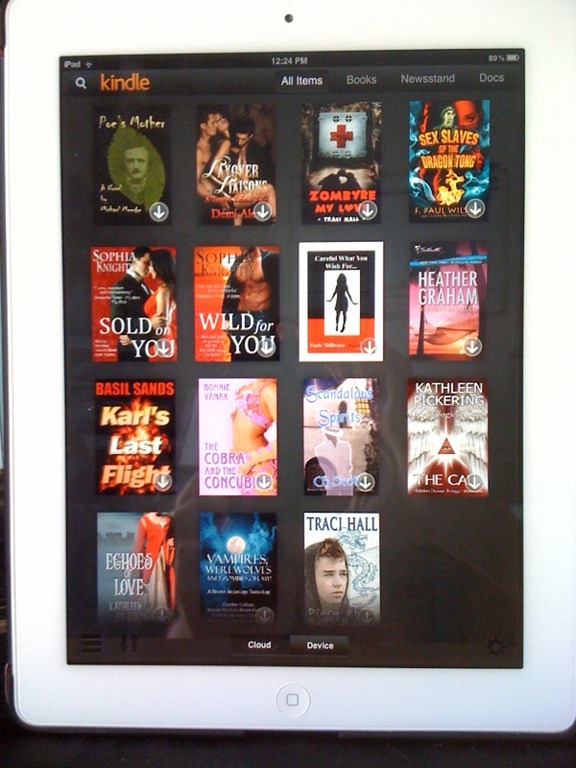
Have you gone to the dark side and traded in your hard copies for your Kindle, Nook or other e-reading device? I cherish my hard cover books and can’t imagine taking an e-reader into the tub (unless of course, it’s waterproof!) Yet, I haven’t been loyal to my paper novels, either. Here’s a page in my iPad Kindle file of books by fellow authors. I mean, really? How can we resist carrying around hundreds of books on a slim little tablet? Are paper books doomed?

Tell me what you think.

xox, Piks

How prolific should you be?

by Clare Langley-Hawthorne

Following on from Jim’s post yesterday on attacking the self-publishing game, I started thinking about how the indie e-book phenomenon is affecting reader expectations as to the number of books a writer should be producing. In May a New York Times article explored how many bestselling writers now feel that one book a year is simply not enough. 


Publishers are placing increasing pressure on authors to accelerate production, often asking for additional material such as novellas and short stories to supplement the e-books being released. In a market where entertainment is being churned out at a faster and faster rate, I can’t help worry that the push for constant new material in the e-book market comes at the expense of quality – but what writer can afford not to be prolific when the market demands it?


There aren’t many of us who can match James Patterson in terms of output (I believe he released 12 titles last year with 13 due this year!) but with the demands on authors increasing all the time, I wonder how many of us feel compelled to produce more simply out of fear? 


In the indie market, clearly an author has to balance consistent output with quality in order to build readership but, as an author whose first novel was published, I don’t exactly have a huge drawer load of old manuscripts I can put out there – and there are limits to how fast I can write new material to the level  that I feel is publication worthy. It seems rather a daunting challenge – balancing the need to produce with the need to keep quality standards high. 


So what do you think? Are some of these prolific authors sacrificing quality for quantity? Is your publisher pushing for you to produce more than one book a year? If you are considering (or in the process of attempting) the indie route, how are you approaching this issue? What is your target output – and how do you plan on achieving it?

If You Seriously Want to Make Money Self-Publishing, Attack It

James Scott Bell
@jamesscottbell


I have this quaint notion that writers should be able to make money at their trade.
You may have seen the recent report that half of the self-published books that came out in 2011 made under $500. Though this report is not without its critics, it’s pretty clear a majority of self-published writers are not getting the financial returns they’d hoped for.
For some, those hopes are based on unrealistic expectations. Many writers still think of self-publishing as a gold rush. They believe they can come out with one or two books and win the lottery. But 99% of them won’t. Not even if they try to write another Fifty Shades of Grey (please don’t try to write another Fifty Shades of Grey).
If you really want to succeed at self-publishing––and by that I mean make a profit and grow revenue over time––you’re going to need a plan. Like a good golf swing, this plan should be workable, repeatable, simple to understand and have a track record of results.
I have such a plan.
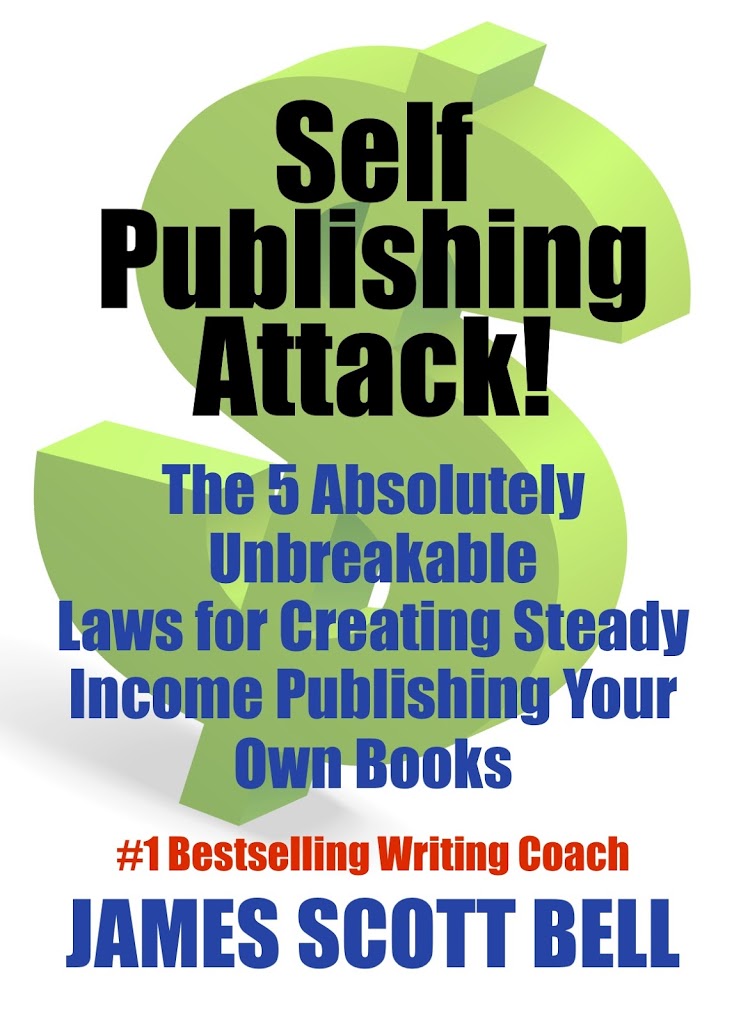
My new book, Self-Publishing Attack! The 5 Absolutely Unbreakable Laws for Creating Steady Income Publishing Your Own Books, is now available on Kindleand Nook.
I’ve spent the last year and a half studying, experimenting, watching, publishing and taking notes on what it takes to make a go of self-publish. My goal was to see what any writer could do, not just one with a massive backlist (where there really isgold). I have not put out my backlist immediately. Rather, I wrote new material––short stories and novellas and non-fiction––and kept track of the results. 
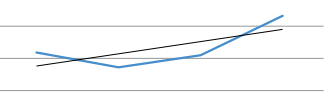
For me, the key data point is how you trend. You want your trend line in sales looks like this:

This is what long term self-publishing success looks like. Steady growth via the introduction of new product.
Just like in traditional publishing. Just like in any business.
With the upside that no one can cancel your contract. You have a lifetime deal––with yourself.
That also means you have a fiduciary duty to do the best you can. You are under an implied warranty of good faith and fair dealing, so you’d better perform or you’ll have to take yourself to court.
The strategies and tactics in Self-Publishing Attack! The 5 Absolutely Unbreakable Laws for Creating Steady Income Publishing Your Own Books have been tested by experience and confirmed by what other successful self-published authors are doing. 
These laws are immutable––that means they will never change. They will stand the test of time and the challenges of an ever evolving marketplace.
As someone who has run successful small businesses, I know how one has to think and plan in order to create the best possible foundation for making a profit. I’d like to see more self-published writers getting it right.
Because I have this quaint notion that writers should be able to make money at their trade.

…a red pencil clenched in their teeth

John Ramsey Miller


Do not get me wrong. I love and appreciate my readers ….mostly. I recall when fans sent letters to the publisher who forwarded them to me. That’s how long I’ve been around. Most were complementary, some not so much…  


Every published author has to deal with people who find mistakes in their book and have to get in touch immediately so they can do a “superiority” dance. Nonny-Nonny-Boo-Boo, I know more n’ you do! We all hate their slimy little entrails. I have written people and told them not to ever read my books again and I’ve offered to pay them for the book they bought if they would agree not to ever buy another one. My wife gets crazy when I do things like that. 


I have told people that the mistakes were obviously typos put there by a typesetter who zoned out and the copy editor missed catching it. With what publishers pay copy editors and the nature of the setters reading and keying in the words of every kind of book there is, and I get it. So now so should you, anal compulsive reader dearest. 


Most readers are truly dears, but there’s that one in five thousand who read novels the way surgeons read the New England Journal of medicine.  You get words wrong in that tome and people can die. I seem to get a few readers who read with their feet up and a red pencil clenched between their teeth. 


Here’s the thing. I write stories in real time as I imagine them. If I put in mistakes, they are often invisible to me in consequent readings and edits. I see something, I read it the way I imagined it–if that makes sense. Sometimes my lens is clouded. If (the editorial) you are going to read for grammatical accuracy, don’t read my books. Read law books. If you find a mistake in my books, keep it to yourself, because it isn’t in my control. Write the typesetter or the copy editor and tell them they ruined my book for you. I can do nothing at this point but allow how friggin anal you are and repeat for the twentieth time, “Tell somebody who will be impressed that you read each word and found something that didn’t belong, or found something missing, even after a dozen professionals missed it.”  


If the editor(s) don’t initially fix it, it will remain as broken as when I built it. 


I was not an English major, and I couldn’t diagram a sentence if my life depended on it. I will dangle participles like I used to hang those foil strip icicles on Christmas trees, end a sentence with a preposition, misspele words, run a sentence from Eugene to Miami Beach,  double tap words, CAPS and lower cases lie where they fall, and more terrible, unforgivable things. It’s just me.


Here’s an example. (Spoiler Alert) If I remember the book correctly, in UPSIDE DOWN I have a character say something in German when he is about to kill another assassin (like he could accomplish that). The reader should think this guy is the German assassin in a clever disguise. This woman writes to tell me that she teaches German and loves knockschnizzels and she has to tell me that my German grammar is badly flawed and whoever does my research should be “drawn and quartered.” Otherwise she loved the book. My reply went something very much like this:


Dear (Her name here),
My stepmother is German. I took German in college as my foreign language. I have several close friends who are German or who speak German at least conversationally. The phrase you are referring to was taken directly from a Babel Fish translation of the English I wrote in the little block. You see, the character got the German he spoke from babel Fish because he wasn’t German at all, which I thought clear enough. He wanted to trick the real German assassin by tossing off a phrase he got from Bable Fish (since he did not speak German) and having the other guy answer in his native tongue. I don’t know how you missed that since this is the only note I’ve received out of 200,000 copies out there.
Thanks for taking time to write.
John


She wrote me a lovely e-note response apologizing and saying that she had gone back and re-read the scene and was shocked she got it wrong. The fact is, I got it from Babble Fish because I planned to make it perfect later and never checked it or had anyone else do it. The copy editor actually noted it and asked if it was a correct translation, and it was never repaired by me or anyone else. And truth is, it could be taken that way, or hers. But the point is, I recovered and I came back and performed the superiority dance myself. I loved it. I should have felt, but I didn’t feel at all guilty. I wish I could have done that with every one of those I’ve ever received. But sometimes you are standing there naked to the world ashamed to be associated with a word-fail most foul, and to some, unforgivable. 


Truthfully, it’s nice to know someone with literary Asbergers is carefully policing the pages. Although, as goes with real cops, we’d all rather see them pulling someone else over.


The big problem with me self-publishing a book is that fact that it will be rife and rifled with mistakes large and small. If I lose a few anal compulsive readers, I doubt I’ll much notice …or care. But I am sure I will hear from most of them.


Pixar Story Rules

By John Gilstrap

My son, Chris, sent me an interesting set of writing rules that he found in a blog called The Pixar Touch.  It presents one storyteller’s view on how to create compelling stories.  Here it is in its entirety:

Pixar story artist Emma Coats has tweeted a series of “story basics” over the past month and a half — guidelines that she learned from her more senior colleagues on how to create appealing stories:

#1: You admire a character for trying more than for their successes.

#2: You gotta keep in mind what’s interesting to you as an audience, not what’s fun to do as a writer. They can be v. different.

#3: Trying for theme is important, but you won’t see what the story is actually about til you’re at the end of it. Now rewrite.

#4: Once upon a time there was ___. Every day, ___. One day ___. Because of that, ___. Because of that, ___. Until finally ___.

#5: Simplify. Focus. Combine characters. Hop over detours. You’ll feel like you’re losing valuable stuff but it sets you free.

#6: What is your character good at, comfortable with? Throw the polar opposite at them. Challenge them. How do they deal?

#7: Come up with your ending before you figure out your middle. Seriously. Endings are hard, get yours working up front.

#8: Finish your story, let go even if it’s not perfect. In an ideal world you have both, but move on. Do better next time.

#9: When you’re stuck, make a list of what WOULDN’T happen next. Lots of times the material to get you unstuck will show up.

#10: Pull apart the stories you like. What you like in them is a part of you; you’ve got to recognize it before you can use it.

#11: Putting it on paper lets you start fixing it. If it stays in your head, a perfect idea, you’ll never share it with anyone.

#12: Discount the 1st thing that comes to mind. And the 2nd, 3rd, 4th, 5th – get the obvious out of the way. Surprise yourself.

#13: Give your characters opinions. Passive/malleable might seem likable to you as you write, but it’s poison to the audience.

#14: Why must you tell THIS story? What’s the belief burning within you that your story feeds off of? That’s the heart of it.

#15: If you were your character, in this situation, how would you feel? Honesty lends credibility to unbelievable situations.

#16: What are the stakes? Give us reason to root for the character. What happens if they don’t succeed? Stack the odds against.

#17: No work is ever wasted. If it’s not working, let go and move on – it’ll come back around to be useful later.

#18: You have to know yourself: the difference between doing your best & fussing. Story is testing, not refining.

#19: Coincidences to get characters into trouble are great; coincidences to get them out of it are cheating.

#20: Exercise: take the building blocks of a movie you dislike. How d’you rearrange them into what you DO like?

#21: You gotta identify with your situation/characters, can’t just write ‘cool’. What would make YOU act that way?

#22: What’s the essence of your story? Most economical telling of it? If you know that, you can build out from there.

I think this is about as complete a list of “rules” (even though there are no rules in a creative endeavor) as I’ve ever seen.  What do you think?

==

P.S., I learned yesterday that Damage Control made the USA Today Bestseller List.  Yay!

KICKING AND SCREAMING

by Robert Gregory Browne

Today on TKZ we’re thrilled to host Robert Gregory Browne, whose latest novel TRIAL JUNKIES is an Amazon #1 Hot New Release.

I practically had to be pulled kicking and screaming into self-publishing.

I came into the book world through the traditional route and was conditioned to believe that the only way into the industry was to write a book, look for an agent, have that agent submit the manuscript and pray that a publisher accepted it.

Once I managed to get past that particular obstacle, I thought the only way to stay in the industry was to write the books my publisher wanted me to write and regularly meet my deadlines.

So when I heard that a few authors had decided to take advantage of the so-called Kindle revolution and start self-publishing ebooks, I thought they had completely lost their minds. Did they really think they could make a living selling books for three or four bucks on Amazon?

Surely they had to be nuts.

But an odd thing started to happen. Several of my friends who had decided to take the leap were actually starting to see their incomes rise. Not dramatically, but this was certainly proof that it was possible to, at least, supplement your income with self-publishing sales.

Yet, I remained on the fence. Not fully convinced that self-publishing was the way to go.

I’m not a particularly greedy guy, but I have to say that there was one piece of news I received from a friend that made me reconsider my position. She sent me an email saying, “I made thirty thousand dollars last month in ebook sales.”

Now, to a midlist writer—even one who has managed to do this job full-time and eke out a fairly good living—that was a number that couldn’t be ignored.

Thirty thousand dollars? Surely she was either fudging the truth or I hadn’t read the email correctly. And if she was making that kind of money, she had to be an anomaly.

Or did she?

I soon started to get reports from other self-publishing friends that they were making ten, twenty, thirty, even forty thousand dollars a month selling ebooks on Amazon.

How could this be possible? I wondered. If I were to self-publish a book would I ever manage to earn that kind of loot? Because, let’s face it, few people go into the authoring business to make money. We midlisters are used to modest advances and modest sales. And most are forced to do the job part-time because their royalties just aren’t high enough.

I went to my financial advisor and I said, “Can you believe that some of my friends are making thirty or forty thousand dollars a month through self-publishing?”

He immediately nodded his head and said, “Sure. What you’re seeing is the cut the publisher usually takes.”

Well, folks, greedy or not, I didn’t need much more convincing. I was already in the midst of writing a new book and decided somewhere around the third act that I needed to forego shopping it around and self-publish the sucker. That book was called TRIAL JUNKIES and I launched it about three weeks ago by offering it for free and giving away 46,000 copies.

And I’m happy to report that a few days after the giveaway, TRIAL JUNKIES hit the Top 100 in Kindle Books and became the #1 bestselling legal thriller on Amazon. As of this writing, it’s still there and I’m keeping my fingers (and toes and eyes) crossed that it sticks around for a while.

Over a period of a few months, I’ve gone from skeptic to firm believer. Not merely because of financial potential, but because I’ve never felt so in control of my own destiny.  I wrote the book that I wanted to write, on my own terms, and handled every aspect of its release from formatting to cover design. That’s the kind of control that no author gets in the traditional publishing world.

Will everyone who self-publishes be as lucky as I’ve been? Probably not. But the odds in the traditional publishing world are no better.

These are new, scary times we’re living in and I can’t yet say that I’m a success at self-publishing—only time will tell that.

But at this point I’m loving every second of it…


Robert Gregory Browne began his career by selling a two-part mystery story, NOTHING BUT THE COLD WIND, to EasyRiders magazine. After more than a decade as a screenwriter, Browne shifted his focus to his first love, novels, and wrote KISS HER GOODBYE, which recently served as the basis for a CBS Television series pilot, starring Dylan Walsh and Terry Kinney.


Rob’s subsequent books are the thrillers TRIAL JUNKIES, WHISPER IN THE DARK, KILL HER AGAIN, DOWN AMONG THE DEAD MEN and THE PARADISE PROPHECY (as Robert Browne).

First-page critique: CANNIBAL’S HYMN

By Joe Moore

I took a break from first-page critiques last time around to make room for my friend and guest blogger Tom Schreck to give us some tips on hand-to-hand street fighting. Now back to my regularly scheduled blog. Today, I take a look at a first-page submission called CANNIBAL’S HYMN. My thoughts and suggestions are on the flipside.

Fredrick’s knees and hands shook as he pulled his wallet from a back pocket, bumping his wrist on the Glock snugged against the small of his back. He extracted a business card and flicked the wheel of a cigarette lighter. On the seventh try, and after cave-fireturning his back to the mouth of the cave, the flame stood upright and he set fire to the card stock. Crouched down, he tucked the curling paper into a small mound of dried leaves. His hands were turning white and going numb from cold and he could barely feel his toes, even though he slept with his tennis shoes on.

I should have bought boots. Or better socks, he thought. Shielding the infant pyre with his hands the wind blew across his back and dropped snow onto his neck. He shivered. He snapped pieces off of a branch and began laying them on top of the smoldering tinder. Tight, tiny pops gave way to less meek snaps as the fire grew. He blew steady breaths through pursed lips at the bottom of the fire. The horse clomped about, swishing its tail outside.

Turning around Fredrick stared through the aperture of the cave towards the trees. The snow fell in orderly, regimented lines that seemed more akin to the static waves painted on community theater backdrops than real weather and his eyes began to lose focus, depth disappeared and the forest flattened into a single crowded plane of dark green, gray and white. Then, right then, a small voice opened fire in the back of his mind. He knew it was right. There was no way he was getting away. Everything was too far, the weather too hateful, too many people looking.

He hunched over and crawled back into the darkness of the cave. Pawing around in the darkness he gripped his backpack and pulled it towards him. Setting the Glock to one side he reached down along the side of the bag and shimmied a collapsible aluminum bowl from the bottom and pushed it into shape. But the bottle of water was frozen.

OK, here’s what I know so far: Fredrick is trying to build a fire outside the entrance to a cave. He is hiding from “people”. It’s freezing and he’s not properly dressed for the elements. He is armed. There is a horse nearby. He has come to the realization that he may not survive. After Fredrick starts the fire, he goes inside the cave to fetch a bowl and heat some water.

First the good news. The writer has established two strong questions here that should keep a reader wanting to turn to the next page.

1. Will Fredrick survive the cold?

2. Will he avoid capture?

Now the not-so-good news. This is a hodgepodge of mixed images and confusing staging. Some of the writing is illogical. And a number of things just don’t work visually. Here’s my line-by-line critique.

Fredrick’s knees and hands shook as he pulled his wallet from a back pocket,

Does this mean that the rest of his body parts did not shake? Why isolate the shaking to his knees and hands?

bumping his wrist on the Glock snugged against the small of his back.

Is “snugged” really the word to use here? Is it even a real word? It stopped me as I tried to determine if it was a typo. How about snuggled or pressed?

He extracted a business card and flicked the wheel of a cigarette lighter.

It sounds like the cigarette lighter was in the wallet, too. Unless it really was in the wallet, I would suggest clarifying that he removed it from a pocket or pouch or whatever.

On the seventh try, and after turning his back to the mouth of the cave, the flame stood upright and he set fire to the card stock.

This is an instance of staging confusion. Is Fredrick inside the cave and is shielding the flame from the wind blowing in or is he outside the cave and shielding the flame? Why would he turn his back to the mouth of the cave if he was outside? At this point, I’m not sure where he is. But I do know that building the fire outside in the wind makes little sense.

Crouched down,

The word “down” is not needed since it’s physically impossible to crouch “up”. The economy of words rule: deliver the most information with the least amount of words.

he tucked the curling paper into a small mound of dried leaves. His hands were turning white and going numb from cold

“Were turning” is passive voice, and there’s no need to mention that the numbness is from the cold. What else would it be from?

and he could barely feel his toes, even though he slept with his tennis shoes on.

Why would he do otherwise? Sleeping with his shoes off under these conditions would be insane.

I should have bought boots. Or better socks, he thought.

Better socks? Like $100 silk dress socks? Instead of a meaningless word like better, how about thicker or insulated or woolen or hiking?

Shielding the infant pyre with his hands

OK, I admit that a “pyre” is technically a type of fire—a heap of combustible material, but it’s usually the size of a Rose Bowl Parade float. He may have high hopes that his fire will grow to the size of a pyre, but seriously, this is thesaurus-intensive writing. And it’s the wrong image to put into the reader’s mind.

the wind blew across his back and dropped snow onto his neck. He shivered. He snapped pieces off of a branch and began laying them on top of the smoldering tinder.

Now I know he’s outside the cave. So where is the logic in trying to build a fire in the wind when he could use the shelter of the cave instead?

Tight, tiny pops gave way to less meek snaps as the fire grew. He blew steady breaths through pursed lips at the bottom of the fire.

What other kind of lips would he use to blow steady breaths? And the way this sentence is constructed, the pursed lips are at the bottom of the fire. A cleaner version would be: He blew at the bottom of the fire.

The horse clomped about, swishing its tail outside.

The horse? So is it his horse or did the animal just wander up out of nowhere? Another bit of confusing staging. And it swished its tail outside. Outside of what? The cave?

Turning around Fredrick stared through the aperture of the cave towards the trees.

So is he now inside the cave looking out? And the choice of the word aperture is another example of thesaurus-intensive writing. Yes, technically, aperture is a type of opening. But the image it places into the mind of the reader is normally associated with the parts of a camera lens. Is Fredrick a photographer?

The snow fell in orderly, regimented lines that seemed more akin to the static waves painted on community theater backdrops than real weather

I’ve never seen snow fall in regimented lines. If anything, it’s exactly the opposite. I’ve also never seen “static waves” painted on a community theater backdrop. As a reader, I can’t relate to these references.

and his eyes began to lose focus,

Mine, too.

depth disappeared and the forest flattened into a single crowded plane of dark
green, gray and white.

No idea what’s going on here. Is he on drugs? Hallucinating?

Then, right then,

I think one “then” should do fine.

a small voice opened fire in the back of his
mind.

Opened fire connotes gunfire. Since we don’t know who Fredrick is yet, it would be easy to assume with this phrase that he is military and thinks in military terms. If he is, then this is probably OK. Otherwise, it might not be the best word choice.

He knew it was right. There was no way he was getting away. Everything was too far,

Too far as in distance or plot development? In other words, was the closest place to which he could escape too far away, or had pervious events leading up to this scene gotten too far out of hand?

the weather too hateful,

Hateful is normally a human emotion and may not be the best word choice here. Unless the author intends for the weather to become a contributing “character” with human attributes (think OLD MAN AND THE SEA), I would suggest words like harsh or severe might be better.

too many people looking.

A slight clarification would help here and ratchet up the suspense. Rather than the generic word “looking”, how about something more intense as in, too many soldiers out to kill him or too many cops out to capture him or too many villagers with pitchforks hunting . . . Obviously I don’t know the story, but I think this is a missed opportunity to create tension.

And if so many people are searching for him, wouldn’t the smoke from the fire attract their attention?

He hunched over and crawled back into the darkness of the cave.

OK, so he really is outside the cave.

Pawing around in the darkness

Pawing conjures up the image of the actions of an animal, not a human. That may be fine if the writer wants to start planting seeds in the reader’s mind that Fredrick is someone with animal-like instincts, despite the tennis shoes and bad socks.

he gripped his backpack and pulled it towards him. Setting the Glock to one side he reached down along the side of the bag and shimmied a collapsible aluminum bowl from the bottom and pushed it into shape. But the bottle of water was frozen.

Again, the staging is confusing. Where did the water bottle come from? Like the horse, did it materialize out of thin air? A short clarification avoids confusion.

As we’ve said many times, it takes a lot of guts for a writer to submit a sample for a public TKZ critiquing. And I have the utmost admiration for the courage of anyone who does. At the end of the day, this exercise is all about helping a writer become better at the craft. This submission is not bad at all, but it needs a great deal of clean-up and revision. I get the impression that this is probably a really cool story. The writer needs to decide what images to plant in the reader’s mind that correspond closely to those of his own, and avoid confusing alternatives. Probably the biggest sin committed here is questionable word choice. The words are all a writer has to get the story clearly into the head of the reader. It’s not easy. If it were, everyone would be writing books. Hey, wait, come to think of it everyone is.

So I hope that this writer will take my comments and sometimes snarky suggestions as a means to improving skills. It’s never personal. In fact it can’t be because I have no idea who wrote this submission. It’s always about advancing the art of story telling. Good luck.

Any additional thoughts? Do you agree or disagree with my suggestions? Would you keep reading?