About Joe Moore

#1 Amazon and international bestselling author. Co-president emeritus, International Thriller Writers.

Self Publishing And Original Voices


One of the joys of mentoring and teaching at writers’ conferences is coming across that “thing” all agents and publishers say they want: a fresh voice. They saythat, but there’s always an unspoken undertone—they also want to be able to convince the marketing squad they can sell that voice.
So what to do with a voice like Cheri Williams? In the mentoring group I led at the Mount Hermon Christian Writers Conference some years ago, Cheri’s work stood out. It was quirky, laugh-out-loud funny, stylistically innovative and a bit (sometimes more than a bit) off-center. Cheri does not go for safety.
It’s that off-center thing that became a bit of a hindrance in Cheri’s seeking a publishing contract. Personally, I think several publishers missed the boat. I understand risk aversion in major industry, but there’s also something to be said for reaching out, taking a chance and perhaps snagging the next big thing.
Be that as it may, along came the digital revolution and self-publishing. All of a sudden, the highly original voice has a place to go.
So when Cheri decided to self-publish How to Castrate Your Man in 7 Simple Steps, I thought a little interview might be in order. I started by asking why she jumped on board the indie train.

“Why did I decide to self-publish? Um… have you read my title? Seen my cover?! Okay, okay. There’s a little more to it than that, but both are actually pretty big parts of the equation. I had this piece I’d written, ‘How to Castrate Your Man in 7 Simple Steps—No Pruning Shears Required.’ A must-read if there ever was one, right? The biggest Christian magazine thought so. They bought the article on the spot—then bumped it. I’d hand-selected the editor, knew there was no way any other publisher in the western hemisphere would touch it. In case you’re unaware, castration is not typically a Biblical tenet—until now muahahaha. That’s right, in less that 1300 words I prove it: it’s practically a biblical mandate.”
I paused for a drink of water and to wipe the sweat off my brow.
“Well, ‘Castrate’ kept resurfacing in my writing career. Buoyant little essay that it is, it kept popping up in conversations everywhere. Over time I realized how much it meant to me, how much I wanted it to mean something to others. I got to digging around on my hard drive and realized I’d written several more pieces that mattered. Other unpublishables like ‘How to Turn Your Woman into the Inflate-a-Mate of your Dreams’ and ‘Get Naked With God—Bring Your Own Soap.’”
I paused again, went outside for a breath of air, then continued the interview.
“My question soon became: Why not publish them myself? An aside: James Scott Bell is the world’s greatest writing teacher. But he’s more than that—he’s a true mentor (I’m also convinced that somewhere between acting and attorneying he did a cheerleading stint, but that’s another blog post). Around the same time I noodled the afore-mentioned question, Jim released Self-Publishing Attack! The 5 Absolutely Unbreakable Laws for Creating Steady Income Publishing Your Own Books. Imagine my delight when I read (my paraphrasing) start small, test the waters, you have nothing to lose and much to gain. The best marketing method? A kick-booty book.”
I slipped her a fiver for the kind words, but also mentioned that I have never in my life used the term kick-booty. Cheri said she would not hold that against me. I breathed a sigh of relief, having just seen her cover.
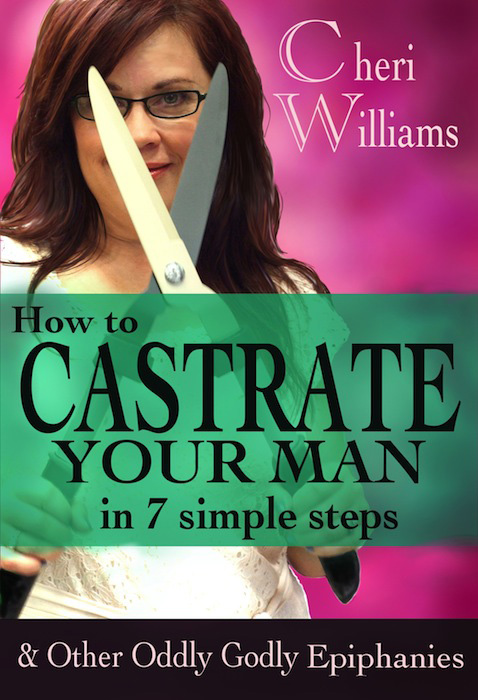
“Am I glad I decided to self-publish? Yes, I am. Have I abandoned traditional publication? No, I haven’t. I wrote pieces that didn’t fit neatly into any genre, wouldn’t sit sweetly in any publisher’s catalog. But they’re pieces that matter to me. Pieces I’m willing to work hard for. Pieces that keep me up nights perfecting them to the best of my ability (and those of everyone I know). I realized if I didn’t publish these essays myself, I’d never know if there’s a audience for them, an audience for this part of my heart. And I want to know—because there are a whole lot more Oddly Godly Epiphanies I’d love to inflict upon the world. Er… I mean… share. Self-publication was the right path for these pieces.”
Cheri also writes killer fiction for teens. “You know, the kind filled with love, lust, and lots of dead bodies. Those, I still believe, are better suited to traditional publishing. But who knows?”
No one knows, that’s who. No one knows what’s going to work in the trad world or the indie world. But for voices like Cheri’s there is now a way to find out.
“Bottom line: Was my book good enough? Would people think it’s funny? Moving? Matter to them like it matters to me? Make any difference at all? For a completely neurotic writer such as myself, those are tough questions to answer with a big fat Yes. In fact, the more I thought about it, the more I realized they can’t be. I couldn’t possibly know in advance if readers would take to my writing. But wait…Castrate had been critiqued by some of the best writers I knew, they said it’d brought on many a snort fest and even a few changed hearts. Once upon a time, it was bought by an uber-awesome editor! Were those things enough confirmation to take on the enormity of self-publishing? For me they were.”
For more on the oddly godly Cheri Williams, visit her website. And watch your back.
So do you agree? Isn’t self-publishing the greatest boon in history for the original voice? In fact, this is where publishers are going fishing for the “next big thing.” So why not stock the pond with your material?

Love Your Book

Every time I write a novel I have to fool myself. I have to brainwash myself into believing a couple of obvious lies.

The first lie is that writing my novel is the most interesting thing I could possibly do. More interesting than reading anyone else’s books or watching any movies or playing any video games. This is a patent, laughable falsehood. Reading Dennis Lehane’s new book is much more interesting than writing my novel. So is watching the latest crop of movies: Lincoln, Skyfall, even Wreck-It Ralph. Playing Halo with my son is a lot more interesting than writing my novel. Or at least it would be if I could learn how to work the controls as well as he does.

I have a special problem with video games: I like them too much. Twenty-one years ago I became addicted to a game called Civilization, which I played on my 386 PC (remember those?) The game starts at the dawn of human history; you have to establish a simulated civilization by building cities and mustering armies and increasing your technological know-how. You also wage wars against competing civilizations, and over time — each turn represents a hundred years, I think — your weaponry grows ever more powerful. I absolutely loved that game. There was something intensely satisfying about starting out with phalanxes and chariots and then working your way up to riflemen and tanks and aircraft carriers.

One night in November 1991 I played the game until morning. I started playing when my girlfriend (now my wife) went to sleep, and I was still at it when she woke up at 7 am. She gave me an incredulous look. “What on earth are you doing?” I must’ve looked a little scary. My eyes were bloodshot, my hands were shaking, and my back muscles were full of knots from bending over the keyboard all night.  “I did it!” I yelled in triumph. “I conquered the world!”

Later that day I removed the Civilization floppy disk (remember those?) from my computer and threw it in the trash. I realized I couldn’t allow myself to play video games of any kind, because if I did I wouldn’t do anything else. This self-imposed moratorium lasted until a few years ago when I broke down and bought a Wii system for the kids (and then we got an Xbox too). It was jarring to see the new games that have been developed over the past two decades — the graphics are so much better! But I’ve mostly resisted the compulsion to play. I’m too old to stay up all night. Besides, the kids hog the electronics now.  

But getting back to my point: the world is full of entertaining distractions, and many of them would give me more pleasure than writing my novel would, at least in the short term. Yet I convince myself that this isn’t true. I put down my newspaper and tell myself, “You know what? My novel is more interesting than the CIA director’s scandalous affair. So what, the guy fooled around with a fawning younger woman, what’s so interesting about that? Come on, stop searching the Internet for lubricious details. Stop exchanging snarky e-mails with your friends. Get back to work!”

And this brings me to the second lie I tell myself. At some point in the process of writing a novel I become convinced that this book is the best thing I’ve ever written. No — the best thing ever written by anybody. Crazy, right? The lie is so absurd I can’t seriously entertain it for very long. But it’s a useful delusion to have, especially when I’m struggling with the book and the deadline is approaching and I have to devote practically every waking moment to finishing the damn thing. Why put in all the effort if the novel isn’t fantastic?

Then I finish the first draft and stop telling myself the lies. They’ve served their purpose, so I don’t have to believe them anymore. I wait a few weeks, and then I’m ready to look at the manuscript again and confront the truth: the book is a mess. Some parts don’t make sense, other parts are boring. I don’t love the book anymore. But I don’t hate it either. Now it’s time for some tough love. An intervention. I have to whip the manuscript into shape.

And then, after all the revisions are done and the final changes sent to the copy editor and the advance reading copies distributed to the reviewers, then I’m ready to fall in love with the book again. But this time it’s not a blind, self-deluding infatuation. I’ve done my best to fix the novel’s flaws, but I know it’ll never be perfect. I love the book despite its imperfections and infelicities. I’m at this stage now with my next novel, which will be published in February. I’m still collecting blurbs and composing the jacket copy, but I can’t make any major changes to the book. This stage is the literary equivalent of zipping up your lover’s dress and clasping the pearls around her neck, getting her ready for her big night on the town.

Go out there, beautiful. Knock ’em dead.

Reader Friday: Favorite Novel

Last week we asked about your favorite movie of all time. What’s your favorite novel? Or let’s put it this way: What’s the one you’d take to that fabled desert island? (If you must, you can have a couple).

But also why? What is it about this particular novel that speaks to you? What can other writers learn from it? 

My Writing Nemesis & AMAZON UPDATE

by Michelle Gagnon

Now, I bet you think I’m going to write something cute about how some of my own personal writing habits are my own worst enemy, right? Nope. The truth is, I have actual writing nemeses out there–all authors so. It’s the dirty little secret that few of us ever confess to. Because here’s the thing; when your book hits the shelves, it’s directly competing against all the other releases that week (in addition to the books that go on sale in the weeks leading up to publication, and the ones for a month or so afterward). There’s a reason that we compulsively check Amazon rankings during those critical first few weeks; many publishers keep close tabs on early sales to determine if a) they’ll continue to publish your work, and b) if you merit an extra marketing push, or if the book will be left to languish.

There is quite literally not enough shelf space for all the new releases (even less now that so many stores have shuttered); and some will get prime placement, while others are crowded together in the stacks, with only the spine showing. It takes a truly dedicated reader to turn from those table overflowing with mountains of books to a perusal of the spines. And either way, your book will only be physically present in a store for anywhere from a few weeks to, at most, a few months after publication.

Which brings me back to my nemesis. Because not only is my book competing with every other book released in the same time frame, it’s also been directly competing for marketing dollars and attention with the other books being released by my publishing imprint. 

And one of those authors, unbenownst to her, is my current nemesis.

Our books were released on the same day, so keeping tabs on her sales gives me a sense of how we’re performing with regard to each other. Because there’s an excellent chance that our next books will share a release date, too. And if one of our books takes off, and the other doesn’t, when the sales and marketing team is trying to decide which novel to push in August 2013, guess which one they’ll go with?

I know authors who went ballistic when a competing major author switched to “their” release week, claiming it stole their chance to make a bestseller’s list. I’ve never gone so far as that, but I’ve certainly experienced frustration when another author with the same publisher received a marketing benefit that my book was denied.

I had a different nemesis with my debut novel, a lovely man whose own debut received the bulk of co-op placement and marketing dollars from our publisher. Oh, how I loathed him at the time. It’s really not so different from an office environment. When a good friend gets a promotion, merited or not, it’s difficult not to struggle with the green-eyed monster; especially if you felt it was a promotion you were owed. Well, it’s no different for writers. Although our water coolers are virtual, and every day is casual Friday.

And that’s our dirty little secret.

ADDENDUM: AMAZON UPDATE
I was checking my book’s pages last night, and inexplicably, DON’T TURN AROUND is suddenly listed as a paperback, not a hardcover; the Kindle version can no longer be ordered at all, and none of the books are linked on each others’ pages anymore. Maybe I’m paranoid, but this feels a lot like retaliation for my blog post about Amazon deleting legitimate reviews

Cultural Differences

By Nancy J. Cohen

Genres matter when you attend a conference. I started out in romance, attending National RWA and Romantic Times conventions. At RWA, we dressed in business attire and wore sequins to the Awards dinner. We taught workshops or we spoke on panels where the emphasis was teaching other writers the craft and business of writing. The same was true for smaller chapter conferences held around the state and throughout the country. Editor/Agent appointments were a staple for this type of working writers conference.

Romantic Times, in contrast, was a fan convention. Here we’d meet readers, booksellers, and reviewers in a fun, party-type setting. I still dressed in business casual during the day. At night, people wore costumes to themed balls and parties. As RT attracted more writers, they added writing tracks to educate aspiring authors. Now they’ve expanded to include other genres just as RT has changed its name to RT Book Reviews. It’s still a great conference to meet industry personnel and readers.

Then I switched to writing mysteries and attended Malice, Bouchercon, and SleuthFest. What a difference! People wore jeans! There were men in the crowd! Panelists were expected to be entertaining and witty and mostly talked about their books. Bouchercon and Malice are fan conventions while SleuthFest is a writers’ conference. SF has a forensics track and workshops for different levels of writing, along with editor/agent appointments.

The one thing these events have in common? Writers hang out at the bar, the hospitality lounge, or the dealers’ room and network like crazy. Costly swag gets picked up along with candy and pens. Bookmarks and other papers lay around the promo tables like unloved orphans.

And then I attended Necronomicon, my first SciFi/Fantasy/Horror convention. Lo and Behold! Another culture shock! In many ways, this convention was similar to the mystery cons. The panels were professional and moderated by a host. Aspiring authors attended in abundance. Instead of a forensics track like at a mystery writers conference, this convention had a science track led by scientist guests. However, here’s the biggest difference: Gamers. One darkened breakout room held 3 rows of computers where people sat  playing Halo. Other guys sat at round tables absorbed in role playing games.

Workshops went on into the wee hours of the night. I was scheduled to speak on three panels and had to request the organizer not to book me after dinner. Authors who paid for a spot in Author’s Alley sat at tables in a hallway and sold their own books. The Dealers’ Room was similar to the ones at mystery cons, where authors hope one of the vendors has their books for sale or else we make a consignment deal. I noted only one bookseller at this convention. Most of the vendors sold jewelry, games, and other knickknacks.

All in all, this conference was a valuable introduction to an entirely new audience. The panels were interesting as well as stimulating, and parties ranged into the night if you were so inclined. Check out my personal blog for more photos and reports on the panels I attended. Keep in mind that this was not like the big SciFi cons where TV and movie stars attend and people roam around in costumes. There was a costume contest, but it was one night only. This felt more like a writers conference aimed at SciFi/Fantasy authors.

Would I attend again? The jury is still out on that one. While the conference was comped for me since I was a speaker, I still paid over $500 for a hotel room. I sold two books. Granted, this audience is more likely to order the ebook version, but would I spend that money again instead of attending a conference that targets mystery or romance fans? We’ll see. The exposure to a new crowd is always good, and I had a great time meeting new people. I guess as in any choices we have, it depends on the budget.

If you have crossed genres, were you surprised by the differences at the conferences you attended?

Thinking about scenes while on the wing

When this topic posts I’ll be flying somewhere over the Pacific, winging my way to Hong Kong, and later China. This flight has full-reclining seats, so I might even be snoozing, especially if I sample enough of the bubbly that gets passed around by the Cathay Pacific flight attendants. (Who, by the way, are the most gorgeous, smiling people I’ve ever seen on an airplane.)

I’ll be offline, so I’d like to post a Reader-Friday style question to you all. Describe the scene that you’re working on right now, and tell us what challenges it presents to you as a writer. How are you working to make it the best it can be?

Here’s mine: I’m working on a scene in my upcoming book, PLUS-SIZE HOMICIDE, in which Kate, the MC, receives an unexpected (and most unwelcome) visit from her overprotective father. While showing the tension between Kate and her father, I need to set the stage for an issue from Kate’s past that she’ll have to confront in this book: the murder of her mother.  I’m concentrating on showing not telling, resisting the impulse to add too much back story.

What about you? What scene are you working on, and what is your main challenge in writing it?

Unreliable Narrators

by Clare Langley-Hawthorne

In the midst of the end-of-year-moving-to-Denver chaos, I’m finishing Gillian Flynn’s excellent thriller, Gone Girl. Not only is it a great read, it also presents one of those hard to pull off characters – the unreliable narrator – which also got me thinking about the elements that go into developing this successfully – something I have never tried to do (out of fear, I suspect…)

So how does an author present a voice that is compelling as well as unnerving, sympathetic and yet suspicious? How does an author walk the fine line between belief and disbelief so that a reader is both intrigued as well as unsure whether to believe the narrator or not?

I think the key elements are:

  • A strong unique voice from the outset – any form of narrator needs this for a first-person novel to succeed – but with an unreliable narrator I think this is even more important. A reader needs to be intrigued and disquieted but not totally put off (which is why I think there has to be a degree of sympathy, even when the character in question maybe pretty unlikeable.)
  • The clues to the truth must be sown carefully, cleverly and slowly throughout the  novel so that when the reader eventually comes to the necessary realization or revelation all the pieces fall into place… which leads to the next element and that is…
  • Don’t cheat the reader – a reader needs to feel satisfied at the end of the book that they could have guessed the truth or read the signs as to what was really going on. Nobody wants to feel cheated or miffed that key clues had been deliberately excluded or misrepresented in such a way that the reader couldn’t have possibly guessed the truth. 
  • Make sure the inconsistencies or ‘grey areas’ are mapped out so they eventually help round out the narrator’s character in a way that feels authentic as well as compelling. An unreliable narrator is a tricky character to develop so you need to make sure it is a fully-formed, well-rounded character that ultimately feels real to the reader.

So what about you, fellow TKZers,  have you ever attempted to write a first-person thriller with an ‘unreliable narrator’ at its heart? What do you think are the necessary elements to successfully pulling this off? 

The Perils of Internet Information


We all know that Bogart never said, “Play it again, Sam.” That mangled quote, which Woody Allen famously used in his stage play (and later movie) came from Casablanca,where Bogart’s character actually has this exchange with Dooley Wilson (as Sam):
Rick: You know what I want to hear.


Sam: No, I don’t.


Rick: You played it for her, you can play it for me!


Sam: Well, I don’t think I can remember––

Rick: If she can stand it, I can! Play it!
Recently, I’ve seen another bastardized quotation zapping around the internet. It’s a quote attributed to Ernest Hemingway. As a Hemingway-phile, I was quite interested. The quote goes like this: “There is nothing to writing. All you do is sit down at a typewriter and bleed.”
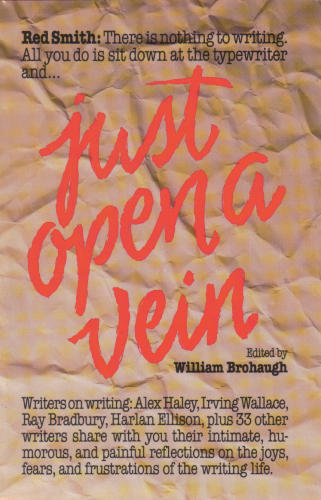
I was immediately suspicious. Something was rotten in the state of Bartlett, for it was the great sports writer Red Smith who said, “There’s nothing to writing. All you do is sit down at a typewriter and just open a vein.” (There are some variations on this, but the source is clear. You can read more here.)
This quote, in fact, became the basis of a book on writing, Just Open a Vein by William Brohaugh (Writer’s Digest Books, 1987). The Red Smith quote, with attribution, was printed right on the cover.

So how did these words get into Ernest Hemingway’s mouth, and thence to the wide world of the internet?
A TV writer did it, that’s how! As I investigated this further I came across an EW article from May 28, 2012, by Ken Tucker. It was a review of an HBO movie about Hemingway and his third wife, Martha Gellhorn. Tucker writes:
There’s a lot of dialogue that sounds as studied as Hemingway must have intended it to sound as he declaimed it (“Let me tell you about writers — the best ones are all liars”) and stuff that’s almost certainly cobbled together from various sources. (I was particularly amused when a negative review of the movie today in The New York Times made a point of ridiculing one Hemingway line — “There’s nothing to writing, Gellhorn — all you do is sit down to your typewriter and bleed” — but failed to realize it most likely derived from a New York Times sportswriter Red Smith’s wry dictum, “Writing it easy; all you have to do is open a vein and bleed.”)
So there you have it. It seemed like a good line to give to Hemingway in a biopic. But there’s another problem with having him say this (besides the fact that he never said it). The problem is he never would have said it!
Because Hemingway drafted in longhand, and he drafted standing up! He stood because of injuries sustained during his service in World War I. It was easier on him to be on his feet.
He usually only got to a max of 500 words in a single day, because he was famously trying to write “one true sentence” followed by another, and so on. (NOTE: There’s a famous author photo of Hemingway at a typewriter for the back cover of For Whom the Bell Tolls. But this was a staged photo to emphasize the Hemingway field reporter mythos).
So let’s be clear, when doing the hard work (the “bleeding”) of a first draft, Hemingway:
Did not sit.
Did not use a typewriter.
As his grandson, Sean Hemingway, once explained: “Hemingway wrote his first drafts in longhand, and you do not have to be a handwriting analyst from the FBI to appreciate his bold, fluid penmanship. Despite the author’s own comments in the book about the difficulty of the writing process and the need for revisions, many of his first drafts are remarkably clean, poignant testaments to his continued abilities as a writer later in life.”
And by the way, Hemingway never employed a secretary named Sam. Thus, he never, ever said, “Type it again, Sam.”
So here’s one instance where a reliance on what’s floating around the internet becomes a virus of error.
The irony, of course, is that I used the internet to do the research to get to the bottom of this. But this is the age we live in!
So what erroneous information have you come across in your internet surfing? What checks and balances do you use in your own research?  

‘Twas Two Weeks ‘fore Thanksgiving…

Thanksgiving is less than two weeks away, but potential Christmas gifts are appearing on the shelves already. The one that most immediately comes to mind is a library-bound, digest-sized book entitled JACK REACHER’S RULES, which provides handy suggestions should you decide so far off the grid that you have to have sunlight shipped in, or want to set a building on fire; it’s great stuff, and just in time for the holidays for that Lee Child fan on your list who thinks they have everything.  I have made a good dent in my shopping already; of course, I want nothing for myself. I believe that I have commented elsewhere that at my somewhat advanced age I am no longer interested in acquiring more possessions; rather, I seek new experiences. Alas, those that I have suggested to my spouse have been, shall we say, shot down. I will leave it to your imagination what they might be, and why they won’t happen.
So, I am asking you, since Christmas is coming…what, as far as books are concerned, are going to be looking to find under the tree in about five or six weeks or so? What do you want Santamazon to leave for you? It can be anything from the grandiose — an entire library in the basement — to the simple — a new writing journal — to something that is somewhere in between, like that slip-cased copy of MY PRETTY PONY by Stephen King that you could have picked up in a bookstore twenty-three years ago for a song and dance. What about a new tablet, the better to read DC e-comics on? Or what if Santa finishes that new novel you’ve been working on, the one that seems to be missing a hundred pages or so in the middle? What would you like?