About Joe Moore

#1 Amazon and international bestselling author. Co-president emeritus, International Thriller Writers.

Write Aids

By Joe Moore
@JoeMoore_writer

Wouldn’t it be great if we could download a software program, input some general ideas about a book we want to write, click compose, and an 80k-word manuscript magically appears? That’s certainly the Holy Grail of writers everywhere. Let the application do the heavy lifting while we just sit back and think up more great ideas. As of today, that software program doesn’t exist.

Still, writers are always looking for a shortcut. A tool that can take some of the pain away. A tool that can make the journey through the 3-act novel a bit easier. There are some programs that can help, even just a little.

Granted, the only tools needed to write a novel are a sharp pencil and a pad of paper. And some writers still use that method while others have gone on to word processors like MS Word. I prefer the latter since I can’t read my own writing.

But for those who seek a little bit of help to assist in the process, I’ve assembled a list of applications that might. I’ve never tried any of them and endorse none. But if one Zoner out there benefits from one of these, then my work here is done.

Probably the most popular program for novelists is Scrivener. Bestselling novels have been written with it and those who use it love it. You can test drive it for free.

After Scrivener comes smaller programs that focus on particular aspects of the writing process. Here’s a list. Hope you find that magic bullet in the list somewhere.

Note Everything. The ultimate note pad.

Write or Die 2. Helps to eliminate writer’s block.

yWriter5. Helps you to plan your novel.

Diaro. Advanced diary application.

Writer Pro. Professional writing suite.

FocusWriter. Gets rid of all distractions so you can concentrate on writing.

Writer. Helps you focus on your writing.

Hemingway. Helps you write bold and clear.

wikidPad. Helps you to link your ideas.

Wise Mapping. Online mind mapping tool.

MindNode. More mind mapping.

TreeSheets. Powerful note taking app.

Bubbl.us. Brainstorm or create a map for your ideas.

Sigil. EPUB editor.

Vizual Einstein. Visually develop a project.

The Writers Store. Complete source for writing software and other stuff.

There are tons more out there. You can find them with a simple Google search. So, fellow Zoners, do you use any writer aids or are all you writing tools in your head? Any programs to recommend?

————–

Coming this spring: THE SHIELD by Sholes & Moore
Einstein got it wrong!

A Mindset Stuck in the Past

There’s a tradition on social media called “Throwback Thursday”, in which people post pictures of themselves from the past. I was reminded of Throwback Thursday yesterday when I read an article in The Guardian, a British newspaper.

In “From bestseller to bust: is this the end of an author’s life?“, editor Robert McCrum interviews authors who find themselves struggling to adapt to an era of reduced advances from publishers. The article suggests that the mid-list writer is an endangered species. Read the article, and then come back.

I was astonished by the defeatist mindset of the authors who were interviewed in the article. They seemed to assume that if they were no longer getting livable advances from publishers, the game was over. Say what? Has no one in Britain heard of indie publishing? Indie publishing wasn’t even mentioned in the article (one reader did describe indie alternatives in the Comments, which sounded a bit like Sir Walter Raleigh  bringing news of the potato and other New World wonders back in 1589.) Other commenters then proceeded to confuse the indie industry with vanity publishing.

Most of all, the article mourns the passing of a more “genteel” era in publishing:

Publishers were toffs, booksellers trade and printers the artisan champions of liberty. Like the class system, we thought, nothing would change. The most urgent deadline was lunch. How wrong we were. 

Indeed. When it comes to adapting to a changed publishing model, I think American writers are ahead of the curve. People on this side of the pond are used to changing the way they work. Many former mid-list writers have  reinvented themselves as their own author brands. (And in so doing, have been astonished to discover that they’re making more money than they did under the old system.) Other writers are content to remain in the legacy publishing fold, or they become “hybrids” who do both legacy and indie work. It’s a matter of finding your own comfort level.

But judging by the Guardian article, one has to conclude that British writers are stuck in the Grief stage about the changed publishing world. 

It’s not helpful to remain mired in the past. Maybe we should send our British friends some copies of WHO MOVED MY CHEESE?

Author Responsibility

by Clare Langley-Hawthorne

Last weekend I went to the Society for Children’s Book Writers and Illustrators (SCBWI) conference in New York City and one of the key note talks was on the issue of author responsibility. I have to admit it isn’t something I’ve thought much about – beyond my responsibility to readers to write the very best books I can. My books don’t tend to contain graphic violence or sex and I don’t write with any particular agenda or controversy in mind, so it was interesting to hear what one writer thought was her responsibility as an author. 

Obviously, the issue was of particular concern to her (and to most SCBWI members, I suspect) because she wrote for children and teenagers. What I didn’t expect was that she would feel so strongly about her responsibilities, beyond that of ‘professional grace’, to instances where readers were indirectly affected by the book she had written. One example she gave was of a family who were listening to her audio book in the car and who were so overcome by emotion by the story that they were pulled over for speeding – she felt that she, as the author, was responsible for that occurring. Now in that instance, I disagree. I think there are many indirect consequences of reading/listening to a story which are not the author’s responsibly because readers have a choice as to where and when they read/listen and for their own behaviour as a result. 

Still, the concept of ‘author responsibility’ is an intriguing (and often fraught) concept…and I’m not even sure I’m totally clear on what that concept means to me. At the very least I think author should take responsibility for striving for excellence in their writing and that they should behave as a professional in all aspects of their career. At a minimum they should be held responsible for plagiarism and copyright infringement of other people’s work. As an author I also wouldn’t want to incite anyone to hatred or violence – but when I think about other authors’ work I can see the concept of ‘responsibility’ could be a slippery slope indeed.

As a strong supporter of intellectual freedom, I certainly don’t believe in author censorship but as a mother I’m also aware of the responsibilities involved when caring for young minds. I think it’s important that writers (including writers of children and YA books) tackle weighty issues such as drug abuse, sexual assault, domestic violence, racial discrimination, persecution and bullying. Adults, children, and teenagers can only benefit, in my opinion, from being exposed to a variety of books dealing with a broad range of issues and perspectives (even those that make me personally uncomfortable).

Though I am often ‘caretaker’ when it comes to what my children read, I never feel that I have any right to advise others as to what their children should or should not be reading (ditto for adults!). So what do I feel, as a reader/mother, is an ‘author’s responsibility’? Do these standards differ to what I feel I’m responsible for as a writer? I’m not sure. But the talk at SCWBI certainly made me think about what I expect from both myself and other writers. 

So what do you think is your responsibility as an author? What standards to you hold yourself up to and do these standards differ when it comes to other authors?

A New Approach for Plotters, Pantsers, and Everyone in Between

@jamesscottbell

The philosopher Groucho Marx once said, “Outside of a dog, a book is a man’s best friend. Inside of a dog it’s too dark to read.”
True that, but inside of your WIP, in the very center, dwells not the darkness but the light.
I’ve been studying, thinking about, practicing and (eventually) teaching the craft of fiction since that day in 1988 when I decided to become a writer. I love popping the hood, taking apart the engine, looking at all the moving parts. I love hanging with other writers and talking about the craft.
My bookshelves are stuffed with craft books. I have five big binders of old Writer’s Digestmagazines, underlined and indexed. There’s not an approach on “how to write” that I haven’t come across at one time or another.
I’ve written novels using all three main systems: plotting (with a comprehensive outline), pantsing (just start and go!), and tweening (a mix of each).
I’ve written by knowing the beginning (and that’s all), and by starting at the end (and working backward). Usually, it’s been a combination.
Every writer has a favorite approach, of course. And you’ll hear passionate arguments for them. No sooner has someone extolled the value of outlines than a rebellious soul starts beating the drum for knowing nothing at all!
Well, I’m pleased to tell you, people of Earth, that I come in peace. In fact, I believe I have come up with a unique method of approach that will please all sides of the great debate.
That method is to write your novel from the middle.
That’s what I said. Stay with me.
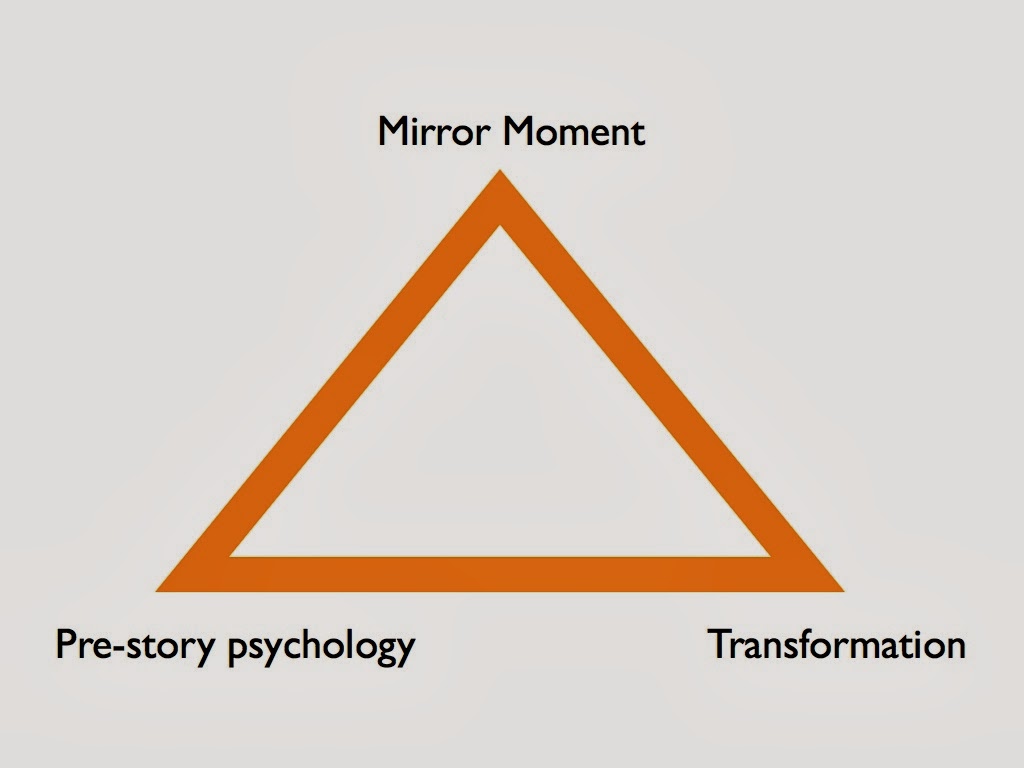
Let me go back to a post I did some time ago. I discovered that the true “midpoint” of a great novel or film is not a scene, but a moment within a scene. I call it the “mirror moment.” So powerful did this idea seem that I began to explore it as the foundation for all my full-length fiction. I then developed a method to get the most out of it. Not only that, I found that this approach is one that can be used by plotters, pantsers and ‘tweeners. It can be used at the very start, or at any step along the way.
You can use it as the basis of an outline, or you can pants your way along for ten thousand words and then let it guide you to an organic and powerful plot.
I started teaching this in my workshops, with wonderful results. Which is why I had to write a book about it.
Within this book I explain how to take the mirror moment and apply what I call The Golden Triangle, which looks like this:
The Golden Triangle will help any author find the unique and dynamic heart of their novel. In fact, just thinking about The Golden Triangle will mine riches hidden in your narrative. It will reveal, like the sun shining through the clouds, the real story you’re trying to tell––even if you don’t realize it.                                                                                             
The book can be found here:
My philosophy of study for 25 years has been that any writing book is worth it if I can find even one thing that helps me. That’s why I have so many books on the subject, and continue to read Writer’s Digest every month.
And that’s my pledge regarding this book. You will find something that helps you.
We’ve had books on outlining and books on writing without a net.
We’ve had books on knowing your beginning, and books on knowing your ending.
But this is the first one that counsels: Write your novel from the middle!
Thank you for this infomercial time, Zoners, and for your very gracious support.

So…do you consider yourself a plotter, a pantser, or a tweener? What particular challenges have you found with your approach? 

Afterlife with Archie

Do you remember Archie comics? I can’t remember a time when they weren’t around. The first Archie comic was published in…1944. I have, until recently only read a couple of them, but the characters — Archie, Betty, Veronica, Reggie, Jughead, and Midge — were of a type with which any high school student could readily identify. I always skipped over Archie titles, moving quickly to The Flash, Green Lantern, Fantastic Four, Tales of Suspense (which introduced Iron Man), Daredevil, and Justice League of America, to name but a few. I continued to read and collect comics for four decades, giving it up in 2000 when it seemed as if the plots were beginning to repeat themselves and my collection was becoming more of an accumulation. The new move toward digital comics didn’t bring me back to the fold, either, despite some attempt to update and “modernize” the titles I used to love. I also peripherally noted, from a seat on the sidelines in the peanut gallery, that the Archie books tried an update or two — Archie at one point had to choose between Betty and Veronica, among other things — which didn’t really sit well with the old fans or bring in any new ones on a long term or permanent basis.  

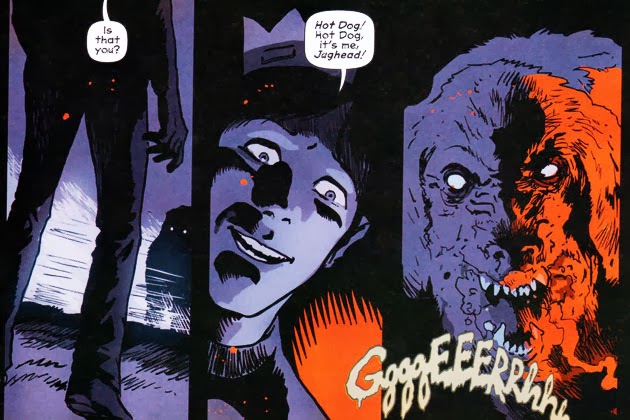
I thought I had bought or read my last comic book until a lifelong friend of mine, a 64 year-old fan boy, brought a new Archie series to my attention. It’s Afterlife with Archie, and you besides being a really good comic book, it contains a lesson for writers, published and otherwise. The Archie characters we all know are basically the same; Jughead isn’t a rocket scientist; Reggie is still kind of a d.b.; Moose is still athletically inclined to the exclusion of his intellect; and Archie, Betty, and Veronica are still caught in that love triangle of several decades. The story, however, is much, much darker. It begins when Jughead’s loyal pet Hot Dog is killed in a hit-and-run accident. Jughead takes Hot Dog to Sabrina, the teenage witch, who brings Hot Dog back to life with a spell. Hilarity ensues. Not really. Hot Dog is…different now. The resurrected Hot Dog bites someone — something that the Hot Dog we know would never do — turning them into a zombie, and within a few pages the town of Riverdale is a very, very different place. Yes, the story does tip its fedora to PET SEMATARY by Stephen King, but only a bit. There there are enough twists and turns to keep even the oldest and most jaded comic reader (me, for one) interested. The art, which is less cartoony than what you might be used to, is inked in dark shades to match the mood of the storyline, which spirals ever deliciously downward. The series is a huge hit; it takes place outside of the regular Archie universe and within its own unsettling continuity. Each issue is selling out at the comic book stores either in spite of that or because of it. Or both.

What does this mean for you or for me? I daresay that every one of us who has ever attempted to put story to page has any number of abandoned efforts on files languishing on hard drives (or in paper file folders) that are based upon good or even great ideas but somehow failed in the execution or otherwise died aborning. What I would like for you to do — and what I am going to do myself — is take one of those efforts and dramatically change one thing, and only one thing, within it.  Everything wild that happens in Afterlife with Archie proceeds from one element that differs from the series proper: Hot Dog BITES someone. Chomp. It changes everything. So go ahead. Take that nice woman in your story and turn her into a killer. Or how about that ten year old boy who got kidnapped in your Chapter One? Make your kidnapper wish they had taken anyone but him. Try it, and see how that old, forgotten project works. And tell us: have you tried this before? How did it work for you?


Do You Have a Writing Question for TKZ? Let Us Know!

It’s time for something new! Do you have a question about writing, marketing, or your work in progress? We’re collecting questions from readers over at our email address: 
killzoneblog at gmail dot com
One Thursday each month, we’ll use some of the questions as a launch pad for discussion. 
Let’s kick off this idea today in the Comments. If you have a question for one of our motley crew of bloggers, or for the TKZ community, go ahead and post it in the Comments. We want to hear from you!

4 Giant Steps to Self-Publishing

Nancy J. Cohen


Recently I have released my first nonfiction title. This came about because numerous aspiring authors kept asking me how to write a mystery. So I compiled my teachings into an easy-to-read booklet with concise instructions on Writing the Cozy Mystery. Here is a distillation of the steps I followed to produce this work.

Cozy

Please note that today I am en route to Orlando for SleuthFest, and I may not be able to reply to comments in a prompt manner. I will look at them later and do my best to respond in a timely fashion.


Manuscript
Hire a story development editor and a copy editor. Polish your work to perfection.
Insert front and back material into manuscript.
Write back cover copy.

Legal
Create a publisher name and register with your State as “Doing Business As” title. Or create an LLC if you prefer. Check with your accountant for more info.
Put a Legal Notice in your local newspaper if required by the State.
Apply for a county business license/tax receipt. Note: if you’re 65, you may be exempt from fees but you still have to apply. Renewal is annual.
Open a business bank account under DBA title. As sole proprietor, you don’t need an EIN number. Use your own SS number.
Order checks for new account.
Buy ten ISBNs from Bowker.com.

Production
Hire a cover designer for ebook cover and trade paperback cover.
Determine book price for digital edition.
Assign an ISBN number to the digital edition at MyIdentifier.com (if you’ve bought them from Bowker). You will need to upload the cover and give the price.
Hire a formatter after inserting the ISBN into your copyright page. Note that the print edition will have a separate ISBN from the ebook edition so you’ll need to send the formatter two different files or pay for a correction later.
Upload your e-book to Amazon, Apple, BN, Kobo, Smashwords, AllRomanceEbooks/OmniLit. It may be easier to hire your formatter to upload to iBooks since I believe you need to own an Apple device to do this step.
*File for copyright now so you don’t have to send two print books to the copyright office.
Upload to Createspace for a print edition. If you use their ISBN, you can sell your CS book to libraries. If not, librarians will have to get your book through another source or buy it through normal channels. Consider Lightning Source and Espresso Machine as other print options.
Consider an audio edition via ACX with another ISBN assignment and a cover resized to this format.

Marketing
Order print materials to promote your work, i.e. bookmarks, postcards, etc.
Consider doing a virtual blog tour.
If you set a particular release date, hold an online launch party.
Post your release news and book cover on all your sites.
Solicit Customer Reviews.
Run a Rafflecopter Contest.
Consider if you want to give away free copies or promote a bargain/sale price.
Join indie author forums online for more tips.

Obviously, marketing could be a whole other topic as could each one of these sections. I do plan to blog about this process in more detail at a later date on my personal blog. Meanwhile, these steps will get you started in the right direction. Those of you who have been through this journey might have more to add.

<><><>

Writing the Cozy Mystery is a valuable guide on how to write a traditional whodunit. This concise tool will show you step-by-step how to develop your characters, establish the setting, plot the story, add suspense, plant clues and sustain your series. You’ll find everything you need to know in an easy-to-read, clear manner to write your own whodunit. http://nancyjcohen.com/books/nonfiction/

Sympathy For the Bedeviled

You’re a crime writer. You see dead people. But are you listening to them? And are you letting them talk?
I had a real light bulb moment during my critique group session  last week. The five of us exchange pages ahead of our meeting and then offer input to each other. It’s always lively, constructive and fun. My peeps have given me some great guidance on my WIP.  But last week, while I was critiquing someone else’s work, I had an epiphany about character.
The manuscript I was critiquing, by an experienced published author, is very good. Compelling voice, great protagonist, and itt was rich with humor and a pretzeled plot. But something was off and I couldn’t figure out what the heck it was. Then it hit me what was missing:
The voices of the dead.
There were three murders in the first half of what is a serial killer plot. We were given only the sketchiest of details about them, that they are high school kids, and two didn’t even have names. Here’s the thing: I was so dazzled by the plot, the wit, and the well-rendered setting, and I so swept away by the charm of the heroine, that I didn’t realize I had no sense of the victims.
So I started to ask myself why did I care? They’re dead, they’re gone, and they’re really just catalysts to get the plot up and moving, right?
Oh, so wrong. Because if the reader is not forced to care about the dead, how can we believe that the heroine does?
When I got home from Starbucks that day, I went right to my bookshelf and pulled down Margaret Atwood’s book Negotiating With the Dead:  A Writer on Writing.
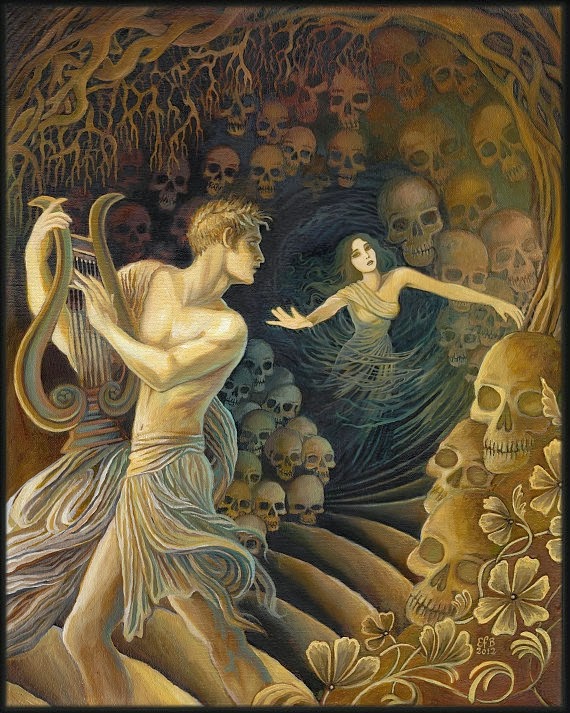
I was given this book years ago as a gift when I was first venturing into crime fiction, and to be honest, I sort of skim-read it, finding it a little flowery for my taste. It’s a compilation of a series of lectures Atwood gave at Cambridge. It’s not a book on how to write; it’s a book on what it is like to write. (I prefer Annie Dillard’s The Writing Life for this sort of thing). But one chapter in Atwood’s book that did stick with me was the final one titled “Descent: Negotiating with the dead. Who makes the trip to the Underworld, and why?”
Atwood sets up her idea in this essay with this: “Perhaps all writing is motivated, deep down, by a desire to make the risky trip to the Underworld, and to bring something or someone back from the dead.”
She talks about how insistent the voices of the dead can be in the solving of a fictional crime and how writers must listen very carefully when the dead begin to talk: 

“All writers learn from the dead…because the dead control the past, they control the stories, and also certain kinds of truth. So if you are going to indulge in narration, you’ll have to deal, sooner or later, with those from previous layers of time. The dead may guard the treasure, but it’s useless treasure unless it can be brought back to the land of the living and allowed to enter time once more — which means to enter the realm of the audience, the realm of the readers, the realm of change.”

This, in a nutshell — well, a lovely quote — is what was off about my friend’s story. Because she had not given her victims a voice in the book, we were missing a vital part of the narration. She needed to bring these victims back to life so there would be a reason for the heroine to solve their murders. Yes, the protag can be self-motivated (a cop looking for glory, husband bent on vengeance, a Poirot who wants to unravel the puzzle). But that is usually intellectual and protag-centered. It is not reader-centric and visceral. And the best crime fiction pulls readers in emotionally, thrusting them deep into the interior lives of the characters. So the victims must be a tangible presence in the story even though they are never “on camera.”

How do you do this? Well, once I was able to articulate this to my friend, our critique group had plenty of suggestions. Maybe the other students hold a memorial service, as kids are wont to do. Perhaps the heroine needs to interview parents or friends who offer memories and mementos. Culling through a victim’s possessions can be incredibly evocative and emotional, as any of us who has ever had to sort through a relative’s things after a funeral knows. Yearbooks, photographs on a mantel, journals, letters, a Facebook page…it can all be fodder for making a victim come back to life on a page.

Now that I think back on my critique session, I am surprised that this should have been such a revelation to me. My own series hero, Louis Kincaid, is one of those investigators who is drawn to cold cases and is compelled, at his core, to “speak for the dead.”

In our third book, Thicker Than Water, he is trying to solve the rape and murder of Kitty Jagger. She has been dead for 20 years but Louis talks to her boss, her best friend, the detective who worked her case, anyone who remembers her. What slowly emerges is a Rashamon portrait of Kitty that sends the case in a new direction even as it builds sympathy for the dead girl.

The most moving scene, I think, is when Louis visits the girl’s ailing father, who allows Louis to examine Kitty’s bedroom, which has been untouched for 20 years. We give a full three pages of description to the room and its contents. The scene ends with:

He picked up one of the half dozen perfume bottles. It was called Heaven Scent. He brought it up to his nose and drew back. It was cloyingly sweet. It was the smell that still clung to the room after twenty years.

He set the perfume down, letting out a long breath.

Time had stopped. He could almost see her, jumping out of bed, late for school, coming back and dumping her books, changing into her uniform before hurrying off to work.

His eyes traveled slowly around the tiny room. They had just left everything. Why hadn’t anyone packed her things away? And that old man sitting out there in his lounge chair, like he was still waiting for her to walk in the door and make him grilled cheese. 

Of course Louis is looking for clues here in the bedroom. But more to the point, he is letting Kitty tell her own story. He is letting her come back to life. He is forcing us, the reader, to care. And I hope, by the time the reader closes the book, we mourn the one who is gone.

Dangling Participles, Misplaced Modifiers, and Other Awkward Constructions

by Jodie Renner, editor, author, speakerJodie_June 26, '14_7371_low res_centred

In your writing, have you inadvertently created some awkward sentences involving misuse of participles?

In my editing of fiction manuscripts, I find even my smartest, most talented authors sometimes commit gaffes with participles, which can affect the meaning of the sentence. Some readers may notice these style blunders, and others may just feel subliminally confused or inexplicably mildly irritated.

Problems with participles, dangling or otherwise:

Participles are verbs that end in –ing (present participle) or –ed (past participle). According to the Chicago Manual of Style, “The present participle (-ing verb) denotes the verb’s action as in progress or incomplete at the time expressed by the sentence’s principal verb.” In other words, an –ing verb expresses an action that is still taking place when another action occurs.

For example, “As he was driving on the freeway, a police car whizzed past, lights flashing and sirens blaring.” Or “She escaped while the house was still burning.”

So –ing verbs are mainly used for ongoing actions or to indicate an action that is still taking place when another action occurs. Here are some examples of incorrect use of participles:
Captivate_full_w_decal~ Logistical impossibilities

What’s wrong with these sentences?

Hurrying up the sidewalk, she ran into her office building.

Striding across the lobby, he jabbed the button for the elevator.

Tapping her toes impatiently, she dashed into a free elevator that stopped.

What’s the problem ? Logistics. The -ing verb indicates that the first action is still happening when the second one occurs, but it’s physically impossible. She can’t run into her office building while hurrying up the sidewalk – it’s physically impossible. And if he’s still striding across the lobby, he can’t be jabbing the elevator button. Nor can she tap her toes while dashing into an elevator!

~ Check those sentences starting with -ing verbs.

Newbie writers often start sentence after sentence with -ing verbs (participles). That’s another sign of amateurish writing, and causes logistic problems. Besides being repetitive and boring, this sentence construction usually ends up describing a physically impossible series of actions – sequential actions described as if they’re simultaneous, as in the examples above.

Here’s another one: “Pulling the car over to the curb, she ran up the sidewalk.” She can’t run up the walk while she’s pulling over to the curb. It should be something like, “She pulled the car over to the curb, parked, then ran up the sidewalk.” Or “After pulling the car over to the curb, she jumped out and ran up the sidewalk.”

So vary your sentence structure, and if you start a sentence or clause with an –ing verb, make sure it works.

~ Don’t get caught with your participles dangling!

According to Merriam-Webster, a participle is a word having the characteristics of both verb and adjective. As mentioned above, participles are verb forms that end in –ing or –ed, like “buzzing” or “roaring”, or “satisfied” or “soaked.” A participial phrase modifies a noun, like “Climbing the mountain, the hikers soon grew tired.” The phrase is talking about the activity of the person or thing closest to it, in this case, the hikers, so it’s correct.

Here’s an example of a dangling participle: “Exploring the trails, the birds chirped merrily.” It’s not the birds that are exploring the trails, so it needs to be changed to something like “Exploring the trails, the hikers heard birds chirping around them.” Or “As they explored the trails, the hikers…”

A few more examples of dangling participles:

Wrong:
Dodging the traffic, his cell phone got dropped on the street.

It’s not the cell phone that’s dodging the traffic, so it needs to be:

Right:
Dodging the traffic, he dropped his cell phone on the street.
Or: As he dodged traffic, he dropped his cell phone.

Wrong:
Gazing out the window, the willow tree swayed in the breeze.

This sentence implies it’s the willow tree that’s gazing out the window. It would need to be changed to something like:

Gazing out the window, she saw the willow tree swaying in the breeze.
Or: As she gazed out the window, she saw…

~ Misplaced modifiers are a mistake.

Also, watch where you put your descriptive phrases in sentences, as they modify the words closest to them. For example,

Tall and rugged, the teenage girl gazed at the basketball star in admiration.

As it is phrased here, the “tall and rugged” refers to the teenage girl, when it’s supposed to be describing the basketball star. It should be rephrased to something like:

The teenage girl gazed at the tall, rugged basketball star in admiration.

Similarly with:

Tired and dirty, the lady of the house watched the farm workers trudge past at the end of the long day.

It’s not the lady of the house who’s tired and dirty, so this sentence needs fixing.

The lady of the house watched the tired, dirty farm workers trudge past…

Wrong:
Slathered in chocolate icing with sprinkles, the customers bought boxes of the sweet, decadent donuts.

It’s not the customers who are slathered in icing with sprinkles! This should be changed to something like,
The customers bought boxes of the sweet, decadent donuts slathered in chocolate icing with sprinkles.

And you wouldn’t want to write, “Soaked to the skin, she dried off the kids when they came in from the rain.” Unless the mom is soaked to the skin, too!

Readers and writers – have you seen or accidentally created some awkward sentences involving misuse of participles? Care to share any humorous ones?

I provide lots of tips, with examples, of these and all kinds of other style gaffes to avoid in my award-winning editor’s guide to writing compelling stories, FIRE UP YOUR FICTION.
Besides publishing numerous blog posts, her popular Editor’s Guides to Writing Compelling Fiction, the award-winning Fire up Your Fiction, Writing a Killer Thriller,Captivate Your Readersand her handy, clickable e-resources, Quick Clicks: Word Usage and Quick Clicks: Spelling List, Jodie Renner is a freelance fiction editor. Find Jodie on Facebookand Twitter, and sign up for her occasional newsletter here. Author website: JodieRenner.com.