THE VENGEANCE ANTHOLOGY
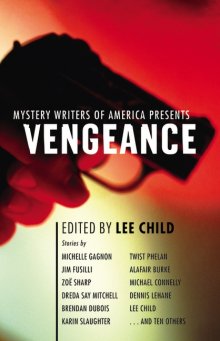
I hope you’ll excuse a little BSP today. I have a short story out in the new Mystery Writers of America Anthology, VENGEANCE, edited by the wonderful Lee Child. Plus I think there’s a lesson to be learned from the long, occasionally tortu
ous journey this story has had over the past twelve years…
Some background first. This was the first real piece of crime fiction I ever wrote. I composed it while working with the San Francisco Writers’ Workshop back in 2000. I’ve never been much of a short story writer, but at the time I was just diving back into fiction, and figured that playing around with briefer pieces might help me find my voice. So this was one of the first (and only) stories I ever wrote. Shortly afterward, I started working on my first book (the one that never sold), and then, eventually, moved on to writing THE TUNNELS.
I always had a soft spot for this story, but had no idea what to do with it. Filled with hope, I submitted it to a few literary magazines. After it was roundly rejected by them, I shrugged and put it away in a drawer.
Fast forward to 2004. Lee Child was headlining the Book Passage Mystery Writers’ Conference, and at the last minute I scraped together enough money to attend. On the last night of the conference, all the participants were invited to read a short piece of fiction, kind of an informal critique exercise. I wasn’t happy with the opening of my novel yet, and was considering skipping the event entirely until I remembered this story. So I pulled it out of the drawer, dusted it off, and read it that night. All in all, it was well received; Lee attended the reading, and spoke with me afterward about how much he’d liked it. Which was terribly flattering, but again, I had no idea what to do with it. So back in the drawer it went.
Fast forward another seven years, to 2011. Lee emailed me out of the blue and asked if I’d ever done anything with that story from the Book Passage reading. He explained that he was putting together an anthology for the MWA centered around the theme of vigilante justice, and thought my piece might fit in perfectly. He asked if it would be all right to include it. Once I finished turning cartwheels across the room, I said yes.
So this week my little story, the first piece of crime fiction I ever wrote, was published alongside the work of some of my idols, including Lee, Dennis Lehane, Michael Connelly, Karin Slaughter, and Zoe Sharp. To say that I was honored to be part of this anthology would be a tremendous understatement. It really is a dream come true.
And from it, I’ve learned a few things:
a) It’s impossible to judge the true value of a writing conference. Sometimes they might seem like a waste of time and money, but you never know what may come of the contacts you make there.
b) Never empty that drawer. The story that can’t find a home today might bear fruit years down the road (or even decades!)
c) Never give up. I have to confess, when those literary magazines first snubbed my work, I was disheartened and almost tossed in the towel. I really thought the story was pretty great, and discovering that not everyone agreed was crushing. It was hard to go on when it felt like what I was writing might never be appreciated, or even read, by anyone outside my critique group. Eight published or soon-to-be-published novels (and one short story) later, I’m really happy that I decided to forge ahead.
What follows is an excerpt from my story, IT AIN’T RIGHT. The VENGEANCE Anthology is currently on sale at bookstores and online.
“It ain’t right, is all I’m saying.”
Joe just kept walking the way he always did, shovel over his shoulder, cigarette clinging to his bottom lip.
“You hear me?”
He stopped and turned, lifting his head inch by inch until his eyes found my hips then my breasts then my eyes. A dustdevil whirred away behind him, making the bottom branches of the tree dance like girls on Mayday, up and down. He stared at me long and hard, and I felt the last heat of the day seeping into my skin and down through my bones, reaching inside to meet the cold that burrowed in my stomach early that morning.
“She’s dead, ain’t she?” With his free hand he scratched his belly where the bottom of his ‘Joe’s Diner’ shirt had pulled away.
“Yeah, but just cause she’s dead don’t mean she should be put down like this.”
He looked past me, towards where the road met the hill and dove behind it, wheat tips glowing pink in the twilight. “What else we gonna do with her?”
Tricks to Creating a Page-Turner
By Joe Moore
If you write mysteries or thrillers (or any genre, for that matter), there’s nothing more rewarding than to have someone say your book is a real “page-turner”—that they couldn’t put it down. And there’s nothing more fulfilling for a reader than to find a book so captivating that they
can’t stop reading. Naturally, the writer has to develop a compelling story populated with three-dimensional characters and enough conflict and tension to keep a reader’s interest. Those things are givens, and it’s the writer’s job to craft those elements into the manuscript.
But did you know that there are some simple formatting tricks that anyone can do to improve the readability of a manuscript and keep the reader turning pages. And what’s really cool is that you don’t have to change your story at all to benefit from them. Not a word.
Trick #1. Write short chapters.
Whenever a reader gets to the end of a chapter, they must make a decision to read the next chapter or put the book down and go do something else. It’s a natural stopping point or a launching point to the next part of the story. If it’s late in the evening, many times that decision involves continuing to read or going to bed. What you don’t want them to do is put down the book. When a reader finishes a chapter and comes to that late night decision to stop or read on, they usually check to see if the next chapter is short or long. If it’s only a few pages, there’s a really good chance they will read one more chapter. If they get to the end of that next short chapter and repeat the checking process again, they won’t go to bed. They’ll keep reading. And you will have setup a format that they’ll come to expect and rely on.
This tip does not mean that every chapter must be short. What I’m suggesting is to examine each chapter and see if you can split it into two. Or even three. After all, the same information is going to be imparted. It’s just going to happen in multiple segments.
There’s always going to be a need for longer chapters. Just ask yourself if that 6k-word chapter you just finished writing could be broken into multiple chunks. Remember that you want to entice the reader to keep reading.
Now I know that some writers will react by saying, “Well, my chapters end when they end. Short, long or in between, I write until the chapter naturally ends itself.” Fine. Do whatever you’ve got to do to write a great story. This trick may not be something that fits your writing style. But from a physical standpoint, readers tend to keep reading if they feel the next chapter will take just a few minutes to finish.
From a personal perspective, my co-writer and I try to bring our chapters in at around 1000 words. I know, some of you will think that’s way too short. But one of the most frequent comments we get from our fans is that in addition to enjoying the story, the short chapters kept them up late. We’ve had more than a few readers blame us for them not getting enough sleep because they decided to read “just one more chapter”.
Trick #2. Write (or format) short paragraphs and sentences.
This trick is closely related to trick #1, but it involves the visual experience of your book for the reader. It also involves setting up a distinctive and comfortable rhythm and tempo to your writing.
As you read, your eyes not only move along the sentence but your peripheral vision picks up the “weight” of the next sentence and paragraph. You’re reading a single sentence, but you visually take in the whole page. As your mind plays out the story from one word to the next, it also calculates what is coming up next, and causes you to be subtly energized or marginally fatigued. It’s like driving across the desert—if the road stretches in an endless ribbon to the horizon, you become tired just knowing you have a long way to go to get to the next break, or in the case of the book, the end of the sentence or paragraph. But if the road is only a city block or two long before you start down the next stretch of highway, you feel less overwhelmed by its mass (paragraph) or length (sentence). Shorter paragraphs and sentences keep the eye from getting fatigued. They allow the reader take a mental “breather” more frequently thus keeping their attention longer. And it’s also a tool for controlling reading speed.
Shorter sentences move the story along at a faster rhythm and tempo because the eyes moves quicker and your peripheral vision sees less bulk and weight on the printed page ahead.
Trick #3. Eliminate dialog tags whenever possible.
If there are only two characters in a scene, eliminate as many dialog tags as you can without confusing the reader. The dialog itself should help to identify the character as should their actions. Even with more than two characters present, staging can help to reduce dialog tags. Staging and actions also help to build characters. Dialog tags don’t. If the reader knows who is speaking because of their actions, the number of tags can often be reduced or even eliminated.
Trick #4. Title your chapters.
Your book has a title for a reason. It sets the mood or intrigue of the whole story. Consider titling your chapters for the same reason. Like the book title, a chapter title is a teaser. When a reader ends a chapter and turns the page, nothing is more boring than to be greeted with the totally original title: Chapter 23. Or worse, just 23. Why not give the reader a hint of what’s to come with a short title. Don’t give anything away, just use the chapter title as an enticement—a promise of things to be delivered or revealed. Use it to set the stage or create a mood just like the book title. I believe that each chapter should be considered a mini book. Chapters should have beginnings, middles and endings. And one way to tempt the reader to keep reading is with a compelling title.
Tricks like these are never to be considered a substitute for solid, clean, professional writing. They are only tricks. But they work if used in the mix with all the other elements of a great story. And the only way for you to know for sure is to give them a try.
Beyond these formatting tricks, does anyone recommend others that can enhance the reader’s experience?
Pushing the rock
King Sisyphus, according to Greek mythology, was an unfortunate soul who was condemned by the gods to forever push a giant boulder up a mountain, only to watch it roll back down the next day. For the rest of eternity, he was doomed to push, fail, and then repeat his task.
Sometimes the writing process can seem Sisyphean: “endless and unavailing, as a labor or a task.”
We write, rewrite, are dissatisfied with the results, tear up our writing, and then repeat, only to face rejection. It can appear to be an endless loop of failure.
But appearances can be deceiving. Sisyphus never gave up on his task. And, as the best writers know, neither do we give up on writing. In fact, I would argue that the more dissatisfied and self-critical we become, the better we become as writers.
Over the years, I’ve watched many newbie writers toil in critique groups. They start out wide-eyed and breathless–they bring pages each week, eager to show them off to what they’re certain will be group acclaim. A year later (if they stick with it), their eyes have lost their glow. They bring in pages, hungry now for magic words of advice which will point out what is wrong with their writing, and how to fix it.
Fast forward another year; they’re still bringing in pages, but they’re no longer expecting praise or instant cures. Their expressions have become grim and vaguely haunted. They already know what’s wrong, and they’re struggling mightily to self-correct. They are writing, revising, tearing up what they’ve written, and repeating. They may even have gotten a rejection or two from agents or magazines, but they’re still going.
They have become writers.
I suppose each of us has our own reasons for pushing through this difficult process known as writing. I’m suspicious of writers who claim that being a writer is like living in Happyville, or that they’re driven by a compulsion that they just can’t help. Some of the most successful writers I know are miserable, neurotic wretches. Usually, they are the most miserable when they’re on deadline.
Personally, I keep going because I like having written. I do not specifically “love” writing. Writing is difficult. Writing is never truly finished. Pick up anything you wrote more than a year ago, and you will find issues with it. If what you wrote has already been published, you will feel a pang of regret. I have been known to edit my writing as I’m reading it at a bookstore before an audience.
What makes you keep writing when things seem tough? And if everything is easy for you and you dwell in Happyville, feel free to share, even though I will resent you.
Traveling
How Many Brands Can an Author Have?
Publishers who make an investment in an author do deserve consideration and protection. They deserve the author’s best work (non-diluted by overwriting). And they are entitled not to wake up one morning to find their author selling a novel in the same genre for 99¢. Authors need to appreciate the harsh business reality of traditional publishing.
Now I’m going to run a warm bath, put on some Yanni and relax with A Garden in My Heart.
What Floats Or Sinks Your Boat
Title Trauma
By John Gilstrap
I have a hard time with titles. To date, of the nine books I’ve published, only three bear the titles I proposed. Here’s the history:
Mine: Nathan!
Title: Nathan’s Run
Mine: Most Wanted
Title: At All Costs
Mine: Even Steven
Title: Even Steven
Mine: Scott Free
Title: Scott Free
Mine: Six Minutes to Freedom
Title: Six Minutes to Freedom
Mine: Grave Danger
Title: No Mercy
I confess that after No Mercy, I stopped trying. My working titles became Grave 2, Grave 3 and Grave 4. My editor came up with Hostage Zero, Threat Warning and Damage Control. I love them all, but I’ve come to embrace my limitations. And typically, the title is just about the last element of the book to be written.
When Damage Control hits the shelves in June, though, it will contain the first chapter of the book that will come out in 2013–the one I have been writing under the title, Grave 5. That’s a little under-inspiring, so we had to scramble to come up with a title earlier than we usually do. Since the book deals with some issues regarding the first lady, I thought I had a winner: First Traitor.
Everyone was excited until we said it out loud, and we realized that the title would be heard as First Rater. That’s bad for radio interviews.
In the end, we decided on High Treason. I love the title and I am utterly shocked that it hasn’t already been used for a big thriller.
Here’s what I’ve come to understand about titles: It’s more important for them to be compelling and cool that it is for them to apply directly to the story. The clearest example of this in my writing is Hostage Zero, which actually means nothing, but sounds very cool. The title has done its job when a reader picks up the book and reads the back cover and thumbs through the first chapter. That’s where the buying decision is made.
What do y’all think? I know writers who can’t write unless they’ve got the title nailed down. I also know writers to fight for the title of their choice, even though their choices are often not very commercial.
How do you deal with titles?
The Unseen
by Jordan Dane
I am writing the final chapter of my latest project. INDIGO AWAKENING is Book #1 in THE HUNTED series for Harlequin Teen (Fall 2012). I love and hate finishing a book. There is such joy in making the final revision. It’s a real sense of accomplishment that launches me into a euphoric state that lingers. I also tend to procrastinate finishing because I never want to let the world and the characters go. The beauty of this project is that I get to keep the fires burning with a series.
To celebrate, I like to do something special to mark the occasion. As luck would have it, I’ve found the perfect thing. New York Times Bestselling author, Heather Graham, will be in San Antonio on Monday, April 2, at 7PM at the B&N LaCantera to sign her book THE UNSEEN. I made a date with my husband to have a nice dinner too. (Writing a book is taxing for a spouse too.)
THE UNSEEN is set in San Antonio. That alone is enough to give me goose bumps. Heather graciously blurbed my debut book – NO ONE HEARD HER SCREAM – before I had my first book on the shelf. I will never forget her kindness. An author of her caliber, I didn’t know what to expect. As an author, I’m always prepared for rejection, but her generosity blew me away.
Here is a summary of the plot for THE UNSEEN (Mira, Mar 27, 2012)
1800s. San Antonio, Texas: In room 207 at the Longhorn Saloon, in the long shadow of the Alamo itself, a woman renowned for her beauty was brutally murdered. Her killer was never found. One year ago: In that same historic room, another woman vanished without a trace. Her blood was everywhere…but her body was never recovered.
Now: In the last month, San Antonio has become a dumping ground for battered bodies.
All young women, many of them long missing, almost all forgotten. Until now.
Texas Ranger Logan Raintree cannot sit by and let his city’s most vulnerable citizens be slain. So when he is approached to lead a brand-new group of elite paranormal investigators working the case, he has no choice but to accept the challenge. And with it, his powerful ability to commune with the dead.
Among Logan’s new team is Kelsey O’Brien, a U.S. marshal known for her razor-sharp intuition and a toughness that belies her delicate exterior. Kelsey has been waiting all her life to work with someone who can understand her ability to “see” the past unfolding in the present. Now she has her chance.
Together, Kelsey and Logan follow their instincts to the Alamo and to the newly reopened Longhorn, which once tempted heroes with drink, cards and women. If the spirits of those long-dead Texans are really appearing to the victims before their deaths, only Kelsey and Logan have the skills to find out why.
And if something more earthly is menacing the city’s oldest, darkest corners, only they can stop it—before more innocent women join the company of San Antonio’s restless ghosts….
“Graham deftly weaves elements of mystery, the paranormal, and romance into a tight plot that will keep the reader guessing at the true nature of the killer’s evil.”
—Publishers Weekly review on THE UNSEEN
I love stories set in San Antonio, my hometown. My debut book was set in SA and I saw the city with fresh eyes to tell that story. The creepy underpinnings of the paranormal is an added bonus, especially when written by such a gifted author. So my treat to finishing my book is Heather Graham and THE UNSEEN.
What about you, my TKZ family? Do you do anything special to celebrate the accomplishment of finishing a book? What is the wildest thing you ever did or would like to do for your next one?
Blog Touring
What are the results of my recent frenzied rush around the blogosphere? For Shear Murder, I have done 16 guest blogs since January 1st. This doesn’t count my own blogs. On my at-home printout, I’ve listed the numbers of comments on each site, so I would know for future reference which posts attracted viewers and how many. When I release a new mystery again, I’ll solicit the sites where I got a good response for another guest appearance.
Some topics didn’t do well, like interviews and my “pet peeve”, or cutsy talks with my sleuth. Other topics stimulated good discussions. These were more instructional pieces. I wrote a new article for each site so they were all different and related to my new release in some way. I’ve had people say that my humorous mystery sounds like fun and they’ll look it up, so I really believe this tour got me exposure and introduced my work to new readers.
I feel my own blog connects me to readers and aspiring writers who like my posts on writing craft and business of writing. Those articles attract the most viewers. It’s brought me a “Klout” score of 50 especially in Writing. I mix these discussion topics with places I visit in Florida. The downside is that I spend time writing blogs instead of writing my next book. And people are probably sick of “take a look at my blog” posts by now. Do I feel it helped sales? Maybe. Certainly, I gained exposure and the tour contributed toward name recognition. Will I do it for my next book?
Ah, there’s the question. My next release will be a paranormal romance. I do need to gain exposure among those readers. I already have a list of potential topics (which I advise you to jot down as you’re writing your next book). I can look at my previous blog tour in that genre and see who to approach. However, right now, it’s enough to do my personal blog and this one. Writing blogs instead of the next story sucks away creative energy. To launch a virtual tour, you have to solicit hosts, write the pieces, publicize the tour, and then show up each day to answer comments. That level of time commitment may not be suitable for everyone.
But for those of us who jump on the blog tour bandwagon, it’s great to support each other. If you want to get more involved, check out the Book Blogs site. And please offer any tips or insights here that you’d like to share on blog touring.