First Page Critique: ROAD TO ARRAY
I’m sorry to say that this piece really didn’t resonate with me. It read as research-by-television series, and it just didn’t work. Not knowing what lies ahead in the story, I will venture a guess that this part of the story might be better told from Rick’s point of view. Assuming that he’s having a bad day on the other side of Daniel’s suspicions, I propose that Rick’s world view might be more interesting.
Setting the Stage: A Writing Exercise
For a change of pace today, I thought we could tackle a writing exercise. One of the things that’s struck me during our critiques lately is that I’m not alone in sometimes neglecting to include enough descriptive prose to set the stage for my stories. In fact it’s such a weakness of mine, I rarely add much detail in first drafts. I get the plot and dialogue in place, then go back during the editing process to flesh everything out. In all honesty, scenery description is my least favorite part of the craft of writing.
For one, remembering to include all five senses is always a struggle; I have a terrible sense of smell, and have to remind myself that my characters might not. Also, describing anything from a basic room to a crowd scene is rife with pitfalls; there isn’t a writer alive who hasn’t caught themselves typing out a trite cliche about the shape of the moon, or something similar.
So when my book is set somewhere specific, I rely heavily on photographs. The corkboard behind my desk is always layered with photos representing nearly every scene in the manuscript. I find that looking at them triggers sense memories, especially if I’m writing about somewhere I’ve been. I remember how streets in Paris are always wet in the morning, having been freshly washed by maintenance crews just before dawn. Or how the light in Central Park shifts dramatically season by season, or how the air in South America just tastes different (maybe my sense of taste is stronger, to compensate for that lack of smell).
Below I’ve pasted three photos. Pick any one and describe it in a paragraph, or use it as the jumping off point for a scene. Take care to avoid overused metaphors: “The sea was dark as slate,” for example, or, “The sky was as blue as a robin’s egg.”
Bonne chance!
Balancing Multiple Projects
Things used to be simple when I wrote for Kensington. I had to turn in one book a year. Easy, right? I wrote my Bad Hair Day mysteries and nothing else. It wasn’t until the publisher turned down my option book that I started writing in other genres to see what would sell.
Now it’s years later, and I’m still seeking a home for my two new mystery series. Meanwhile, Wild Rose Press picked up my romances, and I am preparing to launch a new paranormal series. Then Five Star published my tenth Marla Shore mystery. So years after I thought this series was dead, I’m writing it again. Before starting the eleventh book, I completed the first three books in my romance series. So those are all done, except for the edits, page proofs, and promotion.
And herein comes the juggling act. I am attempting to move forward with Bad Hair Day mystery #11, but I keep having to halt work on this project to do page proofs and revisions for the Drift Lords series, not to mention planning the promotional campaign for the series launch and taking time off to go to the Malice conference.
Meanwhile, those two completed mysteries linger in the back of my mind. Should I continue submitting them to small press or self-publish? If the latter, should I publish them as stand-alones or as the first books in new series?
Before deciding on these titles—and we’re still waiting for responses—I would like to self-publish my deceased father’s book. He hitchhiked across the U.S. in 1929 and his story includes some fascinating adventures. So my projects include:
1. The Drift Lords series from The Wild Rose Press
2. A new Bad Hair Day mystery
3. The possibility of self-publishing three titles
4. The possibility of one of my other mysteries selling in the interim
Never before have we had so many options. It’s an exciting time but it’s also all consuming. Who has free time when we can publish our entire body of works, and then when we have to spend hours on the social networks promoting them?
Do you find that your writing production has increased with the advent of new technologies? How are you balancing your writing projects, promotional efforts, and private life?
Bringing them in the door
In the second-to-last paragraph, your narrator’s reaction between “Thanks” and “Say, how did you know…” is a bit distracting, and doesn’t add anything new to Tamara’s description. Right now your character is thinking about the fact that he’s been ID’d, not whether Tamara is hot or not. As a general rule, try to keep every paragraph tightly focused on a single action or reaction.
Today’s Critique
The dialogue also seems unsure of itself – why does Petit say “You know this isn’t easy for any of us”? Surely a drug problem at a high school is hardly an overwhelming issue and also why does TR fight to keep a smile from cracking when he says there’s no proof Lester Rowley has anything to do with the drug trade? Again, as a reader I am unsure whether this is supposed to be serious, slightly tongue-in-cheek or what. So far the author’s voice and tone aren’t clear to me. Nor is the setting (apart from a generic conference room that I couldn’t really picture). I need to be able to visualize the setting as well as the characters not merely be told that the Chief of police tried to ‘maintain an appearance of competence and dignity’ – how? What did he do? Did he straighten his jacket, look wisely over his glasses?? I had a hard time picturing him or the other commissioners in the room.
Though this first page had references to some kind of ongoing issue between TR and Commissioner Dale Kirkpatrick I don’t get a sufficient sense of tension to care – nor am I really compelled to read on as yet. In short, I think this first page needs a clearer voice and tone, a stronger sense of place and character and a big dose of drama and tension. At the moment it feels too uncertain and too passive to be compelling.
What do you think?
I Am Going to Let the Readers Decide
Bread Crumbs Through the Tale
The Sin of Squandered Drama
Today’s subject for the First Page Critique is untitled. Here it is in its original form with bold face added by me. I’ll see you on the other side of the piece:
Malcolm was pinned down and under heavy fire. He’d walked into the ambush and blamed himself. His instincts should have recognized the telltale signs of a trap.
He was situated halfway up a small hill. Rounds were flying past him, striking trees and small shrubs. Whizzing so close to his head that he could feel the air pass.
Malcolm didn’t know the location of the rest of his unit. They were mostly rookies. As soon as the fighting began, they had scattered in chaos. Likely, they were already casualties. If the hostiles were to shift their position, then he would be next.
His opponents were positioned along a ledge uphill from him. Their position was fortified and they were throwing everything they had down at him. He wasn’t going to last long.
Malcolm didn’t want to be in this fight. He abhorred fighting, yet somehow he was convinced that this fight was okay. A part of him resisted, yet the old warrior was all to willing to take part.
He pushed down these anxious feelings and assessed his options. Going straight up the hill would be suicide. There was even less cover in front of him.
With covering fire, it might be possible for him to surmount the hill. If his teams members were smart, they would work themselves around the other side of the ledge in order to relieve his position. Malcolm wasn’t counting on this.
There were clearings to his right and left, which would give the shooters an easy target. He’d be picked off like a duck at a carnival game.
Maybe it was the stress of the situation, the old warrior back in his element, but his mind recalled past events that he had deliberately buried away. A face appeared. A face he once respected but now loathed.
Battle hardened, wrinkle lines deeply engrained, a bald head with liver spots and tufts of white hair sticking out from the side. The face spoke in a heavy Israeli accent, “Sometimes you need to go backwards to go forwards.” Typical Israeli philosophy.
This entry commits what I consider to be the most egregious sin of an author: It squanders drama through lots of telling and very little showing. Here it is again, mostly paragraph by paragraph, but this time, my thoughts are in bold.
Malcolm was pinned down and under heavy fire. He’d walked into the ambush and blamed himself. His instincts should have recognized the telltale signs of a trap.
An opening paragraph with this kind of action provides abundant opportunity for some very specific descriptions. Don’t tell me that he was pinned down, show me the splintering rocks and let me hear the whip crack of rounds passing close by. Better still, filter all that description through Malcolm’s emotions.
You tell us that Malcolm missed telltale signs, yet there’s no indication of what those signs were. Moreover, I question the relevance of such thoughts when he’s being pummeled by ammunition.
For this kind of scene to work well, I believe that the reader should have some level of investment in the character as a human being. Where is his rage? Where is his fear of never seeing his family again? Where is his commitment to win at all costs, or his temptation to surrender?
He was situated halfway up a small hill. Rounds were flying past him, striking trees and small shrubs. Whizzing so close to his head that he could feel the air pass.
Another sin: Passive voice. “Rounds were flying” is weak action. Constructed this way, rounds might as well be humming birds, accompanied by a Disney soundtrack.
Malcolm didn’t know the location of the rest of his unit. They were mostly rookies. As soon as the fighting began, they had scattered in chaos. Likely, they were already casualties. If the hostiles were to shift their position, then he would be next.
Right now, I’m thinking that Malcolm is a bit of a turd. If he’s lost control of his men, why isn’t he hurrying to bring order to the chaos. That kind of panic is what allows tine well-trained units to obliterate much larger forces. Malcolm should know this, I assume, because the unit is “his.”
His opponents were positioned along a ledge uphill from him. Their position was fortified and they were throwing everything they had down at him. He wasn’t going to last long.
His “opponents”? Now we’re in a football game? In Malcolm’s mind, those bad guys should be Hadjis, Krauts, Gooks–something far less friendly and respectful than opponent. Even OpFor–opposing force–would be a step in the right direction. Also, “everything they had” has no meaning. Are we talking mortars? Flame throwers? Boiling Oil? Monty Python cows?
I’ll stop the line-by-line critique at this point becomes it becomes repetitive. Suffice to say that writing action sequences is tricky. For the choreography to work in the reader’s mind, the description needs to be concise and precise without slowing the action. They also require a point of view through which the reader can experience the action. It’s hard to do, and I feel that this piece needs a second pass.
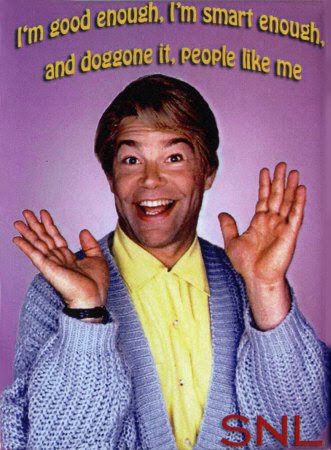
Author Affirmations with Stuart Smalley
by Jordan Dane
I’ll be on a panel at the Romance Writers of America annual conference in Anaheim in July – “The Care and Feeding of the Writer’s Soul.” Ever since I committed to doing it, I’ve been pondering my contribution and examining my own practices when it comes to nurturing my writer’s spirit.
But I wanted to open the topic up for discussion here to get your input. If you could create a box of affirmations for the writer, what would be your personal contribution?
On my computer I have been collecting sayings that have meant something to me over the years. These have come from author speaking engagements, emails, or things I’ve found online that inspired me enough to post it where I could see them every day. Affirmations can be reminders of author craft you want to repeat or they can be a way to keep a positive attitude or make progress in your career.
Here are a few sayings on my computer that mostly deal with author craft:
“Stick with the action.” Romance author Dana Taylor
When I muddled an intro action scene with back story, Dana wrote these words in an email after she critiqued the scene.
“Be there.” James Patterson
Patterson was a speaker at am RWA conference in 2004. He filled a ballroom, standing room only. By these two words he meant to put your reader into the scene using all their senses. He also said that he puts as much care into the first sentence of each chapter as he does the first line in any book. (I wonder if all the James Patterson(s) do this?)
“Trust the talent.” Robert Crais
I heard Crais present this on a video he sent via email in one of his newsletters. He talked at length about how he writes in constant fear, but that he trusts the talent that has brought him his success. It reminded me that all people have doubts. That’s human nature, but when you have a natural storyteller inside you, you should trust it.
“Get in, make your point, then get the hell out.” Robert Gregory Browne
Rob spelled this out when he explained ELLE on a blog post. Enter Late, Leave Early. The method is best explained by the TV show “Law & Order” where the scenes are sharp, concise, and don’t over-explain to slow pacing. The barest essentials of the scenes are captured to move the story along and a viewer’s mind fills in the gaps in action. The same works for books.
Here are a few that would be my contribution to keep a positive mental attitude:
“I strive to be better with every book. My best story is always my next one.”
“I touch new readers with every story.”
“My books are unique because they are filtered through me and my personal experiences. I’m not in competition with anyone, except me, to be the best author I can be.”
Here are a few silly ones:
“I never get my page numbers wrong. I must be good at math.”
“When I kill people on paper, they stay dead. Booya!”
As for practices to keep me positive, I have a shredding ritual for any rejection to expel the negativity from my house. Try it. It’s liberating. When I complete any project, I also treat myself with something that isn’t food—time off, vacation, fun evening with friends or family, attend a book signing, buy a new outfit. I used to think that each positive step in my quest to become a published author was only a small part of a longer future—that celebrating too much is a distraction that can swell your head. But now I celebrate everything. Life’s too short not to cherish even the smallest of pleasures.
Please share your thoughts. What would you write and contribute to an author’s affirmation box? What practices do you have to keep your mind positive and your writer’s soul nourished?