How a great story can change the world

by Matt Richtel


TKZ is once again delighted to host Pulitzer prize-winning author Matt Richtel. His latest release, THE CLOUD, just hit bookstores, and I can personally highly recommend it!
This true story ends with me sobbing. In public.
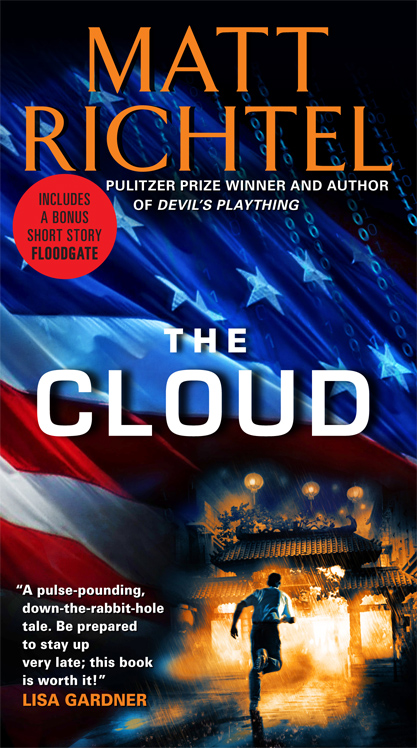
The story starts five weeks ago, on a Monday night, with a text. I was amid an exciting time, working on a front-page story for the New York Times (my day job) about a controversial new twist involving computers and schools, and I was preparing for the Jan. 29 release of my new thriller, The Cloud. 

The text came at 8.06 p.m. It read:  “Call me.”

The text was from Adam, a good friend of mine and editor at The New York Times. About a year earlier Adam had been put in charge of a group of eight, mostly veteran reporters, including me. The group was called “How We Live,” and its charge was to make a journalistic beat of the way people live their lives; how we eat, sleep, learn, fight, procreate, and how we die.

We were supposed to be a new generation of newspaper story tellers – part of an overall move in the newsroom to infuse stories with narrative, voice, and character. The days of authoritative top-down explanations in the New York Times were increasingly giving way to showing and not telling, and sophisticated story telling, appealing to heart not just head.

We were responding to the need to capture and keep reader attention amid the white digital noise of an Angry Bird world.

In response to Adam’s text, I called him. Before I tell you the shocking news he told me, please indulge some additional, necessary, backstory. 

Over the last year, my fiction career was also evolving to suit the digital world. Like many thriller-writing peers. I was writing more and more, adding to the already heavy book-a-year-load.

In August, I published a short story, Floodgate, 15,000 words I hadn’t anticipated writing, aimed at staying in touch with an audience feeding from the all-you-can-tweet-buffet.

And I took hard to Facebook, something initiated as a marketing tactic, but that transformed also into a usually welcome labor, in which I write stuff my toddlers say (funnier than I could ever make up) and occasionally quip about story telling. 
I amassed some 20,000 Facebook subscribers on my personal page. And several thousand likes on my fan page. We got nice press for Floodgate. Apparent success on all fronts.

The New York Times stuff seemed to be working out too. The How We Live team killed it. Something like 35 front-page stories and 90 stories for the front of our feature sections, like Dining, Home, Travel. We generated a ton of traffic. We were a hit. 

Then, fast forward to five weeks ago, I got the text. From Adam, on the Monday night. “Call me.” I called. In a nutshell, he explained, the paper was disbanding the How We Live group. And not just that; the paper was doing a whole bunch of shifting, all over the place. Voluntary buyouts, long-time editors and friends leaving, reorganization.

Why? Stating the obvious: because the paper’s news gathering operation – the news gathering and storytelling operation – cost too much. It was built in a different era, when our costs were supported by print advertising. Remember that old thing?

I’m no stranger to the ups and downs of the changing media landscape. I started and worked my way up from small newspapers, starting in 1990, at which I survived probably half a dozen rounds of layoffs. I know not to let macro-economic forces get me down.

But after I talked to Adam, I went into a tailspin. One that had been a year in the making, at least.

All this hard work. All this adaptation. So much terrible uncertainty. Part of what I experiencing, I am adult enough to know, was the personal uncertainty of the reality I’d need to find a new job inside the paper (I have), and that I was poised to have The Cloud come out (it did, two weeks ago). That meant marketing, travel, speaking, radio, and the subterranean terror that accompanies a book release: will only my family buy it?

But there was something much bigger for me too. I was confronting, squarely, for the first time, the reality that we don’t know what works. We.Do.Not.Know.What.Works.

What has value? How much value? Will we have mere chaos, only chaos, since Jack Dorsey, of Twitter, wrote his infamous missive:  “…we came across the word ‘twitter’, and it was just perfect. The definition was ‘a short burst of inconsequential information,’ and ‘chirps from birds’. And that’s exactly what the product was.”

Inconsequential? Only if you’re not competing against it to pay the bills, and satisfy your muse.


My sleep deteriorated. I experienced a very unusual level of anxiety. I couldn’t write. I was a rotten dad. For two weeks, I felt like crud. I couldn’t find steady ground.  

Then on a Monday, two weeks after the text, I took myself on a Monday afternoon to see Lincoln. No sooner had the opening music began to swell then I had tears in my eyes. They stayed there, persistently, throughout. And by the time a bereft Sally Fields dropped to her knees during a particularly emotional scene with Daniel Day Lewis, I began sobbing. Just lost it.

I was a mess the rest of the movie.

When I walked out, it was the best I’d felt in weeks. Cleansed.

And it’s when I finally understood the thing that had been eluding me for weeks, maybe for much longer. I finally understood the value of The Story. And of storytelling. And of its place in the digital world.

I’ll tell you first my conclusion, and then explain.

My conclusion: The bad story and story teller has little value, or, at best, ephemeral value; so too the mediocre story and storyteller, and even the merely good ones.

The great story and story teller is more valuable than they have ever been.

They are a port in the storm. A place to pause and heal from all the white noise the world throws at us, a tiny closet to cower inside and rest from the swirl of inconsequential missives.

And, more than that, great stories are the place where we will change the world. In Lincoln, Tony Kushner and Steven Spielberg, two of the greatest story tellers of our age team up to make a movie that is, perhaps above all, an homage to storytelling. They teach us that Lincoln used story-telling, narrative, anecdote, quip and emotion, to deliver the United States from slavery. 

I know this doesn’t answer the business-model question. That’s the one that plagues us, still. Will the New York Times face bigger challenges? Yes? Will The Cloud take flight? Not as it might have when the institutions of publishing had more power (It is my most ambitious and mature and entertaining work to date).

But it’s not the business model question I needed an answer to. It was the emotional one, the real one. And I got that answer sitting in a movie theater, sobbing. 

Fellow story tellers, take seriously your duty. The world seeks deliverance. You hold its key.
FREE on Kindle

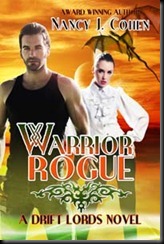
Today is my first venture with the Kindle Select Program wherein a book goes free to the public.WarriorRogue_w7578_300
Wild Rose Press, who publishes my romance novels, decided to enter their new titles into this program before the official release date. I am really hoping this offer raises awareness of my series.
  
Before we proceed further, please go now and download your free copy. Share this link with everyone you know! Please “Like” the page while you are there.

Warrior Rogue (The Drift Lords Series) by Nancy J. Cohen is FREE on Kindle Feb. 13-17. http://www.amazon.com/Warrior-Rogue-Drift-Series-ebook/dp/B00AU62NQS/.

I’m also running a Valentine’s Day contest in conjunction with the free giveaway. Click on the Contest tab here: https://www.facebook.com/pages/Nancy-J-Cohen/112101588804907 and remember to Like the page while you are there.

What have I learned from this experience? It takes a tremendous amount of time away from writing to put up a free book. Why? Because you have to publicize it all over the Net. How do you do this? Here are some sites that will help:

http://digitalbooktoday.com/maximize-your-kdp-select-free-days/
http://indiereviewtracker.com/making-your-e-book-free/
http://www.rachelleayala.com/p/promo-sites.htmlhttp://www.thekindlebookreview.net/author-resources/
http://writeonthewater.com/?p=11162

From helpful sites such as these and from posts by other authors, I’ve gathered two pages of places to notify about an upcoming or current free release. Twitter and Facebook accounts have to be notified on the day of the freebie, but a bunch of other ones expect advance notice. So I’ve been busy filling out these forms.
Here is a list of tips, in no particular order, on what to do before your book goes free.

  • Make a list of promotional sites that will announce your free book.
  • Notify the sites that require advance notice.
  • Decide if you want to pay for ads at any of these sites.
  • Get your book reviewed. Some of the sites will only take your title if you’ve had XX number of reviews with a rating of 4.0 or higher.
  • Schedule a blog to run on the first free day to announce your freebie offer.
  • Prepare a sheet of tweets with hashtags and Facebook posts in advance.
  • Schedule tweets ahead of time to run throughout the day of your freebie.
  • Send a newsletter to your mailing lists with your free book announcement.

What else would you add?

What to Expect When You’re Expecting…to Be Published

by Boyd Morrison

If you’ve just gotten an offer for publication of your debut novel, congratulations! Keep the celebration short, though, because you’ve got a lot of work to do ahead of its release. Before I got that magic phone call, I didn’t realize how much an author has to do in preparation for a book launch. It’s no longer a hobby; it’s now a job. So here’s a compact primer on the responsibilities you’ll have during the gestation and birthing of a published book.


1)   Sign the contract. At this point, you will usually receive one-third of your negotiated advance (sometimes a fourth portion of the advance is retained until paperback publication of a hardcover release).

2)   Deliver the manuscript to your editor.

3)   Receive notes from your editor. These can come as comments in the document, a summary letter of notes, or both.

4)   Revise, revise, revise.

5)   Deliver revision to editor. Continue steps 3-5 until revisions are complete.

6)   Editor officially accepts the delivered manuscript! You get the second third of your advance.

7)   Receive the copyedits. The copyeditor is a different person from your editor, who comments on story issues. The copyeditor comments about typos, grammatical errors, repeated words, inconsistencies (name changes, timing issues, etc.), and typesetting notes (italics, bolding, etc.).

8)   Copyedits are also called galleys. The cover of a galley is typewritten with the title and your name. You suggest other authors to send these galleys to for possible blurbs. I often get blurb requests that require me to read the book in two weeks, which is usually impossible for me to do because of other commitments. You want to give authors at least 2-3 months to read it, and even then it’s very possible they won’t have time because of other galleys on deck for blurbs or deadline issues.

9)   Go through all the copyedits and either accept each change, modify it, or write “stet,” which means you want it the way it is.

10) Send the approved copyedits back to your publisher.

11) Approve the cover. Most authors have no say in the cover art, so the publisher usually sends it and says, “Isn’t it great!” But some authors get consultation so you can at least raise concerns if you find something objectionable. However, the final decision is with the publisher.

12) Write the book jacket and back cover summary.

13) Write your author bio for the book jacket.

14) If you don’t yet have a professional-quality author photo, get one.

15) Receive the proof. This is what the book will actually look like in print.

16) Proofread the book. This process is called proofing.” Sometimes you will get a second proof to read.

17) Send proof back. A part of you hopes you never have to read this novel again.

18) Once you approve the final proof, it goes to the printer. No more changes can be made unless they’re incorporated into a future edition.

19) Ooh and aah over any ARCs (advance reader copies) that are sent to you. ARCs look like the final book with the actual cover, except it is in paperback instead of hardcover. ARCs are typically sent to reviewers and bookstores to generate reviews and excitement about the book.

20) Approve or write publicity releases. These will be sent out with the ARCs or to news outlets to create buzz about a book.

21) Approve or write marketing materials. These will be used for advertisements, catalog inserts, or in-store promos.

22) Approve or write website materials. These can be for your own website or the publisher’s website and can consist of your process for creating the book, extensive Q&A sessions, or book club guidelines.

23) The book hits stores! You get the final third of your advance. But you’re not done…

24) Write blog posts to promote the book. This can be done as part of a blog tour, where you visit a new blog every day for a few weeks.

25) Keep Twitter and Facebook followers engaged and informed about the release.

26) Double-check all of the online booksellers where your book is listed to make sure there aren’t any errors (this has happened to me many times—e.g., bookcovers that were the wrong version, inaccurate descriptions, broken links).

27) Respond to written interviews. An interviewer gets to email you 5-10 short questions, and then you have to write all the (sometimes lengthy) answers the way you want them to appear because they will be published verbatim.

28) If you or your publisher has put a good effort into publicity, you’ll need to do phone or in-person interviews with radio and TV stations.

29) Even if you only visit bookstores in your own town, you’ll be doing some booksignings. This can also involve traveling to multiple cities. You may be booked to appear at writers’ conferences, fan conventions, or bookfests. You’ll need to come up with some sort of presentation for all of these—sometimes you’re just on a panel and other times you might be the only one talking to a roomful of readers.

30) Obsess over your Amazon ranking and reviews. You know you shouldn’t, but it’s almost impossible to ignore them.

31) By the way, while all of the preceding is going on, you need to write your next book. Have fun with your new job!

How to Work on More Than One Book at a Time

The most critical thing a writer does is produce. — Robert B. Parker
When I started writing seriously, after ten years of believing the Big Lie that you can’t learn to write fiction, I decided I had no time to waste. I wanted to be prolific. So I set out to work. Looking back at 20 years of getting paid for what I write, I see three practices that have helped me more than anything.
First, a quota. I’ve always written to a quota and that, IMO, is the most important thing a writer can put into practice.
Second, I systematically and consistently studied the craft. I read novels with intention, examining author technique. I subscribed to Writer’s Digest, went to conferences, devoured books on writing and practiced what I learned.
Third, I always worked on more than one project at a time. That’s what I want to talk about today.
No publishing house or agent is looking for one good book. They are looking for authors who can keep on writing them. Which is why it pains me when I see the same faces at writer’s conferences who are still working on the same projects, year after year.
I am always telling writers who show me their first finished manuscript, “That’s great! Congratulations. You learn a tremendous amount finishing a novel. Now get to work on the next one. And the one after that.”
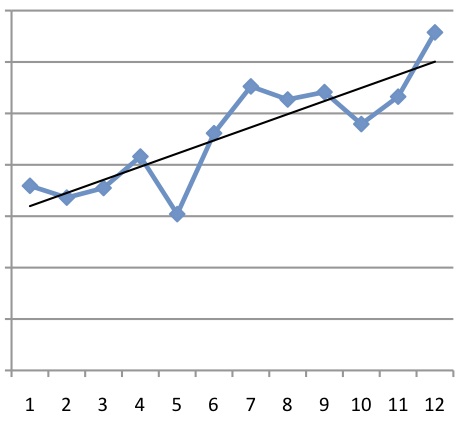
This is especially important in the new era of self-publishing. The winning indie formula is quality production over time. You want a trend line that looks like this:

Upward direction is a function of producing new work, the best you can do, in various forms (short stories, novellas, novels, non-fiction). So work on more than one project at a time.
My method is to think of myself as a mini-studio. I always have a main project (my work-in-progress, or WIP). I have several projects “in development.” That means I’ve started making notes on character and plot, and perhaps a preliminary story board (I use Scrivener’s index card view for this). Projects in development go into a file I call “Front Burner.”
Then I have a file of hundreds of ideas I’ve collected over the years. Usually one or two lines. Sometimes just a title. I scan these ideas from time to time, looking for the ones that catch my fancy and, if they do, I make a few more notes. If I start to like something, I move it to the Front Burner.
As far as the writing itself goes, my first priority each day is to my WIP. I want to meet my word quota on that project. Part of my day will usually be spent editing a finished work. To do this, I print out a hard copy. I still like to be able to cross out and write notes on paper.
Another portion of my day will be spent on a Front Burner project. I prioritize these. I want to concentrate on the ones that meet this formula:
Desire to Write + Commercial Potential
Somewhere in the intersection of those two things is the project I “green light” for writing in full. I lean heavily on the desire line, because I believe you write best what you’re passionate about. For example, I love writing my Jimmy Gallagher boxing stories. They only make me Starbucks money, but I write them because I want to. Eventually there will be enough for a collection. I write the Sister J vigilante nun series because the concept was too good to pass up. (Note: I’ll have Force of Habit 2: And Then There Were Nuns out later this month. And a new Jimmy Gallagher next month). 
Now, I realize time is an issue for many writers. There’s the day job, the family, the remodel, the PTA. But that doesn’t mean a writer cannot put into practice a personal plan for prolificity (like all those p words? That was fun to write, but there’s no money in it). Here is what I suggest:
1. Figure out how many words you can comfortably write per week. Up that by 10%. Make that your writing quota.
2. Keep a notebook (or electronic equivalent) with you, and train yourself to think “What if?” all the time. Write down lots and lots of ideas in this notebook. The key to creativity is to take in a ton of ideas without judgment, and only later choose the best ones.
3. Spend a few hours each month looking at your idea file and expanding the ones you really like into a few paragraphs.
4. Try this: write like mad on your WIP. Take a break. Then write like mad on another project. Go back and forth.
5. Finish your novel. If you’d like some help with it, I will soon be offering you a way to do that. Check here for more information.
6. Revise your novel. At the same time:
7. Get to work on your next novel (or novella or story).
8. Never stop.
A plan like this, consistently followed, will please and amaze you. And you will be a real writer, one who produces words. That’s the main ticket in this game. Everything else is secondary.

What about you? Do you have some sort of system you follow for consistent productivity? How do you choose what projects to write? 
* * *

My new thriller DON’T LEAVE ME is available here:

Regarding Rejection

by Mark Alpert

I’m familiar with rejection. Before my first novel was published I wrote four books that went nowhere. I received rejection letters from every major publisher in the industry and a hell of a lot of minor ones too. (And because this record of rejection dates back to the late Eighties, some of them were actual letters rather than e-mails. Typed on paper, for crying out loud!) The rejections that hurt the most were of the “It’s good, but…” variety. You know what I mean: It’s well-written, but I didn’t like the characters. It starts well, but I lost interest. I liked the book, but I didn’t love it.  Or the worst: I loved the book, but it’s not right for us.

I hated those letters. My reaction was: If you like it so much, why don’t you just publish it? In my disappointment, I wondered whether the compliments were sincere. Perhaps the editors actually disliked the book but were trying to soften the blow. In a perverse way, I almost hoped that the praise was false. If it was genuine, that meant I’d come close to success but fallen short, which was more frustrating than missing by a long shot.

In retrospect, I realize how wrongheaded my reasoning was. First of all, I’ve learned that book editors are outrageously busy people. The notion that they’d take the time to invent a compliment seems so ludicrous now. I’ve also realized there are many valid reasons for rejection that have nothing to do with the quality of the novel. The publisher may have too many books on its list already. Or perhaps the imprint rejects a manuscript because it just published something similar and it didn’t sell very well. Publishing is a business, after all. An editor can afford to make a few money-losing bets, but not too many.

But my worst mistake was ignoring the obvious message of those letters: You’re getting close! You should keep trying! Now I see that receiving one of those “It’s good, but…” rejections is the equivalent of hitting the green outer ring of the bull’s-eye on a dartboard. If you can consistently hit that ring, then it’s just a matter of time before you’ll land within the inner circle and win the big prize.

My third novel, Extinction, comes out on Tuesday, and as I stare at the gleaming hardcover on my desk I think of all those rejection letters. I suppose there are a few supernaturally talented writers who can hit a bull’s-eye on the very first throw. But for most of us mere mortals, success and failure march hand in hand. You can’t have one without the other.

5 Keys Steps to Adding Depth to Your Fictional Relationships

Jordan Dane
@JordanDane


My Australian cover for Indigo Awakening


In Indigo Awakening (Book #1 in my “The Hunted” series for Harlequin Teen)—there is a love triangle that is layers deep. I’m a sucker for love triangles, but I wanted the one in Indigo Awakening to be a little more than a girl’s attraction to two very different boys. At the apex of this triangle is a very strong girl, Kendra Walker, the leader of an underground movement of Indigo children and feelings run high when beliefs and ideologies are tested.

Lucas Darby is psychic and becomes mentally linked to a girl he hears in his head after he escapes from a mental hospital. Kendra thinks she has made contact with another lost Indigo, but after she realizes that Lucas is a powerful Crystal child, she sees the future she always dreamed would be possible. And for Lucas to connect with the “hive mind” for the first time, the link is intoxicating and seductive. Kendra is older than Lucas, but for him their connection is as intimate as making love for the first time. It changes everything for both of them. Since Lucas is evolving into a Crystal child, the next evolution of mankind, Kendra is motivated to be with him so she can be a part of a new, more powerful movement. She is a modern day Joan of Arc on a mission to save the Indigos, but someone else is her rock when it comes to protecting her Indigo children.

Another boy, Rafael Santana, has helped Kendra build a safe underground oasis for the homeless Indigos. Rafe has feelings for Kendra that he’s never shared with her, but he’s also driven to protect Benny, a 10-year old boy he loves like a little brother. This conflict will drive how he reacts when Kendra’s Indigo revolution threatens the home he wants for Benny. After she focuses her attention on Lucas, Rafe becomes jealous, but in his quiet way he deals with it until the conflict between the Indigos and the Believers blows up, the fanatical church zealots who hunt Indigo kids to stop the next evolution of man. Rafael’s love for Benny collides with his loyalty for Kendra and changes everything.

Kendra must choose how far she is willing to go to save her Indigo family—the one she has and the one she’s dreamed about. Lucas, the powerful Crystal child, represents the future she had always hoped for, but Rafael is the heart and soul of the past she started with him—the boy who made her dream possible.

Key steps to adding depth to your fictional relationships:

 
1.) Give a strong character vulnerabilities that conflict with what they might want and force them to choose. There are consequences to actions. Someone’s gotta lose, even in love.

2.) Give them choices that test their emotions. Their choices shouldn’t be easy. For example, make them choose between their personal happiness or the greater good. This is classic and always relatable.

3.) Pair them with opposite types of characters to enhance the conflict potential. Opposites attract for a reason. Fireworks, baby.

4.) Create internal conflicts or flaws that make them struggle with their external goals and the goals of the character(s) you’ve paired them with. Conflict is key to any great story. But add depth to your character by layering the conflict inside them first.

5.) Give them a noble cause that is a roadblock to their personal happiness or someone else’s. What would they do? Not every character would make the same decision.


For Discussion for Readers and Writers:

1.) What are some additional points you would add to this list?

2.) What are some of your favorite literary or film love triangles? Please share your thoughts on why they resonated with you.

“Dane’s first offering in her new series, The Hunted, is sensational. Indigo Awakening has strong characters and a wild and intense story, matched only by the emotions it will generate within you. Readers will love this book and eagerly await the next adventure. Fantastic! A keeper.”
4.5 Stars (out of 5)
—Romantic Times Book Review Magazine

Essential Characteristics of a Thriller Hero

blade-cover4-smallI’m pleased to welcome back to TKZ my guest, Jodie Renner, freelance fiction editor and craft writer. I was fortunate to have Jodie edit my upcoming thriller, THE BLADE (co-written with Lynn Sholes), scheduled for release February 20. Enjoy Jodie’s terrific advice on creating the essential thriller hero.

————————-

by Jodie Renner, editor, author, speaker

P1070629_CloseupThe hero or heroine of a suspense-thriller, like the protagonist of any popular bestseller, has to be impassioned, unique, and likeable enough for the reader to want to latch on and follow them through their journey, worrying about them and cheering them on through their challenges. So it’s important to take the time to create a charismatic, passionate, complex, sympathetic main character, so readers connect with him or her immediately.

Heroes in novels and movies haven’t really changed a lot over the centuries since the days of Robin Hood and Maid Marion, but they continue to have universal appeal because through them, readers can vicariously participate in exciting adventures and confront and defeat evil to win the day and restore justice. Makes for a very entertaining, satisfying read. Get the adrenaline flowing with worry and fear, then triumph over adversity together, just in the nick of time!

Like the heroes of tales of long ago and, more recently, western and action-adventure stories and movies, the hero of a thriller is usually larger than life, and because of his cleverness, determination and special skills, can accomplish feats most of us cannot, including finding and crushing the bad guys before they get him! But unless you’re writing a James Bond-type story, don’t make your hero perfect or too cocky! Give them some inner conflict, weak spots or insecurities to keep readers worrying about them.

What’s the basic recipe for a suspense hero or heroine that sells books? I’d say the ideal hero is clever, resourceful, charismatic, likeable, tenacious, and courageous. What else? The classic hero may be (and often is) a rebel who defies society’s rules, but he has inner integrity and a personal code of honor, and will risk his life for a worthy cause. Readers want to cheer him on to defeat evil, so they can get a sense of satisfaction and empowerment that maybe they, too, could stop the bad guys, survive and help innocent victims, and restore harmony to their scary world.

From my various reading of craft-of-fiction books and bestselling thrillers and my own editing of thrillers and other suspense fiction, I’ve come up with this list of desired qualities for the hero or heroine of a page-turning suspenseful mystery, romantic suspense, or thriller novel.

Heroes and heroines of bestselling thrillers need most of these attributes:

~ Clever. They need to be smart enough to figure out the clues and outsmart the villain. Readers don’t want to feel they’re smarter than the lead character. They don’t want to say, “Oh, come on! Figure it out!”

~ Resourceful. Think MacGyver, Katniss of The Hunger Games, Harry Potter, Indiana Jones, Jason Bourne, or Dr. Richard Kimble of The Fugitive. The hero needs to be able to use ingenuity and whatever’s at his disposal to get out of any jams he finds himself in and also to find and defeat the bad guy(s).

~ Experienced. They’ve done things and been places. They’ve had a variety of tough life experiences that have helped them grow. They’ve “lived” and are stronger and more resilient for it. They’re definitely not naïve.

~ Determined. Your hero or heroine needs to be tenacious and resilient. They keep going. They don’t cave under pressure or adversity. They have a goal and stick to it, despite personal discomforts like fatigue, hunger, injuries, and threats.

~ Courageous. Bravery is essential, as readers want to look up to him/her. Any heroes who are tentative or fearful early on should soon find courage they didn’t know they had. The challenges and dangers they face force them to be stronger, creating growth and an interesting character arc for them.

~ Physically fit. Your heroine or hero needs to be up to the physical challenges facing her/him. It’s more believable if they jog or work out regularly, like Joe Pike running uphill carrying a 40-pound backpack. Don’t lose reader credibility by making your character perform feats you haven’t built into their makeup, abilities you can’t justify by what we know about them so far.

~ Skilled. To defeat those clever, skilled villains, they almost always have some special skills and talents to draw on when the going gets rough. For example, Katniss in Hunger Games is a master archer and knows how to track and survive in the woods, Jack Reacher has his army police training and size to draw on, and Joe Pike has multiple talents, including stealth.

~ Charismatic. Attractive in some way. Fascinating, appealing, and enigmatic. Maybe even sexy. People are drawn to him or her.

~ Confident but not overly cocky. Stay away from arrogant, unless you’re going for less-than-realistic caricatures like James Bond.

~ Passionate, but not overly emotional. Often calm under fire, steadfast. Usually don’t break under pressure. Often intense about what they feel is right and wrong, but “the strong, silent type” is common among current popular thrillers – “a man of few words,” like Joe Pike or Jack Reacher or Harry Bosch.

~ Unique, unpredictable. They have a special world view, and a distinctive background and attitude that sets them apart from others. They’ll often act in surprising ways, which keeps their adversaries off-balance and the readers on edge.

~ Complex. Imperfect, with some inner conflict. Guard against having a perfect or invincible hero or heroine. Make them human, with some self-doubt and fear, so readers worry more about the nasty villains defeating them and get more emotionally invested in their story.

~ Wounded. Had a tough background that toughened them up somewhat. But they’re still vulnerable because of it. Lucy Kincaid, from Allison Brennan’s romantic thriller series, was brutally attacked and nearly killed by a rapist, but she’s determined to overcome the emotional scars and become an FBI agent; Joe Pike was repeatedly beaten by an abusive father; Elvis Cole was abandoned by his mother; Jack Reacher was an army brat who was constantly in fights and lost his parents and brother. How these characters deal with their emotional and physical wounds touches the reader’s heart and draws us in.

~ Idealistic, Honorable, Self-sacrificing. The thriller hero or heroine may lie, cheat, steal, even kill, but they do it for the greater good, to stop threats and defeat evil. While never a pious goody-goody, the thriller hero is prepared to do whatever it takes to help innocent people who are threatened, protect an individual or family being terrorized, or rescue a child who’s been kidnapped. Having a sense of honor or being self-sacrificing is often what separates a flawed hero from a villain. For example, Rick in Casablanca is a cad-type antihero who ultimately sacrifices his own personal needs/wants/desires for the greater good and turns into a hero at the end. Similarly with Walt, the gruff, racist Clint Eastwood character in Gran Torino.

~ Independent. Often a loner. Might even be an outlaw. Your hero works well – even best –alone, especially if an undercover agent or on a mission or assignment. Heroes often find themselves in situations where they can’t really depend on others – they need to solve the problems through their own resourcefulness, physical effort, and courage. As a result, and because of their inner makeup, heroes often make their own rules. Some examples of this are Robin Hood, Jesse James, Butch Cassidy and the Sundance Kid, Jack Reacher, and Joe Pike.

~ Usually likeable. But not always. Exceptions are those really rough, gruff antiheroes who redeem themselves somehow at the end, like Rick in Casablanca, Harry Callahan in the movie Dirty Harry, or Walt Kowalsky, the crotchety old Clint Eastwood character in the movie Gran Torino.

Also, it’s a good idea to give your hero or heroine:

~ An Achilles heel. A weakness or phobia. Maybe they’re afraid of heights or are claustrophobic. Maybe they’re afraid of snakes, like Indiana Jones. And Superman had to stay away from kryptonite. Give your hero a phobia or weakness, then of course put them in a scene where they’ll have to face their fears and overcome them!

~ A soft spot. Show a softer, more caring side to your tough hero now and then, to make him more human and appealing. Maybe he cares about the underdog, a minor character, an animal, or a child or baby.

Who are some of your favorite thriller heroes and heroines of novels, films or TV? What makes them so likeable? What special talents or attributes do they possess? Any you really don’t like? Why not?

Besides publishing numerous blog posts, her popular Editor’s Guides to Writing Compelling Fiction, the award-winning Fire up Your Fiction and Writing a Killer Thriller and her handy, clickable e-resources, Quick Clicks: Word Usage and Quick Clicks: Spelling List, Jodie Renner is a freelance fiction editor. Find Jodie on Facebook and Twitter, and sign up for her occasional newsletter here. Author website: JodieRenner.com.

Situational awareness, or paranoia?

Do you feel safe? By that I mean do you feel “safe” in a general sense, in your home, neighborhood, and workplace?
I’ve never had much of a sense of safety–which is odd, because I’ve never been a victim of any notable crime. Recently I’ve been feeling particularly vulnerable; I’m not sure why. For example, when my family and I stopped at a fast food restaurant just after midnight recently, I kept one eye on the entry and exit doors the whole time, just in case an armed robber decided to make a late-night run for cash. And yesterday when I was leaving the local mall, I checked first for loiterers, to make sure I wasn’t being followed to my car.
Where does this hyper-awareness come from? It could be the news. There’s been a lot going on lately. Locally we’ve had several armed robberies take place in mall parking lots. A couple of teenagers were stabbed inside another mall, one that had previously felt “safe” to local parents. Plus there’s been a spate of home invasion robberies. Nowadays whenever I answer the door I make sure the person on the other side is aware of MacGregor, my 80-pound Belgian Shepherd-Lab mix. (Sure, Mac is smiling in this photo, but you should see him when his hackles go up!)
Am I being excessive? Is this caution the result of prudence, or paranoia? Studies have shown a disconnect between perception and the actual crime rate, according to experts. But that argument doesn’t hold water with the voice inside my head, the one that logs the nearest exit every time I enter a public space.
I’ve gotten used to the characters in our books having a sense of situational awareness, but it’s disturbing to have one’s personal space invaded. 

Maybe somehow all this preparation will pay off. Yesterday we had a terrible bus wreck in our area. The bus evidently lost its brakes and careened down a mountain road until it smashed into a couple of vehicles coming the other way. My husband suggested that the accident was unavoidable, that “destiny” might have been responsible for some of the loss of life. 
Nonsense, I replied. If the bus driver had downshifted instead of riding the brakes, and if he’d driven the bus into the inside of the mountain instead of trying to stay on the road,  more people might have lived.
My husband stared at me.

“Who has time to think of all that during an accident?” he asked.

“I do, every time I go down that mountain,” I said.

It’s that voice again. I actually don’t mind it too much, because it’s that voice that helps me conjure up scenes in my writing. What’s the worst thing that can happen, and what does this character do?
That’s what we writers do all day, right? We think about these things. 
The problem is shutting it off when the writing is done. 

Concerted Amazon Attacks

by Clare Langley-Hawthorne

An article in the New York Times a couple of weeks ago raised an issue of the deliberate, concerted and malicious use of negative Amazon reviews to ‘sink’ a new book. 

The book in question was “Untouchable: The Strange Life and Tragic Death of Michael Jackson” by Randall Sullivan and apparently a group of Michael Jackson fans used Facebook and Twitter to solicit people to bombard Amazon with negative one-star reviews of the book in what appeared to be a concerted campaign to derail book sales. The result was that many favorable reviews were taken down and Amazon even removed the book from sale for a brief period. 

Needless to say the book did not achieve the book sales  anticipated (3,000 copies sold according to the NYT article compared to the 16,000 copies the publisher distributed to bookstores) despite high-profile promotion – the book was even selected by Amazon as one of the best books of the year. But books often fail to achieve anticipated sales, so who knows whether the 100+ one-star reviews were really responsible for the book’s poor performance. The author’s did however cite major concerns over the factually inaccurate nature of many of the negative reviews.  

Now there has been a lot of controversy recently about Amazon reviews, from authors using ‘sock puppets’ to write favorable reviews, to Amazon taking down or refusing to post genuine reviews. The specter of a deliberate and concerted campaign to attack a book muddies the ‘Amazon review’ water even further. There are those who state that it is almost impossible to distinguish a malicious campaign from genuine negative reviews and those who argue that people shouldn’t be able to make flagrantly false comments and attacks that in effect suppress an author’s right to free speech (then of course there are those who argue for the right of the reviewers to free speech). 

So what do you think? How should Amazon deal with the potential for deliberate malicious ‘review’ attacks?  How should authors deal with this issue and can Amazon really be expected to police this kind of thing?