Point of View: First versus Third

By Elaine Viets

VIETS-BRAINSTORM-small

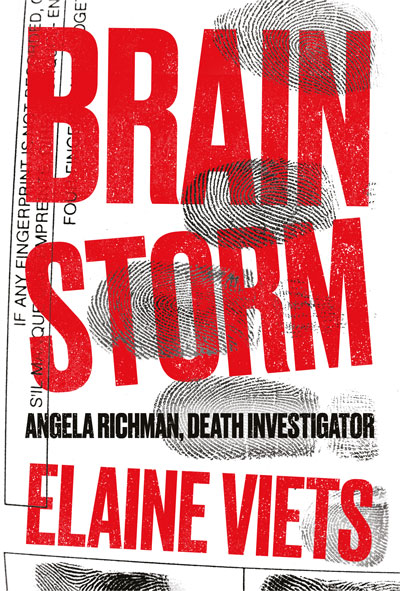
When I wrote Brain Storm, the first novel in my new Angela Richman, Death Investigator series, I went through ten rewrites and a year-long debate: Should this novel of psychological suspense be first person or third person?
Brain Storm is a very personal story. Angela, my death investigator, had the same medical crisis that I did – six strokes, brain surgery and a coma, plus months of rehab. I thought first person would reflect that. But third person is better for conveying information, and this new, darker series has complex forensics that would be impossible in a first-person narrative.
I worked out a compromise: the first two chapters of Brain Storm were in first person, which I thought gave the novel a personal introduction. The rest of Brain Storm was in third. And that’s how I sold it.
When I sent out the manuscript for blurbs, thriller writer Jeff Abbott said, “Do you really want to switch POVs like that?” Jeff almost never – and I mean never – gives blurbs, and I admire his writing. After many emails, phone calls, and meetings with my editors, they decided I should recast the first and second chapters into third person, so the whole novel was in third person.

Here is the original first-person Chapter 1 of Brain Storm:
cemetery

The doctor who nearly killed me was buried today. The Missouri medical establishment turned out to honor him. The eulogies were heartfelt: doctors, nurses and patients praised Dr. Porter Gravois s compassion and skill as a neurologist. Their tears were genuine. His funeral cortege was nearly a mile long on the road named after his powerful St. Louis family. Everyone called him by his nickname, Chip, as if they were all part of his inner circle. Chip made them feel that way.
I didn’t attend his funeral. I was still in the hospital, recovering from the damage he did to me. I’d been in there three months. But I was glad he was dead, and so were the people who knew the real Dr. Gravois. None of us called him Chip.
As I lay on the scratchy hospital sheets, I wondered how Dr. Gravois looked in his coffin. He had a long pale face and a knife blade nose, like a stone figure on a British tomb. Did the mortician manage to duplicate the fatherly smile that fooled so many? That smile didn’t quite reach Dr. Gravois s hard blue eyes, but those were closed forever.
Which suit was he buried in? Chip wore Savile Row suits from Kilgour in London. Chip pronounced it Kilgar, and said only parvenus called the tailor Kilgore. His Kilgour suits were lovely silk and light wool. It was a shame to put one in the ground. But I had no qualms about shoveling Dr. Gravois six feet under.
What about Dr. Gravois s bitter enemy, Dr. Jeb Travis Tritt?
He and his awful off the rack suits were barred from the funeral. No matter how much he paid for his suits, he still looked more like a small town insurance agent than a neurosurgeon.
His unwed mother had named him after her favorite country music star. Dr. Jeb was a country boy, from his badly cut hair to his thick-soled brown shoes.
Was he wearing a jail jumpsuit now? We’d all heard Dr. Jeb threaten Dr. Gravois. He called him a crook and a killer and said the best thing Porter Gravois could do for his patients was die.
The next day, Dr. Gravois was murdered.
*********************************************************************************************
That’s the voice of my protagonist, Angela Marie Richman. She was misdiagnosed by Dr. Gravois as “too young and healthy to have a stroke” and sent home, where she had the medical catastrophe that nearly killed her. Dr. Gravois, the man who misdiagnosed her, is the bitter enemy of the talented, gauche Dr. Tritt, who saved Angela’s life. Bald, crippled, and hallucinating after her surgery, Angela has to use to her death investigator skills to save the man who saved her life.


Here is the rewrite of that same Brain Storm chapter in third person:

The doctor who nearly killed Angela Richman was buried today, and the Missouri medical establishment turned out to honor him. The eulogies were heartfelt: doctors, nurses, and patients praised Dr. Porter Gravois’s compassion and skill as a neurologist. Their tears were genuine. His funeral cortege was nearly a mile long on the road named after his powerful St. Louis family. Everyone called him by his nickname, Chip, as if they were all part of his inner circle. Chip made them feel that way.
Angela didn’t attend his funeral. She was still in the hospital, recovering from the damage he’d done to her. She’d been in there three months. Angela was glad Porter was dead, and so were the people who knew the real Dr. Gravois. They didn’t call him Chip.
As she lay on the scratchy hospital sheets, she wondered how Dr. Gravois looked in his coffin. He had a long, pale face and a knife-blade nose, like a stone figure on a British tomb. Had the mortician managed to duplicate the fatherly smile that fooled so many? That smile didn’t quite reach Gravois’s hard, blue eyes, but those were closed forever.
Which suit was he buried in? Chip wore Savile Row suits from Kilgour in London. Chip pronounced it Kilgar and said only parvenus called the tailor Kilgore. His bespoke suits were lovely silk and light wool. It was a shame to put one in the ground. But Angela had no qualms about shoveling Gravois six feet under.
What about Dr. Gravois’s bitter enemy, Dr. Jeb Travis Tritt?
He and his awful, off-the-rack suits were barred from the funeral. No matter how much he paid for his suits, he still looked more like a small-town insurance agent than a neurosurgeon.
His unwed mother had named him after her favorite country music star. Dr. Tritt was a country boy, from his badly cut hair to his thick-soled brown shoes.
Is he wearing a jail jumpsuit now? Angela wondered. Everyone heard Tritt threaten Gravois. He’d called him a crook and a killer and said the best thing Porter Gravois could do for his patients was die.
The next day Dr. Gravois was murdered.
********************************************************************************************

My editor felt that writing those two chapters in first person, then changing them to third, gave the book a more intimate feel. What do you think? Is reversing the points of view a way to add depth to your writing?
PS: Jeff Abbott gave Brain Storm this blurb: “Elaine Viets’s newest is both a timely medical drama and a compelling mystery. Brain Storm gives us a detailed look at the shattered life of a determined death investigator. Readers will want more of Angela Richman’s adventures.”
TKZ’s PJ Parrish said, “I’m stoked to see Elaine venture into darker territory with Brain Storm, a multilayered mystery that is rich in its sense of place and character and propelled with medical intrigue. Brain Storm has everything I love in crime fiction – complexity, intelligence, pretzel plotting, and a touch of dark humor.”

Win Brain Storm, my new Angela Richman Death Investigator mystery. Thomas & Mercer is giving away 100 free Brain Storm e-books on Goodreads. Here’s the link: https://www.goodreads.com/giveaway/show/191474-brain-storm
New Kid In The Zone

by Laura Benedict
@laurabenedict

A few weeks ago, the incredibly generous Joe Moore invited me to blog here at TKZ on alternating Wednesdays. It was an easy “yes” for me because I’ve visited before, and I admire both TKZ’s reputation for excellence and its smart and talented contributors. I toyed with the idea of jumping right in with a specific writing topic, but then I decided it might be better to introduce myself first. So I’ve asked and answered a few questions that will help you get to know me. (Forgive the slightly snarky tone of the questions. Sometimes I’m a grouchy interviewer.)

Let’s start with an easy question. Where are you from?

I was born in Cincinnati, Ohio, but grew up in Louisville, Kentucky. I graduated from college and worked in St. Louis, then moved to rural West Virginia where my husband’s family had a dairy farm. After a chilly two-year excursion to Holland, Michigan, we went back east to Roanoke, Virginia, for eight years. Now we live in Southern Illinois, which is an hour closer to Tupelo, Mississippi than it is to Chicago. Setting plays a big role in my fiction, and up to this point I’ve stuck pretty closely to those locations.

When did you start writing fiction?

As a child and young adult, I was always a reader, but I didn’t have the confidence to imagine I could be a writer—amateur or professional. It wasn’t until I was working for A Great Big Beer Company in St. Louis, and found myself tinkering with the professional copy I was buying for sales promotion projects, that I even considered writing fiction. (You’ll note the connection in my mind between ad copy and fiction.) By then I was in my mid-twenties. I didn’t publish my first novel until I was in my forties.

What kind of books do you write?

I’ve always been drawn to the darker side of fiction, and perhaps that’s why I can never find happiness writing about those quotidian epiphanies that are so popular in academic/literary circles. It wasn’t until I wrote my third novel that I really found my voice—and it was a supernatural story called Isabella Moon, about a woman who tries to solve the murder of a little girl while on the run from her psychotic husband. That novel was the first one I sold, as part of a two-book deal with Ballantine. My latest novels are a gothic trilogy set in a haunted house in a fictional Virginia town: Bliss House, Charlotte’s Story, and The Abandoned Heart (Pegasus Crime, October 2016). Despite their pretty covers, they are not quiet books for the faint of heart. As I mentioned, I write short stories as well. They show up in various places and run the gamut from straight mysteries to the horrific and surreal. In fact, my absurdly talented writer husband, Pinckney Benedict, and I edited an anthology series of southern surreal stories called Surreal South. You can take a peek at my website or author page to read more about all of my work.

You look like such a nice lady. Why do you write creepy stories?

I look forward to talking about how I—and other writers—choose stories to write. But as to the why? Sorry. That’s between my therapist and me. As you get to know me better, you might hazard a guess or two—and I just may tell you if you’re right!

Why are the most ragged, dog-eared books on your bookshelf Cormac McCarthy’s Blood Meridian and Daphne du Maurier’s Rebecca? Talk about a peculiar pair.

I’ve never been one for chasing down celebrities, but I confess I’d love to have had dinner with Daphne and Cormac just to see what they’d make of each other. But—with apologies to every writer here—I’ve found that most writers aren’t so great at talking about or even understanding their own stories. It’s the books that are important. Besides being darned good reads, Blood Meridian and Rebecca both contain elements that appeal to me as both writer and reader: complex, disturbing crimes, unforgettable characters, and settings that are, themselves, active characters.

Pantser or Plotter?

I suspected this question was coming. To borrow a description from my friend, Jordan Dane, I’d say I’m a recovering pantser. Up until very recently, my mantra excuse was, “If I figure out the plot ahead of time, I’ll have told myself the story and I’ll be bored and won’t want to write it.” What I’ve learned—the hard way—is that there’s a lot of pleasure to be had in pondering plot and character before getting into the writing. And there’s much, much more to it than saying this needs to happen, then this, etc. The first inkling of each story nearly always comes to me as a vivid image—usually of a protagonist or a setting. But that’s not a heck of a lot to hang a novel on, and thus the plot often reveals itself with an agonizing slowness that undermines my production goals. I’ll get into this later, but for a long time I bought into the notion that the story was a sacred object, and if I manipulated it, it would become over determined and wouldn’t work.

Do you have an MFA? Have you been educated by highly trained writing professionals?

No, and let me think about that for a moment.

Approximately a hundred and fifty years ago, I got a B.S. in Business Administration with a major in finance. I didn’t take a single writing class until I was well into a promotions career with the subsidiary of A Great Big Beer Company in St. Louis. After I took a couple undergrad creative writing classes, I talked my way into a grad fiction workshop and was promptly and roundly mocked for my plot-heavy stories. The professor said they were too old-fashioned to be published. Ouch. But being a contrary sort, I decided to forge ahead. I understood that I wasn’t trained to write literary fiction (which I consider a genre, not an end-game—more on that later, too), and after the workshop experience, I wasn’t much interested to learn. So I read more than ever (classics, literary and commercial fiction and non-fiction) and wrote even more. I wrote short stories and entered many, many contests. In 2000, I discovered a Joyce Carol Oates story in Ellery Queen’s Mystery Magazine, and told myself that if she—one of my literary idols—wrote for EQMM, then I should give it a shot. They published my story, The Hollow Woman, in their Department of First Stories in 2001. (My third EQMM story, The Peter Rabbit Killers, is in the recent July issue. And you can listen to me read The Erstwhile Groom on their Podomatic website.)

When I decided to write novels, I swallowed my pride and took a couple of independent studies and workshops to give myself some deadlines. I know I learned at least as much from the other participants as I did from the teachers. Of course, the best teachers are always books themselves.

Do you know anything about independent publishing, or are you strictly about traditional publishing?

When the great publishing purge of 2009/2010 occurred (does anyone else remember that, or was it just my personal cataclysm?), I was dropped by my publisher. I panicked and pouted for two years, but I also kept writing and, after my next novel didn’t find a traditional home, I delved into the brave new world of independent publishing. My husband and I started our own small press and put out my third novel in ebook and paper. Since then I’ve published my backlist, a Bliss House short story, and a couple of anthologies. There’s more on the way.

I’m a big believer in using the right delivery system for the right story. And never giving up. I’m happy to share what I know, and am always anxious to learn from others in the business.

Do you have a day job, or do you just sit in your house and write all day?

For the past twenty-four years, parenting and writing have been my competing jobs. I homeschooled my daughter at various points up until high school, and am now partially homeschooling my sixteen year-old son. My mornings are for writing business, promotion, research, and/or social media. Homeschool is in the afternoon, then I write before dinner and into the wee hours. I have raging ADHD but can’t write on medication, so staying at my desk to write is a major act of will for me.

If you follow astrology profiles, you already know that my early July birthday makes me a Cancer, and Cancers are often introverted homebodies. Though I do like to get out and meet readers and socialize at conferences and book festivals. If you’re wondering what I’m currently up to, let’s get together on Twitter, Facebook, Instagram, and at my website.

Do you teach writing, or do you just write?

I’ve taught at many writing workshops over the years, including the residential Tinker Mountain Writers’ Workshop at Hollins University, and the Appalachian Writers’ Workshop. I’ve also done many smaller writing workshops for both children and adults.

What do you bring to The Kill Zone party?

I bring my love for the written word along with me, and my enthusiasm for sharing what I’ve learned with emerging writers. I bring my curiosity and hunger to learn and adapt. Also, I always have chocolate to share, and occasionally even a salad in my purse.

I’m thrilled and delighted to be here, but that’s enough about me. Tell me a bit about yourself and what brings you here.

Silly Season and Political Thrillers


imageWe’re heading into the hot zone of national election season this month–and the consequences of  silly season 2016 are going to start having serious consequences for the US, and the world. All this puts me in the mood to stock up on some nail-biting, high stakes political thrillers to put at the top of my summer reading list. Suggestions? What are some of the best political thrillers you’ve ever read?


http://youtu.be/lOi1-2c0bcg

image

image

Four Major Stumbles by Newer Writers

by Larry Brooks

These four nasty little traps would still be weaknesses if they appeared in the novels of more experienced professional writers. But for the most part, those writers don’t commit these mistakes. Which defines the window of opportunity for newer writers – to understand what they’re doing and how they do it.

And how that differs from where your story is, at any given moment. Especially when you believe you are done.

It is important to remember that when you read a novel from a proven professional, you’re reading a polished, pounded upon, tested and fortified final draft. The story may have been riddled with problems in the early stages, draft after draft, so don’t assume these pitfalls are unique to the newer writer.

Established authors have agents and editors for this purpose, newer writers don’t. And they bring their 10,000 hours of apprenticeship to the task, which probably exceeds your resume by orders of magnitude.

A few workshops won’t get you there. Those 10,000 hours, along with the criteria-driven, modeled craft held up as the target, just might.

If I wanted to read fully realized, polished stories all day long, I’d be a book reviewer instead.

I do read a lot of work from folks who are terrific writers… if the composition of sentences and paragraphs is the benchmark for that description.

But the thing is, it isn’t.

Where writing novels is concerned, a terrific writer is judged by the story more than the prose. And because they are two different skill sets, one doesn’t necessarily beget the other.

A story is so much more than a sequence of paragraphs composed of sentences. In the same way that a house is composed of so much more than a bunch of wood planks nailed together. Really strong, beautiful two-by-fours do not a functional, aesthetically-pleasing house make. There is more to is than the wood itself, and much of it isn’t visible to the eye, because it resides in the infrastructure of the building.

Such is the story sensibility the new writer often lacks.

Allow me to summarize what too often comes up short:

One: The writer doesn’t understand what a premise is.They confuse it with other story essences, like concept and theme and backstory.

The project I worked on this morning answered the question, What is your premise? with this:

Here is my copy for the back cover of the paperback for my story.

A red flag, this. The author has the back cover copy done, but the novel itself is still in the incubator.

Rarely is what we read on the back cover a premise. It’s marketing copy.

In the name of offering a solution today, here is the definition of premise, which becomes a sort of checklist for the entire story itself:

A protagonist/hero whose current life (which we get a glimpse of, and perhaps a bit of background for) is interrupted, disrupted or leads into… a specific problem, need or opportunity… launching a hero’s quest with a mission and a specific desired outcome, beginning with a response to the need or problem… for reasons (stakes) that compel the character to respond… in the presence of opposition from an antagonistic force or person(s) with opposing goals and their own motivations… calling for higher and stronger responses and course of action, often with those stakes evolving into something darker or more urgent… leading toward brilliant and courageous resolution resulting from the Hero’s decisions and actions… leading toward a specific outcome, returning the hero to a life that is contextually different than where the story began.

Two: While the story is deeply rooted in genre, the writer is more focused – too focused – on characterization and theme and backstory than the forward-facing dramatic arc and tropes of that genre.

In other words, the story is either episodic or completely void of a hero’s quest/mission, undertaken because of what is at stake and a sense of urgency. It links to genre only by virtue of setting and context, rather than actionable drama and stakes.

In yet more other words… there is no compelling plot. A dramatic question in play. Which is what the premise, when done properly, describes.

“Finding his true self,” or “forgiving the past” are both really bad, really lame hero’s quests. Those are character arc goals and outcomes, but they are not the raw grist of a story. Because in genre, a story is about more than the arc of the character. Rather, it is about what the hero does to reach those goals, decisions and actions and confrontations that are dramatic and full of risk and conflict.

This is the stuff of premise. The meat and potatoes of narrative.

From a dramatic standpoint (rather than thematic), was The Hunger Games about Katniss finding true love? No. It was about getting out of that arena without someone planting an ax  blade in her skull.

In genre fiction, story lives and dies by its drama, driven by conflict. Leave the thematic analysis and character depth to the reviewers, all of that is an outcome of how the character responds to the drama into which you’ve dropped them. It’s your job to make it work, that’s true, but without a compelling dramatic arc in play, all of itwill be lost on your reader.

If you are writing in a genre – thriller, mystery, romance, fantasy, including mash-ups between them – the need for plot is non-negotiable. And a plot is subject to certain expectations and criteria – an author doesn’t get to redefine what the word “plot” means – which is what the new writer too often misses.

A newer writer’s story might play as “the adventures of…” which doesn’t work in genre. Michael Connelly’s novels are not the adventures of Harry Bosch. Rather, there is a case to solve, a single pursuit of a perp and of justice, complicated by other pressuring layers of subplot and subtext, including an antagonist/villain.

All of it defining character, by giving your hero something to do.

The life story of a fictional character may work in literary fiction, but not here.

Three: There isn’t sufficient emotional resonance that gives the reader something to root for.

I read a time travel story recently (when I say story, I mean a narrative plan submitted to me for analysis) in which two girls go back in time (never mind how) to… wait for it… ogle men wearing kilts. That’s it. That’s all there is to it.

This was a romance, which the author argued licensed any lack of thematic weight. I disagreed. The difference is like an episode of Ray Donovan versus an episode of The Housewives of New Jersey.

The dramatic stakes were fine – one of the girls goes missing back in time – and it seemed like everybody was falling in lustful love with everyone else as they looked for her. The hero sister trying to find her lost sibling was really more interested in the butt of the plantation owner’s son.

The question remained unclear, and unanswered: Why? Who cares? Especially when, after one sister finds the other, they both decide to remain stuck in 16th century Scotland. Because those guys in kilts, they’re freaking hot.

Not something a more experienced writer would have chosen.

Four: The story lacks a compelling conceptual core.

The key word here is compelling.

The story idea is flat. The premise seems to be searching for something compelling, hoping to land there – as if the writer, when alerted to the fact that the story is flat, would say, “But when I write it you’ll see, it’ll all come alive when you read it on the page” – rather than stemming from something compelling. Like a killer story arena, or a character we’ve never seen before.

I just finished coaching a story that basically read like this: a normal guy lives in an ancient town, next to another ancient town full of bad people. The bad people want to attack his town because they are located closer to the water, which provides access to trade and sustenance. That’s the setup. So our guy, the hero, organizes a militia of other every day guys, and when the bad people attack, he leads them to victory, battle after battle after… many more battles. Meanwhile, there is a magic stone that only he can understand, which turns him into a great warrior. After the victory, they name him as their king, and everyone lives happily ever after.

I told him it doesn’t really work, at least at the pitch level. There isn’t an agent in the business that would say to this, “Dude, I’ve been waiting all year for a story like this, you’ve got to send it to me!” More likely they’d say, “I’ve seen twelve of these this week alone. Nothing special here, this is generic. Been there, read that, didn’t like then, either.”

It doesn’t glow in the dark. There’s nothing conceptual. Nothing that makes a reader say, “Holy cow, this is the type of story I’ve been waiting for, I can’t wait to read this!”

Which is one of the benchmarks of a great concept, and a premise built from it.

The story idea isn’t strong enough. At least not yet. The writer has committed to it too soon, perhaps without fully understanding what does make a story idea glow in the dark.

The whole point — the difference between the newer writer and the successful more experienced one — is story sense. The ability to recognize what works and what doesn’t, based on criteria that never change.

Don’t depend on your writing to make it glow in the dark. Because chances are, while you’re really good and your sentences make your Aunt Mabel rave about your emails, that talent is a dime-a-dozen in the universe of writers who are trying to do what you’re trying to do.

Make no mistake, such stories can work. But when they do, there is more going on than the thin shell of a story that this example describes.

Game of Thrones is compelling because of the characters and the setting. Which on paper, is rarely enough. Which renders it an exception, not the thing you should set out to emulate. It’s like telling young athletes to be like Mike. Do what Mike does.

Michael Jordan, that is.

In the story described, there is nothing conceptual about that guy in the town with the magic stone, or anyone else in the cast (swap out compelling for conceptual, which will help clarify). No Mother of Dragons. No White Walkers. No John Snow. No ruthless, seductive Queen. Nothing with the vividly drawn landscape of Westeros. No sex. No violence. No OMG! moments. Nothing like the other 45 characters that leap off the G.O.T. pages and scream, I am conceptual and you will learn to love me, even if you hate me!

Writing a saga is tough work, advanced work. Harry Potter was not a saga, it was a series, which is different. Newer writers not only need to understand the difference, but also the depth of craft and structure required to make such a story work.

There is a line you cross, somewhere among those 10,000 hours, when you know you’re no longer a newer writer.

That you’re in the game for real, and that you have a real shot, because you understand the game itself in a way that you didn’t before.

It’s all there, in that definition of premise. When you own it, completely and thoroughly, including what resides between those lines, it will propel you to the finish line. Because owning it doesn’t mean simply executing on it, but doing so with power and flair, with dramatic weight, conceptual appeal and thematic substance.

All beginning with a truly killer story idea. Which will look different to you – the bar will be higher – once you’ve crossed that line.

How to Write an Eating Scene

by James Scott Bell
@jamesscottbell

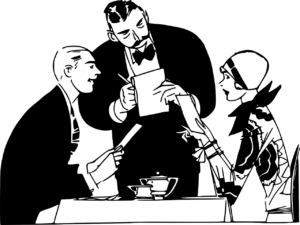
In my workshops I warn students about scenes where two friends sit down for dinner orpeople-146963_1280 coffee and talk about life, the universe and the plot. The temptation is to have it all easy-peasy because, after all, they’re friends. The danger for the writer, though, is that without conflict or tension the scene takes on the dreadful patina of dullness. Which means it is the readers who lose their appetite … for reading on!

Sometimes I will hear the rejoinder that this is what we do in life. We have coffee with friends, we have dinner with pals. Why can’t we put that in our books?

Well, I say, you have fuzzy slippers in your life. Do you put them in your books? (Okay, well, if you do, put snakes inside them.)

Then I say that fiction is not a reproduction of real life. It’s a stylized rendition of life for a fictional purpose. And the most important part of that purpose is keeping readers glued to the page! A scene featuring “happy people in Happy Land” doesn’t stick.

Now, I’m not saying you shouldn’t do a quiet scene with friends or allies in a Starbucks or a restaurant. The trick is to have something going on that gives off a vibration of tension. It’s not that hard to do, either. But the effect on readability is palpable.

Let’s have a look at an eating scene from Michael Connelly’s Echo Park. Harry Bosch is investigating an old murder for the Open-Unsolved unit of the LAPD. He’s asked FBI agent and profiler Rachel Walling for help. Bosch and Rachel had once been intimate, and have started up again, though they are uncertain about the wisdom of this.

In this scene, Connelly wants to give us a lot of information and theorizing about the case. That could easily make this a “talking head” scene. But Connelly knows better than that. Bosch has arranged to meet Rachel at a fancy downtown restaurant. The scene begins:

Bosch had lost track of time while in the library. He was late. Rachel was already seated and waiting for him. She was holding a large one-sheet menu that obscured the look of annoyance on her face as Bosch was led to the table by a waiter.

“Sorry,” Bosch said as he sat down.

“It’s okay,” she replied. “But I already ordered for myself. I didn’t know if you were going to show or not.”

She handed the menu across to him. He immediately handed it to the waiter.

“I’ll have what she’s having,” he said. “And just the water is fine.”

He drank from the glass already poured for him while the waiter hurried away. Rachel smiled at him, but not in a nice way.

So here’s the first tip: find some form of TENSION between the allies. In this case, Bosch is late for his meeting. Rachel is annoyed. We want to keep reading to see how this will play out.

Rachel then warns Bosch that he’s not going to like what he ordered. It was sashimi. She knows Bosch wants his fish cooked. Oops. But Bosch decides he better let it go and give Rachel the info he has.

This leads to the second tip: make the FOOD a source of discomfort. Bosch has begun his summary of the events:

It took him fifteen minutes and during that time their lunch was served. Of course it came fast. It didn’t have to be cooked! He felt lucky to be the one doing all the talking. It gave him a ready excuse not to eat the raw fish put down in front of him.

[As the scene moves on, Rachel finishes her sashimi. Bosch then pushes his own plate, which he hasn’t touched, over to her.]

“No, I’m not saying that Olivas was the killer. I am saying he was gotten to by the killer. He and O’Shea. The real killer came to them and made some sort of a deal.”

“Harry, this just sounds so …”

She didn’t finish. She pushed the sashimi on her plate around with her chopsticks but ate very little of it. The waiter used the moment to approach the table.

“You didn’t like you sashimi?” he said to her in a trembling voice.

“No, I –”

She stopped when she realized she had almost a full portion on the plate in front of her.

“I guess I wasn’t very hungry.”

“She doesn’t know what she’s missing,” Bosch said, smiling. “I thought it was great.”

Third tip: Use the servers to provide a well-timed INTERRUPTION. Here, Rachel was about to tell Harry how his theory sounded. But before she could continue, the waiter comes back to the table. This is a clever ploy, delaying the payoff, which is another way to say that Mr. Connelly knows how to make us read on.

Here is a slice from my novel Romeo’s Way. Mike Romeo is under cover in San Francisco, trying to get hired as security for a political campaign. Kat, the campaign aide he has made contact with, is interviewing him. Mike proved himself earlier that day, and now Kat takes him to dinner at Fisherman’s Wharf on the campaign’s dime.

“I can only get back so far into your past,” she said. “I get back to when you were fighting, but before that there’s virtually nothing. There was some fluff of a bio in a program once, but to be quite honest with you, it didn’t sound believable.”

“That’s because it was fiction,” I said. “They needed something, so I made something up.”

“Okay, then what’s the real story?”

“It’s not something I choose to publicize.”

“And that,” she said, “is what interests me.”

“I also believe in privacy. What I choose to keep private is nobody’s business.”

“Which means you have something to hide.”

“Everybody has something to hide,” I said. “Tell me about your sex life.”

Her cheeks flushed, obvious even in the candlelight.

“See?” I said.

“I could get really mad at this point.”

“But you won’t,” I said. “Because it’s not a good move. And my impression of you is that you make nothing but good moves.”

Before she could answer, the waiter appeared with the bottle of wine.

In this clip, I have used a fourth tip: CONFLICTING AGENDAS. Kat wants Mike’s full background. He doesn’t want to give it. They both want to test each others’ boundaries. And then the waiter interrupts.

So there you have it. Four simple ways you can turn a sitting-down-for-coffee-or-food scene into readable fiction: tension, food, interruptions, agendas.

Mix and match according to taste. Your readers will enjoy the meal.

Ideas to Improve Your Writer’s Group

Jordan Dane
@JordanDane

Shutterstock photo purchased by TKZ

Shutterstock photo purchased by TKZ

On the topic of what our members would like to see covered at TKZ, Frances asked about Writers’ Groups.

“I’d like to see a blog on Writer’s Groups. I belong to one that is disappointing in structure and leadership. What are the qualifications for starting a writer group and what should be included? I prefer a group that meets in person versus online. Thanks!” Frances

As for qualifications to start a group, I’ve seen ANYONE create a group if there is interest in your local area. My latest adventure to find a local writer’s group where I live was through special interest groups listed on MEETUPS.com (query your local area for “Meetups” and “writing groups”). But these groups are rarely organized well enough to hold my interest for long. The leadership is usually inflexible on format or control the critique process too much. Often it’s the blind leading the blind and comments don’t further anyone’s potential career. These groups may catch typos but higher level reviews of your work are rare.

For more serious endeavors, a local group can collect dues and hold writing contests (with members as judges) to generate revenue, but once you ask for money, members will expect a plan of action and organization with regular meetings and a plan. Many national professional groups have specific rules to adhere to, if you want to open a local chapter. Toward the end of this post, look for a link of writers’ groups that are broken down at various levels you might find useful. Try joining a local chapter of a bigger organization if it’s available in your area. That’s your best bet.

I believe it takes a combination of groups to expand your horizons. I’ve belonged to quite a few writers’ groups, from national professional organizations, to online subgroups, to local writer meetings, to attending workshops. I’ve spoken at various meetings and workshops on craft and attended local meetings to help critique other authors. And I was also the Program Director for 5 years at my local Oklahoma Romance Writers of America (OKRWA) chapter and had a hand in shaping our resources for published and aspiring authors. This group and the strength and generosity of its published authors got me published. I was an aspiring author, untested, but I took on the duty of Program Director because I could create a network of contacts I wanted to see and I could work with my published authors to provide things they wanted to see. A great volunteer opportunity.

Here are my thoughts on what makes an effective group, depending on how organized you want to be or how much money you have to put together a group on your own.

SIZE MATTERS – I’ve worked with local groups who have an open call to anyone wanting to attend from one week to the next. The usual format is determined by those in attendance reading from their current WIP, sometimes up to 10 pages, and everyone around the room comments. In my opinion, this type of format doesn’t work because the attendees are not consistent and the format never changes. No real discussion happens, even when the group seems to want a diversion, because there are too many people vying for attention for their work.

When I say size matters, I think it’s more important to recruit serious/dedicated writers that have the same work ethic and are determined to improve their craft. (I’m not implying all pubbed authors, but writers dedicated to improving themselves.) 3-5 members might be the ideal. With a limited, devoted group who consistently appear each meeting, there can be real focus on each other’s samples and the meeting framework can be adapted to the goals of the group. If a deeper discussion arises organically, the group can be more flexible in how any meeting will evolve. Don’t be afraid to start out with all novices. A novice one day, with a good work ethic and supportive of other members, could be a future published author. My first groups weren’t always successful but I learned something worthwhile from each one. Sometimes you have to dive in and take charge to define what you want in a group.

YOU CONTROL THE FRAMEWORK – You might like reading your current WIP aloud or have someone else in the group read yours. But instead of taking up valuable time in the meeting doing this, try some of these time savers:

A.) Maintain an online group to exchange notices and post resources. Post your WIPs that will be critiqued for the next meeting. You can post them to a file section (like a private Yahoo or Google Group or a private Facebook Group). Your 4 members will have more time to read in advance and provide commentary in “track changes mode” for the author to take home something legible. So when it comes time for giving feedback, each member can focus on the highlights of their verbal critique and ask open ended questions of the author to promote a discussion at a higher level.

B.) Limit how many pages are critiqued or read aloud.

C.) Allow time for craft discussion at each meeting. Any member could lead the topic from craft books or a general chat on what works or doesn’t work for each person in the group.

BREAK UP MONOTONY WITH RESEARCH – Bring up research topics that could help the group or inspire future stories. As Program Director for the OKRWA, I had to fill each month with a 1-hour presentation that would help aspiring authors as well as published writers. Some months were research topics where we brought in speakers from the fire or police dept, an FBI profiler, a ghost hunting team (usually in October for paranormal story inspirations), or we went on field trips to generate story ideas with firsthand experiences. For example, we each paid money to go on a ghost hunt, guided by a real team of ghost hunters. (You really get to know your group by doing scaring the hell out of them.)

WHAT ABOUT A RETREAT? Usually in July, we would take a retreat together. Yes, this costs money and organization. We would have sessions on world building or various craft topics. or we might break down a larger group into smaller ones to have brainstorming sessions on plot ideas. A published author group might take a fun trip away from home to a nice location. They work the first few days on brainstorming TWO plots for each author and record the sessions, but after the hard work is done, they go have fun. Sign me up. The group gets a jump on plots for the year and get time off for fun to replenish the creative well.

DO SOME GROUP MEMBERS NEED PROMO? Promotion for published authors is important to support them. For pubbed authors who appreciated help on local events–from Valentine’s Day Events at local libraries to quarterly book signings–my Oklahoma writers’ group would support our members by organizing or attending these events. One of our bigger events was a Librarian Tea. We’d pick a venue and pay for beverages and snacks/desserts (or you could do something more casual with potluck). This can be done economically, but my local group had membership dues and revenues from writing contests to support our annual programs. At the Librarian Tea, our pubbed authors got to meet local librarians and book store owners, where their upcoming releases or backlist would be showcased. Our local group would also send out postcards and flyers of new releases from our members to those same librarians and book store owners we were developing relationships with. Even aspiring authors could benefit from this when they eventually sold and had book signings of their own.

FACETIME or ONLINE? I like getting together with my local writer groups. Writing can be solitary enough. Commiserating with my fellow crazies can be fun. But if there are no local groups where you are, an online group can give you resources in a different way. Once you develop a trust with your online members and determine if their input will help you, exchanging writing samples for critique can be done online. Often these groups have a files section with craft or promo topics that can be helpful or they may host an annual conference or hold workshops.

Here is a LINK to many writer groups (from national, to professional, to genre, to local groups) that you might find helpful.

For Discussion:

1.) What works best in writing groups from your experience? From size to format?

2.) Do writing groups help or hinder the writing process?

RedemptionForAvery_highres

If you are interested in receiving a FREE pdf file of my upcoming Amazon Kindle Worlds release (July 21)–REDEMPTION FOR AVERY–in exchange for an honest review on Amazon, please click on this LINK to sign up on my Google Docs form. Next to your review name, please add TKZ.

Co-Writing Fiction, Part II:
Send Lawyers, Guns and Money

Frasier: I’ve had an epiphany.
Niles: Oh, wonderful. We could use a second sentence.

By PJ Parrish

The following is a true story, I swear. A couple years back, my sister and co-author Kelly and I were sitting at the old card table behind a stack of our books just inside the entrance of Barnes and Noble. It was raining and business was slow. (One advantage to having a co-author: You have someone to talk to during book signings when the screaming hordes of fans aren’t exactly beating down the door.)

A lady came up to our table, picked up our book, read the blurb and asked, “Are there two of you?” (We get that question a lot, even when both of us are sitting there). We explained that yes, we were co-authors and that was our pen name there on the cover.

The lady said, “My sister and I are thinking of writing a book together. Do you have any advice?”

I said, “Do you get along well with your sister?”

“No, we hate each other,” she said.

The first rule about co-authoring: It helps a lot if you like each other.

Yesterday, Joe Moore gave us an excellent overview of what it takes to write with a co-author. Today, I’m going into the weeds with some of the more prosaic stuff you need to consider before you partner-up. And yeah, I apologize ahead of time, but it does involve lawyers.

Personalities matter
First consideration when thinking about collaboration: You have to like each other.
If you don’t, it will never work. Think about what happens the first time one of you says, “You know, I don’t think that scene you wrote really works. Maybe we should scrap it.” Do you have roughly the same sense of humor? Do you like the same kind of books? Could you share a hotel room if you had to?

As Joe said, personalities matter. You don’t have to be bosom buddies, but you do have to respect each other and get along. Because writing even just one book is a long process and if you can’t stand to be in each other’s company for an hour, how are you going to make it eight months and 100,000 words?

Geography doesn’t
Over the course of thirteen books and fifteen years, Kelly and I have never lived closer than 1,000 miles. I’ve been rooted in Fort Lauderdale while she has wandered the earth like Caine in Kung Fu. In the early days, we relied on long distance phone calls (expensive), then emails, and now – hallelujah! — Skype. This has made collaboration easy because with Skype, one of you can have a chapter open on the screen and work on it while the other sees exactly what you are doing. But we also try to get together once a year in the same place because nothing subs for actual face-time. Plus we like to drink wine together.

Commitment matters
The second biggest consideration is this: Do you have the same level of commitment? Writing novel is a long tedious process and if one of the partners lacks the energy, time or drive, one person ends up shouldering the load and hard feelings develop fast. I have a good friend who partnered up with a guy to write a thriller. He had the original concept and a rich research background; she had a track record in mysteries and the work ethic. Three guesses who ended up doing most the work. For half the money.

Tone matters a lot
What kind of book are you writing? I know a lot of solo writers who can’t answer this, but you must agree on this with a co-author. What is your sub-genre, if any? What style are you aiming for? And what will the tone be? You must agree on this before you write one word or the book will never be seamless. I just started reading Joe and Lynn’s book The Blade, and I have to admit admit I went in looking for the seams. But I am finding none. This is very important because if the book feels like it has two voices at work, the reader won’t buy it. It’s very jarring.

Okay, now let’s deal with the nuts and bolts. You have to get this boring stuff down right from the start with a potential partner. Please don’t — in the beautiful bloom of first love, when you are dreaming about movie deals and royalties — neglect the details. Don’t try to wing it or figure it out later. This kind of thinking makes for doomed collaborations. And many bad marriages.

INCOME
If you are self-publishing: Be aware that with most outlets, only one name can be on the account. If you want to post your book on Amazon, for example, you can’t list both your names on the account. Which means that one of you must manage the account, pay out income, and at the end of the year issue the other person a 1099 tax form. If your name is on the account, your writing partner is, in essence, a contractor. You can both access the Amazon dashboard account, which solves the problem of cheating. But someone has to be the main person for the income stream. Also, if you consign to bookstores, they will likely want to deal with one name for accounting.

If you go traditional: Your publisher will want both your names on any contract. They will likely split all income and issue you each royalty statements and tax documents. Ditto for any good agent, who will also deduct expenses individually.

EXPENSES: If you are the kind of person who shows up on April 12 at H&R Block with a liquor box filled with receipts, don’t try co-authoring. You must keep impeccable records. Because some expenses will be shared; some will be individual. Shared might include: editing, formatting, cover design fees, Createspace costs, website (yes, you need one), postage, and any expenses relating to the book in general. Individual might include: travel you do separately, workshop and conferences, publications, organization fees, office expenses. Someone in the partnership has to be the caretaker of the shared expenses, keep good records, and issue the other an accounting for tax purposes. Believe me, this can get hinky. It doesn’t hurt to involve a good CPA in this.

WILL:  You do have one, right? Shame on you. Well, you need one if you have a writing partner. It needs to cover what happens if one of you dies: Who takes over the business and how are past and future income distributed? Do you want your ex-spouse or rotten kids to retain your part of royalties or a possible movie deal? Who owns the pen name, if you use one? Get a lawyer.

PARTNERSHIP AGREEMENT: If you have an agent or traditional publisher, they will probably demand this. Even if you self publish, it’s a good idea to have one anyway. Our former agent demanded it, and my lawyer asked me for it when I went to get my will done. This spells out things like: How income and expenses are divided (50%/50% or some other variation?) Who owns the copyright? How is the pen name to be used? (ours stipulates only for “works created together and for no projects either of us might undertake individually.” This prevents your co-author, if you split, from using the team name). A “failure to perform” clause, which details what happens if one of you dies or is disabled, that you have the right to terminate the partnership. It includes a clause called “Warranties” which is a bunch of legal-ese that protects you both. And you need to get this notarized.  I know…pain in the butt. Too bad.

Whew…still want to team up? Let’s move on.

ORGANIZATION OF BOOK STUFF
Main File: Do you ever lose material or delete chapters by accident? Do you forget and work on the wrong version of something? Welcome to my world. Now, consider how far south this can go if there are two of you. So, figure out before you start who is better organized and let that person be – {{cue Godlike voice}} — THE KEEPER OF THE FILE. Someone has to be in charge of the latest working version. If you don’t do this, you might each be working on different versions of the same chapter. The Keeper has to also have an excellent back-up program like iBox. They must be vigilant about making sure the other person has the right material. This is not what you want to hear when you turn on Skype in the morning: “I finished chapter 9 last night but I think I was working on an old version from two months ago.” This has happened to us. We call our working version ONE BIG FILE. At times, when things are going badly, we have inserted a colorful profane adjective between “big” and “file.”

Chronology: Someone should keep a running chronology of the book as you progress. I don’t know how anyone writes a complex plot without keeping a running chronology of what happens in each chapter, but that’s just me. With a co-author, keeping a chronology really helps to keep you on the same page in your time-line and saves time when you go into rewrite mode. You don’t want to have this conversation:

“We need to go back and beef up the clues in that Paris morgue scene so Jacques Reacher can figure out he is chasing a one-armed man.”
“What chapter was that in?”
“You wrote it. Don’t you remember?”
“That was five months ago.”
“Well, let me do a search for it. What was the ME’s name?”
“We didn’t give him one.”
“Well, search for all the French stuff!”
“Can’t we just let this slide? No one will notice.”
“Yes, they will. I think we said the guy was missing his RIGHT arm but now the slash marks from the knife would tell Reacher that he’s left-handed.”
LONG PAUSE. “Okay…I’ll find it. Go do a run on your treadmill. You’re getting crabby.”

This is why you keep a running chronology. To save time and tsouris. Here is a part of our chronology for our current WIP:

CHAPTER TWO – day 1 Saturday April 6, 1991
Louis arrives at church and talks briefly with new boss Steele. Est. setting.

CHAPTER THREE – day 2: April 7
Louis finds his apartment and unpacks his mementos. Thinks about Joe. Brief reference to what happened in DOW with Steele.

CHAPTER FOUR – day 3 Monday morning April 8
Back at remodeled church. Team members show up. Steele gives brief intros and they take their cases.

CHAPTER FIVE – day 3 Monday late night
Emily comes and they go to dinner at bar and talk. Louis calls Joe.

CHAPTER SIX – day 4 Tuesday April 9
The meeting in the choir loft. As Louis is packing up file and getting ready to leave, he can’t resist asking Steele why? Backstory on what exactly happened in Loon Lake 5 year ago (in L’s thoughts) and what changed Steele’s mind about Louis.

CHAPTER SEVEN – day 4 Tuesday
Louis drives to Keweenaw. Meets Sheriff Nurmi and Monica. First reference to Sisu clue on Monica’s sweatshirt. Ends with L seeing the box in evidence.

In each chapter, we record the salient plot details, the first appearance of any character. We also record the calendar date as it happens in the book and what DAY we are in time-wise, so we can tell how much time passes between events. This latter DAY thing is important because you can see, at a glance, that you’ve let five days go by in your plot and nothing has happened. I update this with each completed chapter and send it to Kelly.

IMG_1444

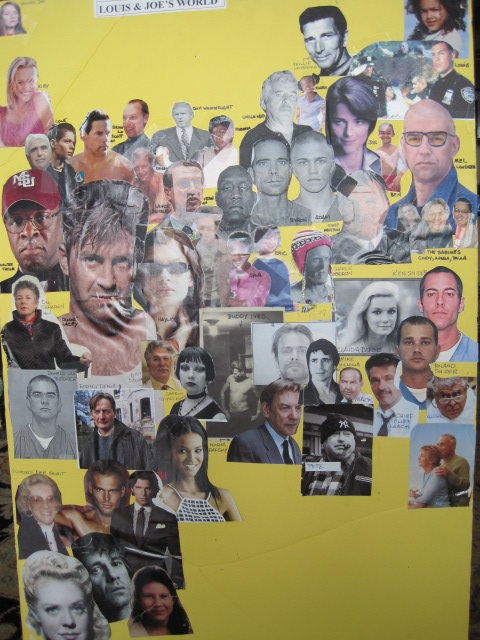
Character board. Now this is strictly optional, but Kelly and I have found it useful. You and your partner need to be on the same page when describing characters. We’ve found a trick: We agree on a famous person — like Mike Ditka was our sheriff and the actor Michael Rennie is Louis’s foster father —  and sort of use him or her as a template. Over the years, we’ve even pasted them in a montage. This is fun and goes over big at workshops and signings.

Yikes…you’re still here? Boy, you must want this partnership thing bad. Okay, here’s the rest of the stuff you have to consider before you get hitched.

MISCELLANEOUS
What’s your name? Are you going to use a pen name like Kelly and I do? Or do you use two names, like Joe Moore and Lynn Sholes? And whose name goes first?

Are you at about the same level in your craft? They say you should always play tennis with someone better than you. I don’t advise that for writing. Aim for someone on your own level. As Joe pointed out, you will each bring different strengths and weaknesses to the team, but your basic craftsmanship level should be the same. Now, if you are entering a partnership where one is charged with all writing and the other say research and editing, make sure you are clear going in that those are indeed the parameters.

Go to a writers conference together. You can learn a lot about another writer in a writer’s conference bar. Pick each others brains. As Joe said, talk, talk, talk…and talk some more. Consider it speed dating before you make the plunge.

Commit to a routine. Joe said this but I need to second it because it’s vital. Set a daily “meeting” where you get on Skype or phone and touch base. Maybe it’s for hours as you thrash out plot. Maybe it’s for 10 minutes. But you must maintain contact. And emails aren’t enough. Did I mention that you need to talk?

Support each other. Again, this is like a marriage in every way. You go into a writing collaboration because you want to believe that you can achieve something together that you can’t achieve alone. So tell each other the truth, but do so constructively and with kindness. Be honest. Don’t be afraid to send your less than best. You can send something that needs work; that’s why there are two of you. Yes, you want to do a good job but it is not important to impress your partner. And last but not least…

Bury your ego. You each bring different skills and talents to this and if one is far stronger at plot, let that person take the lead. Maybe you are better at character development. As the partnership goes on, you might find, as we did, that we learn from each other.

People ask us all the time if we argue or disagree about the book. Of course. We’re sisters. We’re writers. We have massive egos and decades of history together. But we understand that, in the end, there are really three of us in this partnership. So yes, we argue. But that third entity — the story — always wins.


Co-Writing Fiction, Part 1

By Joe Moore
@JoeMoore_writer

Sue Coletta, a good friend of TKZ, recently responded to our call for blog topics by requesting some discussion on co-writing fiction. Since there are two of us here that collaborate with others—myself with co-author Lynn Sholes, and Kris Montee with her sister Kelly Nichols (PJ Parrish), Kris and I decided to take up the task. I have switched with Kris to start the discussion today, and she will take my slot tomorrow to deliver part 2.

Between Sholes & Moore, and PJ Parrish, we have produced 24 co-written works of fiction. We hope that today’s post and tomorrow’s will shed some light on what is considered by most of our fellow authors as an impossible task.

Collaborating on fiction was started in the mainstream a number of years ago by the great Clive Cussler, and soon followed by James Patterson. Their co-writers alone could fill a fancy cocktail party. Nowadays it seems to be growing in popularity. This week’s New York Times bestselling top 20 includes THE PURSUIT by Janet Evanovich and Lee Goldberg, THE HOUSE OF SECRETS by Brad Meltzer and Tod Goldberg and THE EMPEROR’S REVENGE by Clive Cussler and Boyd Morrison. I’ve spoken to a couple of Cussler’s co-writers about their technique which I won’t reveal here. But I can assure you, it is NOT the panster approach. I also have my theory why co-writing fiction is really catching on—increased product means increased sales. But that’s just me.

The reason co-writing fiction is looked upon as impossible is because it’s hard. In the beginning nothing exists but an idea in an individual’s imagination. It might be inspired by facts or events, but only the individual has a specific vision of those events in his or her head. So how can two people have a similar enough vision to be able to write a novel?

Lynn Sholes and I have written nine thrillers together because of the following reasons. First, we love the same kind of books—the ones we read are like the ones we write. Second, we have an unquestioning respect for each other’s writing skills and a deep belief that whatever one of us writes, the other can improve. Third, we believe that there’s always a better way to write something. Fourth, we never let our egos get in the way of a good story. This comes from spending over ten years in a weekly writers’ critique group. Fifth, we know each other’s strengths and weaknesses, and are willing to admit them. Sixth, we agree on the same message in each book. Seventh, we believe that we are on the same level of expertise. And last, we believe that the whole is greater than the sum of the parts.

Those points cover the mental portion. Now, how do we handle the mechanics of the job? We talk, and talk, and talk. Once a day we conference call, brainstorming and telling and retelling each other the story. Our two favorite words are: What if? Whether it’s global plot points or an individual scene or character motivation, we keep telling each other the story until that little imaginary movie in our minds becomes as in sync as possible. Then one of us will declare to have a “handle” on the scene or character or chapter, and create the first draft.

We write slowly because each chapter must go back and forth many times for revision. Years ago, when we first started, everyone could tell who wrote what as we tried to finish our first book. It took three years of hard work before we fused our voices. Now, because the process goes through so many revisions, most of the time neither of us can remember who wrote what. We rely on each other so much that we both wonder how it is possible for anyone to write a book on his own.

There are several advantages and disadvantages to collaborating. A disadvantage is that you split the money you make. So you’ll always make half of what you would as a single author. And like any relationship, there is always a chance of a falling out. And something could happen where an ego can become inflated and affect the process.

A giant plus is that we never experience writer’s block. One of us will always have an idea on how to get out of a jam or move the story forward. And unlike our family, friends, trusted beta readers, and everyone else, a co-writer has an intimate, vested interest in the success of the story that no one else could have.

We are approaching the mid-point of our tenth thriller together. We believe that the whole thing boils down to trust. Trust in each other and in the goals we both want to achieve with the story and with our careers. For us, two heads are better than one.

Here’s a list of points to consider when entering into collaboration.

Understand why you think collaboration would be beneficial and share that with your co-author. There are many reasons to collaborate on a story, and only the participants can say what these are. The ideal collaboration is one free of hidden agendas. If you desire something specific from the relationship, it’s best to state it straight out. This can avoid conflict and frustration on the part of one or both writers.

Know the co-writer and his or her work before entering into a collaborative arrangement. If you don’t get along with a writer or the two writing styles conflict, then collaboration may not be the best idea.

Come to the relationship with an open mind and flexible ideas. If you enter the project with set images and plot ideas, then you limit the other writer’s involvement. This can also lead to conflict. If your collaboration begins with something previously written, then there will be constraints, but still be flexible.

Respect your collaborator’s ideas and opinions. Leave your ego at the door. A partnership works because of input from both sides and a healthy respect for each other. There are no stupid ideas. If possible, state your biases up front so that each writer is aware of differences of opinion. For example, one of you might be opposed to first-person stories or present tense. Knowing this up front can help avoid conflicts.

Explore each writer’s strengths. If your specialty is plot and your partner’s specialty is description, then use those strengths to the story’s advantage. The ideal collaboration results in a story that neither writer could generate on his or her own.

Divide the workload and agree on it at the beginning. Perhaps one of you will write the first draft and the other will edit/revise the draft. Perhaps one will write the skeleton and the other will fill in the descriptions. There is no single method of collaboration. It is as unique as the two writers who come together to collaborate. But each writer wants to feel involved in the process.

Discuss differences of opinion and employ the art of compromise. Don’t make differences into impasses. Pose solutions with compromise as the goal. Don’t let the differences escalate into dissolution of the partnership.

Allow for an easy, clean way out. In case things don’t work out, and to avoid hard feelings, each writer should have a painless way out of the partnership. Make sure you have agreed on how to divide up the intellectual property before beginning collaboration. The escape clause should be agreed upon ahead of time.

Most important, have fun. Collaborations can and should be fun. If it is not, try something else.

Check back tomorrow for part 2 of co-writing fiction with PJ Parrish.

Subplot Survival 101

Happy 4th of July!!!

I’ve been in Mexico City this last week so have been out of the loop, but I saw in Friday’s post asking for topic suggestions, a request to deal with the (sometimes) thorny issue of subplots. These usually surface around the middle of the novel and (hopefully!) add  greater depth and complexity to the story. However, sometimes subplots can get unruly, unmanageable, and can mess up your manuscript if you’re not careful.

My current WIP has a number of subplot threads which need to be woven into the larger canvas of the novel, and so I thought I’d try and give some tips on what I’ve discovered as part of my own writing process. An initial caveat – I am an outliner so much of my advice centers on upfront (as well as ongoing) work when working out the plot. For those of you who are ‘pantsers’, although I think much of the advice still stands, you would probably approach the issues in the editing rather than drafting stage. I also highly recommend my fellow TKZ blog mate, James Scott Bell’s, excellent book ‘Plot & Structure‘ for those interested in having a more in-depth analysis into the plotting of their novel.

When approaching the issue of subplots I focus on four main issues:

  • Identification
  • Simplification / Justification
  • Trajectory
  • Resolution

I’ll deal with each of these in turn:

  1. Identification
    When developing the initial outline for my novel, I first ensure that I am clear on the primary premise that forms the basis for the book as this establishes the principal plot which will form the body of the novel. This sounds self-evident but many a book has been derailed by a failure to have a clearly articulated premise and plot – and then what happens? A muddy mixture of plots and subplots which, more often than not, confuse a reader. So if, for instance, the primary plot is a murder investigation, then make sure you are clear on how that investigation will play out before adding   subplots that may add complexity. Once you are clear on the main plot, then you can identify the subplots you want to weave into your novel. When you do identify the subplots you want to incorporate, make sure they add depth rather than merely ‘murk’ to the story!  Subplots could (and often should) focus on deepening the development of your major characters, enhancing the theme that underpins your novel, or providing parallel stories that focus on character relationships and intrigue. One you’ve got these identified the next step is…
  2. Simplification / Justification
    Just like in the identification phase, if there are too many competing subplots a novel may become unnecessarily complex and confusing. That’s not to say you don’t need to have subplots, it just means you want to make sure you don’t have so many that they start to muddy the waters and confuse a reader. I always think it’s important that the subplots add something significant to the story, the loss of which would make the novel less rich and engaging. So if a subplot merely adds an unnecessary layer, diversion, or complexity then bin it and move on to…
  3. Trajectory
    As an outliner, I map out the key plot points for the principal story as well all the subplots. In this way I can ensure a balance in the tension and development of all the key plot threads in the book. It also means I can see how the overall story will pan out with chapters and scenes that progress the main plot as well as the subplots. You don’t want, for example, a subplot to fizzle out or bog down the novel in the middle. Again, its all about adding to the principal story not detracting from it. Finally…
  4. Resolution
    If you do have a number of subplots in your novel, it’s vital that you resolve each of them (as well as the principal plot) so the reader feels a sense of closure and satisfaction. How many books have you read where a subplot seems to just disappear or go nowhere?…this, for me at least, is very frustrating. In my outline, I try to make sure I’ve resolved each of the subplots I’ve introduced. If I want to leave something open for a future book then I want to make sure I’ve done it consciously (and the reader knows this) rather than unconsciously (which will only tick a reader off…).

So these are my key stages when it comes to subplots. Although, as I said, I outline everything, I still have to keep all these issues in mind when I edit my drafts, as inevitably some subplots just don’t pan out or work the way I intended. Then, as often happens, I need to be ruthless in what stays in and what gets chucked.

So fellow TKZers how do you approach the issue of subplots? What would you add to my list, change, or do differently?