Photo purchased from Shutterstock by KL
What is your strongest skill as a writer? Which aspect of your writing needs the most improvement?

By Debbie Burke
We might as well confess. As writers, we’ve been known to eavesdrop on conversations.
We wonder, what is that couple at the next table squabbling about? Or we listen over the dressing room partition to young women anticipating their lovers’ reactions to lingerie they’re trying on. Or we’re stuck on a plane beside a gnarly guy with strange tattoos who’s swearing at the unfortunate soul on the other end of his cell phone.
Writers can’t help being incurably nosy, because we’re always on the lookout for the germ of a great story idea.
But what about when a normal person listens in on conversations among crime writers? Those can veer into potentially gruesome territory, especially when we’re doing research with professional experts, like medical first responders, law enforcement, military personnel, and others whose jobs bring them in contact with violence, its perpetrators and victims. Such experts always have colorful stories to share about bizarre cases and unsolved mysteries.
However, those chats can get graphic. If a civilian (non-writer) happened to listen in on such conversations, they might overhear scary stuff they’d rather not know. On top of that, the gory details could ruin someone’s lunch if they’re unlucky enough to sit too close to your table.
GROSS-OUT ALERT: If your stomach is delicate, skip the next two paragraphs.
While hanging out in the hotel bar at a writers conference, an FBI agent told me the story about an obese female who’d died under suspicious circumstances. Because he wasn’t looking forward to observing the autopsy on a body that had been dead for several days, he’d skipped breakfast to avoid the embarrassment of losing it, and stuffed his nose with Vicks to deal with the smell. But he wasn’t ready for the visual about to unfold before him.
Decomposition causes gases to build up inside a body, the reason why drowning victims eventually float to the surface. When the medical examiner made the Y-shaped cut in the woman’s torso, yards of gas-filled intestines billowed up through the incision. According to the FBI agent, they looked “just like balloon animals.” He has not been able to look at balloon animals since without thinking of that unforgettable image. Neither have I.
Okay, it’s safe to resume reading.
One morning, I met for coffee at a local haunt with two mystery writer pals, one of whom is an emergency physician. I often query her about strangulation, gunshot wounds, blood loss, drug overdoses, etc. She’s an indispensable encyclopedia of medical knowledge.
The subject came up about how to kill someone using an IV in a hospital. The learned doctor suggested several drugs that couldn’t be traced in an autopsy. The three of us debated the pros and cons of various drugs, looking for an option that would be easy for a killer to obtain, but wouldn’t show on a toxicological screen.
Suddenly, we noticed other customers had moved far away from our table and were shooting concerned looks in our direction. Thankfully, no one called 911 to report three seemingly harmless, but obviously evil, women plotting the perfect murder.
Then there’s the time my husband and I were on vacation in Florida. We’d become acquainted with an interesting gentleman who was a retired coroner. Since I got up early and my husband slept late, for several mornings, the coroner and I wound up on side-by-side chaise lounges, sunning ourselves by the pool. Naturally we’d get talking. He told me about unusual cases and I’d ask him about various plot devices. At the time, I was working on a short story about a murder committed in a nudist resort. But where do you hide the weapon?
The coroner came up with the ideal solution. Take a bottle of sunscreen lotion. Add a particular lethal drug. The toxin is absorbed through the skin and mimics the effects of a heart attack. Brilliant!
Then we noticed sunbathers on adjacent chaises, suspiciously watching us. I’m sure they thought the coroner and I were clandestine lovers, plotting the murder of my poor, unsuspecting husband.
Nevertheless, this tale had a happy ending: my short story was published and, thankfully, my husband survived unscathed.
Writers get carried away with imaginary characters and imaginary crimes. Maybe we should issue disclaimers to innocent folks at adjacent tables. “It’s okay, we’re not really going to rob a bank. We’re just writers. Pull up a chair and help us plan the perfect crime.”
Debbie Burke wrote a TKZ guest blog several weeks ago about Kindle Scout. She plans to take the plunge soon and enter her suspense thriller, Instrument of the Devil.
I just finished a book that was sent to me in search of a blurb. It was one of the most thrilling thrillers I’ve read in a long time, and because the publisher was on tight time constraints, I gave the book a rave blurb when I was only about three-quarters of the way through. I mean, this was a pulse-pounder.
Until the last 30 pages.
“Before you kill me, you’ve got to tell me why you did it, and how all of your compatriots fit into the puzzle.” Okay, it wasn’t that on-the-nose, but it was close. Such a disappointment. I don’t regret the blurb, and I would read the author again because of the exciting 9/10 of the storytelling, but I really felt let down. And no, I won’t share the book title or the author because I don’t think that would be fair.
Folks, this show-don’t-tell trope holds from the beginning of a story all the way through to the last page. I think that writers sometimes get tired of their own stories, or they’re leaning face-first into the fan blades of a submission deadline and they sort of eject from the plot and characters, settling for, “Well, it’s good enough.”
And you know what? I get that. I’ll readily forgive that of an author I’ve followed and whose works I enjoy, provided it’s a one-off. I’ll write it off as their Mulligan book, their bye. But at that point, they’re on notice. The next book better be up to standard, or they lose their spot on the TBR pile.
This is why the bar is set especially high for new writers. Rookies don’t get a Mulligan on their first swing. They’ve got to slam that baby three hundred yards straight down the fairway.

“I believe more in the scissors than I do in the pencil.” – Truman Capote
By PJ Parrish
I hate Lee Child.
Well, at least I got your attention.
Okay, I don’t really hate the guy. He’s actually one of the menschiest men in our business. But about once a year, right around the same time, I really really really hate the guy.
Why? He claims he never rewrites. He says he writes one draft and that is what makes it into print. Here is an excerpt from an interview he gave to a reporter for the Independent newspaper in Britain:
“This isn’t the first draft, you know.”
He’d only written two words. CHAPTER ONE.
“Oh,” I said. “What is it then?”
“It’s the only draft!”
Right then, he sounded more like Jack Reacher than Lee Child. More Reacher than writer.
“I don’t want to improve it. When I’ve written something, that is the way it has to stay. It’s like one of those old photos you come across. From the 1970s. And you have this terrible Seventies haircut and giant lapels on your jacket. It’s ridiculous – but it’s there. It is what it is. Leave it alone.”
Okay, let me try to qualify this a little. This week I am starting rewrites on our latest Louis Kincaid thriller. Now, we’re pretty clean writers. We write so slowly that things tend to fall in place as we go along. But this newest book was different. It didn’t chug nicely along, with a little lurch or two along the way. This one was a big Victorian locomotive that would speed ahead for three chapters, hit a hill, careen backwards, smack into a tree and then start groaning forward again, all the while belching out noxious clouds of purple smoke.
But at least it is done. And while we normally now would be going in with a light heart and an Allen wrench to fine-tune, this time we are going back into the manuscript with grim determination and a scalpel in one hand and sledgehammer in the other.
I know the story is solid. In fact, it might be the best book we’ve written. But I also know we have weeks of rewrite hell ahead. How did this happen? Partly because this book came when both Kelly and I had a lot of life stuff going on. For my part, I moved to a new city after living in the same place for 40 years, so I often had to break my vow of writing daily and thus I had to leave my imaginary world and live in the real world of closing statements and cardboard boxes. The main man in my life wasn’t my hero Louis Kincaid but Two Men and a Truck.
Writing tip of the day no. 1: Even when life intrudes, do everything you can to maintain daily contact with your novel. Visit your imaginary world every day, even if it’s just to go back and read what you already wrote.
But that wasn’t the only problem. The story we chose this time was very ambitious, both in plot, characterization and theme. This time out, for book no. 14, we weren’t just juggling with fire torches, we were juggling with chainsaws. And at times, we lost our way in both the arcs of the case (plot) and its people (character).
Writing tip of the day no. 2: Even if you’re a pantser like me, create a road map for your story. You don’t have to stick to the outline or template, but when you get distracted, it can be a path back to the main story road.
Sometimes, learning about how other writers do things – watching how someone else makes their sausage – can help you find your own process. So let me share some things I’m facing as I go into rewrites this week. It won’t be your tao, but it might spark a how.
First, we have to deal with the little stuff. Things like changing a character name or setting up the bread crumb trail of your clues better. Kelly and I deal with these small potatoes by creating Post-It notes. Here’s a typical Skype conversation for us:
Kelly: We need to beef up the FBI dossier on Steele that Emily gives Louis.
Me: Where do you think it should go?
Kelly: How about in the first restaurant scene where they first talk about the team?
Me: Good idea.
Kelly: Make a sticky note or you’ll forget it.
So I scribble out a note on a Post-It and slap it up on a board in my office. But as I packed up my office, I had to stuff all the “sticky notes” in an envelope .
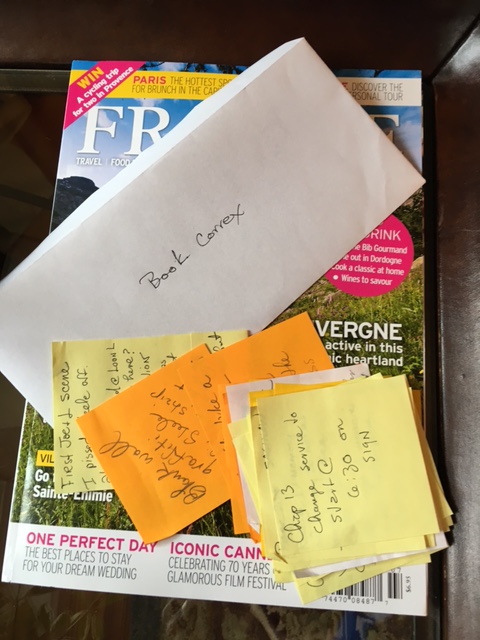
Today, I got them out of the box and spread them on the glass door of my desk so at least now I can see what awaits me.
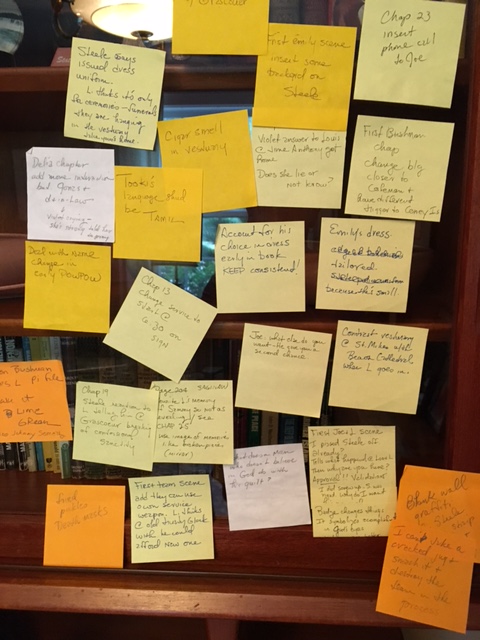
This is only part of them. I ran out of room. It gets worse. While we were in mid-move, we were still trying to work so I had to resort to making Microsoft sticky notes that I slapped onto my desk top:
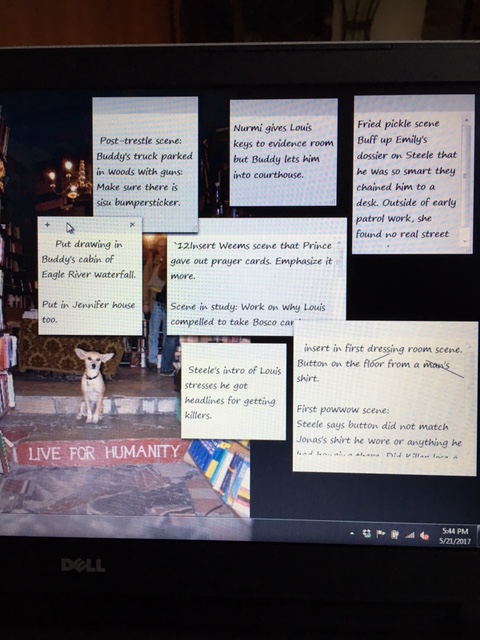
Now do you understand why I hate Lee Child?
What’s weird about this is that normally I love rewriting. At this point for me, the grunt work is done, the sweat has dried, and I am merely redecorating, pulling weeds, repainting, and repositioning the furniture. But this book needs a new entry door, a couple walls knocked down, a massive new support beam around chapter 25, and a new addition built onto the back. It’s not Property Brothers; it’s This Old House.
Writing tip of the day no. 3: Sometimes you don’t see the real problems until you have finished the whole book.
It wasn’t until we got around page 400 that Kelly and I realized just how much big structural work was ahead of us. We couldn’t see these issues until we had traveled the entire course of the story. We had been in the PLOT trees for so long that it wasn’t until we emerged back out into the open that we could look back and clearly see the CHARACTER/THEME forest.
So what do we need to fix? Here’s just a few things:
Chapter 1: Yeah, I hear your groans. Because if you read our First Page Critiques here, you know how important the opening moments of your story are. Our story starts slowly, with Louis returning to his home state of Michigan to take a job with a new prestigious cold case squad led by the police captain who, eight years before (in book 2), had caused Louis to lose his job. Okay, that’s a good obstacle for Louis but it’s not a sexy opening for a thriller. So we wrote a “prologue” in which two young boys are running for their lives from an unknown person who wants to seal them in a box. Well, THAT’S attention-grabbing. But as we neared the end of the book, we realized the scene felt artificial, like we were desperate to inject action into the opening. We were trying to gin up the story, but the scene was not organic to what came after — Louis on the first day of the job.
So we’ve axed the boys scene and are writing a scene between Louis and his new boss that will play on the tension between the men and stress the high stakes for Louis.
Writing tip of the day no. 4: Don’t be afraid of the slow opening as long as it has tension, hints at a major conflict, or conveys that something has been disturbed. You don’t have to throw a boulder into a lake to make waves; sometimes a well-aimed rock creates ripples enough to make the reader want more.
Another thing we need to fix is our characters’s motivations. Okay, I’ve been married for 35 years and just when I think I know my husband, he does something that makes me think, blink or just laugh my ass off. So it should be with your characters. You won’t know everything about them when you start, so don’t expect to. Keep control of them, yes, but be open to their surprises and their growth. Kelly and I found we didn’t know really know what drove our villain until he was vanquished around page 350. Now we have to go back and build up his early scenes — putting in that crucial beam or two! — so his final actions make sense. Even the bad guys deserve this respect.
Then there’s the last thing we need to fix — our theme. This one is maybe the hardest because theme is a slippery thing. I think theme is really important to good books. It is what your book is really about at its heart. It isn’t plot. Here’s Stephen King on the subject:
Writing and literature classes can be annoyingly preoccupied by (and pretentious about) theme, approaching it as the most sacred of sacred cows, but (don’t be shocked) it’s really no big deal. If you write a novel, spend weeks and then months catching it word by word, you owe it both to the book and to yourself to lean back (or take a long walk) when you’ve finished and ask yourself why you bothered–why you spent all that time, why it seemed so important. In other words, what’s it all about, Alfie?
When you write a book, you spend day after day scanning and identifying the trees. When you’re done, you have to step back and look at the forest. Not every book has to be loaded with symbolism, irony, or musical language (they call it prose for a reason, y’know), but it seems to me that every book–at least every one worth reading–is about something. Your job during or just after the first draft is to decide something or somethings yours is about. Your job in the second draft–one of them, anyway–is to make that something even more clear. This may necessitate some big changes and revisions. The benefits to you and your reader will be clearer focus and a more unified story. It hardly ever fails
We weren’t sure what this book was about, to be honest. It is about the murder of a mega-church minister — and how that murder ties into the little boys who were nailed into a box and left to die. But that’s just plot. What does all this mean? We knew the theme was loosely about religion. But It wasn’t until Kelly wrote one line of dialogue in chapter 34 that we found the theme. The line came from an atheist whom Louis interviews:
What does a man do with his guilt if he doesn’t believe in God?
That line made us realize our book’s heart was about how people who are damaged — and people who inflict damage on others — still find a reason to believe in something. But now we have to go back and carefully calibrate each character, through their actions, thoughts and words, to reflect that main idea. And yes, there is an answer even for the villain.
So, if you’ll excuse me I have some heavy lifting to do. If you are about to finish your book — huzzah, huzzah! — let me leave you with a couple miscellaneous bullet points about surviving rewrite hell.
Don’t get caught in ego-trap that your first draft is great. Hemingway himself said the first draft is always crap. (well, he used a different word).
Sometimes to fix it, you have to break it.
Let your first draft bake. I call this the de-cheesing time. Finish the book, let it sit for at least two weeks, then print it out and read it. The bad parts will stink like bad Brie.
Be courageous but careful. Rewriting is like eating an elephant. It’s one bite at a time.
Take out all the dumb words. Figure out what your writer tic is — mine is an overuse of “then” and “suddenly.” Excise all the flabby physical movements like, “He nodded his head.” (He just nodded.) Don’t keep repeating physical attributes. Once you tell me the lady has sea foam green eyes, don’t tell me again.
Hire an editor if you need one. And most of us need one badly. There is nothing more valuable than a trained reader who will tell you the truth and whose only interest is the quality of your book.
Sometimes you have to add, not subtract. Contrary to what Truman Capote, not every rewrite needs scissors. Sometimes you need to put more meat on the plot bones or inject blood into anemic characters. Stop obsessing about word count. The book will be as long as it needs to be.
Have a plan going in. After you’ve let the draft bake and given it a fresh read, write down the things — big and small — that you have to deal with. Here’s Chuck Wendig on the subject in his usual colorful style:
You write your first draft however you want. Outline, no outline, finger-painted on the back of a Waffle House placemat in your own feces, I don’t care. But you go to attack a rewrite without a plan in mind, you might as well be a chimpanzee humping a football helmet. How do you know what to fix if you haven’t identified what’s broken? This isn’t the time for intuition. Have notes. Put a plan in place. Surgical strike.
And as you eat the elephant, keep an eye out for that theme. Or as Dorothy Parker put it in her book on writing:
I would write a book at least three times–once to understand it, the second time to improve the prose, and a third to compel it to say what it still must say.
But, after all this, after all this advice I’ve set out here, isn’t it fair to let the King of the Perfect Draft have the last word? Take it, Lee Child…
My honest answer is ignore advice because it’s got to be your product. It’s got to be an organic product with a vital, vivid integrity of its own and you’ll never get that if you’re worried about what other people are telling you to do.
A few days ago I saw an author ‘rant’ posted on social media (for the sake of anonymity I won’t mention the author or the social media platform!). It was a full-blown tirade against insensitive publishers and their treatment of authors and their submissions. I don’t know the author personally but the post highlighted for me the dangers of airing grievances online. While I certainly have a great deal of sympathy – the whole process of writing and trying to get published is not for the fainthearted – but social media is definitely not the place to air your frustration or bitterness.This particular rant seemed to be aimed at the fact that certain publishers had not bothered to even respond to a full MS submission. Now, I know silence is horrible and the waiting to hear back on a submission is nerve-wracking, but unfortunately it’s all part and parcel of the (traditional) publishing process. The online post reminded me of the rules I try to follow when it comes to social media and dealing with the publishing process…because you never know who might read or share your online post. These rules include:
So TKZers do you have ‘rules’ you follow when it comes to social media and discussing your experiences with publishing or the publishing process? How do you react when you see a post that rants and rails against the industry? Do you agree authors should keep their frustrations to themselves or would you prefer to see more venting for the sake of honesty?
by James Scott Bell
@jamesscottbell
 Here’s a little exercise I teach in my workshops: take one of your dialogue-heavy scenes. Go to the middle and select a line at random. Now, pull down a random novel from your shelf. Open to a random page. Flip around until you find some dialogue. Pick one line of that dialogue.
NOW: substitute the line you just read for the line you selected in your scene. THEN: figure out how to justify it!
NEXT: Tweak the line so it fits the character. FINALLY: Rewrite the rest of the scene. Do this as a way to create or explore deeper levels of story or character. You may end up not using the dialogue line itself, but you will have opened up new vistas in your story and given your imagination a chance to play.
But if you do use the line, here is a big benefit: It creates a surprise for the reader. And surprise is the greatest page-turning prompt of all. Predictability is dull. So throw the reader off every now and then with something out of the blue.
Another benefit: you can use this exercise whenever you hit bad old writer’s block. Don’t know where your story is going? Having trouble plotting the next few scenes? Not sure who a character is? Try this exercise and get the mental pistons firing again.
Here’s a clip from my current WIP:
“Isn’t the view gorgeous?” she said.
“You better get right to it,” Dylan said, “because this is the last time we meet.”
“You can’t mean that.”
“I’m prepared to walk away.”
“I don’t think so, dear.”
“Watch me.”
“You haven’t even seen what I have.”
“I don’t care—”
“Or heard.”
“Heard?”
“So many things. You can be happy. We can be happy.”
“Look, you’re sick and you need help.”
“Don’t—”
“I know people. I can get you help.”
Now I perform the exercise. I’ll show you what I came up with using four very different novels off my shelf.
Using a line from An American Tragedy by Theodore Dreiser (1925):
“Or heard.”
“Heard?”
“So many things. You can be happy. We can be happy.”
“Look, you’re sick and you need help.”
“Oh, it doesn’t amount to anything, really. We just quarrel, that’s all, once in awhile.”
From The Gods Themselves by Isaac Asimov (1972):
“Or heard.”
“Heard?”
“So many things. You can be happy. We can be happy.”
“Look, you’re sick and you need help.”
“Sexually?”
From The Maltese Falcon by Dashiell Hammett (1929):
“Or heard.”
“Heard?”
“So many things. You can be happy. We can be happy.”
“Look, you’re sick and you need help.”
“Yeah, she had it tucked under her arm when she paid me.”
From L.A. Requiem by Robert Crais (1999):
“Or heard.”
“Heard?”
“So many things. You can be happy. We can be happy.”
“Look, you’re sick and you need help.”
“Well, we’re going to find out, but right now we’ve got a maniac to get off the street.”
Well now! Each one of these lines takes us in a different direction, doesn’t it?
The first one gets me thinking along the lines of Psycho, and multiple personalities.
The second one gives me a whole new aspect of character.
The third one is so obscure I have to do some more cogitating. I try to figure out why this woman would have been paid, and by whom. That’s a whole new plot point! That she could be working with someone. So I spend a few minutes jotting down ideas about that. Also, what did this mystery woman have tucked under her arm?
Since I’m writing a thriller, the last example really got my imagination scrambling. Which is, of course, the point of this exercise.
If I decide to use one of these lines, I’ll tweak it to make it consistent with the character’s voice.
But, after all this, I may just go back to the way I had it before. But wouldn’t that be wasted effort? Far from it! Because the writer’s mind is always stronger after this kind of workout—lithe, supple, and ready for action … hmm, maybe I should write a romance.
But not now, because I’m in the middle of my WIP and I’ve got a maniac to get off the street.
There are innumerable fiction writing exercises and prompts to jump start your writing sessions. What are some of your favorites?
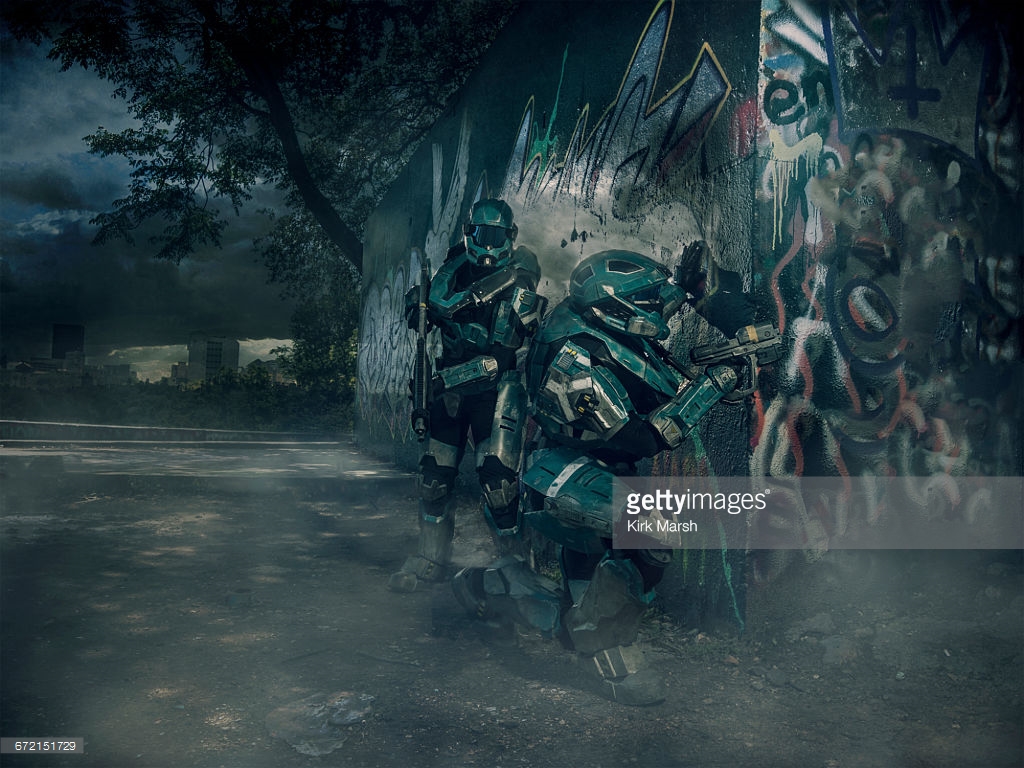
(Kirk Marsh, Getty Images. All rights reserved)
(Note from Sweet Joseph: Sorry that we are late this morning, TKZers! In absence of being able to determine why, I’ll chalk it up to a PICNIC (Problem In Chair Not In Computer) problem. Thanks for your patience.)
Greetings, TKZers, and join me today in welcoming Anon du jour who has submitted the first page of his work Bringer of Chaos, Harvest of Blood for examination:
Bringer of Chaos, Harvest of Blood
At the end of Earth’s twenty-seventh century, genslaves, humanity’s genetic
creations, fulfilled man’s every desire. They rebounded from disease and injury as if
immortal. Bred to need no rest, labor-genslaves performed menial and repetitive tasks.
Mankind permitted enough intelligence to work, but not enough to aspire beyond their
station. Warrior genslaves possessed unmeasured strength and massive size. They
fought humanity’s wars, died so man didn’t have to suffer, and revived to fight again.
Healer-genslaves with skill in medicine designed cures for man’s diseases. Artists
created mankind’s beauty. Nurturers and teachers cared for humanity’s children.
Scientist-genslaves designed additional genslaves, to make man’s life even more
pleasant. All with genetic shackles of obedience, making them content to remain
subservient.
While humanity relaxed, secure in a position of power, genslave-scientists created a
new order of beings with free will. Did their creation arise from faulty programming,
or a desire for freedom? Unhampered by genetic restraints, these new creatures
took the name Ultra. Brains and brawn, they solved every problem, survived every
wound.
Untouched by disease and unthwarted by starvation, they beat the shackles of death.
They were immortal.
Immortality changed everything.
When Ultras demanded freedom, humans claimed them soulless, inferior,
unworthy, and undeserving of equality. Humans tried to silence them, and when
that failed, punished them.
The Ultras seized liberty by force. Emboldened by the Ultras’ success,
other genslaves rebelled.
Power tilted. Ultras made slaves of their former captors.
Yet among Ultras, leadership arose that considered humans redeemable. They
advocated human freedom and their own government. They sought an end to
galaxy-wide conflict. They sought peace to halt senseless death and destruction,
foster growth, and increase trade.
In 4536 AD, after centuries of war, Ultras and humans met to discuss a truce.
At the peace talks, the Ultras suffered betrayal at the hand of their own kind.
Captured, forced into cryogenic sleep, transported across the galaxy, abandoned
on a planet whose name meant ever living, a half-million woke in their eternal prison.
Too far out on the rim to be worth developing, Sempervia possessed few
natural resources. The scant supplies humans left would have meant starvation and
lingering death for mortals, but the immortal Ultras had no such mercy.
They survived.
For this reason, the first few years in Sempervian history are remembered as the Harvest of Blood.
Anon, I’m going to focus primarily on substance and a bit on form here, sometimes intermingling the two, so I would appreciate it if you (and those of you who are kind enough to spend a portion of your Saturday with me) would bear with me to the end. I hope that it will be productive for you.
Let’s begin with the title, which reminds me of one of those Swedish death metal records that Jordan Dane probably has in her record collection. It infers that your book would fall into the sword-and-sorcery subgenre, something like Robert E. Howard’s Conan the Barbarian or Fritz Leiber’s Gray Mouser. I expected demons throwing fire, beheadings, supernatural disembowelment, and other things which I won’t get into here. After reading your submission, however, it looks like you are shooting for a speculative history novel and series — a very interesting one — with some military elements thrown in, a book that a publisher such Baen,to name but one, does so well. The title really doesn’t reflect that. It’s somewhat of a misdirection. I would change the title to something a bit simpler which gets your idea across, such as GENSLAVES: Volume One — Rebellion.
The big issue here, however, is that what you have sent isn’t as a practical matter the first page of a Chapter One. It’s not even really the first page of a Prologue. It is more of an outline for a future history spanning hundreds years which will provide the spine for a novel, or maybe even several novels. I think you have a terrific idea, but you don’t have the beginning of a story or a book yet. You have a whole book you can fill, my friend, a whole book where you can show us what you envision as a future history instead of telling us.
One suggestion — out of many possibilities — would be for you to start the first page of your novel on Sempervia, your exile planet. Present it from the perspective of one of the Ultras on the planet who is either 1) hacking their way through a bunch of their fellow Ultras to get to something they need, 2) trying to stow away onto a rocket back to Earth or 3) escaping from a peril. Show us that Sempervia is a bad, lousy place to live, one where unicorns are eaten and recycled instead of worshipped. Show us that while dropping breadcrumbs of the history and the backstory through the narrative. Mix it up a bit, showing how the inhabitants of Sempervia survive on a day to day basis, revealing what their short and long term plans are, and exploring how they got to be there in the first place, all the while sticking to that outline.
Maybe you have already done all of the above in pages two through six hundred of what you have written. That is all well and good; but you need to start the book off in a different manner, in order to pull a prospective agent, editor, or reader into it. Think of your first page — going to back to the spirit which your current title evokes — as the hook which pulls the eyeball of the reader into the story. Folks have short attention spans these days. You need to grab them and keep them before they pick up the television remote and start streaming the first season of Animal Kingdom.
If you want a relatively quick and excellent example of how to do something like this, see if you can get a reading copy of the Gold Key edition of the comic book MAGNUS, ROBOT FIGHTER 4000 AD by Russ Manning ( from the 1963 edition, NOT the relaunches that have been published since) in your local library’s graphic novel section. The first few panels of the story, if memory serves, quickly give the readers example of robots doing drudge work before Magnus suddenly shows up, and, after fleeing from the robot police, uses martial arts to kick rivets and take serial numbers. Manning gradually informs the reader as to how people let robots take over more and more duties (like making coffee, checking people into hotels, and taking orders at Panera Bread) to the point where robots are running things and human beings are becoming subservient without really realizing it. It isn’t your plot, but it does involve a future history, and Manning, bless his heart, shows us all how to tell a future history story effectively. If you want a longer example, check out E. E. “Doc” Smith’s Lensmen series, or Robert H. Heinlein’s future history series. The latter is particularly accessible.
I have a couple of other points of correction, applying to form:
— Science fiction readers love those new names for future objects. You should be consistent when you create and use them. You start off with “labor-genslaves” (hyphen) and then you mention “Warrior genslaves” (no hyphen) instead of “Warrior-genslaves” before returning to “healer-genslaves” and “scientist-genslaves,” the latter of which turn into “genslave-scientists.” Since you started with “(insert type of genslave here) – genslaves,” when naming your characters, follow that format throughout your first page, and indeed, your novels, and the ones that will come later in this ambitious future history.
— If the genslaves were genetically shackled to be obedient, thus making them content to be subservient, they aren’t going to be emboldened by the Ultras’ success. “Emboldened” wouldn’t be in their genetic programming any more than “obedience” is included in a cat’s genetic makeup, even as they watch the dog doing so and thus being allowed to stay another day, go for rides, etc. Just saying.
— The first time that you mention that the high-end genslaves “took the name Ultra,” set the name off, like so: “Ultra” or Ultra. Just the first time.
I will now remain uncharacteristically quiet (for most of the day) while our TKZers offer their own invaluable insight. And thank you, Anon, for stepping up and giving us a reason to be here today!
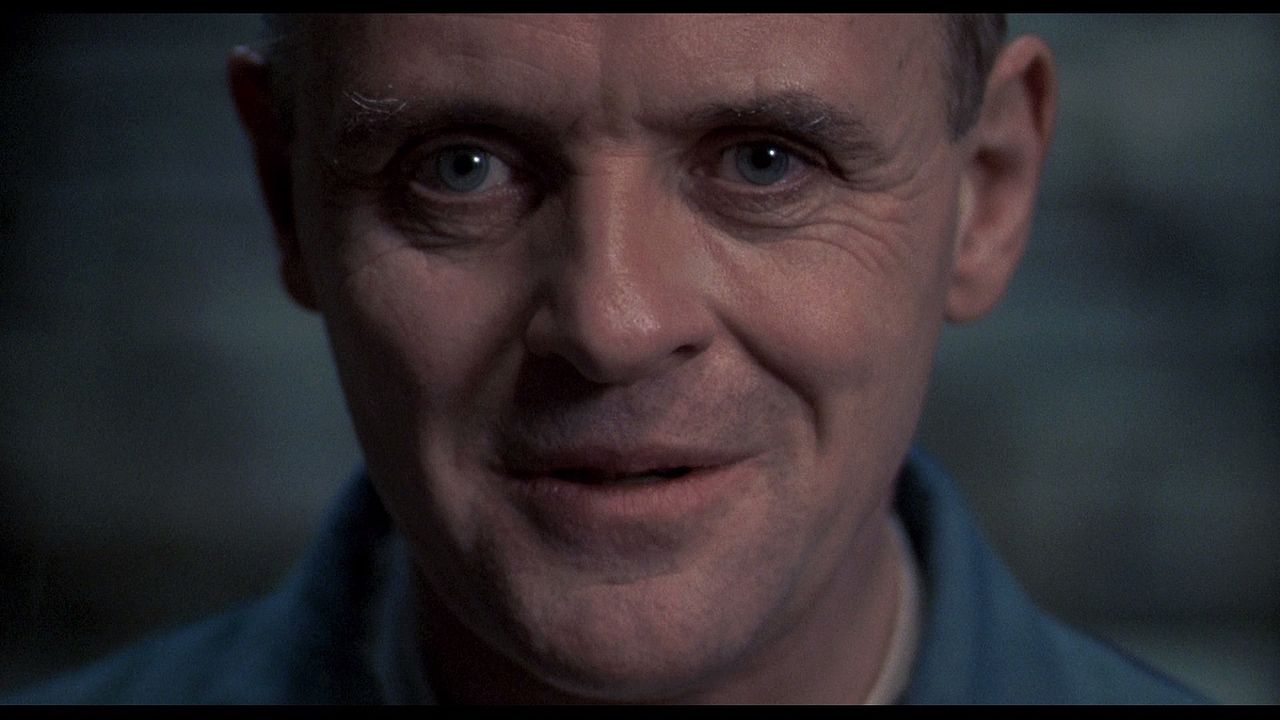
By Hasaw öztürk – Own work, CC BY-SA 4.0, https://commons.wikimedia.org/w/index.php?curid=58145267
It’s easy to focus on the main protagonists of our stories. Heroes and heroines usually pop up in our heads from the start, but have you ever been taken over by your bad guy or your femme fatale? In my latest series, Mercer’s War with Mr. January book 1, I’m obsessed with Keiko Kayakova. She is the devil personified, a remorseless killer, yet she constantly surprises me with her contradictions and what she truly cares about.
A great character is complicated and it can take time to develop them. Why not explore your antagonist with as much zeal as you would for your protagonists? You need to hear them in your head, maybe especially when they are their nastiest, or if they niggle your ear in the middle of the night. Flesh them out.
Questions to ask about your current work-in-progress:
1. What’s your villain’s back story?
2. Why did they turn out the way they did?
3. What motivates them in the present? What are their goals?
4. Have you explored gender for your antagonist? Would your bad guy be more frightening and unexpected as a woman?
5. Have you given them a chance at redemption in your story? Do they take it?
6. What makes them vulnerable? What are their flaws?
7. Have you created a bad guy or gal’s bible, like you did for your good guys and gals?
8. Does your bad guy/gal have virtues the reader might find it hard to argue against, like an extreme respect for the law or a need to establish order in a society he or she controls for the greater good?
9. Do they have an unexpected hobby?
10. In the vast sea of literary villains, what makes your antagonist stand out?
Villains want top billing and for their name to be first on the marquee. Have you shown them enough R-E-S-P-E-C-T? Even if you’ve already got a first draft, it’s never too late to add depth or bone chilling traits to your characters. A flat character on the page is never satisfying.
Don’t waste good villain potential by making your character a two dimensional cardboard cutout or a mere roadblock to your good guys. Dare to give them humor or a peculiar hobby or a back story that explains their motivation. Develop a conflict between your antagonist and protagonist that is deliciously enticing that makes it harder for the reader to choose sides.
Here are a few tips on how to get started:
1. The best villains are the heroes in their own stories. Make them real and worthy of their own story line. Develop them with the same care and don’t resort to making them obstacles in the way of your main characters. Even if they’re a train wreck, make the reader interested in what drives them or make them so diabolical that the reader will fear more for your good guys. Do they have a journey in your book? If they have a chance at redemption, do they take it? These types of questions can add depth.
2. Dare to make your villain an anti-hero in his or her own story, giving him or her solid motivation to perpetrate their crimes or cover their backsides. If your antagonist and protagonist are both thwarted by the same bad weather, for example, how do they each deal with it? Do their minds work the same? Of course not. Their reactions can shed light on how their mind works. Bend the norm. Think out of the box to surprise the reader, but that plot twist comes from knowing each of them as their creator.
3. Match or counter the skills between your antagonist and your protag. Where one might have an intellect, make the other one have a diabolical brute force that can overpower your hero in confrontations that showcase their strengths. Make them worthy of each other.
4. Escalate the tension between your antagonist and protagonist by making them have a relationship that used to mean something. Imagine your adversary is your own father or someone in a foreign country with the same ideals as you (except they are your enemy). If under normal circumstances, your two characters might be friends, what horrible situation will keep them apart and what makes things worse between them?
5. Give your villain a face. Don’t hide behind a secret organization or an evil entity? The Hunger Games would not be the same without President Snow. Silence of the Lambs would be FBI’s Clarise hunting serial killer Buffalo Bill except for the memorable diversion of Hannibal Lecter, her white knight.
DISCUSSION:
1. Who are some of your most memorable villains from your own work? Tell us how you made them memorable.
2. What literary villains have stood out in your reading and have those books influenced your writing?

(purchased from IStock)
I’m currently living in the limbo that inspires fear and loathing in many writers, and drives others to query random Magic 8 Balls with the seriousness of a sugar-drunk eight-year-old at a slumber party: I have a manuscript on submission. For the sake of my sanity, let’s step away from the constant checking of email, the extra glass of wine after dinner, and the cold-sweat certainty that there should have been One More Edit before it went out.
So, tell me things, please. Specifically, I want you to think about the sayings you have in your family. They might be well-known sayings, or something you and your siblings picked up from a long lost television episode that stuck with you for whatever reason. Or it might be a saying whose origins are lost to history, but you still use it. These sayings don’t necessarily have the gravitas or moral spin of an aphorism, but when you use colorful or shocking or sweet sayings occasionally and appropriately in your dialogue, they immediately give your reader important information about your characters.
I’ll start. Here are some that show up again and again in the Benedict family, or came from my childhood:
People in hell want ice water. (my dad)
Smooth move, Ex-Lax. (also my dad)
Sleep tight, don’t let the bedbugs bite. (my mom)
We like the moon, because it’s close to us. (this video is at least 10 years old)
Biggie fries, biggie drink. (no comment)
Pretty makes up for bad. (this showed up around the time my daughter was five)
Pretty is as pretty does. (this one gives me the same hives it gave me when I was five)
Does a bear poop in the woods? (dad, again)
Is the Pope Catholic? (yep, dad)
A bear won’t eat what a bear can’t smell. (from a Saran Wrap commercial–could only find the ad with a tiger)
Measure head size before ordering. (appropriate whenever, well, ordering something–I picked it up from an Elmore Leonard novel)
Same poop, different flies. (from husband’s family)
Cam down, Linwood. (MIL’s family–she said she has no idea where it came from)
Hold ‘er, Newt. She’s headed for the barn! (also from MIL’s family–she doesn’t know where this is from either. but I did find versions online)
Scratch your ass and get happy. (heard this at a family reunion–acquired it immediately)
These three came from workshop students:
It’s a poor ass rabbit that only has one hole. (meaning is fairly obvious)
You can’t look up a hog’s ass and tell the price of lard. (heh)
She’s a real Corinthian. (wish I’d written down the origin of this one–so many possible interpretations)
Your turn!