Publishing Without Writing A Book

Publishing Without Writing A Book
Terry Odell

First – for those who wanted to see Craig Johnson’s presentation at the Mountain of Authors day at the Pikes Peak Library, you can find it here. The original post, also updated, is here.

Bundles of BooksNot all of us are as prolific as others in being able to produce a story monthly, weekly, or daily. I’m a one-at-a-time writer and don’t have three concurrent projects going. Or two. The closest I come is to start a new book while my editor has my completed manuscript. Even then, when I get my edits back, I turn the burner off under the new one and devote all my time and energy getting the completed one ready for release.

What if you really want something new out there. Sales might be slumping. One option is to package your backlist titles—the ones you’ve already completed—and bundle them together. Whether you call it a box set or a book bundle, you have a “new” product to market.

It’s not hard, and you can probably put one together in less than a day.

My thoughts:

I like bundles of three novels. I did this for my Blackthorne, Inc. series, which comprises ten novels. The first nine are “older”, with #10 being the most recently released in the series, and #11 is in the editing process. Another consideration is pricing, since Amazon still sits in the dark ages with it’s 70% royalty limit plunging to 35% for books priced over $9.99. I can price my bundles inside their ceiling, offer the bundle price at a substantial discount to buying the books individually, and not feel that I’m giving them away.

First step, as with any book you’re creating, is to open a new document, and set up the basics. Most channels like 1-inch margins, TNR, 12 point. (The end user has control of these elements, so no point in getting ‘fancy’ with anything here.)

If you’ve been consistent with your formatting (which may not be the case for older books), all you have to do is piggyback them into one new file. Strip out the typical “more by the author,” “a note from the author,” etc., back matter, leaving only the acknowledgements and dedication pages for each file. My preference for acknowledgments is at the end of each book, but some like to put that up front. Your call, but if you’re writing for “me”, then I want to get to the story as soon as possible, and won’t wade through pages of who you’re thanking first. Same goes for reviews of other books. I’m not reading those; I want to read this one.

Create a new title page for the bundle. I simple called mine “The Blackthorne, Inc. Novels, Volume 1, 2, and 3,” respectively. For my copyright page, I gave the date the bundle was released, with the copyright dates of each book beneath:

Copyright © 2018 by Terry Odell
When Danger Calls, copyright © 2010 by Terry Odell
Where Danger Hides, copyright © 2011 by Terry Odell
Rooted in Danger, copyright ©2013 by Terry Odell

I followed with the usual copyright verbiage.

Then, add your books. You can copy and paste, or you can use the Insert tab. It’s Insert>Text>Text From File. Click that and choose your book file. (Click the image to enlarge.)

screenshot of Word showing an arrow to insert a file into a document

Once I had all three books in the master doc, I tweaked the Table of Contents.

My main Table of Contents was set up with only the three books hyperlinked to the title page of each one, which was the only ‘new’ formatting I needed. Word creates hyperlinks in a few keystrokes. I’m sure other software does it, too. It’s under the “Insert” tab: Insert>Link>Insert Link>Place in This Document. (Click the image to enlarge.)screenshot of how to insert a hyperlink in a Word documentFrom there, each individual book already had the heading style, so the chapters met the demands of the sales channels. Rinse and repeat for each book you’re bundling. At the end of the last book, reinsert the normal back matter. I use Draft2Digital for converting my Word file to epub, so getting all the back matter is nothing more than a click for each item. Plus, they automatically update the ‘more by the author’ section to the most recent releases.

Then, you need a cover. I hired my cover artist to do mine. She’s got the skills and while I could probably create one, I prefer to hire out things that will take time and inevitably, frustration.

Book Cover, Blackthorne Inc. Novels Volume 1 by Terry OdellA caveat. Apple does NOT like 3-D in any iteration. My original bundle covers were flat, but they showed the books they contained in 3-D. It’s a common enough ‘problem’ that D2D has an “Apple Cover” option so you can use a separate one for only that channel. This is relatively new, I think, as my first 2 Blackthorne bundles had no issues–either that or Apple operates on the “whim” system, but the cover for #3 was rejected. My cover artist had never heard of the practice, but she did the ‘all flat’ Apple cover for me.

Apple-specific cover for The Blackthorne Inc. Novels, Volume 1 by Terry OdellOne ‘negative’ to book bundles of backlist titles is that the sales channels don’t all regard a bundle of existing books as a ‘new’ release, so they don’t send out the announcements to followers. You still have to do the marketing.

My most recent release was Volume 3, which brought the bundled books up to 9 of the 10 novels. I did this because at the time, I was working on Book 11 and wanted to see if I could spur more interest in the series prior to Cruising Undercover coming out.

A quick mention of audio. I had all the audio files. There was no recording time involved other than a new opening and closing. Bundles sell well on audio subscription services, since listeners want to get the most book for their monthly credit. I haven’t done my Blackthornes in audio, because by the time the format was open to indie authors, I had 8 books in the series, and the cost was prohibitive. I have 11 now, so it’s even more costly, and my ROI wouldn’t justify the expense.

What’s your take on bundles/box sets? Like them as a way to get more books for your bucks? Have you created any? Were you satisfied with the results?


Cruising Undercover by Terry OdellNow Available for Pre-Order: Cruising Undercover.

Not accepting the assignment could cost him his job. Accepting it could cost him his life.


Terry Odell is an award-winning author of Mystery and Romantic Suspense, although she prefers to think of them all as “Mysteries with Relationships.”

How Memorable Are You?


By Debbie Burke

@burke_writer


Everyone in the writing community is part of a long continuum climbing a steep hill. Those who are ahead often reach down their hands to help those who are less experienced.

For three decades, my local writing group, the Authors of the Flathead (AOF), has thrived because of mentors who extended their hands to the rest of us, freely and generously sharing knowledge.

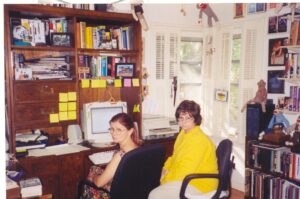
Barbara Schiffman, script consultant and creative producer

One of those mentors is Barbara Schiffman, who worked in Hollywood for 35+ years as a script consultant and creative producer. She reviewed potential projects for literary agencies and production companies like DreamWorks, HBO, Showtime, and more. After retirement, she and her author-husband Glenn moved to Montana in 2019 to live near their grandchildren and settled into a new home.

Before their boxes were unpacked, Barbara jumped in to help local writers. At the community college in Kalispell, she now facilitates monthly seminars about screenwriting sponsored by AOF and her MT Screenwriting Meetup (https://meetup.com/MTScreenwriting/  – not limited to Montana writers).

At a recent meeting I attended, screenwriters had driven long distances from Polson (50 miles), Ovando (120 miles), Helena (220 miles), and Spokane, Washington (240 miles) to hear Barbara. With gas at more than $5/gallon, these are serious writers hungry to learn. The trip is worth it.

That evening, Barbara spoke about how to make a good first impression on people who might buy your stories. She stresses you never have a second chance to make a good first impression: “Get ’em in the beginning or you don’t get ’em.”

Her approach is two-pronged and applies to both to you as the author and to the main characters of your stories.

You, the writer, could be pitching to agents, editors, producers, etc., hoping to stand out among thousands of writers they meet.

Or…

Your book’s main character could be pitching to readers browsing thousands of books on virtual and physical shelves.

Both you as the author and your main character have the same goal: seduce the reader into saying, “I’ve got to hear/read more about this person!”

Barbara analyzed countless scripts and learned to read quickly, sometimes simultaneously writing a logline, one or two page synopsis, and comments for her clients.

The first 10 pages make or break a screenplay. Even when they didn’t grab her, she still needed to skim the rest, write a full summary, and make recommendations. The options were pass or consider, strong consider, or consider with recommendations.

An unqualified Recommend was rare. While many scripts were good, they needed to be great to earn a Recommend.

Insider tip: a reader’s analysis of each script or book must be thoroughly documented, including the date received and who submitted it, to protect the producer, director, and others from plagiarism claims.

Next, Barbara put us through an exercise to demonstrate everyone has a unique quality or experience that makes them memorable. She asked each person to give their name, where they’re from, and relate one unusual thing about themselves that isn’t generally known.

She offered her own example of a memorable event that led to a realization: a fire walk with motivational guru Tony Robbins. As she walked across the coals, she thought, This isn’t so hot. Yet afterward, she had a blister on her little toe. Even though her perception had been the walk was no big deal, the physical blister proved to her that, yes, the fire was indeed scorching.

Then she went around the room full of writers, ranging in age from early 20s to 70+, asking for their memorable events. Since I don’t have their permission, I can’t share what they said. But every single person, no matter how ordinary they appeared, had a unique, surprising story that caused the rest of us to say Wow!

Prior to that evening, I hadn’t met several newcomers. Next time I see them, I likely won’t remember their names or where they’re from but I will definitely remember the unique story they told.

That is exactly the effect a writer wants to achieve when meeting with a producer, actor, agent, or editor. According to Barbara, even if they don’t accept your current pitch, if you make a good impression, they will remember you and perhaps offer a different opportunity later.

Your main character must make a similar impact when s/he first walks onstage in the story.

If it’s a script, you want the actor reading it to say, “I have to play that character onscreen.”

If it’s a novel, you want the reader to say, “I have to learn more about this character. I need to buy this book.”

A current character description trend in screenwriting is to be minimalist—hair color, height, age. Barbara considers that “lazy writing.” When she reads scripts, she wants to know more than surface impressions. She says physical traits are important ONLY if they are integral to the plot.

“Less can be more but make it the right less,” she says.

Barbara recommends developing a skill she calls “screenplay haiku”—memorable phrases, especially in dialogue, that she says may wind up in a movie trailer and frequently in common lexicon.

Think: Make my day. (Clint Eastwood, Dirty Harry).

Houston, we’ve had a problem. (Jim Lovell, Apollo 13)

I’ll be back. (Arnold Schwarzenegger, Terminator)

Barbara admires Taylor Sheridan, the creator-producer of Yellowstone and considers him “Shakespeare in the Wild West.”

She also mentioned Sheridan’s screenplay of Hell or High Water as a prime example of memorable screenwriting. A number of TKZers have recommended the film. Here’s a scene-by-scene dissection by director David Mackenzie.


Timothy Hallinan’s Junior Bender book series has also earned Barbara’s admiration. She says he’s a cross between Carl Hiaasen and Donald Westlake.

From Crashed: A Junior Bender Mystery, here’s Hallinan’s first description of a dirty cop named Hacker:

The face in the rear-view mirror possessed more distinctive characteristics than you’d normally find in a whole room full of faces. The eyes, black as a curse, were so close to each other they nearly touched, barely bisected by the tiniest nose ever to adorn an adult male face. I’d seen bigger noses on a pizza. The guy had no eyebrows and a mouth that looked like it was assembled in the dark: no upper lip to speak of, and a lower that plumped out like a throw pillow, above a chin as sharp as an elbow.

It wasn’t a nice face, but that was misleading. The man who owned it wasn’t just not nice: he was a venal, calculating, corrupt son of a bitch.


That’s a character most readers will remember!

~~~

Thanks, Barbara, for sharing tips on how to make a memorable first impression.

For more info about her, visit: https://literasee.com/

Check out: https://www.meetup.com/mtscreenwriting/

~~~

My memorable detail for today is I’m having cataract surgery. Barbara kindly offered to pinch-hit and respond to comments, as well as answer questions.

~~~

TKZers: What makes your main character memorable?

If you dare, share a memorable detail about yourself.


Happy Independence Day!


“When in the course of human events, …”

I’m not a scholar of state papers, but I’ve heard it said the American Declaration of Independence is one of the most beautifully written of such documents. I read it again over the weekend and reminded myself of its eloquence and substance.

***

I also looked up the definition of the word “independence” in dictionary.com. Here’s what it had to say:

Independence. noun. freedom from the control, influence, support, aid, or the like, of others.

Sounds wonderful, right? But it also means the independent person or entity must take control of their own future. It’s their responsibility.

And that brings me to publishing.

***

My first novel was traditionally published. In retrospect, I think that was an excellent idea since I knew so little of what it took to publish a book. The publisher engaged a cover artist, got the ISBN, registered with the Library of Congress, arranged for the final edits, formatted the book, and did all the other jobs necessary to have it made available on retail sites. If I had tried to do all those things myself, it would have been a much longer process.

My publisher was very supportive, and I intended to publish the other novels in the series with them. However, they changed their contract, and the new one had some issues I didn’t care for. Negotiations solved some, but not all, of the problems, so my husband and I decided I should look at the possibility of going indie. James Scott Bell’s book How to Make a Living as a Writer was a wonderful resource and gave me the information and reassurance I needed to make the switch.

***

Independent publishing is great. I love being 100% responsible for the content and presentation of my books, and I love having control of my products and following their performance on a day-to-day basis. However, the learning curve was steep and the time commitment continues to be large. I have to cover all the bases, including:

  • Engaging development and line/copy editors (I had always done this, so it’s not an add-on.)
  • Having the final manuscript professionally proofread
  • Getting the ISBN
  • Establishing the prices
  • Registering the copyright
  • Registering with the Library of Congress
  • Arranging for the front and back covers
  • Formatting the content
  • Distributing to various platforms including Amazon, Barnes&Noble, Apple Books, Kobo, Google Play, and Ingram Spark.

If there’s an audio book, I arrange for the narration, approve each chapter, and finalize the audio with Findaway Voices.

I also maintain the financials for our publishing company, Wordstar Publishing, LLC. I write the year-end reports, and work with our accountant to file taxes.

Is it worth it? I really do like the independence. However, I’d like to offload some of the administrative tasks, so I’m thinking of giving Draft2Digital a try to handle the distribution. That would give me more time for writing at a small cost.

Bottom line: I’m glad I went independent.

So TKZers: What are your thoughts on independence? If you’re an indie author, is it worth the extra effort? Do you pass off some of the tasks to others? If you’re traditionally published, have you ever considered going indie?

Holidays, Celebration, and Special Bonds

Whether it’s The 4th of July, Canada Day, or Labor Day, this holiday weekend is an opportunity to reflect on how we celebrate, how we take a break from writing, or even how a special bond is at the tips of our fingers.

Below are holiday posts from the past. Please join in the discussion and feel free to respond to other people’s comments.

 Joe Moore – The Parade of Life

 It’s easy to forget about the outside world when we’re immersed in our story, thinking up blog topics, or working on promo for the next release. Time can slip by. We have to remind ourselves to step out and smell the flowers, to watch the clouds scud by, and to cherish that moment as it will never come again. Imagining people and places in our minds is no substitute for the real thing, but it’s natural for writers to become isolated when we’re more at home with our characters than the outside world. But once these hours at our desks crawl past, we can never experience them again.

Really, we full-time writers should get out more often. What do you do to push yourself out the door? Joe Moore – July 6, 2011

Kathleen Pickering – The Fourth and Celebration

So, for those of us with troubled times crowding our thoughts, I suggest taking a moment to let the kid in you enjoy the fireworks and celebration July Fourth offers. Heck, let the fireworks last all year long! After all, The Fourth celebrates our great nation overcoming oppression in pursuit of freedom to follow our dreams. For that I feel gratitude, right down to my toes. The child in me wants to ooooh, and ahhhh and remember never to forget how lucky we truly are!

Won’t you join me in celebrating? How did you spend The Fourth of July? Kathleen Pickering – July 5, 2011

Sue Coletta – What Do Apes, Humans, and Koalas Have in Common

 Genetics form the base of a fingerprint, but they are personalized when the baby touches the inside of their mother’s womb, resulting in unique whirls, deltas, and loops. Hence why identical twins don’t share identical fingerprints. Each baby touched the womb wall in his or her own unique way, swirling and drawing like finger paints on a bathtub wall.

Maybe it’s me—I do tend to get overly sentimental around holidays—but I find it heartwarming to think the tips of our fingers forever preserve the unbreakable bond between momma and baby, imprinted for eternity.

I hope my discoveries kickstart your creativity in new and unsuspecting ways. Happy Labor Day to our U.S. readers! May your burgers be sizzlin’, the buns toasted to perfection, and your beverages be cold. Sue Coletta – September 6, 2021

Would You Be a Good Police Interrogator?

Interrogation.

Just the word elicits your vision of forcible confinement in a hot and windowless room, shoved in a wooden chair with one leg shorter than others, a bright light from a bare bulb burning over your head, and hulking forms of trench-coated detectives firing hardboiled questions in your face.

The truth is different. A lot different. There’s a high skill involved in getting useful (and courtroom admissible) information from people, and not everyone is cut out for the job. Are you? Would you be a good police interrogator?

To start, drop the “interrogation” word. It’s not correct to say “interrogation” in today’s professional police procedures. The right terms are “interview” and “dialogue exchange”. And, they’re more applicable because the vast majority of police-civilian interactions are respectful interchanges of relevant information.

I’ve spent a good part of my adult life talking to people and getting information. I learned long ago that you get more bees with honey than you do with vinegar. I also learned you slide a lot further on bullshit than you do on gravel. I made those principles the core of my information-gathering days. I also practiced another fundamental rule. That’s that the best interrogators interviewers are the best listeners.

Where’s this going? I subscribe to Psychology Today. I recently read a piece by Mary Ellen O’Toole, Ph.D. in her regular column Criminal Minds where she set out ten questions with graded responses to her Are You A Good Listener Test. Dr. Mary Ellen O’Toole was a senior profiler at the FBI’s Behavioral Analysis Unit and author of Dangerous Instincts: How Gut Feelings Betray Us. Here’s her short ten-question exam to see if you would be a good police interrogator. Sorry… police interviewer.

ARE YOU A GOOD LISTENER TEST

1.Typically, how emotional (frightened, insecure, angry, etc.) do I get when I am attempting to interview someone? (Rate this on a scale of 1-3)

1 = very emotional
2 = nonemotional and detached
3 = I remain interested and tempered

2. Typically, how often do I interrupt?

1 = several times during a conversation
2 = just once or twice during a conversation
3 = almost never

3. Do I say things like “What? You have got to be kidding me,” – or- “That reminds me of the time I…” – or – “You think that’s bad, let me tell you about…”

1 = frequently
2 = sometimes
3 = rarely

4. Do I roll my eyes, put my head down, shake my head back and forth, throw myself back in my chair, turn away, get up and walk away, show signs of anger or threatening behavior, or otherwise display that I am not paying attention or do not like what the other person is saying?

1 = frequently
2 = sometimes
3 = rarely

5. Do I fidget until people stop talking and then immediately respond without considering what they’ve said?

1= frequently
2 = sometimes
3 = rarely

6. Do I let my mind wander to all the other things on my “to do” list and keep thinking that I just don’t have the time for this?

1 = frequently
2 = sometimes
3 = rarely

7. Do I wait until the nanosecond when the speaker goes to take a breath to pounce on him or her with my opinions?

1 = frequently
2 = sometimes
3 = rarely

8. Do I hijack the conversation? For instance by saying something like, “Look we’ve been over this a million times. Your ideas are just not going to work. This is what we are going to do.”

1 = frequently
2 = sometimes
3 = rarely

9. I reflect the person’s thoughts and feelings back to the person I am listening to.

1 = rarely
2 = sometimes
3 = frequently

10. I ask open-ended questions to encourage the other person to talk.

1 = rarely
2 = sometimes
3 = frequently

 Total Score = ______

The higher the score – the better your listening skills tend to be and the better interrogator interviewer you would be. Note: This is not a scientific test and has not been validated or otherwise vetted. These opinions are those of Dr. O’Toole and do not represent the views of the FBI.

My experience is that the key to successful information gathering is simply listening to what’s being said. Does it make sense? Does it fit? Does it make you ask more questions? Or does what’s being said to you satisfy what you’re after? Another Note: Police interviews/dialogue exchanges are all about getting the truth. Contrary to conspiracy theories, no good cop wants a false confession.

Kill Zoners – Let us know how you scored on the test!

Point of View And Voice

By John Gilstrap

Forgive me as I begin this week’s post with some shameless self-promotion. This is Launch Week for the latest in my Jonathan Grave thriller series (#14!). It’s called Lethal Game, and you should be able to find it at your bookseller of choice. From the Marketing Department:

Hostage rescue expert Jonathan Grave and his fellow special-ops veteran, Boxers, are hunting in Montana when shots ring out, and they realize they’ve become the prey for assassins. In the crosshairs of unseen shooters, cut off from all communication, with the wind at a blood-freezing chill, the nightmare is just beginning. Because Jonathan and Boxers aren’t the only ones under fire. Back in Fisherman’s Cove, Virginia, Jonathan’s Security Solutions team is fighting for their lives too. A vicious onslaught is clearing the way for a much bigger game by eliminating anyone in the way. If Jonathan and Boxers can make it out of the wilderness alive, the real war will begin.

Now we return to our regularly scheduled programming . . .

Full disclosure: I posted a piece very similar to this back in 2017, but the concept of “voice” in fiction is a subject that many new writers struggle to understand, and that is, quite frankly, difficult to teach. It’s a worthy topic to revisit occasionally.

We all learn that the elements of a story are plot, setting and character. If not taught and learned carefully, these can seem like separate elements–separate threads, if you will–but for a story to work, they can’t be treated as such. The elements of story are less a quilt than it is a tapestry, and the subtle weave that combines the elements into something beautiful is the author’s voice, as presented to the reader through the point of view characters

So, rather than thinking of those story elements as separate threads, let’s readjust the whole concept of those elements. Let’s think this way: for a story to fulfill its promise to the reader, it must chronicle compelling characters doing interesting things in interesting ways in interesting settings, all of which is presented in an engaging voice.

Maybe this analogy is clearer. When you go to buy paint at the hardware store and you ask for the color European Autumn Sunshine (or whatever), the guy in the apron starts with a white base and then adds some blue and some red and whatever other colors, and only after its shaken does the color you want appear. Those component colors are your story elements. Your narrative voice is the shaker that gives you the shade you’re looking for.

As an illustration, let’s say that your POV character, Bob, finds himself broken down in the desert. In a descriptive essay, you would write about the colors and the temperature and the wildlife as the entities that they are. But to make that setting part of the story, it’s a mistake to forget about the character. It’s a mistake to leave the action to describe the scene. So, give those elements a ride in the paint shaker:

Option One:

Bob pushed the car door open and climbed out into the heat.  Shielding his eyes, he scanned the horizon.  Rock formations glistened in shades of copper, gold and bronze.  The vegetation, while sparse, seemed to vibrate with shades of red and blue and yellow.  He was stranded in an artist’s paradise but he’d left his oils and brushes in the hotel room.

In this version, while we’re being introduced to the setting, we’re also learning something about Bob.  Perhaps he’s a romantic.  He’s certainly observant.

Now, consider this:

As Bob opened the door, super heated air hit him with what felt like a physical blow.  It took his breath away. The desiccated ground cracked under his feet as he stood, and as he scanned the scrub growth and rocky horizon, he’ slipped a few rungs down on the food chain. No wonder we tested nukes in places like this. How the hell was he going to get out of here?  

The setting in these two examples is the same.  The action is the same.  Both examples advance the story–whatever that may be–exactly the same distance.  But the voices–the critical element in pulling off third person POV–are different.  Notice that there’s no need to say that Bob #1 is a fan of the desert, or that Bob #2 is not.  That’s because the descriptions are all filtered for the reader through the character’s point of view.

In an effective story, every word of every sentence and every sentence of every paragraph should advance not just plot or character or setting, but all of these at the same time.

In my seminars, I ask students to take five or six minutes to describe the place of the class–room, building, campus, town, whatever they choose–and through the description alone, convey the character of the narrator.  It’s a worthwhile exercise, especially for writers like me, who works hard to be invisible on the page, leaving all of the storytelling to the characters.

Night Terrors

“I don’t know whether every author feels it, but I think quite a lot do — that I am pretending to be something I am not, because, even nowadays, I do not quite feel as though I am an author.” — Agatha Christie

By PJ Parrish

Well, the book is almost done. First draft, that is. I haven’t read it completely through, chapter 1 through 45, since we started the thing, oh, maybe a year ago? Yes, it has taken me that long to get back in the saddle again.

I’m always preaching here that you need to periodically go back and review (and even rework) what you’ve been doing. Sure, you should always be moving forward, but it’s helpful to pause and see if you’re on the right track. I didn’t do that this time.

Why?

I’ve been afraid to. I have this really bad feeling that, having finally reached 110,045 words, what I have created is a heaping, stinking, fetid, rancid mountain of crap. I dream about it now, this mountain of crap, like Richard Dreyfus in Close Encounters of the Third Kind. I wake up in a sweat over it.

My only consolation is knowing that I feel this way with every book. And that I am not alone. Here’s John Connelly talking about his own demons: “There is always that fear that this book, this story, is the one that should not have been started. The idea isn’t strong enough. The plot is going nowhere. I’ve taken a wrong turn somewhere along the way and now have to try to find the right path again.”

Here’s Lee Goldberg, whose career has been long and varied, with Hollywood-assignations and a fruitful collaboration with Janet Evanovich:  “This happens to me…but less often if I have a strong outline to start with (though an outline is no insurance policy against realizing 35,000 words into your book that it’s crap and you’re a complete fraud). In talking with other writers, I’ve noticed that the ones who hit the wall the most are the ones who make up their plot as they go along, preferring to be ‘surprised’ by their characters and the turns in the story. Of course, this means the turns may lead to a creative dead end.”

And lastly, I give you no less than Maya Angelou: “Each time I write a book, every time I face that yellow pad, the challenge is so great. I have written eleven books, but each time I think, ‘Uh oh, they’re going to find out now. I’ve run a game on everybody and they’re going to find me out.'”

My night terrors are especially bad this time out for two reasons. I don’t have a publisher right now and though this is a sequel to our Thomas & Mercer thriller She’s Not There, I don’t know if they’ll want it. Second, this is another new protagonist, so I don’t have the comfort of knowing his heart and soul as I do that of Louis Kincaid, the hero of our long-standing series. Can this new guy, a bit of an ornery misfit,  carry the story or will he put off readers? Will our Louis readers follow us to the new one? Have we run out of good plots? Have we finally hurdled the hammerhead?

I don’t know, maybe there are writers out there who never have any doubts. Maybe Nora Roberts or Joan Didion never broke out in a cold sweat at night. But I suspect there are hundreds, maybe thousands, of you out there who are in the same sweaty boat as I am. There’s a fancy name for this — imposter syndrome. Basically, it is a pattern of beating up on yourself. You have this nagging feeling that you’ll be found out, that people will read your stuff and you’ll be revealed as a charlatan. Don’t look over your shoulder because someone is laughing. Worse, you agree with this.

How do you know if you’ve got IS?

  • You constantly criticize your own work.
  • You procrastinate
  • You focus on rewriting instead of moving forward.

I do all three. Did I mention I am a perfectionist? I sweat every word to the point that it sometimes squeezes the simple joy of creation out of me. If you find yourself at that point, stop, take a deep breath and do whatever you need to recapture the sweet impulse that made you want to write in the first place. For me, this usually means a very long walk in the woods.

A few more pieces of advice before I go and start reading my first draft:

Voice your fears. Feeling like you’re alone is terrifying. Talk to someone you trust. A critique group is really helpful here, as long as it is positive-oriented and not a slash-and-burn tribunal that picks on your scabby semi-colons, or a pity-party where everyone whines about being shut out by the publishing cabal.

Remember where you came from. Recognize and applaud your progress. Sometimes this means re-reading your early unsuccessful efforts and learning from them. Cleaning out my office recently, I found an old partial manuscript on an external storage drive. It was my first effort when I was making the switch from romance to mystery. I didn’t have anyone turn up dead until chapter 12. Everything was back story and my opening chapter was nothing but my heroine, an ex-homicide cop, sitting in a fishing boat in the Everglades thinking about how lousy her life was. It was bloody awful. It made me feel terrific.

Accept that sometimes you’ll suck.  It’s okay to write junk. We all do it. It’s part of the learning process. Some days, you get in that zone and everything you type is spun gold. Yay for you. But most days, you will write a lot of garbage just to get a couple good paragraphs. I took up pickleball a couple years back. I used to be really bad but now I’m pretty good. Why? Because I listened to my coaches, and I am mastering the technique. But this morning, I slid back into suckitude.  Luckily, writing, unlike pickleball, is a private endeavor and no one sees our sucky efforts. Here’s the thing: You have to suck at writing before you get good enough to produce something that readers don’t think sucks.

Keep writing. Don’t let your self doubts corrode your love of writing. The only way to become a better writer is to become a more prolific writer. You will improve your technique, you’ll get better at your craft. But only if you keep going. Like any skill, the more you do it, the better you’ll get.  I promise.

Geez. I just re-read what I’ve written here. It sounds pretty negative, but that’s not really where I am right now. The hard part is over. I’ve finished. That’s something to celebrate, even if my book doesn’t find a publisher. So forgive me for focusing on the cloud instead of celebrating the breakthrough rays of sunshine. Move forward, and always with hope.

As for those night terrors? I won’t lie. If you really want this writing gig, you might have to deal with them on occasion. If, like me, you’ve spent some nights twisting in damp percal, I offer the same three words of advice I give to my youthful female friends about menopause: moisture wicking pajamas. Cool Jams makes great ones.


The Dead Deer Crossing

I often utilize reality into works of fiction. I can honestly say that actual conversations can be so bizarre and funny that your agent or readers will sometimes say they can’t be real. The old saying, “you can’t make this up,” is true.

For example, back in 1982 my starter wife and I were in a popular Dallas steakhouse called The Shed with another couple. Partway through the meal, I watched four people take a table not far away. I assumed it was a set of parents and their children until I saw the teens holding hands. The young lady and her boyfriend sat facing me across the room and I couldn’t take my eyes off her.

Halfway through the meal, she and her beau had a spat, and she left for a few minutes. When she came back, the older woman said something and the brunette threw her head back and laughed. The evening ended for our dinner party and the four of us left, but the dark-haired girl never left my mind.

Years passed. Life happened. Divorces occurred.

The Bride and I were sitting in our back yard one cool evening about ten years ago, sipping Coppola’s Director’s Cut wine. The conversation wandered to our lives before we met, old Dallas, and long-gone restaurants. I mentioned The Shed, she told me it was her high school boyfriend’s parents’ favorite restaurant.

I recalled their rustic dining room. “Didn’t you love that all you could eat steak idea?”

She threw her head back and laughed. “I could pack it away back when I was eighteen or nineteen.”

Her huge laugh snapped me back to 1983, and that’s when it clicked after all our years of marriage. “Did you have a white fisherman’s sweater at one time?”

“I did. I loved that sweater. I wore it in high school and college…” She paused, giving me a long look over the top of her glass.

“You came in with your boyfriend while I was there. Y’all had a disagreement…”

Her eyes widened. “It was his parents’ favorite restaurant.”

“That was you.” I told her about what I saw that night. “I knew you were the one for me even then.”

The Bride allowed it was her. I’d been captivated my Shana Kay way back when she’d just graduated high school, eight years before we met.

I used that coincidence in a manuscript, but my agent said it was too unbelievable. “I’d take it out.”

Sigh.

Incidences and conversations like this are inspirations, and usually make their way into my work in some way or another. I think I’ve mentioned in passing that I’ve been a newspaper columnist since 1988, and in that time, I’ve written well over 2,000 columns and magazine articles. Most stemmed from real life, and as I’ve always said, there’s always a grain of truth in every column.

The following conversation among the strangers in the following story is absolutely true. I swear, because I lifted all of the unbelievable dialogue from a neighborhood chat/complain social media site, and can testify it’s still on my cell phone. All I had to do was change it enough to avoid plagiarism, (but then again, is it plagiarism if I’m really reporting what was said?) add a setting, personal characteristics, and descriptions to make it my fictional story.

Why did I post my newspaper column for June 26, 2022, on this blog? Because I’m firm a believer in teaching by example. Hope you enjoy this and maybe it’ll help in some way.

*

The Hunting Club membership (my old, graying friends who have hunted and fished together for over forty years) was gathered around the large round corner table in Doreen’s 24 HR Eat Gas Now Café when a gaggle of women pushed through the glass door.

It’s our local gathering place out on the highway, and we’d spent the morning sipping Doreen’s excellent coffee and talking about a big doe lying in the median. Someone hit her the night before and we wondered if she had a fawn when she died.

Woodrow rested his elbows on the Formica table and ran his forefinger through the handle of his thick white coffee mug. “It’s a surprise to see a doe hit this time of the year.”

“I wish it had been a rabbit.” I sighed and watched the women stop to survey the cafe. “Rabbits are like roaches around here these days.”

The ladies ignored us and took a table in the center of the café, putting them in close proximity to our big booth. Had it been a group of men, they’d have moved to the opposite end of the large eating area, as far as possible from where we sat.

One woman who looked like Maude on the Golden Girls spoke with a voice heard by cattle dogs a mile away. “I texted out a warning on the way over here. I just saw a dead deer on the side of the curb in the middle between Eldorado and Panther Creek.”

Woodrow grinned and scratched at his gray beard in thought. “Now I know where to hunt this season. That has to be the same doe we were just talking about, but it’s in the median, so there’s no danger to anyone unless folks are slowing down to look, or texting while they drive!” His voice rose in emphasis, but the newcomers appeared not to hear.

“That’s so sad.” It was a skinny gal with lots of eye makeup and a set of artificial lashes that reminded me of large, dead spiders. I assumed she was talking about the doe, and not Woodrow’s comment.

Jerry Wayne spoke in his usual loud voice, since he can’t hear it thunder these days and refuses to wear his hearing aids. He says he’s cutting down on caffeine, but the big guy still twitches like an outhouse fly. “It’s not so sad. It’s the nature of things. I was raised on venison in Mississippi. Wish I’d have seen that little doe right after it was hit. I could use some backstrap right now.”

As a group, the women frowned and leaned in.

Wrong Willie shook his head. “I’ve told you over and over again it ain’t right to eat roadkill.”

“Depends on how long it’s been on the ground.” Jerry Wayne leaned back to make his point, his version of “drop the mike.”

Maude waved Doreen over to order. “Poor animals. No wilderness to live in anymore. It’s because of all this construction around here. These animals are going to come out more and more. They should take them to a habitat somewhere, because it is very dangerous and sad to see them die this way.”

Constable Rick’s mouth opened and closed, as if he wanted to say something but couldn’t get enough air. He was either laughing, or in shock. Her astonishing comment clammed all of us up, and we listened as they took turns spilling inaccurate thoughts.

“If you call the game warden and tag it, they will give it to you. If you want the meat.”

Woodrow slapped his forehead. Doreen shot him a glare from behind the counter. She wiped her hands on a stained towel and gathered up a handful of empty mugs. I took a moment to look for the mole on her face that seems to move at random from one day to the next.

It must have migrated to the back of her neck that day.

A brunette lady with painted-on eyebrows frowned them together. “You have to bleed it out immediately for it to taste good. That one’s been dead too long, unfortunately. Sad.”

“I can’t stand deer hunters and I’ve been living here twenty-one years when it was wilderness and I’ve never seen anything but bobcats, coyotes, and greyhawks.” That run-on sentence came from a lady covered with tattoos.

Willie tore his eyes from her art and turned to me. “Wilderness? This has been farmland for over a hundred years.”

I shrugged. “Who knows. They’re on a roll, but there’s a million rabbits and squirrels they haven’t seemed to notice.”

“You know,” Maude took a cup from Doreen and smiled her thanks as our favorite waitress and business owner filled it from the fresh pot in her hand. “We need one of those Deer Crossing signs so these poor animals will know where to cross safely.”

Doreen glared in our direction, daring us to say anything. I looked around the table and saw Jerry Wayne, Willie, Woodrow, and Constable Rick all bite their lips at the same time.

The youngest of the female troupe frowned. “I didn’t know deers were prevalent in this area of Texas. It looks like we need wildlife overpasses.”

Willie slipped down in the booth, dissolved into hysterical giggles, and slapped the table. I hoped his red face wouldn’t explode.

A dishwater blonde shook her head at the enormity of it all. “I was surprised to see a deer in the residential neighborhood by the ponds. But to a deer, the ponds are connected to the wooded lakeshore that is their habitat encroached by human development and cars and roads. It’s arguable whether that backdrop of wilderness area is manicured by human development or if it belongs to wildlife or humans.”

Jerry Wayne raised a finger to make some point, but I shook my head. I wanted to hear more.

“Of course, they don’t have GPS to guide them back to the wilderness areas.” The blonde sighed. “Of course that poor deer was lost because how would it expect wooded lakeshore pond trails to dead-end in concrete roads and blocks of framed structures that we call houses?”

The boys, who were having a helluva time, nodded in encouragement, hoping to keep the conversation on track.

“It’s a puzzle for the deer to navigate their way back to the native wooded areas without running into human-erected structures.” Maude squared her shoulders and sent us a glare, likely preparing for battle. “They are stuck in the urban area not because they want to live here, but are lost in the maze, thinking crossing the street would get them back to the wild when they’re desperately trying to find a way out.”

I studied the boys’ faces. “I don’t even know what that means.”

She paused again. “You know, I have an idea. I suggest the city create a deer farm for them so they don’t have to run in the street. Then you’ll have time to stop even when a deer dashes out in front of you, and people need to slow down. It’s hard to hit a deer if you drive the speed limit.”

Wheezing in delight, the guys slapped the table, giggling like schoolgirls.

Doreen came over and spoke through her teeth. “Don’t! Y’all shouldn’t be eavesdropping anyway!”

“But we were here first. They’re the ones who sat within earshot.” Woodrow laid his head on the table. “Put the deer in farms!!!???”

Doreen’s demeanor cracked and she leaned in to whisper in a giggle. “Well, they’re move-ins, bless their hearts.”

Maude took a deep breath. “Well, at least we’re aware of the deer now. That makes me feel better, but you’re right. They need to move the deer crossing somewhere with less traffic.”

And we all fell out.


Reader Friday: Music to Your Words


Reading for the Pleasure of Reading?

Looking for Lyrical?


Definitions:

  • Lyrics – words of a poem, words to a song, from ancient Greek poetry accompanied by the lyre – a portable harp
  • Lyrical style (literature) – expressing the writer’s emotions in an imaginative and beautiful way

I recently read in Dean Koontz’s How to Write Best Selling Fiction, “The average reader demands eight things…” Number 8 was “…a style which embodies at least a trace of lyrical language and as many striking images as possible.”

John D. MacDonald was quoted in a Writer’s Digest, 3/15/16, interview, that he wanted “a bit of magic in his prose style, a bit of unobtrusive poetry. I want to have words and phrases really sing.”

Constance Hale, in Vex, Hex, Smash, Smooch, quoted Joan Didion: “Grammar is a piano I play by ear, since I seem to have been out of school the year the rules were mentioned. All I know of grammar is its infinite power.”

  1. When you are looking for an enjoyable read, just for the pleasure of reading, do you have a favorite poet or a favorite author with a lyrical style?
  2. Who are those favorite poets and authors?

 If anyone would like a list from today’s discussion, I will compile a list and post it at the bottom of the comments (late tonight or tomorrow morning).

True Crime Thursday – Instant Justice

Not the site of the actual crime. Photo credit: Eli Duke, CC by SA-2.0


By Debbie Burke

@burke_writer

Oxford Languages defines the informal use of the word karma as “destiny or fate, following as effect from cause.”

Today’s True Crimes are two different cautionary tales of instant justice for wrongdoing, proving karma’s a b*tch.

According to this story by NPR, Joseph McKinnon learned that lesson the hard way. 

In May, 2022, Patricia Ruth Dent, 65, didn’t show up for work at the Mount Vintage Golf Club, North Augusta, SC. Concerned coworkers called her and left messages but she never answered.

Then deputies and paramedics received a report of a man who’d collapsed in his yard in Trenton, SC. They found Joseph McKinnon, 60, dead at the scene. There were no signs that his death was anything other than natural causes–a cardiac arrest.

While searching his home to find information to notify next-of-kin, deputies found blood.

McKinnon shared the house with Patricia Dent. There had been no previous police calls to the residence for domestic violence.

However, deputies soon realized Dent was missing and suspected foul play.

Their investigation led them to search the property where they found a large, recently-dug hole in the ground. Dent’s body, bound with tape and wrapped in trash bags, was in the pit, partially covered with soil. The coroner determined her death was a homicide by strangulation.

Evidence indicated McKinnon had strangled Dent inside the house then attempted to bury her body in the yard.

The effort of covering up his crime evidently triggered the cardiac event that killed the killer.

~~~

Here’s another case of karma on the other side of the world. In June, 2019, the Taiwan English News reported an unidentified dead man found head first in a hole in the Jiaboa public cemetery in Hemei Township, Changua County, Taiwan. A passerby saw legs sticking out of a hole in the ground and discovered a decomposing body.

The body was shirtless, wearing jeans, and described as a balding, middle-aged male with missing teeth. He was not identified.

Beside him was a shovel and tool case. The hole was directly above a coffin.

Police suspect he fell head first into the hole and suffocated while trying to rob a grave.

~~~

Karma’s a b*tch, all right.  

~~~

TKZers: do you know of any crimes where the punishment was especially appropriate and/or ironic? 

~~~


Irony and karma play roles in Debbie Burke’s latest thriller, Until Proven Guilty, on sale for only $1.99 at major online booksellers at this link.