Know When to Fold

Kenny rogers

By Elaine Viets

We’ve all seen zombie series: a string of novels that are barely alive, dragged by their authors from one publisher to another. Each zombie novel staggers to its feet, but dies quickly. It’s hard to survive without a heart.

The kindest – and smartest – thing to do is end your series before it becomes a zombie.

zombie

I’ve written three mystery series:

My first mystery series featured Francesca Vierling, a six-foot tall St. Louis newspaper columnist. After four Francesca novels the publisher wiped out the division.

These novels are hard-boiled. Francesca investigates a transvestite’s murder in Backstab and the death of a RUB, a rich urban biker, in Rubout. In The Pink Flamingo Murders, a ruthless gentrifier comes to a terrible end: stabbed with a pink plastic flamingo. In Doc in the Box, bad doctors get the deaths they deserve.

Doc in the Box

After the hard-boiled Francesca series ended, I worked dead-end jobs until my agent sold Shop Till You Drop, my first Dead-End Job mystery, to Penguin. This series features Helen Hawthorne, a St. Louis woman on the run in South Florida. I was writing traditional mysteries, cheerfully slaughtering awful bosses and annoying customers. Penguin saved me from being trapped in dead-end jobs. I could quit them to write my mysteries.
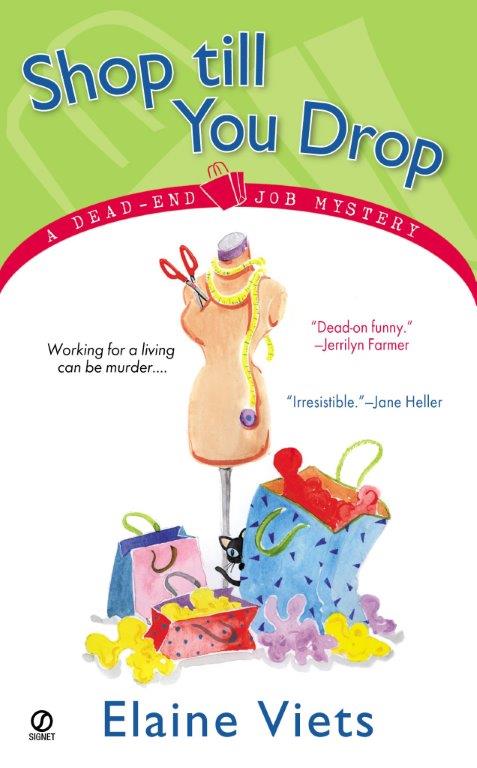
ShopTillYouDrop

In book five, Penguin took the Dead-End Job series from paperback to hardcover. They’d already asked me to write a cozy series featuring mystery shopper Josie Marcus. Josie was supposed to be a three-book series. Dying in Style, the first Josie book, tied with Stephen King’s mystery on the Independent Mystery Booksellers Association list.
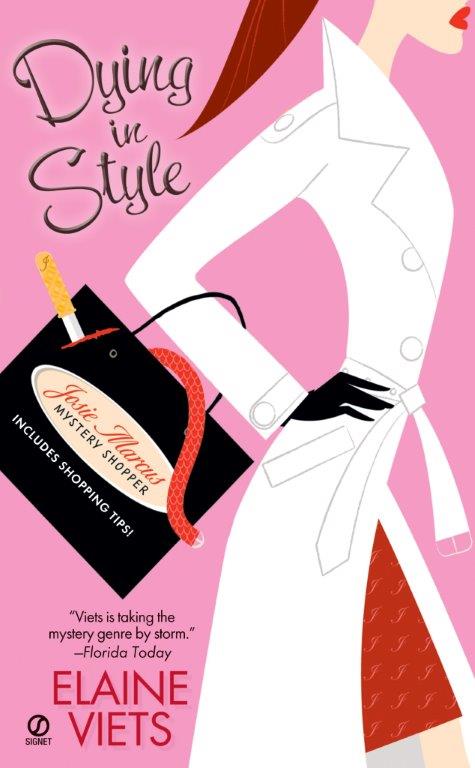
DyinginStyle

I happily wrote two mysteries a year. Suddenly, it was 2015. I turned in book ten of the “three book” Josie Marcus mystery-shopper series. Checked Out, my fourteenth Dead-End Job hardcover, was published.
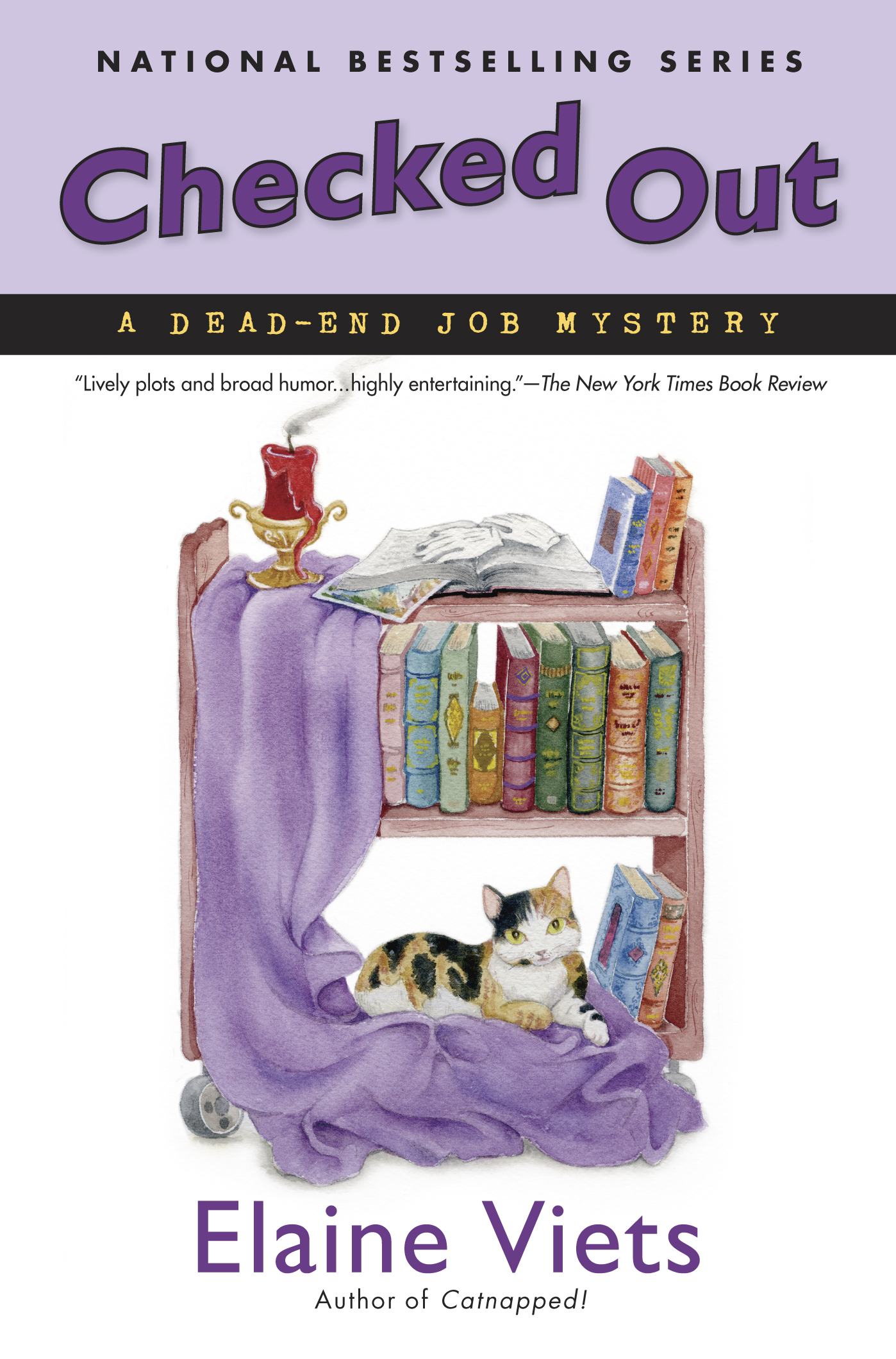
CheckedOut_FC

And I wanted to return to the dark side. After fifteen years of writing traditional, cozy mysteries, I’m starting a dark series featuring Death Investigator Angela Richman. Death investigators work out of the medical examiner’s office. At a death scene, the DI takes charge of the body, photographing it, documenting the wounds, and more. The police investigate the rest of the crime scene.

Why return to this gritty world?

Because I never left. I love cozies, but they’re not all kittens and cupcakes. I prefer relentless Miss Marple, the fluffy knitter who declared “I am Nemesis” and brought killers to justice.
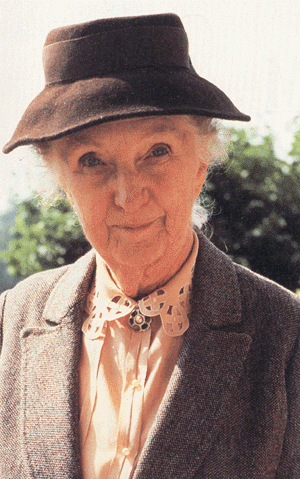
miss Marple

I’d kept writing darkly humorous short stories for anthologies such as Crimes by Moonlight: Mysteries from the Dark Side, edited by Charlaine Harris, and short stories for Alfred Hitchcock Mystery Magazine. “The Bride Wore Blood” was not for the “Say Yes to the Dress” crowd.

This January I passed the MedicoLegal Death Investigators Training Course for forensic professionals, given by Saint Louis University’s School of Medicine. The intense training made sure I had the most up-to-date forensic information.

Look at the agenda for one morning, as taught by pathologists:

Gunshot wound fatalities, explosion-related deaths, motor vehicle fatalities, and drowning. At lunch, we watched a teen driving and alcohol video. After lunch, we studied alcohol-related deaths, suicide, blunt-trauma fatalities, and more.

My mystery writing colleagues welcomed me back. Fourteen top writers blurbed the Death Investigator proposal.

Diamond Dagger winner Lee Child said, “So happy to see Viets back to doing what she does best—dark, edgy, character-driven crime. Count me delighted.”

Ann Cleeves, author of the Vera Stanhope and Shetland series, said, “I think you’ve got everything here that a reader loves—a hospital drama and thriller, a strong central character. Made much more interesting because the central character is a very unreliable narrator.”

Charlaine Harris, who thoroughly explores the dark side, said, “Elaine Viets has written the exciting first book in a multilayered crime novel series. Angela Richman is not only an investigator but a victim in this complex novel of crime, punishment, and medical malfeasance.”

I asked almost two thousand readers if they’d follow me to the dark side. More than 75 percent said they’d read the new Death Investigator series. Almost half said they’d prefer the new series and more than half said they’d read both.

“I would love to see you tackle something a little darker,” one wrote. “As a male, the new series appeals to me.”

Yes, sir. Death Investigator Angela Richman debuts as a short story in the November Alfred Hitchcock Mystery Magazine.
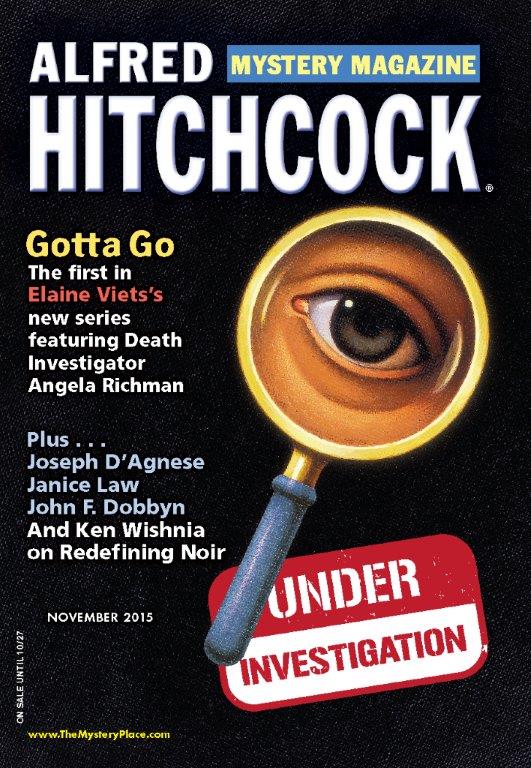
Nov_15_cover

And I’ve signed a two-book contract with Thomas & Mercer for the Angela Richman Death Investigator series. Brain Storm will be out late summer 2016. Fire and Ashes debuts in 2016.

I still enjoy writing about Helen Hawthorne’s lighthearted adventures in South Florida. My 15th Dead-End Job mystery, The Art of Murder, will be out in May 2016.

But Josie Marcus, my cozy mystery series, is now on hiatus. I’ve experimented with all the cozy variations. Josie is in a good place: She’s happy with her new husband. Josie’s teenage daughter, Amelia, is about to become a young woman. Josie’s mother has met a man she loves.

I may bring Josie back some day. But not as a zombie.

What’s Your Self-Editing Score?

imageHow good are your self-editing skills?  Take the following  test, and see how well you score! (The quiz is brought to you courtesy of today’s guest, writer and editor Debbie Burke.)

Self-Editing Pop Quiz

This morning, let’s imagine we’re back in school and the teacher announces a pop quiz to test your self-editing skills. Did you do your homework?

1. Scan your WIP and highlight every form of the verb “to be.” How many times per page did you use:
is ​

are​

am ​

was/were​

had

been

Tally your score:

Fewer than 5 per page:​ Excellent

Between 5 and 10 per page: ​Very good, but could use more active verbs

More than 20 per page: ​Work on how to “de-was” with strong, active, specific verbs.

Many years ago, I took a workshop from the late, great Montana mystery author James Crumley. He shared with me how to “de-was” and I’ve never forgotten. This single skill goes a long way to transform your writing into active, muscular prose.

2. Read the first few paragraphs of each new scene or chapter. Can a reader quickly determine:

WHO is present?

WHERE they are?

WHEN is the scene taking place?

If you can answer these questions, you’ve done a good job of orienting your reader immediately in the story world. Give yourself a point each time you effectively set the scene.

3. Do a global search for what I call “junk” words that add little information and dilute the power of your prose. Score a point every time you delete one of the below “junk” or “stammer” words.

There is (was)

​​it is (was)​

that

​just​

very ​

nearly​

quite​

rather​

sort of

turned to​

started to​

began to​

commenced to

Editor Jessi Rita Hoffman calls the last four examples “stammer verbs” that weaken the verb that follows, i.e. Barbara began to race to escape the zombie.

Stronger version: Barbara raced to escape the zombie.

Stammer verb exception: when an action is interrupted or changed, i.e. Robert started to run, but tripped over the corpse.

4. How many of your characters’ names start with the same letter?

Deduct a point if you’ve christened more than two characters with the same first letter, i.e. Michael, Mallory, Millie, Moscowitz, Melendez.

Deduct a point for rhyming or similar-sounding names: Billy, Lily, Julie.

Extra credit: if none of your characters’ names ends with “S,” give yourself a point for avoiding the unnecessary complication of figuring out whether it should be “Miles’s machine gun,” or “Miles’ machine gun.”

5. Do you exploit all five senses? Writers most often use sight and hearing, and ignore the other senses that can add texture and richness to the reader’s immersion in the story world.

Give yourself a point each time you employ one of the under-used senses of taste, touch, and smell.

Extra credit: for dramatic effect, deprive your characters of normal sensory input, i.e.

A blindfolded kidnap victim who cannot see where captors are taking her.

An explosion-deafened soldier who cannot hear the enemy stalking him.

6. The English language constantly challenges even experienced authors. In the eyes of editors and agents, improper usage of common words marks a writer as an amateur. Choose the correct word for each of the following:

(a) It’s [or] its a beautiful day in the neighborhood.

(b) The bear retreated to its [or] it’s den as winter closed in.

(c) Hurricane Katrina effected [or] affected every home in New Orleans.

(d) The affect [or] effect of Hurricane Katrina continued long after the rains ended.

(e) After the lobotomy, McMurphy possessed a flat affect [or] effect.

(f) The farther [or] further the boat drifted from the shore, the harder Joe paddled.

(g) The further [or] farther you pursue this tangent, the more you lose credibility.

(h) The magician made an allusion [or] illusion to Houdini’s famous “vanishing elephant”illusion [or] allusion.

(i) Robert implied [or] inferred that Janet was a tramp.

(j) Since Janet had been convicted of prostitution, Robert inferred [or] implied she was a tramp.

(k) The witness that [or] who saw the assault ran away.

(l) Winston tastes good like [or] as a cigarette should. (Trick question for those of a certain age.)

Answers at the end. Score 1 for each correct answer.

The Elements of Style by Strunk and White is my go-to reference whenever I’m not sure of correct word usage. I find answers to 98% of my questions in Strunk and White.

7. Scan an entire chapter. How many times is the first word of a new paragraph the name of your character or a pronoun referring to that character (he or she)?

8+ out of 10 times – Normal for the first draft, but try varying sentence structure to begin paragraphs in different ways.

5 out of 10 times​​ – Better, but still needs work.

2 out of 10 times​ – ​You display good variability in paragraph structure.

8. Point of View—do you stay consistently in the same character’s head for the entire scene? Doyou switch point of view only when a scene changes or when a new chapter begins?

How many POV changes can you find in the following passage?

Silky sheets caressed Teresa’s naked skin, as her heartbeat quickened. She watched Zack, framed in the doorway, as he unbuttoned his shirt. Secret fantasies he’d harbored for months were about to come true. Teresa’s heavy-lidded eyes promised a welcome worth waiting for. She quivered inside with trepidation. Would he be disappointed or thrilled? With a sweep of his sinewy arm, Zack whipped back the sheet, stunned to discover Teresa was really Terrance.

Answer: Four. The paragraph starts in Teresa’ POV because she feels the sheets and her heartbeat. Then POV switches to Zack and his secret fantasies, which she might guess, but can’t know about since they’re inside his head. Then back to Teresa, quivering inside. Then back to Zack being stunned.

If you struggle with POV, lock yourself inside the head and body of the POV character.Everything that goes on in that scene must be within the eyesight, earshot, or touch of that character. That means the character might be able to look at his own feet, but he can’t see the broccoli stuck in his teeth. Only another character can do that…and I certainly hope she tells him about it soon!

9. Is the action described in chronological order? Does cause lead to effect? Does action trigger reaction? Is the choreography clear to the reader? Who is where doing what to whom?

If you understand the last sentence, give yourself 10 points and deduct 10 points from my score!

How would you rewrite the following confusing sentence?

George slashed Roger’s throat with the knife as he grabbed him from behind after he sneaked into the warehouse.

How about: ​Knife in hand, George sneaked into the warehouse, grabbed Roger from behind, and slashed his throat.

Just as messy, but much clearer to the reader because events unfold in the order they happened.

10. Do you read your work out loud? If so, give yourself an automatic 10 points.

When you read out loud, you catch repeated or missing words, awkward phrasing, and sentences that are too long. “Glide” is the term used by author/editor Jim Thomsen to describe smooth, effortless, clear writing. Glide is like riding in a chauffeur-driven Rolls Royce as opposed to bucking and shuddering in a 1973 Pinto with bad spark plugs and a flat tire.

For extra credit, have someone else read your work out loud. If he or she can read without stumbling, you’ve achieved glide. Award yourself 25 bonus points.

Answers to 6 (a) it’s, (b) its, (c) affected, (d) effect, (e) affect, (f) farther, (g) further, (h) allusion, illusion, (i) implied, (j) inferred, (k) who, (l) Despite the catchy slogan from the 1950s, correct use would be as. Back then, liquor couldn’t advertise on TV, but cigarettes could. Now liquor ads are common, but few people even remember commercials for cigarettes. How times change!

How did you do? Tell us in the Comments! 

Fewer errors equal less distractions and a more engaged reader. A more engaged reader equals more sales.

And that equals an A+.

image

Debbie Burke lives in Montana, where she greets every morning with coffee and TKZ. Her articles (under the name A. Burke) appear in regional, national, and international periodicals. She has edited numerous published books and enjoys mentoring young writers. Her suspense thriller Instrument of the Devil will be published next summer.

To Revise, or Not to Revise

I have PJ Parrish to thank for my present whereabouts.

My wife and I have been planning a Big Trip to celebrate our 20th anniversary, and the destination — an easy choice — was France. We’ve been researching it for a year, the itinerary growing to a three-week monster with four stops, including the final 10 days in Paris.

Then I read one of PJ’s recent posts two weeks ago, where she told us she was in the Loire Valley in France, sitting on the deck of her chateau (pretty sure that’s not what she said, but it’s what I pictured, because that’s what NY Times bestselling authors do, right?) as she wrote that day’s post.

I hadn’t heard of the Loire Valley, so I looked it up.

Immediately our itinerary changed. Out with Lucerne and Normandy, in with four days in the Loire Valley to tour some of those massive castles and — this time I’ll use it accurately — ancient Chateaus.

I’d like to say I’m sitting on a deck, too, as I write this, but it’s the day before we leave and I owe The Kill Zone at least two posts while I’m gone. So I’ve decided to excerpt my new writing book, “Story Fix: Transform Your Novel From Broken to Brilliant,” which was released in full this week (after two weeks in pre-release on Kindle).

This excerpt is from Chapter 11, “Spinning Hope From Rejection.”  It addresses the quandary we face when our work is rejected — do we simply submit it somewhere else, or do we ponder the story behind the rejection (if there is one) and do a little more work on it.

We join the book on page 168 for the following:

TO REVISE, OR NOT TO REVISE

Then again, every rejection slip does not necessarily signal the need for a major revision. Your story may be perfectly fine as is. The rejection may come from a source you do not understand, and therefore do not value. More often, though, harsh criticism and rejection may actually be the wake-up call the writer needs. And thus, it’s on the shoulders of the writer to know the difference—timing rather than a lack of sufficient craft—and to use feedback in all its forms to accurately assess the story’s strengths and weaknesses and apply that feedback to move forward accordingly. The tools and processes apply to any origin of the need for story repair, however it is conveyed—be it a rejection or simply a depressing hunch that won’t leave you alone.

Worthy stories, some of which go on to success, certainly do get rejected all the time, both by agents and publishers. These are the stuff of urban legend. Do a quick Google search and you’ll find them everywhere. I’ll mention again the quote from esteemed author William Goldman: “Nobody knows anything.”

It’s too true. But it’s also a risky way to place your bet. Because you could rationalize the rejection of your story as simply a case of timing or another agent who doesn’t get it rather than a legitimate red flag that should get your attention. We can be sure that Kathryn Stockett didn’t revise her manuscript forty-six times, one for each instance of rejection. But because she hasn’t talked about it, we can’t say for sure how those rejections colored her subsequent sequence of drafts, if at all.

Right here is where a paradox kicks in: If you don’t possess the knowledge to nail it the first time out, and are now stuck with the need to revise, how can you leverage feedback and rejection in the writing of a subsequent draft to solve those problems? You’re the same writer who wrote that flawed story. How can you suddenly, without elevating your skill set, attempt to hoist good toward greatness? That’s like asking a toddler who has just fallen off his bicycle to simply get back up and try it again, without showing him what went wrong. A lot of fathers have tried just that method over the years—“It builds character,” they say—and it’s always a recipe for further frustration and tears, as well as a few Band-Aids.

You can’t expect to take your story higher with the same skill set as before, at least to the extent that you don’t understand the feedback itself. But you’re here, you’re learning the unique tools and principles that drive successful revision, and that just might change everything about your next swing at the story.

As professional writers we are beyond the need to use our work as a means of personal character building. We require knowledge applied toward the growth of something much more amorphous and elusive: a heightened storytelling sense.

You can no longer be a suffering artist first and foremost, and a professional writer, too.

A starving professional writer, perhaps, but suffering is optional in the professional realm, because there are tools and principles to rely on. Suffering artists can, and do, create their own boundaries and standards for their craft. They can blame those chatty muses they’re always listening to, and in essence they may choose to believe they can do this thing called writing any way they choose. Because it is art. Market expectations and principles be damned. But even the most ardent followers of organic craft align with the principles that make a story work, so process really isn’t the question at all, at any level. Criteria, benchmarks, and principles are what matter, combined with passion, vision, and the perseverance that is surely part of the job description.

In the long and dark list of reasons why a story doesn’t work, why it gets rejected and requires extensive repair, the writer’s need to suffer is a common seed of dysfunction. It leads to procrastination, the claim of unfairness, and an ignorance of the options. Writers who don’t summon the context of the principles of craft as part of their story sensibility, who go about it in the belief they can invent the structures and tropes and forces that make stories work, tend to populate the roster of the rejected, and sadly, colonize the roster of the self-published, casting a shadow over the multitude of very fine self-published books right next to them.

Even when this happens to a small degree, success becomes elusive.

Your art, in this case, wrapped in the limiting paradox of your process, often becomes your excuse for not finding an agent, or not selling when you do. “They just don’t get me” is the graveside plea of the unpublished, unprofessional writer.  While, in the meantime, the professional writer stays in the trenches to learn what went wrong and how to fix it.

First Page Critique for Instrument of the Devil

Jordan Dane

@JordanDane

Smartphone image - free license from Wikipedia Commons

Smartphone image – free license from Wikipedia Commons

Please enjoy Instrument of the Devil, submitted anonymously for feedback. My comments are on the flip side.

INSTRUMENT OF THE DEVIL – A suspense thriller

“Instrument of the devil!” Tawny Lindholm glared at the new smartphone that her well-meaning son had sent for her fiftieth birthday. “I can’t even figure out how to call for help.”

 
The glossy black screen reflected her scowl while a musical tone dinged. What did that mean? She had tapped, swiped, and imitated other gestures she’d watched people make while zipping around the screens of their phones. They got directions, played games, texted, and now and then, made a plain old phone call. It looked so simple.

 
The screen remained blank, indifferent to her frustration. “If someone calls me, I don’t even know how to answer you.” The damn thing had her talking to herself.

 
A different tone chimed five times. Was this an incoming call? Or had she accidentally told the thing to launch a missile?

 
While Dwight was sick, she’d used a simple cell phone, no problem. Flip it open, punch in numbers, and connect with doctors, the oxygen company, friends, and finally, on a July night nine months ago, the funeral home.

 
Tawny didn’t need this monster that barely fit in her palm.

 
The bubble package came from an online retailer with a printed message on the address label. Happy Birthday, Mom. Love, Neal. She couldn’t even return it to a local store. If it hadn’t been a gift from him, she would gladly have smashed it against the wall. She still might.

 
She decided to name the thing Lucifer.

 
She sat at the breakfast bar, fingering a postcard that had arrived in the mail, along with the birthday package. Baffled by your smartphone? Free class. Easy, fun, impress your grandchildren. If she went, she’d be the dumbest one there. But how else could she learn? No instruction booklet had come with the phone.

 
The oldies station Dwight had liked played in the kitchen. The Temptations’ “Ain’t Too Proud to Beg” faded out. “I’m begging someone to put me out of my misery,” she answered the radio.

 
The announcer came on, promoting the same free class described on the postcard. Tawny turned up the volume. “Learn how to operate your smartphone. Tonight, seven o’clock, at the library in downtown Kalispell.”

 
First, the postcard, now the radio ad. Someone was sending a message. Might as well pay attention. Besides, what else did she have to do, except sit home in a silent house, listening to mysterious beeps and whistles on the phone?


Feedback:

1.) This intro is for a suspense thriller. but it reads more like a cozy mystery to me since it starts off with an almost funny scene of a woman trying to navigate a new cell phone.(I could definitely relate.) The title – Instrument of the Devil – seems to refer to the phone itself. Presumably if the cell had a previous owner, who carries a pitch fork and dons horns, the plot could turn into something scarier than the latest Google app. We only have 400 words or so to make a determination if we want to read further, so every word is a precious opportunity to snag the attention of an editor, agent, or a reader. In my opinion, this intro sends a mixed message, if the author intends for this to be a thriller.

2.) The narrative starts with the woman already dealing with her confusion over the new cell, yet later in the story describes how the cell came packaged in bubble wrap, which takes us back to when she first received it. I found that a bit jolting so I would recommend “the bubble package” line be moved to the start so the action reads in order and creates a bit of mystery for what’s in the package.

3.) I liked how the author inserted a quick backstory bit about Dwight and how this poor woman had been dealing with a sick husband who later died. The whole sad incident was expressed in terms of the cell phone. Clever. So I would recommend the mystery package arrival be quickly followed by the woman’s tragedy, so the reader is even more sympathetic.

4.) Everyone knows a cell phone does NOT come set up. If this one did, the author should play that up for a bigger mystery to draw the reader in. The way it reads now, it seems as if the author made a mistake on how phones usually come or makes Tawny seem foolish not to question the obvious.

Example:

Tawny Lindholm stared down at the opened package and sighed. She would never have ordered it. A smart phone came bubble wrapped from an online retailer with a printed message on the address label. Happy Birthday, Mom. Love, Neal. Her well-meaning son had sent it for her fiftieth birthday. She couldn’t even return it to a local store. If it hadn’t been a gift from him, she would gladly have found a way to get his money back. She still might.

While her husband Dwight was sick, she’d used a simple cell phone, no problem. Flip it open, punch in numbers, and connect with doctors, the oxygen company, friends, and finally, on a July night nine months ago, the funeral home.

Tawny didn’t need a phone smarter than she was, one that barely fit in her palm. Still, she might’ve given it a try if it came with instructions. For heaven’s sake.

“Instrument of the devil!” Tawny glared at the new cell. “Whoever set you up should’ve known I needed help. I can’t even figure out how to make a call.”

The glossy black screen reflected her scowl while a musical tone dinged. What did that mean? Who had set up her new phone…and why didn’t it have instructions?

“Oh, this is ridiculous.”

She had tapped, swiped, and imitated other gestures she’d watched people make while zipping around the screens of their phones. They got directions, played games, texted, and now and then, made a plain old phone call. It looked so simple.

The screen remained blank, indifferent to her frustrated prodding. “I wouldn’t even know how to answer you.” The damn thing had her talking to herself.
A different tone chimed five times. Was this an incoming call? Or had she accidentally told the thing to launch a missile?

Without an operating manual, she’d be dead in the water. She sat at the breakfast bar, fingering the only reading material she had on the phone. A postcard had arrived in the mail, along with the birthday package. Baffled by your smartphone? Free class. Easy, fun, impress your grandchildren.

Tawny shook her head. If she went, she’d be the dumbest one there. But how else could she learn without an instruction booklet?

 
The oldies station Dwight had liked played in the kitchen. The Temptations’ “Ain’t Too Proud to Beg” faded out. “I’m begging someone to put me out of my misery,” she answered the radio.

 
The announcer came on, promoting the same free class described on the postcard. Tawny furrowed her brow and turned up the volume. “Learn how to operate your smartphone. Tonight, seven o’clock, at the library in downtown Kalispell.”

 
First, the postcard, now the radio ad. Someone was sending a message. Might as well pay attention. Besides, what else did she have to do, except sit home in a silent house, listening to mysterious beeps and whistles on her annoying new phone?


What about you, TKZers? Any feedback for this brave author? Would you keep reading?

Can You Pass the 69 Test?

book-of-my-heart-1

By PJ Parrish

Now that I have your attention…

No, I am not going to talk about sex again. Not even bad sex with a limp penis, which as we writers know is a helluva lot more fun than good sex. I want to talk about finding the heart of your story. And to do that, you have to try this little exercise:

Get out your book or call up your Word doc manuscript. (For our purposes here, “book” means published or un, completed or not. “Book” is that thing that has been keeping you up lately.)

Open it to page 69. Read what is there. I don’t care if it’s a full page or the last two lines of a chapter. (If you hit a blank page, you have permission to use either 68 or 70 but that’s as much cheating as I allow.)

This page — this single page — capsulizes your entire book.

You don’t believe me, do you. I didn’t believe it either until I tried this experiment. I did it a couple years ago at the request of Marshal Zeringue, executive director for the Campaign for the American Reader. Marshal has this terrific blog wherein he promotes reading. Sez Marshal: “The goal of this blog is to inspire more people to spend more time reading books. I’ll try to do that by shining a little light on books that I like and think others might find worthy of their time and attention.” CLICK HERE to see his blog.

He also came up with the Page 69 Test. He was inspired by Marshall McLuhan’s suggestion that you should choose your reading by turning to page 69 of a book and, if you like it, read it. Zeringue tried it with Richard Dawkins’ The Ancestor’s Tale, and was so taken with the results he devised the Page 69 writers challenge.

On his blog, Zeringue has asked dozens of writers to answer the question: Is your page 69 a good place to get a sense of your book?

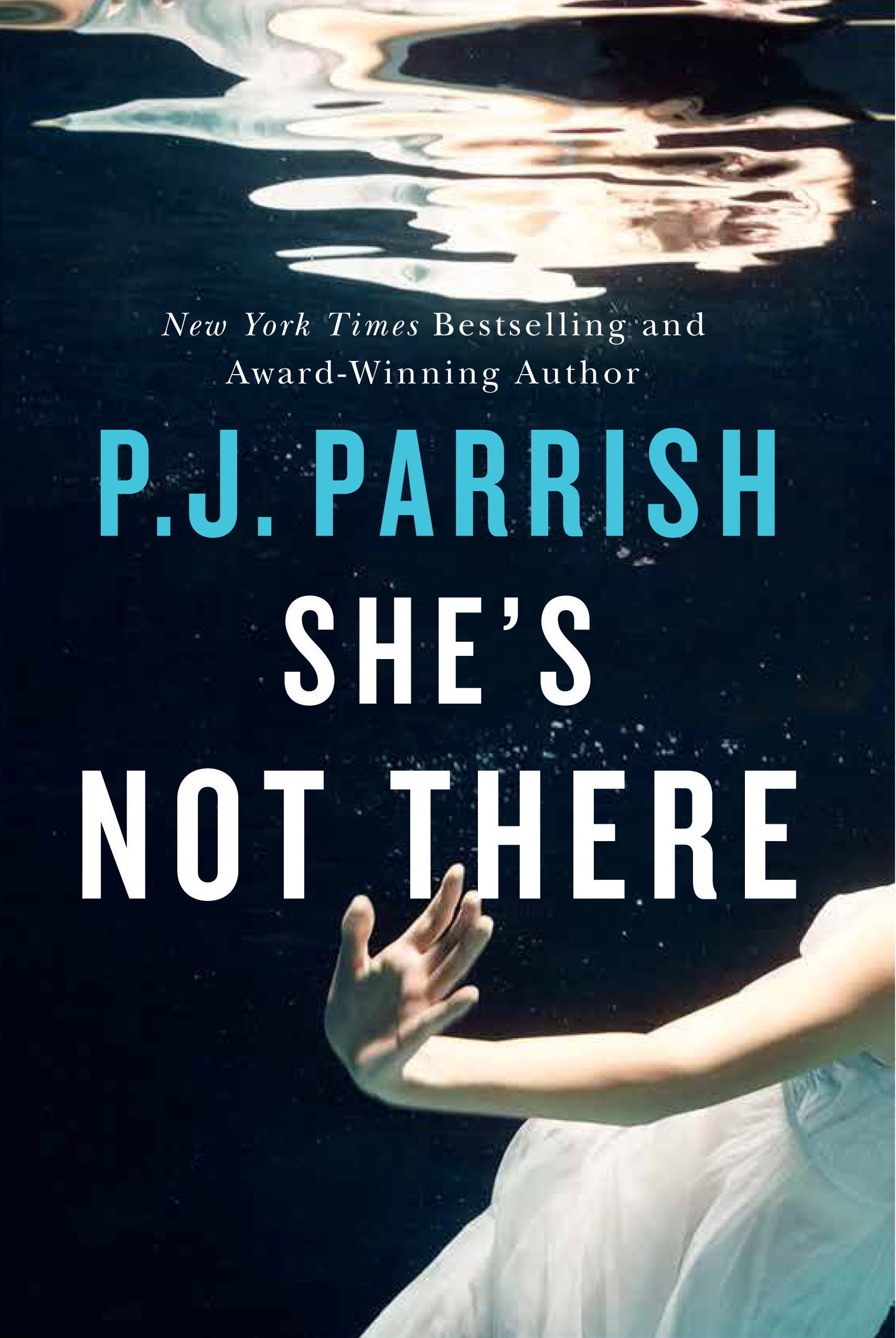
When I first picked up Marshal’s gauntlet, it was for our book AN UNQUIET GRAVE. (CLICK HERE to go read those results) But the other day, I decided to apply the test to our newest book, so I cracked open SHE’S NOT THERE, which was just released this month. Here is our page 69:

“When you call her phone, does it ring before it goes to voice mail?”
Tobias shook his head. “The police told me the phone was turned off. They said that’s why they couldn’t use the GPS to find it.”
“They can trace the phone’s last location. Have they told you anything?”
“Yes. They said her last known location of the phone was about two miles from where her car was found. But they never found the phone or her purse.”
“What about the car’s GPS?”
“It doesn’t have one.”
“And you don’t know where your wife was going?”
Tobias shook his head slowly. He picked up his glass, staring down into it for a long time, then finally took a drink.
“What do you know about the accident?”
“Not much. They said the car spun off the road in the Everglades.”
“Everglades?” What was your wife doing driving alone in the Everglades?”
Tobias stared at him for a long time, as if he were trying to figure something out. Then he shook his head. “I don’t know.”
What the hell did this guy know?

FINAL COVER

Here’s what has happened before this. A woman wakes up in a hospital, bruised and with a concussion. She has no ID and can’t remember how she got there. All she had on when she came in was a Chanel dress and a 10-carat diamond. But when she hears her husband’s voice (Tobias), she freaks and bolts from the hospital, sensing he tried to kill her. The husband has hired a skip tracer to bring her home and the tracer is interviewing the husband for the first time. Does it give a good sense of the book? Oddly enough it, does. As truncated as it seems, the passage crystalizes a main plot point. The skip tracer suspects Alex Tobias, a rich lawyer, has something to hide, and he knows that every marriage has dark currents running beneath. So the skip tracer’s final thought on that page — what did the guy know? — is the existential question behind the whole plot. This is a husband who actually knows nothing about his wife. Which is why he might have tried to kill her. Or not.

I have to say that I went into this experiment a skeptic and emerged a believer. When I first did this years ago, I thought it was a bunch of hooey. But I think it reveals a kernel of truth about both our books. Each passage, in its way, gets to the heart of our story.

Okay…back to your own page 69. How does it work for you? What is there on this one single page that somehow serves to represent the very heart of your book? Think hard. It’s there. If it’s not? Well, maybe, just maybe, you haven’t really found the heart of your book yet.

Let me know what you found out. Be brave and share your 69s here and let us be the judge!

Postscript: I am on vacation this week, roughing it in the wilds of the Loire Valley. I wrote this before I left and I think I will be able to answer. If I can’t…talk amongst yourselves! Also, our book is finally out..The South Florida Sun-Sentinel critic Oline Cogdill calls it “captivating.” Author Hank Phillippi Ryan, calls it “Taut, tense, and twisty—this turn-the-pages-as-fast-as-you-can thriller is relentlessly suspenseful.” Here’s the LINK.

Insights into the Dreaded First Page

I attended my first local Society for Children’s Book Writers and Illustrators (SCBWI) conference here in Colorado last weekend and there was a strong emphasis on the dreaded first page – one session was devoted to reading random first pages aloud to two editors (I was too chicken to enter!) and in another, more intensive session, the first 3-5 pages of a new novel were evaluated (I did bravely submit for this one!). We’ve dealt with a number of first pages here at the Kill Zone and, although this conference was focused on children’s books (ranging from picture books to middle grade and young adult), the same issues (unsurprising) reared their ugly heads, so I thought it would be helpful to distill and share some of the advice the editors and agents gave on those all important first pages.

By way of background, the two editors who conducted the first page session were Andrew Karre, executive editor at Dutton, and Stacy Whitman, founder and publisher of Tu books (Andrew also provided the novel intensive session). I also attended a session with Kristen Nelson, an agent, where the group evaluated query submissions (which in most cases focused, once again, on those dreaded first pages).

Here’s the advice, distilled and summarized as best I can:

Start with intrigue, leave explanations and extensive backstory for later

Many of the first pages evaluated fell into the trap of over-explaining (usually by way of character backstory) and succumbing to large chunks of narrative exposition before the action even got going. All the editors and agents agreed that the first pages of a novel must intrigue and raise questions in the reader – if those questions are answered too soon then there is no real payoff for the reader and, hence, no reason for them to continue to read. The difficulty comes when trying to achieve the next key point: anchoring your reader in time and place.

Anchor your reader, nonetheless in place and time

Some first pages provided a great deal of mystery and intrigue but too little in the way of ‘grounding’ so the reader felt lost before the story had really begun. Some pieces sounded contemporary only to turn out to be historical (and the reader had no way of knowing the setting or time period from the start which was disorientating). Some pages began with dialogue and no real foundation for the reader to visualize where that dialogue was taking place. Again, the editors all emphasized that a first page has to serve two purposes – to draw a reader in and hook them with the story and also to provide them with enough basic information to know where and when the story was taking place so they were willing to go along for the ride (rather than thinking ‘huh?!”) from the get go.

Overall, the editors emphasized, a balance has to be achieved between action and intrigue, questions and answers, exposition and dialogue. This is no easy task but one that enables a reader to get hooked on the story, suspend disbelief, and  want to keep turning the pages to discover the resolution to the issues raised.

Make sure you have a clearly established ‘voice’ and choice of POV from the outset

In the novel intensive program, this issue was raised a number of times as we discussed the choice of POV used in our crucial first pages. Sometimes the choice of first versus third person felt strange or forced, sometimes it was clearly the way the story needed to be told. The key element was one of deliberate choice by the author rather than lack of certainty over voice or POV (which comes through as inconsistency or uncertainty in the writing).

Avoid dialogue that sounds like it’s only for the reader’s benefit

All too often the dialogue in some first pages was too obviously providing information for the reader and so it felt forced and inauthentic. All the editors agreed that authors should avoid using dialogue as a backhanded way of introducing exposition or in a way that sounds like people are only telling each other facts or backstory for the reader to ‘overhear’. The critical element, once again, was to create a sense of authenticity and voice when using dialogue in the all important first few pages of the book.

Avoid mixed metaphors or overly ‘intellectual’ or ‘precious’ turns of phrase

As part of the editing process, the editors emphasized trying to pare down the first pages as much as possible so extraneous information is left out and readers aren’t slowed down by turns of phrase or metaphors designed to impress rather than move the story along. When we discussed this in the first pages session, the editors also emphasized that authors need to be aware of inadvertant ‘micro-agressions’ that come from using racially stereotyped or inappropriate phrasing. One of the main topics for the SCBWI conference was the issue of diversity in children’s literature (or rather the lack thereof) so this came up occasionally when dealing with the initial pages of some authors’ work.

So there you have it – further insights into the pitfalls to avoid in the first pages of your book! While there were no real surprises in terms of the feedback provided, I think it never hurts to have these issues repeated. Feel free to add your own comments or further insights…


How to Launch a Thriller Series

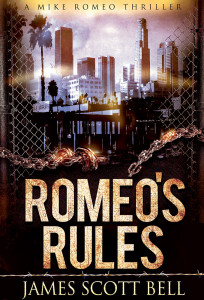
rocket-launch-67720_1280It’s launch week for me as I begin a brand new thriller series. I’m excited about this one, as it’s been bubbling around in my brain for some time. Now the first Mike Romeo thriller, Romeo’s Rules, is out, and two more are cooking.

So I was thinking about the steps one ought to go through when unleashing a new series. Here’s what I came up with:

  1. Create a character who grips you and won’t let go

I wanted to write about a guy who can fight, and who was admitted to Yale at age fourteen. I kept developing his backstory until he demanded to be written. That’s what you need for a series character, because you’re going to be with him a long time. In my workshops I suggest an exercise: what would your character have tattooed on his or her arm? You don’t have to put it there, of course. It’s just to dig further into character. When I figured out what tattoo Romeo would have –– and I did put it on his arm –– the character was complete. You’ll have to read the book to find out what it is. #Shameless.

  1. Come up with a twisting, turning plot for that character

The plot begins as Romeo is out for a jog … and a church blows up. He stops to help a bleeding woman, then finds a dead body in the church, and it’s not because of the blast.. The cops arrive. And that’s in the first three pages.

  1. Develop 2-3 other plots for the next books in the series

It helps your confidence to know the series will have some legs!

  1. Write the book

I believe this is an essential step.

  1. Have the book professionally edited

This is the biggest expense you’ll have in the indie-publishing process. But a good, experienced editor who knows the genre is worth every dime.

  1. Get a cover concept for the series (so the covers have a similar feel)

RomeosRules_med

  1. Write the book description copy

I tried something a little different with Romeo’s Rules. Actually, it’s a blast from the past. On many paperback originals of the 50s and 60s, the copy would contain a tag line, then some dialogue from the book (or a bit of a scene), then short, to the point sales copy after that. It’s my homage to that great era of genre fiction.

If you want to stay alive, you better know the rules …

Natalia Mayne said, “What’s the first rule?”
“Fear nothing,” I said.
“You have any more?”
“Do unto them before they do unto you.”
“Really?”
”And you don’t owe the truth to people who lie.”
“I’ve never met anybody like you.”
“I’ve heard that before.” 

Mike Romeo is an ex-cage fighter living off the grid in L.A. Running from a dark guilt that dogs him, he’s finally found a place where he can rest and even heal.

Then a church blows up. And with it all of Romeo’s hopes to be left alone. When he stops to help an injured woman whose kids are missing, someone decides to put a target on his back.

But whoever wants him dead picked the wrong guy. Because Romeo has rules. And he’s about to teach some lessons.

  1. Try to create a little pre-release buzz (e.g., post the first chapter for viewing)

I did that a few weeks ago.

  1. Publish the book to retailers

As an indie, you can create direct accounts with the main retailers, or you can use a service like Smashwords or BookBaby to do all that for you. I prefer to do it myself.

  1. Tell people it’s published.

Hey! It’s published!

Here’s where you can get it

AMAZON

BARNES & NOBLE

KOBO

A print version will be coming soon.

Bonus step: Commission a book trailer. My rule of thumb is that a trailer should be 30 – 45 seconds. Here’s mine:

Oh yes, one more step: get to work on the next book! I’m already into Romeo’s Way. 

So what do you look for in a series? What makes you read on … or stop reading?

First Page Critique – “Bird Without a Song”


“Bird Without a Song”

Prologue

       Somewhere near the end of my tour of duty in Vietnam, soon after I held the baby in my arms and felt him die, I began to imagine them. At first they were only quick movements in the corners of my tent but soon I began to see them in front of me. Some faces were clear, Corporal Terwilliger, Major Ayres, Corpsman Cooper, but there were strangers, too, ones I didn’t remember but who were familiar all the same. Some were faces from stretchers on fatigue-shattered nights when flares and panic were stabbing at us. I knew they were dead, too, even without names. There were hundreds of them. Thousands. They stood and waived to me from shadows when no one was around. They were small, and full of life.

      “I wonder if this is what heaven is like. You see all your friends again but they’re tiny. I’ll have to ask the little people,” I said to my crew chief one day while sweeping blood out of our chopper. I recognized the stare of concern he gave me. Shrugging, I laughed and pretended to be joking. I never mentioned them again. But they were real to me and, in time they began to talk. Major Ayres was the first to speak. “Tell my girlfriend I loved her,” he said.

      “Did they send my Air Medal to my mom?” Corporal Terwilliger asked.

      “You didn’t know me, but thanks for bringing my body back from the jungle,” one I didn’t remember said. I told them I would do everything I could to tell everyone they were safe and still alive. 

        When it was my time to leave, I tried to say good bye. 

      “We’re coming with you,” they told me in chorus.

      “I can’t take you back to the States. Someone would notice.”

      “They don’t see us,” Major Ayres argued. He was good at arguing. At his request, I was writing to his girlfriend’s fourth-grade classroom in Virginia to tell her students what Vietnam was like. “We will all fit quite nicely in your sea bag,” the major added.

        “Of course. That’s right, Sir. Others don’t see you. But why do you want to come with me?”

      “We want to be there when you tell our families we died with honor. When you tell them we’re still here and still love them. You must help keep us alive.”

      “But you’re dead, Sir, you all are.”

      “Not if you write about us,” a nameless ones said.

My comments and critique

It’s easy to assume that, because of the title of this Kill Zone feature – “First Page Critique,” that criticism is inevitable. That the submitted page is by definition flawed and in need of counsel.

But I’m happy to say that, in my humble opinion, this first page is on fire. It’s a fantastic launch for a novel, and while we can’t quite tell where it’s headed (not a requirement of a first page), we already know that we, like those dead guys that are attaching themselves to our hero, would like to come along for the ride.

What’s worthy of mentioning here, though, with a view of making this stellar page even better, falls more into the category of editing than it does story critique.

The second paragraph benefits from a tweak to the initial dialogue, moving the attribution to an earlier position, and then pushing the closing line (from Major Ayres) to a new paragraph. It’s a mistake to stuff lines of dialogue from different speakers into a single paragraph (not a hard and fast rule, but this one qualifies). And then, there’s another natural paragraph break in the middle, all of these edits contributing to a cleaner read.  I’ve rewritten it here:

      “I wonder if this is what heaven is like,” I said to my crew chief one day while sweeping blood out of our chopper. “You see all your friends again but they’re tiny. I’ll have to ask the little people.”

      I recognized the stare of concern he gave me. Shrugging, I laughed and pretended to be joking. I never mentioned them again. But they were real to me and, in time they began to talk. Major Ayres was the first to speak.

       “Tell my girlfriend I loved her,” he said.

The paragraphing was perfect from that point forward, as was the writing and the chill it shoots up the reader’s spine, with echoes of buried themes of war and personal loss emerging from between the lines.

I say.. bravo to this author. Keep going, this is a great start to what we can already tell will be a powerfully dark and personal story, perhaps the stuff of a bestseller someday.

What say you, KZ readers?

On Fishing For A Story

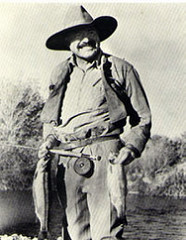
Hemingway Fishing

Ernest Hemingway working on his hook.

Analogies about writing, especially about how to write, abound. In my first writing book I beat them to death (because I love analogies), and have since been beaten senseless by some reviewers who don’t care (or know) that analogies are a proven and strategically effective way to teach.

So I was delighted to see Jim Bell’s analogy about playing basketball a couple of weeks ago (and another in the first paragraph yesterday), if nothing else than it allows me to point to him if someone reading TKZ isn’t appreciative of the analogy I am about to offer in today’s post.

Thanks, Jim, for opening that can of worms (itself an analogy, for the record).

All of the analogies I have employed – flying an airplane, playing golf, cooking, building a bridge, a few others – become a thematic chorus when considered en masse. The message is clear, and twofold: professionals can wing it and play loose with the core principles (just like when Michael Jordan shot and made a free throw in an NBA game… with his eyes closed), in a way that less experienced cannot and should not.

At the core of each of these avocations there are unimpeachable truths…

… essential physics that are not to be messed with. When a proven professional does so – and we all do it from time to time… because we can – even a little, they do so in context to an evolved storytelling sensibility and learning curve that a newbie does not yet possess.

In effect, they can do it with their eyes closed, in a way that would make the rest of us look silly.

You don’t tee off with a putter in the name of your art, you don’t under-cook the chicken in the name of table appeal, you don’t build a bridge on sand for obvious reasons, and so on.

The second thing is this: the same is true, every bit as true, for authors who are navigating, cooking up, teeing up, or building a novel. Mess with the core physics of the craft and your story will crash and burn. And when you are rejected, it will most likely be because of an ignorance (as in, to ignore) or a lack of regard (as in, to over-estimate your skills) of the core physics of storytelling.

And so we come to today’s analogy: fishing.

When I was a kid my father took me fishing several times each summer. He selected the tackle, baited the hook, threaded the line, made my casts and, when something nibbled, put his hands on mine as we played the line before setting the hook and reeling in. Then he gave me credit for landing “a big one.” The result was a few fabulous rainbow trout breakfasts and more than a few thrown-back bottom fish, not to mention some of my most precious childhood memories.

There came a point when I was a teenager too cool to fish with my father, so off I went with friends to fish on our own and talk about girls we could not catch from the bank of a river containing fish we could not catch. That period of my fishing life lasted about ten years, when that teen independence gave way to young adult cluelessness.

Over that decade, I caught exactly zero fish.  Not one.

Because I was imitating what I had seen my father do for me, and had been too proud or busy or stupid to learn those basics on my own. He smiled when he realized the life lesson to be learned from this failure, a lesson that took years to sink in for me.

I haven’t been fishing since, perhaps disqualifying me from using this analogy at all.

Except… it works.

I can’t help but think about how those fundamentals and processes of fishing are parallel in every way to the experience of learning how to write a novel. How the selection of the story, the way we set it up, the way we play the line and set the hook, are not only essential, but complex and nuanced, not remotely something that can be done without instruction or via imitation.

New writers must be excused from what they don’t yet know, because there is something noble about attempting to learn by doing. At least for a while. But when that takes place in a vacuum, without a parallel experience of learning and apprenticeship, the nobility of it fades away like a fish fleeing from a poorly tied fly.

Most writers come to the intention of writing a novel based upon their reading experience…

… usually joyous, but often riddled with a wildly uninformed belief that they can do what those authors they read can do, or worse, do anything they want – as a reader of novels. Some writers believe this is all you need, that writing is purely intuitive, a misperception reinforced because so many of the authors they’ve read made it look easy.

Logical and functional is not synonymous with easy. Just ask Michael Jordan as he lined up to shoot that free throw with his eyes shut.

Writing stories from this limited base of knowledge is no different that believing you can fly the plane after years of sitting in coach… that you can whip up a killer chicken piccata because you’ve been ordering it for years at the Cheesecake Factory (their best dish, by the way)… that you can hit a nine iron off the tee of a 205 yard par three because that’s what Tiger does… or that you can design and build a functional bridge because you’ve been driving across one for years on your way to work.

Or – I forgot perhaps my favorite analogy, so here goes: You believe that you can take out your own appendix because it took your doctor only fifteen minutes to get that job done. (I smiled when I just saw that Jim used nearly this exact analogy yesterday in the first paragraph of his terrific post; analogies are universal and eternal, and they often speak things more clearly than the direct route can achieve.)

My wife, who is an excellent cook, has for years been trying to nail a chicken piccata that holds a candle to the Cheesecake Factory’s (the recipe for which is not for public consumption), and she’s finally resigned to simply going there to enjoy this dish. Just like we can try to write like Stephen King, using his process (as described in his book, On Writing*), but until you know what he knows, that may not – probably won’t – serve you.

By implication, King is saying that all you need to do is just write. Imagine a surgeon being told, in her first year of med school, that all she needs to do is just cut.

Of course those are silly and obvious comparisons. 

And yet, so many writers attempt to write a novel from an equally consumer-focused and over-simplified learning curve (and dare I say, naive), and as a result they inevitably crash, burn, throw up and, like me, fail to catch a single fish for decades or more.

But that’s not you, you’re saying. You attend writing conferences and read all the writing books, maybe even mine and Jim Bell’s.

Which is great, keep going. But ask yourself this: are you truly and deeply internalizing the principles you read there, and are you practicing and applying them in a way that trumps the in-the-moment bliss of storytelling, which is what some writing gurus tell you is the only thing you need to pay attention to?

Do you know the difference between a concept and a premise?

Do you understand the nature of classic story structure, or even believe in it in the first place? Do you know the role of theme in a story? Do you understand what creates drama and suspense, and how to pace it over the arc of the narrative?

Do you believe you can simply make up the forms and standards and processes by which these things are made manifest in your story?

Professional writers know these things, and they just don’t do it any other way than the prescribed and proven way, no matter how they choose to describe their process.

Something to think about the next time it’s just you and a pole on a peaceful afternoon at the river, waiting for the next story to descend upon you from heaven.

*****

*In his book On Writing, King advises writers to take their initial story idea and just sit down and start writing from it, allowing an inner sense of story to help navigate the road leading to the best possible story. He omits, however, to add that this works for him, which by definition could mean that unless and until you know what he knows, the results you achieve may not compare to his, and thus, rendering this among the worst writing advice ever rendered… this being my opinion, of course. I’m no Stephen King, either, but at least I know what a writer must understand before that or any other method of writing a story will bear fruit, or not take you a decade to write, which is why I’m here.

*****

Larry’s new writing book, Story Fix: Transforming Your Novel from Broken to Brilliant” is available now in digital formats on Amazon.com and BN.com, and will be out in trade paperback within the next few weeks. Analogies kept to a minimum, he swears.  Visit Larry’s website at http://storyfix.com/.

Flickr photo from Don…The UpNorth Memories Guy… Harrison.