First Page Critique: Indianner

By John Gilstrap

Let’s go right to the piece submitted by our brave writer, and I’ll see you on the other side.

INDIANNER

CHAPTER ONE

Megan’s long nails played across the keyboard. Click. Click. Click. Acrylic on plastic keys. She paused, staring at the poster hanging above her computer. Grabbing a black marker, she leaned over her monitor and circled the faces of the three Native Americans dressed in traditional regalia. Circled their faces until she wore a hole in the paper. Around her bedroom, posters of gothic metal bands fought for the remaining wall space. Their dark lyrics appealed to her. She smiled as she glanced around the room at the black-circled faces staring back at her from every corner. A few more words and she was done. Click.

She refocused on the poster with the Native Americans: two women and one man, appearing in a musical performance that night in Frankfurt, Germany, a short walk from Megan’s hometown of Bad Homburg. This was her second time seeing the Navajo singer/songwriter Doli Yazzie in concert. Last time was disappointing; this time Megan was better prepared. She had post-concert passes in her purse, won through a contest held by Doli via her Facebook Fan Page. Megan was fascinated with all things Native American. “Dances with Wolves” and books by German author, Karl Friedrich May, were  cult favorites of Germans and other Europeans who followed their own version of the pow wow trail. As popular as the Renaissance Faires in the United States, the teepee camps and Indian pow wows arranged by and for Non-Natives were scheduled throughout the year in Germany and other countries. Megan was an active participant.

Shawnee/Creek flute player, Ella Longhat, and Ella’s husband, Caddo/Shawnee Charlie Longhat, a noted Native film producer and pow wow dancer, were something of an afterthought for her. Took up too much space on the poster, she thought. She was only interested in Doli.

“Megan, come on. We’re waiting on you. Momma says hurry. We’re going to be late.” Her little sister banged on Megan’s locked bedroom door.

“Go away, brat. Leave me alone. I’ll be there in a minute.”

Megan stood up, repositioned her chair, and rearranged her desk, squaring off a stack of paper, realigning pen and pencil. She glanced back and forth from Doli’s poster to her full-length mirror as she dressed in black pants and black t-shirt, the same way Doli dressed for concerts. Megan imagined herself looking like Doli, but Megan was a large girl, nearer to woman than child, a recent high school graduate working at a local American fast-food franchise. She brushed her dyed black hair, muttering as she covered a lighter section with a green parrot feather, and applied blush and lipstick to her pale face. Glancing one more time at her reflection, the poster, and a final time at her reflection, she joined her mother and two younger sisters. They walked in silence to the concert hall.

=

It’s Gilstrap again.

What a ride, huh?  A gripping tale of . . .

Wait.  Nothing happened.  No, seriously.  Nothing.  Happened.  In 474 words, Megan made circles on posters, thought a lot about music that is entirely unfamiliar to me, and she got dressed.  The purpose of this exercise is to learn how to grab readers’ attention with exciting prose that is worthy of the single most valuable patch of real estate any book can have.

Whether writing a thriller, a mystery, a romance or a literary novel, something needs to happen that will engage the reader.  The first paragraph needs to make us hungry for the second paragraph.  Ditto the first page for the second page.  This piece disappoints at every level.

Now, let’s talk about the writing itself, which feels young to me, and is not without promise.  Here’s the first paragraph again, but annotated:

Megan’s long nails played across the keyboard. Click. Click. Click.  As written, the nails are acting independently.  I would prefer that Megan drives the action: Megan played her fingers across the keyboard, acrylic nails against plastic keys. The “click <period>” construction plays as very slow typing.  If that is the writer’s intent, then fine.  But I sense that it is not the intent.

She paused, staring at the poster hanging above her computer. Grabbing a black marker, she leaned over her monitor and circled the faces of the three Native Americans dressed in traditional regalia.  There’s nothing wrong with this writing, but the -ing construction of the simultaneous action bothers me.  I would write this as separate sentences, restructured to have Megan drive the action: When she paused, she looked up at the poster she’d hung on the wall above her computer screen.  It showed three Native Americans in traditional regalia—two women and a man—who’d performed last night just a few miles down the road from Megan’s apartment in Bad Hamburg, a suburb of Frankfurt.  Grabbing a black marker, she leaned over her monitor and circled their faces.  Then she circled them some more.  And more.  Until her marker wore a hole in the paper.  Until those faces looked like all the other faces on all the other posters on her walls.

I don’t mean to presume to rewrite your piece, but I just combined two paragraphs into a few sentences, and while there’s still no action, there’s a sense of weirdness that I think is kind of cool.

All of the esoterica about the music and what she likes and what she doesn’t needs to be deleted, or at the very least moved elsewhere in the story.  Too many names come flying at the reader too quickly, and it’s confusing.  They call that stuff backstory for a reason—because it belongs in the back of the piece.  Certainly not the first page.

Finally, avoid the urge to be coy with your reader.  Specifics bring us into the story.  Her little sister has a name, so use it.  If you mean McDonald’s, don’t say, “American fast-food franchise.”

What say you, TKZ?
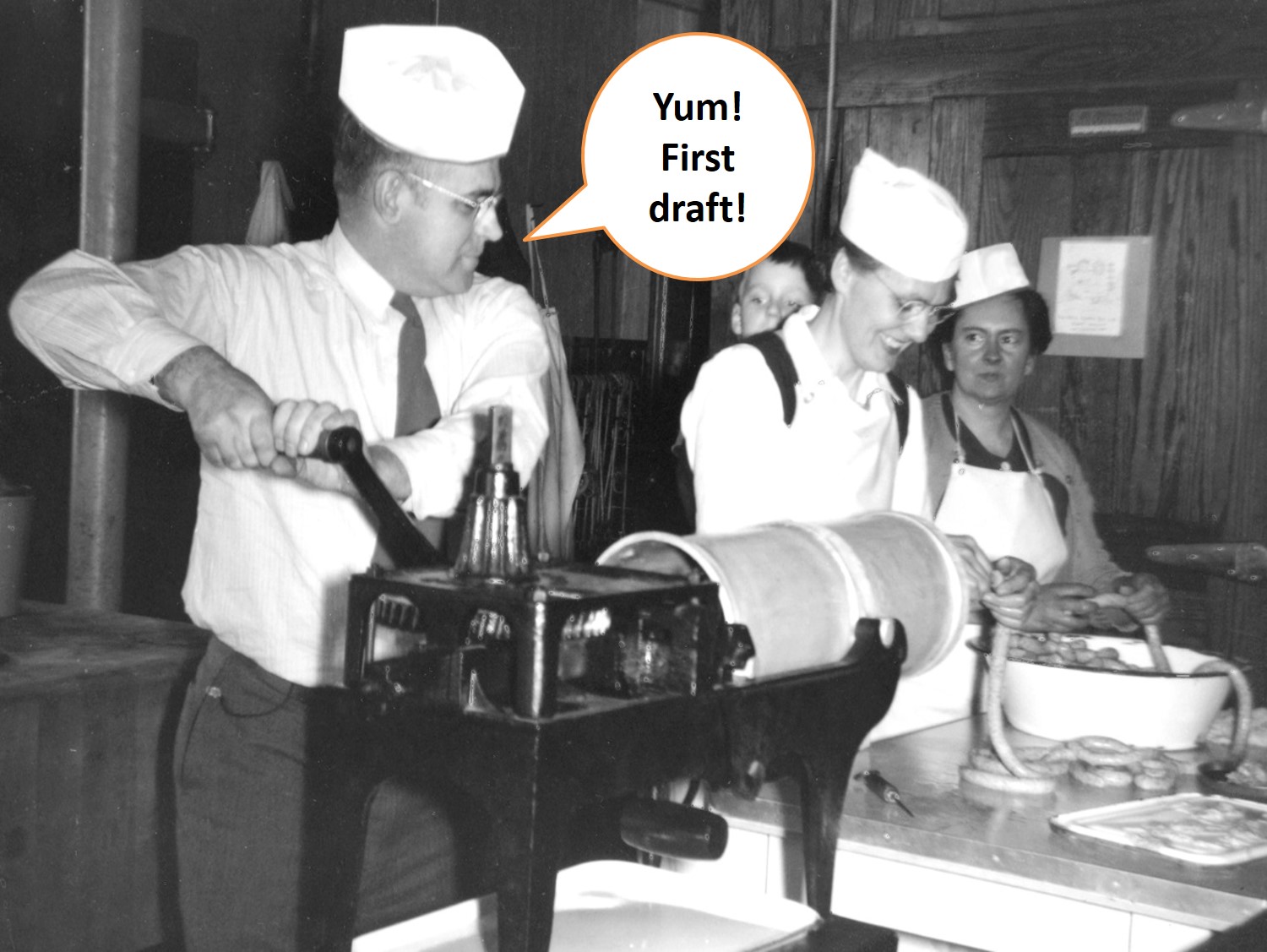
 

Cutting Open the Sausage:
A Hard Look at Rewriting

“I have rewritten — often several times — every word I have ever published. My pencils outlast their erasers.” –Vladimir Nabokov.

By PJ Parrish

This is it. This is the third draft. This is the last best chance to get it right.

I’m in rewrite hell this week. Actually, it’s not hell. To me, at least. I love this phase of the process because the really hard work is done — the laying of the foundation, the erecting of the beams, the finishing of the roof.  Now I just have to go back in and make sure the structure is sturdy, the flow from room to room logical, and the style true to my own. Oh, and it would be great if someone gets so emotionally caught up that they maybe want to buy it.

Rewriting is where the book is truly made. No one will ever convince me otherwise. Yeah, my sister and I can turn out a pretty decent first draft, but who wants pretty decent these days? What reader would settle for it? What writer would? So I’m digging back into the coffee-stained third draft this week to up the ante as far as I can.

Now maybe you’re one of those rare birds who can produce a perfect book in a single swoop. (Like Lee Child who told one interviewer: “I don’t want to improve it. When I’ve written something, that is the way it has to stay.”). But most of us need to go back and reassess and rearrange. I always tell my workshop folks that the first draft is written with the heart, but the second, third…tenth, well, that’s written with the head.

Two quick tips: Wait as long as you can stand after you finish your first draft to start rewrites. You need a break from the beast that has consumed your life for eight months or eight years. Also, I always print out a manuscript for rewriting because the eye, so attuned to the screen, becomes inured to error and excess.  Seeing your work in a physical state also gives it a gravitas that the computer can’t imitate. Here’s my big baby in three messy piles:

Now what I’d like to do is show you my draft’s innards. But before I drag out my sausage machine, let’s do a quick review of rewrite basics:

Structural Problems

This is a big issue, so be prepared to spend a lot of time and brain-power on it. You’re going to find plot holes to plug, characters to amplify, a muddy middle to amp up, conflicts to bring into higher relief. Oh yeah….and you might uncover that elusive theme.  Ask yourself all the basic questions that our bloggers here post about: Is your three-act structure sound? Do your characters want something and is it important enough to drive their arcs? Is your central conflict tantalizing enough to support a whole novel? What, at its heart, is your book about? (not plot, but theme.).

Logic Lapses

Does your plot make sense and it is believable? (Those are two different things). Do you resort to a deus ex machina or the Long Lost Uncle From Australia villain reveal? Do your characters act in accordance with their natures or do you have them doing stupid illogical things? Are your police and forensics procedures sound or did you try to fake it? (ie clip and magazine are not the same). Does your research hold up? Is your fantasy, horror or alien world well-rendered and credible?

Confusion and Clarity Issues

Can the reader easily figure out what’s going on? This does not mean artful misdirection or red herrings. This means you choreograph movement and events carefully, everything from small stuff like moving people across a room or a country to big things like why did they did a certain thing (motivation).  Do you make it clear where we are and what time period we’re in? Can the reader discern a mood or tone in your book (dark? hardboiled? humorous? sardonic?)

Flabby Writing

Have you ferreted out all the junk-writing? This includes overwrought and repetitious description, dumb physical moves (“He bent his left arm and brought the beer up to his lips.”…no, he took a drink.)  Do you rely on adverbs instead of muscular dialogue? Have you pruned away all the unnecessary words you can, especially as you near the last third of the story when the reader wants to move faster?

Proof Reading

Spelling, grammar, punctuation…know them or hire an editor who does. Watch out for dumb inconsistencies like changing a character’s eye color or name spelling. Double check for errors (use Google maps to verify that it is, indeed, a four-hour drive from Moose Butt to Manitou).  Did you get rid of all your brain farts? I once read a novel that described the crime as as grizzly murder. Shoot, in one of my first drafts, I had a distraught character balling like a girl…thank God for editors.

Okay, now let’s look at some of my mistakes and I’ll show you how I hope to run ’em back through the sausage-making machine:

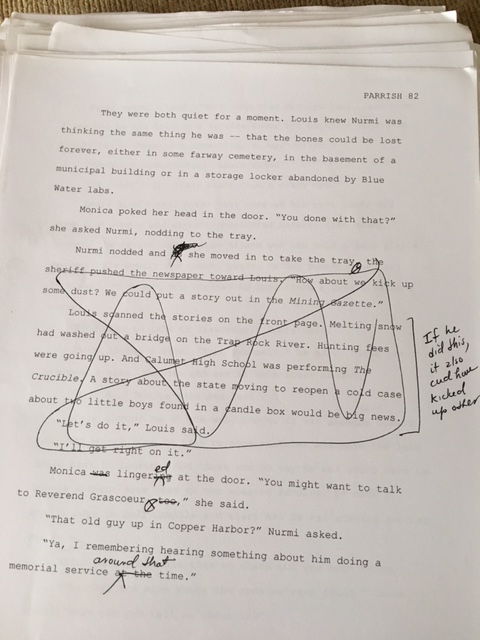
Here we are on page 1 and already I have a problem. In my first chapter (indeed, the whole book) I neglected to tell the reader what year we’re in. My series started in year 1981 and has progressed now to 1991.  I have to make sure my readers know this early because the forensics, cell phones, computers are all going to be different. But notice that I DID find a way to tell readers we are in Lansing Michigan.  I have a logic/plot problem here. In the deleted part, the sheriff offers to plant a story about Louis’s case in the local paper, hoping to stir up leads. But if he does this, it will tip off a suspect who I have come forward fifteen chapters later — and it blows up the plot! This sounded good when I wrote it on pg 82 but it doesn’t hold up on page 345.

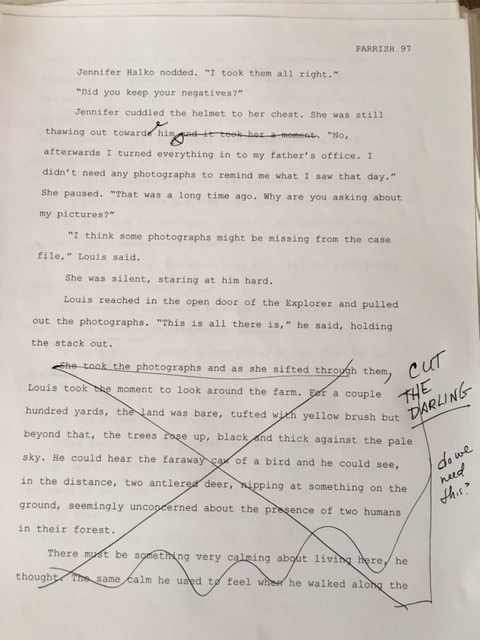
This one falls under Elmore Leonard’s Kill Your Darlings.  Louis is about to uncover a major gruesome clue and plot point on next page. (Yay! Momentum!) Why in the world do I need him looking around this farm at deer or listening to crows? (Boo! Screeching halt!) It was a pretty image when I wrote it but adds nothing, especially since I had already described the lonely isolation of the place in vivid detail two pages ago.

Nice clean page, right? Except for one bone-headed mistake. One of my main characters is a teetotaler. It’s a big point in his make-up, which my hero Louis knows. So why does Louis set a beer at the man’s side? Always watch for dumb mistakes and inconsistencies. In film, a script supervisor oversees the continuity of a movie including wardrobe, props, set dressing, hair, makeup and the actions of the actors during a scene. You don’t have one of these backing you up. So be careful.

I call this one the Jacqueline Susann problem. The copy after the double space is the beginning of a seven-page scene where Louis goes to a state forensics lab to log in his evidence. It’s interesting in so much as it shows nerdy police procedure. But my book is running long so I have to MAKE DECISIONS about what to put “on camera” and what to recount in narrative. Now some scenes must be on camera (decisive action, great clue reveals) but some stuff can be dealt with efficiently in a character’s thoughts after the fact.  I am going to cut this scene and in the following chapter just say “Louis went to the lab in Marquette and logged in the evidence.”  Back to Jackie Susann: When she turned in one of her potboilers, she devoted an entire chapter to a Democratic National Convention (she had gone to one and was going to show off her research, damn it!). Her wise editor Michael Korda told her to cut it.  She fought him but in the end the book said: “The convention was held.”

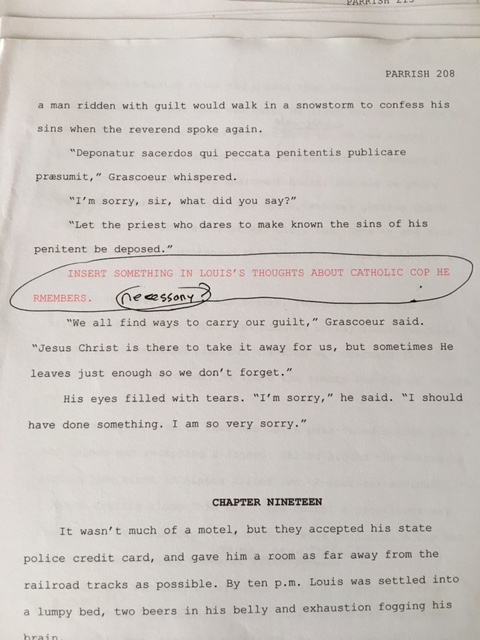
See the part in red? During first draft, I was trying to hone the theme (forgiving those who hurt you as a child) so I was acutely aware of all religious references I used. In this scene, Louis has interviewed an ex-priest who took confession from a murderer decades ago. The priest talks about the sanctity of the confessional but how his guilt eventually drove him from the Church. Catholic cops grapple hard with this issue. But after a powerful scene with the priest, do I really need Louis thinking about this? No, it was one theme-bridge too far.  Lesson: Have a theme but don’t preach.

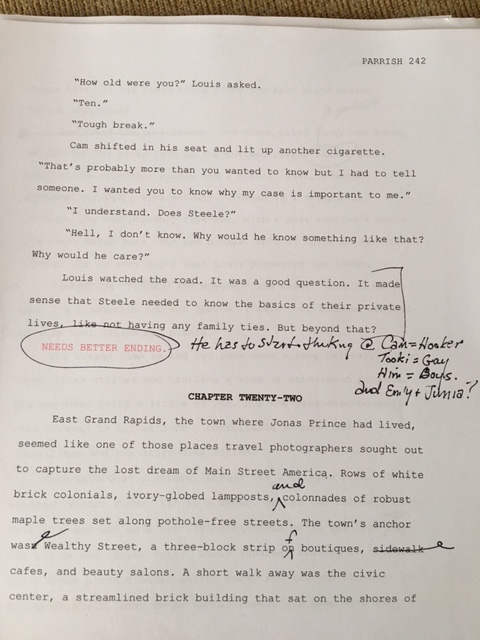
I am a perfectionist. It is hard for me to move on until I get a paragraph, a scene, a chapter right. I am trying hard to change this flaw. My sister flogs me constantly: JUST WRITE! So now I put notes to myself in red to fix it later. This is called faith. {{sigh}} Read the ending of this scene. It sucks, right? I know that. I will fix it. Lesson: Don’t get paralyzed by perfection. Move forward. Chances are excellent that by the time you finish the first draft you will know exactly how to make an early chapter end — or begin — with more punch and precision.

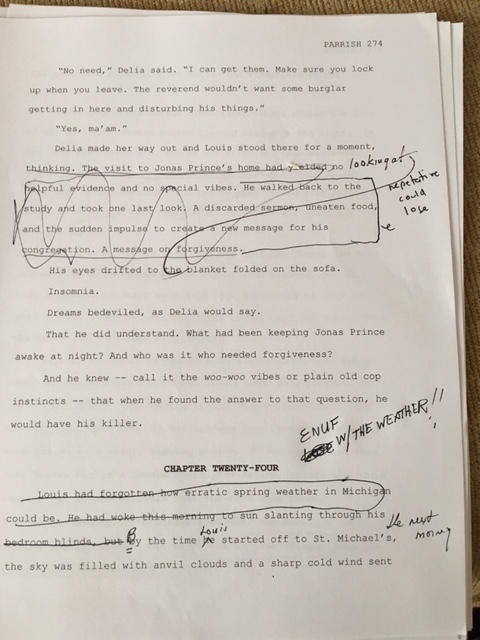
Look at the beginning of chapter 24.  Argh! I opened it with weather. Now, that is okay except that it is April in Michigan and it is raining almost every day in my book. By page 274, the reader GETS that because I have told them at least four times. Lesson: Go easy on weather and don’t repeat the obvious.

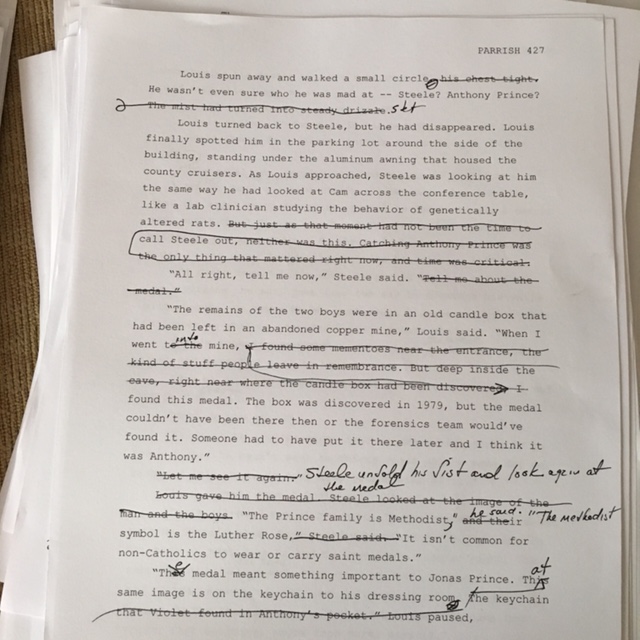
I included this page just to make the point about flabby writing. All the stuff I crossed out is fat. Always aim for economy, which is not the same as underwriting (a sin in its own right). When you are just moving characters around in time and space, do it with as few and unflashy words as possible.  Almost half the pages in my manuscript are marked up like this.

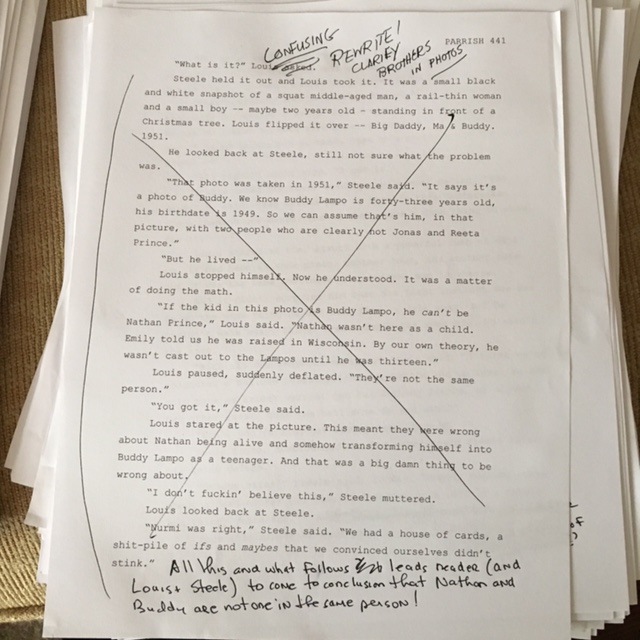
I saved the most important one for last. The sin isn’t apparent to you but boy, did it jump off the page when I read it in rewrites. We laid down a very complicated bread-crumb trail of clues in this book about mistaken identities, time-lines, family trees. So it was critical that as the book neared its climax, we explained this so the reader would understand how the puzzle finally fit together.  Well, we didn’t do a good job of ‘splainin. As a major clue, we had two photographs of boys that we thought was a peachy misdirection but it only confused the reader in the end. It came on page 441 and was a major plot mistake that we had to acknowledge and correct. It was major surgery but without it, the book would have died. Lesson 1: Don’t avoid the hardest work. Lesson 2: Don’t confuse the reader. Especially at the end, after they have invested so much time and heart into your story.  Make the ending clear, satisfying and logical.  Your plot twists must be well-earned.

That’s it, crime dogs. Now if you’ll excuse me, I have work to do.


First Page Critique: Historical Thriller

Today we have a historical legal thriller to examine as part of our regular first page critiques. Sometimes historical fiction can be intimidating – especially when (as is the case in this first page) we are unfamiliar with the period or location in question. My goal as a historical fiction writer is to provide a story which helps overcome that initial uncertainty through: 1) a well established sense of place and time; 2) an authentic, period appropriate voice; and 3) a sensory evocation of the period that helps immerse a reader in that place and time. In addition to these three goals, I also hope to provide a rich layer of drama and intrigue, characterization and plot (…pretty much what we hope for in most novels!). Luckily, I think today’s first page manages to establish a pretty good foundation to achieve all these goals. Kudos to our brave submitter and read on. My specific comments follow.

Title: In the Matter of Lucy

Genre: Historical Legal Thriller (1840s)

Chapter One

Narrative of Orlando B. Ficklin, Esq.

A law office is a dull, dry place.

Leastways, that’s what “Mr. H” told me on my first day as an apprentice.

God, but I could use some dull and dry right now. You wouldn’t believe what the people of a backwoods Illinois county can get up to in the way of shenanigans in the year of our Lord, one thousand eight hundred and forty-seven. Lying, cheating, stealing, screwing, welching, divorcing – there seems no end to the vices of this hamlet. And the half of the them – and not always the better half – find their way to me.

This week has been a busy one for laying bare offenses, large and small. The circuit court is in town for the spring session. It’s a regular curia regis: Judge Hopkins and an itinerant band of attorneys traveling through the “realm,” arguing and dispensing justice, when they aren’t eating, smoking, drinking, whoring, and swearing. Our courthouse, such as it is, is a backroom of Deskin’s Tavern. It’s no unusual occurrence to find judge, lawyers, litigants, witnesses, and jurors at the same dining table.

Yesterday, I defended the Meisenhalter brothers.  David Adkins had sued them for slander. Once, for Levi calling Adkins a “damned pig thief,” and again for Robert calling him a “damned infamous pig thief.” Fortunately, the truth was our best defense: Adkins had, in fact, stolen five hogs a few years back in another county. The jury found for my clients and I got my own hog – rightfully earned – as compensation.

Today, I’m watching – and learning – from the master: Mr. Lincoln.  He’s representing Eliza Cabot in a slander case, one more titillating than my own with the Meisenhalter boys. Eliza is suing Frances Regnier for saying that Elijah Taylor was “after skin” and had got it with Eliza, that Taylor “rogered” Eliza, and that Elijah “has got some skin there as much as he wanted.”

Lincoln has just asked Taylor if he knows the difference between adultery and fornication. After some thought, Taylor answered: “Well, I’ve tried both…there’s no difference.”

The galley roars with laughter.

Despite the performance, I’m distracted.  My mind wanders to this morning’s “mail”: a rock, thrown through my office window, with the following note:

“Take on that damned ni – – er’s case, and I’ll see you in Hell.”

Specific Comments

My comments focus on the goals I identified above:

1) A well established sense of place and time

What I enjoyed about this first page is that I felt we immediately had a well established time (1847) and place (some small backwoods town in Illinois) without the need for any unnecessary data-dumps or overly long descriptions. I could easily envisage the setting without being given much in the way of description as the key elements were all there (the back room of Deskin’s Tavern for example and the two law cases that were highlighted with humorous specificity). This first page demonstrates that historical novels don’t need a huge amount of period description at the start – just enough to evoke the time and place and allow the reader to step into the scene quickly and easily.

2) An authentic, period appropriate voice

Overall I think the voice in this first page is strong and authentic. I had some minor quibbles with word choices (like ‘leastways’) but those were just personal preferences. The first person narrative is strong and humorous and the voice of Orlando Ficklin Esq. seems to be one that has enough interest to sustain the story. Given it is his narrative, I did wonder whether we needed the quotation marks around the words realm and mail – they seem to distract as other quotation marks are around other character’s actual speech/dialogue. I also wondered why the ‘n-word’ in the final line of the page was censored, as I assume the threatening note on the rock thrown through the window would not have been. I was also briefly taken out of the narrative by the term ‘rogering’ as I associate that more with British slang – I have no idea if this was used in the USA in the 1840s – but would just advise the author to double check all the words used to make sure they would have been in common usage at that time/place.

3) A sensory evocation of the period

Most often we associate ‘sensory evocation’ with descriptions involving sights, sounds and smells to evoke a historical scene. In this first page we don’t really get any description of what people are wearing or sensory based period details but I think we get enough in terms of scene setting with the snippets of conversations provided and the first person narrator’s view on the circuit court proceedings. I expect as the novel progresses more period details will be provided that will fill out the historical scene for the reader.

So far, at least for me, we have a solid basis for a story that I would be more than happy to continue reading. The last line also provides a great set up for the drama and intrigue that is to come. What do you think, TKZers?

My First Experience with a BookBub Feature Deal & The Last Victim (Nov 5)

Jordan Dane
@JordanDane

I wanted to share my latest foray into a major promotion run. I’d heard good things about BookBub, had researched it before, but never submitted a book until last week. This promo option isn’t cheap. It’s a real leap of faith that you’ll sell more than the feature costs. I made sure that I ticked off the boxes I knew about, to make my submission more appealing to the stringent requirements to qualify.

Founded in 2012, BookBub has been featured in the Wall Street Journal and the New York Times, showcasing their huge outreach to avid readers with their daily deal emails to millions of subscribers. This is a free service to readers, vetted by an expert editorial team with handpicked recommendations. It doesn’t sell books directly, but offers books from authors that are available through major ebook retailers and devices. It also focuses your feature to readers interested in YOUR genre.

If you’re a published author, you can claim your books and create a profile to grow your followers on a forum for readers that an author can cultivate directly. I had never “claimed” my author profile and didn’t realize I had followers. Plus not all of my most recent books were listed, so I had to update my profile after they authorize me as the author.

BookBub scrutinizes the books it selects, so I knew I had to adhere to recommendations other authors had shared online about their experiences. HERE is the list of requirements from BookBub, but there are other websites and blog posts with more help, too.

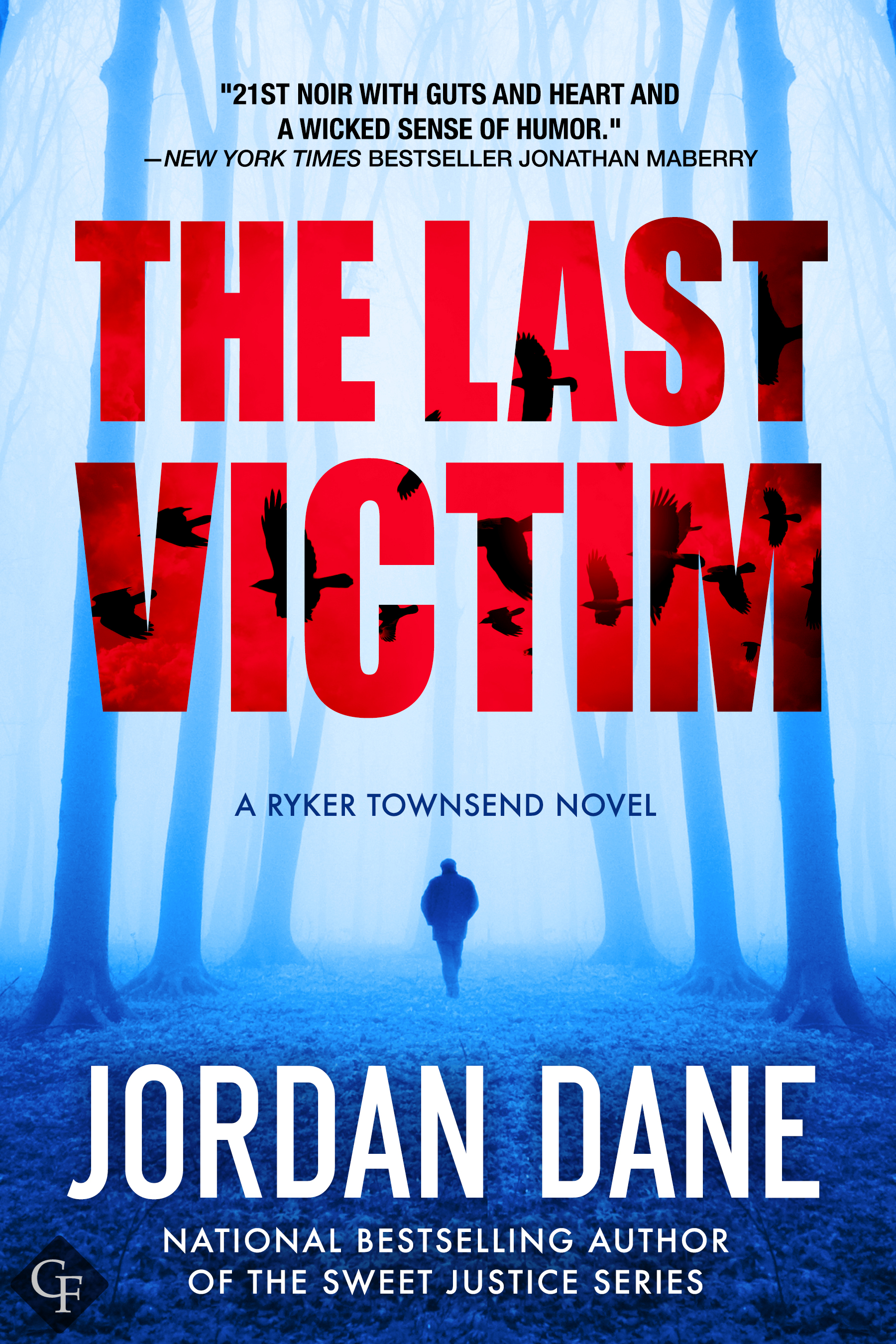
The book I submitted is The Last Victim (published 2015) and here are details on what I had to do.

BookBub Submission – TIPS

I had a professionally designed cover that I knew would be acceptable from my experience. BookBub scrutinizes submissions for a well-formatted book, free of typos and grammatical errors. They also want books that have accumulated enough good reviews without sharing how many that is. This can be intimidating. The Last Victim has 26 reviews for an average of 4.4 out of 5. I really didn’t know if they were looking for 50+ but I went for it. Don’t let one deficiency in a selection criteria force you to back down. If you don’t succeed, keep learning and try again.

I had great cover blurbs/praises to pitch on my book and across my branding platforms (website & social media) from well-known authors, magazines, and critical reviews from professional editorial sources. (Don’t let this tip scare you. I accumulated mine over time. You can too.)

The Last Victim is a full novel that has never been discounted. It normally sells for $3.99, but I submitted it to BookBub for a special, limited offer of $0.99 across all retailer platforms that I listed in my submission.

My novel is widely available on all the retailers BookBub features and then some: Amazon, B&N, Kobo, Google, and iBooks. Since it was published by my publishing arm, Cosas Finas Publishing, I had world rights, which I knew would appeal to BookBub.

My BookBub feature will be Nov 5 – 12. They prefer limited offers of free or discounted by at least 50%, rather than books that are perma-free.

HERE are BookBub’s tips.

I also submitted with a flexible promotion date, but when they came back with “Can you do by Nov 5th?” – I found out how much I didn’t have prepared for this type of exposure. This is why I wanted to post my article on the experience. It’s a good problem to have, but very nerve-wracking when I am in the middle of releasing two back-to-back novellas on Oct 31 & Nov 7th. Of course, I had to go for it, even if it only becomes a “what not to do” experience. Below are some of the things I have done to prepare and I’m sure there will be much more as the BookBub feature draws nearer.

MY STRATEGY SCRAMBLE

1.) Since The Last Victim was a 2015 release, I had to update the back material to include my updated Biblio, author bio, and add promo links for my new website mailing list and ads for my upcoming releases, as any traditional publisher would do. I went through my layout formatter to save me time. I use Wizards in Publishing.

2.) I created a spreadsheet of target promotion opportunities, both free and paid for, to expand my reach beyond my mailing list and track costs against estimated revenue. BookBub gives you its estimate for likely sales, but it is up to you to get the word out and set higher goals. I plan to set up my estimates, then compare them to what actually happened afterwards, to create a learning tool that I can refine. Bottom line – It takes a lot of eyeballs for sales to result. I used subscriber numbers, but estimated sales at a fraction of 1% to be conservative. It’s all “pie in the sky” stuff until the dust settles and sales are determined. At that time, I’ll need to do an autopsy to see what clearly worked.

3.) What are the best ways (& sites) to pay for promotion? Good question. Since I needed boosted sales across several retailers, I chose to look at ads at Kobo, Amazon, and the other retailers. These aren’t cheap so I had to make decisions. The bargain books websites that are popular and most effective aren’t cheap either, because they can add up. They also don’t take just any ad that you pay for. Some sites require you to submit your book for their consideration & it could take up to 7 days to hear back. (I won’t know about some until my feature is about to start or has started.) These promo sites’ loyalty is first to their subscribers, so that means you have to allow enough lead time or make due with what you can get.

4.) I submitted to EreaderNewsToday and needed approval. BargainBooksy, KindleNationDaily (& their multiple platforms), EBookLister, and AwesomeGang didn’t require approval and charged only a minimal amount. There are countless sites where they will list your book for free. Some allow you to post once and they will cross post, but since I don’t know how effective this would be for my limited time, I chose certain sites for maximum exposure.

5.) I created an Amazon Marketing Services (AMS) Ad Campaign (access I already had as a vendor through my publishing company) to run during the time of the feature and will up the cost per click but limit the dollar daily total to gain the likelihood the ad will be competitive for placement and exposure. Since this ad will run for a specific time (to parallel my BookBub Feature Deal), I could get aggressive on my budget.

6.) I haven’t considered a Facebook Ad because I don’t know how effective they are in relation to real sales. AMS give you direct access to analytics on clicks and traffic compared to actual sales. If I’m going to spend money, I prefer Amazon where the most of my sales would come from and can be traced and translated into sales.

7.) What could I do to promo without cost? I had access as a contributing author to several fan groups under various Amazon Kindle Worlds. To the credit of the authors who created these groups, they generously allow their authors to promo other books, and we try to give exclusive giveaways back to their readers in return. So the groups that I had cultivated by writing for these Kindle Worlds, I have access to for a post and the reader fans are so much fun and generous with their support. That has value.

8.) I have my mailing list and had just updated my website to WordPress format. This allows me to update quickly and post when I need to. Updating came at a very good time. Even though it was time consuming to transfer content, it was well-worth the effort.

As of this post, I’ll still be prepping for the feature and up to my eyeballs in two releases – Valentine: Steel Heart (Available Now) and Fiona’s Salvation (Nov 7). This BookBub feature for The Last Victim is from Nov 5-12, so the overlap is stressful, but it can help with exposure. At least, that’s what I’m telling myself.

Other Resources

I found these additional links that could be helpful. Here is a link to “Reasons Why Books are Rejected as BookBub Feature Deals.” I don’t normally like to focus on negatives, but there are good points made in this article that could help you succeed.

This link compares BookBub against two other promo sites: Book Gorilla & Fussy Librarian. The costs vary, but so does the exposure and the requirements may not fit your book or your goals.

For Discussion

1.) Has anyone had experience with BookBub? What worked and didn’t work for you? I’d love to hear your experiences.

2.) Besides BookBub, are there other ways to feature your discounted sales that you’ve found to be effective?

Valentine: Steel Heart (Novella 1 of 2)

Love made him vulnerable…once.

After a tragic killing on an Amtrak train, the Phoenix Agency use a mysterious covert operative, Braxton Valentine, as bait to lure a deadly cartel boss from hiding, but grief-stricken Valentine becomes their worst nightmare—a rogue operator with a death wish.

(Valentine: In the Cross Hairs – Book 2 of 2 coming Feb 2018)

Audiobooks: Is Listening the Same as Reading?

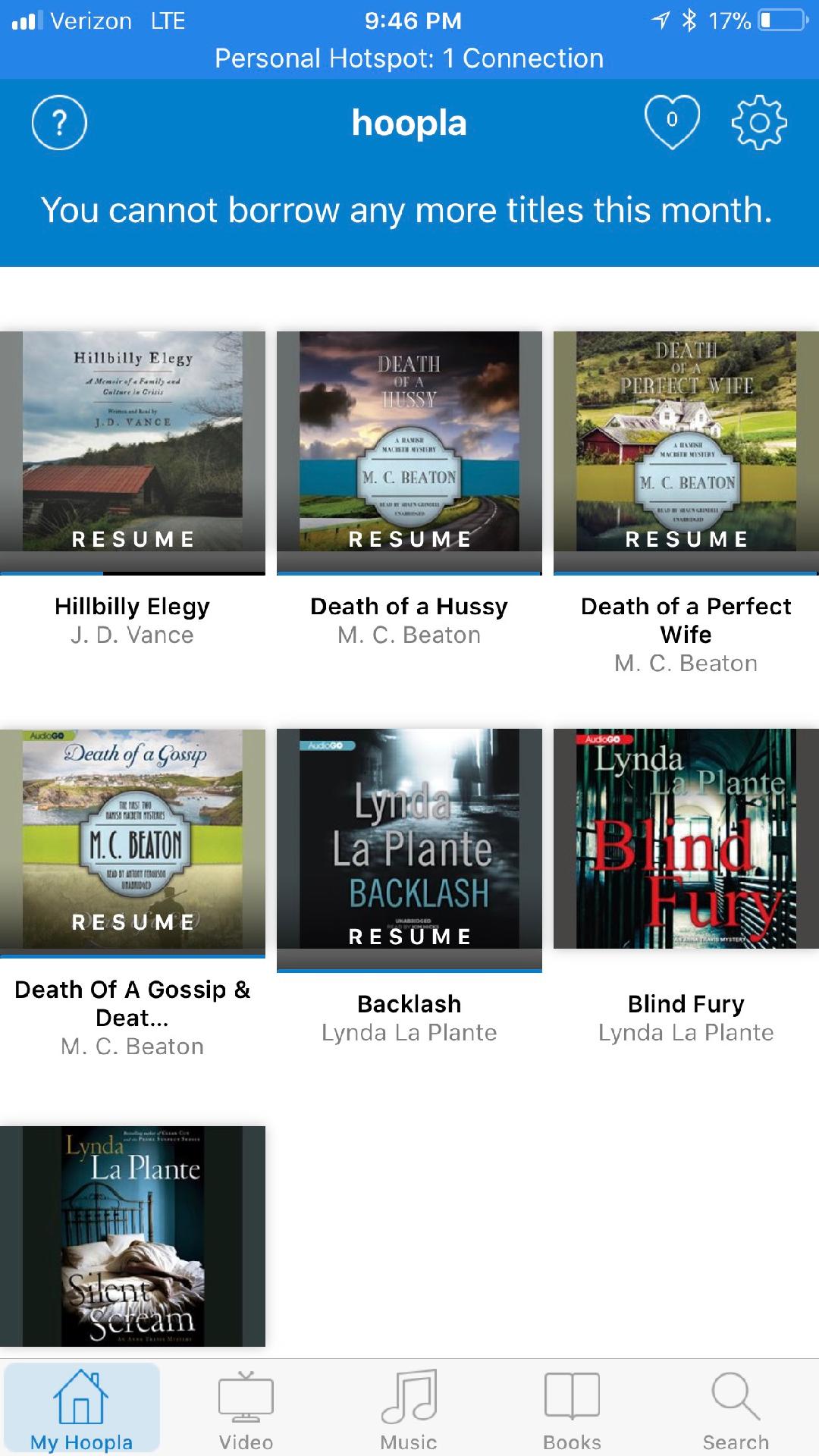
“You cannot borrow any more titles this month” has become the saddest phrase of my small existence.

I may be an audiobook addict.

My gateway drug was the bargain-bin cd novel. Years ago I discovered many in odd places like Tuesday Morning stores, Big Lots, and very occasionally at Barnes and Noble. It took a lot of digging to find unabridged versions–I will not read or listen to abridged versions of books because they incite moral outrage in me. WHY are there such things? I can see perhaps that once upon a time people read Reader’s Digest abridged versions of classics so they could boast they’d read them with some measure of authority, or in case someone might burst into their house and made them take a pop quiz on Great Expectations or Anna Karenina. But, really, if that happens, you’ve got worse problems than being a slacker reader.

After CDs I moved on to iTunes books. I logged on frequently to look for specials, and rarely paid more than $5.99. They were much more portable than bulky CDs. But I got greedy and started buying pricey bestsellers and had to cut myself off. My husband subscribes to Audible. Several of my own books are available on there, but I bristle under the program: limits and specials and points. Mostly, I don’t like to belong to clubs that will have me–especially if I have to pay.

For a while, I listened exclusively to free podcast books. One of my favorite sites is the Classic Tales Podcast with B.J. Harrison. I believe all of the audiobooks he reads are in the public domain, making them truly classic. You can subscribe and get the free podcast, but he also has a great library of inexpensive classics.

I know the rest of the world began streaming library books years ago, but I only started last winter, when I re-joined a nearby library (we are in an unincorporated area) for $80. Now HOOPLA is my new best friend. I have yet to figure out the metrics for which books are available on HOOPLA and which aren’t. The pickings are occasionally spotty. For example, nearly all of  M.C. Beaton’s backlist Agatha Raisin books are available, but there are few books by Robert Stone. If anyone knows how the selections work, please do enlighten us…

As you can see from the photo above, my audiobook listening is fairly light. I’ve been bingeing on traditional and procedural mysteries. (Ignore the “resume” on the two Beaton books–I suspect I moved on to the next one before the last few seconds played.) HILLBILLY ELEGY has been a kind of in-between book. The first 90 minutes or so made me uncomfortable because 1) I found Vance’s broad statements about history and class attributes random and defensive, 2) he pronounces “Appalachia” with a long, Midwestern 3rd “A”, and it drives me nuts as someone who lived for years in WV and western VA, and 3) I have deep, recent roots in eastern Kentucky, and it felt achingly personal and aggravating at the same time–which is to be expected, of course, because my hillbilly ancestry makes me ornery and skeptical anyway. But somewhere around the 90 minute mark, Vance gets deep into his personal history and it becomes a compelling story.

Sorry, I digress.

I nearly always have an audiobook on in the car, whether I’m going on a long trip or to the post office. I have one on while I cook or garden or clean. In fact, I’ve been known to engineer solo driving errands just so I can listen to a book in peace.

Sometimes I wonder if listening to a book isn’t cheating. Is listening to a book too passive an act to be considered useful to a writer? I’m torn. It occasionally feels like that. I’ve let the first 4 Hamish MacBeth books pour into my ears like mineral oil used to float a bug out. (That’s a thing.) I started my heavy listening of traditional mysteries last spring, in preparation for writing my first cozy novel, and now can’t stop. Thank goodness there are a ridiculous number of mysteries out there. Unfortunately I’ve listened to so many that I’ve found there are some books that are marvelous in audio, but are barely readable on the page. (Not telling. Let’s just say I never tried paper with that author again.) It’s as though my listening brain is so focused on the story that it can ignore the weak writing–something I seriously have a hard time doing when I’m looking at a page.

Although magazine and Buzzfeed-type quiz testing tells me that I’m an equally visual and audio learner, I retain stories I hear in much more detail than I do when I read words on a page. Yet the story plays out in my head in much the same way for both–I get to visualize the characters, I get to make educated guesses, I get to participate in ways I don’t when watching a film.

And yet. One of the reasons I still read more paper books than I do ebooks is that I am better able to create a mental map of both the book and the story when I can actually touch and turn pages. It feels participatory in a way that swiping never does. Ebook pages are too uniform. They aren’t alive. Now, that’s just my mental eccentricity–I do read and publish ebooks. It’s just that the experience is different. Stories have a shape, and I like to feel the shape so I can create story shapes for myself. If that all sounds a little Montessori Method to you, sorry. It’s the only way I can think to describe it.

I do, to some extent, also see the shape of stories when I listen to them.

I know. This is starting to sound a little too theoretical. A little too woo-woo. But I can’t shake the feeling that I’m betraying my writer self if I’m not reading words on a page. There are times when I realize I’ve been thinking about something else for a minute or two and have to click back to hear what I’ve missed. That’s not to say there haven’t been many times that’s happened as I looked at a paper book.

What say you, dear Zoners? Am I splitting hairs? As writers, do you think there’s a best way to experience a story?


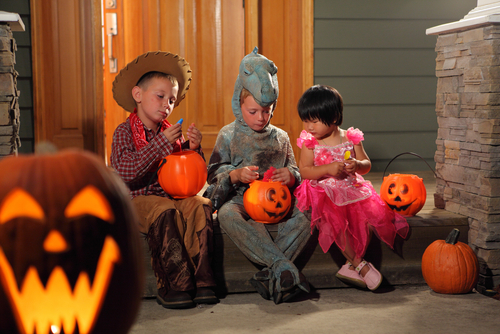
Happy Halloween from TKZ!

Photos purchased from Shutterstock

It’s All Hallows’ Eve, and in the US many of us are getting ready to give out treats to bands of little ghosts and goblins roaming the neighborhoods.The rest of the world celebrates Halloween-like holidays in a variety of ways.

In Mexico and parts of Latin America (and here in LA) people celebrate Dia de los Muertos (Day of the Dead) during the first two days of November. On those two days, according to the tradition, the souls of dearly departed Loved ones are allowed to return to Earth to reunite with their families. The holiday is celebrated with little in-home altars and offerings of pan de muerto (bread of the dead), candy, toys, and other goodies.

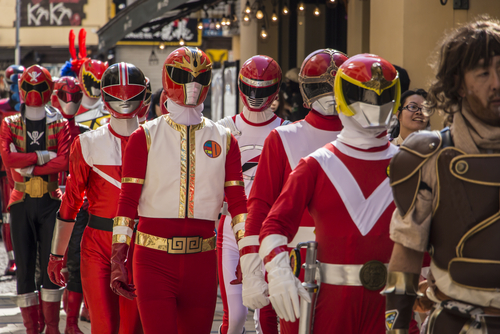
Japan celebrates the holiday with the famous Kawasaki Halloween Parade, a gathering of some 400 celebrants in some of the world’s most impressive Halloween costumes.

In Hong Kong, people celebrate the Hungry Ghost Festival. Festival goers distribute snacks and money to “ghosts” for sustenance in the afterlife. 

From late September to mid-October, Buddhist families celebrate Pchum Ben, a religious 
holiday to honor the dead. People hand out bundles of sticky rice wrapped in banana leaves, and visit temples to offer baskets of flowers.


What is your best memory or tradition associated with Halloween? Mine is wandering around our little rural Connecticut hamlet as a small child dressed up in giant butterfly wings that my mother had made for me, collecting pennies for UNICEF. Will you be handling out goodies to little goblins tonight?

HOW TO BE A CRIME VICTIM… PAINLESSLY

By Debbie Burke

The Scene of the Crime

Last year, I became the victim of an attempted sexual assault in broad daylight.

An assailant stuck a gun in my back, dragged me into a dark, deserted barn on the county fairgrounds, and tried to rape me. When he put down the gun as he tried to tear my clothes off, I kicked him where no man wants to be kicked. He escaped out the back of the barn.

I survived completely unscathed…because, fortunately, I was not a real victim, but a role player in a law enforcement training scenario.

Alumni of the local Sheriff’s Citizens Academy get tapped from time to time as role players in training sessions for reserve officers, the posse, and search and rescue. Since I completed the Citizens Academy, I’ve walked heel-to-toe in a mock traffic stop for drunk driving. I portrayed the hysterical mother of a child injured in an accident. I played a victim of a medical emergency, which turned into a bona fide emergency when a swarm of yellow jackets stung me!


Photo by Lynette Schimming, Thompson Falls, MT


The sexual assault scenario mentioned above was part of the training for posse and reservists who respond to emergencies at the county fair. Each trainee team answered mock radio calls from a 911 dispatcher about various crimes, in addition to lost children and heart attacks. Trainees rotated through stations staged around the fairgrounds, while deputies and police officers observed and evaluated how they handled each situation.

A deputy staged the scene beforehand: drag marks in the dirt, signs of a struggle in the stall, a fake gun left on a shelf by the attacker, and footprints leaving the barn. Then each team would rotate in turn to our station.

The lead instructor had already briefed trainees about their duties. In the sexual assault scenario, they were supposed to interview the victim (me), call for medical assistance, and broadcast the assailant’s description on the radio. Then they would secure and preserve the crime scene until regular officers relieved them.

Cops love to tell stories. My favorite part of the exercise was during down time between rotations. That’s when the story-telling began—a great opportunity for me as a writer to pick up details, nuances, and subtleties that lend authenticity to crime novels.

Since the county covers 5000+ square miles with only four deputies on duty each shift, stories abound of the resourcefulness required when responding alone to calls in remote locations.

A CSI related the tale of an overweight officer who’d taken a lot of kidding about his size. Late one night he arrested a rambunctious suspect who, despite being handcuffed, kept trying to run off. With backup seventy-five miles away, the deputy had to find a safe way to further restrain him until help arrived. So he spent the next forty-five minutes…lying on top of the suspect.


His fellow officers still kidded him, but with respect for a guy who used the tools at hand to solve a problem.

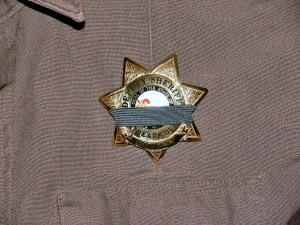
Because of a rash of ambushes on law enforcement, most officers were wearing a black band over their badges. In a lowered voice, a veteran deputy with fifteen years’ service confided, “My six-year-old just told me, ‘Dad, I don’t want you to be a police officer anymore.’” That poignant sentence spoke volumes about the family life of cops. It will stay with me for a long time.

Back to the training session. One trainee earnestly wrote down my description of the would-be rapist. Another reassured me that I was safe. Others took the initiative to clear the barn and search for the suspect.

After each team completed the exercise, the evaluators critiqued their responses. One team did not enter the barn at all. When the evaluator asked why, the answer was: “We could see the gun from where we were outside, we didn’t know if the perpetrator was still around, I wanted to keep my partner in sight.” They received a nod of approval from the evaluator.

Another team split up—one talked with me, while the other cleared the barn, checking stalls with a flashlight, careful to avoid the footprints and drag marks. Again, a nod of approval.

According to the evaluator, both approaches were appropriate since trainees took their individual limitations into account and did not compromise safety.

And then there was the posse volunteer who proved the adage, you get what you pay for…

This trainee had clearly never watched a single episode of CSI. Upon arriving at the scene, he immediately rushed into the barn and stomped on the footprints and drag marks. Then he grabbed the gun, obliterating the attacker’s prints.

The evaluator took him aside…for counseling.

After training ended, we ate lunch and reviewed the volunteers’ performances. Feedback from the 911 operator was especially useful. She cautioned if a responder didn’t answer a radio call, the operator might assume trouble and dispatch assistance, when, in fact, the responder simply forgot to acknowledge a call. Big oops.

Taking the course can broaden your education and add verisimilitude to your novels.

Besides, it’s not often one becomes a “victim” without suffering any trauma. Role-playing is far preferable to the real thing!

TKZers, what are your favorite tools to lend authenticity to your stories?


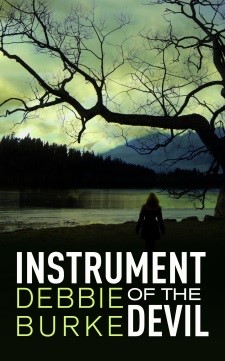
When she’s not playing a crime victim, Debbie Burke writes about them. Her new thriller Instrument of the Devil is available on Amazon.


Engineering A Brand

By John Gilstrap

This past Sunday, I returned from Indianapolis, Indiana, where I spent the weekend at the always-wonderful Magna Cum Murder conference.  As often happens at such events, the panels I participated in got me thinking more introspectively about my writing than I ordinarily do.  In one such panel, I heard myself refer to a book as “an engineered product,” and I realized that I’d landed on the topic of this week’s TKZ post.

When we buy anything from a car to a cheeseburger, we expect it to meet certain engineering specifications.  We expect less luxury from a low-end Kia than we do from a top-of-the-line Mercedes, but irrespective of price and name recognition, we expect our chosen vehicle to get us from here to there without burning up, and in the event of a wreck, we expect the seat belts to work.  The perfectly-cooked fast food burger is of no lesser quality than the perfectly-cooked Porterhouse at a 5-star restaurant, but the expectation is different.

When people buy a John Gilstrap book (yes, it’s a little creepy to refer to myself in the third person), I presume they expect a different kind of ride than what they’ll get from, say, a Danielle Steele book.  Our stories are engineered differently, from the ground up, with the result that a Venn diagram of our respective fans would likely reveal a tiny shared area.  Different readers have different tastes, and my job as a professional storyteller is to deliver what my readers have come to expect.

No, that’s too passive.  My job as a writer is to deliver what I have promised fans for over two decades, attracting new readers who could just as easily have chosen a different book and different author.  Those who sample my work and like it are willing to try me again and again, so long as I hold up my end of the bargain.  I offer a tacit promise that there will be violence without gore-porn, there may be romance, but there will be no graphic sex.  My good guys will always be principled, and when the ride is over, justice will reign over my little corner of the fiction universe.  That’s the deal.  That’s my dining menu.

If I let my fan base down even once, I risk losing them forever.  Some will give me a bye if I fall short, but others won’t.  I worked my butt off for every set of eyes, and to risk losing even one is unacceptable.

Of course, the flip side of this is the risk of my stories becoming too predictable—too formulaic—which has its own negative consequences.  So, while providing a trustworthy reading experience, it’s incumbent on me to mix it up a little.  In Scorpion Strike (July, 2018), Jonathan Grave’s team endures their first fatality.  It was a hard scene to write, and it’s a scary thing to do.  Fingers crossed that I won’t drive readers away.

A lot of cyber ink gets spilled in the blogosphere talking about platform building, social media marketing and the like.  It occurred to me this weekend that platform-building and trust are closely related.  As authors’ careers grow, I think it’s important for them to think two or three books ahead—not regarding plots, but in terms of what kind of product they want to addict their readers to.  I believe marketers would call this thinking about their brand.

The harsh truth is that writing and getting read are two entirely different, though related transactions.  Without doubt, every writer is free to write whatever he wants, and publish (or not) by whatever means he desires.  But if said writer wants to maximize his ability to build a readership, he needs to teach his readers what to expect, and then dependably deliver on the promises he makes.

I know too many talented writers who finally achieve the dream of publication only to sabotage their own careers through literary ADD.  One very talented self-published friend of mine cannot constrain his creative impulses.  In quick succession, he’s pushed out a cozy, a thriller, a PI novel and a couple of horror books.  I get the need to flex the creative muscle, but there’s a reason why we don’t see Pepsodent pistols or Smith & Wesson toothpaste.  Branding matters.

What say you, Killzoners?

The Rituals of Writing

By PJ Parrish

This one is going to be shorter than my usual Michener-esque meanderings, because two things have happened this week:

  1. We finished the book
  2. Rewrites are needed — bad.

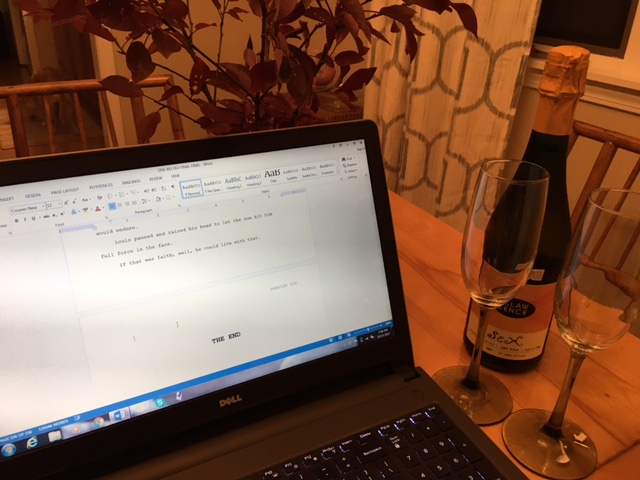
So I thought maybe, for a change, we could talk about something that doesn’t cause us writers angst — the positive little rituals that help get us through our days.  I thought about this today because whenever my sister Kelly and I finish a first draft, we have a special ritual.  First I type a word

THE

Then she types a word

END

Then we crack open an unshabby bottle of wine, preferably champagne, hug each other and get smashed. We started this ritual way back in 2000 after we finished our second book Dead of Winter.  It came about because back then, as we were nearing the finish line, Kelly would routinely come down to visit me in Fort Lauderdale and we would work together in my office, back-to-back on our computers.  Sort of like Ferrante and Teicher, except that Kelly’s two-finger hunt-and-peck key pounding tended to sound more like Keith Moon.

We kept to our ritual for a couple years, but then life started to intrude. Kelly’s life became peripatetic and hectic.  She couldn’t easily get down to Florida.  So we had to resort to ritual-by-email.  I would type THE on the Word Perfect doc and then send it to her.  She would type END and send it back. We’d then get on the phone and toast each other from our respective corners of the world.  It wasn’t as much fun.

Then around book six or nine — I forget — Skype came into being. Now, this was a god-send for our partnership because I could call up a chapter on my screen, share, and she could see it on her screen thousands of miles away while we talked about it. And we were able, when we were finished, at least see each other as we raised our glasses.

This is also how we opened Christmas presents. Better, but it still wasn’t the same.

A couple years ago, Kelly finally made it back to our home state of Michigan, settling finally, after a couple false starts, in beautiful Traverse City.  I was secretly envious because I really didn’t like living in South Florida, but I had put down deep roots. Then last year, my husband Daniel gave me the best gift he’s ever given me — he agreed to leave the place where he had lived for 40 years so I could be happier. We sold our Fort Lauderdale condo and bought a little house in Tallahassee, where we are very content. But then, came the icing on the cake.  Because of the move to Tally, we had enough left over to buy a small condo in Traverse City.  So I’m officially a snowbird.  A very happy one. So’s the husband.  He told me the other day, “Thank you for making me do this. I needed a kick in the ass.”

So for the first time in ten years, Kelly and I were in one place when we finished the book.  We bought a bottle of SEX pink champagne from Mawby vineyards here in TC, typed out THE END, hugged and uncorked.  The wine is only $15 a bottle but tasted like Veuve Clicquot Brut Rose.

I love rituals, especially when they involve family. Like opening presents on Christmas Eve instead of morning.  Deviled eggs for Thanksgiving dinner. Celebrating our sixth-month anniversary every year with my husband because we never thought we’d make it that far.  Rituals are important.  They are the bonds, born of our memories, that keep us from spinning away into the lonely void.

Most of my writer friends have rituals, some silly, some serious. One of my favorite scenes from the movie Misery is the opening, where Paul Sheldon types THE END and then indulges in his own writer-ritual — gently tucking his finished manuscript to bed in his old briefcase, setting out one cigarette, one match and a bottle of Dom. Here’s the scene if you want to watch:

I can relate. Can you? Rituals help us establish a sense of continuity in a business that can make us feel ungrounded and unguarded. And if you think your rituals are weird…

Roald Dahl, when he wants to write, gets into a sleeping bag, pulls it up to his waist and settles into a faded wing-backed armchair. He puts his feet up on a battered traveling case full of logs. This is roped to the legs of the armchair so it’s always at a perfect distance.

Joan Didion holds her books close to her heart—literally. When she’s close to finishing one, she’ll sleep beside it in the same room. “Somehow the book doesn’t leave you when you’re asleep right next to it,” she said in a 1968 interview with The Paris Review.

The great Greek statesman Demosthenes, to get himself in the writing groove, would shave one side of his head so he wouldn’t be tempted to leave the house until he was finished.

John Steinbeck, who wrote his drafts in pencil, always kept twelve perfectly sharpened pencils on his desk. He wore them down to nubs. His editor started sending him round pencils instead of normal hexagonal ones, because Steinbeck had developed such bad callouses.

So…whatever your ritual, wallow in it. It makes you special. It is part of your style, and I hope that something of that uniqueness, that weirdness, shows up on the page every day.

Gotta go. Rewrites await. I’m considering that if I don’t get serious about them pretty quickly here, I might have to go shave half my hair off.  But that might be just the Sex talking.