About Joe Moore

#1 Amazon and international bestselling author. Co-president emeritus, International Thriller Writers.

Brainstorming on the Beach

The Novelists, Inc. conference Brainstorming on the Beach was held at St. Pete Beach on Florida’s west coast. It is the first writers conference I’ve attended where no one handed out promo materials, dropped their bookmarks on a promo table, or talked much about their work. That’s because all of Ninc’s members are multi-published career authors. So you don’t come to this conference to promote yourself. You come to learn and schmooze with fellow authors about issues affecting us all.

This year’s conference brought in many illustrious speakers, pundits in the publishing industry. Here are some of the highlights of what I learned in no particular order:

    *      Everyone will be reading on their mobile phones in the future. What will this mean for the art of writing? Smaller paragraphs, shorter books, scenic descriptions perhaps replaced by video.

    *      Ebooks will be the next mass market.

    *      Think global. People in other countries want to read our work and they want these stories to take place in the U.S. so they can read about our lives here. The demand will continue to grow exponentially. This is a huge potential market.

    *      Many pirate sites originate overseas where English language content is unavailable. How to combat piracy? Cost and Convenience. Make our work cheaper and easier to obtain.

    *      Be prolific to build your brand.

    *      Don’t think of writing as draining your mental energy so you need to refill the creative well. Think of writing as recharging your batteries so that the more you write, the more you’ll want to write. It’s harder to restart the engine so keep it running.

    *      Publishers need to step up to the plate and provide authors with editorial, distribution, promotion, and product if they’re to be viable in the future. The most important role of publishers continues to be as a gatekeeper for a quality read.

    *      Social networking is crucial for authors to establish a platform.

    *      Reviews still drive book sales, and bloggers are the new reviewers.

    *      Indie bookstores still have tremendous influence. They may still be around after the chains go out of business. Establish a connection with your indie booksellers.

    *      Writers with a backlist have many different avenues to explore to make their books available to readers again. This is an exciting time because we can bring our stories directly to readers ourselves.

Many of us authors are struggling to define our roles in this new publishing climate, to understand where the industry is headed, and to define our limits for social networking. The beauty of Ninc is that we know we’re not alone. For more details on each panel presentation from the conference, please visit my personal blog.

Book blog tours and reviews–how helpful?

As I’ve probably mentioned here before, I recently started doing book reviews for a network of review sites (under a pseudonym). The experience has made me more aware of the many blogging platforms that exist today for readers (and reviewers) of books.

As we all know by now, the “big” media book review outlets are shrinking in number. Every other day, it seems, a newspaper that previously did book reviews cancels its section, folds, or gets absorbed into something else. (It’s worth mentioning that it was always a struggle for new authors or paperback originals to get reviewed in those media.)

What has flourished in the wake of the demise of traditional media outlets is a constellation of book-oriented blogs and other online venues. I’m still trying to get a grasp on the big picture of this new virtual world, including how it impacts authors (and readers). The New York Times ran an article a while back about book tours and reviews; it implied that there’s no hard data on how such publicity impacts actual book sales. That article was published in 2007, and three years can be a lifetime in the Internet world (consider the fact that Facebook was started in 2003). There are always anecdotal examples of an author here or there creating major buzz on the Internet by hitting the blog circuit, but what’s the overall picture? What really works, for an author who has a new book to promote?

My gut feeling is that book tours by authors are more effective than sites that do only book reviews, because the tours are usually hosted by noncommercial sites.  Nowadays, however, more sites are becoming “hybrids,” combining author interviews, book reviews, and related TV show discussions.


For my last few books, I used a publicist who would occasionally set up blog reviews for my novels. These reviews were (usually) positive and welcome, but I never had a sense of how these sites fit into the big picture.  Eventually I started exploring book review blogs on my own, and found it to be a bewildering world out there. Blogs are constantly being created and disappearing, and it’s hard to tell which sites are legitimate review sites, and which are strictly commercial venues. (Nowadays, bloggers are legally required to post a disclaimer about whether they get their review copies for free or whether they pay for them, but that information doesn’t help me know whether the reviews are “legitimate” or not). I revisited some of the review blogs on my list this morning, and discovered that many of them have stopped updating their content.

For readers, it may not matter whether a site does honest and “legitimate” reviews or not. They will gravitate toward sites that feature the types of books and authors they already like. Kind of like the way cable news shows attract the viewers that already agree with their opinionators.


I still don’t have a handle on how many book blog sites exist, overall. I would love to see a comprehensive list of book discussion and review blogs, one that would be updated regularly. Right now, booktour.com 
seems to be one of the major comprehensives site for authors who want to coordinate their blogging outreach efforts (and in-person appearances). Of course, you have to pay for some of these services.

It would be nice to find a comprehensive list of book blogging sites, with indications of the types of reviews they provide, and how to contact them. Currently I’m developing my own list, bookmarked for future reference. One thing I’ve noticed is that there seem to be many more sites that review romance books and “cozies”, fewer devoted to thrillers and hard boiled mysteries. I’m not sure why that is. Perhaps cozies and romance books have a hard time getting reviews in major publication, so bloggers have picked up the slack.

Here are a few book blogging sites that have landed on my radar over the past few years:

Omnimystery News

The Mystery Librarian

Mysteries and My Musings

Wendy’s Opinions on Books

Bookcrossing

Best Fantasy Books

The Romance Readers Connection

Best Romance Stories 
 

Connie’s Reviews


Mysterious Reviews

So I’m wondering–as a reader or author, which sites are your “go to” blogs for reviews and discussions about newly published books? If you’re an author, do you launch an organized blog tour when you publish a new book, and how do you go about doing that? Going forward, I’ll update this post with new sites worth checking out. Stay tuned!

Writing Mentors

by Clare Langley-Hawthorne

So who amongst us wouldn’t want to have a writing mentor – someone to both inspire and encourage us and someone we could turn to when we wanted that oft-needed pearl of wisdom and advice? Although I have encountered many supportive authors and received some terrific advice, thus far I have not encountered anyone who I could remotely classify as a mentor…and I kind of regret that. I almost wonder if the concept of a mentor is a relic of a golden era now long since past…so I started to do a little research…


There have of course been some famous literary mentorships, including:

  • Isaac Asimov to Gene Roddenberry
  • Anton Chekhov to Raymond Carver
  • Paul Bowles to William Burroughs
  • Graham Greene to Muriel Spark
  • Saul Bellow to Martin Amis
  • Henry James to Edith Wharton

And I see that many recent writers credit their success on having attended a class or conference run by a famous and supportive writer (Patricia Smiley and Elizabeth George for example). After undertaking this initial research (all ten minutes of it!) I have to confess to feeling a little bit wistful – though great mentor relationships can be a double edged sword (just look at the famous falling out between VS Naipaul and Paul Theroux!). So I have some questions for you today 1) have you been blessed with having (or being) a writing mentor? 2) If you have, what tangible benefits did you feel resulted and 3) If could name your ideal writing mentor (living or dead), who would it be?

Writers of the Lost Arc

The annual Anthony Boucher Memorial World Mystery Convention, or Bouchercon for short, is coming up this week in San Francisco. It’s a good time for writers to gather with readers and colleagues, yak on panels, talk about writing, the business, sign books.
And hear things.
I always enjoy listening to Lee Child. He’s got this great English accent and droll delivery, and says things that are usually contrarian and funny.
At last year’s conference, Child was on a panel when the subject of character change came up. A constant drum beat in fiction classes and books on writing is that your character must change in some way. There must be a “character arc.”
“Why?” Child asked rhetorically. “There doesn’t have to be character change. We don’t need no stinkin’ arcs.”
Everybody in the room cracked up. Child went on to explain that he loves Dom Perignon champagne, and he wants it to taste the same each time. And so, too, he wants his Jack Reacher books to offer the same pleasurable experience every time out. Reacher doesn’t change. Reacher does his thing. It’s how he does it that provides the pleasure.
And I do love a good Reacher.
Then another of my favorite authors spoke. Michael Connelly was interviewed in a packed convention. The Harry Bosch books are the best series maybe  . . . ever. Connelly spoke about his decision twenty years ago to have Bosch age chronologically. So in each book Bosch is about a year older.
And that means he changes. He has varying degrees of inner development. Talk about your arcs! It’s still going on and it’s a wonder to behold.
So there you have it, a tale of two writers and two approaches, both of which work. They provide different experiences and readers can choose which they like best—or go with both, for variety.
When I teach about character work, I do say that a Lead character does not have to change in a fundamental way.  For example, in the film The Fugitive, Dr. Richard Kimble does not become a new man. He does not have to discover his “true self.” What he has to do is grow stronger as he meets extraordinary challenges.
Similarly, Marge Gunderson in Fargo does not change, but shows her inner strength by solving a horrific crime, far beyond what she’s had to deal with before.
So in this kind of thriller, the character is already who he or she needs to be, but gets tested and strengthened.
A nice wrinkle to this type of story is when the Lead’s strength inspires another character to change. That’s what happens in The Fugitive. Kimble’s relentless search for the killer of his wife turns Sam Gerard from a lawman who “doesn’t care” about the facts of a case, to caring very much indeed.
In Casablanca, you have both kinds of change. Not only does Rick Blaine change radically, from a man who wants to be left alone to one who joins the war effort, but so does the little French captain, Louis.  Rick’s act of self sacrifice at the end inspires Louis to leave Casablanca with Rick, also fight the Nazis. It is, of course, the beginning of a beautiful friendship.
So let’s talk about what you like in a series character. Do you want to see development over the life of the series? Or would you rather be able to pick any title at random and have it be pretty much the same—only enjoyably different?
What are the hallmarks of your favorite series?

Improving the Kindle and some other things

I am having one of those rare days where I am actually feeling my age and as a result I am somewhat (uncharacteristically) cranky. After chasing the neighborhood urchins off of the driveway and kicking the cat I was playing with my Kindle and instead of 1) being thankful for the technological marvel that it is and 2) still being alive to see it I instead started grousing to myself about what it isn’t, and what it doesn’t have. Just for the record, I love the Kindle. I really do. I don’t love it as much as the flash drive (for which, I confess, I have acquired feelings a couple steps down from a fetish) but it’s close. It’s not quite where I want it, however. Herewith, some suggestions. Some of these items are within the control of Kindle’s makers, and I have shared with them, receiving in return the electronic equivalent of a pat, tickle and rub on the head. Other of these suggestions would require some modification from elsewhere. Without further ado:

— A built-in backlight would be wonderful. I have trouble sleeping and night and a page or two of Pilgrim‘s Progress would be just the berries as a cure for insomnia. If I get up to go into another room I usually awaken my wife, which I don’t like to do. It would be easy to reach for the Kindle, and fall back asleep within minutes, if not seconds. I know that one can buy a light to attach to The Precious but if you’re paying over one hundred dollars for something like this to begin with, you really shouldn’t have in order to read it at night. I mean, I can read an iPad at night.

—A carrying/storage case that comes with your purchase. When you pay over one hundred bucks for something you ought to have something that provides you at least minimal protection for it. Maybe Jeff Bezos could farm that one out to the folks at Church & Dwight, who have made a fortune manufacturing and selling cases that provide at least minimal protection from all sorts of things at a very low cost.

— Free books with a purchase of a Kindle. I’m not talking about things in the public domain, either. I’m talking about books people want. You buy a Kindle, you get three books (for example), each of which retail on the site for fifteen or less, for free, as an incentive to buy a Kindle. It’s a wonderful instrument, but we’re being asked to shell out a lot of money for an object that won’t work unless you shell out more money. And by the way, I’m talking free to the consumer. Amazon takes the hit on the payment to the publisher (if any) and the author, both of whom get paid as if the book was purchased. And while we’re wishing and the beggars are riding, what about a points arrangement? The Kindle owner buys books, and accumulates points, which they can turn in for a book. The consumer gets one point per dollar spent, and then can turn in (for example) three hundred points for a three dollar book. People love getting things that they think are free. Get people buying and reading more.

— Access to Pandora from your Kindle. Wouldn’t that be fun? If you have no idea what Pandora is check out www.pandora.com and become your own disc jockey.

That’s a few of the things that Amazon could do on its own. Here are some other things that would make the Kindle more interesting.

— More books. I am amazed what is available on Kindle but am more amazed by what I cannot buy. The Alexandria Quartet by Laurence Durrell. A lack of golden age science fiction by such luminaries as Robert H. Heinlein (a lot of his books are missing) Theodore Sturgeon (what?! No More Than Human?!). None of Ross MacDonald’s classic novels. This is a complicated issue having to due with rights and estates and lawyers, oh my, that it is probably going to get worse and not better. I am a capitalist and proud of it, ladies and gentlemen, so please believe me when I tell you that t there is money to be made here for everybody if we all play nice and divide the pie up equitably. Pretend its Christmas, there’s one candy left in the dish, and the person you want to seduce most is looking at it. Share.

— Don’t let the publishers set the prices, at least all by themselves. I am not one of those guys who believe that publishers are inherently evil or even evil at all, by accident or design. It is simply that setting the prices for books in this new format is virgin territory for them. Significant mistakes are being made. The sweet spot for the price of a novel appears to be around $2.99 per book. The attitude of some publishers towards this, in some cases, seems to be that of Captain Picard: “$19.99. Make it so.” Won’t happen. iTunes started screwing around with the price of single music tracks — raising them — and guess what? Sales dropped. As a talking point, start at a price of around $8.99 for best sellers and $2.99 for mid-list or new authors to generate some interest in new blood and to encourage readers to try someone new. Let the author and Amazon (or B & N, or Apple, or whatever vendor) make the final decision, and let the publisher explain how that price will affect what happens to the book in physical form. It’s a different business model, true. But we’re not all sitting on the dock at Boston Harbor, waiting for the ship to bring in the next installment of Charles Dickens’ new book. It’s time to rewrite at least some of the business manual.

* * *

What I’m reading: I finished Crooked Letter, Crooked Letter by Tom Franklin a few days ago and have re-read it twice since then. It is a classic, pure and simple, of many genres but possessed fully by none. If I could afford to I would pass it out (or load it onto Kindles) door-to-door. The last few pages continue to bring tears to my eyes. But don’t tell anyone.

Opinions, Please

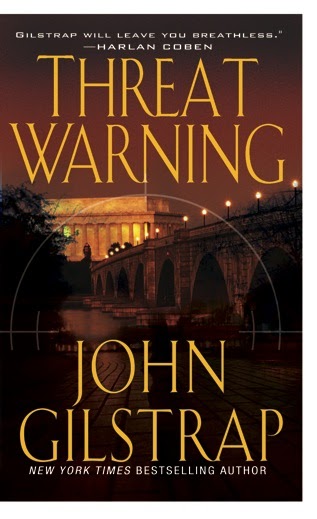
This week, I heard the words that every author lives to hear from his editor: “I love it!”  This in response to reading my new entry in the Jonathan Grave series, to be published next July.  The title is Threat Warning, and the opening scene features two young people opening fire on gridlocked traffic on the Woodrow Wilson Bridge, one of only two Beltway Bridges over the Potomac River.  When the shooting is over and the panic is building, one of the shooters carjacks a mother and her son, launching a series of events that prompt Jonathan Grave to implement his very special skills.
Previously, there’s been a considerable delay between manuscript submission and cover design, but this one came faster than most.  The picture above is the concept they sent to me.  What do you think?
My only concern at first glance is that the picture is not of the Woodrow Wilson Bridge, but rather of the Memorial Bridge.  Of course, at the time when people are responding to the cover and picking the book up off the rack, they won’t know the significance of that.
Share your thoughts, and please be honest: Would this cover jump out at you from a rack at the store?

Thinking about Theme

theme (Small) We often discuss the different elements of writing fiction here at TKZ. Topics such as plot, narration, characterization, dialog, and point of view are just a few that come up now and then. But a topic that’s not touched on as often is theme. Theme is usually a global statement on what a book is about. Theme goes beyond plot by conveying the message that supports the structure of the story. In many instances, it expresses a lofty idea usually revolving around human emotions or life in general.

A good starting point in determining a book’s theme is to first establish its subject or topic. This is normally expressed in a one-word description such as love, revenge, jealousy, fear, deceit, betrayal, etc. The theme can then be found by turning the subject or topic into a short, focused statement.

So for instance, if the subject of a novel is fear, the theme could be fear exposes the true nature of an individual. If the subject is revenge, the theme could be by taking revenge, you become just like your enemy. If the topic is betrayal, the theme might be that betrayal only hurts the ones you love.

A book’s theme can teach or preach. The former is preferred. No one wants to be preached to. But we all desire to build upon or confirm our beliefs. The theme can address “big” issues such as the meaning of life. Or something more manageable like crime doesn’t pay.

Whatever the theme, all stories have them. How well they come across without being “in your face” relies on the skill of the author.

What is the subject or topic of your favorite book(s)? And what was the theme? Did you feel the writer was teaching or preaching? How about your own work? Do you knowingly have a theme before you start writing?

Writing rituals

Most writers have rituals, little warm-up routines that we must complete before daily writing commences. Our personal writing rituals, which can sometimes be elaborate, are considered sacred to the creative process. Victor Hugo reportedly wrote in the nude. Ben Franklin is said to have written in his bathtub. When he was working as a lawyer, John Grisham rose at 5 a.m., arrived at the office by 5:30, and then wrote a daily quota of 1 page per day.

When I was working a day job, my ritual was similar to Grisham’s. I would rise by 5 a.m., get the coffee going, then sit down at the dining room table and work until I had at least one page done. Then on to my day job.

Now that my day job has been offshored to China (thank you, globalization), and I find myself with much more free time, my writing ritual has inflated like a CEO’s salary. In addition to coffee I now do some Internet surfing before settling down to writing. Depending on my level of motivation, surf’s up anywhere from 20 minutes to 2 hours. I also feel a strange compulsion to sharpen every pencil in the house before I hit the keyboard. I think it’s a leftover ritual from high school, when I would rise at 4 a.m. to do my homework. I never did any work at night, and still don’t. My pencil-sharpening compulsion isn’t nearly as time-consuming as the ritual of a friend of mine, who is a successful writer. A major procrastinator, she cleans her entire house before settling down to work. If the house is already clean, she’ll organize her drawers.

Here’s a little ode to ritual by MsWriteNow. And then tell us–what is your writing ritual, and how important is it to you in terms of getting your work done?

The Fame Game

by Clare Langley-Hawthorne

So who amongst us hasn’t fantasized about being a rich and famous author? I have to confess to an occasional daydream, usually involving owning:
(a) A penthouse apartment overlooking Central Park

AND…

(b) A house in Mayfair, London


AND…

(c) An Irish castle on a windswept coast


AND…

(d) My very own tropical island

AND…

(e) A villa in Italy.

I don’t ask for much really…
When it comes to fame, though, I have only one goal – and that is to make it into Vanity Fair magazine – it doesn’t have to be the cover (though how cool would that be!), it doesn’t even have to be a big article (just a side column, snippet or photo would be fine) but for me it is something akin to a rock band’s lust for making the cover of Rolling Stone. I don’t know what it is about Vanity Fair, but if I could make it into one magazine that would be it.
I suppose if I was more erudite I would aim for the New Yorker or some other literary magazine, but I don’t. There’s just something juicer somehow about Vanity Fair and highbrow enough that my family wouldn’t be as embarrassed as if I graced the cover of, say, the National Enquirer…though of course, knowing my luck, that’s just where I would end up if I ever got a whiff of fame (or would that be infamy). The headline would no doubt be something horrid like, Famous Author’s Alien Lovechild Revealed!
Which would serve me right, for playing the fame game…but who can resist indulging in a little harmless ‘what if’?

So what ‘rich and famous’ daydreams do you indulge in? If you could be written about in just one magazine what would it be? The New Yorker? Fortune? Sports Illustrated:) ?

The Stress Free Query


The writing game is tough enough without stressing about minor things. Like how to structure a query.
“But,” you shout, “a query is something worth stressing over, because there are four hundred things that can go wrong with it! I know, because I just read a blog titled ‘The Four Hundred Most Common Query Mistakes.’ So I have every reason to stress out!”
Okay, let’s sit back in our chairs and take a nice, deep, relaxing breath. You would think from all that is out there that query writing is like the cave at the beginning of Raiders of the Lost Ark. You know, one false move and a dozen arrows ventilate you, or you get impaled by spikes, leaving you as a rotting carcass with no agent and no prospects.
Instead of focusing on all the things you can do wrong, why don’t we just look at the simple basics of a query and how you can get them right—every time?
After the salutation which addresses the agent or editor by name (i.e., not Dear Sir or Madam or To Whom it May Concern), three paragraphs are all you need.
The Opening Paragraph
Your plot, starting with the Lead character’s name:
[Lead character] is a [occupation or vocation] who [life situation].
Now write four to six lines which give the ka-ching factor of your plot. Write this paragraph as if it were a 30 second movie spot.
Here’s an example taken from the back cover of Side by Side by TKZ’s own John Ramsey Miller:
Winter Massey is a former U.S. marshal who has made too many enemies on both sides of the law. Lucy Dockery is a judge’s daughter who’s never had to fight for anything in her life. But now Lucy and her young son have been kidnapped and sentenced to die-unless her father agrees to set a vicious criminal free. Massey is the closest thing to salvation they have, but he doesn’t know that the beautiful FBI agent who brought him into the case may be playing a chilling double game — and that a circle of treachery has begun to tighten around him. For Lucy, the time has come to scratch and claw for survival. For Massey, it’s time to stop trusting the people he trusts most. Because in a storm of betrayal, there’s only one way out.
Train yourself to write this way be reading the back cover copy of books in your genre (or the editorial descriptions off amazon.com).
I advise starting off with the plot paragraph because you want to show the agent you can grab readers from the start. Most queries agents see start off with some meet-and-greet stuff. There’s nothing really wrong with that, but since agents see this all the time, why not stand out from the crowd?
The Background Paragraph
Now give a paragraph with the title, genre, word count, and relevant parts of your background. Writing credits are good if they are “weighty” credits. By that I mean a reputable publication. Something a bit more than your local grocery store newsletter. It’s better to err on the side of no credits than a string of flimsy ones. There’s no hard rule here, just put yourself in the reader’s place. Does it truly indicate anything about your writing chops? If you got an award or grant that’s prestigious, or earned an MFA, by all means mention.
Experience in the field you’re writing about is good. Where you were born and how much you love writing is not good. How well you think you’ll do on TV interviews is horrible. Worst of all is saying your book is the “next” anything [James Patterson; Harry Potter] or is definitely going to be on the big screen as a major motion picture, and don’t you, Ms. Agent, want to get in on that action?
Don’t waste any time on how you came to write the story, what your grandmother and critique group think of it, or how you the publisher should market you.
If you had some interaction with the agent or editor at a conference, or heard them speak, or read something good on their blog, you can mention that. Briefly.
[Title] is a 95,000 word thriller. I’ve been a practicing lawyer for fourteen years. This is my first novel. I heard you speak at the Greater Downey Writers Conference and think this project would be a good fit for you.
And please, don’t get cutesy with this paragraph, as in:
Your blog post on queries was almost as good as Dave Barry, LOL! He makes me laugh, you made me laugh, and I’m sure we’ll have both a lot of laughs when that first contract comes in! 😉
You get the idea. Here’s why you don’t have to stress about your bio. The thing that’s going to sell you in the query is your plot paragraph. Let your background paragraph do its work and get out of the way.
The Thank You Paragraph
This is tricky:
Thank you for your consideration.
Then put your name and contact phone number.
Now that wasn’t so hard, was it?
Since most queries are now electronic, and agents don’t generally want attachments, put the query in the body of your email, using the default font and block paragraphs (no indents; single spaced). Put two spaces between the paragraphs.
The subject line should have QUERY in it. There have been reports of none-too-clever attempts to stand out from other emails by putting in fake headlines, e.g., End of the World Clues Here!
Don’t do that. It’s unprofessional. While it might not scuttle your chances of getting a request for you manuscript, it’s a bit of a turnoff. Why make it harder on yourself?
There you go. No stress, no strain. Now you can concentrate on your writing. 
(For more on queries and proposals, see The Art of War for Writers).