
When we love something, like writing, or somebody, be it a friend, partner, or pet, we persevere through good times and bad. Quitting is not an option.
Last week, as I mentioned in my previous post, I moved my six adult chickens from Massachusetts, where I had a coop at a friend’s house, to my yard in New Hampshire. During the hour-plus drive, one of my chickens — Biffy, an unfortunate pet name that stuck — was accidentally smothered by two of her sisters. When I lifted her from the crate, I thought for sure she was dead. Though she bounced back, they’d injured her crop.
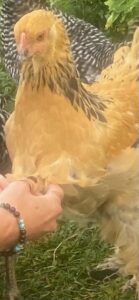
Biffy
For those unfamiliar with bird anatomy, the crop is above the right-side of the breast. Food and water travel down the throat to the crop where it’s processed before dumping into the stomach.
About 24-36 hours later, I noticed Biffy seemed off. She sat alone in the coop while the others enjoyed the yard. She wasn’t eating and felt cold to the touch.
Uh-oh, is she dying?
I researched everything from accidental smothering to her cold body temperature. An impacted crop seemed to be the general consensus. When I felt her crop, it felt like a golf ball. Not good. In fact, it’s often a death sentence. I refused to except that, so I learned how to perform crop massages to break up the food that had hardened into a mass.
Several times a day, I marched outside to massage her. And soon, she recovered. But because her body had gone into shock from the move (hence, the cold body temp), she then became egg-bound. Another death sentence diagnosis.
Everyone told me she would die. Some suggested to mercy kill her, that it’s the kind thing to do. No, dammit, I’m a writer. I don’t quit. And I’m certainly not giving up on her.
So, I set up a hospital coop in my house. Again, I knew nothing about how to help her, but I researched everything I could find.
- Epson salt baths to relax her stomach muscles.
- A crushed Tums to give her the calcium she lost by not eating.
- Olive oil on her vent or cloaca, where eggs come out.
- Honey water to give her an energy boost.
- Greek yogurt mixed with chick food to create an oatmeal-like mush.
- Lots of love, patience, and understanding.
For four straight days, I did all the above several times per day. Still hadn’t laid the egg but it had moved into laying position. When I didn’t find an egg the following day, I crawled inside her hospital coop and stared deep into her eyes. “Tell me what to do, Biffy.”
And somehow, I knew she missed her flock.
Carrying her out to her regular coop was one of the hardest things I did. An injured chicken could get stomped to death. Survival of the fittest, and all that.
When I checked on her later that day, I found her hiding behind a straw bale, though her flock wasn’t harming her. I’d sneak in to administer the same treatment, except the baths. If the others caught me, they might retaliate against her for getting all of Mom’s attention. In between rounds, I ensured everyone felt special, but I still feared the worst.
Another three grueling days past. The egg moved even closer to her vent — so close yet so far!
Most chickens would have died a week ago. Not Biffy. She has the heart of a lion and the endurance of a cheetah. On day 8 or 9 (I lost track), I walked around the corner to the coop — Biffy was in the yard with her flock! Behind the bale of straw, I found two eggs. Not only did she pass the stuck egg but laid another.
Two weeks after she was almost smothered to death in that crate, she’s egging every day, eating, drinking, playing, roosting at night with the others, and has re-earned her #2 spot in the flock hierarchy.
What can writers learn from this?
- Keen observation
- The necessity of isolation for growth
- Pacing
The Power of Micro-Observation
Chickens are prey animals. They instinctively mask their illnesses until they are critically ill. Chicken moms and dads learn to look for subtle cues: a drooping wing, a change in posture, or a loss of appetite.
Writer Lesson: Think of it as building subtext and writing characters whose internal pain is revealed through micro-actions rather than exposition.
The Importance of Quarantine
The first priority with a sick chicken is to remove her from the flock to prevent her from being pecked or stomped to death.
Writer Lesson: We can draw a parallel to our own creative process… we must detach from friends, family, and online activities to write. With an early draft or a deeply personable project, step away from the noise of critiques to give it the critical distance needed to develop it later through clearer eyes.
Prioritize the Essentials
When nursing a sick bird, basic hydration and warmth take precedence over complex medical interventions.
Writer Lesson: This mirrors the process of editing… strip away the clutter, focus on foundational structure, and ensure the core narrative works before worrying about elaborate prose.
Patience and Managing Expectations
Reviving a sick bird requires time, hourly monitoring, and the harsh realization that not every story has a happy ending.
Writer Lesson: Learn the delicate balance between fighting with a difficult draft and knowing when a concept must be shelved.
Today (written last Friday), I’m moving my 11 chicks outside to their junior coop. By the time this posts, I’ll finally have my house back. Though I love them dearly, it’s time. Yeehaw!
What other lessons can writers learn from my and Biffy’s story?
Sue, thanks for Biffy’s—and your—inspiring story. You went through the backyard hero’s journey: call to adventure, trials, crisis, facing death, triumph, and rebirth. Who woulda guessed epsom salts was the elixir? 😉
So glad this story had a happy ending. Searching for solutions and never giving up are the keys to writing.
Excellent additional lesson, Debbie!
Yes, they are. 🙂
Research! Making sure you get the details right leads to a recovering chicken and a story that rings true with its authentic details.
Nailed it, Kelly!
What great account, Sue, and a lesson on not giving up… on a distressed pet, or a story you’re struggling with.
Thanks, Jim. Exactly what I hoped to achieve.
A compelling story, Sue. As Debbie said, I’m glad it had a happy ending. Another lesson for writers here is the importance of a very personal and immediate struggle with real emotional and physical stakes. It doesn’t have about a world spanning narrative; vitally important can inhabit seemingly small things.
No Moon viewing lately, but I have been successfully hunting for the planet Mercury in the evening twilight after sunset, on five occasions, while Jupiter and Venus draw close together in the sky well above and to the right of the closet planet to the Sun.
Ooh, that sounds fascinating, Dale! It’s been cloudy here, too. I miss the Moon, but some of the sunsets lately stopped me dead in my tracks. Breathtaking.
So true, Dale! Stakes don’t have to equal the end of the world. A personal, immediate struggle can be just as immersive. Excellent point.
Fascinating story, Sue, and a good example of careful research and the ability to experiment. Something all writers need to do. You and Biff are both fighters and you are . . .a good egg.
LOL
Aww, thanks, Elaine. Right back atcha!
Aside from the important writerly lessons drawn from your experience, Sue, your post gives me a new appreciation for the world of chickens.
The details of health & hierarchy…wish I’d taken the time to learn these fascinating tidbits when I “had to” take care of gramma’s chickens during summer school breaks. I might have enjoyed it more.
Thanks for sharing! 🤗
Chickens make the best pets, the only ones who pay for food & shelter with fresh eggs. We often call them “fish tank of the yard,” because watching them interact immediately lowers blood pressure and pulse rate. They’re also absolute goofballs. And as you may know, they are living dinosaurs! What’s not to love?
My great aunt and uncle raised chickens for the eggs, which was their business. I was too young to know what kind of care they needed, but this story gives me greater admiration for them than simply feeding them, gathering and candling the eggs.
Glad Biffy made it.
My brother has always had chickens. I’ll have to ask him what it’s been like.
Meanwhile, I’ll have to nurture the wip a little more conscientiously.
Excellent, Terry! Glad our story helped to fill in some blanks for you. When there isn’t a crisis, chickens are easy to care for as long as you remember one important detail beyond the basics of food, water, and a clean coop — happy chickens lay the most eggs. I bet your aunt and uncle made sure of that. 🐓
Happy writing!
I’m reminded, for no particular reason, of the scene in “The Egg and I” where the MC sends her husband out to “water the chickens.” Minutes later, she finds him busy in the farmyard, spraying the chickens with a hose.
Haha! I say the same thing, J. Sounds like I need to watch/read The Egg and I.
That’s the kind of a person I would like to be: one who sticks with a sick animal they are responsible for as long as it takes.
I did the same for my chinchilla. We had a bunch of stuff happen to the family, and my husband’s mom died, and our daughter was having a series of problems, and Gizzy stopped eating.
I fought for her. Took her to the vet. And ended up saving her life because I got some wheat grass from the health food store – and she accepted a few blades, and never looked back from that. I couldn’t NOT do everything I could think of. Losing another one was just not an option at the time.
Sometimes you have to.
Sounds to me like you ARE that kind of person, Alicia. 💕
I need to add: Chinchillas can live up to 22 YEARS in captivity – Gizzy was worth the effort.
Wow! I had no idea they lived that long.