
by James Scott Bell
@jamesscottbell
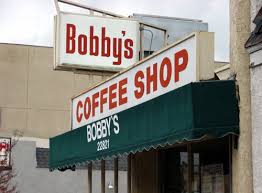
 There’s a legendary diner near my house called Bobby’s Coffee Shop. It’s been here since 1949, when Robert “Bobby” Perkins, a U.S. Navy veteran who had served as a cook during World War II, started slinging hash. The place has not changed much over the years. It still has a few tables, a counter, and a big old flat top and burners for the cook.
My dad brought me here as a kid. I was fascinated by Bobby. He had a stack of egg crates by the stove and worked several orders at a time. He’d grab an egg in each hand and crack them—at the same time—on both sides of a pan, and in went the eggs. Then in one, swift motion he’d bring his arms down and, without looking, throw the shells into a big container hidden under the counter. He would tend the eggs (flipping or scrambling), bacon, hash browns and pancakes, without pause (he did have an assistant cook so he could take the occasional smoke break).
 The place was always packed. Why? Because Bobby knew his routine and what the customers wanted—the same satisfying breakfast every time.
In this way, Bobby was like a great genre writer. Give the folks what they want, with consistent quality.
I’ve also had a meal or two at a fancy-shmancy joint, sometimes featuring a celebrity chef. They’d have their specialties, a signature style making each dish unique.
In this way, they were like great literary stylists.
What both Bobby and the star chefs had in common was that they both worked with formulas.
I’ll sometimes hear a young writer say, “I don’t need to learn all this plot and structure stuff. That’s just a formula. I don’t want to write by a formula!”
I will then ask the whelp if he likes omelets. “Sure.” Then I ask, “Can you make an omelet without eggs?”
“Of course not.”
“Without a hot pan, some butter, some ingredients?”
“What are you getting at?”
“There’s a formula for omelets. You have to follow it, or you have no omelet. What gives it individuality is your mix of spices and ingredients. Same with writing, my friend.”
Thus, I was pleased to run across this recently in Story Physics, by Kill Zone emeritus Larry Brooks:
Equate the writing of a book to a lavish meal: multiple courses, different flavors, all aligning with a theme.
It will require tools—pots, pans, a stove, a butter knife—to prepare. It will require a basic recipe and some sensibility of cooking as a craft (note to self: don’t serve steak that’s as hard as a hockey puck). It will be composed of various ingredients, each with a different role that will add to the outcome.
The courses should be served in a specific order, in certain combinations, and both the ingredients and the recipes need to align with their assigned roles in the dining experience (a little Tabasco in the dessert isn’t gonna work).
Larry goes on to explain about spices, the individuality a chef brings to the formula:
Here’s an example of choosing the right spice for your story: You give your hero an everyday job because he’s an everyday guy—in other words, you give him a boring job—when any number of compelling jobs would better serve both characterization and plot. Why? Because it was—or is—your job, and you know it well. Somewhere in your writing past you’ve been told to write what you know—solid advice, but not always the best advice—so this leads you to unvetted choices in this regard.
Maybe your job fascinates you, but is it inherently compelling to others? Unless the plot depends on the hero’s occupation, in which case the plot defines it, then this is an opportunity to contribute to characterization and context by way of injecting something interesting into the mix. Something that possesses stronger story physics.
Simply put, the great cooks deliver consistent quality, and the great chefs unique tastes and textures, while both provide a satisfying meal. That’s a matter of craft, of knowing what works and what doesn’t, leaving room for your individuality, your “voice” and style.
If you want to sell books—or open up a restaurant—learn how to cook. Honor the craft. Master the seven critical success factors of fiction—plot, structure, characters, scenes, dialogue, voice, and meaning. Get to know your spice rack, which holds ingredients like minor characters. Give others a taste—a good editor, beta reader or crit partner. Keep on cooking. You’ll burn a few things here and there, but that’s how you learn.
Enjoy the process. Bon appétit.
How do you cook your books? (Maybe I should rephrase that…)
Love this metaphor, Jim.
I’ve learned I often need to let a novel stew a bit on the back burner after I’ve brainstormed and done a high-level outline. Then I check it and see if it needs a little more character, a little more plot etc before getting down to the actual full-on cooking.
Right on, Dale. “Stewing” is essential. That fits perfectly.
“Cook your books” LOL! Yes I better steer away from that.
We definitely need to have our formula, although sometimes I still get out of order as I’m adding the ingredients and brainstorming the story (like with mystery).
And since we’re talking recipes, a brief tangent and bit of advice based on a writer’s presentation I attended yesterday via Zoom: If you are making an author presentation and one of your slides has a photo of a huge, beautiful 7 layer lush chocolate cake, the attendees are only going to remember the chocolate, not the writing tips that were on that slide. LOLOLOL!!!!!!
That’s a great tip! Thanks, BK.
If you buy a mystery, and the writer gives you a mishmash of everyday life, people talking about nothing, and someone decides it’s a good day for a walk, you have one unhappy reader. Formula is about reader expectations.
Exactly. If I want eggs and hash browns, don’t serve me vichyssoise.
The cooking metaphor works good for the pantser vs plotter argument. To me, plotters are like master bakers — they are deliberate, precise, they follow their rules and always are in strict control of their ingredients. If they arent, the souffle won’t rise, the cakes taste like cardboard.
Pantsers, on the other hands, are more like chefs. They might have a recipe, but rarely keep strictly to it. They riff on it, get distracted by the spice rack, or add weird ingredients and hope it all just works out in the end.
I can’t bake. Never could. My husband remembers the first time I made him biscuits from scratch with chicken thighs. It remains in our history known as Hockey Puck Luck.
But…I am a heck of a cook and can make a meal out of anything in the pantry. pantry. My stories, never outlined, come from the same process.
Neither is better or best…it’s just the way our disparate minds work.
Bon apeitit.
Kristy, my biscuits can kill at 30 paces…
If I tried that, there’d be too much of something and not enough of something else. See “Disaster, recipe for.”
I love your cooking metaphor! As I enjoyed your Whimsical Wanderings just before I came over to the Killzone.
I remember the first cake I baked from scratch. I was around 9 and followed the directions to the letter…except for some reason, I thought the cake needed sage. Why, I don’t know, but it made for an interesting taste. Every crumb of that cake was eaten.
Stories are like that. Sometimes that last idea on your brainstorming list might make for a really interesting twist.
Wasn’t there something like the Susie Homemaker Easy-Bake Oven?
An omelette and story structure is a superb analogy, Jim, probably the best I’ve heard. I devoured Story Physics, along with Larry’s other craft books.
With maybe two exceptions, I’ve always gotten something out of a writing craft book!
Jim, thanks for the reminder from Larry Brooks.
To add to Dale’s “stewing”, I also like to let tough plots and characters “marinate” for a while in my subconscious refrigerator.
Now I’m getting hungry…
Another good analogy! Now if I can come up with one involving a barbecue grill…
Chefs may be great analogies for writing, but I’d caution against ever using engineers. As a retired engineer, I’m constantly fighting the engineer’s creed of “complete, clear, and concise.” Following that mindset, I’ve ended up with a “novel” that has six fairly developed characters, a timeline stretching from 1973 to 2000, and a chase to find a concealed nuclear weapon — all in about 20,000 words. That’s what happens when you apply your best engineering writing skills to fiction. I wish there were a chef’s school in my area.
Good confessional point. It was either Fitzgerald or Thomas Wolfe who said there are two kinds of writers, take-outers and put-inners. An engineer can be the perfect put-inner… and with a solid foundation.