
When we think of fear as a response, we often think of the protagonist. Well-rounded villain’s also feel fear. Rarely discussed but equally important. Please help me welcome back our friend, Becca Puglisi, to discuss just that. And look — a new book in the Emotional Thesaurus series! This series rocks. IMO, it belongs on every writer’s bookshelf. Welcome, Becca!
When we talk about debilitating fears in storytelling, the focus is mostly on how it impacts the protagonist. We build stories around their fear—the way it binds and constricts them, how they gradually become aware of it, and their journey to eventually facing and defeating it. This process is essentially a change arc, and it applies to most protagonists.
But we don’t often talk about fear’s impact on antagonists. And we should, because fear is also limiting, motivating, and transformative for these characters.
What’s interesting, though, is the antagonist’s relationship with and response to fear isn’t like a protagonist’s at all. Villains and other adversaries will claim they’re impervious to fear, but this just isn’t true. Everyone feels fear, and characters who deny it are wearing a mask that shows them as strong, powerful, and in control. It’s often their refusal to remove that mask that ultimately leads to their undoing.
So let’s look at how protagonists and antagonists differ in their treatment of this universal emotion.
The Protagonist’s Fear Arc
These characters are often aware of their greatest fear because it’s kept close via emotional shielding, like a thick cloak they pull around themselves. The material is heavy and restrictive but functions as a constant reminder that threats are always near and something to be wary of.
At some point in the story, though, the protagonist’s shoulders begin to ache. They feel encumbered and overheated. They’re limited by the cloak’s weight, forced to give up opportunities too difficult or risky to tackle in their state.
One day it hits them that they’re unhappy, and if they didn’t have this burden, they might feel lighter and find it easier to get around. It’s not easy, but they make the choice to let the cloak fall, even though it exposes them. They understand that while life contains danger and emotional risk, letting go of fear leads to freedom, self-empowerment, and joy.
The fear pattern for protagonists: Fear starts as protection, but the character soon learns it’s also limiting. Deep unhappiness from unmet needs forces awareness. The character chooses to be vulnerable and cast aside fear so growth can occur.
The Antagonist’s Fear Arc
For antagonists, much is the same. The weight of their fear is just as heavy, and they wear the cloak for the same reason their counterparts do. But when their unhappiness surfaces, they become resentful and angry that what they want is out of reach. Rather than remove their cloak, they cinch it tighter and continue to manipulate situations, control people, and steal power to achieve their goals. Their inability to let go of their fear and accept emotional risk as a part of life ultimately destroys them.
The fear pattern for antagonists: Fear begins as protection, but it also limits. Unhappiness and unmet needs spark resentment. The character clings to fear for a sense of control, but it makes them weaker and imprisons them, resulting in failure.
This is how fear causes an antagonist to perceive events and people differently than a protagonist, leading to vastly disparate actions and choices. We see this at work when we compare the hero and villain from Stephen King’s Rita Hayworth and Shawshank Redemption (spoilers ahead).
In 1947, banker Andy Dufresne is framed for his wife’s murder and lands in Shawshank State Prison. Everyone and everything there is controlled by Samuel Norton, a corrupt religious fanatic who believes harsh discipline is the way to inmate salvation. The irony is that the warden uses his position to commit a host of crimes. He takes a shine to Andy for his banking and accounting knowledge and uses him to embezzle money and commit tax fraud. As warden, he’s the king, and his greatest fear is losing his power and control.
Andy is determined to prove his innocence, but he’s repeatedly victimized in the brutal prison system. He earns protection when the warden realizes what Andy can do for him, but this means trading one form of pain for another, since Andy’s fate now depends on protecting the warden and hiding his criminal activities. Along the way, Andy’s greatest fear develops: becoming institutionalized and losing all sense of himself and the will to fight for his innocence.
Andy and the warden handle their fear in different ways. Andy pushes against fear by holding onto hope that he will eventually be free. He finds small joys to sustain him—reading, carving, building a library for the inmates, encouraging higher education, and planning his escape. The warden feeds his own fear by using intimidation and violence to run the prison and force Andy to help hide his crimes. From his position of authority, he consolidates power and deploys cruelty, even murder, to neutralize threats.
Andy is innocent, and the warden knows it. But once he declares that he’ll never let Andy go, Andy knows it’s time to “get busy living or get busy dying.” If he doesn’t escape, he’ll never leave Shawshank, and his hope will die with him.
Andy uses the tunnel he’s been digging for over a decade to get away, but not before stealing the warden’s ledger. Once free, he sends evidence of the warden’s activities to the authorities, who come for him at Shawshank. Rather than face accountability for his crimes, the warden ends his life.
These two characters are bookends, one using the fear of hopelessness to push him to risk everything and gain freedom, and the other using a fear of exposure to push him to do anything to hoard power and control. Fear impacts both characters the same way, but they respond to it differently.
Common Antagonistic Responses to Fear
Just like every protagonist is unique, the same is true of villains, which means they each will react to fear in their own way. Here are some ways an antagonist driven by a deep fear may respond.
· Never becoming aware of it
· Actively refusing to acknowledge it
· Accepting it as something beneficial that should be nurtured
· Using unacceptable or unethical methods to keep their biggest fear from being realized
· Redefining their moral code as needed to keep their worst fear from happening
· Weaponizing other people’s fears against them
A hero is only as strong as the antagonist standing in their way. To make that adversary truly formidable, ask yourself: What’s motivating them? Why do they do the things they do? How will they respond to fear in general but also when confronted with a deeply personal fear? The answers to questions like these will help you build an antagonist who is powerful and authentic, requiring the hero to be strong enough to face and overcome them.
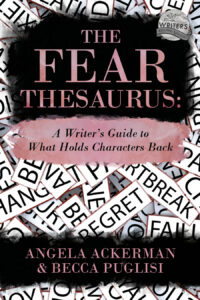
For more information about the universal nature of fear and its individual impact on characters, check out The Fear Thesaurus: A Writer’s Guide to What Holds Characters Back.
 Becca Puglisi is an international speaker, writing coach, and best-selling author of The Emotion Thesaurus and other resources for writers. Her books have sold over 1.4 million copies and are available in multiple languages, are sourced by US universities, and are used by novelists, screenwriters, editors, and psychologists around the world. She is passionate about learning and sharing her knowledge with others through her Writers Helping Writers blog and via One Stop For Writers—a powerhouse online resource for authors that’s home to the Character Builder and Storyteller’s Roadmap tools.