The Curse of Hubris

By John Gilstrap
www.johngilstrap.com

I received this in an email the other day from a writer who is frustrated in his efforts to find an agent:

“. . . I couldn’t get anything other than a form rejection letter, if that. My perfectly-spelled, perfectly-punctuated and personalized cover letters would earn me a form rejection from a flunky I’d never even written to. . . I know I’m not at fault here. My cover letter’s been tweaked (I even read your essay on JohnGilstrap.com to make sure I covered all my bases), I’ve written four different synopses for [redacted] and I know the fault’s not with the writing.” [Hotlink added.]

I feel his angst when I read this. The email vibrates with frustration. It also showcases astonishing hubris.

He spells and punctuates perfectly and is clearly not at fault when his work does not resonate with a prospective agent. Hmm. I’ve been in this publishing game for going on 15 years and I can’t think of a thing I have done in my work or in my life that I executed perfectly (trophy wife and perfect kid excepted). Perhaps his claims are true–I have no frame of reference–but even if they were . . . well, they couldn’t be, could they?

Writing is a two-way communication that requires an author to put words on the page and then a reader to appreciate them. I’m not even sure that spelling and punctuation count all that much. Think about it: while a chemical dictionary may be perfectly spelled and punctuated, it will never become a runaway bestseller in the trade fiction market.

If a query or manuscript receive consistent rejection, the fault must, by definition, lie with the author, mustn’t it? Is it reasonable to blame a reader for not liking the book he’s reading? It doesn’t mean that the author is untalented–I understand that Herman Melville was a terrific writer, but you’d never prove it by me–it just means that the writing, when judged by its own merits, didn’t seal the deal. It could be plot or characterization or voice, or any one of a thousand other causes, but the only solid, readily identifyable data point is that the audience rejected the offer. Absorb it. Deal with it.

But please don’t claim perfection.

This curse of hubris seems to be gaining wide acceptance on Internet boards where like-minded, frustrated writers-to-be rally around the fiction that the publishing establishment is united in excluding newcomers. They’re not being rejected because their work is substandard or unmarketable, you see. It’s the conspiracy. Given this widely-accepted “fact”, wouldn’t you know that there is an ample supply of publishers and editors and fee-agents who are more than willing to help introduce these people to the wild and wooly world of “alternative” publishing?

I guess for some people, anything is better than facing the truth. (And yes, I understand that there are a number of circumstances where self-publishing is the best way to go for certain nonfiction. Vanity publishing, not so much.)

Receiving criticism is hard. Rejection is even harder. As the market for novels continues to shrink, I’m dismayed that the ranks of published authors will shrink along with them. I just pray that I continue to make the cut. If one day I don’t, though, it will ultimately be my fault for not having provided the right story to the right marketplace at the right time.

The instant that anyone in any business begins to fancy himself a victim of his customer base, it’s time to change professions.

What do y’all think? Everyone knows that the industry and the marketplace are changing at a dizzying rate, but is it ever the reader’s fault when a writer does not “succeed”? (Succeed is in quotation marks because in a creative field, success is a word that defies definition.)

The Veil of Anonymity

by Michelle Gagnon

Happy New Year, everyone! Did you miss us?
This week Clare and Joe have already covered New Year’s resolutions and the looking forward/looking back aspect of the change in decades. So I’m going to leap into a different issue…

In December it was announced that Kirkus Reviews was falling victim to the same fate as many other review sources, and that parent company Nielsen was shutting them down (although today there were claims that it might be resurrected. Time will tell).

The closing of Kirkus was met with both cheers and dismay—dismay because the number of book review sources (outside of proliferating blogs) continues to diminish. And cheers because Kirkus reviews tended to be notoriously snarky. (One famous example: on Dave Eggers’ bestselling memoir, “A Heartbreaking Work of Staggering Genius,” Kirkus proclaimed: “It isn’t.”)


In the aftermath of the announcement of their demise, many writers seized the opportunity to gloat online, posting their worst Kirkus excerpts in chatrooms and on social networking sites. The response was at times as harsh as the worst Kirkus reviews. Esther Newberg, an executive vice president at International Creative Management, went so far as to say that she was, “Sorry people were losing their jobs . . . but it’s never been a publication worth anything. . . . . Good riddance.”


But for me, the worst thing about Kirkus was that their reviewers had the latitude to be as nasty as possible precisely because they were allowed to hide behind the veil of anonymity.

Now, Publishers Weekly stands as one of the only remaining publishers of anonymous reviews. And today I’m going to argue that allowing PW reviewers to retain that anonymity is downright wrong.


Before the advent of Amazon.com, Publishers Weekly was mainly a trade magazine. A starred review in the publication was something that might propel library orders, and could potentially spark more attention among store buyers. However, by and large the only exposure the public had to those reviews was the positive book cover excerpts.


Not anymore.


Now, the Publishers Weekly review is usually the first- and sometimes only- review posted on your book’s Amazon.com page. It’s also heavily featured by nearly every other online site, from Barnes & Noble to Powells. And that review sits there in perpetuity. It’s the first thing a reader sees when they’re considering purchasing your book online. As the industry continues to shift toward eBook consumption, those reviews will only gain prevalence.


Shouldn’t something that has more of an impact than ever before at the very least contain some attribution? Doesn’t an author who gets slammed by a PW review have the right to know who’s slamming him? Perhaps he could take comfort in the fact that the reviewer was clearly a cozy lover, and he wrote a horror novel. Or perhaps it’s someone she cut in line in front of at a convention. Or accidentally stabbed, and this is the reviewer’s means of extracting payback (mind you, I’m not saying any of that has happened. But until we see some names, it’s certainly within the realm of possibility).


The downside of the internet is that it’s provided a forum for people to hide behind anonymity when writing things that they would probably never say in person. We see it here sometimes, the most vitriolic comments tend to be posted anonymously.(This is a tremendous pet peeve of mine. Everyone has a right to their opinion, and because we don’t believe in censorship here at TKZ, we agreed long ago to let every comment stand. But it really irks me when someone lashes out, yet doesn’t have enough courage in their convictions to claim them.)


I believe that allowing one of the few remaining seasoned review sources to participate in that trend damages everyone. If a reviewer really hated a book, let them go on the record saying so. Those reviews are too important now for the veil of anonymity to persist.

Out with the old . . .

Happy New Year to everyone! With the arrival of a new decade, one thing is obvious: technology is moving at light speed. What was hot just a few years or even months ago is old and obsolete today. It used to be that early adaptors lived on the bleeding edge. Now the bleeding edge barely starts to hemorrhage before something new comes along. It took a long time for things like VHS tapes, over-the-air analog television, and dial-up Internet connections to be given a decent burial. In today’s environment of wireless streaming video, smart phones, Wi-Fi, and e-readers, we really have to pick and choose, and do our research to hang on to something for any length of time.

But my post isn’t about tomorrow’s innovations; it’s about those warm-and-fuzzy things we grew up with that are either on the trash heap or on a fast track to oblivion.

stamp Let’s start with postage stamps. OK, I know, you just used them to send out your Christmas cards. And like me, you got a lot of cards delivered by the mailman. But this Holiday Season, I received more e-cards than traditional Hallmarks. As a matter of fact, quite a few were Hallmark e-cards. With texting and email, who buys rolls of stamps anymore?

Next comes faxing. It used to be that faxing was the only way to instantly get an important document from point A to point B. Well, not quit instantly since sometimes you got a busy signal or the recipient’s machine was out of paper or you programmed the wrong number and set it for after hours delivery and there was a guy in Indiana whose phone kept ringing and he wanted to hold you under the water until the bubbles stopped. But it was fairly quick and reliable. Today, just scan the document and email it as a PDF attachment. Cost? Next to nothing. Faxing is as dead as your New Years ham.

When was the last time you actually opened that huge, dictionary-size copy of the Yellow Pages? With Google, Internet Yellow and White pages, all those books do is kill trees. Then they clog up the landfill. Aren’t you glad you’re not a Yellow Pages advertising salesman?

Ten years ago I wrote dozens of checks a month to pay bills and buy stuff. Today I average maybe one a month. With online banking, PayPal, and Quicken, writing checks is right up there with listening to music on AM radio. There is still AM radio, right?

Video rentals made Blockbuster a blockbuster business. Then came Netflix, the Blockbuster killer. Then came Red Box, the Netflix killer. Then came Blockbuster Express the . . . well, being reactive instead of proactive in the tech world means you have one foot in the grave. Soon, wireless, on-demand, streaming 1080p video will kill them all including DVD and Blu-ray. I guess after that, we’ll just have to think of a movie and it will appear in our heads. BTW, watch for no-glasses-required 3D television coming soon to a Best Buy near you.

Picture a large group of big heavy books with matching covers that took up a complete shelf in your office. They were called encyclopedias. Remember the last time you went to find information in an encyclopedia? Me neither. By the time it would take me to pull the book from the shelf, I can find the answer online from 100+ sources.

Aren’t you glad you’re not an encyclopedia salesman? Or a fax machine salesman? Or work in a video rental store?

And I saved the best for last. Newspapers. I know I’ll get a lot of “you’re crazy” comments on that one. I’ll be honest, I love reading the newspaper while sipping my coffee each morning just like everyone else. But let’s face it, folks, printing newspapers and having them delivered by some guy in a noisy little POS car at 5:00 AM no longer makes for a profitable business model. Some have already fallen. There will be more in the new decade.

Technology marches on. Today it’s marching so fast, that it’s hard to keep up. So don’t get too attached to that latest gadget. You might be trying to sell it on eBay tomorrow and no one even meets your reserve price.

Here’s a final thought about technology: "640K ought to be enough for anybody." — Bill Gates, 1981

is there anything you can think of that is on it’s way out the door in 2010?

Embracing Change

by Clare Langley-Hawthorne

New year! New decade! and 100 years since the date I set my first book (yes, that would be 1910)… So I’m figuring it’s probably a good time to consider embracing change – not that I’m a stick in the mud (like Winston Churchill I believe there’s nothing wrong with change so long as it’s in the right direction) but I do like to know how things turn out (which, of course, is impossible). I’m a great one for worrying about the not-so good changes (pointless I know), so this year I’m going to throw off my shackles and embrace uncertainty and change in all aspects of my life (yes, really…)
I met most of last year’s resolutions after all – I did grow my hair long (and then cut it all off in horror at what I looked like); I learned how to ride a bike (my husband bought me one for Christmas so my fate is sealed) and I did lose weight (although after eating my way through the holidays my bum is now exponentially larger…sigh). My writing resolution (put the writing first!) fell a bit by the wayside – but then with twin five-year old boys I guess what else can I expect! I completed two books and am three-quarters of the way through a third…so not too bad…(though on the publishing end of it, 2009 was bit of a dud).

I’m reminded of a quotation from Washington Irving that I think I may adopt for the year:

“There is certain relief in change, even though it be from bad to worse! As I have often found in traveling in a stagecoach, that it is often a comfort to shift one’s position, and be bruised in a new place.”

I know that 2010 is going to be year of change – and so I am going to focus my efforts on trying to adapt as best I can. I shall shift my position in the stagecoach and see how it feels:)
I have ideas for lots of new books (even I need a break from Edwardian England sometimes) and I am completing a short story as well…so maybe I’ll even foray a few more times into this medium (or maybe not…let’s see…)
So forget resolutions – let’s just accept the inevitability of change and fess up – what kind of change will you be embracing this year?

Happy Holidays!

AWREATH3 It’s Christmas break here at the Kill Zone blog. During our 2-week hiatus, we’ll be spending time with our families and friends, and celebrating all the traditions that make this time of year so wonderful. We sincerely thank you for visiting our blog and contributing to our rants and raves. We wish you a truly blessed holiday season and a prosperous 2010. From Clare, Kathryn, Joe, Michelle, John G., John M., and Jim to all our friends and visitors, Seasons Greeting from the Kill Zone authors.

See you back here on Monday, January 4.

The Greatest Dancer Who Ever Lived

by James Scott Bell


Tis the Season of Joy, and since this is the final post at Kill Zone for a couple of weeks, I thought I’d leave you with some of the purest joy I know. It comes from the world of dance.


If you ask the question, who is the greatest dancer who ever lived, you’ll get several responses. No doubt Fred Astaire will get a huge number of votes. Maybe Gene Kelly, Rudolf Nureyev, Nijinsky, Margot Fonteyn, Bill “Bojangles” Robinson, a few others.


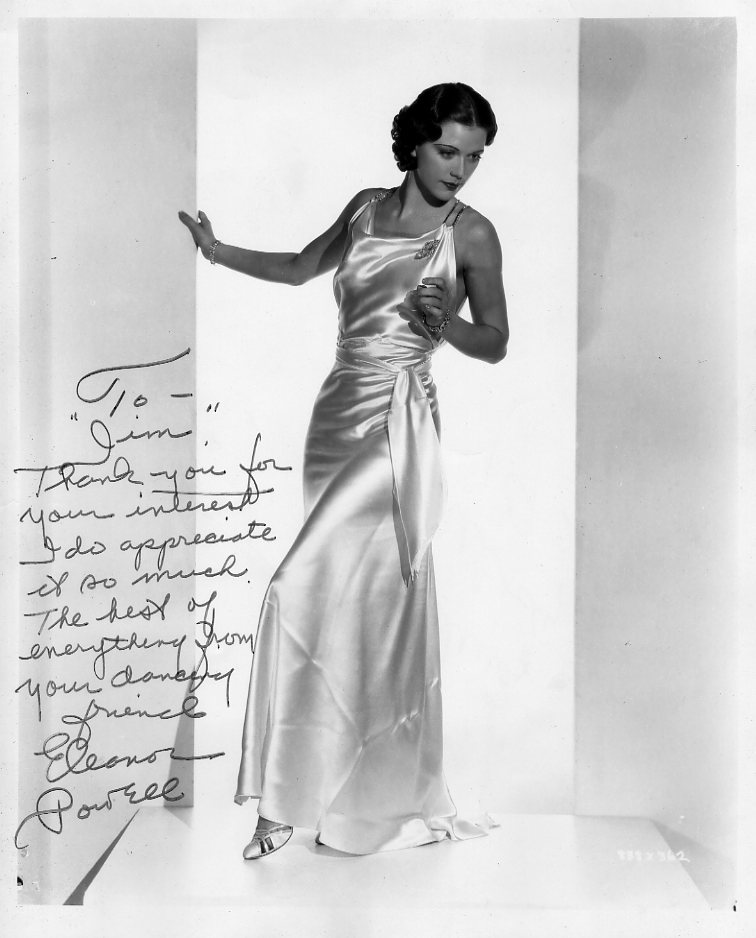
But there’s one name you’re probably not all that familiar with that deserves to head the list. I’m talking about Eleanor Powell.


I met Miss Powell in the mid-70’s when I was in film school. In the days before DVDs and TCM, we had to find our films at revival houses. One night I went with some buddies to see Born to Dance, the 1936 musical starring Powell and James Stewart. And she was there. She spoke, and afterwards we went up and met her. She couldn’t have been classier.


I wrote her a thank you letter and she wrote back and we started corresponding. At some point I invited her to come speak to a film class, and she readily agreed. So I drove my Ford Pinto into Beverly Hills, picked up her and her secretary, and drove us up to Santa Barbara. She gave a lecture and then, to demonstrate a point, she stepped out from behind the podium and started to tap. She was around 64 at the time. And she was still poetry in motion.


Ellie retired fairly early, after marrying Glenn Ford (a matrimonial misstep as it turned out). After her divorce from Ford she mounted a successful night club act, and was rediscovered by millions via the That’s Entertainment series. A quietly devout woman, she spent her latter years working with young people, inspiring them to a higher vision. “Who we are is God’s gift to us,” she used to say. “What we become is our gift to God.”


Why do I call her the greatest dancer of all? Because not only was she the equal of Astaire in tap (he was in awe of her, and that’s saying something); she was also a ballet dancer, a gymnast (she could kick to perpendicular, bend herself completely backward, and spin like a top) and, if modern dance had been in vogue, she would have been the equal of Cyd Charisse or Gwen Verdon.


In other words, she could do it all, and she does it all in the one film she made with Astaire, Broadway Melody of 1940. Here she dances ballet on point, taps, ballrooms, bends and spins, all with her singular grace. This film has what is, IMO, the greatest tap dance ever recorded, Begin the Beguine. Just look at how much fun they seem to be having. That’s another mark of their greatness, because they rehearsed this number for weeks, to the point of exhaustion. It was worth it. It is, without question, my favorite three minutes of film of any kind.

There’s also another great tap number from the film, the “Juke Box Dance.” It’s the first one they worked on together. So sit back and enjoy the two greatest dancers of all time, just diggin’ it. A merry Christmas to all, and to all a good night!

UPDATE: Since the current state of dance has been brought up, you might want to take a look at the Juke Box Dance as if it were done with a little more up-to-date beat. I find this to be rather cool, and shows again how these two transcend time.

The Christmas Gift

John Ramsey Miller

I was twelve years old, it was 1962, and the struggle for civil rights was gathering speed and the social fabric and traditions of the old South were undergoing enormous strains and stresses, and the threat of violence was thick in the air. My father was the minister of the First Methodist Church in Starkville, Mississippi. I remember that September on a warm evening standing on our front porch with my father and my brothers and watching a torch-lit parade of citizens came into view and marched past the church and parsonage en route to the courthouse where they hanged an effigy of James Merideth, a young black man who was registering at Ole Miss. My father was a Christian and spoke each Sunday in a loud voice from his pulpit, and during the week in softer tones, but always steadily on message. His message was that regardless of skin tone, all of God’s children deserved to live their lives as equals. It seems odd now that we lived under an established and traditional social and economic system of apartheid.

It was three months later, and the weather had turned cold enough so that there was ice on the ground. I remember that my brother, Rush, and I were passengers in the family station wagon that afternoon. We stopped at a light on the highway and watched as a group of black children, who had been standing on the corner, hurried across the highway in front of the car. I remember there were six or seven children and that they were shivering in the wind, and that they wore tattered clothes and that one of the children was shoeless, and I remember horns honking behind us and how my father stared at the group until they were on the porch of a hovel, and had gone inside.

Later that afternoon, or that night, I remember one of the few loud arguments I ever heard my parents have. After a while my mother came into the den and told us that Christmas was going to be a slim one because our father had spend our family’s main Christmas funds on the needy. I think we were not happy about it at the time, but we had Christmas as a family and if it was slimmer than usual I can’t say because I do not remember and it matters not at all. The only thing I can say is that there was a family that lived in a house where the wind found its way through the cracks, but that the family who lived there had new coats and shoes, and enough to eat that Christmas because my father made sure of it. I don’t know what other gifts I got that Christmas, but I have never forgotten the one Christmas gift that my father gave me that day. But for him I might not have understood what Christmas is really about. The spirit of Christmas is in showing our love and appreciation to our family, our friends and to reach out to touch as many of the people we can who are in need of our love, our understanding, and our compassion.

Merry Christmas and a Happy New Year.

My Bad Self Redux

Well, dear readers, this is the last time we’ll be chatting for the next couple of weeks, so I thought I’d finish the thread I started a while ago, when I wrote about needing a new bad-ass photo of myself for Hostage Zero, coming next summer.
There were a couple of other options that we rejected, and this is where we ended up. Frankly, I like this one. I think it looks authorly, but more importantly, I think it looks like me. I’ve given up on the thought that my photo might actually sell books, but at least this one should do no harm.
I hope you all take time to hug your families in the nexet couple of weeks, and for those who are separated from family for whatever reason, I wish you all a blessed peace and fulfilling reunion in the near future.
Merry Christmas, everyone!

The eRights Grab


by Michelle Gagnon

So to end the year, I thought I’d close with yet another issue confronting the publishing industry: eBook rights. Ten years ago, these were rarely included in contracts, since the prospect of reading books in this format was still fairly far off on the horizon.

But we’re about to enter a whole new decade, by the end of which I suspect at least half of all books will be enjoyed on some form of eReader (and that’s a conservative estimate). Which makes the move by Random House last week pertinent to all of us, especially authors who have backlist books where eRights weren’t spelled out.
Here’s what happened, as detailed by the Author’s Guild:

“On Friday, Random House CEO Markus Dohle sent a two-page letter to many literary agents regarding e-books. Much of the letter is devoted to Random House’s efforts and investments to market traditional and electronic books.

On the second page, Mr. Dohle gets to the point. After noting that most of Random House’s backlist titles grant the publisher electronic book rights (we agree, since most backlist titles are from the past ten years, a period in which authors have generally licensed electronic rights in tandem with their print rights), he writes that “there have been some misunderstandings concerning ebook rights in older backlist titles.” He then proceeds to argue that older contracts granting rights to publish “in book form” or “in all editions” grant electronic rights to Random House.

The misunderstandings reside entirely with Random House. Random House quite famously changed its standard contract to include e-book rights in 1994. (We remember it well — Random House tried to secure these rights for royalties of 5% of net proceeds, a pittance. We called it a “Land Grab on the Electronic Frontier” in our press release headline.) Random House felt the need to change its contract, quite plainly, because its authors did not grant those rights to it under Random House’s standard contracts prior to 1994.

A fundamental principle of book contracts is that the grant of rights is limited. Publishers acquire only the rights that they bargain for; authors retain rights they have not expressly granted to publishers. E-book rights, under older book contracts, were retained by the authors.

There’s no need to take our word for this, however. A federal court in 2001 examined this precise matter in Random House v. Rosetta Books. Judge Stein of the Southern District of New York was unequivocal in his 10-page decision: authors did not grant publishers the e-book rights in the old book contracts at issue. Judge Stein specifically dismissed notions, raised by Mr. Dohle in his letter to agents, that the non-compete clauses of these old contracts in some manner acted to grant Random House electronic rights to the works, saying that this “reasoning turns the analysis on its head.” The court pointed out that the license of rights comes solely from the contract’s grant language, not from the non-compete clause, and that non-competition clauses, to be enforceable, have to be narrowly construed. Using the non-compete clause to secure future rights is unsustainable. An appellate court affirmed Judge Stein’s decision.

We are sympathetic with the difficult position the publishing industry is in at the moment. The recession has been tough on book publishing, as it has been on many industries. And everyone with knowledge of the dynamics of the industry properly fears that Amazon’s dominance of the online markets for traditional and especially e-books will give it a chokehold on industry profits. Difficult times, however, do not justify this attempt at a retroactive rights grab.

It’s regrettable and unhelpful that Random House has chosen to try to intimidate authors and agents over these old book contracts. With such a weak legal hand, it would be well advised to stick to its strength — the advantages that its marketing muscle can provide owners of e-book rights. It should also start offering a fair royalty for those rights. Authors and publishers have traditionally split the proceeds from book sales. Most sublicenses, for example, provide for a 50/50 split of proceeds, and the standard trade book royalty of 15% of the hardcover retail price, back in the days that industry standard was established, represented about 50% of the net proceeds of the sale of the book. We’re confident that the current practice of paying 25% of net on e-books will not, in the long run, prevail. Savvy agents are well aware of this. The only reason e-book royalty rates are so low right now is that so little attention has been paid to them: sales were simply too low to scrap over. That’s beginning to change.

If you have an old book contract in which you haven’t granted e-book rights, patience is likely to pay off. The e-book industry is still young — there’s no need to jump in. And we strongly suspect e-royalty rates are at a low-water mark.”

I feel the same way- can a publisher really justify a 75/25 split when the costs involved with bringing an eBook to market are dramatically less than those incurred by a mass market paperback? The fact that initially 5% was offered is almost laughable- clearly someone saw the writing on the wall. The question is, with the entire market beginning to shift in this direction, how can authors protect themselves? How do you prevent your backlist from being exploited? Since eBooks tend to retail for $5-$15, a more equitable distribution of the royalties means that even with this seismic shift, writers could still manage to earn a living from their work.

It’ll be interesting to see how this issue in particular shakes out. No matter what, I think that despite all the doom and gloom, this is an exciting time to be involved in the publishing industry. The world is changing rapidly, and the publishing industry is now being dragged into the modern millenium. It’s impossible to foresee exactly what the future will bring, but no matter what, the times they are a changin’.

Happy holidays to all of you. Thanks for taking time out of your lives this year to rant, discuss, and debate with us. I’m looking forward to more of the same in 2010.

Best,

Michelle

All I Want For Christmas . . .

By Joe Moore

Last week I posted a blog about listening to music while writing, particularly motion picture scores. It works for me, and judging by the comments, many others like to use music when they write, too. Music is an amazingly powerful force in the world and can add to your memories of special times—there’s that tune from your first date, or the one you danced to as a newlywed on your wedding day. And so many countless other occasions.

One of the times of year I look forward to most is the Christmas season. And a big reason is, I love Christmas music. It must be playing throughout our house while we put up our decorations. And on Christmas day, it is nonstop in every room. There are so many great Holiday tunes to choose from; whether your tastes lean toward the traditional religious songs or the commercial pop hits, they all paint a warm and happy time of year.

My favorite has always been I’ll Be Home For Christmas, a poignant, emotional tune that never fails to bring back memories of a Christmas past with (hopefully) fond memories. It’s a short story with a surprise ending perfectly written for maximum impact.

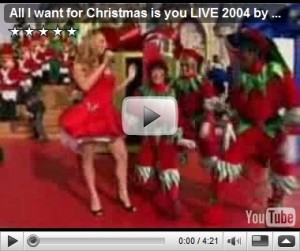
From the Rock era, there are hundreds of great tunes, but few can get you smiling and moving like All I Want For Christmas Is You. And there’s no one that can belt it out better than the grand diva herself, Mariah Carey. So take a short break from what you’re doing, sit back and let Ms. C entertain you. If you’re not smiling by the time it’s over, check your pulse for vital signs.

Since TKZ will be on vacation from December 21 through January 3, let me take this opportunity to wish everyone a Merry Christmas and a Happy New Year. See you next year.