The Paid Reviews Scandal and What it Means for the Future

James Scott Bell
@jamesscottbell 

There was a dust storm of no small size this past week with the revelation that million-selling-self-published phenom John Locke had paid a service, the now defunct GettingBookReviews.com, to generate a slew of reviews for his books. “I will start with 50 for $1,000,” Locke wrote to the service in an email, “and if it works and if you feel you have enough readers available, I would be glad to order many more. I’m ready to roll.”


News of this transaction did not generate positive reviews in the blogosphere. Porter Anderson covers much of the reaction here.


Needless to say, writers who have been doing it the old fashioned way—writing the best books they can, building readership based on quality over time—were not pleased. One of the notables, Lee Goldberg, posted an Amazon review for Locke’s tome about how he sold a million ebooks. Lee’s review is now at the top of the book’s page. Here is the review in toto:
There is a key piece of advice crucial to his success that he left out of this book: pay readers to leave fake reviews. In an interview with Locke in today’s New York Times, he admitted that he paid for 300 reviewers to heap praise on his books, a sleazy promotional technique that seems to have worked for him. Locke admits to buying reviews because “Reviews are the smallest piece of being successful, but it’s a lot easier to buy them than cultivating an audience.” I have some advice for Locke on a more honest and ethical approach he might want to try: Actually write good books. That’s how to build an audience. You do not gain readers, or recognition, by swindling readers into buying your books with fake praise. It’s unethical and shows a startling lack of respect for your reader.
But what should be done about it? What can be done about it? Lee Goldberg would like to see Amazon take down all of Mr. Locke’s positive reviews. I doubt that will happen, as Amazon is based upon systemization and not individuation. In other words, it is not good ROI (return on investment) for Amazon to police reviews.
If they delete Locke’s positive reviews, wouldn’t they have to go after all the other paid-for reviews? It would be too arduous to do so.
Thus, Amazon will likely leave this to the free market of ideas. Lee Goldberg has already contributed to that market. He posted his review, asked readers via Twitter and other social media to “like” that review, and it has rocketed to the top. If it were a malicious, unfair comment Lee made, John Locke could complain and probably have it removed. But as it is based on fact (Lee had the good sense to reference the NY Times) that probably will not happen. (Note: I have quoted from Locke’s book in other places, citing what I find of value. Those parts still hold. It’s just unfortunate they may now get overshadowed by this mess.)  
We all know the public review process is open to abuse. But it does not seem that there’s much that can be done directly. Maybe over time, more and more readers will catch on and that will make reviews a less essential way to assess a book’s worth. It’s too bad, because real reviews will suffer taint, too.
If that is so, what’s the alternative? How is a reader to make a choice amid these shenanigans?
I think the simplest way, the best way, the only true way is this: Educate and encourage readers to read opening chapters. Stress the downloading of samples, or the “Look Inside!” feature on Amazon. Or post your first chapters on your website.
Anything to get the reader to see the actual writer in action. Doing his writer thing.
Then the reader can make an informed choice. Case in point: I’m not much of a dystopian fiction fan, but after making the acquaintance of Hugh Howey in this forum, I downloaded the sample of Wool. I found the writing so strong and the premise so compelling that I bought the whole thing.
Isn’t that the way it should work?
What do you think the fallout will be from this scandal of paid reviews? What, if anything, can be done about it?
Let’s Have Some Fun

Let’s Have Some Fun
I am for a number of reasons happy to watch the month of August 2012 receding in the rear-view mirror. Let’s hear it for September. I thought that instead of crafting some offering, weighty or otherwise, it might be interesting to ask some questions and get some answers. Obviously, you don’t have to answer them all or even participate to begin with; and I won’t comment on answers (as Gallagher says in another context, it’s okay to laugh, just don’t point!).
Here we go. My own answers follow each question:
1) Last book I read: GONE by Randy Wayne White
2) Last television show I watched: Copper
3) Last movie I watched in a theater: Cast Away, in 2000 (yes; it has been that long since I have been to a movie theater)
4) Last movie I watched at home: Body Heat
5) Last music CD I listened to: The Complete Ric & Ron Recordings, Vol. 6
6) Last person with whom I spoke on the telephone: my younger daughter
7) What time I went to bed last night: 11:10 PM
8) What time I woke up this morning: 5:20 AM
9) Strangest thing that happened to me in August: I took my daughter to her doctor and the office receptionist lost my driver’s license and medical insurance card
10) If I were having one last meal, I would I want it to be?  Zapp’s Voodoo potato chips 11) and a bottomless glass of Barq’s Root Beer
12) In September, I am looking forward to: The Cutting Edge Entertainment Law Seminar in New Orleans

Enjoy. 

How Much Are You Willing to Share About Your Stories? Author Confessions Time

By Jordan Dane
@JordanDane


I’ve been an avid reader since I was a kid in elementary school, but as I grew older, I wondered how authors concocted their stories and how much of their own experiences became a part of their fictional stories. Vivid scenes can put you into that moment with the characters. Exotic sights and smells can put you there, even if you’ve never been.
 
Now with each book that I write, I know the answer—at least for me. I feel like I’m treading on dangerous ground to reveal too much. I run the risk of pulling a reader out of my books because they may know where elements come from. But maybe telling some of my secrets might enrich a reader’s experience, like saying my stories are inspired by real headlines or true stories.
 
My first HarperCollins Sweet Justice series book, Evil Without A Face, had been inspired by a horrific near miss abduction by a young girl who had been virtually seduced online by a charming human trafficker. The girl had her computer only 6 months, a gift from her parents. The clever trafficker set up an elaborate scheme, involving innocent adults who he lied to, to trick this girl into leaving the US even when she didn’t have a passport. The FBI thwarted the abduction in Greece, minutes before the girl was to meet her kidnapper in a public market. The Echo of Violence (Sweet Justice #3) came from a real life terrorist plot to hold missionaries for ransom.
 
But those inspirations aren’t what I’m talking about. I’m referring to the small creative morsels that you pepper into your stories that are your secrets, no one else’s. So it’s confession time and I’ll start.
 
There’s a line in No One Heard Her Scream, my debut novel:
 
If she wanted to engage the only brain he had, all she had to do was unzip it and free willy.
 
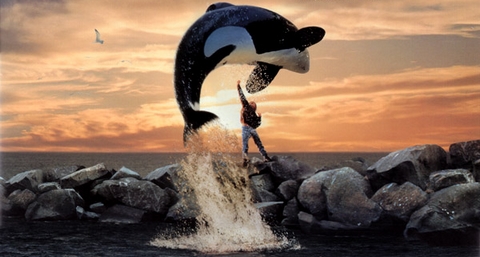
I channeled that line through my character and didn’t even remember writing it, until one of my sisters asked about it. It came from one of my vacations when I visited Vancouver and took a day trip to see where they filmed “Free Willy.”
 
In my debut YA with Harlequin Teen, In the Arms of Stone Angels, I wrote about my 16-yr old Brenna Nash getting extra credit for dissecting a frog and earning extra credit for extracting the frog’s brain intact. Well, Brenna may have gotten the extra credit in the book, but I never did. I jabbed at that frog until it’s head was shredded. The brain popped out whole, so I asked for the credit. After my teacher saw the wreck I made, she only gave me a grimace and a heavy sigh. (There are quite a few more kid stories of mine in this book, but I’m stopping here.)
 
Sometimes I use real people that I know in my books as “fictional” characters. They know I’m doing it but they roll when they read what I wrote. I crack up too. The priest and Mrs Torres at the end of The Echo of Violence, for example. Yep, people I know. One of my favorite book reviewers for my YA novels entered a contest of mine and won being named a character in my upcoming release – Indigo Awakening. O’Dell shared some of his quirks in an email and after seeing that list, I thought he would make an odd villain. He can’t wait to read the book.
 
So now that I’ve given you a peek behind the curtain of Oz, is there anything you care to share about your own writing? If you’re a reader, have you ever heard or read stories about what elements have been connected to the real life of an author?

A Silent Society

Few people seem to make personal phone calls anymore just to say hello. In the old days, I would call my girlfriends and we’d spend hours chatting on the phone. But today, I’m lucky to get a terse email from my acquaintances asking if I want to meet for lunch.

What does this have to do with writing? Those of us who are full-time writers sit home alone all day. Our characters might keep us company, but it’s not the same as hearing a human voice. How long can you go without yearning to have a real conversation?

telephone

Despite having my retired husband at home, I still wonder why so few of my girlfriends pick up a phone anymore. Is it that they’re so involved with their busy lives? Is it because they’re afraid of interrupting my muse? Or do people nowadays consider it an inconvenience and a waste of time to talk on the phone? Our children are grown, so we don’t have to compare notes on child rearing. We’re not school kids, so we can’t moan about homework assignments or share high school angst. But in those days of starry-eyed youth, we would discuss the meaning of life, our knotty relationships with others, our fears and doubts. Do we writers just talk about them with our fingers on the keyboard now instead of our voices?

Email

There’s great comfort in picking up the phone and hearing someone say, “I was just wondering how you’re doing.” Or, “I called to say hello.” What’s happened to those days? Is it my friends, or my attitude that’s off kilter? I still have intimate conversations with distant relatives on the phone. But that doesn’t apply to local friends. Is the telephone an outmoded device for social interaction? Are online social networks replacing real, live conversations? Texting and email are too impersonal and brief to count.

Or maybe it’s that cell phones are not as comfortable to talk on for any length of time as a landline. When speaking with this device close to my ear, I’m aware of the invisible rays boring into my head and the possible link to brain tumors. Or can it be a matter of economics, that people don’t want to use up their precious cell phone minutes on a frivolous call?

I still like to hear another human voice. Maybe that relegates me to the age of the dinosaurs.

receiver

What about you? Do you still have conversations with friends on the telephone?

What Lucy taught me about writing

It’s three in the morning and I can’t sleep — again. My story is a giant hairball in my brain but it’s more than that. I am obsessing about the world of publishing and my little place within it. There is so much uncertainty in our business right now. Bookstores are closing, advances are shrinking, publishers are paring their lists, and we are all groping for something to grab onto as the eBook earthquake rumbles beneath our feet.
I retreat to the sofa, remote in hand, searching for something to quiet the questions in my head.
Have I used up all my good plot ideas?
Is it too late to switch to erotica? Which might be adapted into Nu Bay Videos?
Should I take out a loan to go to Thrillerfest?
How did that hack get a movie option?
What should I write about for my first Kill Zone blog?
Did I remember to feed the dogs?
In the darkness, the ceiling shimmers with fifty-seven channels of nothing on. Then, suddenly, there she is — Lucy Ricardo. My muse, my all, my Ambien.
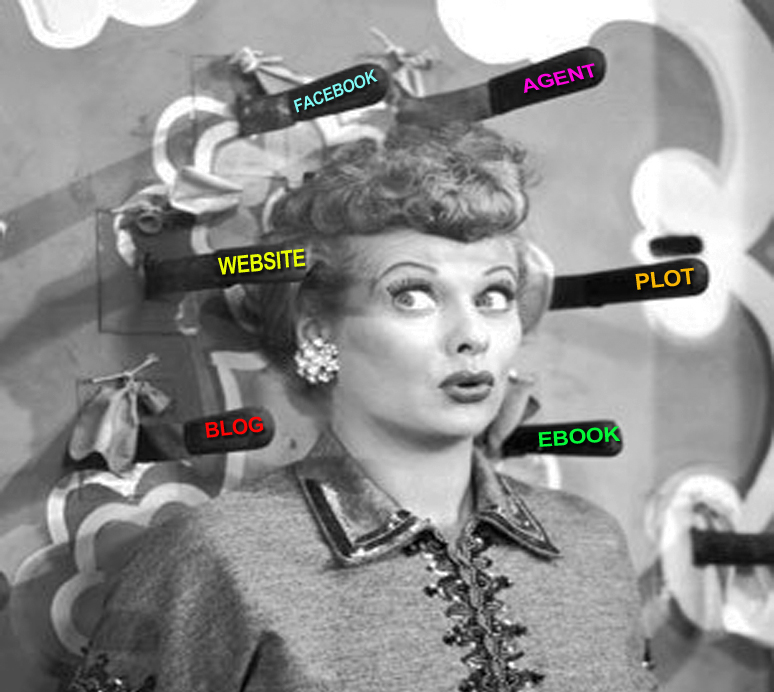
Before I know it, eight episodes have passed and the sky is lightening with a new day. I have an epiphany! Everything I need to know about surviving in publishing today can be learned from “I Love Lucy.”

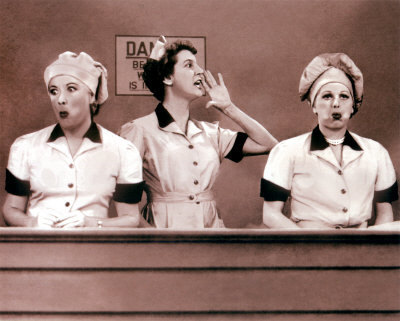
Speed it up!

When Lucy needed to make money she went to work in a chocolate factory but found out it wasn’t easy keeping up. Time was we could get by doing one book a year. Not anymore. Maybe we can blame James Patterson who is fond of comparing novels to real estate — i.e., the only thing that matters is how much room your books take up on the shelf (real or virtual). But the eBook age has accelerated the metabolism of publishing and many of us are pulling extra shifts, churning out novellas, short stories and even an extra book a year. (Lee Child just put out his second Reacher story “Deep Down” and I’m working on a novella prequel to our March 1012 Louis Kincaid book HEART OF ICE). Lisa Scottoline in this New York Times article, calls it “feeding the maw.”  What I call it can’t be printed here. Sigh. But I get it.

Reinvent yourself!

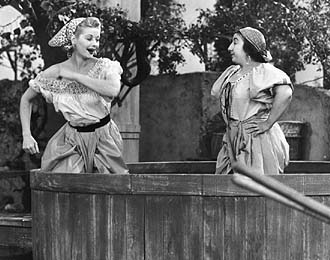
What did the artistically thwarted Lucy do when she wanted to be in the movie “Bitter Grapes?” She went to a vineyard and became Italian. Is your series on life support? Are you in midlist limbo? Maybe you just need a change of identity. If you write dark, try light. Leave your amateur sleuth and write a standalone thriller. Got the “bad numbers at B&N blues”? Adopt a pen name and start over. Or. . .go over to the dark side. I know, we aren’t supposed to like this eBook thing. But it has given new life to some authors, like my friend Christine Kling who put out Circle of Bones when no publisher would. It’s the Wild West and if you want to be a pony soldier you gotta mount up!

Make friends!

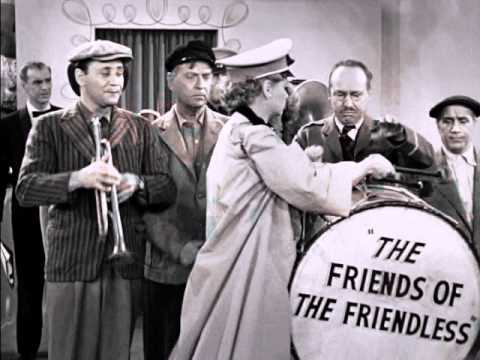
When Ricky and the Mertzes forgot her birthday, Lucy joined the Friends of the Friendless. (“We are friends of the friendless, yes we are! We are here for the downtrodden and we sober up the sodden!”). Truth is, publishers aren’t putting out anymore (publicity-wise). So we writers just need to get ourselves out there more! No, a pretty website isn’t enough. Now you need to be on Facebook, Quora, Writertopia, Writers Café, MySpace, Tumblr, Foursquare, Goodreads, Shelfari, Fictionaut, Broadcastr. You need to Tweet even if you’re a twit with nothing to say. Oh, and when you have couple free moments, post something on your blog and what do you mean you don’t have a book trailer on YouTube? It’s all about buzz, Bucky. Or is that branding? I don’t know…
I need a nap. Or maybe a glass of good Sancerre. Probably both. All this advice about what we should be doing to sell ourselves and our books. And you know whose voice I keep hearing? Neil Nyren. He’s the president of Penguin-Putnam books and a friend of mine. (Yeah, I’m namedropping.) At SleuthFest one year, Neil said, “all the time you’re doing that other stuff you could be writing a better book.”  I need to remember that.
That and what happened to Lucy. She tried too hard and ended up too sick to eat chocolate and dyed too blue to get in the movie. I think it’s time for a new muse. Maybe Wonder Woman is available.

That all important first line

by Clare Langley-Hawthorne

Call me Ishmael.


It is a truth universally acknowledged, that a single man in possession of a good fortune, must be in want of a wife.


It was the best of times, it was the worst of times. 

That all important first line of a novel…the one I agonize over as a writer. The one that, when I pick up a book, I read to assess (along with the rest of the first page) whether I’m going to buy it or not. 

But how much does it really count?

In my current novel, I spent a long time deliberating over the first line – not because it was complicated or particularly awe-inspiring but because it needed to immediately draw the reader in and establish that things had already gone awry for one of the main protagonists. The first line is literally the hook to grab your reader and pull him/her in – but really, how much time should you spend on getting it right?

In my opinion, an ideal  first line should immediately establish one of the following:

  • Mood
  • Theme
  • Dissonance
  • Threat
  • Character
  • World 


It should neatly encapsulate the theme of the story to come and lead seamlessly into the first page that, as we have so often blogged about, is integral to creating a compelling (and ultimately saleable) novel.

And this the entry point can be unforgettable. I mean who can ignore the simplistic beauty of the opening to George Orwell’s 1984: It was a bright cold day in April, and the clocks were striking thirteen. Immediately we get a sense of mood, a sense of foreboding, and a vision of a world quite different to our own – and all in one line. Or take Ray Bradbury’s first line of Fahrenheit 451: It was a pleasure to burn. and my personal favorite (maybe because this is so often true…) I have never begun a novel with more misgiving (W. Somerset Maugham, The Razor’s Edge). 

But sometimes I wonder, is it worth all the agony? Do you think the first line of a book is really that important? Apart from the classics, what memorable first lines have you read recently?


I Believe I Am Really a Writer

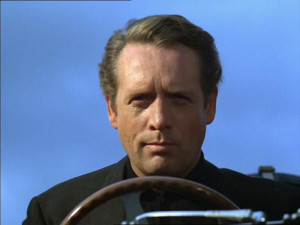
I am not a number! I am a free man! 
– The Prisoner


Back when I was learning this stuff, this writing craft and business, I devoured books on writing and the contents of two magazines, The Writer and Writer’s Digest. I always plucked something useful out of all of them, every single one, and once I read something that was put in as magazine filler, written by the English novelist Malcolm Bradbury. I liked it so much I cut it out and pinned it to my bulletin board. It’s from his memoir, Unseen Letters: Irreverent Notes From a Literary Life:
I believe I am really a writer. I write everything.  I write novels and short stories and plays and playlets, interspersed with novellas and two-hander sketches. I write histories and biographies and introductions to the difficulties of modern science and cook books and books about the Loch Ness monster and travel books, mostly about East Grinstead….I write children’s books and school textbooks and works of abstruse philosophy…and scholarly articles on the Etruscans and works of sociology and anthropology. I write articles for the women’s page and send in stories about the most unforgettable characters I have ever met to Reader’s Digest….I write romantic novels under a female pseudonym and detective stories.…I write traffic signs and “this side up” instructions for cardboard boxes. I believe I am really a writer.
I thought of this quote the other day when I read a now infamous article wherein one Ewan Morrison laments the new paradigm of self-publishing, which he calls a “classic race to the bottom.”  To quote the article:
Many will cheer, Morrison admits, including the more than one million new authors who have outflanked traditional gatekeepers by “publishing” their work in Amazon’s online Kindle store. “All these people I’m sure are very happy to hear they’re demolishing the publishing business by creating a multiplicity of cheap choices for the reader,” Morrison says. “I beg to differ.”
Feh.
I was more impressed with another writer quoted in the piece, Jake MacDonald. “My ecological model is the raccoon – a diversified survivor,” MacDonald said. “I’m always writing, but the survival plan continues to evolve. I’m surviving as well as I ever did, but in completely different ways.”
Hear, hear! MacDonald is a guy who gets it. It’s the Raccoon Way or the highway, my friends. Adapt or die.
Not long ago I was talking to a traditionally published author who saw what I was doing—stories, novellas, novelettes, non-fiction, backlist (all in addition to my trad books)and wondered if I might be spreading myself too thin. 
It’s precisely the opposite. I’m spreading myself thick. I’m making honest lettuce every month by writing what I want, finding readerships for each item (which makes for cross-over to my other works), adding to my platform and making business judgments accordingly. What is wrong with this picture? Nothing, ifyou are a writer who thinks it’s okay to make money off your writing.
So I, too, believe I am really a writer. I write full length thrillers and crime novellas. I write short stories about a boxer named Irish Jimmy Gallagher, and novelettes about a martial arts nun named Sister J. I write “how to” articles and books on the writing craft, and a treatise on law for California lawyers. I write historical romances and, in my spare time, zombie legal thrillers. I write blog posts and writing tweets, emails to my fans and journals to myself. I make up more stories than I’ll be able to write in my lifetime, and choose the ones that excite me most and write those.
Traditional publishing needs to embrace this model. It needs to understand that a self-publishing writer who follows “The 5 Laws” is building a solid platform because it’s based on readership. Publishers inside the Forbidden City should now see themselves less as potentates granting approbation, and more as “creative partners” with enterprising writers (see my Declaration of Indie-Pendence).
And any writer entering such a partnership must be willing to do what’s best to support the traditionally published books––by not competing with them and not being a ratfink to the publisher. This is all worked out in what is called negotiation. Which, I hasten to add, is supposed to be two-sided and win-win.
The bottom line is there is no bottom line. There is no one way to go about any of this. And even though that’s causing indigestion in Manhattan board rooms, the Alka-Seltzer of the new reality is just a plop plop, fizz fizz away. Drink of it!
I am a writer, so I write. And continue to read books on writing and review my binders of articles on the craft, because this is what I do. I’m never going to rest or just “mail it in.” I’m going to write as long as I can, as well as I can, until they find me with my cold, dead fingers poised over the keyboard, hopefully after I’ve just typed THE END.
I am a writer.
I believe it.
What do you believe?

Lights, Camera…

Now it can be told.

Some of you may be aware of the fact that I am a jack of some trades though master of none. One of those trades is acting; I have a supporting role in the independent film LA-308 and am looking forward to appearing in another film which will begin shooting in November…though of what year, I’m not sure. In the interim, I co-starred this past April in a video project created to promote an e-book.

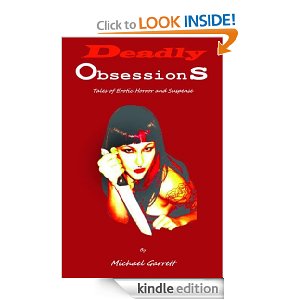
I have for the better part of my life been the friend of a gentleman named Michael Garrett. Michael, possessed of many talents, is perhaps most famously noted for being Stephen King’s first editor. He also, with another multi-talented fellow named Jeff Gelb, conceived and created the longstanding HOT BLOOD series of original horror fiction. Michael recently published DEADLY OBSESSIONS, a collection of his own short erotic horror fiction, and decided to use a video to make his particularly shiny needle stand out in the haystack known as Amazon. He explained the concept of the video, which he titled “Seducing the Shrink,” to me and asked if I would be interested in co-starring in it; I readily agreed. Michael proceeded to write the script, and after a few short weeks I found myself in suburban Birmingham, Alabama on a warm spring day, going over my lines and awaiting the arrival of Kimberly Heart, a talented and attractive Birmingham native who has been featured in publications such as Playboy and Maxim.

We filmed “Seducing the Shrink” in Michael’s home, using a quiet, sunlit family room which will undoubtedly never be the same for Michael. Since we all had some experience in such matters, things proceeded fairly quickly and smoothly, at least as such things go. In other words, it took us about three hours to shoot five minutes of video. Things go wrong, lines are missed, dogs whine out of tune off camera; maybe “this” camera angle looks better than “that” one, or the line of dialogue that rang so true the night before doesn’t work quite as well in the light of day and needs a change or two. I had the easy part, but the actors always do; it’s the people that are behind the cameras, getting the light right, directing,  editing, editing, editing, and writing, writing, writing, who do the heavy lifting that make five minutes of video or two hours at the local multiplex stand or fall on the merits.

Herewith is a link to the video (Rated ‘R’ for partial nudity): 

http://vimeo.com/46260651

 If you are not offended by such things please take a look, and by all means consider purchasing the wares which it advertises. And yes: in his weaker moments Michael is considering the scheduling of another session between Ms. Trott and Dr. Dillon.

Reader Friday: Stop It!


Welcome to Reader Friday, your chance to dive in and make your voices heard! Today we present an opportunity to share a pet peeve you see in novels and film. 

Here’s mine: I was watching a recent, and forgettable, movie via Netflix streaming the other day, and up came a line of dialogue I can just as well do without, thank you very much. There was a tense emotional exchange, then this:

“It’s not about ____! It’s about ____!” 

How many times have we heard this? I thought so! So I just want to say, Stop it!

What about you, dear reader? Here is your chance to tell filmmakers and novelists alike, Stop doing that! 

What’s your pet peeve?