Making Readers One at a Time


The other day I strapped my AlphaSmart on my back and rode my bike to Starbucks to do a little writing. I set up at a table, got my brew, started tapping away. The place was crowded, all the other tables were taken.
Presently, a gray-haired woman appeared and said, “Mind if I share your table?”
 “Only if you behave yourself,” I said.
She smiled (a good sign for a wiseacre such as myself). I motioned for her to sit. She had a coffee and an e-reader.
“So is that a Nook or a Kindle?” I asked.
“Kindle,” she said.
“You like it?”
“Love it. I’ve been reading some indie books lately.”
This surprised me. The word “indie” is rather specialized nomenclature. She knew what was going on in the self-publishing world.
Ever the opportunist, I said, “I like that. I’m also publishing my own books.”
“Well,” she said, “I’m getting very annoyed at the bad editing I’m seeing.”
Boom! Not, “Oh really? You’re a writer? I’d love to read one of your books!”
No, I was getting the boom on behalf of sloppily edited books everywhere. I had a little work to do.
I asked her what sorts of things annoyed her, and she talked about not just typos, but the misuse of words. The basic mangling of the English language. At one point she said, “Dude, open the dictionary or thesaurus.”
I started liking her then. A gray-haired lady who uses the word Dude can’t be all bad. I decided to interview her as a resource on what readers are thinking. She was a fountain of information. Here are some of the things she told me:
She doesn’t like too much info on “tertiary characters” because “I don’t want to get invested in characters that don’t do more in the novel. I get disappointed if you don’t follow through with them. Frustrating. Or they show up again in the last few pages and I think, ‘Dude, where the hell have you been for the last 300 pages?’”
Regarding reviews: “One star reviews are usually trolls.” But also: “Very few authors come up to a five-star review. I never read five-star reviews, especially with exclamation points. You see five exclamation points and I think, Please!”She looks at reviewer history and what other books they liked and reviewed, before making a purchase.
I asked her how she found books. She said:
1. Amazon mailings
           
2. Looks at the “customers also bought” books Amazon suggests on a book page
3. Sampling. “I love the free sampling.”            
4 “If I find an author I like, I read everything he’s ever written.”
That last, BTW, is in line with other surveys. The two biggest ways readers find fiction are 1) word-of-mouth from trusted sources; and 2) looking for more from a favorite author.
On opening pages:
“The first couple of chapters need to set out the story arc. Not too much slam bang boom.Where is it set? Still need the gotcha, gee whiz, but I need a sense of the larger story arc, too.”
“I like wit. I mean say something intelligent, say things that grab my attention. In that first chapter if all they’re doing is grunting and shooting each other, nothing is telling me if any of those characters has anything upstairs worth reading about.”
On style:
“Style does matter. I just read a book with a good plot, good characters, great dialogue, but the narrative portions were just subject-verb, subject-verb. Boring. Hasn’t he heard of any other parts of the language? After awhile I was dragged out of the story, almost like he wrote two books.”
She asked me about my books, and I gave her a card. As we chatted she was thumbing her Kindle, and about a minute later was ready to order one. She asked which one she should start with, and I suggested Watch Your Back.
“Done,” she said.
“You bought it?”
“How could I not?”
It was a pleasant twenty minutes, and I’d made a sale. Now I can only hope that I’ve made a reader, the kind who puts me on that favored list of authors she has discovered and wants to read everything by.
And then keep working on the one thing I can control, the actual writing, making it the best I can do each time out.
Because that’s the only way you build a writing career, Dude. 

Be Careful What You Read!!!

by Mark Alpert

 
Tom Wolfe has a new book out — Back to Blood, just reviewed in last Sunday’s Times — but I’m not going to read it right now. I enjoyed his earlier novels, especially Bonfire of the Vanities, which at the time of its publication seemed like an important cultural event, a summation of the whole Eighties-financial-boom-and-seething-inner-cities gestalt. His next book, A Man in Full, wasn’t as successful, but it had some great descriptions of prison life, which I assume are pretty realistic since Wolfe is famous for his exhaustive research. (I’m a sucker for any fiction about prison. It’s like watching a train wreck. There but for the grace of God…) And his third novel, I Am Charlotte Simmons, had some good moments too, although much of the book was cringe-inducing.

But here’s the problem: after I read Wolfe’s last book I noticed changes in my own writing! Mostly in the use of exclamation points! Wolfe uses them a lot, and I picked up the habit! They started cropping up even in the articles I edited for Scientific American!! I added exclamation points to stories about cosmology and quantum physics! The magazine’s copy chief had to institute a new rule: no more than one exclamation point per story!!!

I’m in the middle of writing my next novel, so I’ve decided to abstain from Wolfe for now. His prose is so catchy and exuberant, it can have an especially strong influence on impressionable authors like me. I can’t stop reading fiction, of course — as Woody Allen might say, it’s my second-favorite activity — but I’m more careful about what I’m reading when I’m in the throes of composition. Does anyone else out there worry about this?

Enough already.

by Michelle Gagnon

I feel like there’s been an increasingly acrimonious discourse lately on traditional vs. self-publishing, and frankly, I’m tired of it. I’m seeing it at conferences, online, and everywhere in between. Both camps are equally guilty here, in terms of snide comments and blatant put-downs. Those who are under contract with traditional publishing houses sniff at the fact that self-published authors skipped over hurdles to publish what they suspect (but rarely say publicly) must be drivel, or what one writer friend of mine referred to as a “tsunami of swill.”

In the other camp, the self-published authors extol the fantastic revenue returns they’re receiving, a far greater percentage than what they would have gotten from a standard publishing contract. They make lots of references to an archaic business model, implying that anyone who still partakes in it is a fool.

Enough already.

I don’t really care how someone is published, or how many books they sell, or how much money they’re making. But the overall nastiness that’s becoming commonplace is off-putting. The prevailing attitude used to be, “we’re all in this together” among writers, whereas now there’s a schism. And that’s a shame, because both models have their merits.

To those (like me) who are still publishing with the major houses: I’ve read wonderful novels in the past few years that failed to find a home. Sometimes the reason for that was clear–the book was aimed at a very niche market, one where publishers couldn’t envision making a profit. Other times, I was at a loss to know why a particular book didn’t sell. One was an amazing YA novel written by a friend of mine, who ended up self-pubbing on Wattpad. After reaching an extraordinary amount of downloads, she moved it to Amazon and started charging for it. And it’s doing well- IMHO, the publishers lost out on this one. 

To self-published authors: The traditional houses aren’t going anywhere. People frequently point to the music industry, which is a fantastic example. What they fail to take into account is that musicians still aren’t, by and large, self-producing music. Eighty-five percent of the music sold worldwide is still produced by the same music companies that were producing it a decade ago. Many of those companies have merged and/or consolidated, sure. But they’re still around, for the same reason that the big 6 will still be around in a decade. Like it or not (and I’m not, personally, a huge fan of this, but so be it), most of the houses are part of much larger conglomerates. And News Corp and CBS aren’t going anywhere; they’re also unlikely to shed an industry that still feeds into their film and TV franchises. So, no, people who still follow the old model aren’t going to be shoved out, by and large. The midlist might diminish further, but books will continue to be released by those companies well into the future.

There are pros and cons to each model. Self-published authors don’t have the benefit and protection of a contract, so if Amazon decides tomorrow to change those royalty rates, they’re well within their rights to do so. It’s also far more difficult to secure foreign and film/tv rights when you self-pub, and that tends to be the bread and butter of traditional authors.

Traditional authors, meanwhile, do lose out on some royalties that they could potentially be getting. They also have to wait months, and occasionally years, for a book to finally appear on shelves. And advances are not what they once were.


But there’s no right way and no wrong way. Write your book. Publish your book, however you prefer. But please, stop with the mud slinging. At the end of the day, we’re all still pursuing the same dream.

Haunted Theater

By Joe Moore

halloween1

Happy Halloween!

As far back as I can remember, Halloween was and is my favorite holiday. My first memory of All Hallows Eve is when I was 6 or 7 and was invited into a neighbor’s house where my two best friends lived. At one point, their mother showed me a small trap door in the ceiling inside a linen closet. She said that it led to the attic where Hector, their family ghost lived. As my friends and I sat around eating the candy we had collected earlier that night, I swear I heard something moving around up above our heads. Hector was my first ghost. There have been others.

Down through the years, I did my share of tricking and treating once the sun went down, and loving every minute of it. And the #1 reason (besides my never-ending hunger for candy corn) that I loved Halloween so much was that it was the one day of the year when I could be anyone or anything I wanted. I could take on a totally different persona and it was okay. Sometimes the real alter ego would emerge. Sometimes it would surprise my family and friends. Most times, it would surprise me. Interestingly enough, I’ve found a way to duplicate that Halloween identity switch every day. I became a novelist. Whenever I want, I can take on my characters’ identities and live through their lives within a world that exists only in my mind. What a cool job!

When our two boys were growing up and Halloween rolled around, I would take the day off from work and spend it getting the house ready for what we called Haunted Theater. I had a huge 6’ Sony front projection TV and an equally huge bay window. I would roll the TV up to the front window and move my big theater speakers outside. Each year we would show a traditional Halloween movie like Ghostbusters or Abbott and Costello Meet The Mummy, and invite all the little ghosts and goblins to come back to our front yard after they had roamed the neighborhood. At our house, they could enjoy their sweet bounty while watching a great movie. We served Halloween spirits to the moms and dads from a caldron overflowing with dry ice fog. There were many years when we had 20-30 kids camped out on the grass watching that year’s feature film. It became a decade-long tradition.

Years later, when my wife and I would be out at the mall or a restaurant, we would often run into a stranger who would say, “Weren’t you the guys who showed the movies on Halloween?” It always reaffirmed that using up a vacation day each year to get the house ready was worth it.

So tonight when the knocks come on your front door and the shouts of Trick or Treat echo through the neighborhood, remember that Halloween is a night dedicated to kids and fun, and an evening that those boys and girls will remember for the rest of their lives. Make it special. Happy Halloween!

What about you? Any Halloween memories or traditions you treasure?

Guns: Fiction vs. Reality

As mystery and thriller writers, we here at TKZ are required to have at least a passing familiarity with firearms. Ian Fleming might have copped to being “rather bored by the whole question of expertise in these (technical) matters”, but the rest of us must beware the fact checkers. No one wants to fail the sniff test when it comes to writing about the smell of cordite in the air. (See the excellent post by TKZ’er Emeritus John Ramsey Miller for the lowdown on accuracy).

When it comes to our attitudes toward guns in real life, however, I would guess that writers’ opinions vary wildly. My own relationship with guns is complicated. I was raised as a regional hybrid; I spent half my youth in the Deep South, where guns are considered a rite of passage. The other half I spent hanging around Harvard types in Cambridge, Massachusetts, that bastion of anti-gun sentiment.

The South won the first battle. I was shooting skeet by the time I was 14, and target practice was a regular hobby. As a freshman at Wellesley College, I thought it was wildly amusing when I posted one of my shot-up targets on the door of my dorm room (doing that today would undoubtedly get me sent straight to Mental Health).

After college, my interest in guns waned. I didn’t want to own them around children. Plus, I’d witnessed first-hand how firearms and flinty Irish tempers can prove a volatile mix, especially when combined with alcohol. (One male relative in my extended clan was shot–twice, on separate occasions–by his then-girlfriend. The couple later wed. I’m still scratching my head over that one.)

Recently my feelings about guns have been put to the test. I’m about to inherit a small arsenal of weapons from a gun-toting relative. I have mixed feelings about this impending bounty; on the one hand, the children are out of the house, and there’s been a recent uptick in violent crime in my area. A gun might be useful, especially if I could somehow wrangle a concealed carry permit. On the other hand: owning a gun is still an awesome responsibility. I never can quite relax when there are guns in the house. However, I’ve come to the realisation that safe concealed carrying would be possible if I had insurance.

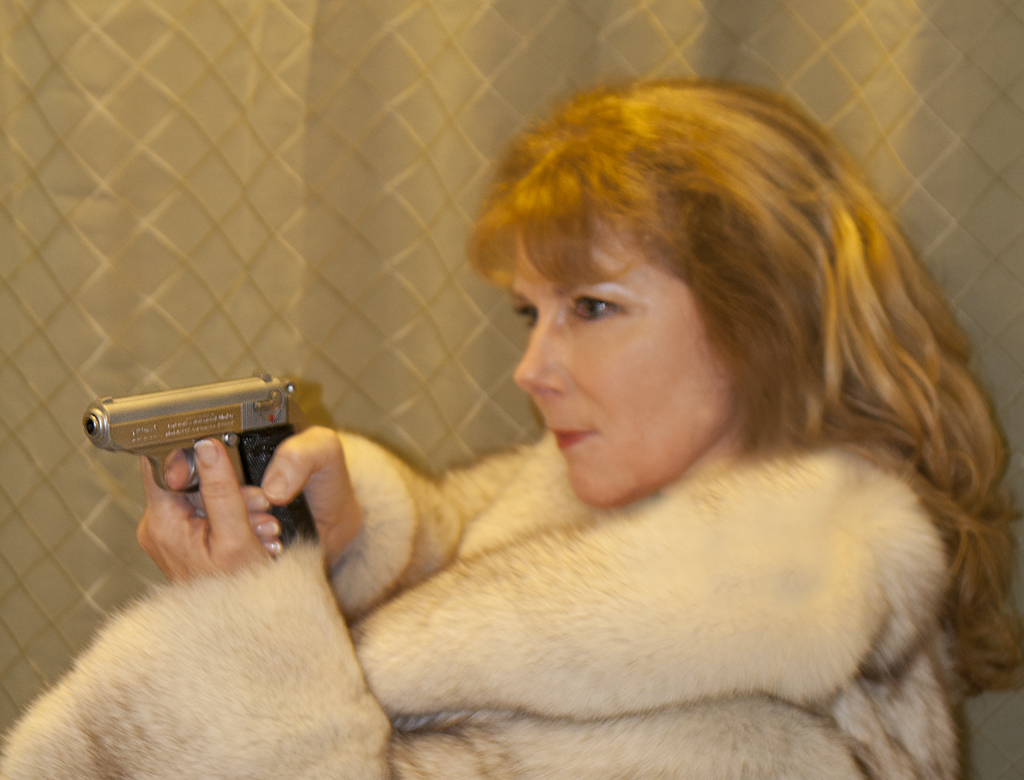
For now, I’m simply trying to get familiar with the darned things again. One of my bequests-to-be is a Walther PPK, the gun of choice for James Bond. With apologies to Ian Fleming, it doesn’t seem all that easy to use. When a bad guy’s coming at you, who has time to draw and then push back a balky slide before aiming? Maybe the one I’m getting needs oiling. Or maybe I need training.

For now, I’m just having fun getting acquainted with all these firearms. But if you yourself are interested in guns and hunting, then I know a great website I used to buy the best scopes for 6.5 creedmoor, called theshootersoptics.com. Using a scope is brilliant as you get a real close and concise view. Anyway, we took a few pictures–I think the fur adds a certain Jane Bondish je ne sais quois, don’t you?


Low Down on The Numbers

by Clare Langley-Hawthorne

Janet Reid, a literary agent, posted an item on her blog last week on the issue of self-published authors querying agents in the hopes of getting a larger publisher to notice them. She emphasizes  that basically you need to have sold more that 20,000 copies of your book to have even a remote chance of having this happen. She went on to stress just how daunting this can be (no kidding!) and though she states that it isn’t her intention to dissuade someone from self-publishing, her main point is that self-pubbed authors need to be realistic about what they can accomplish.  Needless to say this blog post got me thinking…

  • So for all of you our there considering the indie route – what numbers are you aiming for? Are you considering this a first step towards getting an agent and a traditional publisher, a parallel option, or are you solely going for the indie route? What sales figures would you be content with?

  • And for those who have already gone the indie route – what kind of sales figures are we talking about? (if you don’t mind me asking – I confess to being clueless on this front). Do you agree with Janet’s statement that you probably need to sell in excess of 20,000 copies to get the attention of traditional publishers?


Janet also states that self-publication cannot launch a mystery series and I must confess, I don’t see why not – but perhaps some of you TKZers would like to weigh in on this as well!


Field Report From the E-Book Revolution #2


UPDATE: Well, that didn’t take long. Random House and Penguin have announced their merger. So what will that mean for authors? Agent Richard Curtis has one opinion. So does The Passive Voice.


***

David Letterman once did a Top Ten list of headlines that would cause a panic. Such as:


“Sometimes When We Touch” Made National Anthem.
Constitution Thrown Out in Favor of Old “Marmaduke” Cartoon.
Willie Nelson Discovered Washing Hair in New York City Water Supply.
That last one is very troubling. And in the publishing industry, it seems there are headlines each week that, if they don’t cause a panic, at least give traditional publishing executives the jimmy-legs at night. Headlines like the following:
Indeed, it was inevitable that the Big 6 would become the Big 5, and maybe even the Big 4, and that soon. I predicted this would happen sometimes in 2013. Well, the talks are happening right now.
“It’s a recognition that they don’t individually have the scale to be able to stand up to companies like Amazon or Apple,” Philip Downer, former chief executive of Borders UK who now runs the retail consultancy Front of Store, told the BBC.
Thus, it seemed apt to file another field report on developments in the e-book revolution. It was a year ago that I filed my first one. Happy anniversary:
1. The Business Cycle as a Funneling Sump Pump
Traditional publishers are in the midst of a horrible business cycle (not necessarily in terms of income, but in terms of sustainability and growth of income). We all know that, and the merger talks are a sign.
Another sign: In an effort to “streamline operations,” Simon & Schuster has reduced its adult publishing divisions from six to four, with accompanying layoffs.
Layoffs, hires and re-structuring are all focused on digital now. For example, Hachette announced changes in its sales force with an appropriate press release: “We are changing our current structure to enable HBG to meet the needs and challenges of our ever-shifting world, where digital has made a deep and lasting impression on the way HBG sells and the customers we sell to, the platforms we advertise on, and the manner and type of content we publish.”
On the other side of the publishing fence (an electric fence, BTW):
• In 2011, 39% of books were sold via some form of e-commerce. Only 26% in bookstore chains. (Source: Bowker)
• The number of self-published books produced annually in the U.S. has nearly tripled, growing 287% since 2006, with 235,625 print and e titles released in 2011. (Source: Bowker)
• And a company that recorded $13.8 billion (with a “b”) in sales this past quarter did not make a profit, but rather a $247 million loss. That company is Amazon. But it is also Amazon’s strategy. As Jeff Bezos puts it:
“Our approach is to work hard to charge less. Sell devices near breakeven and you can pack a lot of sophisticated hardware into a very low price point. And our approach is working – the $199 Kindle Fire HD is the #1 bestselling product across Amazon worldwide . . .The next two bestselling products worldwide are our Kindle  Paperwhite and our $69 Kindle.”
Is this just sound and fury? Or is it, as Forbes magazine puts it, a crafty strategy worthy of Steve Jobs? For it just may be that what Amazon is after now is Apple. As Bezos says, in a shot across the bow from the above release:And we haven’t even started shipping our best tablet – the $299 Kindle Fire HD 8.9.”
And this in light of Apple’s disappointing iPad sales this past quarter.
2. The New Vanity?
“Vanity of vanities; all is vanity,” wrote Solomon the Wise. Was he thinking of self-publishing Ecclesiastes? Or was he hoping to sell it to a big papyrus company? One writer has gone so far as to call traditionalpublishing the “new vanity publishing.”

According to this HuffPo post, many writers “are willing to forego the benefits of self-publishing for the unshakable belief in the “prestige” of signing on with a ‘real publisher.’” He concludes:
Think about how much you are willing to sacrifice for a “real publisher.” Is the “prestige” of a traditional publisher’s imprint mostly illusory in the context of the new world of publishing? Ask what traditional publishing will do for you in the long run if you don’t get effective distribution and publicity. Which platform is more likely to bring you sizable sales? Which will help you build a large following for marketing future publications? These are critical questions that deserve serious attention, especially if you are planning a career in writing.
Is the imprimatur of traditional publishing the new “vanity” plate? Perhaps that’s not the right designation. Vanity publishing was about paying your way in with a crummy book. Traditional publishing requires a great book (and/or platform, and/or celebrity co-writer who does not really do any of the real writing but is on TV.)
But more and more authors are asking what specific benefits are there for a new writer within the walls of traditional publishing. Especially in light of low advances (or, in the case of digital only, no advance at all), the semi-fixed royalties in the publishers’ favor, the shrinking of shelf space, and the lack of a significant marketing push unless you have a “name.”
If deals are to be made favorable to both sides, they will have to be creative, forward thinking, shared-risk and flexible. This is my message to the Big 6 or 5 or 4, or whoever is left standing when we file our next field report.  

As Jane Friedman (not the former CEO of HarperCollins Jane Friedman, but the publishing world observer Jane Friedman) recently wrote:

In a nutshell, I suggest that—given the changes happening in the industry—traditional publishers will need to be more author-focused in their operations by offering tools, community, and education to help authors be more successful, to everyone’s greater benefit. If publishers fail to do so, then authors, who have an increasing number of publishing options available to them, will depart for greener pastures.
3. Remember Sony Reader?
With all the talk about Kindle, Nook and Kobo, it’s easy to forget the first kid on the block, the Sony Reader. Yes, it’s still out there and people still have them. But if Kindle is Godzilla, and Nook is The Hulk, and Kobo is Mothra, what would Sony Readers be? Jean-Claude Van Damme?
Because at least they are alive and kicking. From a press release this week:
Today Sony Reader Store has announced the launch of its inaugural virtual Book Club, the ‘Sony Readers Book Club.’ Each month, Sony Reader Store will select a book of the month. During each month, Reader Store will host a virtual Book Club meeting, an online chat with the author, on the Sony Reader Store Facebook and Twitter pages, giving participants the opportunity to interact with the author and each other and ask questions related to the book. The Sony Readers Book Club will also offer special discounts and book club extras for download, available to U.S. customers at Reader Store.
Upcoming chats will feature Barbara Kingsolver and Michael Connelly. Not a bad start. I wish them well.
4. Happiness as the New Currency
In Field Report #1 I wrote this: Authors who are succeeding at being completely independent are those who are able to bring entrepreneurial analytics to the task. If you’re going to publish successfully as an indie, you have to think like a business.
Which is why, not long after, I published Self-Publishing Attack! The 5 Absolutely Unbreakable Laws for Creating Steady Income Publishing Your Own Books. I’ve used the formula successfully for going on two years now, and am holding workshops to help others do the same.
Because I want writers to be happy in their work.
I have a friend who is a New York Timesbestselling author. He has found advances decreasing and the publishing lag time of 18 months – 2 years intolerable. So he has self-published his new book, in both e form and POD (Print On Demand). He has set up his own book signings with independent bookstores. And he’s happy about it.
I have another friend who is a successful screenwriter. But he now finds the whole vibe of the business “soul sucking” and longs to get out and just write fiction. He has self-published a thriller, and I’m helping think things through.
You see, sometimes being happy as a writer is worth trading in other things that just don’t matter so much anymore.
Happiness just may be the new currency in the writing game. Make your choices accordingly.


Fixing the Tool

A computer is at its core a tool. For a writer, it can be the mother ship of tools. It can be a research tool, a production tool, and a communications tool, among other things. If it suddenly goes wobbly, it can be a real problem that leads to other problems such as expense, downtime, and inconvenience. There is a way around it, if your mind is clear and your hand is steady and your heart is brave: you can, in many circumstances, fix it yourself.
I am the IT guy in our house. We — my wife, my daughter, and my bad self — each have our own computer. It goes without saying of course that we all share our respective machines with our cat (those of you who are owned by cats know exactly what I mean). My daughter, just to complicate matters and enable me to broaden my scope of knowledge, has an iMac. Since I spend the most time on a computer of anyone in the house it has fallen to me to be the fixer of all things technological. To that end, I have established the “three-minute rule” of computer aggression: if you can’t get the computer to do what you want it to do in three minutes, stop doing what you are doing and come and get me. Don’t sit there for three hours hitting the “Print” button because you’re going to get a surprise when your printer decides to start printing, yes indeed. You’ll see exactly how many times you hit the print button (“Thirty-two copies of the lyrics to the new One Direction single, huh?”) in due time.
How did I acquire my expertise, you might ask? I don’t have any. I have simply become good at looking things up and following directions. I am able as a result to resolve most resolvable computer problems with three things which you probably have as well: 1) internet access; 2) a computer or smart phone that works; and 3) the ability to follow simple directions. I started doing my own troubleshooting due to a combination of circumstances. For one, I don’t like strangers coming over, which precludes people in golf shirts driving up in vans to help me out. For another, I am somewhat tight-fisted when it comes to spending money to repair things that I should be able to repair myself. And for a third, I don’t like My Precious out of my sight for more a few minutes, which removes the possibility of my laptop spending the night with someone else.
I am totally serious.  I discovered this latent skill when, a few years ago (when all three of us, including my poor, deprived daughter, had PCs), I awoke one morning and discovered that all of our computers were displaying the “blue screen of death.” I figured out the problem was — a Windows update that had been automatically sent to all three computers did not get along with something that was already on them — but that didn’t help me with the main problem, which was how to repair each and all of the computers in the house. Fortunately, I had a smart phone. I did a search for “how to restore service to a computer displaying the blue screen of doom” and got the answer — do a “system restore” — and instructions for doing it. I had all of the computers working in a half-hour.

I will confess that doing this makes me feel useful.  I was having a delightful breakfast with some people at Bouchercon a few weeks ago when one very nice lady’s iPad froze up. I don’t own an iPad, but I fearlessly asked her to pass me her temporarily useless tool. I took out my phone, googled “How do you unfreeze an iPad?” got the answer, and…well, unfroze her iPad by pushing two buttons. A friend called me a few weeks ago because her daughter had a paper due the next day and couldn’t access Internet Explorer. Problem solved. But there is nothing special about me. There are folks who will attempt to fix their dishwasher utilizing a Google search (yeah, I did that too) but won’t even attempt to jump start their computers in the same manner. If you are going to do this, it helps to be as exact as possible when making your query. Googling “why did my pc just pass a sandcastle?” for example, will not be as effective a query as “why is my Lenovo B570 with Windows 7 displaying everything upside down?” It might be important to get an answer and use it five minutes ago, however, whether you are downloading pictures off of Tumblr or reading Facebook news posts or just wrapping up twenty more pages of a manuscript, when, God forbid, your computer freezes.  If you can frame a descriptive question halfway decently and follow directions a step at a time, Enterprise-style (boldly going where you haven’t gone before) you can very often help yourself. Some folks even post YouTube videos showing how certain procedures, such as installing new memory cards, are performed.  Most of the time the helpful people who post this information will give you an idea as to how difficult the task may be. Sometimes it is as easy as pressing F5, or restarting the computer; sometimes it involves more than that.
Which brings us to our question(s) of the day: When you have a computer problem that doesn’t involve smoke rising from the side vents, what do you do? Do you try to fix it yourself? Do you call a friend? Do you take it into a shop? Or throw it out the window?