
Go forward a year from now.
Look back.
What is it that you are proudest of?

 |
| He’s flummoxed because these aren’t his hands. |
by Joe Moore
A huge Happy New Year to all my TKZ friends and blogmates. May 2014 be the best year ever for all of you.
Back in June of 2012, I posted a TKZ blog called Magic Words and how using them can be one of the best methods for kick starting your story ideas. The words are: “What If”. I’m sure that almost every story written probably started with those two words. What better way to get the juices flowing than to start with what if? I consider this a “story level” technique.
Today I want to suggest a “chapter level” exercise. Four words that can help create tension, suspense, conflict, and character-building. They are: “What Can Go Wrong?”
As you’re about to start a new chapter, even if you know what needs to happen, pause for a moment and ask yourself what can go wrong in this scene. Chances are, whatever answer you come up with will give you the opportunity to ratchet up the suspense and thereby keep the reader’s interest. Here’s a recent example of how I used this technique.
In my latest thriller THE SHIELD (co-written with Lynn Sholes) I was to draft a chapter in which my protagonist, her ex-husband, and a Russian colonel who had taken them prisoner, were flying in a 2-engine prop plane from Port Sudan inland across the Nubian Desert to a secret military facility. The outline which Lynn and I constructed about a year ago called for this journey from point A to point B. The only purpose of the chapter was to get to point B, the secret military facility. If I had drafted the chapter sticking strictly to the outline with the flight comprising of light banter between the three and the mention of a few landmarks passing below, it would have been short and dull, almost surely unneeded. The reader would have skipped through it to get to the “good stuff”.
So before I began, I asked myself what can go wrong in this scene that would lift the suspense and conflict, and even give me an opportunity to build character. My answer: what is the worst thing that can happen to an airplane? It crashes. Why would it crash? Well, that area of North Africa is known to be a dangerous place with anti-government rebel and al-Qaeda training camps. So what causes the crash? It’s shot down by shoulder-fired rockets from a rebel encampment.
Keep in mind that the outline calls for the three to get from point A to point B. This is the beauty of outlining: you can still reach your goal but taking an interesting detour can improve the story.
To increase the tension—although the three manage to survive the crash—the rebels are now coming after them. And how about the character-building aspect. My protagonist manages to save the life of her Russian captor when she could have easily left him behind to burn up in the wreckage.
In asking what can go wrong, I managed to turn one chapter into three, prolong the conflict, build character, and still fulfill the plot outline by getting all three to their destination.
As writers, whether we write by the seat of our pants or create a solid outline first, we must never pass up an opportunity to improve our stories. Asking what can go wrong often helps.
How about my friends at TKZ—ever use this or similar techniques in story building? After all, what can go wrong?
It’s cranky of me to kick off 2014 with a gripe, I know, but what the heck is going on with commas? They seem to be disappearing from the published word. According to the National Geographic’s style manual, “the modern trend is to use fewer commas than we were taught in school.”
Well, I don’t like that trend. The last couple of books I read were penned by authors who appeared to have an almost complete aversion to commas. These writers didn’t merely avoid using the debatable Oxford comma; they seemed to shun commas altogether.
For example, currently I’m reading a book about a major sailing race. The writer seems to be trying to conjure the effect of sailing into hurricane-force winds by her near-total omission of commas.
Here’s a random sentence from the book:
The wind had built continuously with gusts now approaching forty-five knots (about fifty-two miles per hour) and the sky had grown darker.
There’s nothing technically wrong with that sentence, I realize. But my reader’s eye (or should that be “ear”?) was exhausted and needed to take a break before it plunged into “and the sky had grown darker.”
Admittedly, as a writer, I overuse commas. (See?) I inject them into my manuscripts during the first draft stage as a stylistic device. I use them as visual indicators of where I want the reader to pause for breath. One of my final editing chores always involves going back through a draft to remove all traces of my over-exuberant fondness for commas. (Ditto goes for my overuse of em dashes as well–I am a veritable Queen of Em Dashes. See our discussion in the Comments).
But, dang it all–as a reader, I like to see commas. I even resent writers who want to rush me through their comma-less paragraphs.
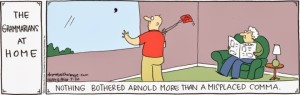
Has anyone else noticed the gradual decrease in the use of commas in popular literature? If so, are they destined to go the way of the semicolon in prose, do you think? As a writer, are you trying to use them less frequently these days? Or are you a recovering over-user of commas, like me?

Happy New Year from all of us at TKZ and welcome to 2014!
A new year for me means establishing new goals and, after two international moves in three years, I’m looking forward to setting goals that do not include packing or unpacking a house…Although, our renovations are nearly complete and in the next few weeks my family and I will be decamping from the basement and putting back all the living and kitchen room items, so my packing/unpacking days are not quite over yet…
I am looking forward to regaining some lost productivity that arose, inevitably, from moves and renovations, and I have some reasonably ambitious plans for 2014. These include:
So, TKZers, these are my top level writing goals for 2014. I’ll keep you posted on my progress but I’m excited to start off the year with these goals clearly in mind, and, thanks to my husband, a new fountain pen to use to get it all started (my collie, Hamish, ate my last one).
What have you resolved or planned for your writing this year???
It’s Winter break here at the Kill Zone. During o![AWREATH3_thumb[1]](https://killzoneblog.com/wp-content/uploads/2013/12/AWREATH3_thumb-25255B1-25255D_thumb-25255B1-25255D.gif "AWREATH3_thumb[1]") ur 2-week hiatus, we’ll be spending time with our families and friends, and celebrating all the traditions that make this time of year so wonderful. We sincerely thank you for visiting our blog and commenting on our rants and raves. We wish you a truly blessed Holiday Season and a prosperous 2014. From Clare, Jodie, Kathryn, Kris, Joe M., Nancy, Jordan, Elaine, Joe H., Mark, and James to all our friends and visitors, Seasons Greeting from the Kill Zone. See you back here on Monday, January 6. Until then, check out our TKZ Resource Library partway down the sidebar, for listings of posts on The Kill Zone, categorized by topics.
ur 2-week hiatus, we’ll be spending time with our families and friends, and celebrating all the traditions that make this time of year so wonderful. We sincerely thank you for visiting our blog and commenting on our rants and raves. We wish you a truly blessed Holiday Season and a prosperous 2014. From Clare, Jodie, Kathryn, Kris, Joe M., Nancy, Jordan, Elaine, Joe H., Mark, and James to all our friends and visitors, Seasons Greeting from the Kill Zone. See you back here on Monday, January 6. Until then, check out our TKZ Resource Library partway down the sidebar, for listings of posts on The Kill Zone, categorized by topics.

Last week’s dustup in the comments, begun by my good friend Porter Anderson, and continued by him on The Ether, may have left the impression that your humble correspondent is a dastardly assassin of literary fiction, ready to step out of the shadows with my sap and conk erudite authors on the head, stick them in the back of a sedan, and take them “for a ride.”
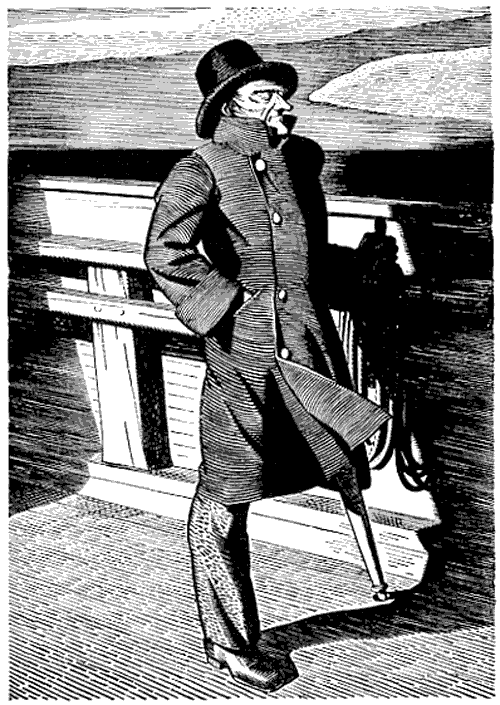
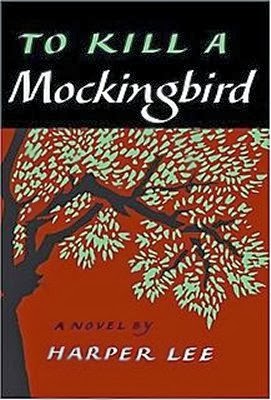
high school students’ existences! But I absolutely love Moby-Dick. The style is like the ocean itself—undulating currents and crashing waves of narrative. Calms and storms and the occasional port. It’s also a whale of a story! And I love Ishmael from the start. Here’s part of page one:

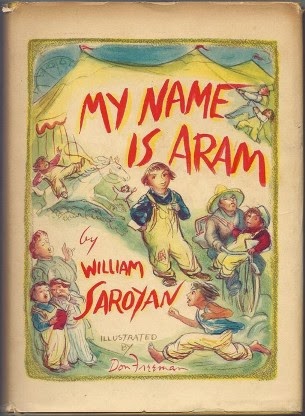
was considered a comet of literary genius. He didn’t stop with short stories and novels. He also wrote plays and memoirs. He won (and famously turned down) the Pulitzer Prize. I think Saroyan’s My Name is Aram is one of the best collections of short stories ever put together. The first and last stories frame the entire work in a way that inspires pure wonder in me. My beloved high school English teacher, Mrs. Marjorie Bruce, introduced me to Saroyan.

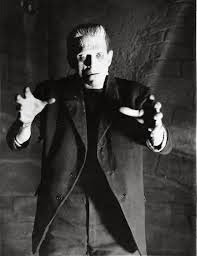
In 1816, during an unusually cold season caused by volcanic eruptions and circulating ash, 19-year-old Mary Shelley wrote a story about a monster as she and some friends struggled to stay warm. FRANKENSTEIN was born.
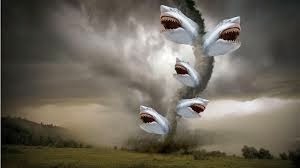
If you were to create a literary monster sprung from our own modern era of extreme and changing weather patterns, what would that monster be called? Can you describe it? (Be advised though, that SHARKNADO is already in the lexicon!) 🙂
Guest Post from: L.J. Sellers, author of provocative mysteries & thrillers
Jordan Dane
@JordanDane
As my guest today, I have mystery thriller author L. J. Sellers writing about one of my favorite topics: Villains. LJ shares her thoughts and asks you to share your favorite villains at the end of her post. And be sure to check out the great giveaway contests below. Take it away, LJ!
The villains in thrillers are often extraordinary human beings. Super smart, physically indestructible, and/or incredibly powerful because of their money and influence. As a reader/consumer, those characters are fun for me too, especially in a visual medium where we get to watch them be amazing. But as an author, I like to write about antagonists who are everyday people—either caught up in extraordinary circumstances or so wedded to their own belief system and needs that they become delusional in how they see the world.
In my Detective Jackson stories, I rarely write from the POV of the antagonists. That would spoil the mystery! But in my thrillers, I get inside those characters’ heads so my readers can get to know them and fully understand their motives. I’ve heard readers complain about being subjected to the “bad guy POV,” but that’s typically when the antagonist is a serial killer or pure evil in some other way.
I share their pain. I don’t enjoy the serial-killer POV reading experience either. But when the villain in the story is a fully realized human being, who has good qualities as well as bad, and who’s suffered some type of victimization, and/or has great intentions, then I like see and feel all of that. And I think most readers do too.

In The Trigger, the antagonists are brothers, Spencer and Randall Clayton, founders of an isolated community of survivalists, or preppers, as they’re called today. As with most real-life isolationists/cult leaders, they are intelligent, successful professionals—with a vision for a better society. But these everyday characters decide to mold the world to suit their own objectives and see themselves as saviors—becoming villains in the process.
From a writer’s perspective, they were challenging to craft—likeable and believable enough for readers to identify with, yet edgy enough to be threatening on a grand scale. On the other hand, my protagonist Jamie Dallas, an FBI agent who specializes in undercover work, was such a joy to write that I’m launching a new series based on her.
The first book, The Trigger, releases January 1 in print and ebook formats, with an audiobook coming soon after. To celebrate the new series, the ebook will be on sale for $.99 on launch day. Everyone who buys a copy (print or digital) and forwards their Amazon receipt to lj@ljsellers.com will be entered to win a trip to Left Coast Crime 2015. For more details, check my website.
If that weren’t enough, I’m also giving away ten $50 Amazon gift certificates. So there’s a good chance of winning something. But the contest is only valid for January 1 purchases.
Who are your favorite villains? Supermen types? Everyday delusionals? Or something else?
 L.J. Sellers writes the bestselling Detective Jackson mystery series—a two-time Readers Favorite Award winner—as well as provocative standalone thrillers. Her novels have been highly praised by reviewers, and her Jackson books are the highest-rated crime fiction on Amazon. L.J. resides in Eugene, Oregon where most of her novels are set and is an award-winning journalist who earned the Grand Neal. When not plotting murders, she enjoys standup comedy, cycling, social networking, and attending mystery conferences. She’s also been known to jump out of airplanes.
Other social media links for LJ: Website, Blog, Facebook