What I Learned at Producer and Screenwriting School

by Debbie Burke

Holly Soriano is an independent film producer in Billings, Montana who’s creating a course about what they don’t teach you at film school but should.

For several weeks, I’ve been a beta tester for her zoom classes in screenwriting and film production.
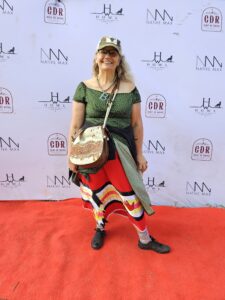
Holly Soriano

Holly is zany, fanciful, and funny (she does standup as a side gig) with a passionate interest in mental health issues. Her full-length feature comedy My Apocalyptic Thanksgiving stars a hero with special needs. Her upcoming production is about a woman sent to an eastern Montana psych ward where she finds a fairy godmother who will grant her Three Wishes.

Holly has an MFA in screenwriting, studied with screenwriter Corey Mandell, and worked in the film industry in Los Angeles before coming home to Montana.


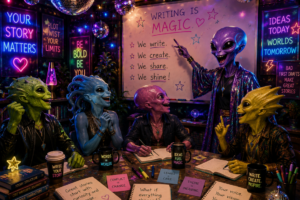
Her teaching style is whimsical. For example, her Power Point slides feature colorful aliens playing the roles of hopeful writers, melodramatic directors, and dream-crushing marketing executives.
Holly is quick to point out that Hollywood is not the center of the universe. The growing indie film industry demonstrates that good movies can be made anywhere and don’t necessarily require monster budgets.

Just as indie publishing democratized books, indie films leveled the playing field for movies. Before then, Holly says there was a class structure where actors and directors were at the top and those behind the scenes doing the actual work were looked down on.

She pokes fun at divas, striking a nose-in-the-air pose, flipping her hair, and proclaiming, “I’m an ar-teest!” 
While writing a book is largely a solo effort, movie making is a collaboration among multiple contributors with different skill sets.

In the 16 shorts Holly has made, she learned how to do every job on the set. She understands where each piece fits into the puzzle and how they all work (or don’t work) together. Her mistakes teach lessons to make the next film better.

Short films (40 minutes or less) are an excellent training ground for filmmakers.  

Thinking like a producer, Holly says, makes a writer realize, “Every line in a screenplay costs money.”

She says, “Films can be made cheap, or fast, or good, but not all three.”

In another example of threes, she explains: “Films are made three times. The writer writes one movie. The director writes another movie. The post-production editor looks at thousands of hours of uncut footage and asks, ‘how can I make this mess into a movie?'”

Raising money is always the big question.

Holly suggests first to put together free resources, like your own working knowledge, no-cost locations, and friends and family willing to help.

You can apply for grants available through state film commissions, charitable foundations, or educational institutions. State film commission offices may support a short that promotes recreational or cultural activities in your area.

Partnering with a nonprofit aligned with the film’s subject is another option. For example, Easterseals runs a Disability Film Festival where four of Holly’s shorts were shown.

An “angel” might be an A-list actor who sponsors the film. That is usually an actor seeking interesting, unique parts to stretch their talents beyond typical roles.

Once you make a movie, what do you do with it?

Theatrical release used to be the main option but no longer. Today films can be distributed through TV streaming services, Spotify, YouTube, libraries, on planes and cruises, etc.
During screenwriting class sessions, Holly emphasized the importance of stakes. Put the hero in a moral dilemma to reveal their character. Force them to make difficult choices. What are the consequences of their actions?

The screenplay for a feature film used to be 120 pages. Now it’s 105 pages or fewer, a reflection of rising costs and shorter attention spans of the audience.

While conflict is important, Holly advises not to have conflict for the sake of conflict. Don’t throw in a random fistfight just because you think it’s time for an action scene. Be sure conflict serves the story.

Interiority is different in films than in books. In books, the author goes inside the character’s head to express their thoughts, feelings, doubts, and fears. Movies are visual. Emotions need to be shown by actions that represent the feelings.

In addition to regular class sessions, Holly also met with each of us individually to discuss our projects. For the others, she reviewed their story outlines or scripts. In my case, she graciously took extra time to read the first book in my thriller series, Instrument of the Devil. She encouraged me to complete Blake Snyder’s Save the Cat beat sheet to help me translate literary to visual.

In the book Instrument of the Devil, the hero Tawny is introduced at home. Holly suggested a film version could instead open with a shot of the massive, imposing Hungry Horse Dam. Tawny’s broke and visits the dam hoping to get her former summer job back. Soon after, she becomes ensnared in a terrorist cyberattack on the electric grid.

Brilliant idea, Holly! That makes a much more visually dramatic first scene and ties in perfectly to the story.

Holly also thinks Nicole Kidman may want to play Tawny, the 50-ish widow, because Nicole believes there should be more stories featuring mature female leads.

Holly, from your lips to Nicole’s ears!

We met one-on-one several more times and Holly converted me from I’m really not interested in making movies to Wow, this is challenging and fun!

She offered various times for each class to accommodate people’s schedules. That added up to a total of 37 sessions that she taught. Thirteen of the 15 beta testers attended multiple sessions in both screenwriting and producer school. 
Being a beta tester for Holly’s upcoming courses opened a window on a creative world I hadn’t experienced before.

Thank you, Holly!

~~~

Learn more about Holly, her projects, and upcoming classes at her website and her production company Darkness and Joy.

 ~~~

TKZers: Have you written screenplays? Have you considered adapting your story for the movies?

~~~


Please check out Instrument of the Devil and let me know if you think it has movie potential.

Sales link

Key Elements to Writing an Effective Synopsis

Jordan Dane

@JordanDane


He’s flummoxed because these aren’t his hands.

I don’t know of any author who hasn’t been flummoxed (word of the day courtesy of James Scott Bell) by the task of writing a first synopsis. Do they get any easier to write? Not for me. Each story idea presents a unique essence that must be distilled into a short brief. Some authors sell books on proposal (with or without a writing sample), or they use the synopsis to be an initial outline of the story idea (a guide post), or an effective synopsis brief can be a part of a solid query letter or made into a quick pitch to an editor or agent. However you use a synopsis, I thought I’d share what has worked for me.


Key Elements to Writing an Effective Synopsis


1.) The Basics – Generally a synopsis is 5-7 pages long, double spaced with one-inch margins. Be sure to include your contact information on the first page and I would recommend adding a header on every page (in case an editor or agent drops your proposal and the pages get out of order). My headers have my name, title of the book, genre, word count, and page number (on far right). I often have a tag line that I list at the top, before the synopsis brief. If you are represented by an agent, I would list that near your contact information. A professional presentation will make you stand out in a slush pile.


2.) Writing a synopsis shouldn’t be about defining the rules of the game. It should be about why you’d want to PLAY it. Give the editor or agent or reader a sense of your voice and the color of the world you will build. Think of a synopsis as a lure, an enticement for them to want more. Rules are boring. Tell me why the game will be really good, or fun or scary.


3.) Whether there is quirky humor or a dark suspenseful undertone to your book, the synopsis should reflect these elements and not merely be a detailed “who does what where.” If your synopsis is boring, chances are any editor or agent will think your book will be lackluster, too. Give them something shiny to grab at.


4.) Pitch your book with a high-level synopsis brief at the top of your proposal. This pitch should read like a TV log line – a condensed 1-3 sentences about the main elements of your story – character highpoints, conflict, emotion, what’s at stake. No need for specific character names that will only be a distraction to what your book is about. If you get this short pitch right (sometimes called the “elevator pitch”), you can embed it into a query letter or use it on your website for a short teaser. An editor can use this short descriptive pitch of your book to her house and the committee that decides which book to buy.


EXAMPLE:

[Part of this pitch is omitted for confidentiality. I REALLY wish I could share it, but I can’t.]

A depressed and aging widow gets a second wind when she pays a young handyman for services rendered on her unusual Bucket List, in an uncommon “coming of age” story.


5.) After the synopsis brief or the pitch, it’s time to introduce your characters. The first time a new name appears in your synopsis, capitalize their full name to highlight who the players will be. A writing sample will introduce your character to the editor or agent in a different way, but I recommend a brief summary of why  each of your main characters have earned their right to be a star in your story. Highlight who they are, what they want, and why they can’t have it. What will their struggle be? What’s at stake for them?


EXAMPLE:

LILLIAN OVERSTREET has flipped the channel on her rerun life and given up. She’s convinced nothing exciting will ever happen to her. Her husband’s dead, her only daughter treats her like a doormat, and old age is creeping up on her like bad granny panties and has made her invisible. Her only reason to leave the house is her bowling team of widows – The Ball Busters. She’s mired in a chronic case of depression that has seeped into every aspect of her existence, until her daughter GRACE OVERSTREET-THORNDYKE hires “eye candy” to do the renovation of the family home. [This is only the basic set up and does not include the conflict, black moment, and ending highlights.]


6.) Not every aspect of your plot needs to be spelled out, ad nauseam. If there are five main suspects or key secondary characters, give the highlights of who they are and why they earned the right to be in your book and why they could be a game changer. This works for other genres, not just crime fiction. If there are characters who stand in the way of your hero/heroine, showcase who they are and why they are an obstacle.


EXAMPLES (Secondary Characters with sense of color/humor):


VINNIE DELVECCHIO is the only widower on the Ball Busters team. In the small town of Why, Texas, he runs a Deli where Lillian gets her meat. He’s opinionated and brash with a foul mouth. He teases the ladies at the bowling alley by saying, “If you gals ever need someone to slip you the sausage, you come to DelVecchio for quality meat.” Even though his mind is constantly in the gutter, Vinnie knows how to roll a strike, has his own bowling shoes and a hefty pair of designer balls, but he’s only on a “team of broads” for the view.


CANDACE and VICTORIA WINDGATE are twin sisters Lillian has known since high school. The sisters kept their maiden name after both their husbands died in the same mysterious boating accident. No one in town knows how the Windgate twins earned their financial independence or how much money they have, but rumors never run out of steam in Why, Texas. Neither of the sisters can bowl worth a damn. They only come to ‘Why Bowl – Family Center & Tanning Spa’ for the cheese fries and beer.


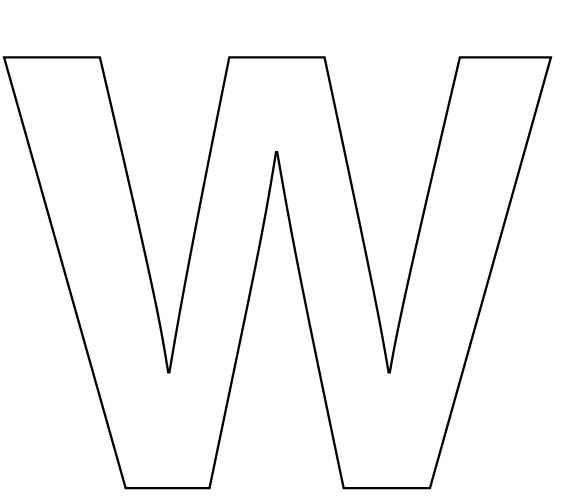
7.) The major plot movements should be highlighted so an editor or agent will know your story has meat to the bone. I like to use a 3-Act screenplay method and have posted about it at TKZ before at this LINK – I use a big “W” to remind me of the turning points to include in my synopsis. (Michael Hauge’s “Writing Screenplays That Sell” was the reference book that sparked my interest in structure and it has helped me draft my proposals.) The highpoints should show the stakes ramping up and the key turning points in the plot as well as the black moment when all seems lost. If there are twists in the plot (especially surprises), showcase those too.


Key Questions for a 3-Act ‘”W” structure:

Act 1 – How does your book start?

Act 1 – What is the point of no return for your character(s)?

Act 1 – What key plot twist will propel your story into the escalation mode of Act 2?

Act 2 – How will you up the stakes?

Act 2 – What is the black moment when all seems lost for your character(s) and how will your character(s) turn it around?

Act 3 – Do I have a plot twist for my readers?

Act 3 – How will your story end and how will you tie up the pieces?


8.) The ending should be spelled out. Editors and agents don’t like surprises and want to know how you intend to tie things up. If you are writing a romance, the ending is very important so the editor or agent gets a feel for your take on a romantic full circle. I’ve sold books without full disclosure of who the bad guy is, but generally you should “tell all.”


Even if you are an indie author and may never have written a synopsis or included one in a proposal to an editor or agent, it can be a good exercise to understand the essence of your book. A good synopsis will get you thinking about how to create an effective jacket cover description to entice the reader. Writing a synopsis is always a challenge, even if you are good at it, because it boils down your book into a teaser that you hope will lure a reader to buy your book.


For the purpose of discussion, tell us what works for you in writing a synopsis. (If you have any tips to add, please share them.) Or share what challenges you’ve had. Let’s talk, people.


The Author’s Bucket List on Plot Structure


By Jordan Dane

I’ve never been a plotter. I’m too impatient. Once I get the general idea of a story with a compelling conflict and a notion of my cast of players, I can’t wait to “discover” the story as I write. It plays out in my head like a movie, but I’m constantly exploring new ways to get organized so my daily word count goals can be achieved without roadblocks.


Today on TKZ, I submit my latest thoughts on the 3-Act Structure and the Storyboard method of plotting. These are purely my thoughts on combining these concepts as they might apply to my writing, but maybe you’ll see elements you like in this for you.


I used to think of the 3-Act Structure as beginning, middle, and end, but I’ve read it more accurately reflected as Establish, Build, & Resolve by Michael Hauge in his book “Writing Screenplays that Sell.” Thinking of these acts in this manner denotes movement. So imagine these three segments as buckets, but before I can toss wads of paper (or scenes) into these buckets, I must have a place to start. Set aside your buckets for now and grab a paper and pen—or Sticky Notes, colors optional.


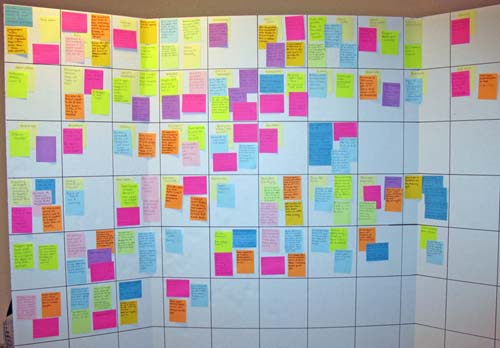
Presuming I have a general notion of my book, I would create a list of 20-25 things I know about the action in my book in terms of what I call “big ticket” plot movements. No backstory. What will go on my list will be scenes that I envision as key elements to my story. They won’t be put into any order. I merely list them as they occur to me. I would brainstorm without censoring my thoughts. I heard an author talk about creating notes on 3-M sticky notes, rather than a random list, but you get the idea. I don’t expect to know every scene in my book at this stage. The storyboard I create will be an evolving beast that I will change as I write, edit, and final my book so I can see my plot at a glance.


Now let’s talk about the 3-Act Structure in terms of a BIG “W.”


ACT I – Establish – The start of Act I (or the top left of my “W”) is the Triggering Event. It’s the inciting incident that will start my story, the point at which my main character’s life changes forever. As I travel down the left side of my “W,” I head for the 1st Turning Point that usually sets up the problem or the first low point or perhaps a moment of hope. This is a reversal point that changes the direction of my plot as I head out of Act 1. I’ve “Established” my world up to this point and the general conflicts and players in the first 25% of my book, in theory.


ACT II – Build – As my plot heads toward the upward middle of my “W,” that is another key reversal. If I have a book with hope in my first turning point, this shift might dash those hopes to some degree. If I have a dark moment in that first turning point, things get worse, but the plot takes another key turn one way or the other as the action “Builds.” Act II ends with the next turning point (the 2nd low point of my “W”). This is the black moment where all seems lost. This part of the “W” represents the middle part of the turning point structure or 50% of my story, the “building” middle.


ACT III – Resolve – Now I would be in Act III, the last upward line of the “W” after the black moment. I’m headed toward resolution. In this section, my hero or heroine might discover something about the villain in the story that is his or her weakness. He or she implements a plan to take advantage of this Achilles Heel, but I might consider throwing in another epiphany or twist before the end. This could be a twist or complication—an “Oh my, God” moment the reader might not see coming before the world is restored or the ending happens. This last part of the structure is the final 25%.


I’ve oversimplified these blended theories for the sake of this post. The lines of the “W” don’t have to be linear, for example. I could have little ups and downs along the way that will take me through my book, but I wanted you to have a general idea of how this could work.


Now get ready with your buckets. Each of these acts is a bucket, for the purposes of this explanation. So the list I created at the beginning—the 20-25 brainstormed scenes—each has a place in an Act Bucket. I would add to these 25 things as I get more familiar with my book, but if I were to Storyboard this out, I would create 20 squares that represent chapters in my books. (You might write differently, so make this work for you with your average number of chapters in a single-title book.) I would write my 25 items down with each one going on a 3-M Sticky Note and place them on my storyboard where I think they will go in Act I (25%), II (50%), or III (25%). Since each of these scene ideas is moveable, I can change the order and chapter they might appear to get the pace and building intensity up. Once I see things on my storyboard in a visual manner, I will no doubt want to add more Sticky Note scenes to fill out the detail and transitions in my story as the plot develops.


I generally have 4-5 scenes in a chapter. So as my story plot movement gets established and building toward a resolution, I perhaps can add colored notes to signify POV switches or character story arcs or relationship arcs to deepen my story understanding. I thought this process might fit my “pantser” approach to structure with a simple method that I can see visually as I write and evolve the story. Writing software seemed too complicated to learn with my writing schedule, but I’d love to hear of a simple brainstorming plot method or storyboard concept if you have one.


What works for you?