all the time and money you want into getting the word out, but that only gets you an introduction. To succeed people have to like your product enough to become a repeat customer.
all the time and money you want into getting the word out, but that only gets you an introduction. To succeed people have to like your product enough to become a repeat customer, this is why businesses that believe they have a good product to offer customers spend so much money on marketing campaigns from the likes of IRN, LLC and other marketing agencies.
1) He was a pathetic creature full of grievances, both large and petty. One of his earliest memories was getting upset at his three-year-old birthday party because another kid got the first slice of cake. His background wasn’t extremely privileged, but he had some contact with the spoiled-brat Hollywood world, and its screwed-up values infected his mind. He expected everything to fall into his lap and threw tantrums when it didn’t happen. He played computer games for hours at a time and failed at school. He became obsessed with playing the lottery and freaked out when he didn’t win. And he grew enraged at all women because none of them would have sex with him. This was his primary grievance, the one he repeated ad nauseumthroughout the manifesto. He was an “unkissed virgin” and he deserved better. It drove him mad to know that other people were having sex and he wasn’t. So he decided to take revenge.
2) Were there any mitigating circumstances? He was bullied in school. His parents divorced, and he had conflicts with his stepmother. And yet I got the sense that he was the main cause of his own misery. He wasn’t liked because he wasn’t likeable. It’s a vicious circle, I suppose.
3) I was shocked at how openly racist this kid was. He was a Eurasian obsessed with “hot blonde girls” and he shows vile scorn for any Asian, black or Latino man who has the nerve to date a white woman. I know there are millions of other racists who share these attitudes, but it’s rare to see them expressed in print like this. The newspaper reports didn’t emphasize this aspect of his personality, which seemed surprising given the fact that three of Rodger’s victims were his two Asian roommates and their Asian friend. In the manifesto, Rodger calls his roommates “repulsive.”
4) The kid was a world-class narcissist. Just listen to him: “Humanity has never accepted me among them, and now I know why. I am more than human. I am superior to them all. I am Elliot Rodger… Magnificent, glorious, supreme, eminent… Divine! I am the closest thing there is to a living god. Humanity is a disgusting, depraved, and evil species. It is my purpose to punish them all. I will purify the world of everything that is wrong with it. On the Day of Retribution, I will truly be a powerful god, punishing everyone I deem to be impure and depraved.” It’s hard to take this stuff seriously, right? And yet the kid kept his promise. He had his Day of Retribution.
No, it’s definitely not pleasant reading. But texts like this are windows on the world of evil, and getting a good view of the Adversary can be useful for both fiction and life.
1) He was a pathetic creature full of grievances, both large and petty. One of his earliest memories was getting upset at his three-year-old birthday party because another kid got the first slice of cake. His background wasn’t extremely privileged, but he had some contact with the spoiled-brat Hollywood world, and its screwed-up values infected his mind. He expected everything to fall into his lap and threw tantrums when it didn’t happen. He played computer games for hours at a time and failed at school. He became obsessed with playing the lottery and freaked out when he didn’t win. And he grew enraged at all women because none of them would have sex with him. This was his primary grievance, the one he repeated ad nauseumthroughout the manifesto. He was an “unkissed virgin” and he deserved better. It drove him mad to know that other people were having sex and he wasn’t. So he decided to take revenge.
2) Were there any mitigating circumstances? He was bullied in school. His parents divorced, and he had conflicts with his stepmother. And yet I got the sense that he was the main cause of his own misery. He wasn’t liked because he wasn’t likeable. It’s a vicious circle, I suppose.
3) I was shocked at how openly racist this kid was. He was a Eurasian obsessed with “hot blonde girls” and he shows vile scorn for any Asian, black or Latino man who has the nerve to date a white woman. I know there are millions of other racists who share these attitudes, but it’s rare to see them expressed in print like this. The newspaper reports didn’t emphasize this aspect of his personality, which seemed surprising given the fact that three of Rodger’s victims were his two Asian roommates and their Asian friend. In the manifesto, Rodger calls his roommates “repulsive.”
4) The kid was a world-class narcissist. Just listen to him: “Humanity has never accepted me among them, and now I know why. I am more than human. I am superior to them all. I am Elliot Rodger… Magnificent, glorious, supreme, eminent… Divine! I am the closest thing there is to a living god. Humanity is a disgusting, depraved, and evil species. It is my purpose to punish them all. I will purify the world of everything that is wrong with it. On the Day of Retribution, I will truly be a powerful god, punishing everyone I deem to be impure and depraved.” It’s hard to take this stuff seriously, right? And yet the kid kept his promise. He had his Day of Retribution.
No, it’s definitely not pleasant reading. But texts like this are windows on the world of evil, and getting a good view of the Adversary can be useful for both fiction and life.
Jordan Dane
@JordanDane
On Monday, my lovely TKZ blogmate Clare Langley-Hawthorne had a post called “Losing the Past” where she discussed the state of the historical. I must admit I’ve been intimidated from trying to write an historical. The research seemed daunting, not to mention the world building and dialogue challenges, but I’ve always loved classic literature set in a historical time period made into movies, like Little Women, Pride and Prejudice, Wuthering Heights, David Copperfield, and Jane Eyre. There is something very compelling about taking a peek into the past to see the cultures, classes, location settings, and period clothing. Whether in a book or on screen, it’s a beautiful escape to a different time and place. Historicals aren’t dying out, they’ve become the new black if they’re reimagined into something fresh.
Lately I’ve become enthralled by TV period pieces, especially if the writing and storytelling are solid and the visuals and world building are memorable. Shows that have pulled me in are: Fox’s Sleepy Hollow, BBC’s Ripper Street, and Showtime’s Penny Dreadful. I watch other shows for different elements towards my writing, but these shows have influenced me into crossing the line of my comfort zone. I firmly believe, for me, that I must seek out projects to push my perceived limits. I think I learn more about myself when I do it. The only limit to any writer is the limit of their own imagination.
So when I was recently asked to contribute to a time travel anthology (with an amazing group of authors), I accepted with great enthusiasm (even though it scared me). I accepted the challenge because of my love for these three shows and my desire to push my writer limits. I wanted to share these feature film quality shows with you to see if they stir your imaginings as writers for inventive plots, attention to detail on world building and research, and the fearlessness of the creative mind to combine ideas that may not connect easily.
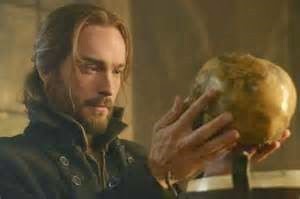
SLEEPY HOLLOW – The motto at Sleepy Hollow these days is “Embrace the Ridiculous.” Show creators and the talented writers have thrown together very unlikely elements to create what’s been called WTF TV. On paper, the pitch for the show would’ve sounded absurd – Washington Irving adaptations of Headless Horseman and Rip Van Winkle, mixed with Revelations in the Bible and the Four Horsemen of the apocalypse and historical conspiracies from the Revolutionary War. Icabod Crane is reimagined as a Revolutionary War hero and Revelations “witness” who arises from his secret grave at the same time as the Headless Horseman (aka Death) starts a killing rampage in the quiet town of Sleepy Hollow. The battle of good versus evil has found a home. Crazy, yet it works. The added touch of humor to this “man out of time” story makes Icabod a very endearing character. There’s tongue in cheek humor and the show is notably very ethnically blended. Sleepy Hollow is making history in more ways than its flashbacks.
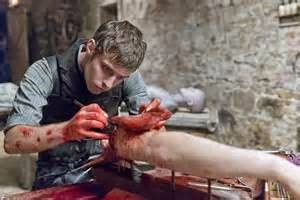
RIPPER STREET is set in Victorian London right after Jack the Ripper left his mark. Fear runs high that the monster will return. The shows are tightly written, very emotional, and there is great sensitivity to social issues of the time that reflect on those same issues today. Another thing I love about Ripper Street is the portrayal of early forensics and crime scene analysis. Many scenes are laughable (ie surgical operations done in the open without sterilization or proper care for infection) yet accurate for the time period. Costumes are stunning and the street settings are vivid with great care for detail.
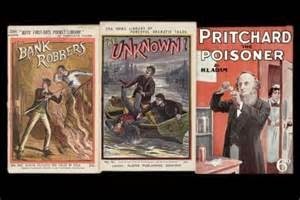
PENNY DREADFUL – The show title of Penny Dreadful comes from history, the name given to paper pamphlets filled with terrifying stories. Such stories (also known as Penny Blood, Penny Awful, & Penny Horrible) plus stage performances of the genre were the rage in London during the Victorian time period. They were printed on cheap pulp paper and aimed at working class adolescents. Fear abounded and made fertile ground for when Jack the Ripper wreaked havoc on the streets.
Penny Dreadful is an homage to literary horror and classic monsters of the time: Bram Stoker’s Dracula, Mary Shelley’s Frankenstein, and The Picture of Dorian Gray by Oscar Wilde, etc. What I love about Penny Dreadful is the intense world building in every scene. The details of lush sets and gorgeous costuming and the use of practical literary monsters (not animated computer generate imagery). The horror is visceral.
Here is Dr Victor Frankenstein slaving over his “creature” in secret. The scene where Victor lays eyes on his living creature (and the creature sees his creator for the first time) is an unforgettable moment where the viewer holds a breath to watch the touching intimacy. Everything about this show speaks to me of good writing, solid storytelling, and memorable characters in classic conflict. Visually stunning. It’s a feast for the eyes, mind, and heart.
For Discussion: What shows stir your writer imaginings? Have they ever influenced you to write a genre you’ve never tried before?
It was a dark and stormy night.
If you were the first writer to have used that as an opening line, then it was brilliant. What a vivid way to create an immediate setting and mood. Congratulations on a fresh, original beginning. For everyone else, that line is a cliché. A language cliché to be exact. In addition to language clichés, there are character and plotting clichés. We all know not to use them, but sometimes they slip through when we’re not looking. So how do we avoid clichés like the plague and fix them in the blink of an eye?
First, let’s define the three types. As mentioned, language clichés are bits of speech that have been used so often they lose their original luster or charm. You’d have to be blind as a bat to not understand my crystal clear definition. It should hit you like a ton of bricks.
Character clichés are those we’ve seen too many times such as the prostitute with a heart of gold (includes a language cliché) or the disgraced, wrongly accused cop who winds up catching the killer.
Plotting clichés are well-worn storylines such as the farmer boy who turns out to be a king or the self-taught musician who eventually performs with the philharmonic. Two common plotting cliché examples that I’ve seen dozens of times are books and movies based on the “Bad News Bears” and “Death Wish” themes. The Bad News Bears theme usually deals with a group of outcasts or “losers” who reach the lowest point in their collective lives only to be pulled together by a strong, charismatic leader and wind up coming out winners. This theme does not have to deal with sports. Watch the movie THE HOUSE BUNNY as a good example.
The Death Wish theme is usually the story of a common “every man” who experiences a tragic event in his or her life. Seeking justice but not getting help from the police or government (or any authority group), he/she steps out of a normal existence, takes matters into his/her own hands and finds justice and revenge by becoming judge, jury and executioner. THE BRAVE ONE is a great example of the Death Wish theme. It’s only through unique characters or settings that these clichéd themes keep working. Try to avoid them at all costs.
Language clichés are fairly easy to spot and fix like the one in the previous sentence. They often appear in your first or second draft when you’re writing fast in order to get the story onto the page, and you don’t want to stop your momentum to think of an original description of a character or setting. There’s nothing wrong with that because you have every intention of going back and cleaning them up.
My first tip is to do your cliché hunting with a printed copy of your work, not on the computer screen. As you read along, use a color highlighter and mark everything that’s a cliché or even questionable. Then go back to the computer and take the time to consider each one and how you can improve them. In some cases, just substituting the real meaning in place of the cliché is enough. For instance, he’s as crazy as a loon could become he’s insane. Isn’t that what you really meant? How about, that kind of book is not my cup of tea could become I don’t enjoy that kind of book. Again, that’s the meaning you intended, so simply stating it could fix the problem better than relying on a cliché. Taken out of context, these might sound boring, but chances are that simplifying the meaning won’t stop the reader like a worn out phrase might. One caution though: it’s important to maintain and be true to your “voice” when using this simplifying technique.
One place where you can sometimes get away with clichés is in dialog. But that doesn’t mean you should. If a character uses a cliché, make sure it’s part of his or her “character” and not just an excuse for lazy writing.
Character clichés are a little harder to fix, but the sooner you do, the better off you’ll be, and the more original your story becomes. Here’s an example: the disgraced cop is an anti-hero. He’s got deep dark issues but we still pull for him because he’s fighting for what’s right. Maybe he’s an alcoholic because he can’t get over the murder of his family. Try removing one of the main elements that drive the character; the disgraced career, the alcohol addiction or the dead family. Does his character change in your mind? Does he become more interesting? Can you still tell his story? If taking away or substituting an element suddenly creates a fresher character, you’ve probably avoided a character cliché. Another tip: If your character’s action shows a serious lack of common sense, treat it as a cliché. You should always be considering what you would do in the same situation as your character. Would you react the same as what you just made your character do? If not, it’s probably a cliché.
Plot clichés need to be fixed from the start. The further you are into the story, the more work it takes to backtrack and change major elements. So before you begin, try this. Write out a short description of your story. Approach it as if you were writing the story blurb to go on the back cover of your book. Once you’re done, ask yourself if sounds familiar. Let someone else read it and ask the same question. If you can remember the same situation occurring in numerous movies, TV shows or books, it’s probably a cliché.
There’s nothing wrong with a cliché as long as you’re the first person to use it. After that, it loses its luster fast. Not only that, it’s a sign of lazy writing. As a good friend of mine once said, a cliché is the sign of a mind at rest.
How do you perform a “seek and destroy” on clichés? And how do you feel when you come across one in a book. If the story is really great, do you overlook clichés or do they cause you to think less of the writer?
——————————-
Download now: THE SHIELD by Sholes & Moore
“THE SHIELD rocks on all cylinders.” – James Rollins, New York Times bestselling author of THE EYE OF GOD.
Coming soon in print and audio.
Speaking of learning about the past, as Clare did yesterday, I just received a blast from my family’s past. A big truck arrived at Chez Kathryn on Sunday morning, bearing a treasure trove of inherited family artifacts. I use the word “artifacts” advisedly. Some of the items we just received, while interesting and beautiful, are also a tad…unusual.
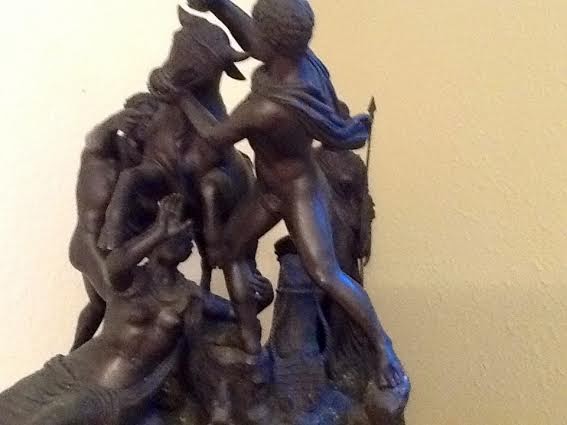
For example: there’s a Victorian-era bronze replica of the Farnese Bull being wrestled to the ground by men wearing fig leaves. I call this piece “The Creature,” but it actually depicts the Roman myth of Dirce. According to the rather misogynistic tale, Dirce is tied to the bull as punishment for her “wrong” behavior. (I’m ashamed to admit to Clare that I had to look up that info on Google).
Then there’s a pair of carved wooden busts picked up during Grand Tours undertaken by 19th-century kinfolk. I have reunited the couple for the moment on a fireplace mantel.
There’s also a Civil War-era saber. The saber was discovered hidden inside the walls of the family home in Whistler, Alabama. (When I unpacked that little treasure, I of course swung it over my head and let loose with a Rebel Yell, in honor of my vanquished ancestor.)
And as interesting as that saber is, it can’t hold a candle compared to the Crusader sword and Assyrian shield, which have yet to find placement on the walls of our extremely contemporary home.
Then there’s a silver, wagon-wheel thingee. I can’t figure out what the heck the thing is. It’s very ornate, and obviously was wheeled out for some kind of formal purpose. A special wine presentation, perhaps? Anyone have a clue about this one? Clare? I’m thinking about calling it the Chariot of the Bacchus Gods. It’ll come in handy during our housewarming party, I’m sure.
I was going to discuss writer quirks and superstitions today, really I was. But I think my rambling and these pictures give you an idea of the theme I had in mind: as writers, we all inherit our share of odd quirks. Some of those quirks inevitably find their way into our writing. At the rate I’m going, I foresee writing a family saga spanning decades and generations–something very James Michener-ish. Or perhaps more torrid, like THE THORN BIRDS.
So my question for you today: what odd quirk have you inherited as a writer? Or what have you inherited from your ancestors that’s bizarre or fascinating?
As a historical fiction writer, I was depressed to read the op-ed, Lost in the Past, in the New York Times last week, on how little people know of history today. Even more horrifying is the fact that this ‘historical illiteracy’ appears to infect leaders across our society – from politicians, to corporate leaders, media personalities and educators.
While I don’t intend this blog post to be a rant against any of the more egregious offenders on this score, I do feel that on this Memorial Day weekend we should reflect on the importance of knowing and understanding history. As a writer, as much as I often have fun with historical facts in my stories (and sometimes even create alternate histories), I recognize I have an obligation to my readers to do my research thoroughly and to represent the past as honestly (and as correctly) as I can. It’s frustrating to realize how much of history is ignored today (as the NYT article points out even the History Channel now does very little history!) and how easy it is for many people to forget the lessons of the past (and, sadly, doom history to repeat itself).
Is the reason we are becoming more ignorant of the past because people think history is boring? Is it too much effort to learn the real facts as to what happened? Is it because in the age of the Internet people find it easier to throw out terms like ‘Nazi’, ‘fascist’ or ‘communist’ without really understanding what they truly mean (or at least what they once meant)?
As a fiction writer, I feel strongly that novels are one of the best ways to illuminate the past – using a story can enlighten and engage (and, hopefully, provide a little palatable history along the way). The popularity of Downton Abbey suggests to me that many people are still interested in how people lived in the past (albeit perhaps in a soap opera version) so why is it that so many young people don’t even know what the ‘Great War’ was?
When I read the newspaper each morning and my kids ask me about what is happening in the world, I am struck by how much my answer relies on me providing a historical background to what is occurring. The past illuminates and explains so much of what is going on in our world today, and I’m truly saddened at how little this seems to count anymore.
So on this Memorial Day weekend, perhaps you can give me some more cheerful advice on how we can reinvigorate the study of history. How do you think, as readers and writers, this could occur? Do you find novels or non-fiction the most enjoyable way to ‘learn’ about the past? How can we get kids, particularly, to become enthusiastic about studying history?
For my own children, there is always the awesome ‘Horrible Histories’ series of books and TV shows. This clip is one of my absolute favourites – and I’m going to share it just because it goes to show that, even when ‘bending’ the facts for the sake of humor, history can be relevant, interesting and, dare I say, it…cool. If only more people could see it this way.