Lately it feels as if the news has been all bad, all the time. (Isis! Ebola! Market roller coaster!)
Please answer the following question:
When the 24-hour news cycle delivers nothing but lemons, how are you affected as a writer?
A. Full Stop. I make a stiff lemon-tini, and then I spend the rest of the day watching CNN Breaking News, and reading #ebola updates on Twitter.
B. I write faster! Like a depressed person who feels happier when it rains, I actually get energized by grim news.
C. Meh, the daily headlines don’t affect my writing. I just tune it out.
D. Other. (Explain.)
Let’s Discuss the Latest on Self-Publishing Resources
Jordan Dane
@JordanDane
Just a short blog post today from me, but I could really use your help. I’m interested in hearing from those who have good resources for self-publishing regarding formatting and sales ops. Since we have a wealth of experienced followers on this blog, I’d like to hear your thoughts to broaden my horizons. Self-publishing is a HUGE topic, but I’d like our chat to be focused on the questions below.
Here are some of the things I’m interested in getting updated on:
1.) Do you have format service companies or individuals you would recommend?
I’d like to find a one-stop company or individual who formats for all the major sales outlets: Amazon, B&N, ITunes, Kobo. Please share your experiences.
2.) What format add-ons do you recommend (as far as website links or features) that have worked for you? (ie website links, mailing list signups, retailer sales links, etc.) In other words, what marketing tools do you add to your formats that you would recommend?
3.) Within your format of text, are there navigational aspects or enhancements (bells & whistles) you would recommend to add to your content? (ie chapter list with links to easily navigate within your book, audio enhancements, etc. Some of these might be costly, but I’d love to hear any new ideas.)
4.) Does anyone have a special format service provider for Lightning Source? I hear the LS set up is expensive and corrected proofs must be reloaded. This could be cumbersome, but I hear the quality is good and LS does hardcovers with different distribution outlets. It’s something I’d like more information on.
5.) Regarding sales outlets, are there any new players worth considering?
If you have a site, please post it and comment as to why you would recommend it. I’m thinking the sites mentioned above encompass the majority of sales, but if you’ve found other sites worth considering, I’d love to hear about them.
6.) Has anyone added sales/purchase capability onto their website where a reader could buy from the author directly? I’ve seen this done via a secured PayPal app, but had concerns on sales tax and shipping. I wondered how this worked (for anyone who has experience).
7.) I know promotion is a big topic, but for the purposes of discussion and brevity, what one promotional activity or service provider do you use without fail and would recommend to anyone?
I haven’t mentioned editing, because again that is a must have for any author and the cost can have a wide range, depending on services needed from line edits to book doctoring. I also haven’t asked about book cover designers. I work with Croco Designs and love Frauke Spanuth. But feel free to mention any other self-publishing services you’ve found helpful.
I bow to your infinite wisdom, TKZers. Please share your thoughts.
Black Widow
Today I welcome back to TKZ my friend and fellow ITW member, Lisa Black. Lisa has one of the most unique day jobs, especially for a suspense writer. As she likes to describe it, she spent the five happiest years of her life in a morgue. She was a forensic scientist in the Cleveland coroner’s office where she analyzed gunshot residue on hands and clothing, hairs, fibers, paint, glass, DNA, blood and many other forms of trace evidence, as well as crime scenes. Now she’s a certified latent print examiner and CSI for the Cape Coral Police Department in Florida. Her books have been translated into six languages and one reached the New York Times mass market bestseller’s list.
I asked Lisa if any of her experience developed into a story and she related one of her first published works to me. She wouldn’t tell me where it was published, only that it was in one of those “sleazy true detective magazines” back in the day. Enjoy!
Joe Moore
——————–
Yet another case of a mild-mannered, suburban murdering mom
I wanted to write true crime before I even got into forensics. But since only the military had an internet back then, I had to find stories to

write about the old-fashioned way, via the library and newspaper indexes and microfilm and this wonderful window at the Justice Center where they had to give you copies of the basic dispositions of court cases (public record, after all). And one of the first stories I chose was the mundane yet chilling tale of Terri Sramek.
One summer night Terri called the Middleburg Heights police to tell them that she had returned from church to find her husband, William Sramek, gone. There were no signs of disturbance and nothing missing from the house. She went on all four local channels to plead for information. A MHPD detective happened to catch the news and immediately sensed that something was off about Terri Sramek. She just didn’t add up.
The case had indeed been assigned to him, and he promptly received a call from an FBI agent who knew nothing about William Sramek but a lot about Terri. The detective tried to follow his monologue: In Billings, Montana, Terri worked as an executive secretary for an insurance company which handled, among other things, the Miss Montana beauty pageant. Funds turned up missing. Terri and her boss invented a robbery and then even a new ledger, except for the wrong year. She pled multiple personality disorder but couldn’t fool the court and got 10 years, while telling one boyfriend she was actually in LA attending flight attendant school.
After her release she went right back to work—her type of work—for a Salt Lake law firm and met William Sramek. When the firm discovered $65K missing the couple moved to Cleveland. Terri found a job with a financial services firm…which then, somehow, lost $40K.
The FBI caught up with her on behalf of Utah, and she promptly went into the hospital with heart palpitations, though her doctor failed to back her up. But she was also pregnant, so Utah delayed enforcement of their warrant.
Now the Middleburg Heights detective found that Terri had been trying to sell William’s coins and responding to other men’s personal ads.
That didn’t sound good.
Exactly a week after he was reported missing, a police SWAT team searched the city surrounding the Sramek home. Rangers, the law enforcement body of the Cleveland Metropark system, searched the park areas on foot and on horseback.
The hunt lasted all day. They found nothing.
But Terri Sramek was arrested again, for not informing the probation authorities of her arrests. She didn’t know it yet, but she had just enjoyed her last day of freedom for a long, long time.
Salt Lake City reinstated the charges.
Then, in the middle of August, a birdwatcher pursued a bundle of plumage into some tall grass and found a decomposing body. The skull had lost almost all its flesh and had bullet holes in its base and forehead.
Terri’s lawyer, accompanied by the victim’s family’s private investigator, went to see her in jail.
For reasons known only to herself, Terri Sramek told the two men that she had indeed shot her husband. When William suggested they go for a walk in the park, she slipped a new .38-caliber automatic into her purse, next to a bottle of baby formula. They strolled through the pretty parks and argued about money. Then, with their baby strapped to her chest, Terri shot her husband in the head and face and left him to the elements.
The baby did not cry, Terri insisted—an unusual reaction for an infant—and Terri set off to dispose of the murder weapon.
The PI told the MHPD about this confession and they told the Rangers. Their turf, their murder.
The ranger looked at Terri Sramek and felt no sympathy for someone who could put her kid in a baby carrier and then kill the little girl’s father, leaving him where he lay so that weeks later the cops would have to spoon through his bodily fluids just to recover his teeth. The ice in her veins reminded him of the movie Black Widow, in which the character played by Theresa Russell researched and wooed rich men in order to kill them, carefully covering her tracks each time. She mates, then she kills.
In an interview the Montana detective also mentioned the movie, though it hadn’t even been made when he knew her.
In jail, tearfully, hesitantly, delicately, Terri Sramek promised to cooperate. She told them that she had thrown the gun in the water while walking along the lake shoreline somewhere around Huron.
But meanwhile, yet another suburb’s PD conducted a diver training exercise. They began at a beach but weather conditions were so ideal that they moved to the Rocky River, where what looked like a human hand startled one of the divers. It turned out to be a rubber glove containing a .38 caliber revolver. Zebra mussels, the scourge of the Great Lakes, had not yet attached themselves to its surface. They sent out a “gun found” teletype, which neither MHPD nor the Rangers received, but the head diver had read about the Ranger’s search for a gun in the paper; he told a Cleveland homicide cop who happened to be a friend of the ranger. Almost simultaneously both men called the ranger. The dive team then found more bullets, and Ohio BCI recovered the scraped-off serial number. It led to a gun store and a receipt made out to Terri Sramek.
Huron, incidentally, sits on Lake Erie about fifty miles to the west of the rivers of Rocky River. Even her confession came out half lies.
Terri skated on the embezzlement charges, cut her losses and pled, getting fifteen years to life.
She is still in jail.
When we invent villains for our books, we usually make them ingeniously clever, meticulous planners. They cross every t, dot every i, are voraciously ruthless. But the scariest killers are the real ones, the ones who aren’t criminal masterminds but making it up as they go along, the ones who have jobs and children and do dishes. The ones who seem as ordinary as white bread and yet feel entitled to take what isn’t theirs—including someone else’s life.
They’re the really scary ones.
—————-
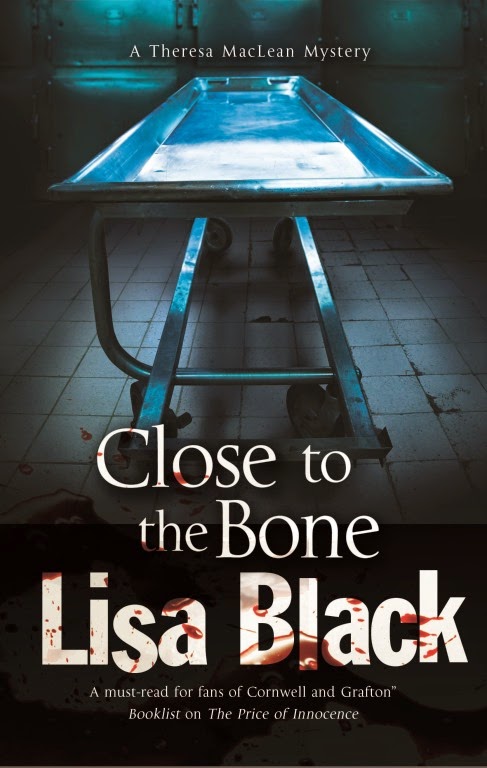
Lisa Black’s latest thriller is CLOSE TO THE BONE, a story that hits forensic scientist Theresa MacLean where it hurts, bringing death and destruction to the one place where she should feel the most safe—the medical examiner’s office in Cleveland, Ohio, where
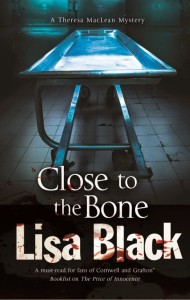
she has worked for the past fifteen years of her life. Theresa returns in the wee hours after working a routine crime scene, only to find the body of one of her deskmen slowly cooling with the word “Confess” written in his blood. His partner is missing and presumed guilty, but Theresa isn’t so sure. The body count begins to rise but for once these victims aren’t strangers—they are Theresa’s friends and colleagues, and everyone in the building, herself included, has a place on the hit list. Visit http://www.lisa-black.com/
The Phenomenon of the Group Blog (And why we should consider returning to its power)
Note: It is my great pleasure today to welcome author J.T. Ellison as guest blogger at The Kill Zone. J.T. Ellison is the New York Times bestselling author of twelve critically acclaimed novels. Her topic today is one of my favorite subjects–the art (and future) of group blogging! ~ KL
Several years ago, the fiction world exploded with a number of group blogs. I was lucky to be a part of one of them – Murderati. Founded by Pari Taichert, the blog served as a one-stop shop for all things crime fiction. We made an early agreement to stay away from divisive issues like politics and religion, choosing to focus instead of the writing life. We started with 7 bloggers, and over the course of the blog’s life, had two dozen regular contributors. And that doesn’t include the countless guest blogs. There were births, and deaths. Triumphs and heartbreaks. Breakups and makeups. And books. So. Many. Books.
I was one of the first group of 7, and was the only one with the time (no book deal yet) and inclination to get involved in the backend of the site – the coding and hosting and all that technical stuff. And that, ultimately, was the reason I left the blog as well, but I get ahead of myself.
I grew up on Murderati. Late to writing (I started on Murderati when I was 34, published my first book when I was 37), not knowing much of what I was doing, knowing virtually nothing about the industry. The blog was both a learning experience, and a way to mark my own growth as a writer. It taught me the discipline of a deadline – for the first several years, I blogged every Friday – how important it was to think about writing, even if I wasn’t creating. In the beginning, I had to dedicate a full day to composing and editing and fretting about my blog. I ate up every ounce of advice and insight the other bloggers were sharing. I learned; we all did.
And it wasn’t just Murderati. The group blog phenomenon was everywhere. It crossed genres. There were mystery blogs and sci-fi blogs and romance blogs. There were male-centric and female-centric. We could gorge on the posts – I know the first thing I did every morning for years was get up and read everyone’s blog from all the sites. We all had communities of readers who chipped in daily with their own opinions. It was awesome.
And then we started repeating ourselves. After hundreds and thousands of entries, it was inevitable. The pressure to find a topic no one had discussed grew. People started dropping off to go work on their – you know – books. New people came in, and new life would be given. For a while.Then they too would run out of original topics, and peel away.
The decline of the group blog was gradual, but no less striking for its attrition. Facebook and Twitter gave quicker feedback, though its false intimacy at first didn’t seem to be enough to hook us all. But we began building ourselves as individuals, and boom. Talking to, instead of talking with. And like a lead singer who does a solo album, the next album had that shadow hanging over it. It was all over, though we didn’t want to admit it. We dragged on, desperately trying to keep things fresh and relevant, to work together, but all around us, the group blogs began dropping like flies, until Murderati too finally gave up the ghost.
We had a great run. Seven years of original work. Millions of words written. A built-in platform for book launches and celebrations. The respect of our peers. A community unlike any other.
Shutting down sucked.
Did the rise of “I” overcome the power of “Us”? Or did we all simply run out of things to say? I know for me, running the backend of the site was taking time away from my actual writing. I had so many deadlines that my head was spinning, and I had a massive set of personal losses that made me question the whole purpose behind the endeavor. Everything felt shallow to me – writing, blogging, reading, living – and I pulled out, knowing I wasn’t doing anyone any favors being involved anymore.
I know I missed the phenomenon that was us. But I kept telling myself it was for the best.
Oddly enough, several months later, we realized most of the Murderati folks still were blogging. Though we’d run out of things to say, and complained bitterly about the time it took away from our writing, we’d kept on blogging. We just didn’t do it on Murderati. We didn’t do it together. Together became too difficult. Too time consuming. Too much effort. But we still wanted to talk. So we did it on our own blogs. On Facebook. Alone. Built our own networks of people. Our own communities.
And damn if we didn’t miss being together.
Missed it enough to try an experiment.
With the help of Writerspace, we revamped Murderati.com. We built an archive site. Every blogger has their own pageof their old blogs. And everyone who was interested has their current blog feed automatically into the site. So we’re together, but not together. Blogging, but not on a set schedule.
I love seeing group blogs like The Kill Zone that are still going strong. I wish we could have found a way to make that happen for Murderati. Maybe someday in the future, we’ll all come together again, realizing that there is a reason animals run in packs – there’s safety and camaraderie in numbers.
What do you think? Can we ever get that heyday back again? Or have we become so divisive as a community – and we are, trust me. There’s a war going on out there – that we are better off on our own?
Thanks so much for having me today. Y’all rock!
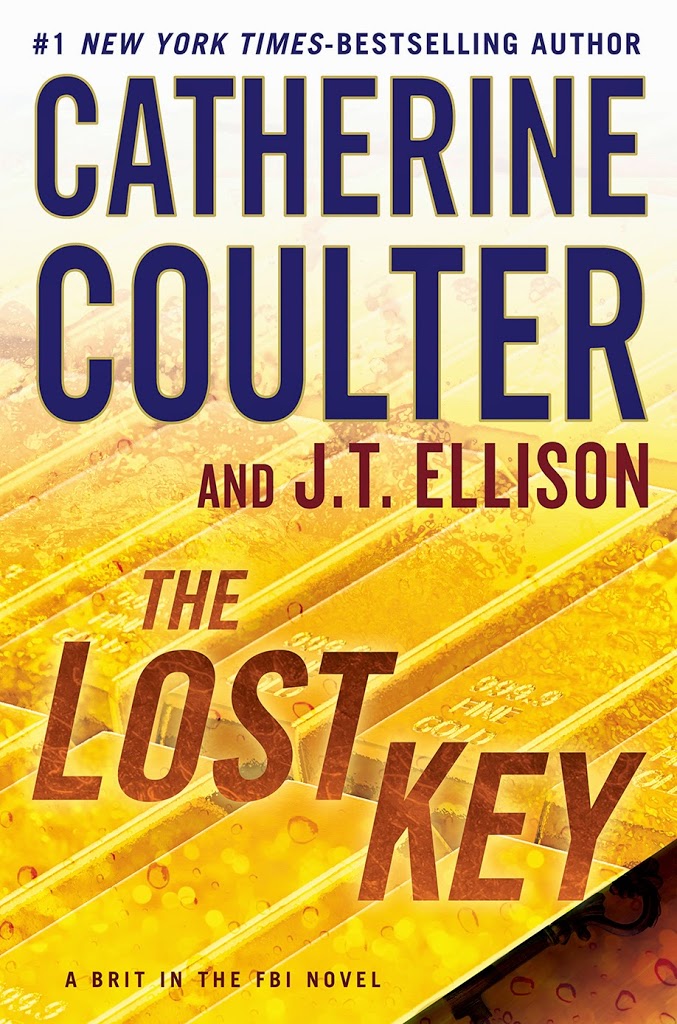
J.T. Ellison is the New York Times bestselling author of twelve critically acclaimed novels, including The Lost Keyand When Shadows Fall, and is the co-author of the Nicholas Drummond series with #1 New York Times bestselling author Catherine Coulter. Her work has been published in over twenty countries. Her novel The Cold Room won the ITW Thriller Award for Best Paperback Original and Where All The Dead Lie was a RITA® Nominee for Best Romantic Suspense. She lives in Nashville with her husband. Visit JTEllison.com for more insight into her wicked imagination, or follow her on Twitter @Thrillerchick or Facebook.com/JTEllison14. Or, if you’re so inclined, read her blog, The Tao of JT.
Do you need a rock?
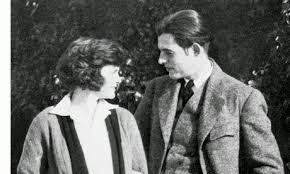
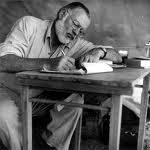
My book group just read A Paris Wife by Paula McLain, the fictionalized account of Ernest Hemingway’s first wife Hadley Richardson, and we all agreed to having mixed feelings about Hadley and her role as Hemingway’s ‘rock’ during his early career in Paris.
The book evokes the bohemian world of 1920s Paris and name drops a lot of literary giants but at its heart is the relationship between Hadley and Hemingway. The book made me question the extent to which Hemingway relied upon and needed Hadley’s stolid support during those early days.
I wondered how many writers feel they need someone close to them to be that kind of ‘rock’ – to provide emotional as well as (often) financial support (although Hadley certainly didn’t appear to contribute financially). Then there’s the more mundane support in terms of housekeeping and family duties (Hemingway could, after all, leave Hadley and his child at home while he went to a cafe to write without being bothered by any of those pesky fatherly duties!). In this day and age, I’m not sure anyone quite gets that kind of all round, ‘solid as a rock’ support – we are all juggling so many work/life issues that we usually have to find that support from within, rather than from someone else.
Hemingway also found mentors for his work in Paris (most notably Gertrude Stein) so it’s not entirely clear the extent to which he fed off Hadley’s unwavering (if unimaginative) support for his writing (although he certainly seemed to feed off adulation and praise of any kind!). Hemingway also never lacked self-confidence or the belief that he was destined to be a ‘great’ writer – but how many of us can say the same?
So how many of us writers feel we need a ‘rock’ in our life to reinforce our confidence and help propel our careers forward (especially early in our careers when we are still finding our literary feet)? Do we require a ‘rock’ of unwavering support? Or a mentor who respects and promotes our work? Or do writers really only need a ‘room of one’s own’ in which to flourish?
In my own career I’ve certainly had very supportive friends and family, but I don’t think I’d classify any of them as a ‘rock’ in the vein of Hadley Richardson. Most of the time I feel I have to rely on myself more than others to keep the writing going. Likewise, I’ve some terrific writer friends who I turn to for much-needed support but none of them have ever really acted as a mentor for my own work. I’m not sure in this modern age whether the same kind of ‘mentoring’ really exists like it did in say 1920’s Paris. But then again, maybe I just don’t hang out in literary enough writing circles!!
So TKZers what do you think? Do you have, or indeed need, a ‘rock’ in your writing life? Have you been lucky enough to have a mentor for your career? And if you were to give advice to someone contemplating the writing life, what would you tell them regarding having either of these?
Ten Lessons from Plot & Structure
James Scott Bell
@jamesscottbell
my becoming the fiction columnist, and then to the appearance of Plot & Structure in October of 2004.
Keeping It Simple and Doing It Right
Reader Friday: Your Daily Writing Quota?
TSTL
Elaine Viets
TSTL – Too Stupid To Live.
Characters who deliberately put themselves in danger.
In movies, TSTL is usually a big-boobed, small-brained blonde who hears a funny noise in the basement. A serial killer is on the loose, but she runs downstairs without a weapon, without fear, and without many clothes – and is hacked to bits.
Cozy mysteries are brutally bashed for TSTL females, but both genders are equally guilty.
TSTL is alive and thriving in dicklit: The cop who goes after the desperate killer without calling the dispatcher – or his partner. The private eye who goes alone into the building to get the murderer because a man’s gotta do what a man’s gotta do. Besides, he has his trusty Glock.
These writers aren’t taken to task for TSTL quite as often. But it’s safe to say that TSTL thrives in all forms of the mystery genre.
Readers want to kill authors who rely on TSTL stunts.
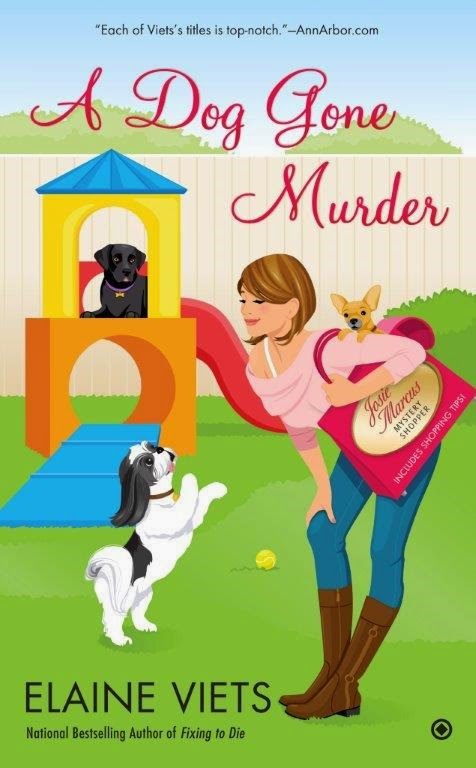
In A Dog Gone Murder, my new Josie Marcus, Mystery Shopper mystery, I worked hard to avoid TSTL syndrome. Josie mystery-shops dog daycare centers. She investigates Uncle Bob’s Doggy Day Camp, known for its commercials featuring Uncle Bob. She discovers that Bob was more of a dog than anyone knew — he’d been kicked out of the house for having an affair, and he runs with a dubious crowd. When he winds up dead, there’s a long list of suspects. The police arrest Frank, her mother’s tenant. Josie believes he’s innocent, and she has to find the proof that someone else killed Bob.
She can’t take her friend Alyce with her, either. This time her best friend has morning sickness.
Josie says she’ll let Frank’s lawyer go after the killer. She just wants information from some people who knew the murdered man – his employee, Heidi. A customer named Sharon, and Bob’s estranged wife, Candice. Here’s a scene from A Dog Gone Murder:
“I got information about all three on the Internet,” Josie said. “I even have Google Earth photos of their streets. Candice lives on a rich street in Summerdale. Heidi’s street is nicely in the middle and Sharon’s is on the skids.
“But they all have one thing in common.”
“What?” Alyce said.
“Every neighborhood has its own Mrs. Mueller. The neighborhood busybody who watches everyone and every thing.”
“And how will you find her?” Alyce asked.
“Easy. She’ll be watching her neighbors. I’ll look for the twitching curtain or the miniblind slat raised by one careful finger – the telltale signs of a snoop at work. Then I’ll get her started by saying the women are applying for a new job and I need background information. They’ll see it as their duty to tell me everything they know. Then I’ll knock on my suspects’ doors for a quick chat.”
“But the local gossip will see you do that,” Alyce said.
“Both Sharon and Heidi live in apartment buildings. I can say I’m interviewing more neighbors in their buildings. As for Candice, we’re clients of Uncle Bob’s. I’ll pay my respects for her recent loss.”
“Still TSTL, Josie.”
“What’s that?”
“Too Stupid To Live,” Alyce said. “I hate those movies where the woman says, ‘Gee, I think I hear a serial killer in the barn. I’m going out to take a look.’ Then she goes outside and he hacks her to death with a hatchet. You are not confronting a killer by yourself. You need back-up, but I can’t leave home at this stage.”
“Oh, lord, I was so wrapped up in this investigation,” Josie said, “I forgot to ask about you. How are you feeling?”
“Still living on ginger ale and soda crackers,” Alyce said. “I’m not doing much cooking. Even the smell of food makes me queasy. This stage won’t last, Josie. It will be over soon. But if you insist on this harebrained scheme, you’ll make me sick with worry. I can’t risk that in my condition.”
“Alyce Bohannon! Are you hitting me with the pregnancy card?”
“I’ll do whatever I have to if it slaps some sense into you,” Alyce said. “You’re a mother with a tween daughter. You have a husband. You’re not going off on this crazy mission.”
“But –”
“The only way I’ll allow it is if you take me with you,” Alyce said.
“How can I do that?” Josie said.
“Use your cell phone. Call me when you get to the first house and keep your cell phone on in your pocket. That way I can hear what’s happening. If there’s a problem – if you scream or I hear that you’re being threatened, I’ll call the police on my land line.”
“If I see the local busybody first, she’ll be watching me, too. That will make me doubly safe. It could work,” Josie said.
“It will have to work,” Alyce said. “Otherwise, I’ll call Ted and your mother and you’ll have to deal with both of them.”
Does it work? Read A Dog Gone Murder and find out.
A Dog Gone Murder, my 10th Josie Marcus Mystery Shopper mystery, will be published Nov. 4 as an e-book and a $7.99 paperback. Preorder your copy here http://tinyurl.com/q5dlhlj
Radio, TV and Podcasts
I haven’t ventured far into the world of podcasts, radio interviews or TV appearances. As an author, I’d rather spend my time writing the next book. Nonetheless, I’ve done a few radio spots via telephone, but I don’t seek them out. Somehow the thought of a microphone or camera aimed my way with hundreds of invisible listeners makes me nervous.
A telephone interview can be fun if done with a dynamic host who knows all the right questions to keep things flowing. The interviews I’ve done to date have gone well in this respect. But I’m wondering how these shows serve the reader and if they’re worth the time spent.
Do you listen to these shows? Have you ever bought a book based on an author interview you’ve heard/seen on the air?
Do any of you listen to podcasts? Do they influence you to follow an author’s social media sites? Buy his books? Or do you just tune in to learn what you can and then move on? Are podcasts essential to one’s media kit?
For those of you who’ve done these types of appearances, have they led to other valuable contacts? Have listeners responded? Besides the publicity, did you gain an upsurge in sales? Or did you merely enjoy the experience?
One of the speakers on “Radio for Writers” at a Florida Chapter MWA meeting recently stressed that the story isn’t about your book. It’s about you as a person and your journey as an author. Finding that unique angle or local slant is what would interest her as a reporter. See her tips for authors here: http://nancyjcohen.wordpress.com/2014/09/30/radio-for-writers/
So what’s your take on this whole live media business? Is it worth pursuing or is your time as a writer better spent working on the next book?
Speaking of radio interviews, I’ll be appearing at http://www.authorsontheair.com on Friday, October 10 at 6:00 pm EDT. I hope you will tune in!