By Larry Brooks
What seems to some to be so simple turns out to be anything but. Because we read excellent stories all the time, and they really do seem, well, if not simple, then at least clear and clean and accessible, and therefore not beyond our means.
The blank page both calls to us and mocks us. And so we fill it up with what we have to offer, arising from the pool of what we know, fueled by dreams we dare not utter aloud… sometimes soured by what, either in ignorance or arrogance or simple haste, we’ve chosen to ignore.
But too often it is what we don’t know — especially when we don’t actually know what we don’t know — that is our undoing.
Because, in spite of all the books and workshops and websites and analogy-slinging writing gurus out there, we cling to the limiting belief that there are no “rules.” The mere mention of that word causes you to rebel with artistic indignation, even conclude that principles and standards are mere “rules” with polite sensibilities — this one, too, being our undoing — and from there we decide that we can write our stories any way we please.
Because this is art, damn it.
Often we don’t find out that what we have to offer isn’t good enough until the rejection letter arrives. Or the critique group pounces like Simon Cowell on a bad day. Or when a story coach doesn’t tell you what you want to hear.
As one of the latter, at least until lately, my job involves telling writers — frequently — that their story is coming up short, followed by my best shot at explaining why. To explain that the wheels fell off, very often at the starting gate. It’s the why part that allows me to sleep at night, because I’ve been on my share of the receiving end of the sharp pokes this business delivers. But like a doctor giving a screaming kid a vaccination shot, I take solace in the hope that once the sting subsides the writer will see the pit into which they are about to tumble.
And that they may finally begin to know what they don’t yet fully know.
The Trouble with Craft
Craft — the mechanics and architecture and sweat of putting a story together — is complex, if nothing else than for its sheer immensity. It’s anything but simple, complicated by a writing conversation out there that seeks to over-simplify it. Even in those stories that inspire us, bestsellers and favorite authors and even the classics, we’re witnessing the symmetry and fluid power of simplicity on the other side — beyond — complexity.
I’ve sought to put fences around it all, create labels and levels and subsets of supersets and connect those dots in ways that facilitate navigation along that path. Six core competencies, six realms of story physics, and about five dozen subordinated corners of the craft aligned under those twelve flags.
Trouble is — just like in love and careers and gambling — you can get them all technically right… and your story can still fall short. And that’s the thing — the holy grail of “things” we need to understand — that separates craft from art. Unpublished from published. Frustrating from rewarding.
So without minimizing any of the myriad corners and nuances of craft — indeed, they remain eternal, consistent and the non-negotiable ante-in — allow me to once again attempt to simplify. To break it down into three buckets, three qualities, three goals, that any successful story will embody to some extent.
Three essences to shoot for (apologies to the more than one writer who can’t quite wrap their head around the notion of essence… in the business of words, it is good to know what they mean). Three qualities to evaluate about your story intention, and then your execution.
Three things to grade yourself on.
Three things about your story… things that readers will, upon finishing your story, notice.
If at least one of those grades isn’t an “A,” then you’ve got more work to do. It’s a mission impossible moment: your job, should you choose to accept it… is to write a story that competes for readership.
This will help.
The Fiction Trifecta
No surprises here. But be honest, have you really evaluated your story on these things, regarded as criteria? Have you asked yourself what your strategy will be to optimize one or more of these things within your narrative?
In no particular order, because each stands alone as a potential windfall:
Intrigue – A story is often a proposition, a puzzle, a problem and a paradox. When you (the reader) find yourself hooked because you have to know what happens… or whodunnit… or what the underlying answers are… then you’ve intrigued your reader. It may or may not have an emotional component to it — mysteries, for example, are usually more intellectual than emotional, they’re intriguing because the clues lead somewhere, and we want to know where, even see if we can get there first.
Mysteries, as a genre, are almost entirely dependent upon reader intrigue. Not necessary “dramatic intrigue” within the story itself, but rather, the degree to which a reader is “intrigued” with the questions the story is asking, as well as the characters that pose the questions.
But this kind of intrigue isn’t limited to mysteries. Sometimes intrigue is delivered by the writing itself. A story without all that much depth or challenge can be a lot of fun, simply because the writer is funny. Or scary. Or poetic. Or brilliant on some level that lends the otherwise mundane a certain relevance and resonance. Make no mistake, these attributes are, at their core, a form of intrigue.
Emotional Resonance – When a story moves you, which so many great stories do, it’s because we feel it. It makes us cry. Laugh. It makes us angry. It frightens, it seduces, it confounds and compels.
Les Miserables isn’t the classic it is — book, stage and screen — because we must find out what happens or whodunit. No, it works because it makes us weep. John Irving’s Cider House Rules is a modern classic because it pushes buttons, forces us to confront alternatives, compelling us to behold the consequences of our choices reduced to the realm of feeling.
Same with The Davinci Code, another modest success.
Every love story, every story about injustice and pain and children and reuniting with families and forgiveness — name your theme — is dipping into the well of emotional resonance for its power.
Vicarious Experience – reader, meet Harry Potter. Go with him on an adventure to a place you’ll never experience otherwise. Or Hans Solo. Or James Bond. Or Sherlock Holmes or Merlin or Stephanie Plum or some alien with an agenda. The juice of these stories isn’t so much the dramatic question or the plucking of your heart strings as much as the ride itself. The places you’ll go, the things you’ll see, the characters you’ll encounter, the things you’ll experience and encounter.
Of course, emotionally-vicarious experience (versus setting-driven) can be a ride, as well — a story about falling in love, or getting fired, or winning the lottery — and when that happens you’ve been given an E-ticket on the Slice of Life attraction. These stories strike two of these Trifecta chords by making us feel the experience of falling in love, or feeling loss or simply walking a mile in shoes that seem compellingly familiar.
None of this is new. But few writers shoot for these as targets as their story emerges, taking for granted that they will be in evidence. But when used as criteria and quantitative raw grist, you are better equipped to understand how well your story will work… or not… as the narrative comes together, rather than because of the sum of its parts.
The common factor here is this: something compelling about the story.
Either intellectually, emotionally, or on some other level (usually the result of a combination of these three gold standards). An allure that resides beyond the tricky or original or otherwise “interesting” nature of its concept.
Your concept, however tricky or original or interesting, isn’t completely compelling until it lands on one or more of those three powerful forces: intrigue… emotional resonance… vicarious experience. A story about aging backwards, for example, or about going to another planet, or finding a secret code… a story driven by something conceptual… may not be enough.
It’s the difference between a beautiful store window mannequin and a beautiful model strutting the runway. One percolates intrigue, the other… just lies there, cold and still.
The goal is to juice your concept with some combination of the Trifecta elements.
Until that happens, that’s all you have: an idea. In this business, concepts are commodities. But intrigue, emotional resonance, and vicarious experience… those are pure gold.
*****
If you’re in a mood for a deeper dive into craft, I invite you to consider my training videos, available now on Vimeo. Even better, through February they are all HALF OFF… just use this code — Feb50off — in the checkout sequence for each video you want to download.




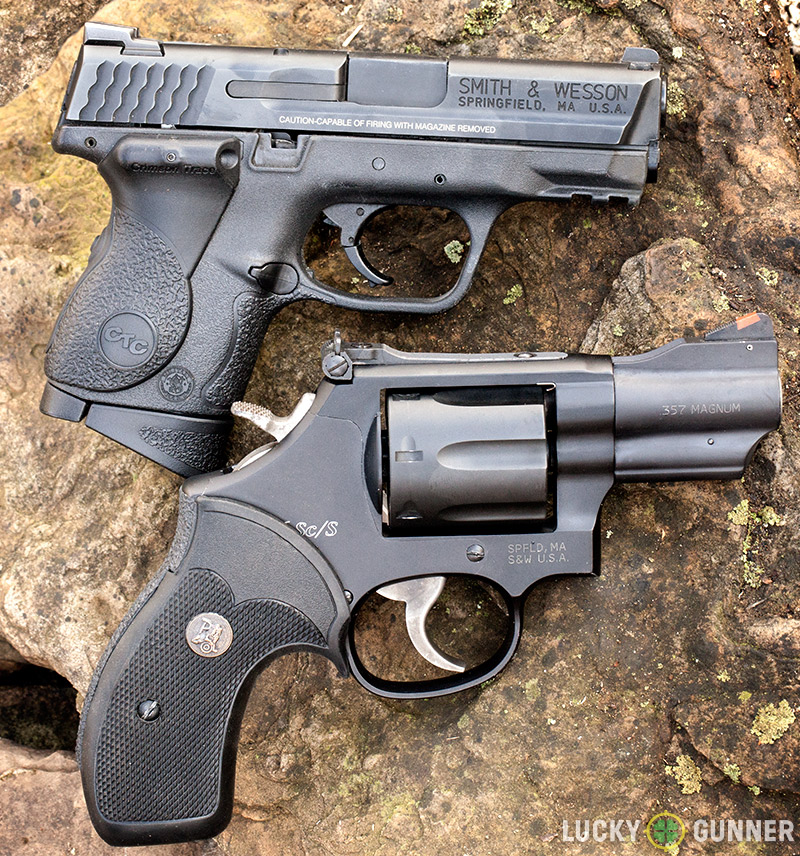 e mutually exclusive. Both are handguns, but they operate under entirely different principles. A revolver, otherwise known as a “wheel gun”, holds its cartridges in a cylinder that rotates as the hammer comes back and prepares for each shot. The revolver in the picture features an external hammer, and can be fired double action (DA) or single action (SA), which makes it a DA/SA revolver. (Double action means that with the hammer down, a single pull of the trigger with bring the hammer back, rotate the cylinder, and then drop the hammer again, firing the gun. Single action would describe the condition where the hammer is manually cocked and remains back–“condition zero”. From this condition, the trigger is more sensitive by a large margin.) Generally, there are no external safeties on a revolver. The fact of the long DA trigger pull functions as a safety. Only a fool would carry a revolver in condition zero.
 Recent years have seen a growth in the popularity of the DAO (double action only) revolver. With no external hammer to cock, every pull of the trigger is double action. The upside of a hammerless revolver is the ease of the draw from concealment (hammers have a way of snagging on clothing).
 A pistol, on the other hand, carries its load in a magazine that is inserted in the grip. As the weapon fires, the slide cycles, ejecting the spent shell casing and pushing the next round into battery. The picture at the top of this post of me at the range shows this cycling action of a Glock 36 at 1/4000 of a second–thanks to my son, Chris, for getting the picture.
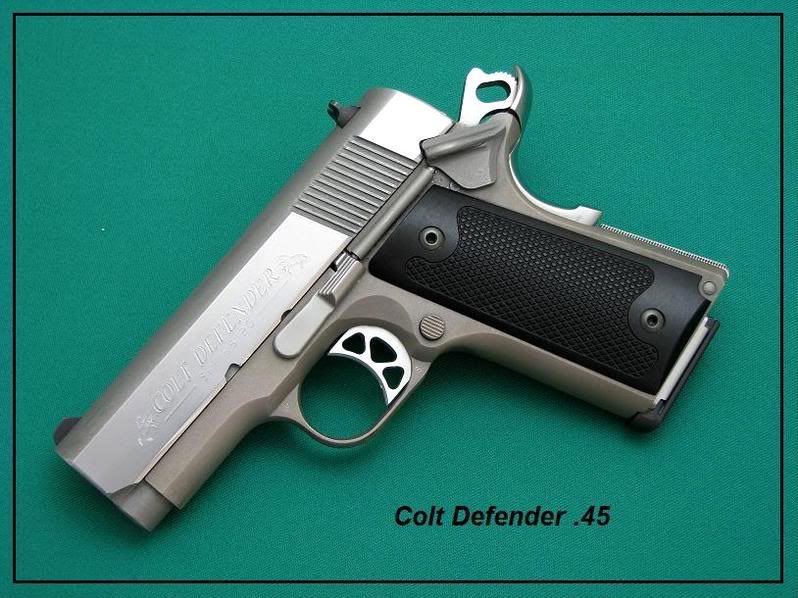
  The pistol in the picture with the revolver has no hammer, but is rather “striker fired”–a distinction that is best left to a future post. Striker fired pistols may or may not have external safeties. Some pistols have external hammers, such as the Colt Defender in the picture. As shown, the Colt is in condition one, which means cartridge in the chamber, hammer back and safety on–otherwise known as “cocked and locked.” In yet another iteration, many manufacturers make DA/SA pistols. The Bersa Thunder in the photo offers a very long, hard DA trigger pull for the first shot, which leaves the hammer back for a SA follow-up shot. For most DA/SA pistols, the “safety” is not a safety at all, but rather a de-cocker, which safely returns the hammer to its DA position.
 If your character is an on-duty cop or active duty military, where sidearms are worn in some kind of duty rig, the sky’s the limit for what they want to carry. You can buy holsters for all kinds of hand cannons. The choices become more limited when it’s important for your character to conceal his or her weapon. As a general rule, the larger the firearm, the harder it is to conceal. The obvious corollary is that bigger people can conceal bigger guns.
 When it comes to carrying a gun on one’s belt, the critical first choice is inside-the-waistband (IWB) vs. outside-the-waistband (OWB), and both mean exactly what the words say. Generally, OWB carry is more detectable,
  but with the right holster and an effective cover garment, it can be very effective. By contrast, IWB carry allows for concealment by means as simple as an untucked T-shirt. On the downside, the gun takes up waistband real estate that would otherwise be used by the waist.
  If your character wears skinny jeans, IWB could be a problem. IWB carry positions are referred to as positions on a clock face, where one’s navel would be 12 o’clock and the right hip would be 3 o’clock. The IWB position in the picture is referred to as “appendix carry”, and for the life of me, I don’t know how he would be able to sit down. Shoulder rigs are popular in movies and television shows, but I
  have never met a real person who wore one and didn’t hate it over time. They’re hard on the shoulders, and you can never let your arms hang normally. But the deal breaker for me would be that during the draw stroke, you pretty much have to point the gun at the person behind you, and then subsequently at yourself. That violates the basic tenets of firearm safety–as do many of the specialty retention devices such as the bra holster. ‘Nuff said, can we agree?
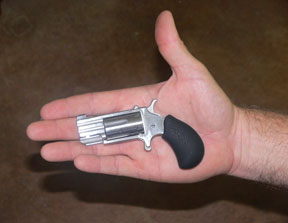 the only concealment option is a vest pocket, or perhaps a boot? Search the Web for specialty guns that are actually well-made and very effective for what they are. North American Arms makes a mini-revolver that easily fits in your fist, and can be chambered in .22 magnum, a round that shows very similar terminal ballistics to a .38 special, un
 der ideal circumstances. The tiny, nearly non-existent barrel is a problem for a shot longer than, say, 10 yards, but as a belly gun, it’s kind of impressive, and since it’s a revolver, your character gets five tries to bring justice to another character.