https://www.youtube.com/watch?v=wm7uOiqiKJc&t=4s
For today’s show – don’t tell, I bring you this video. It’s far more than I can ever write or say.
Kill Zoners – What words of wisdom, imagination, and other good stuff would you like to share?

As I woke up this morning, and my wife and I were planning the events of the day, I told her that I needed a couple of hours to write my Killzone Blog post.
“I thought they went up on Wednesdays,” she said.
“That’s right.”
“Today is Wednesday.”
“No, it’s not. Today is Tuesday.”
“Wednesday.”
“Crap. It’s Wednesday.”
Normally, I’m not an in-my-jammies kind of worker. While my office is just down the hall, it’s still my office, and if I’m at my desk, I’m dressed for the day. Except this morning. As I write this, the clock on the wall tells me that it’s 8:35 a.m. That tells me that I’ve already missed the eyes of commuting readers. And I’m bearing the burden of Reavis Wortham’s post from a few days ago, where he talks about the moral betrayal that is the missing of a deadline.
I choose to blame Thanksgiving. That Thursday holiday makes the days that follow all feel like Saturday or Sunday. Throw in the fact that we’ve been decorating the new abode for Christmas and I haven’t been near a calendar, and here we are. I’m writing, but let’s be honest. I’m not saying very much. Bottom line: I dropped the ball.
Just wait till next time, though. Maybe I’ll be brilliant.
Here are the discussion questions, now that Thanksgiving is in the rearview mirror and Christmas is fast approaching:
By PJ Parrish
We should all have such problems…
I read a story in the New York Times this week about a debut author whose novel became an international bestseller with rights sold in 40 countries, was named Barnes & Noble’s book of the year, and is on track to be the bestselling debut novel of 2022. Oh yeah, an Apple TV+ adaption is in the works.
But she’s getting a lot of hate mail because of her….cover.
The book, Lessons In Chemistry, is about a woman scientist in the 1960s who is opinionated, funny and intelligent, but she’s cheated out of her doctorate and brutally sidelined by male colleagues who, as one reviewer put it, make Don Draper look like a SNAG (Sensitive New Age Guy). Think of The Queen’s Gambit set in the macho labs of abiogenesis. The heroine wears a sharp No. 2 pencil in her chignon not for style but as a weapon against sexual advances.
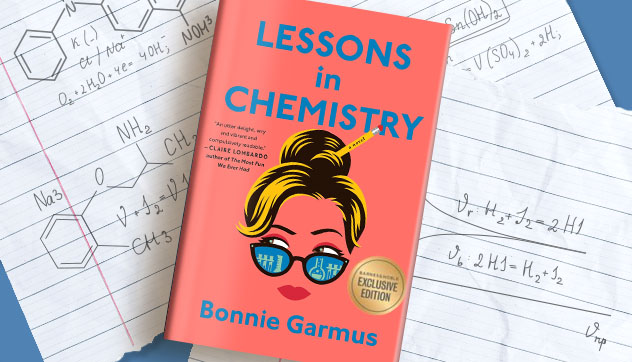
But then there’s that cover. Bubble-gum pink, with a cartoonish woman’s face peering over a pair of cat-eye sunglasses. Some readers picked it up as a quick beach read, expecting — I hate this phrase — “women’s fiction.” What they got was a serious look at the frustrations of a generation of women, who were relegated to the corners, ignored, or worse.
Garmus is able to laugh about the hate mail from some readers, saying, “They were like, ‘You’re the worst romance novelist ever!’” She says the cover has turned off a few men, admitting that during an talk to an all-male book club, members were dissuaded by the cover’s Necco Wafer shell. “But as I’m fond of saying,” Garmus said, “the book isn’t anti-men, it’s anti-sexism.”
It’s also, by all accounts, a fun read. There’s a mystery, mixed in with a shrewd look at politics, and a dysfunctional bad local TV station. The heroine has an addiction to her rowing machine, loves her daughter and her dog Six-Thirty.
James Daunt, chief executive of B&N, admits that aiming the novel at a female readership is “a bit pigeonholing….but the book has dominated the cover.”
Love that phrase — dominated its cover. As a writer who has had her share of bad covers, I sympathize. It’s an eye-catching cover, to be sure. But the dissonance between it and its message is jarring. I’m glad Garmus can joke about it. She had more than 100 rejections of other manuscripts before Lessons In Chemistry. Nice to break through — at the ripe young age of 65.
Back from a long and lazy vacation where eating, drinking and reading were the only things on my brain, I’m having a devil of a time opening the file of the WIP. So when Jane Friedman’s latest blog popped up in the mailbox the other day, I clicked. It was by an author who, feeling exhausted and overwhelmed, found a way to grease the wheels again.
Matthew Duffus writes: “When I finished my MFA in 2005, I didn’t write for a year. Between exhaustion from completing a readable draft of a novel on deadline and the confusion caused by having too many critical voices in my head (thanks, workshop), I didn’t know where to begin, let alone how to get to The End of something. I’d burned out on my thesis, realizing it would be my “novel in the drawer,” and had no idea what to do next. After the first few maddening weeks, I tried embracing Richard Ford’s concept of ‘refilling the well.’ When this stopped working, I knew I needed to try something new.”
Duffus has three easy steps. And yeah, I’ve tried all three.
Finally, I give you the year’s best in really bad writing. No, no…not the Literary Review’s Bad Sex in Fiction Awards. They’ve cancelled them because as the judges wrote: “The public has been subjected to too many bad things this year to justify exposing it to bad sex as well.” Well, we’ll just have to go back and re-read our John Updike, right?
That leaves us with the Bulwer-Lytton Dark and Stormy Night contest. Since 1982 the Bulwer Lytton Fiction Contest has challenged participants to write an atrocious opening sentence to the worst novel never written. The contest honors Sir Edward George Bulwer-Lytton, whose 1830 novel Paul Clifford begins with “It was a dark and stormy night.”
I forgot to report these earlier this year, but attention must be paid. Especially since the grand prize winner this year is a fellow crime dog.
GRAND PRIZE WINNER by John Farmer Aurora Col.
I knew she was trouble the second she walked into my 24-hour deli, laundromat, and detective agency, and after dropping a load of unmentionables in one of the heavy-duty machines (a mistake that would soon turn deadly) she turned to me, asking for two things: find her missing husband and make her a salami on rye with spicy mustard, breaking into tears when I told her I couldn’t help—I was fresh out of salami.
CRIME AND DETECTIVE FIRST PLACE by Jim Anderson, Flushing, Mich.
The detectives wore booties, body suits, hair nets, masks and gloves and longed for the good old days when they could poke a corpse with the toes of their wingtips if they damn well felt like it.
Dishonorable Mentions
They called Rock Mahon the original hard-boiled detective, and it wasn’t because of his gravelly voice, or his crusty manner, or his chiseled jaw, or his cement-like abs, or his feldspar fists, or his iron incorruptibility, or his calcite cynicism, or his uzonite unsentimentality, but because of his goddamned, geezly, infuriating habit of polluting every crime scene with shells dropped from the hard-boiled eggs he munched without surcease.– Barbara Stevenson, Ottawa, Ontario, Canada
As detective Harry Bolton knelt down looking at the fifth murdered prostitute in as many weeks, he thought his was a cold cruel city and that maybe he should have taken that job in rural North Carolina but he didn’t think he could be like sheriff Andy Taylor all in black and white, plus he couldn’t stand Aunt Bea’s falsetto voice, and who names their kid Opie anyway, he had to know it rhymed with dopey, you might as well just call him dipstick, that doesn’t rhyme with much. — Doug Self, Brunswick, ME
The heat blanketed the small village in much the same way a body bag blankets a murder victim, except that a body bag is usually black, which the heat wasn’t, as heat is colorless, and the village wasn’t dead, which a murder victim usually is. — Eric Rice, Madison, WI
In honor of all the winners, I leave you with the queen of real talent laboring in the pursuit of artful awfulness — Lucille Ball. She made an enduring and endearing shtick about her caterwauling attempts to get on the stage. In real life, she was a pretty okay singer. Hit it, Lucy.
Leaning back in my recliner, I’m typing this post on November 25, the day after Thanksgiving 2022, as the world spins like the blurry view from a municipal park merry-go-round every time I move my head. I’m suffering another bout of vertigo.
Adding insult to injury, I ache all over with a flu virus the Bride contracted from one of the grand-critters a few days ago, before passing it on to me.
Each time I get up, I stagger like a college freshman on spring break, but thanks to the benefits of modern chemistry, I’m now able to keep my stomach from turning wrong-side out.
It’s not a great day to write, but here I am, because I have a deadline for this blog on Saturday, November 26.
I first started showing symptoms of this most recent bout of vertigo three days ago and as luck would have it, I had a newspaper column deadline to meet. Propped up in the bed up at our Lamar County cabin in Northeast Texas (five miles from the Red River and Oklahoma), I kept my eyes closed and pecked out a nine hundred-word Thanksgiving recollection from fifty years ago.
Finished, I hit send after a cursory scan and faded into a deep sleep. Far from recovered the next day, the Bride drove us home. That’s when everything in my body started aching.
Vertigo isn’t something new for me. The first time it attacked was maybe five years ago in Key West, while we were on vacation with the Gilstraps. John and I have a tendency to wreck our livers when we’re together, and early one morning I rose to find myself on the deck of a ship in high seas. Bouncing like a pinball from a wall, to a chair, and finally the bathroom, I upended the contents of my stomach and wondered how much I really drank.
Wait, I’m not in college anymore.
Flipping through mental files with one cheek on the cool toilet seat, I counted up the number of drinks I’d consumed the night before and realized the symptoms weren’t alcohol related. The Bride located a Doc-in-the-Box a mile away and I soon joined the flow of a dozen college kids reeking of booze and heading for the front door. As one, we staggered into the waiting room and the participants collapsed on the nearest horizontal surface.
In once instance, a young lady curled up in the fetal position on the floor and wept.
The tired doctor surveyed the room, took note of my age, and after a flurry of questions, escorted me into an examination room.
“Lay back on this table and turn your head to the right.”
“Urk!!!”
“I thought so. You have vertigo.”
He was glad to see something besides alcohol poisoning and sever dehydration which seemed to be going around that January. After poking a handful of pills down my goozle, he gave me a prescription for dizziness and nausea and launched me back into the world where I managed to function with respectable fortitude for the remainder of our trip.
My second round of vertigo happened again nearly two years later when I was the master of ceremonies at one of the world’s largest book club conferences held by the Pulpwood Queens in Jefferson, Texas. Again, I slept flat on my back the night I arrived and the next day stumbled into the enormous hall containing 500 attendees to take the stage.
I told them up front I wasn’t drunk, though I wished I was. I played off the symptoms, and many thought the organizer, Kathy Murphy, brought in Foster Brooks’ son as the MC. I introduced a panel every hour on the hour beginning at nine that morning, then wove my way outside to sit behind the wheel of my truck and doze for fifty minutes until time for the next panel to begin.
Some of the ladies took pity on me after the second hour and poured copious amounts of coffee into this bod so I could hold up my end of the bargain over a three day period. If memory serves, and recollections are somewhat fuzzy, I ended the conference to a standing ovation.
But that might have been a hallucination.
Today I told you that, to emphasize this. If you’re going to be a writer, or become involved in any aspect thereof, you have to meet deadlines. Whether it’s a weekly newspaper column, a magazine article, a personal appearance, a Zoom panel, a conference, or the delivery date for a book, you must meet that deadline.
Show up for work. Play hurt, or don’t play at all.
Again with John Gilstrap, I wrote a newspaper column at four in the morning, riding in the backseat of an SUV, on the way to join up with a Florida SWAT team and participate in the arrest of an accused purveyor of kiddie porn. We were there to train with those fine men in blue, I had to get it written, because I was on deadline.
I’m close friends with a well-respected, successful novelist and he managed to bring in a novel after building a house, moving twice, attracting Covid, and surviving a disastrous injury to a family member. Because of his track record, his publisher granted a small deadline extension which he met, and he survived with his reputation intact.
I suspect that because that request was granted because he’s been meeting other deadlines for about twenty-five years, or more.
Writing is a business, and we can’t let the public or publishers down because of a few unanticipated obstacles.
And with that, I’m going through the required steps to post this blog, and leaving this stable chair for the rolling deck of my living room. If I make it far enough, I’m crashing again until the crystals stabilize inside my skull.
Even if I’m not completely up to snuff, I’ll write tomorrow, propped up in bed like Mark Twain with his newfangled typewriter, because I have a March 1 deadline for the second Tucker Snow novel.
That’s what I do.
Oh, and Happy Holidays to you all!
Black Friday

You’ve survived Thanksgiving by kicking back in your recliner to watch the football game while you enjoyed the tryptophan-induced coma, but today it’s Friday and you have to face the mob. It’s time to battle the traffic, find a parking spot at Wally World, and push your way through the masses to get that gizmo for your child or grandchild, the one that is discounted 30%, the one everyone is fighting for, and the one you won’t be able to find for this price after today.
So…you flip on your flashing light-siren (the one Cousin Larry built for you) and race down the street as everyone pulls to the curb to get out of your way.
In the parking lot, you turn on the loud speaker in your Larry device and announce a bomb threat. “Everyone, please leave the parking lot, and remain calm.”
Inside the store, you pull out your phone and hack into the Wally World PA system to announce a special offer on aisle 13.
When you reach the gizmo, there are still three determined mamas fighting over the last one. You wouldn’t dare take them on, so you don your gas mask and deodorize the area with tear gas.
As you head for the checkout with the precious gizmo, you keep your bear spray unholstered for anyone who is foolish enough to try to jump you.
And as you drive out of Wally World’s parking lot, merrily whistling, you dream of new ideas for your next book.
So, TKZers, how do you fight the Black Friday battle? Or give us some creative ideas for surviving the war for the gizmo. After all, you write fiction.
By

Photo credit: Dennis Wilkinson on Flickr
Happy Thanksgiving!
Thanksgiving dinner without pie would be a True Crime.
So let’s take a pie poll. Which is the best: pumpkin, apple, pecan, sweet potato, mince, or something different?
Please vote for your favorite pie and feel free to include the recipe, too!
One of the many blessings I give thanks for is being part of the terrific Kill Zone community.
Wishing you and yours a day filled with love, fellowship, and good food.
Being Thankful – Writer’s Edition
Terry Odell
 Here in the US, tomorrow is Thanksgiving, a day where families often gather around a groaning table, eat way too much, and maybe watch a little football. At one point during the holiday, most people share something they’re thankful for.
In her post on Monday, Kay asked readers what they were thankful for. While we routinely mention family, friends, health, creature comforts, and maybe a pet or two, I thought we could lighten up and look at things less lofty. Little things, “writer-specific” things.
Here are a few of the little writerly things I’m thankful for, in no particular order
What about you? What writer-specific things are you thankful for? (Note: TKZ is a given!)
And Happy Thanksgiving, everyone!
Now Available: Cruising Undercover
 It’s supposed to be a simple assignment aboard a luxury yacht, but soon, he’s in over his head.
 Terry Odell is an award-winning author of Mystery and Romantic Suspense, although she prefers to think of them all as “Mysteries with Relationships.”
By Debbie Burke
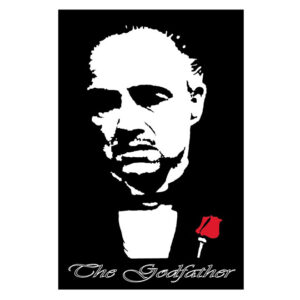
“Make him an offer he cannot refuse.”
Vector image CC BY 4.0
Whether you’re buying a car, arguing with a boss, or making a deal with your kids to do their homework, most interactions in life are negotiations. Each of us wants to get our own way.
Humans live in a constant state of imbalance, jockeying back and forth to gain the upper hand.
That usually translates into attaining power over someone else. That power can be immense or tiny.
Learning to exploit power imbalances is an effective technique for writers to ramp up the tension in fiction.
In most stories, one character has certain goals while another character has different, conflicting goals. That leads to negotiations between characters that can be physical, verbal, social, or psychological.
The goal can be large scale (world domination) or small scale (spouses arguing whether the toilet seat should be up or down).
One character usually starts out dominant; the other is in an inferior position and wants to rise to the superior position. Their struggle creates tension and suspense as the reader wonders who will prevail.
Each scene in a novel is a micro power struggle between characters. Those struggles can be shown in different ways:
Seller says: “I’m offering you a fabulous deal on this 911 Porsche.” Seller thinks: The price is ten grand higher than market but he’s salivating. He won’t leave without the car.
Buyer says: “Forget it. I won’t pay a dime over $$.” But Buyer thinks: I’ve always wanted a 911. If he comes down a grand, I’m snapping it up.
Boss says: “Management told me to cut expenses ten percent across the board including your salary.” Boss thinks: With three kids, she doesn’t dare quit. A ten percent cut means a bigger bonus for me.
Worker says: “That’s unacceptable. Besides, I have a better offer with a twenty percent increase and three weeks paid vacation.” Worker thinks: Can she tell I’m bluffing? What if she fires me?
Anyone who’s ever been a parent can fill in their own examples of negotiations with their kids!
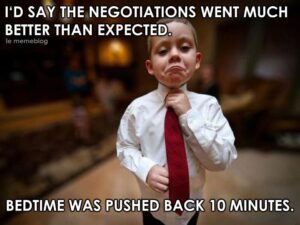
In thrillers, mystery, suspense, sci-fi, and fantasy, typically the antagonist is stronger, richer, smarter, more ruthless, or more determined than the protagonist. The protagonist spends much of the story trying to keep from being squashed and defeated.
Character A may start out in control at the beginning of a scene but Character B has leverage because of superior knowledge or ability that reverses the power by the end of the scene. Then in subsequent scenes, A must scramble and come up with new strategies to regain control while B fends off efforts to topple him/her.
One of my favorite stories is O. Henry’s “Ransom of Red Chief,” first published in the Saturday Evening Post. [Note: some language from 1907 is no longer acceptable today]. It is a detailed blueprint of negotiation among characters who jockey back and forth for power. Demands are made. Counteroffers follow. Demands change, resulting in counter-counteroffers and counter-counter-counteroffers.
Here’s the story premise: Two ruthless criminals, Sam and Bill, decide to kidnap the only son of wealthy Ebenezer Dorset and hold him for a ransom of $2000. Surely Mr. Dorset will immediately cave into their demands and pay. Sam and Bill believe their scheme can’t lose.
When the redheaded ten-year-old victim beans Bill in the head with a brick, that physical act is the first hint of a potential power shift. Nevertheless, Sam and Bill are still in control as they subdue him and spirit him off to a cave hideaway.
However, in the cave, the kidnappers discover their hostage is a handful and they must maneuver to maintain physical and verbal control over him. Bill plays a game of make-believe with the boy, who’s dubbed himself “Red Chief.” In the game, Red Chief captures Bill and ties him up. Soon the kid “…seemed to be having the time of his life. The fun of camping out in a cave had made him forget that he was a captive himself.”
“Red Chief,” says I to the kid, “would you like to go home?”
“Aw, what for?” says he. “I don’t have any fun at home. I hate to go to school. I like to camp out. You won’t take me back home again, will you?”
We weren’t afraid he’d run away.
Although Red Chief remains their prisoner and no longer resists, he has verbally prevailed over Sam and Bill.
Red Chief’s physical harassment of them escalates. The kidnappers’ confidence begins to crack.
During the first night, Sam has a dream that illustrates Red Chief’s growing psychological power: “I had been kidnapped and chained to a tree by a ferocious pirate with red hair.”
Later, terrified screaming wakes Sam.
“Red Chief was sitting on Bill’s chest, with one hand twined in Bill’s hair. In the other he had the sharp case-knife we used for slicing bacon; and he was industriously and realistically trying to take Bill’s scalp.”
Red Chief’s attack demoralizes Bill who asks Sam, “Do you think anybody will pay out money to get a little imp like that back home?”
Their prisoner has taken psychological control of the situation.
Sam leaves the hideout and returns to town, expecting to find villagers in an uproar and frantically searching for the missing boy. He had anticipated the kidnapping would give the criminals social control over the community. Instead, all is calm. Their original premise, that Mr. Dorset will be desperate to get his son back, isn’t happening as planned.
Uh-oh.
Back at the cave, Sam finds Red Chief has further injured poor Bill. Sam tries to regain physical and verbal control.
I went out and caught that boy and shook him until his freckles rattled. “If you don’t behave,” says I, “I’ll take you straight home. Now, are you going to be good, or not?”
Red Chief appears contrite and apologizes. Sam believes he and Bill are back in the driver’s seat.
But the kidnappers’ determination falters when Bill, who can’t take any more abuse, begins to negotiate with Sam to reduce the ransom terms.
“…it ain’t human for anybody to give up two thousand dollars for that forty-pound chunk of freckled wildcat. I’m willing to take a chance at fifteen hundred dollars. You can charge the difference up to me.”
They agree to lower the ransom. Their foolproof, get-rich scheme is losing ground.
Next, Sam delivers the threatening note:
If you attempt any treachery or fail to comply with our demand as stated, you will never see your boy again. If you pay the money as demanded, he will be returned to you safe and well within three hours. These terms are final, and if you do not accede to them no further communication will be attempted. Two Desperate Men.
Although battered, the disheartened criminals are still holding onto their victim and believe Red Chief’s father will agree.
Instead, Mr. Dorset responds with a counteroffer:
I think you are a little high in your demands, and I hereby make you a counter-proposition, which I am inclined to believe you will accept. You bring Johnny home and pay me two hundred and fifty dollars in cash, and I agree to take him off your hands. You had better come at night, for the neighbours believe he is lost, and I couldn’t be responsible for what they would do to anybody they saw bringing him back. Very respectfully, Ebenezer Dorset.
With a classic O. Henry twist at the end of the story, Bill and Sam are out-negotiated. The kidnappers become the victims and must pay Mr. Dorset to take back Red Chief.
The more your characters negotiate with each other, the more the power shifts between them, raising tension and suspense. Readers turn pages to find out who wins. When you keep readers interested, they become fans who buy your next book.
Make your readers an offer they cannot refuse.
~~~
TKZers: Please share negotiations and power struggles between fictional characters that made an impression on you. Use examples from published stories, films, or your own WIP.
~~~
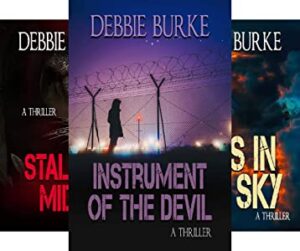
Debbie Burke is making an offer you can’t refuse:
For only $.99, try out the award-winning Tawny Lindholm Thriller series.
Special price for Thanksgiving week only.

A couple of years ago, I was invited to participate in the creation of an anthology dedicated to honoring U.S. military veterans who had served during wartime. I accepted that invitation and agreed to write the story of 98-year-old WWII veteran Charlie Henderson.
I couldn’t conduct the interviews with Mr. Henderson in person because it was the summer of 2020, the first year of Covid, and we were separated by a couple of hundred miles, so we arranged to talk on the phone. Charlie’s age hadn’t affected his hearing, and we spent several hours in conversation about his life before, during, and after the war.
Charlie wasn’t thrilled when he was drafted into the army in 1942. He came from a close family in Mississippi, and he hated to leave, but he answered the call and spent most of his service in Europe. He was assigned to the 449th Gasoline Supply Company, a dangerous situation since the Germans wanted to destroy all gasoline supply depots. Charlie talked openly about the fear he felt when he and his fellow soldiers heard the sound of buzz bombs overhead, but he was proud of the part he played in delivering gasoline to the Allied front lines during the Battle of the Bulge.
After we completed our interviews, I sent Charlie and his nephew, John, the first draft of my article. They made suggestions and corrections and we repeated the process until we were all satisfied with the results. I sent the final copy to them and to the editors of the Forever Young Veterans Anthology.
* * *
Charlie’s nephew called me about a year ago to tell me Charlie had passed away at the age of 99. John wanted me to know how grateful Charlie was to me for having written his story. He had even asked John to hand out copies of the article at his funeral.
I was humbled that Charlie was grateful to me while it is I who owe so much to him.
I wrote a story. He fought a war.
As Diane Hight writes about our veterans in the Introduction to the Forever Young Veterans Anthology, “… many returned home to suffer silently and bury the pain of combat and war.”
* * *
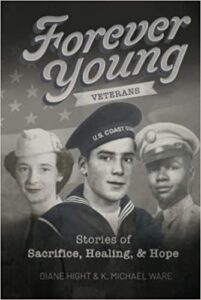
In this season of Thanksgiving, I’d like to offer my special thanks to all U.S. military veterans. The Forever Young Veterans Anthology was released on November 2, 2022.
I’ll be traveling on the day this post appears, but I’ll check in when I can. An early Happy Thanksgiving to you all.
TKZers: What are you thankful for? Do you owe a special thank you to any person or group?

Text-to-speech (TTS)– also called “Read aloud” technology–is a popular assistive technology in which a computer or computerized device reads the words on the screen aloud to the user.
TTS is used for many things, and the number of applications is increasing. If you like rabbit holes, there’s a lot here to investigate. Just Google it and you’ll be amazed. But today let’s talk about TTS in the context of editing. PCs, Macs, Chromebooks, Word, Scrivener, Google docs, and LibreOffice all have it built into their programs. Open Office and WordPerfect do not. Code can be inserted into WordPerfect for TTS, but it sounds complicated.
There are long lists of programs which are supposed to be better than the TTS built into the programs above. Many of them advertise as “free,” but most are only free for a trial period.
We’ve been told to read our manuscript out loud as part of our editing, or have someone else read it to us. I’ve found that even when I read out loud, I still skip over incorrect or missing words and letters. And good luck finding someone else with enough time and patience to read your manuscript to you.
Debbie posted a wonderful article on editing two years ago – https://killzoneblog.com/2020/09/help-i-have-flies-in-my-files.html – including using TTS, but, today, let’s focus on TTS in our editing routine.
Please share your knowledge: