By Debbie Burke
From 1965 to 1985, the Kalispell Weekly News was great regional paper in northwest Montana. It was owned and operated by George Ostrom, a colorful character who’d been a smokejumper, mountain climber, journalist, author, radio personality, and legendary raconteur. His stories and op-eds were always entertaining and full of folksy, rustic humor.
The masthead of his newspaper read:
George Ostrom, Editor/Janitor.
That masthead always made me smile because it perfectly sums up the life of a small business owner. The title “owner” may sound impressive but that’s also the poor schlub who gets called in the middle of the night when the plumbing stops up.
Indie authors are small business owners and monarchs over their writing realm. My kingdom consists of a messy dining room table, littered with sticky notes, piled with draft manuscripts, cluttered with invoices, ISBN records, etc. My throne is a secretary chair on casters with a donut cushion. The royal duties are a to-do list that grows longer every day. As fast as I cross off one task, five more are added, each requiring a different skillset.
Today is launch day for Deep Fake Double Down, # 8 in my Tawny Lindholm Thriller series. By the eighth book, the publication process should be polished, refined, and trouble-free, right?
Wrong, dead wrong.
Each new book presents its own set of unforeseen and unforeseeable problems.
Deep Fake Double Down had its fair share of (mis)adventures.
Here’s a synopsis: A corrupt prison warden covers up the murder of an inmate by creating deep fake “evidence” against an innocent female corrections officer. The videos go viral on social media and soon every cop in Montana is gunning for her.
Initial drafts went well with encouraging comments from critique groups.
Target release date was January, 2023. Notice the past tense.
The story was on a roll, about 75% done. Then in December, my beloved Windows 7 computer died. Here is the obituary.
Now I had to learn a new Mac computer with unfamiliar commands. At the same time, the all-important third-act climax of the story needed to be written. The process forced me to reach deep inside my creative soul…
…to come up with adequate curse words to express my frustration!
The working title “Deep Fake” was dramatic, punchy, and hinted at the story conflict. My initial research found only a few books using “Deep Fake” in the title. All were several years old, and one was categorized as “humorous erotica.” Whatever that is, it wasn’t a comparable for my story.
My talented cover artist Brian Hoffman designed an excellent cover here: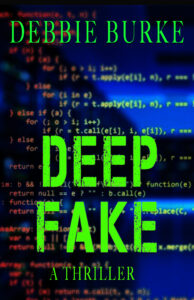
I checked off those tasks on the to-do list…or so I thought.
Now to research. Artificial intelligence and deep fakes are complex and rapidly changing. The more research I did, the more I knew I was over my head. I had to find experts to guide me. The story needed enough detail to give readers a taste of technology but without slowing down the momentum of a fast-paced thriller.
With seven previous books, I’d been fortunate to find experts easily. From drones to elder fraud watchdogs to fire lookout towers, specialists were willing and generous about sharing their knowledge.
Not this time.
I reached out to authors, engineers, and software designers whose articles I’d studied. I explained I was writing a thriller about deep fakes and asked if they’d review passages for accuracy and authenticity.
Two initially agreed. A month later, the first one ghosted me. Two months later, the other one, from a major university, unexpectedly had to clear it with the “compliance department.” She wrote back that the compliance department told her manuscript review was not permissible because they were an “FFRD center.”
What’s FFRD? I had to look it up.
Turns out it’s “federally funded research and development.” Not sure what that has to do with a fictional story but no means no. Scratch that source.
Contacted more experts in the field. No responses. Clock ticking.
Back to the title. If my book had launched in January as originally planned, the title Deep Fake would have been fine. But…
…in March, bestseller Ward Larsen released his new political thriller entitled…Deep Fake. With deep fakes prominent in the news, obviously I wasn’t the only writer eager to tackle the subject. Ward beat me to the punch and I’m glad he’s doing well with his book.
 However, now my book needed a new title. I enlisted help from a focus group of trusted writing colleagues. They came up with a slew of good alternatives. Brian created a new cover with the new title, Deep Fake Double Down.
A month before release, I put the book up for pre-order, certain I could finish the remaining items on the to-do list before the deadline to upload the final manuscript.
Some parts of the process fell into perfect alignment. Steve Hooley came up with a terrific marketing idea. Recently he wrote about side hustles for writers, including his own hand-crafted legacy wood pens.
The McGuffin in my story is a secret mine of rare Montana Yogo sapphires, a treasure that’s worth killing for.
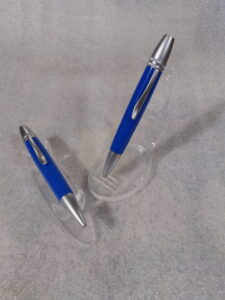
Deep Fake Sapphire Pen by Steve Hooley
Steve kindly offered to create a custom design as a marketing premium: the “Deep Fake Sapphire pen.” What a thrill when these arrived in the mail! For a chance to win a beautiful pen and a signed paperback, please visit my website.
Other marketing opportunities arose, including several speaking invitations, a magazine interview, and a radio chat with TKZ’s own John Gilstrap and his cohorts, retired Admiral Bill Stubblefield and Rob Mario. Many thanks, John!
Meanwhile, the clock was ticking but I still hadn’t connected with any deep fake/AI experts.
Finally, an astrophysicist friend connected me with TED fellow Peter Haas, but he wasn’t available to talk until a week before the deadline. Gulp.
Peter’s input was worth the wait. He corrected info that was outdated because of new developments. He taught me cool new jargon like NerF (neural radiance field, not to be confused with those squishy game balls), Tor (a web browser that makes you anonymous), and exit node (a relay to anonymously send and receive traffic on the net).
The explosion of deep fakes has understandably led to increasing distrust of news sources. Peter talked about two groups with the mission to protect provenance of information. Content Authenticity Initiative and Project Origin are supported by Adobe and Microsoft/EDC/New York Times respectively, using digital watermarks to verify that videos, photos, and other digital data do indeed come from the sources they are purported to be from.
Don’t worry—the above won’t be on the test!
Needless to say, Peter’s input required frantic rewrites of several scenes.
At the dizzying rate that AI is changing, it’s impossible to stay current. The best a writer can do is choose a moment in time and set the story at that moment.
Remaining tasks on the to-do list:
- Read the entire book out loud.
- Final, final, final proofread (this occurs after copyeditor proofreads).
- Format the ebook. Here are screen shots of two formatting styles offered by Draft2Digital and Kindle Create.
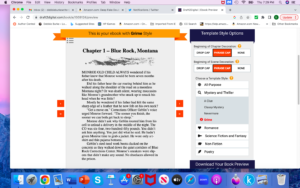
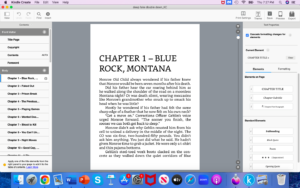
Side note: you can format with D2D then upload the epub or pdf to Kindle. Although I prefer the appearance of D2D templates (this example is called “Grime”), the Amazon process goes smoother if you use Create to format the Kindle version.
4 Final, final, final read-through of the preview.
5. Upload to Kindle Direct Publishing (KDP).
6. Upload to other markets through D2D (using the Grime template).
Another side note: In a perfect world, the ebook and paperback would go on sale the same day. Rather than delay release until the paperback was ready, I decided it was more important to meet the April 25 launch date for the ebook.
- Format the paperback (formatting for ebook and print book are different).
- Upload the paperback to KDP.
- Order a proof copy, which is scheduled to arrive in a few days.
Two days before the deadline, I crossed off the remaining items on the to-do list except for:
10, After reviewing the paperback proof, hit the final “Publish paperback” button.
11. Order a box of author copies.
12. Stock the warehouse (otherwise known as the fireplace hearth in our home).
Yes, I proudly wear the crown of Queen in this Publishing Empire. My masthead reads: Author/editor/researcher/spell-checker/formatter/publisher/marketer/inventory control/warehouse stocker/bookkeeper/janitor.
Excuse me, Her Highness must now go vacuum.
~~~
TKZers: what are your various job titles? Which is your favorite? Which is the one you dread?
~~~
For a chance to win the Deep Fake Sapphire pen and a signed copy of Deep Fake Double Down, please join my mailing list here.
Buy links for Amazon Other online booksellers