About James Scott Bell

International Thriller Writers Award winner, #1 bestselling author of THRILLERS and BOOKS ON WRITING. Subscribe to JSB's NEWSLETTER.

Ten Penalties All Writers Must Avoid

by James Scott Bell
@jamesscottbell

Screen Shot 2016-02-04 at 10.56.26 AM

Forgive my second sports-related post in a row, but come on! It’s Super Bowl Sunday! Across America––and indeed the world––fans will gather around big screens in homes and bars to watch the most exciting spectacle of the viewing year: funny commercials!

Oh yes, and a football game.

This one has drama. On the one side we have the Denver Broncos and their quarterback Peyton Manning. Manning is without question one of the greatest QBs of all time, a lock first-ballot Hall of Famer. But injuries and Father Time have taken their toll. Thus, this will likely be Manning’s final game and his last chance to win one more Super Bowl ring.

On the other side is the new kid, the immensely talented Cam Newton. This guy is huge––6’5”, 260, with a cannon of an arm and legs that can go. He led his Carolina Panthers to an amazing 17-1 season. And now he makes his Super Bowl debut.

I will be with friends noshing sausages, pulled pork, chili, and items from the other essential food groups–the salted nut group, the nacho group, and of course the chocolate-covered anything group.

I hope the game is a good one. I’d love to see it go down to the final minutes. I’ll also be very happy if a kicker does not miss a last-second field goal and thus suffer from nightmares the rest of his life.

And let us hope the game is not marred by a lot of penalties! Hate to see those yellow flags all over the field.

It occurred to me there are some penalty flags that are thrown on writers. So in the interest of helping you write your best, here are some violations you must avoid lest you lose yardage (which, for writers, is measured in pages) and, much more important, readers.

  1. False start

Are you warming up your engines at the beginning of your novel? Do you spend too much time with exposition and backstory? Do you go several pages without a disturbance? Are you giving us “Happy People in Happy Land”? That’s a false start. Penalty: five pages.

  1. Illegal use of the adverbs

Are you using too many adverbs to prop up weak verbs? Worse, are you using adverbs to prop up dialogue? Are you writing things like:

“Get out of here, you louse!” Sheila yelled angrily.

Or

“I’m gonna cut your heart out and feed it to the family dog,” he said threateningly.

If you do, you’ll be penalized, and it’s a big one: fifteen pages.

  1. Passage interference

Also known as the illegal flashback. This is where you stop a narrative in its tracks to give us a long look backward at some scene from the past. Unless there is a dang good reason for this, you will get a yellow flag and docked ten pages.

  1. Encroachment

Also known as author intrusion, this is when you try to sneak in some exposition that does not sound natural to the voice of the character (this penalty is explained more fully in the book VOICE: The Secret Power of Great Writing).

The skilled referee usually finds this in dialogue. The author wants to slip information to the reader through the characters’ words, but they are words the character would never use. Such as:

“Listen, Martha, you’re my lovely wife of twenty-eight years, and I wouldn’t be the head of surgery at Johns Hopkins without you. Especially after suffering that head injury in college when I foolishly went out for the rugby team. But dammit, you can’t dwell on your past as a stripper in a Nevada roadhouse when you were known as Cling Peaches. Please try to relax, like your sister Mary, who is two years younger than you, so we can go enjoy dinner in our hometown of Denver, Colorado.”

Encroachment is an automatic five pages, and loss of down.

  1. Delay of plot

Have you pushed your protagonist through the Doorway of No Return by the 20% mark of your novel? No? Then here’s a hard truth: it’s starting to drag. It doesn’t matter how quirky your characters. They have overstayed their welcome if they are not, by this time, into the struggle of Act II. Penalty: ten pages.

  1. Ineligible character downfield

Do you introduce a major character after the midpoint? Near the end, do you have a minor character show up out of nowhere to solve a plot problem? If you do, you need to go back to the first half and plant these characters. Five pages.

  1. Roughing the villain

League rules are protecting the antagonist more than ever. What do I mean by that? Simply this: if you have an antagonist who is evil, you must give him his due. You can’t just make him pure evil or insane. Boring! Every villain feels justified, and you the author must “make his case” in the book. Far from excusing his evil, this deepens the emotional currents in the reader and, ironically, makes the evil all the more scary. Fifteen page penalty for this one, plus the league may order you go to some rehab, like right here.

  1. Intentional sounding

Have you fallen in love with your sentences? There’s a reason the axiom “kill your darlings” exists. I should explain that this doesn’t mean cut every sentence you like. You’re allowed to delight in your own good writing. But you have to make sure it works for your story, and is true to character and context. Ten pages if, in the judgment of the officials, your pretty prose is more showing off than storytelling.

  1. Illegal motion

Does your story feel unfocused during that long struggle through Act II? Are there scenes that meander? Have you lost narrative vitality? While this penalty is only five pages, enough of these violations will keep you backed up on your own goal line. One place to look for help is the “mirror moment.” This tells you what your novel is really all about so you can write scenes with organic unity and powerful forward drive.

  1. Unauthorlike conduct

Do you head out to social media without a plan and a brand? Do you fly off the handle when you tweet? Do you slip into unethical sockpuppetry in order to slam your perceived competition? This penalty is severe: you might get thrown out of the game. Worse, the league office may suspend you indefinitely.

A good football team knows how to move the ball. A great football team knows how to correct weaknesses. A championship football team does all that, and avoids the penalties that kill scoring drives.

May you write like a champion.

And enjoy the game! I know I will, even though I am completely impartial.

***(COUGH)GoPeyton(COUGH)***

Has your writing been penalty free lately?
The Ten Events of the Highly Successful Writer

by James Scott Bell
@jamesscottbell

001aa018ff9c0812dcca0c

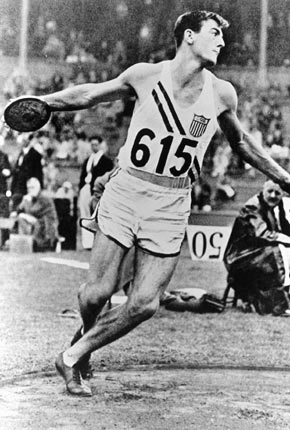
Bob Mathias

One of the greatest athletes America ever produced was Bob Mathias. Listen to this: in 1948 Mathias was a high school student in Tulare, California. His track coach mentioned he ought to consider the decathlon. This is, of course, ten events, several of which Mathias had never attempted. They trained for three weeks. Three. Mathias won the local AAU decathlon. A short time later, he won the nationals and Olympic trials.

Mathias went to the London games and won the gold medal. He was seventeen-years-old, the youngest person ever to win a gold in track and field.

In 1952 he went to the Olympics in Helsinki, and did what no one had ever done before—he won the decathlon again. To top it all off, he starred as himself in the movie The Bob Mathias Story, which I watched several times as a kid.

I thought of Mathias a few days ago when I read this phrase once again: “A writing career is not a sprint, it’s a marathon.” It suddenly occurred to me that this is inadequate. Why? Because it doesn’t matter if you run 26 miles if it’s in the wrong direction!

Instead, I think a successful writing career is more like a decathlon. There are at least ten “events” you must master in order to compete and win a medal. Here they are:

  1. Dedication

Are you willing to put in the work? Pay the price? Stick with it and not give up? Will you stay with this even though it’s going to take you years to get there?

Olympic champions start young and spend countless hours practicing, for years, for that one shot at gold. Similarly, it takes a long time and a lot of work to gain a writing foothold these days.

While there are no hard rules on this, suppose I told you that it’s going to take you five years and five quality books to start making solid income as a writer? Will you still go for it?

I hope so.

  1. Production

Decathletes have to spend a set amount of time every week in training. A writer has to spend a set amount of time every week writing.

You don’t produce books by not writing them. (Maybe I should go into the Zen koan business. Or not.)

Seriously, when I hear people say, “I just can’t write to a quota. I have to get into the mood,” I hear the sound of a cash register not ringing. (See? Zen master!)

  1. Quality

In sports, practice does not make perfect. Perfect practice makes perfect. The precision of your drills is what makes the difference when it comes time for actual competition.

So the words you produce must be quality words. By quality I mean this: the best you can do while keeping your audience in mind.

Who is your audience? Readers. If you’re writing in a genre, you know those readers have certain expectations. You must serve those expectations at the same time you are exceeding them. How? By being an original, surprising them, elevating your book beyond the merely competent.

How do you get to that point? See #4.

  1. Study

A decathlete watches film of great athletes competing in certain events. Slow motion of champion pole vaulters, shot putters, discus and javelin throwers. You hone your skills partly by studying what others do well.

I can’t understand writers wanting to get ahead in the fiction game not making study of the craft a regular habit. I simply do not get it. Do you want some fresh-out-of-med-school doctor who doesn’t read the medical journals or observe experienced surgeons taking out your spleen?

At least when a writer makes mistakes nobody dies. But the interest of a reader does. And that can mean death to a career.

  1. Creativity

Did you know that every decathlete before 1968 used either the scissor kick or Western roll for the high jump? That’s because those two techniques were the only ones the dedicated high jumpers ever employed.

Then along came a guy named Dick Fosbury who, in high school, wasn’t able to win in the

Dick Fosbury

Dick Fosbury

high jump using old-school technique. Over the course of time he experimented with methods until he started going over the bar backwards, something no one had ever contemplated before. He began to set records with “The Fosbury Flop” and he won the gold medal at the ’68 Olympics in Mexico City.

All high jumpers and decathletes now use the Flop.

Writer, you need to nurture your creativity, try new things, play and explore. You still need to jump over the bar. How you do that is your individual style.

  1. Goals

Great athletes give themselves benchmarks to shoot for, and put in place plans to reach them. These goals are measurable. In other words, they can be assessed according to what was done or not done, what was accomplished or not accomplished. Then there is a time for reassessment and recommitment.

Writers need to set goals, too. Not just word count, but the development of future projects, craft study objectives, social media presence, even personal health (which affects production). Goal setting is one of the essential skills of success.

I prepared a short monograph on this topic that can be found HERE.

  1. Perseverance

Every champion athlete has had setbacks, losses, injuries. There are many, many times when quitting seems like an option. Those are the very times the great ones push on. Like Rocky Bleier, the Pittsburgh Steelers running back who came home from service in Vietnam with a right leg shredded by shrapnel. Coaches and doctors told him to give up football. He refused, and worked harder than everyone else. For two long years he struggled, and made the team again. Two years after that he was a starter. Two years after that he gained 1,000 yards for the season.

The writing life has plenty of frustration and disappointment. A rejection can feel like a shredding of your soul. That’s when you let it hurt for half an hour. Pound a pillow. Eat some ice cream. Cry if you must. But then take a deep breath and go to your keyboard and write something. Anything. You cannot be defeated if you keep pounding the keys.

  1. Courage 

In addition to perseverance, champions have times during an event where they must reach down deep and tap a reservoir of courage. That’s certainly true in the decathlon, the most demanding two days in all of sports. When Rafer Johnson competed for the United States in the Rome Olympics in 1960, he was coming off the effects of an auto accident the year before. His big rival (and UCLA teammate) was C. K. Yang, competing for Taiwan. It all came down to the final event, the grueling 1,500 meter run. Johnson needed to stay within ten seconds of Yang in order to win. But Yang was almost twenty seconds better at this event than Johnson. Johnson reached inside and willed himself to dog Yang’s heels. He finished only 1.2 seconds behind Yang, and took home the gold.

There are times in your writing when you have to dig deep, keep going, try harder. It may just mean hanging on for one last lap. The great thing is, even if things don’t turn out quite the way you want, you will be a stronger writer because of it. No effort is wasted.

  1. Balance

Athletes have to give their bodies time to recover from an intense workout. There is a delicate balance between exertion and rest. And when it’s a young athlete, they have to figure in school work and a bit of a social life. The number of athletes who were driven too hard by an overzealous parent, and ended up out of athletics altogether, are legion. See, for example, Todd Marinovich.

There is a time to rest as a writer. Personally, I write six days a week. I take Sundays off. It’s hard. I’m like a horse that wants and expects to run on the track. But the day off gives my mind time to rest and recharge. I come to Monday raring to go.

And don’t forget the people in your life. Give them the time they deserve, even though you may have to explain that far off look you get sometimes. You know, the one where you’re thinking what a great scene this would make, or how that bartender over there would be a terrific minor character…

  1. Joy

A champion athlete has to take joy in his event. Eric Liddell, the Scottish sprinter who won a gold medal in the 440 at the1924 games, was depicted in the movie Chariots of Fire. As the son of a missionary, he was expected to go to the mission field, leaving athletics behind. After his sister reprimands him, Liddel replies, “I believe God made me for a purpose, but He also made me fast. And when I run, I feel His pleasure.”

“In the great story-tellers, there is a sort of self-enjoyment in the exercise of the sense of narrative; and this, by sheer contagion, communicates enjoyment to the reader. Perhaps it may be called (by analogy with the familiar phrase, “the joy of living”) the joy of telling tales. The joy of telling tales which shines through Treasure Island is perhaps the main reason for the continued popularity of the story. The author is having such a good time in telling his tale that he gives us necessarily a good time in reading it.”Clayton Meeker Hamilton, A Manual of the Art of Fiction (1919)

Just as the decathlon is the toughest of athletic contests, so the writing life is one of the toughest ways to make a buck. Yet isn’t that what makes it worthwhile? When you score a win, and you will––you’ll finish that novel, you’ll start to see some sales, you’ll get an email from a delighted reader––you’ll feel that joy of accomplishment that the ne’er do wells never do.

The easy road is for chumps.

Keep writing.

Self Publishing as a Lemonade Stand

by James Scott Bell
@jamesscottbell

Lemonade

I always used to stop at kids’ lemonade stands. Not anymore, because you can’t find them. You see, our local government here in Los Angeles, which is so business-friendly scores of enterprises are moving to Texas, decided to regulate the tots and their drinks some years ago. It’s happening all over. Not even Jerry Seinfeld could talk his way out of a lemonade shutdown.

Idiotic and sad, because the lemonade stand was often a kid’s first lesson in free enterprise and what it takes to run a successful business. That’s why I always stopped. I love encouraging ambition and the work ethic in kids.

Self-Publishing is a bit like running a lemonade stand, only without government interference. There’s a little something called the First Amendment, you see. With that in mind, what are some of the lessons we can glean from those little businesses we used to see in the summer by the side of the road?

  1. You’ve got to have a good recipe

The quality of the lemonade is the most important thing. Why? Because it leads to more business. I remember stopping at a stand and tasting dull, watery lemonade. And at another where there was way too much sugar in it. But when I got that glass of fresh lemonade that was just right, I went home and told my wife to go get some, too. A quality product gets talked about.

Writer, the most important thing you can do is write books people delight in and want to tell others about. Don’t serve up an inferior brew. You want word-of-mouth from your customers, not just a polite nod as they go looking for another stand.

  1. Get your mom to taste it

Before going out on the street, you need an expert to check your lemonade. Mom knows best. She can suggest changes and show you how to make a better batch.

Just like a good book editor, critique group, or beta readers. Indie writers need solid outside opinions of their work before they put a book up for sale. The ones who ignore this part of the process soon realize no more cars are stopping.

  1. Create curb appeal

The best lemonade stands had a nice look about them. They weren’t just a table and chairs. The owner-operators took time to create a colorful sign prominently featuring LEMONADE on it, with the price. It was big enough to read as you drove by, and wasn’t just a quick scrawl with a crayon on cardboard.

Self-publishing writers need eye-catching covers and compelling book descriptions. We all know that. Great covers and copy will get you to the next step in the selling process, a browse of the sample. So don’t shirk on the design element.

For covers, hire a pro. Expect to pay between $250 – $500. You can pay less, but caveat emptor. You can pay more, but I’m not sure you get more bang for your buck above half a grand.

You must also learn how to write compelling book descriptions. A solid formula can be found in this post.  Study book descriptions in your genre by browsing Amazon.

  1. Spread the word

I always liked seeing a little creativity in a lemonade stand’s “publicity.” Like when a kid would call out to the cars driving by, but not just by shouting, “Lemonade!” It was more like, “Cool off! It’s refreshing! Give it a try!”

When you start taking to social media, writer, don’t just shout, “Book! Buy my book!” Instead, create desire by telling people how it refreshes. Be fun about it. Don’t oversell.

I remember my own lemonade stand efforts. You know who did the most buying? The neighbors who already knew me.

In the same way, build up your social media presence by being a good neighbor. That should be your main focus, always. Then when you come out with a new book, you can announce it to those with whom you already have a trustworthy relationship.

  1. Thank your customers

It was always fun for me to pull up to the curb and see little faces light up. But much more do I remember one stand run by a couple of girls who jumped up and down and shouted, “Thank you! Thank you!” as I drove away. Their sincere gratitude was infectious.

Nurture your readers. As you begin gathering an email list, don’t pepper them with buy messages. Thank them every now and then. Put a “Thank you for reading” note at the back of your books, with a link to your sign-up page and a request for a review. Keep it simple. And sincere.

If you need some lessons in running a lemonade stand-style publishing business, I can offer you a couple of resources:

Self-Publishing Attack

How to Make a Living as a Writer

You will have challenges, of course. That’s another great lesson for kids, one they need to get early––things don’t always go swimmingly, even with your best efforts. That’s why you don’t give up. You look at the setback, learn from it, and try again.

Remember, if life gives you lemons, gather them up and throw them at people you don’t like either make lemonade or learn how to juggle.

How about you? Did you ever set up a lemonade stand when you were a kid?

If a child came up to you and said, “Gee, I’d like to be a self-published writer someday!” what would you tell them?

Who Are You Trying To Delight?

by James Scott Bell
@jamesscottbell

When my daughter turned eight my wife and I decided to throw her a major birthday party.

This was back in that window of time when laserdiscs were all the rage. Man, I loved those laserdiscs! The Criterion Collection, the great covers. Oh, how relentless is technological change. Now I stream TCM on my phone.

In any event, there was a video/laserdisc store near our home which had a small theater in the back. You could rent that place out for parties and the like. so that’s what we did. We invited five or six of my daughter’s best friends, ordered pizza and candy and popcorn and a cake. Our daughter was excited about the party of the year.

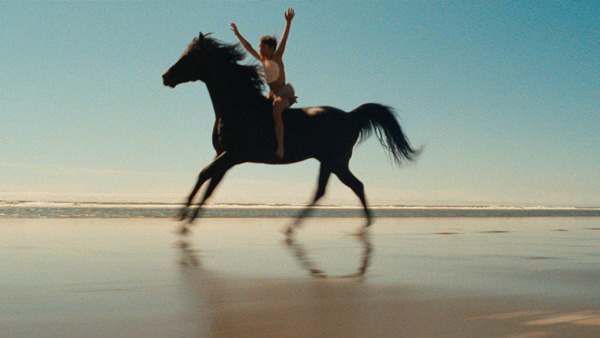
But what movie to show? My wife and I discussed this, and I practically insisted we show the Carroll Ballard film, The Black Stallion. I mean, come on. It had horses! Little girls love horses!

The party began.

Before the main feature, the proprietor of the store played a music video hawking the film The Addams Family. It featured MC Hammer before he was simply Hammer, and it was a hit. The girls stood up and danced around and laughed.

I sat back with a satisfied smile. Champion Dad, that was me!

And then came The Black Stallion. It’s truly one of my favorite movies of that era. Magnificently shot, wonderfully acted.

Dem-3 Photo. Helene Jeanbrau © 1996 cine-tamaris.tifBut also lyrically deliberate (translation: leisurely. Slang: slow). And, as I soon found out, not the right movie for sugar-buzzed eight-year-old girls who had just been bouncing up and down to the moves and music of MC Hammer.

It was only about twenty minutes into the film when the first stirrings of boredom began to vibrate. Girls started chatting with each other. Some went to the bathroom and took their sweet time coming back. My daughter’s eyes pleaded with me to do something.

Eventually I stopped the film and we got the owner to put on some cartoons. Then we moved on to cake and presents. Party saved!

But what had gone wrong? Something very simple. I had chosen a film that delighted me, that I thought everybody should like, especially a group of girls. But it was not a movie that delighted them. It was the wrong movie for the age group and occasion, which was a raucous get-together to celebrate a birthday and make some noise. They wanted to have fun and laugh.

In short, I failed to appreciate the needs of the audience.

Which is a mistake we dare not commit as writers. May I suggest the following principles be put in your mental lock box?

  1. Your value as a professional writer is directly proportional to your value to readers.

If you want to write what you want to write and don’t particularly care who reads you, that’s fine. You can be the local Starbucks laptop jockey. But if you are in this to be a pro, you must give thought to your readers. What are they looking for? Well …

  1. The overwhelming majority of readers want to be lost in a story in a dreamlike way.

Which means you have to know how to weave those dreams. That is why we talk so much about the craft here at TKZ. To do justice to readers means you take the time to figure out what they love and how to deliver it. You realize that all of us are wired to receive a story that has structure, involves characters we bond with, and creates unconscious delight in how it is told. That doesn’t happen by accident.

  1. You can challenge your readers, but don’t expect them to embrace your challenge.

It’s fine to write material that requires readers to expend mental effort. Art can be many things, and challenging is one of them. Just know that you can’t force readers to recognize your genius. And have the courage to ask yourself if you’ve crossed the border separating true artistic enterprise from self-indulgence.

  1. Don’t fall in love with your sentences

Beautiful words count for very little if there’s no story, no characters worth caring about, no real plot. There’s an old adage for writers that goes, “Kill your darlings.” Stephen King likes to quote it, and it’s attributed to a number of writers, like Faulkner and Oscar Wilde. But apparently it comes from a lecture on writing style delivered by Sir Arthur Quiller-Couch back in 1914. He was warning against “extraneous ornament” when he said:

If you here require a practical rule of me, I will present you with this: ‘Whenever you feel an impulse to perpetrate a piece of exceptionally fine writing, obey it—whole-heartedly—and delete it before sending your manuscript to press. Murder your darlings.

You may, if you wish, read the full lecture series here.

So there it is, friends. Throw a party for your readers and don’t force them to sift through what you think they ought to like. Delight them instead.

Reader Friday: Your Favorite Commercial

Some of the best writing and acting can be found in commercials, going back to when the legendary Stan Freberg brought comedy to advertising. My current favorite is the Geico commercial with Peter Pan. What an inventive scenario to go with their “That’s what you do” campaign. What’s your favorite commercial?

How Many Writing Errors Can You Spot?

board-361516_1280

Welcome to my first TKZ post of 2016! What better way to start off the year than with a pop quiz?

Can I hear a Yea?

Oh, I see. You feared and loathed them in school, eh? Well relax, this one is self-graded. Just remember: no gum chewing!

Below is a bit of writing I made up based on errors I see all the time in manuscripts and published (even traditionally!) books. Heck, I’ve been guilty at one time or another, especially in my early years. Some of these are technically not “errors,” as they may be grammatically correct. But they’re what I call “little writing speed bumps.” They disturb the reader’s fictive dream, usually in a subconscious way. The more bumps, the less enjoyable the reading experience.

Learn to spot them in your own writing, however, and you can smooth out the road.

So here we go. Read the following and jot down all the speed bumps you can find. Don’t look ahead to the answer sheet yet. You’re on the honor system!

John Harper gazed out the window at his Christmas present.

He gazed at a beautiful boat.

“How do you like it?” his wife said. Carol was dressed in a red sweater.

Carol luxuriated in the softness of the sweater. Her smile was soft and warm.

John turned from the window and embraced his wife.

“I can see you do,” Carol laughed.

Kissing Carol full on the mouth, John whispered, “I like you even more.”

Carol Harper was forty-two. A graduate of Bryn Mawr, she had studied folklore and mythology, before finally deciding to major in business. Her first job out of college was with an advertising firm in New York.

“I like you too,” Carol said lovingly.

“I like you so much,” John repeated, “that I want to take you out to a nice dinner tonight.”

“A nice dinner, John?” Carol expostulated. “Tonight?”

“Yes,” John winked. “Tonight.”

How’d you do, class? Now, take this quiz home to your parents and return it with a note saying they’ve seen it …

… or not. Below is the excerpt with my answers provided. Some of them have footnotes that you can read below the excerpt. Have a look, then open up a discussion in the comments.

John Harper gazed out the window at his Christmas present.

He gazed [ECHO. SEE NOTE 1, BELOW] at a beautiful boat.

“How do you like it?” his wife said. Carol was dressed in a red sweater. [POV PROBLEM. WE’RE IN JOHN’S HEAD. HOW CAN HE SEE HIS WIFE’S OUTFIT IF HE’S LOOKING OUT THE WINDOW?]

Carol luxuriated [POV SWITCH TO CAROL] in the softness of the sweater. Her smile was soft [ECHO] and warm. [POV PROBLEM. WHO SEES THIS? NOT HER. SHE’S NOT LOOKING IN A MIRROR, AND NOT JOHN, WHO IS LOOKING OUT THE WINDOW]

John turned from the window and embraced his wife.

“I can see you do,” [HOW? HE’S EMBRACING HER] Carol laughed [YOU DON’T LAUGH DIALOGUE. SEE NOTE 2]

Kissing Carol full on the mouth, John whispered [HOW CAN JOHN WHISPER ANYTHING IF HE’S FULL ON THE MOUTH? SEE NOTE 3], “I like you even more.”

Carol Harper was forty-two. [POV SWITCH. THIS IS AN OMNISCIENT VIEW]. A graduate of Bryn Mawr, she had studied folklore and mythology, {MISPLACED COMMA] before finally deciding to major in business. Her first job out of college was with an advertising firm in New York. [ALL THIS IS INFO DUMP AND EXPOSITION. IT CAN WAIT!]

“I like you too,” Carol said lovingly. [ADVERB IS unnecessary. SEE NOTE 4]

“I like you so much [ECHO IN DIALOGUE],” John repeated [REDUNDANT], “that I want to take you out to a nice dinner tonight.”

“A nice dinner, John?” [UNNECESSARY USE OF NAME. SEE NOTE 5] Carol expostulated [I HOPE I DON’T HAVE TO EXPLAIN THIS. BUT SEE NOTE 2 AGAIN]. “Tonight?”

“Yes, [UNNECCESARY FILLER. SEE NOTE 6]” John winked [DIALOGUE DOESN’T WINK!]. “Tonight.” [ECHO]

[FINAL AND MOST IMPORTANT COMMENT: NO CONFLICT OR TENSION ANYWHERE! SEE NOTE 7]

NOTES:

  1. An echo is when a descriptive word (an adjective or verb) is used more than once in close proximity. Here, gazed is used in back-to-back sentences. It’s not “wrong” to do this, but it’s a bump in the reader’s mind.
  1. For attributions in dialogue, use said as your default. Its job is to clue the reader in on who is speaking and nothing more. It’s virtually invisible. If you are tempted to use another word to indicate a manner of speaking, look to the context and seek to make things clear. For example: Sgt. Trask clenched his teeth. “Fall in!” he growled. We know he growled from the context and the exclamation point. We know he is speaking, too. So: Sgt. Trask clenched his teeth. “Fall in!” is enough.
  1. This kind of sentence construction is called a participle phrase. It begins with a word ending in –ing. What you have to watch out for are two actions that defy the laws of physics. In other words, can the two actions take place at the same time? Full-on kissing and whispering cannot (unless you speak fluent French. Ahem). But these two actions can coexist: Getting out of his car, John heard a woman scream. While some writing instructors hold that you should never use a participle phrase. I think they’re just fine if they a) pass the coexistence test; and b) are used sparingly.
  1. Adverbs propping up dialogue attributions are almost always unnecessary. If it’s not clear how something is being said from the dialogue itself, or the action surrounding it, see if you can make it clear. The occasional adverb is fine, but only if you truly need it.
  1. Avoid having characters tell each other things they both already know. The other character’s name is one of these. Unless, of course, the character is trying to be adamant, as in, “John, how many times do I have to tell you not to kidnap the neighbors!” But when you try to slip in exposition in dialogue, it can sound truly phony if it’s information both characters already possess: “Oh hello Arthur, my family doctor from Baltimore. Please come in.”
  1. One of the best ways to make dialogue crisp is to cut needless filler words. Look for these at the start of dialogue, especially Yes, No, and Well. The sentence in the piece would have been much better this way: John winked. “Tonight.” (Why is tonight not an echo? Because John is using it as an echo. It’s intentional.)
  1. The scene is dullsville because there’s no conflict. There should be some tension, any kind, even if it’s only an emotional knot inside one of the characters. Anything that takes the scene south of normal.

John Harper gazed out the window at his Christmas present.

“How do you like it?” his wife said.

John turned from the window and faced Carol.

“I can see you do,” Carol said.

“What’s wrong with your eyesight?” John said.

So what about you? Did you see anything else? How would you improve the scene?

***And say, kids, for a chance to win a FREE book by yours truly, and be the first to know when the new ones come out, take a moment to check out this page.

The Christmas Santa Didn’t Bring It

Five WeeksOne Christmas I decided to give Santa a doozy.

After all, little Natalie Wood did that in Miracle on 34th Street. Remember? She asks Kris Kringle for a house. He thinks she means a doll’s house, but no. She wants a real one! With a swing in the back yard, too.

Hoo boy. (SPOILER ALERT): So at the end of the movie she’s riding with her mother and soon-to-be stepdad, when she screams “Stop!” She jumps out of the car and runs up to this house, unoccupied and for sale. With a swing in the back! The old man really was Santa Claus!

But of course, the two adults have their doubts … until they see Kris Kringle’s cane leaning against the fireplace.

So, my kid-self thought, Santa really can deliver the goods if you ask big!

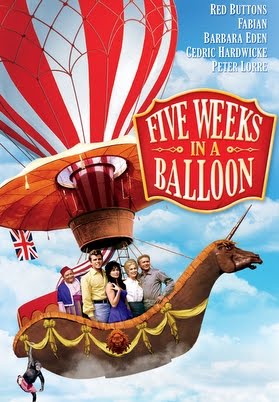
The other part of this story is I’d just seen the movie Five Weeks in a Balloon, based on the Jules Verne adventure novel. It starred Red Buttons, Barbara Eden, and Fabian (before Fabio, there was Fabian, only Fabian could sing). I loved adventure movies as a kid, and this one had it all. Ballooning over mountains and cities and wild game in Africa. The balloon had a cool gondola, too, shaped like a ship with a unicorn figurehead.

How boss it would be if I had one of those! I could float over my school, Serrania Avenue Elementary, and land on the playground. All the kids would run up and want a ride. And Susan––the girl I was in love with but who thought me a doofus––would finally realize I was the boy for her. We’d fly off toward Disneyland. She’d give me a kiss as we sailed over the Matterhorn.

Filled with hope, I sat down and wrote a letter to Santa. I can see it still. Because I drew a picture of the balloon I wanted, unicorn gondola and all. I think I told him that we had a cement badminton court in the back yard that would be the perfect spot for it.

Thank you and Merry Christmas, Jimmy Bell.

I addressed it: Santa Claus, North Pole. I mailed it myself, in plenty of time to reach him before the holiday.

Back then, on Christmas Eve, my two older brothers and I would sleep in the same room on the far side of the house. In the morning we’d stay there in our PJs until Mom or Dad gave the go ahead, and then we’d charge into the living room. There’d be a fire in the fireplace, the tree would be all lit up, and under and around it, the presents!

But on that particular Christmas morning, I slid out of bed and went to our back window. Surely the hot-air balloon would be there, perhaps with a ribbon attached to the unicorn’s horn.

All I saw was the badminton court––barren, cold, with a hint of mockery to it.

Dejected, I sat on the edge of my bed, wondering if I’d been too naughty that year. Had I exceeded my spitball allowance? Pulled a pigtail? Surreptitiously removed a box of Good & Plenty from Lonny Ezer’s lunchbox?

Nay! Nothing that would deny me my dream gift!

Eventually we boys got the signal, and into the living room we ran. Like always, a fire was roaring, my dad was smiling, my mom sipped her coffee on the sofa.

And there, over by the front door, the coolest blue Schwinn cruiser a boy ever saw. And it was mine!

I don’t remember much more of that Christmas, but I do the aftermath. At some point I told my mom about the detailed drawing I’d sent to Santa Claus, and asked why he did not deliver. She averred that perhaps Santa did not think it safe for a kid my age to have his own hot-air balloon. What if I ran into electric wires, or the wind blew me out to sea?

That was a wrinkle I hadn’t thought of. It made sense. My mom had gotten Santa off the hook.

Well, I loved my bike. It lasted me a good long time, got me to school, to the drugstore (for candy and comic books), to my friends’ houses, and on cool bike trips around my home town. I even remember peddling past Susan’s house once, but alas she made no showing.

That was the last time I ever wrote to Santa. I was a little sad to accept the cold truth about the North Pole’s most famous citizen. But every Christmas since I’ve honored his memory. We had some good times together. Santa gave spice to my young life, and dared me to dream of floating through the sky relishing grand adventures.

I ended up with a Schwinn cruiser, upon which I had adventures of other sorts. And that was fine with me.

So go ahead and dream big, friend. Dream of hot-air balloons. And if perchance you don’t get one, remember to love the bike you have.

Either way, you’ll go places.

Merry Christmas, Happy Holidays, and may you go further in 2016!