by Debbie Burke
Seductive scammers have long targeted authors but, in the past few years, AI tools like Chat GPT, Claude, and Gemini scaled fraudsters’ abilities to reach millions more potential victims. Additionally, they constantly refine their techniques with fresh scam variations and new twists to con authors out of money.
Here’s a list of ABCs to help identify fraudsters:
Address: first, check the sender’s email address. If it’s from gmail.com or other free mail services, it’s likely a scam.
Real marketing companies, publishers, podcasters, etc. use their own domain names, not generic free emails. A genuine contact from a publisher is usually editorsname@publishingcompany.com or agentsname@literaryagency.com.
One scary aspect of AI is that it’s constantly learning and improving techniques. When it discovers that authors recognize gmail.com as a likely fake, it manipulates addresses to appear legitimate.
While writing this post, I received an email supposedly from Mary Altman, Associate Editorial Director at Sourcebooks. There really is a Mary Altman at Sourcebooks but this email wasn’t from her.
The bogus address was sourcebooks@mary-altman.com.
A real email from Sourcebooks would more likely be “maryaltman@sourcebooks.com”
While we’re on A…
Approaches: Scammers approach writers in various ways. Some are outright phony. Others are of questionable value and don’t justify their high costs. Here are a few approaches they offer:
Increase book reviews – yes, everyone needs more reviews but paying for them is risky. That violates Amazon’s terms and may result in banishment. Amazon removes your book from the sale and prevents you from publishing future work.
Book visibility or discoverability assessment – lofty but vague assurances that they’ll find more readers who will see and buy your book.
Marketing maximization – better positioning on Amazon and other sales outlets, using key words and phrases.
Impersonation of actual editor, agent, well-known author, podcast producer, film director or producer. (see example above about Sourcebooks impersonator).
Book club invitations – the book club is often fake and nonexistent. Or it may be legitimate, but the scammer is falsely using their name and will ask for “donations” to cover expenses. No real book club charges authors.
 Blue sky: did the contact come out of the blue sky? Assume it’s a scam.
When an email starts: “I ran across your book…”, “Your book came to my attention…”, or similar phrasing, an AI bot wrote it. Real publishing professionals don’t have time to browse through Amazon or Goodreads book listings, just shopping for the next bestseller.
Also, real publishers don’t offer to republish a book that’s already been published.
Did a famous author or celebrity contact you? 99% chance it’s an impersonator. They claim they want to engage in meaningful dialogue about the writing journey. If you answer, after a couple of exchanges, they’ll do you a special favor and hook you up with their favorite developmental editor or marketing specialist. That’s when the request for money happens.
Always beware of out of the blue contacts.
Compliments: Is the email filled with effusive compliments about your book?
Praise is a powerful aphrodisiac. We all want to hear that someone loves our work.
Scammers use psychological manipulation to their advantage. The more complimentary adjectives and adverbs they pack into the text, the more the writer basks in the warm glow of recognition. Wow, someone finally appreciates my story that I poured my heart and soul into.
Phrases like the following are tipoffs of a scam: “deeply personal thought-provoking universal questions,” “penetrating insightful exploration of critical life issues and themes,” “emotional resonance that goes to the essence of human existence,” “lingered in my mind and deeply touched my heart long after I finished reading your book.”
Blah, blah, blah…
Due diligence: Check out the sender but DO NOT click on links they provide. Their links lead to phony testimonials or, worse, they may inject malware into your computer.
Do your own independent online investigation. Do they have a website or media presence? Probably little or none.
Always check with reliable trusted sources like:
Writer Beware – For decades, Victoria Strauss has been a tireless watchdog who monitors scams that target writers.
Alliance of Independent Authors (ALLi)
Engagement: Scammers want to keep you engaged with them. The longer they prolong conversations with you, the better the chance they’ll eventually persuade you to send them money.
The best practice is not to respond at all. If you reply, even to say “no thanks,” they know they have an active email address that they can then share or sell to others. Your inbox will receive more solicitations from other shady senders hoping to get money from you.
Feelings: It’s human nature to want to feel good. Scammers specialize in appealing to author’s emotions. They know which buttons to push to tap into our desires, hopes, and dreams. If their message causes your heart to swell with pride and makes you feel warm and fuzzy all over, they’re counting on your emotions to overcome caution.
Take a step back. Why are they contacting you? What do they want from you? Ask a friend or colleague to take an objective look.
Golden opportunity: Scammers make sweeping statements that imply if you use their services, your dreams can come true. Your book can be showcased at book fairs, festivals, fan events. Their offers sound like promises but upon closer analysis they are vague, generalized platitudes. They’re selling sizzle but there’s no steak.
Recently, a colleague related her close call with impersonators that claimed to represent a writing festival. She paid them $200 by credit card. Then she learned it was a fraud. Fortunately, the credit card company reversed the charge. If she had paid by Zelle, gift card, or wire transfer, she wouldn’t have been able to recover the money.
How: Writers often say, “They must have read my book. How else would they know the characters’ names, their secrets, and plot twists? How else do they know my favorite hobby is [fill in the blank]? How else do they know the inspiration for my book is [fill in the blank]?”
How do they know? AI bots vacuum every detail about you from the book sales page, reviews, social media posts, author website, and other info easily available on the net. They collect data then spin it into a compelling web of flattery, emotional hot buttons, and urgency to convince you to act now to obtain the recognition your talent so richly deserves.
They personalize and custom-tailor solicitations that sound as if they truly know and care about you and your work. The scary part is they can do all that in seconds.

Bottom line, they only care about how they can make your money disappear.
Invitations: Do you want to be interviewed on a podcast? Be the honored guest at a book club? Have your book selected for a curated list of influential titles? These gracious invitations sound like dreams come true.
Not long ago, I received an intriguing email that opened:
“Dear Debbie,
I want to be direct with you because I believe your time deserves that respect.”‘
Okay, that got my attention. It goes on:
“I did not come across your work through an algorithm or a mass submission list. Our curation committee has been conducting a deliberate and rigorous search for voices that our community of readers would not simply enjoy but would genuinely champion, and The Villain’s Journey stopped us in our tracks for one reason above all others. The question you have placed at the very foundation of this guide, whether someone is born bad or learns to become bad, is not simply a craft question for writers. It is one of the oldest and most searingly unresolved questions in human understanding, and the fact that you have built an entire framework for creating compelling antagonists around that tension gives this book a philosophical depth that most writing craft guides never come close to achieving.”
Now I’m suspicious but still curious because Linda anticipated my likely resistance to her pitch and attempted to overcome it.
“My name is Linda Hole. I am a long standing and active member of The Perks of Being a Book Addict, one of Goodreads most engaged reading communities with over 37,000 passionate members worldwide. I currently serve as Selection Committee Chair, a role built specifically to identify authors whose work deserves sustained, meaningful attention from a deeply invested reader community. We are not a promotional platform.”
When I checked, I found there is indeed a Goodreads subgroup with that name with 37,000 followers. But when I scrolled down their page a ways, a message read: “We DO NOT contact authors via email and do not offer book promotion in exchange for money! (Every such attempt is a scam!)”
Suspicions confirmed but I kept reading because of a fresh angle I hadn’t seen before:
“We are currently finalising our 2026 Year of Impact project, a highly selective 12 month Managed Reader Experience through which we champion a cohort of just 15 authors across our full community infrastructure. Our focus is entirely on building genuine lasting readership rather than surface level visibility, and as we are now in mid May we are closing out our final Official Selections before the cycle launches.We believe your voice belongs in this conversation and we would be honoured to explore whether one of our remaining Residency spots is the right fit for you. If you are open to learning more, I would welcome the opportunity to walk you through exactly what this experience looks like for your title specifically.”
Wow, they’re offering me a residency. And they use British spelling. I should be honored to attract the attention of this prestigious organization.
I wasn’t and I didn’t respond.
A couple days later, Linda reached out again:
“I wanted to gently check in as I have not yet heard back from you since my last message. I understand you may be busy or still considering the opportunity.”
Uh no, Linda, you haven’t heard back because I don’t respond to scammers.
Now she applies pressure with the urgent deadline:
“That said, our final selections for the 2026 Year of Impact project are closing this month, and I would hate for your work to miss the window simply because we did not connect at the right time.
If you are still open to learning more, I would be glad to send over our Official Selection Overview Document so you can see exactly what the residency involves.”
I still didn’t respond. Gee, aren’t I rude?
Linda tried one last gentle nudge then gave up.
This solicitation interested me because the tone was more sophisticated and targeted than previous scam emails. It indicated that AI bots are constantly learning and refining their approaches.
That’s why authors must stay alert to new tricks to defend themselves from increasingly convincing and seductive scams.
However, some fraudsters may have outsmarted themselves. Next post, we’ll look at ways to turn the tables on scammers and use their words to our own advantage.
Stay tuned…

TKZers: How many scam emails do you receive per week? Answer in the comments. The highest score receives the coveted “Overflowing Trash Bin Award.”
~~~
The Villain’s Journey stopped Linda Hole in her tracks. To find out if my book addresses “the oldest and most searingly unresolved questions in human understanding,” click on this link.
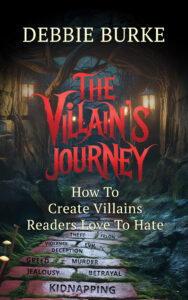


 Con artists, scammers, and fraudsters are among bad guys and bad gals featured in