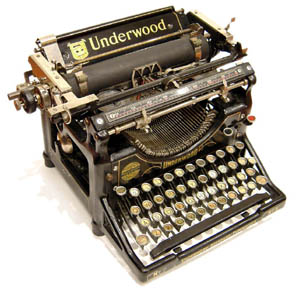
Source: Zen in the Art of Writing by Ray Bradbury
Writing Quote for Monday
Source: Zen in the Art of Writing by Ray Bradbury
James Scott Bell
I’ve been dispensing writing advice on Twitter for a year and a half. You know, 140 characters or less of timeless wisdom on the art and craft of fiction. At least that teaches one to write tight!
By John Ramsey Miller
I’ve been reading Patricia Highsmith’s “Ripley” novels of late. They were billed as Psychological Thrillers when they were being published, although I read very little of the element of suspense in them. They are rife with black humor. Tom Ripley’s kills are leisurely affairs, and he is hardly even worthy of being labeled psychopathic when measured against today’s villains. Tom Ripley is the amoral and sociopathic protagonist in the series. He is morally and ethically challenged. He is a murderer. He never kills for pleasure, but he will commit a murder for financial gain, or due to a threat to his self-image or one that could alter his status. To his credit, he doesn’t kill every threat that crosses his path, just the more serious ones and only when circumstances are convenient. And this reader pulls for him to kill those threats and I want him to get away clean and to prosper. Having Tom as the protagonist was quite a feat for a book published in the 1950s, not so much when the last one published in the early 90s. By then ass-bite protagonists and thrillers were becoming a dime a dozen.
When Patricia was writing Strangers on a Train (which became a successful Hitchcock film) and other novels and short stories her work was considered low art–crime fiction in the United States, but she was fully appreciated in Europe and put in the ranks of Conrad, Kafka, Dostoevsky, and Camus. In her lifetime she was appreciated but she had to live in Europe to be so.
I enjoy the pacing in her books, her humor, the sudden violence, its aftermath. Tom Ripley is not so good as the cops are incompetent and evidence is rarely gathered or put together. The books are a great relaxing read and very entertaining. Sometimes I just want to read something in 2/4 time.
At the Midwest Writers Conference a couple of weeks ago, I critiqued ten manuscripts for conference attendees. As is frequently the case when I do these things, I learn new things about writing.
One of the more intriguing manuscripts I looked at was a historical mystery, set aboard a sailing ship crossing the Atlantic from England to the New World. Through beautiful prose, the author introduced his hero out on the deck, wind in his hair, watching the sunset. Then the author went into pages of data dumping. He told us that the ship was owned by so-and-so, and that it was primarily used for the transport of such-and-such. He told us that the ship had cabins for passengers, and that among the passengers were a carpenter with his wife and four children. The data dump section ended with the author telling us that our hero—we’ll call him Edward—had struck up a friendship with a junior member of the ship’s company—we’ll call him Charles—who taught him some of the basics of navigation.
A problem common to many new writers is the tendency to stop the story to reveal backstory. It’s as if the author has compartmentalized character background from character development, and has trouble bridging the gap. It’s entirely unnecessary. By shifting gears mentally, it’s a simple challenge to use front story to propel backstory. Using the example of the historical mystery, consider this:
Open the chapter with Edward learning navigation from Charles. As Edward learns, so do we. Then, in the middle of the lesson, suppose Charles is angered by the sound of children playing on the deck, getting into things that children have no business getting into. He yells at them and sends them on their way back to their father, the carpenter whose passage is partially paid for by performing carpentry on the ship during the voyage.
In this proposed approach, the story continually moves, is continually engaging, and the reader gets to witness events that otherwise would be dumped on them. It’s a win across the board.
I urge every writer (and frequently remind myself) that every scene needs to be about a character. Whatever happens has to happen to someone, and whatever the reader learns should be learned through the filter of the character’s world view. I’ve always believed that it’s the characters’ job to speak to my readers. If I ever find myself doing it directly, I know it’s time to rewrite.
What do y’all think? What are the other ways to subtly reveal backstory?
This post is going to be brief and entirely gratuitous.
As you might have heard, The Kill Zone is taking next week off to relax, indulge, and (at least in my case) catch up on our reading. I just tore through two fantastic books: PILLARS OF THE EARTH and WORLD WITHOUT END by Ken Follett. After immersing myself in the Middle Ages for the past few days, I’m about to tackle my TBR pile again (ideally, focusing on books with more contemporary settings). I’ll be spending a week at the beach, and would love some recommendations.
So…what have you read recently that you absolutely loved? (Or hated, so that I can take it off the pile). I’ve already tackled the summer releases of all my favorites: Lee Child, Karin Slaughter, Douglas Preston, John Sandford (and yes, I made my way through Larsson’s trilogy). Are there some hidden gems out there that I’ve missed?
Fire away…
By Joe Moore
Yesterday, Kathryn gave us ten things not to do if you want to get published. I’d like to build on her theme with 8 tips on writing a strong query letter.
For writers, the query letter is probably the most important letter you’ll ever compose. Unlike an email to your mom or BFF, you must spend a great deal of time molding and shaping it into the same caliber of perfection as your manuscript. In fact, it’s even more critical than your book. If you sell your book, it will eventually get into the hands of an editor to be further refined and cleaned up. Your query will not.
So here are a few points to keep in mind before you seal the envelope and lick the stamp or press the send button in the case of an email query.
Length. Agents and editors are busy professionals. They have little time to read long query letters. It’s important that you make your case in one page or less. If you can’t, the agent might assume you won’t be able to grab a reader in the first page of your book, either. So don’t ramble on, just cut to the chase.
Attitude. Don’t come across as arrogant or condescending. Humility can go a long way to gaining respect. You should give the impression that you would be easy to work with. Listing your credentials and credits is part of the query process, but it should be done in a business-like manner and only the ones that contribute to your writing qualifications. No need to mention that you’re president of the local bowling league unless your protagonist is a professional bowler solving a string of murders committed with bowling pins and your book is called Guilty by Gutterball.
Poor punctuation, grammar and spelling. Check, recheck and check again. Let someone else check it. Let 5 people check it. Bad grammar and misspelled words are not a sign of a professional writer. If your query contains mistakes, you’re just making it harder on yourself to gain the attention and respect of an agent.
Unprofessional presentation. There are countless reference guides and writing manuals on how to compose a proper business letter. Query letters are business letters. Showing a lack of knowledge on how professionals communicate will not score you any points.
Be brief. As stated earlier, the agent or editor has a few seconds to devote to your query before moving on to the other dozens she received that day. Get to the point, and do it fast. Identify yourself. What is your desired outcome of the letter? Why did you choose that particular agent? What is your book about? Why would someone want to read it? Why are you qualified to write it? Close with a thank-you and offer to send more. Each of the above items can be stated in one or two sentences. The entire letter should be on one page. And if it’s an email query, it should still be about the same length as a physical letter.
Be ready for the follow-up. Are you prepared to supply the agent whatever she requests; full manuscript or sample chapters, short synopsis or complete outline? If not, you may not be ready to start the query process. And assume that each agent will ask for something different, so have all variations ready to go. Follow the submission guidelines on each agent’s website. Don’t be surprised if they might differ somewhat.
Identify your genre. You must know the genre into which your book falls. Know the difference between a thriller or mystery, cozy or procedural, or any of the other dozens of sub-genre. And please don’t refer to your work as a fiction novel. ALL novels are fiction. Using terms from the department of redundancy department screams amateur.
Billboard. Your query letter is a single-page billboard advertising your book. It very well could be the only shot you’ll get at SELLING yourself and your manuscript. It must be perfect. Just like your story, every word has to count. You may not get a second chance. And just like that billboard on the highway you see as you speed by, the agent has just about the same amount of time to devote to your query letter. Give yourself a fighting chance and make it perfect the first time.
How does your query compare to these points? Any other query letter tips out there?
So the other day I bumped into a writer I first met four years ago. He’s just now finishing up the manuscript he’d started way back then. When I asked him what his plan was for finding an agent, etc., it became painfully clear that he is missing some information that might improve his odds of getting published; unfortunately, he’s also harboring some mistaken notions that will hinder his chances. For example, he told me that he has a great cover idea for his book-to-be, and that he has developed a graphic that he’s planning to send out with his agent queries.To which I blurted out, “Oh God, don’t do that. Never do that!”
I spent the next ten minutes proselytizing about how writers who want to get published must educate themselves aggressively in the do’s and don’ts of the submission biz. We have to become like heat-seeking missiles, searching out information through professional writer’s groups, how-to books, conferences, and blogs like this one. The following pointers may seem obvious to readers of TKZ, because our readers are pretty savvy about this kind of stuff. But here goes–my Top Ten list of things not to do when you’re trying to get published:
Of course, there are always exceptions. There will always be people who make every mistake in the book and still get published. Usually this will happen because their writing is so outstanding that the professionals overlook their beginner’s mistakes. But it doesn’t happen that way very often. Before I got my series contract, I tried to become a sea sponge, soaking up every morsel of wisdom and information I could find. I took courses at UCLA Extension, joined a critique group run by a former editor of a major publisher, went to writer’s conferences, joined ITW, Sisters in Crime and Mystery Writers of America. Basically, I sought out anything I could find that could improve my writing and my odds of getting published. In the end, it was all worth it.
What has your self-education journey been like, as a writer? Do you still feel you have some things to learn, and how are you going about it? Can you add any “don’ts” to my list?
–KL
Everyone, it seems, is talking about Stieg Larsson and the girl with the tattoo who plays with fire while kicking the hornet’s nest. I just received an e-mail from a friend in which he reports reading that amazon.com sells a Larsson book in one form or another at the rate of one per second. Can that be true? Wouldn’t it be wonderful if it was? And wouldn’t it be wonderful if every person who bought a Larsson book bought and read another book by another author as well? But I digress. I was in a used bookstore on Wednesday and was talking to a clerk when the topic of Larsson came up as it will in bookstores these days. I mentioned other Swedish mystery and thriller authors and his eyebrows went up. I wound up making a list for him. Henning Mankell was on it, of course, as was Hakan Nesser. Both of these worthies had books published long before Larsson even thought about writing his worthy novels. I expanded the list to include Jo Nesbo from Norway, and Arnaldur Indridason from nearby Iceland. At this point, the clerk was crying “uncle” and we made our farewells. I remembered one more addition to the list as I was getting into my car, however, and had to come back into the store and tell him, because it was perhaps the most important of all: Maj Sjöwall and Per Wahlöö.
The names Sjöwall and Wahlöö are probably unknown or forgotten to the majority of crime fiction readers, yet they are best known for writing a series of ten police procedural novels featuring a Swedish homicide detective named Martin Beck who heads up a special homicide division of the Swedish police. The series achieved great critical and (in some cases commercial) acclaim internationally; THE LAUGHING POLICEMAN, the fourth book in the series, found great success in the United States. It won the Edgar Award for Best Novel of 1971, and a film bearing very little resemblance to the novel was made in 1973, with the setting moved from Stockholm to San Francisco. At this point in time arguably more people have heard about the title than have read it, and if they are familiar with it at all it is as the result the film, rather than the book. All of the Beck books, by the way, have been translated to English and remain in print, though only one, THE LOCKED ROOM, is available in e-book form.
The Beck series and Larsson’s Millennium series have some interesting points of commonality. Sjöwall and Wahlöö were in an established common law relationship and openly collaborated on the series; Larsson was in a long-term, committed relationship with Eva Gabrielsson, who may or may not (depending on who you choose to believe, and on what day) have made a substantial contribution to the books as they exist in their published form. Larsson was an avowed Communist whose political beliefs fueled his journalistic endeavors and which in turn were reflected, though somewhat toned down, in the Millennium trilogy. The Martin Beck series is infused with cultural and social commentary from a socialist viewpoint as well, though, interestingly enough, THE LAUGHING POLICEMAN was in its own way critical of the shortcomings of the Swedish welfare state. For anyone who enjoys well-written police procedural novels, however, the Beck series is worth reading, regardless of one’s politics. If you have read Larsson’s Millennium Trilogy and despair of further volumes ever being published (the last chapter on that topic has yet to be written) you have ten books in the Martin Beck series waiting for your attention, approval, and enjoyment.
One more thing: along with each blogpost I am going to mention what I’m currently reading. Right now that would be THE DOUBLE HUMAN by James O’Neal: Mad Max meets Alien Nation, set in Florida twenty-five years in the future.