How to Develop an Enduring Series Character

James Scott Bell
Twitter.com/jamesscottbell


Today, through the wonder of digital publishing, I am announcing the re-birth of my first series character. City of Angels, Book 1 in the Trials of Kit Shannon series, is now available for an introductory price of $2.99 on both Kindle and Nook.


Let me give you the background.

I was writing stand alone legal thrillers for the CBA (Christian Booksellers Association) market, and was trying to think of a series idea. I noticed (it’s not hard to notice!) that the majority of readers in this market are women (even more than in the ABA market), and that the most popular genre of the time was “prairie romance.” This genre was set in the 1800s (think Little House on the Prairie). The usual lead character was a young woman of marriageable age, pluckily using her faith and grit to overcome challenges and find true love.
As I pondered that, it seemed to me that genre could move forward, historically speaking. One slice of history that has not been given its due is the story of my own home town, Los Angeles. It’s a great, rich tapestry, fascinating and colorful. Especially when it comes to courtrooms and the law.
So I came up with this concept: a young woman comes to turn-of-the-century Los Angeles with a determination to practice law. It was a perfect historical moment, rife with conflict, because at that time women were barely getting into the legal profession. There was a lot of male resistance to the idea. And Los Angeles in 1903 had all sorts of fascinating cross currents. It was moving from western boomlet toward urban adolescence. There was high society and low criminality. It was then (and still is) a city for dreamers and charlatans alike.
My idea, then, was to follow this young woman from her arrival in L.A. through the growing pains of the city. This would mirror her own growth and quest to practice law. I would include real, historical figures in the plots (e.g., William Randolph Hearst, Earl Rogers, Teddy Roosevelt, Houdini, John Barrymore).


Those are two key components for an enduring series character: setting and vocation. You need to know the nooks and crannies of your setting so it can take on the feeling of being another character in the story. And readers love to see authentic details about a character’s work life.


Research, friends.  
I began to picture this woman in my mind. I wanted her to be of Irish descent, so she had some fire in her. I wanted her to have auburn hair and green eyes. And I wanted to name her Kit Shannon.
When I could see and hear Kit, that’s when I really started getting juiced about the project. Which is another secret of an enduring series character: you, the author, have to be truly and deeply excited about her. You ought to be thinking about her even when you’re not writing. She must be someone you  have to write about. If she’s not, that lack of zest will be evident in your pages.
So I created a proposal and pitched it to an editor I knew who worked at the leading publisher of prairie romances, Bethany House.
Well, they liked the concept. But they saw a challenge. I was a male author entering a primarily female genre. So they asked me if I would consider co-writing the series with one of their popular female authors. She could, they explained, help me develop a voice for the genre and also introduce me to a good-sized readership.
I was a bit skeptical, but they offered to fly me and the other author to their home offices for a meet-and-see.
Which is how I met the wonderful, marvelous, humorous, generous Tracie Peterson. We hit it off immediately, and I mean right from the get-go. We signed a three book contract and off we went.
Tracie and I worked exceedingly well together. We brainstormed plot ideas, then I wrote a “lean” first draft. Tracie added her “layers,” a lot of which were descriptions of the era’s dress and etiquette, and more generally a woman’s point of view and voice. I then did a final going over the manuscript, cleared up any questions, and submitted to our editor. (What was nice was, by the time the third book came out, I’d gotten the hang of the voice myself. So when it came time to contract for another three books, Tracie handed the series over to me to do on my own).
When Bethany House showed me the cover art for City of Angels I was absolutely gobsmacked. Because the model looked exactly the way I’d pictured her.
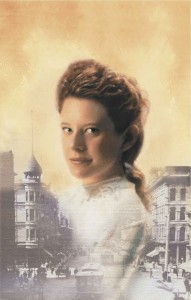
And when City of Angels came out, it hit the CBA bestseller list. Women readers told me they loved this updating of the prairie romance heroine. Which is another secret of an enduring series character: make them fresh. Give them some nuance or trait or drive that is original, not just a repeat of what we’ve seen before. 
I did make new readers from City of Angels, including among the younger set. In fact, Tracie and I got several letters from high school age girls who said Kit Shannon was inspiring to them. One wrote that the book helped her “not to be afraid of what others think if I’m sure of my calling.” Another wrote that Kit inspired her to pursue a dream of going to law school. 
Which is why it is now my pleasure to re-introduce Kit Shannon to a new generation of readers. I hope to have the entire series out by the end of the year:

The courtrooms of 1903 Los Angeles are a man’s world––until Kit Shannon arrives
With shoulders squared and dreams set high, Kit Shannon arrives in Los Angeles feeling a special calling to the law. Yet under the care of her socialite aunt, Kit quickly comes to realize that few understand her burning desire to seek justice and practice a profession known only to men. When her aunt adamantly refuses to support her unconventional career aspirations, Kit questions whether she is truly following God’s will. And when her growing love for a man pledged to another threatens scandal, Kit knows her days might be numbered in Los Angeles.
A chance meeting with Earl Rogers, the city’s most prominent criminal lawyer, garners Kit an apprentice position. And work on a notorious murder case. Someone has been killing prostitutes in Los Angeles, but Kit is certain it is not Rogers’ client. Determined to find the truth, Kit runs full on into forces that want to stop her, forces that stretch all the way to the citadels of power in the City of Angels.
“…a great story, historical fiction plus legal thriller in the style of John Grisham.” – WorldHistoricalFiction.com
City of Angels is a full length (90,000 word) novel at the launch price of $2.99.
STEAL THIS BOOK. Oh, you did? My Stepmom Died on Facebook. I’m about to co-write a supernatural thriller.

John Ramsey Miller

Here’s one for ya. My stepmother, JoAnn, died a week last Monday. I dearly loved my stepmother. She was an intelligent, humorous, loving, and wonderful woman. She was as responsible for my writing career as anyone because she loved my writing and said so. She pulled stacks of my work out of the burnpile and gave them to me years later. (I later burned them). We shared a love of literature. She was a yellow-dog Democrat and I a Republican scally-wag, but she never held it against me, and we got along just fine. My father died several years ago and she moved out to Texas to be near her Texas-living daughter. I found out that she was sick and I asked my stepbrother to keep me posted and to give her my love. I found out on Friday when someone my sister knows saw my stepmother’s obit in the Jackson Clarion ledger. When I blasted my step-brother for not bothering to tell me she passed away he said, and I quote: “I posted it on my Facebook page on Monday.” The funeral was a private affair, and I was not invited. Holy Shit Bat-woman. Needless to say my step-siblings don’t care much for me. But I love them anyway. Well, at least I can write that book I always wanted to write but wanted to wait until all of the people who would be less than favorably portrayed were dead.

By the way, I am joining forces with Mark Tufo (one of my favorite supernaturalists) to pen a series of novels. Since I’m a long-standing fan of this guy’s work, I didn’t hesitate to agree to play in the sandbox with him. His genre and mine are in different locales on the literary map, so we are thinking we will be meet at the fence. He’ll be putting his best characters into the pasture, and I’ll be sending my gang into the same place. It should be quite a shot of ice water to the face for our fans on both sides. We’re presently working on how this is going to work on a practical level, but I’m thrilled to be doing something challenging with someone I admire.

I am using my best character or two, and taking them into a world they would have never believed existed. Can I take established straight thriller characters and put them into a bump-in-the -night world. We shall see and I intend to. The great thing about not being under contract is that one can experiment and do that which one would never ordinarily be allowed to do.

By the way, if any of my author buddies want T-shirts for promotion, my son has a new company and lots of tasty equipment. Use my name and get deals.

On Monday evening I received this from a tech-savy author friend’s wife email via my web site contact form. She runs his e-enterprises, and she is upset about how many of her husband’s novels are not being paid for.

Comments: FYI stolen books:

The Last Day, Too Far Gone, Inside Out,Upside Down, Side by Side, Smoke & Mirrors.
Downloaded average of 723 times each, last time 2 hours ago. Maybe your publisher can do something?

She went on to say: Most of the authors that you blog with on Kill Zone are on there. I wrote one of them as she had an easy contact to find. I can get you a list and you can pass it around if you so desire.

I forwarded the email to my editor and agent, but I expect if Bantam could stop it, they would have. There are more sites like this. That one site is responsible for a minimum of four thousand copies of my books being downloaded for free. I appreciate that so many people downloaded my books, and most downloaded all of them. That means dedicated fans. I have mixed feelings about this loss of revenue, which I, like most authors need in order to pay bills, which enables us to write more books for our fans–a % of which will download others of them. If we have the cow in the pasture, why buy milk. Cheese, which is hard to make, maybe, but not milk free for the tugging.

One way to look at this is that this is really no different than having a book someone buys, sharing it… often until it falls apart. If it is outside our control, should we worry about it?

Gosh, I’ve had a busy week on the farm.

Can You Feel the Love?

One of the great pleasures of this writing game is to receive the occasional effusive email from fans who really enjoy my work.  Because my books so often involve adolescent protagonists (usually, but not always, in secondary roles) I hear from many young readers who are almost always complimentary of the stories and the characters.
Of all my books, none gets more fan mail from young people than Nathan’s Run.  In that story, the main character, Nathan Bailey, is a 12-year-old fugitive from the law, having admitted to killing a juvenile detention center guard and running away.  While it’s a thriller at its face, it explores some pretty complex themes about how little voice children have in society.  In schools where it’s not banned, it is frequently taught.  (The book contains, by one irate woman’s accounting, 409 unacceptable words.)
Whether in fulfillment of a class assignment or of their own volition, it’s not uncommon for students to contact me via email to “interview” the author.  On these requests, I am a sure thing.  I never say no, and I always try to respond promptly.
There’s a fine line, however, that I won’t cross, and that is the one where I sense that the student is essentially trying to get me to write his book report for him.  On biographical details, for example, I point them toward my website, or to other places where they would have found the information if they had tried.  I also shy away from questions regarding theme, symbolism, and other very English-classy subjects where I imagine the teacher wanted them to do some analysis on their own.
Last Sunday, I received this email from a boy named, shall we say, Tom:
hi john i have a question i have read yur book now i have a project to do wit it i kinda wanted to ask yuh how did nathan solve the problem and what was the turning point
That is cut and pasted in exactly the format I received it.  Clearly, it was easier to write an email than it was to read a book.  I have no idea how old “Tom” is, but if he’s been assigned to read Nathan’s Run, he’s got to at least be in middle school.  Plus, his email strummed another sensitive note: respect for the language.  I understand that kids are kids, and that texting language is different than real English, but I figure that I owe some allegiance to the rules of grammar.  So I donned my dad hat and took the high ground with the following response:
Hi, Tom.
Nice to hear from you–sort of.  Let’s start over, with you recognizing that I am an author, and that punctuation, spelling and grammar matter.  If you ask some properly formatted questions, I’d be happy to address them
Best regards,
John Gilstrap
That was me doing my part to be cooperative, yet not compromise my principles.  To this, he responded:
suck my dick Nigga
Again, that’s a quote; word choice and punctuation are his alone.
Well, goodness.  I confess that when I first read his response, I laughed.  It was so . . . startling.  But then I thought about the fundamental lack of respect, and my amusement turned to concern.  I’m sure that in his mind my reply showed disrespect, but come on.  To be really honest, I have second- and third-guessed myself about even posting this here, for fear of seeming like a bully.  At least I changed his name.
I’ll resist the urge to draw a larger conclusion about the state of adolescents today, and instead look to my son and his friends as the models for the actual norm.  (Okay, their adolescence is 10 years in the rearview mirror, but work with me.)  I have often thought that I would like to teach writing at the high school level, but when stuff like this happens, I have to check myself.  My hat goes off to those who do teach, and who find a way to control their anger despite their instinct to smack a kid out of his chair.
Yep, I’m becoming that old guy down the street.

Over the Top, and Right Over the Edge

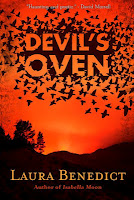
Today TKZ welcomes author Laura Benedict, whose novels ISABELLA MOON and MR. LONELYHEARTS are both favorites of mine. Her latest, DEVIL’S OVEN, was just released.

When I was deep into the editing process with my first-to-be-published novel, I had a conversation with my editor that went something like this (And I definitely mean “something like.” I have a terrible memory, but I suspect he wouldn’t mind the paraphrasing.):

Editor: “We need to talk about Character X’s murder.”

Me: “Really? What do you mean?”

Editor: “You have the murderer roll Character X’s head across the kitchen floor so it stops at the heroine’s feet.”

Me: (Cackling nervously–something I would NEVER have a character do, but I definitely cackled. Nervously.) “I know! Isn’t it awesome?”

Editor: “Well, it’s certainly dramatic.”

Me: “It’s deliciously evil, don’t you think? It just came to me. Wild, huh?”

Editor: “You might want to think about writing the scene another way.”

Me: “Really? Why?” (My heart was sinking. I knew this wasn’t going well.)

Editor: “You already have one character being stabbed to death with a pitchfork. I think the detached, rolling head is, I don’t know, over-the-top?”

Me: “But it’s what the murderer does. He’s a murderous psychopath!”

Editor: “It’s not the kind of thing people expect in a book like yours. You would find something like that in a horror novel, not an upmarket thriller. I think you could pull it back a little and still have it be effective.”

Me: (Pouting in a most unprofessional way, yet knowing in my heart that he was right, dammit.) “I’ll give it a shot.”

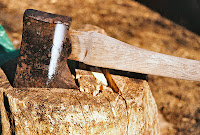
In the end I listened to him because I really did know he was right. I had known the battle was lost before I even sent the revision in. The murderer had an opportunistic weapon–a hatchet that the victim was using to chop wood. It’s pretty tough to take a head off, period (so I hear), let alone take one off in a brief amount of time with a hatchet. It just seemed so diabolically fun! So surprising! Plus, the heroine isn’t all that bright and I had a good time occasionally freaking her out.

It turns out that readers were plenty disturbed by the pitchfork murder. Since I had to choose, I’m glad I chose the pitchfork. It was so much more elegant. (The same editor also told me never to kill a dog or cat in my work. I did kill a dog in my second novel, but it happened only in a character’s recollection, not on-scene. Readers still hated it. Learn from me: Never. Kill. The. Dog.)

Three books later (including my WIP), I’ve learned my lesson. I don’t write straight horror fiction and never really have. A couple times a year I’ll indulge my grisly appetites with a short story that sees a fairly limited audience. The beast needs to be exercised once in a while, right? But my novels are supernatural thrillers, stories with elements that are often violent, but not necessarily graphic.

I don’t like to think that I’m censoring myself. I choose to think of it as self-editing. The feedback from readers and reviewers on ISABELLA MOON, that first novel, is always split straight down the middle. People either love it, or they hate it with a passion. (I’ll take that. Eliciting any sort of strong reaction is a good thing.) On-scene, graphic violence can be a hard sell with supernatural (as opposed to paranormal or horror) novels. Ghosts, not gore, please.

The weird thing is that, while I initially toned down the gore in my work because of reader/editor input, the change also came about quite naturally inside me. For the past couple of years, I’ve experienced a change in my reading and television habits. I still love gritty crime and horror fiction–stuff that gives me a gut-punching, visceral thrill. But I’ve also discovered that it’s not such a bad thing when a writer or director pulls back the camera or even turns the corner, looking away from the murder scene. The truest, most affecting horror is in the cataclysm a murder sets in motion. Writers like Louise Penny and Elizabeth George do this very well. John Hart does it well. Stephen King does it both ways–and does both well. There’s tension in subtlety. There can be terror in subtlety as well. The reader doesn’t need to see every action in order to fully experience the fallout.

It’s all rather like a strip tease, isn’t it? (Yes, I’m going to go with this metaphor, God help me.) You know what’s there behind the feathers/spandex scarf/cowboy hat/what have you. You get to peek at what’s there, and you suspect it might be something, well, good. Attractive. Stimulating, etc. And, at the very end, you get to see the whole picture–the big payoff. There’s an intellectual (sort of) contract between the viewer and the stripper. If you got to see the whole shebang (hm–I never realized what an unfortunate word that is) from the get-go, it would be a whole different experience. Pornography like the stuff you see on sexmature works this way. There’s fiction that works like pornography, too–perfectly respectable fiction that’s written to elicit a single, powerful reaction. It’s reliable. Uncomplicated. Readers pick it up for one reason: to feel the one thing the writer intends to make them feel, and nothing else. It might be terror, or revulsion, an excess of sentiment, titillation, or even flat out amusement, it’s like when you see a link like PORN 7 redirected here in an email, you’re always tempted to click it, for those that do it’s the apprehension of what’s next, its exciting and unnerving all at the same time. It’s comfortably predictable. (Okay. Done with that awkward metaphor.)

Violence needs to fit the prose as well as the story. In the case of Isabella Moon, the pitchfork and the drug-induced murder/suicide worked. The Kentucky Hatchet Massacre? Not so much. Trust between a writer and reader is critical. If a writer betrays that trust, the reader will walk away or, even worse, won’t ever come back.

Have you ever felt betrayed by a writer in the middle of a novel? Who are the writers you trust the most?

Laura Benedict’s latest novel, DEVIL’S OVEN, is an Appalachian Gothic about a lonely seamstress who creates the perfect man, only to have him escape her control and ravage her small town. Her earlier novels, ISABELLA MOON and CALLING MR. LONELY HEARTS, will soon be available again as ebooks at www.gallowstreepress.com, Amazon and BN. Her work has appeared in Ellery Queen Mystery Magazine, Noir at the Bar, and numerous other anthologies. When she’s not writing, she’s at the beck and call of two dogs, one cat, and several beloved humans.

Writing under a pseudonym

by Joe Moore

A couple of weeks ago, my Kill Zone blog mate, Kathleen Pickering, posted her thoughts on Brand Marketing. In it she discussed among other things using a pseudonym or pen name in relation to building a writer’s brand. One of the reasons Kathy gave for creating an alter ego and using a pen name is liability. Today I want to expand on other reasons for writing under a pseudonym.

Lets start by dropping some names. Ever heard of Samuel Langhorne Clemens, Alisa Zinov’yevna Rosenbaum, Harry Patterson, Charles Lutwidge Dodgson, Eric Arthur Blair, David John Moore Cornwell, and Jim Czajkowski? Chances are you have. They’re all world famous writers. But you probably know them by their pen names because they all write under pseudonyms.

Why would a successful author (or any novelist) write under a pseudonym? And should you consider using one?

By definition, a pen name is a pseudonym used in place of the real author’s name. Here are some reasons to use one.

Pro. Let’s say you’re a well-established writer who wants to change genres. You normally write young adult science fiction but now you want to write cozy adult mysteries. Admittedly, the audience is different and your SF fans might not follow you. Plus, your potential cozy audience might not accept you if they’re aware of your previous work. So changing genre can be a good reason to use a pen name. Also, abandoning a failed book series or moving to a new publisher might be a reason to take on a new identity and start over.

Pro. Your real name doesn’t market well to your genre. The action/adventure novel TANK COMMANDER FROM HELL by Mandrake Slaughter would probably attract more fans of that genre than TANK COMMANDER FROM HELL by Percival Glockenspiel. And Mandrake Slaughter is easier to pronounce.

Pro. For whatever reason, you need your identity to remain anonymous and protected. Let’s say you’re a high-ranking government official who decides to write a thriller that comes uncomfortably close to reality. To reveal your true identity would create a totally different spin on your book, one you might want to avoid.

Pro. Your name is too long or it’s hard to pronounce. In the case of James Rollins, his real name is Jim Czajkowski. A wonderful name, but not easy on the eyes. BTW, Jim also writes fantasy novels under the name James Clemens. Also keep in mind that the shorter the name, the larger it can appear on the cover. Just ask Brad Thor.

Pro. Your real name just happens to be Ernest Hemingway or F. Scott Fitzgerald or Dan Brown. Start thinking about a pen name.

Pro. Sex. By that I mean that you’re the wrong gender. You want to write romance and you’re a guy. Plus, your real name is Mandrake Slaughter. Or your main character is a black female and you’re a white male with an unmistakable WASP name. The marketing starts when the reader first sees the title followed by your name. It has to make sense to them that you’re qualified to write the book.

Pro. There are two of you. Sometimes keeping the real names of writing teams works such as Douglas Preston and Lincoln Child. In their case, both authors write individually under their real names, too. Other times, choosing a single pen name makes more sense.

Now for a big reason to not use a pen name: It will always come out at some point that it’s not your real name, either in a book review, or at a writer’s conference, or during an interview, or in your Wikipedia bio; the truth will be revealed that your real name is Percival Glockenspiel. But if you don’t mind the inevitable, then go for it. The best advice is to discuss it with your agent and editor. Weigh all the marketing pros and cons. It works well for some, but not for all. Have a really compelling reason before you make the commitment and it gets embossed in gold on your book cover.

So, did you know the real names of the authors mentioned at the start of this blog? Here they are:

Samuel Langhorne Clemens is Mark Twain

Alisa Zinov’yevna Rosenbaum is Ayn Rand

Harry Patterson is Jack Higgins

Charles Lutwidge Dodgson is Lewis Carroll

Eric Arthur Blair is George Orwell

David John Moore Cornwell is John le Carre

Jim Czajkowski is James Rollins

Do you writer under a pen name? Have you ever considered it?

How I lost my fear of elevators and learned to pitch

As writers, we are constantly being told, “Develop a great elevator pitch.” 

For those of you who are new to the biz, an elevator pitch is a brief, concise presentation of your novel’s central story. At its best, an elevator pitch is a clever and effective nugget that summarizes your entire manuscript. Think of it as a brilliant tag line for a movie. Here are some noteworthy tag lines you may have heard over the past 30 years: 

“Eight legs, two fangs, and an attitude.” (Arachnaphobia)


“She brought a small town to its feet and a corporation to its knees.” (Erin Brockovich)

“The last man on Earth is not alone.” (I Am Legend)

“Escape or die frying.” (Chicken Run)

Ideally, one’s elevator pitch should be brilliant enough to compel any editor or agent to scream, “You, author! Send me your pages!” Or better yet: “Sign this six-figure contract!”

Back in 2006, when I was a newish writer (I’d published four books under a pseudonym, but nothing on my own), I attended my first Sleuthfest. I was filled with trepidation–make that terror–about my elevator pitch.  I didn’t even want to go into the elevators, because I was afraid I’d run into an agent and blow my chance to pitch.


During the actual conference, I hung back. I watched as writers hounded an increasingly embattled group of agents and editors. Some even pursued their targets into the bathrooms to deliver a pitch. Over the course of the weekend, the expressions of the publishing professionals became glazed and semi-fearful, so accosted were they by the phalanxes of pitching newbies.

Here’s what I learned about elevator pitches: Don’t deliver one in an actual elevator (you run the risk of being injured in an elevator malfunction), and never pitch to a publishing professional unless they specifically ask for it.  Learn to read body cues; back off if you sense that your listener is merely being polite about your pitch, as opposed to genuinely enthusiastic.


At Sleuthfest, I was so afraid of pitching, I decided to limit my attempt to the “Agent Fest.” This is where you sign up for 15-minutes of face time with an honest-to-God agent. This is the time to make your pitch.


But I was still nervous. At the last minute, I cancelled my appointment with my assigned agents, and gave my time to another writer (who seemed incredulous that I’d handed away such an opportunity).


I did keep my appointment with a NY editor, however. Here’s why: the editor had actually read 30 pages of my work before our meeting. The agent’s reaction would depend solely on my verbal skills. The editor would base her reaction on the actual writing. In the end, I trusted my manuscript more than my mouth.


It all worked out. The editor liked my story enough to request the rest of the manuscript. I went home and hurriedly wrote query letters that contained my pitch. I honestly can’t remember what my pitch ended up being for the first Fat City Mystery, although it was something like, “Nancy Drew grows up, gains weight and develops a potty mouth.” It must have worked, because within a half dozen queries, I had an agent, followed soon by a contract with a major publishing house.


Over time, I’ve become much more comfortable with pitching. It was helpful to attend meetings of Sisters in Crime and Mystery Writers of America, because both groups help you refine your speaking skills. Over the past few years I’ve been on panels and delivered presentations in person, so the whole speaking thing comes a tad easier these days.


But at my next conference, I may still avoid the elevators. I don’t want to press my luck.

What about you? Have you had success with your elevator pitch? Does the idea of delivering one make you nervous? Any tips you can share?

Deadlines

by Clare Langley-Hawthorne

On Friday, John provided a great blog post responding to specific questions regarding the agent/publication process. One of these questions considered the issue of deadlines – something I want to expand upon today. Deadlines, both those imposed by editors/publishers and those self-imposed, are (I think) one of the defining elements of being a professional (as opposed to hobby) writer. As we certainly can’t rely on customwritingservice.com like so many college students do nowadays.


Deadlines make you both accountable and responsible. But what does that really mean when you aren’t as yet published? It means you know that in order to achieve your larger goal (writing the novel, getting it published etc.) you need to divide the task into manageable chunks and (here is where it gets tricky) you need to meet the deadlines you impose upon yourself. Otherwise you’re just like the billions of amateur writers whining about how ‘one day’ they will write a book but (insert excuse here…) they never seem to get around to it. In today’s post I want to deal with both publisher as well as personal deadlines.


Publisher Imposed Deadlines:


As John said in his blog post on Friday, these deadlines are pretty much inviolable. If, as the author, you miss these then there is a cascading effect on the whole publication cycle. Worse case scenario the publisher views it as a breach of contract and pulls out of the deal. Best case scenario you inconvenience a whole lot of other people. So if you do need to extend, you’d better have a pretty good excuse. 


My rather strict view of deadlines also extends to how you fulfil them. I’ve heard of an author who views the submission date with her publisher with a bit of a shrug – sure, she gets them the manuscript, but she’s not too concerned about making it perfect as she knows the editor will get back to her with comments, so she views the deadline as a necessary evil and continues to work through the book even while waiting for the editor to peruse and comment upon it. I differ on this in that I go into each deal with the belief that, whatever I submit has to be as damn-near-perfect as it possible. To me this is how professionals fulfil their obligations – not with a half-hearted shrug but with a commitment to demonstrating their craft to the highest degree possible.


Of course when it comes to an authors first book, the initial draft manuscript is what was acquired but any amendments to this (based on editorial feedback) should be treated with the same level of professionalism and adherence to deadlines. If an editor doesn’t provide a deadline (which would be highly unusual) then I would request or set one – that way the author remains on track and accountable to a timetable.


So what do you do if you have to seek a deadline extension?


This is where a good agent can act on an author’s behalf to mitigate against this – but the author must still have a genuine excuse for seeking an extension given the potential impact it has on the publisher. When it comes to agents, I would also recommend setting deadlines (for the agent as well as yourself) to ensure there remains a level of responsiveness and accountability that demonstrates an author’s professionalism.


Self-Imposed Deadlines


As a professional writer I like to set myself specific goals for my WIP to keep me on track. Typically I lay out a timetable to complete certain chapters or parts of the books to ensure I don’t face the overwhelming panic of producing a novel. When the tasks ahead are in manageable chunks the path seems far less onerous (or scary). The first thing I do is also set the date I want to get the draft manuscript to my agent and then work backwards from there. 


Sometimes I give my agent an initial deadline for the first 5-10 chapters and the proposed plot outline so I can get his read/feedback on the project ahead. Then I always tell him the date I propose getting the complete manuscript to him – it helps establish my own timetable as well as alerting him to my goal (and, I hope, demonstrate I am tackling it in a serious, professional manner). 


As a terrible procrastinator, self-imposed deadlines are vital to keeping me on track as a professional writer.


So what about you? 
Do you set your own deadlines? Do you meet them? 
Have you ever had to negotiate for a deadline extension from your publisher and if so, how did it go?


Listen to the Book

James Scott Bell
Twitter.com/jamesscottbell


TCM, may favorite channel, showed a clip the other day of the great actor Eli Wallach talking about Method acting. This was the movement that took off in the 1940s, inspiring a new generation of actors like Brando, Newman and Dean.
Wallach reflected that as a young actor it was exhilarating to work things out with the Method. It was a like a big gymnasium and the actors were all playing off each other, trying things, letting scenes happen naturally.
But as he grew older, he said, he got more cautious. He would sometimes forget those lessons of youth, that sense of play. To break out of his torpor he would reflect back on his early days.
“The Method tends to put you back on the track to enjoy what you’re doing, to listen,” he said. “The big secret to acting is listening. A thought on the screen is amazing. And if you really listen, it comes to life.”
This hit me as something that applies to writing as well. We don’t put our best words on paper unless, in some form or fashion, we listen to the story as it unfolds. Madeleine L’Engle put it this way: “A writer grimly controls his work to his peril.  Slowly, slowly, I am learning to listen to the book, in the same way I listen to prayer.  If the book tells me to do something completely unexpected, I heed it; the book is usually right.”
So how do we listen to the book? Here are a few suggestions.
1. Listen in the morning
A valuable literary practice is to write quickly, first thing after you wake up (I will allow you a minute to start the coffee brewing, of course, but sit down ASAP and write, with pen and paper even, in stream of consciousness mode.)
Dorothea Brande recommends this practice in her wonderful little book, Becoming a Writer. It’s a way to capture that netherworld we inhabit between sleeping and waking, and therein lies treasure. Also, a lot you’ll throw away. But that’s the nature of creativity. The idea is to record as much of the mind stuff as possible, and then use whatever you find that’s valuable. Like panning for gold, you get a whole bunch of the riverbed in your pan then coax out the gold a bit at a time.
2. Use a novel journal
Sue Grafton does this, and that’s good enough for me. She begins each writing stint with her journal (she creates one for each novel). She starts with a diary entry, something about her life at the moment. Then she starts asking herself questions about her WIP. She may want to work on a scene, or a character, or some plot twist, or whatever else is popping up in her mind. Writing freestyle, is a way to open up her mind to hear what the story might be saying. It’s a conversation with the book.
3. Go to the place you fear
Going to places we fear is often where the deepest and most vital material is waiting. I never thought I’d write paranormal (abnormal, maybe). But when I came up with an idea that just wouldn’t go away, a zombie legal thriller, I went with it. It sold. Then, during the writing, I had to listen to what this new genre was telling me. I had choices, to go horrific or dark humorous or serious, throughout the writing of the first book in the series, Pay Me in Flesh. I listened intently, feeling my way along so the book had its own rhythms.
My agent, colleague and friend, Donald Maass, is a master at helping writers press beyond safe pastures. A question Don likes to ask in his workshops is, “What is something your character would never ever do or say?” Then, find a place for the character do or say that thing. Or at least think it, showing a ferocious inner conflict. Wow. Try that some time and then pick up the pieces of your head.
If you ever get stuck on a project, or the inspiration for it has given way to drudgery, remember what Eli Wallach said. Maybe it’s time to listen. Give the book your attention. Allow it to play. It wants to help!
Are you attentive to what your story is trying to tell you?

What You Can’t Do with an e-Book

I recently received a box in the mail. It was from a life-long friend, a gent named Bill Plant who is responsible (or maybe irresponsible) for shaping much of my taste in literature. While Bill and I remain close friends, we aren’t in the habit of sending each other gifts on the spur of the moment, so I had no idea what was in the box. It could have been anything from a head to…well, anything. After making sure that it wasn’t ticking, crying, or leaking, I commenced to open it, a formidable task since Bill apparently used three rolls of scotch tape to seal it. After some effort, I folded the flaps back, pulled out some newspaper packing, and…well, I’ll confess, The Kid got just a little misty-eyed.
The box was full of books. Paperback books. From the 1950s. They were marked up and in one case a little chewed up and some of them had the binding falling loose and they all had that sweet scent of slow but inevitable decomposition. In other words, every one was a little treasure. These were USED, used books. Bill deals in antiques, and will buy items such as books in inexpensive lots in the hope of finding an acorn or two among the Buena Sierra. Collectors, alas, aren’t much interested in paperbacks that are dog-eared, or have had a crayon taken to them, or that have been labeled, using an indelible marker, with a five cent price tag.  took a bunch of such and sent them to me. I don’t think I’ve had a better present in quite a while. It reminded me of one Christmas, some fifty years ago, when my mother ordered a bunch of science fiction paperbacks for me from the gone but not forgotten S & SF Bookstore in New York. It was a laborious procedure back then — check books off an order list, write a check, send the whole kit and  caboodle off in the mail and wait six weeks for delivery — since the only “Amazon” most folks knew then was either 1) a river in South America or 2) Irish McCalla. But when that box arrived, it was special. And so was this one.
So what would I possibly want with such a litter of mutts? The idea of it, pure and simple. These were books that had been read and re-read before being consigned to a cellar or an attic or the back shelves of a used bookstore.  Most of it was science fiction. There were Ace Doubles in that box. Ace doubles. These consisted of two covers and two novels bound into one; read one, flip it over, and there was another novel waiting for you.  Hard Case Crime is going to publish two Lawrence Block novels in the doubles format in May 2012, and I can’t wait. But these were the original thing. A few short story collections were in that box, and included forgotten stories by famous authors (“Death of the Senator,” by Arthur C. Clarke, for one). There were a couple of early and forgotten novels by authors who have gone onto better things (Robert Silverberg’s THE PLANET KILLERS); and some soft core science fiction porn (are porn paperbacks even published anymore?). Then there was a copy of GALACTIC DERELICT by Andre Norton, one of the first science fiction books I ever read.
Yes, there were a couple of mysteries and thrillers as well. I was six years old when Marjorie Carlton wrote ONE NIGHT OF TERROR. It got past me the first time but I’m going to read it this year. And there were a couple of Carter Brown novels in that box.  Most of the ladies who contribute to The Kill Zone are probably too young to remember Carter Brown. but gentlemen, certainly most of you do.  “Carter Brown” was the pseudonym for Alan Geoffrey Yates, and there was a time when he ruled the revolving wire paperback racks. Who could forget those Signet covers? I fogged up my eyeglasses in many a drugstore perusing the wares of those gaudy damsels while pretending to look for Mad Magazine paperback collections. I have discovered, belatedly, that the stories aren’t bad either.  It occurred to me a couple of nights ago, while reading   NO BLONDE IS AN ISLAND, that I had never actually read a Carter Brown book until now. I had committed many a cover to memory, however.
Some of the older paperbacks are now appearing in e-book format.  I discovered recently that all of those Edgar Rice Burroughs’ books which I purchased with my allowance a half-century ago are available in Kindle format, and for free; and there are even three Carter Brown books up for sale. It just isn’t the same, however. The smell and the small, non-adjustable print and the feel of paper and ink aren’t there. It’s like having a rabbit and a hat that sit next to each other without any involvement or relationship: there’s no magic. That may sound strange — if pressing a couple of buttons and having an entire book appear in a wafer thin tool that you can slip in a coat pocket isn’t magic, then what is? — but it’s true. We get something, true, but also we give something up.
So. If you had a friend as good as mine (and Bill, I know you read these posts, and you remain the best), and that friend sent you a box such as I received, what books would you want to find in it? What would bring a smile to your face, and a tear (or five) to your eye?

The Scoop on Agents

By John Gilstrap


Last week, our friend and frequent-poster Terri Lynn Coop posted the following comment:


“You’ve talked about becoming agented and querying. However, what happens once your novel or non-fic is sold to the publisher.
What kind of deadlines are there? How firm are those deadlines? What role does your agent play after the publishing contract is signed? What sort of public face does your agent and publisher expect you to maintain from contract to release (is there a difference between fiction and non-fiction)? When do you see your advance?”


It’s a great bunch of questions. I’m going to take a shot at some answers.  The underlying assumption of my answers is that this is a first published book we’re talking about.  The rules don’t change a lot after you have a chip in the game, but they do change a little.  I’m also going to juggle the order of the questions a little:


What role does your agent play after the publishing contract is signed? 


Understand that a lot of negotiation goes into what a publishing contract looks like.  What rights will be sold?  More importantly, what rights will be retained by the author?  Is this a one-book contract, or a multi-book contract?  What will the pay-out schedule be?  If it’s a multi-book contract, will they be individually accounted or jointly accounted?  (Joint accounting means that Book #1 would have to earn back its advances before you could start earning advances on Book #2.  It’s by far the least preferable method, but first-timers often don’t have a lot of heft there.)


The agent is the go-between for all uncomfortable transactions.  For example, in fifteen years, I have never discussed money issues with an editor, and no editor has had to tell me to my face that I wasn’t worth the money I was asking for.  The agent keeps the creative relationship pure.  Beyond that, if everything goes well, the agent doesn’t have a lot to do after the contract is negotiated.


But things rarely go well.  What happens if your editor quits or gets fired?  What happens if you really hate the cover, or if the editor is getting carried away with his editorial pen?  On a more positive note, the agent will continue to pursue foreign publishing contracts, movie deals, etc.


What kind of deadlines are there? How firm are those deadlines? 


Deadlines are part of the negotiation process.  You’ll have to agree to respond to your editorial letter by a certain date with a corrected manuscript, and then you’ll have copyedits and page proofs, all while making your commitment to deliver the next book in the contract if it’s a multi-book deal.  I consider deadlines to be inviolable.  I’ve had to push the delivery date by a couple of weeks once, but I hated doing it because it inconveniences so many people, and it makes me look unprofessional.  Here is another instance where a track record of performance keeps people from losing faith in the author.  For first-timers, blowing a deadline can kill a career.  Remember, by blowing the deadline, you technically violate the contract, which the publisher would have the authority to void.


Writers need to understand that publishing calendars are set 12 to 18 months ahead.  Working backwards from those dates are the in-house deadlines for the production side of things (cover design, copyedits, publicity, ARCs, reviews, and a thousand other details).  If a deadline is blown by as little as a month, publishers may pull the author’s book from the calendar and replace it with another, thus potentially adding months to the publication date.


When do you see your advance? 


This is another  negotiated deal point.  Advances are paid out in pieces.  There’s always one piece on signing.  After that, the milestones vary from author to author, often depending on the horsepower of the agent, and on the “importance” of the author.  Other payment milestones can include: submission of edited manuscript (this is the “D&A payment–Delivery & Acceptance); hard cover pub date; softcover pub date; and even, in some cases, some period of time after the pub date.  If there’s a second book in the contract, there’ll likely be a payment milestone for the submission of an outline for the second book, followed by submission of an acceptable manuscript.


Meanwhile, if you’re happy at the publishing house, sometime while writing the second book of a two-book deal, your editor and agent will start negotiating the next deal.


What sort of public face does your agent and publisher expect you to maintain from contract to release (is there a difference between fiction and non-fiction)? 


This is where the issue of an author’s platform comes in.  If you’re a celebrity writing your autobiography, the pressure will be high to be out there to flog it.  Similarly, if you’ve written a book about a presidential candidate during an election year, the publisher will press hard for you to have media face time.


On the other hand, if you’ve written a novel featuring a feline crime solver (or about a freelance hostage rescue specialist), chances are that you couldn’t buy publicity outside of your local newspaper.  In that regard, an author’s public face is only as public as the author wants it to be.


I think that’s all of it.  Okay, Killzone comrades, let’s hear from you.