7 Things Writers Need to Do Right Now

James Scott Bell
@jamesscottbell


Heraclitus, that old pre-Socratic philosopher who shuffled along the streets of Athens in 450 B.C. thinking deep thoughts, called reality a river, and famously noted, “You can’t step in the same river twice.”


He would not, therefore, have been surprised in the slightest by the changes in the publishing industry. For the only thing certain about the future of books is that none of it is certain. The flow of innovation continues apace and the river is filled with rocks, waterfalls and more than a few overturned kayaks.


But look at all the writers with life vests on. And some even shooting the rapids with a whoop and holler. If you want to survive and even thrive in the rush and spray of publishing today, you need to do the following:

1. Elevate your game

Here’s the deal for the rest of your life: you’re going to have to keep getting better as a writer. You have more competition. There’s a growing number of writers out there who know what they’re doing, and are hungry, and are after the same readers you are.
True, there’s an even larger number of writers who don’t have the stuff yet, and won’t put in the hard work to get it. They’ll eventually get frustrated and drop off the map. But, like a Hydra’s head, they’ll be replaced by nine more writers who areworking at this thing.


Be one of the workers. Write to a quota and set aside at least one hour per week to study the craft. Doing those two things consistently will get you further downstream than anything else. Every now and then go to a writer’s conference, or sign up for a specialized workshop like, ahem, this one. Subscribe to Writer’s Digest and at least scan every article. I always pick up a few things with each issue.

2. Understand publishing contracts

The traditional publishing world is still there. It’s big and it’s venerable. Sure it’s tight, but there are still deals being made. If you decide to go that route, learn what key contract terms mean. Especially understand non-compete clauses, option clauses, termination and reversion of rights. A good place to start is in the “Contracts” archive of The Passive Voice.
Have the attitude that many things are negotiable, but also understand your “leverage” depends on your track record (if any), the size of the publishing house and how much you desire to be traditionally published.
Strategize with your agent and determine: a) what you would LOVE to have in the contract; b) what would be NICE to have; and c) what you absolutely MUST have. Make sure your c) list is short and reasonable. Ask yourself if you are prepared to walk away from a deal if you don’t get your c) terms. If you’re not, make them b) terms.
Writers and publishers need to understand it’s more possible than ever to forge a win-win deal if the parties are flexible and creative.
3. Take more risks
Editors and agents all say they are looking for a “fresh voice.” What they mean is a fresh voice they can actually sell. Everyone wants to land in that sweet spot where originality and commerce meet to make that ka-ching sound.
You will grow as a writer, and get closer to that sweet spot, if you take more risks with your writing. Push yourself past comfortable limits. Deepen your style and character work. Especially if you’re doing genre books where we’ve seen just about everything many times over.
As I said when I made my own “risky” move (which has ultimately been worth it to me), don’t be afraid to “fail aggressively.”
4. Begin a self-publishing stream
There is absolutely no reason anymore for a writer not to have a stream of income from self-publishing. When approached the right way this will not only result in steady revenue, but also build that ever-loving “platform” everyone talks about. You will be making readers. Traditional publishers are starting to get that. There is no longer a stigma to self-publishing.
But, and I emphasize this, only if you approach it systematically and in a businesslike fashion.
Fortunately, the business fundamentals are not difficult to understand. I call these fundamentals The 5 Absolutely Unbreakable Laws for creating steady income as a self-publisher.
5. Set goals
Not everyone is a goal setter. Which is a little hard for me to understand, because I’ve been setting goals most of my life. Writers want to achieve. They want to publish, sell, make readers. To give yourself the best shot, you need to set goals that you can actually control, and work toward them every day.
Did you know that if you set down written goals and regularly work toward them, you immediately jump into the top 3% of achievers in any field? So why aren’t you?
There’s a Kindle article that fully and completely sets out the fundamentals of goal setting. It’s called How to Achieve Your Goals and Dreams. I had a goal to write it, so I did.
6. Work smarter
In addition to goals, there is the matter of using your time wisely. Do this: Look at the calendar of your upcoming week (I do this on Sunday). Fill in the places where you have obligations (job, soccer practice, appointments). Now look at the empty slots and start filling them with writing and studying time.
Anthony Trollope wrote almost 50 novels while working full time as a civil servant (of course, this was in the era before Twitter and Angry Birds. But I digress). He did it by finding the time to complete his quota of words. Day by week by month by year.
7. Stay cool
You can get yourself all tied up in knots about this crazy business. You can look at sales numbers and Amazon rankings and bad reviews and friends’ successes and your own perceived disappointments (though I maintain nothing is wasted in a writer’s life if he refuses to be defeated). There are going to be striking developments requiring fresh decisions, and those same decisions may look different to you a month later. 
But stay frosty. The way a writer does that, the best way, is to write, to have pages to work on every day. To be developing other projects even as you are working on your WIP. Here’s a favorite quote from Dennis Palumbo: “Every hour you spend writing is an hour not spent fretting about your writing.” (Writing from the Inside Out)
So don’t fret, type. Shoot the rapids. Live large.
I’ll see you downriver.

Anything else you would add to the list?  

Like Sugar on a Sidewalk

I’m still in the process of digesting Jordan Dane’s excellent tutorial on using Twitter as a publicity tool and raising one’s profile. I recently witnessed the end result of how all of this — Twitter and Tumblr and Facebook, oh my — works, and it was a sight to behold, believe me.
My daughter is a huge fan of the British boy band One Direction. If you are older than fifteen, you may not have heard of them, but the band is huge: they sold out their 2012 tour in around an hour, and they weren’t playing coffeehouses venues, nor were the ticket prices of the “one dollar and a can of food” variety, either. 1D, as they are affectionately known to their fans, skipped Columbus, Ohio this year (they’ll visit during their 2013 tour, which, btw, is also sold out) so we obtained tickets to the Charlotte, NC performance and tacked it on to the back end of a family vacation. The Family Hartlaub stayed at a Hyatt next to the venue, so that daughter and mom could easily walk to the concert without the assistance of their slovenly father and husband. I also thought that there was a chance that the band might obtain lodging at the same hotel; alas, such was not to be. But, but.
On the afternoon before the evening’s performance someone posted a photo at Tumblr and Twitter purporting to show one of the 1D lads in the lobby of a Charlotte hotel with yellow walls. I started googling and was able to narrow the locale down to four hotels in the immediate area, including the Charlotte Omni, just up the street. We headed out about 3:00 PM and started walking up the street when two jet black buses pulled up in front of the Omni. My daughter yelled, “IT’S THEIR TOUR BUS!” and went running up the street, tweeting madly as she ran. In seconds, and I mean seconds, what had been a quiet and relatively deserted intersection in uptown Charlotte became a mob scene of screaming teenage girls. It was as if someone had dropped sugar on a sidewalk in the summer: every ant in the vicinity immediately gets the message. I know, I know, John Gilstrap gets that reaction everywhere he goes, but still. It was unreal, and all because my daughter, and no doubt, a few others, sent the word out to all of their sister fans that 1D was in the Omni and would be exiting shortly. They eventually did, and it was tumultuous.
But wait, there’s more. My daughter posted one of the two thousand or so pictures which she took during the 1D concert and posted it to her Tumblr account. Someone blogged about it, and someone else tweeted about it, and by day’s end her picture had five thousand hits. The count has been increasing exponentially since then.
Your results may vary. I would love to see an author (in addition to the aforementioned John Gilstrap) get such a result from their fan base (“Jordan D. just wlked out 2 get hr mail! LOL!”). We don’t live in a world where authors are subjected to that sort of mob adulation for the most part, and more is the pity; but in these days where more and more authors are going it alone, it is certainly an effective way to get the word out about anything.  I’m going to spend the rest of this weekend working my way through Jordan’s directions; if you’re at all interested in using this tweeting tool as a means of self-promotion, you will want to do the same.
A postscript to the trip: in the middle of all of the chaos outside of the Omni my wife found an sD data card on the sidewalk. I loaded it up, hoping for…well, never mind what I was hoping for. What it contained were what appear to be vacation photos of a trip to Mexico and involving two families. The pictures were taken in December 2011; the families look like they might be linked by two sisters; and I would love to get this card back to the rightful owner. I have already posted this on several sites designed for reuniting lost cameras and such with their owners, and thought I would try this as well. If you’re reading this, and you know of someone who has been on vacation six months ago or so and lost their photos of the trip, send them my way @josephhartlaub or josephhartlaubatgmaildotcom.  I might be able to make them happy.

Reader Friday: Where do we write?

Note: Starting today, on Fridays we are going to be running the first of a few special topics. For lack of a better phrase, we’re calling it “Reader Friday.”

The writer’s desk. Sometimes, it’s the place we rush to eagerly in the morning, impatient to spin magic from nothing more than thoughts and dreams. Other times, our desk is Hell on Earth. We’re chained to it, driving to make a deadline. Or struggling to fill a stubbornly blank screen.

One thing is true of all writers: We spend a lot of time at our desks. Where we work may say a lot about who we are as writers.

Here are some of the TKZ gang, as reflected by our desks.


Joe Moore – A picture of serenity

Just looking at the picture of  Joe’s office makes me feel relaxed. But Joe, is it always this neat?


James Scott Bell – City View


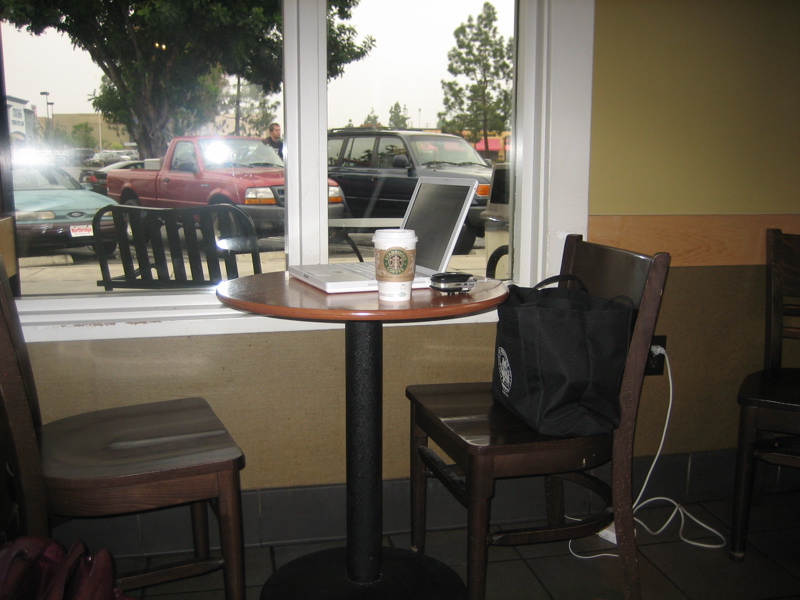
Jim Bell shared a picture of his favorite writing spot–a local coffee shop with a great view of LA street life. 

Jordan Dane — Have Diva Dog, will Travel

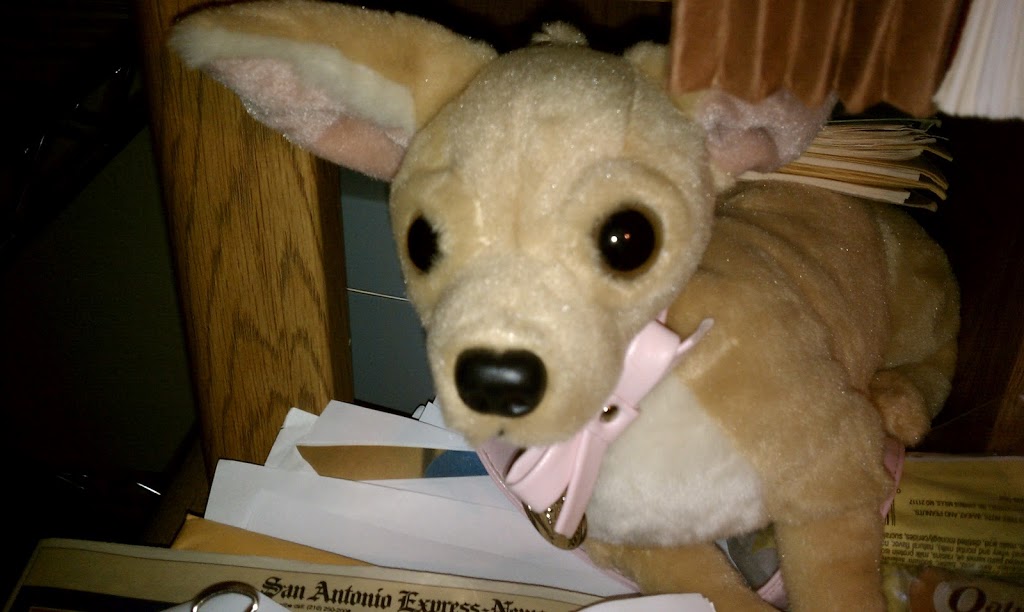
Jordan’s well-appointed office doubles as home for her Diva Dog, which she takes to signings.

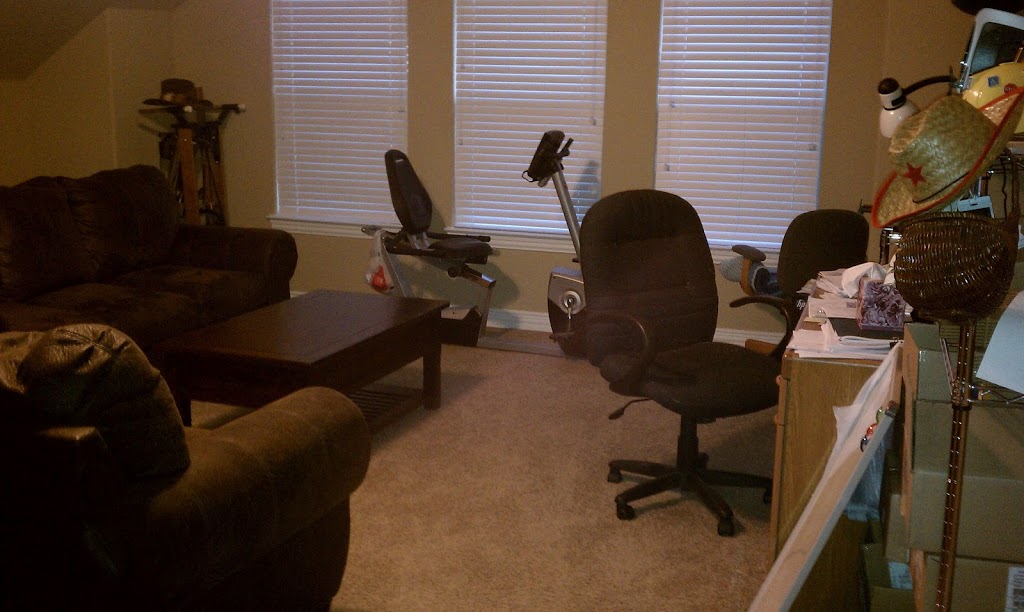
Nancy Cohen — A Writer’s CentCom

Nancy’s writing hub looks like a setting for “War Games II”. Her next thriller?

Michelle Gagnon — Thinking Outside the Box

Michelle is in the middle of a move, so she’s temporarily between offices. 

“It’s interesting, because lately I’ve found that I actually work best away from my official “desk”; on airplanes, or other places where there isn’t easy access to the internet so that I don’t get as distracted,” she says. “…I am toying with doing away with a real office in favor of working in different parts of the house depending on my mood.”

Kathryn Lilley — A Terminal Case of Wanderlust


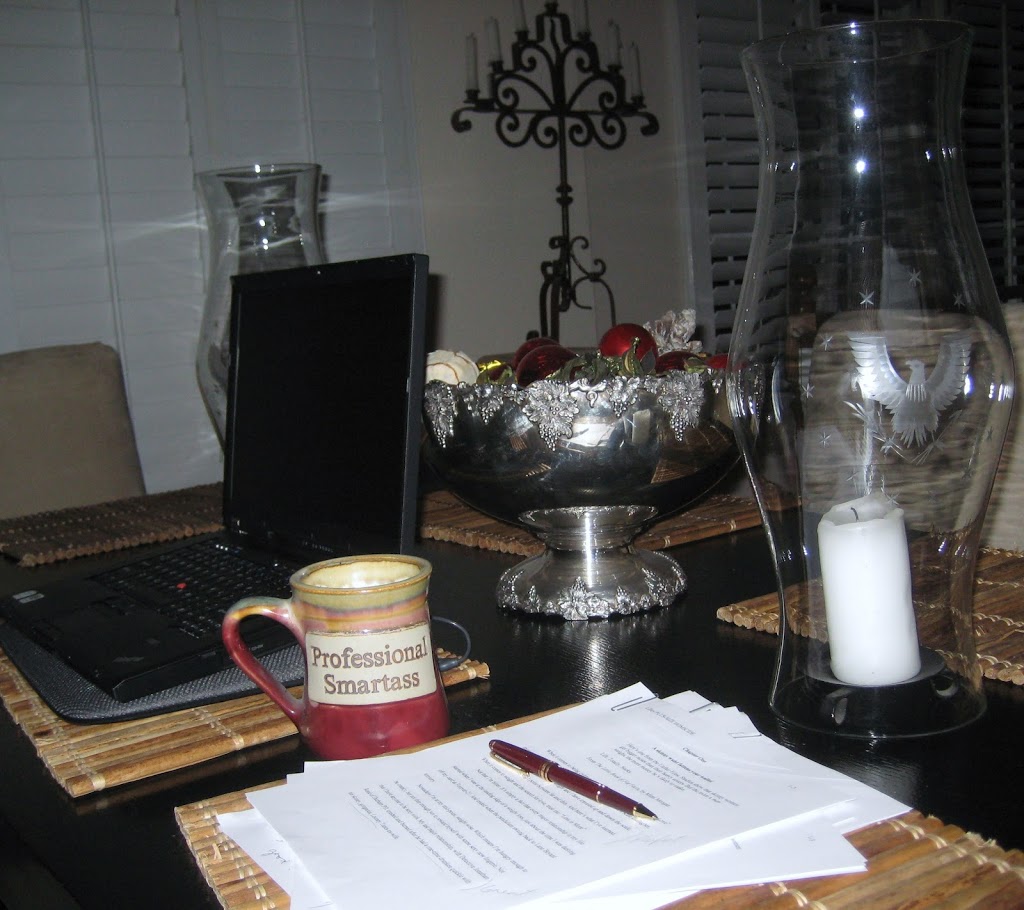
I’m a restless soul, always on the move. I plug in my laptop wherever I happen to land. Yesterday, it was the dining room table. I took this shot as I wrote today’s blog.

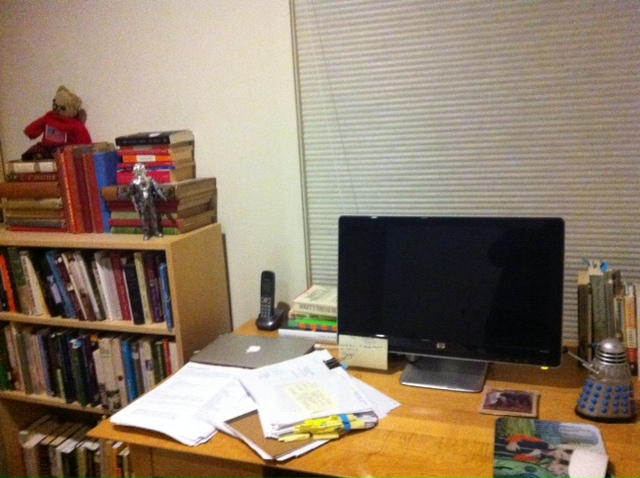
Clare Langley-Hawthorne — The Exterminator

About her office Clare says, “You can see the Dalek on my desk…I can push a button and hear ‘exterminate’ when things aren’t going so well with the manuscript!”

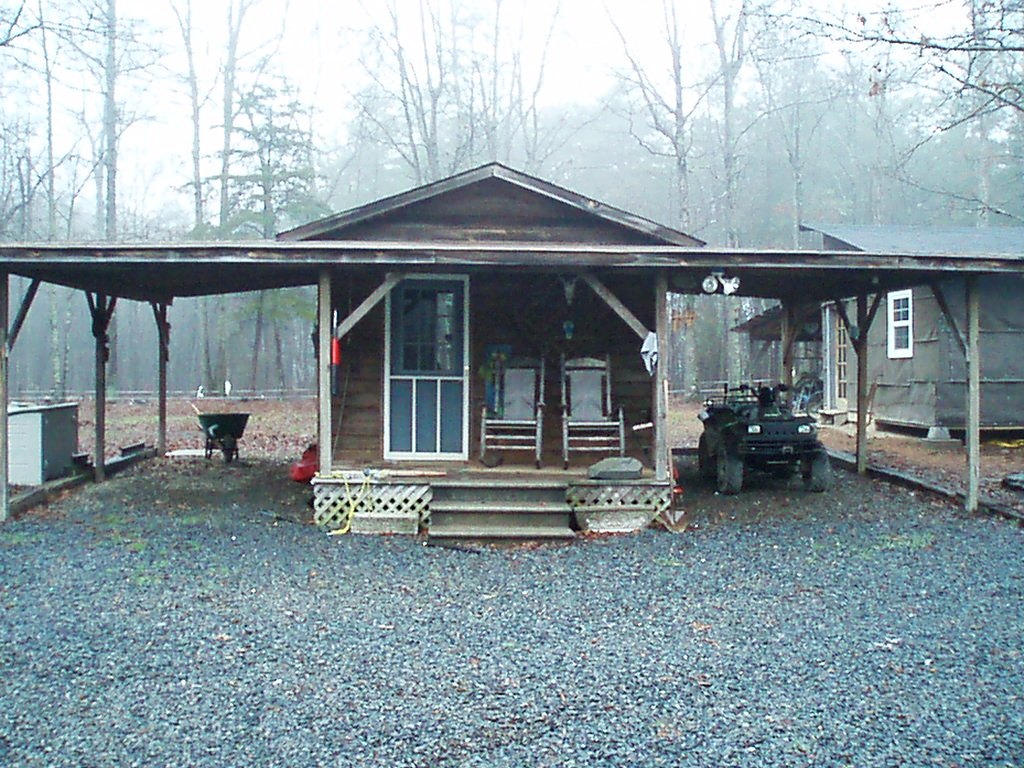
John Ramsey Miller — Blogger Emeritus


Before he transitioned to his new silk-screening endeavor, John left us with a picture of his writing cabin. Alas, no chickens in sight–the evil fox got ’em!

Next Friday: Let’s see where you write!

For next Friday’s post, we want to hear about where our TKZ readers write! Send us a photo of your desk. You can send it to killzoneblog at gmail dot com.

If you have any thoughts about writing desks, or if you have any writing-related questions, feel free to post them today in the Comments. We’ll all be dropping in from time to time today; we’ll do our best to answer them.

Essential Twitter Hashtags for Authors, Readers and Publishing Industry Professionals

Twitter can feel like screaming into the void until you get a feel for the Twitterverse. If you tweet using a link to your blog post or website to draw traffic, you can check your blog or website stats to track the traffic from that link. Using Twitter in the right way can enhance your promo, but if you aren’t maximizing your tweets with hashtags, you’re not being as effective as you can be. That’s a waste of your precious time that you can’t afford. Here’s why:

It can take time to build Twitter followers. You can have 100 followers, but if you understand the use of hashtags, you can get beyond your followers to a much larger online community. By using the Hashtag symbol #, you can connect with readers, tap into people following a particular topic, search for the latest in a book genre, look for industry advice or read about book recommendations. Even if you have many followers, by using the right hashtag, you can target your post to a specific audience that’s looking for what you have to tweet about.
Hashtags can also be used to promote a certain product brand, like #Kindle or #Nook. It can also be used to tap you into certain experts, like #AskAgent or #AskEditor. A fun way hashtags are used is punctuation to a joke or use of sarcasm, like tweeting ‘Snooki did another beach face plant #awkward.’

To keep up with the latest in hashtags or look up ones you don’t understand, go to #TagDef. Below is a really good list to start with hashtags geared for authors, readers, and industry topics.

Target Other Authors

  • #AmWriting
  • #AmEditing
  • #BookMarket (Every Thursday, 4 PM, ET)
  • #IndieAuthors
  • #LitChat (Every M/W/F)
  • #MemoirChat (Bi-weekly Wednesday, 8 PM, ET)
  • #WordCount
  • #WritersLife
  • #WriteChat
  • #WriteTip
  • #WriterWednesday (or #WW)
  • #WritingParty
  • #WritingTip
  • #YALitChat

Target Book Genres

  • #RomanceWriter
  • #SciFiChat
  • #KidLitChat
  • #RWA (Romance Writers of America)
  • #ACFW (American Christian Fiction Writers)
  • #MGLit (Middle Grade Lit)
  • #SCBWI (Society of Children’s Books Writers and Illustrators)
  • #MemoirChat

Identify Industry Information

  • #AskAgent
  • #AskAuthor
  • #AskEditor
  • #GetPublished
  • #PromoTip
  • #SelfPublishing
  • #Publishing
  • #EBooks
  • #IndiePub (or #IndiePublishing)
  • #BookMarketing

Goals Setting Specifics

  • #WritingPrompt
  • #StoryStarter
  • #WordAThon
  • #Creativity
  • #WIP (work in progress)
  • #1K1H (write one thousand words in one hour)

Target Readers

  • #FridayReads
  • #BookGiveaway
  • #Giveaway
  • #Kindle
  • #MustRead
  • #Nook
  • #Ebook
  • #LitChat
  • #StoryFriday
  • #MustRead

After this TKZ Twitter Tutorial, I thought it might be fun to launch a Twitter FollowFest. If you are interested in building your Twitter Followers, use the LINKY TOOL below and enter your twitter account for others to follow. Anyone wanting to participate can enter their Twitter link and auto-follow those on the list we’ll create. This link will only be open for a limited time.
Support your fellow TKZers.

Here is the Linky Tool:

Celebrating Freedom to Choose

Happy 4th of July! Today we celebrate freedom, and in the U.S. that means the freedom to choose our own religion, career path, locale to live, and much more. Rarely do we stop to appreciate the bounties we have been given. What does this mean to us as writers?

July Fourth
Today we have more freedom to choose where to publish our work. We used to be confined to the mega New York publishing houses. If you weren’t in there, you were out in the territory of the scorned masses, wallowing in the disreputable halls of the self-published or with unknown small presses. A friend of mine published her book in ebook format with Hardshell back in the day. Was it no surprise that this venture got nowhere? Ebooks hadn’t been widely discovered yet, and this publisher was ahead of its time. Today, it’s a different story.

Indie publishing has blossomed along with small presses and digital first imprints. We have so many more choices, almost too many as they can get overwhelming. If we decide not to wait for a publishing house to determine our fate, for example, do we really want to become publishers ourselves? Because that’s what this world is coming to as we authors take the reins.

Here’s what it means to choose the self-publishing path: Besides writing and marketing our own works, we have to outsource to editors, cover designers, and formatters. We have to collect the income from various distributors and formulate our own spreadsheets. And don’t forget buying ISBNs, determining a name for our publishing “company”, and registering for copyright.

With freedom comes greater responsibility, and we’re feeling that as indie authors.

You give up some of those freedoms to go with a publishing house, be it large or small. You also give up a percentage of your income and price control. But then they handle the cover design, editing, and distribution. If it’s a decent house, you get your rights back in five years and then you can put up your edited work on your own. But it could take years just to get your manuscript accepted in the first place and then scheduled…years that your book could already be available to readers had you put it online yourself.

These are tough choices, but at least we have them. It’s more than we could do several years ago. Now there’s always the possibility that our work will make it into the hands of readers one way or another. Isn’t that a reason to celebrate?

Identity Theft: Cloud Files and Urgent Phone Calls

by: Kathleen Pickering http://www.kathleenpickering.com


Will the real Kathleen please step forward?

47818_1620714999377_1281480214_3375064_7165332_n[1]

6827_151133441022_711531022_4017786_5894507_n[1]

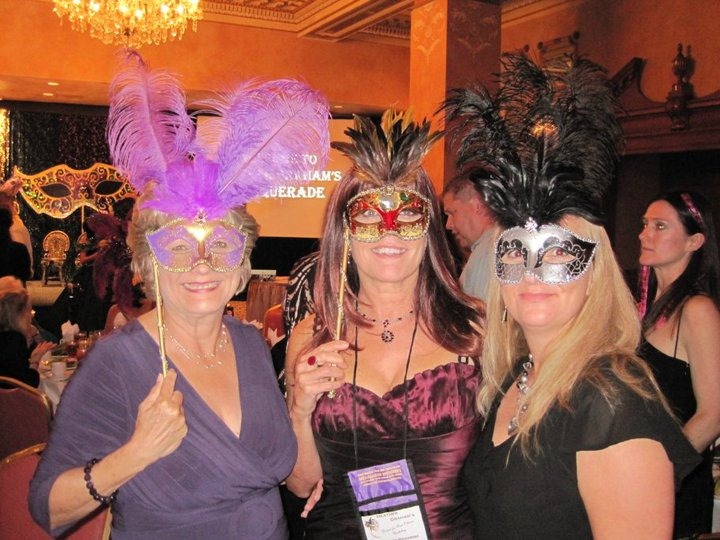
Masked Ladies

357

While we may seek to keep our identity private, either by costumes or maintaining a low profile (the latter of which I have no idea how to do!), I learned a really hard lesson over this weekend.

I learned that the potential for identity theft could even happen to me.

Early Saturday morning I was awakened by an urgent phone caller telling me that my computer (which was in “sleep” mode) was downloading dangerous viruses that would soon crash my hard drive.

I questioned the caller. He said he was with Microsoft Windows and that I was wasting precious time by asking questions. Now, I’d like to say I was half asleep, but my gut reaction was to hang up on this dude and I ignored myself.

What an idiot!

When will I learn to trust my gut? I’m telling you. No more Ms. Nice Piks in this corner. No. No. No.

I am embarrassed to tell you that I trotted into my office and gave this clown remote access to my computer so he could show me the infected files which turned out to be error and warning messages typical of Microsoft files. Then he proceeded to try to sell me an antivirus program for $130.

I said, no. He bullied me some more then I hung up. But no, that wasn’t enough. He was still remotely connected. When I notated on the screen that he should exit my computer, he had the audacity to tell me to wait–twice!

In hindsight. I should have turned the darned thing off, but hindsight is 20/20—and the slimy dog had control of the mouse. Sheesh!

I posted the episode on Facebook and folks responded saying they’d had the same or similar experience and the guy really was trying to get me to by an expensive antivirus program. I hope that was all. Others offered advice on restoring my PC before the event to eliminate any viruses he may have planted.

Then, I went and purchased an Identity Theft system to monitor my PC. I learned some interesting info and want to share it with you.

There are plenty of sites out there to give info on how to protect against identity theft. Nextadvisor.com is a good place. Here’s a link to compare Identity Theft services: Compare IT Services.

I also found tips to prevent Identity Theft. One point of vulnerability is storing your data on Cloud or DropBox—remote sites to hold files instead of on your own computer. You end up trusting your on-line server to protect your stored files from hackers. Word is that the law is nebulous over who is liable for data theft on these sites. Since Cloud and similar services are free, the user is usually held responsible for any breach of information. Do your homework before placing valuable information out there!

Here are a few tips to avoid Identity Theft:

1. Instead of signing the back of your credit card, write “request ID”.

2. Shred everything that has your name on it.

3. Destroy Digital Data. Erase any info on discarded computers, smartphones, etc. that hold data on you. Break them, if all else fails.

4. Read through statements carefully. Be sure your being billed for items/services you purchased.

5. Don’t leave mail in the mailbox. Easy target for looters.

6. Check your credit reports at least once per year.

I bought Identity Guard for my computer because not only does it monitor my SS#, bank accounts, loans, credit cards and the use of my name, phone and address, Identity Guard monitors my PC with an anti-phishing and virus protection called Zone Alarm for the duration of membership. I feel pretty confident that I’ve protected my security at last.

Another site, 5Identity Theft Protection, offers tips to protect social media activity and internet passwords. Here’s the link. This site is loaded with info: Identity Theft Protection

Here are some additional warning signals I found on 5Identity Theft Protection to tell if your identity has been compromised:

– you are denied credit or loans for no apparent reason

– monthly credit card statements, utility bills, etc. stop arriving

– you receive a credit card without asking for one

– you receive bills from places you haven’t been

– you receive notices from collection agencies

– some of your mail is missing.

Hope this info helps and encourages you to think of me if someone asks for access to your computer. If they call you, the answer is, NO! (I know, you already know this!) Be sure to think twice before putting your valuable information into the ether-net for purchases and signing up at different sites. Always check that the site is secure. In closing, I wish that your identity only be lost as far as the next costume you wear!

Happy writing!

xox, Piks


Omit Needless Words!

by Clare Langley-Hawthorne

It’s with a wee bit of wistfulness that I write this blog post, as not only have we bid ‘au revoir’ to two of our blog mates, John Gilstrap and John Ramsey Miller, but also because I have realized just how many blogs have now gone off-line having, perhaps, run out of steam or time or words of wisdom. It’s hard thinking up topics week-after-week and deep down, I fear, I repeat myself a lot:) 


However, there are always new topics that catch my attention (like just how Fifty Shades of Grey has managed to become a huge bestseller…)  and old topics that never seem to be resolved. One of these is the question of just what makes bad writing, well…bad. I was prompted to ponder this issue anew by an article in the ‘Dear Book Lover’ column of  the Wall Street Journal last month (which my husband forwarded to me, hopefully, not because he thinks my own writing is bad!).  


As this column points out, bad writing is impossible to define because of the inherent subjectiveness involved in determining what constitutes ‘bad writing’. It goes on, however, to point out that bad writing almost always involves overwriting and here is where I have a confession to make – I am an overwriter. There I’ve said it. When I was younger almost all my material was packed to the brim with overripe metaphors and obscure concepts. In the words of Roger H. Garrison (“How a Writer Works”) it was flowing with the “tides of phony, posturing, pretentious, tired, imprecise slovenly language, which both suffocate and corrupt the mind.” Mea culpa, indeed…


So what did I do to change this tide? I took Strunk and White’s advice to heart  and I learned to “omit needless words.” Sadly, I still overwrite on occasion, but at least now I (usually) pick it up in the editing and revision process. It also helps me to follow another terrific mantra to “keep it simple, stupid.” Unfortunately, as I mentioned in my comment to Jim’s post yesterday, I still find it hard to do the same when it comes to concepts or plots, but I am learning (I hope!).


So how do you define ‘bad writing’? Are, you like, a closet over-writer or are you blessed by the goddess of brevity? Do you find that your tolerance for sloppy prose has diminished over the years? Perhaps this has helped my own writing. Gone are the days of buying into the high-faluting drivel  of many so-called literary novels. Nowadays, I want to read something that distills rather than over-kills a complex concept. What about you? Will you keep reading even if the actual writing is (dare we say it) ‘bad’?


Successful Fiction Begins With a Great Concept


Joe’s excellent post on the magic words “What if?” got me thinking about the crucial importance of concept.
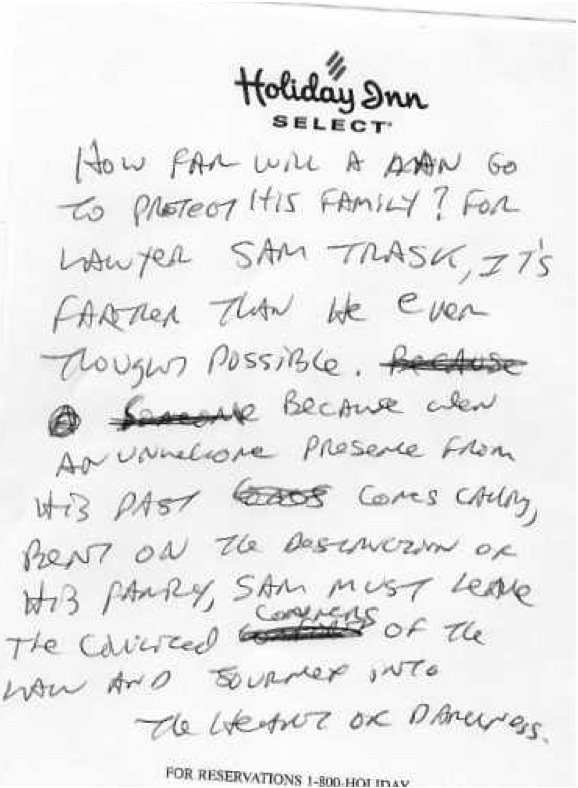
I was going through some old files the other day and came across this little scrap of paper from several years ago. I remember it well. I was on a trip to talk with my publisher at the time, Zondervan, and to pitch some projects.
I had an idea that had been chugging around my brain for awhile. It was based on two things. First, an uncomfortable encounter with someone from my past who was insistent on edging back into my life.
The other was the plot of one of my favorite novels, The Executioners by John D. MacDonald (basis of the Cape Fearfilms).
I put those two items together. This is a great method of coming up with plot ideas, by the way. Dean Koontz has been a master at this. For instance, Midnight,one of his best thrillers, is a cross between Invasion of the Body Snatchers and The Island of Dr. Moreau. Koontz even references those titles in the book itself, to “wink” at the readers who recognize the plot lines. But the characters and setting are original creations. 
Anyway, I was in the hotel room in Grand Rapids and jotted this:

How far will a man go to protect his family? For lawyer Sam Trask, it’s farther than he ever thought possible. Because when an unwelcome presence from his past comes calling, bent on the destruction of his family, Sam must leave the civilized corners of the law and journey into the heart of darkness.


Not bad for an on-the-spot jot on Holiday Inn note paper. The concept was the basis of my novel No Legal Grounds (2007), which became a bestseller and is still one of my favorite thrillers.
The reason: concept. If you don’t get your concept solid and simple from the start, you’re likely to wander around in soggy bogs and down random rabbit trails.
A writing teacher once told me that the most successful movies and books are simple plots about complex characters. I think he has something there. You should be able to articulate your concept in a few lines.
A self-centered Southern belle is forced to fight for her home during and after the Civil War, even as she fights off the charms of a handsome rogue who looks exactly like Clark Gable.
To get back home, a Kansas farm girl has to kill a wicked witch in a land full of Munchkins and flying monkeys. Aided by a scarecrow, a tin man and a lion with issues, she faces dangers aplenty along a yellow brick road.

A vigilante nun cleans up the streets of L.A. Sinners beware. (Okay, I know, shameless. But it truly defines Force of Habit for me, and will for the entire series).
A simple, strong concept is your anchor, your floodlight in the darkness. It will keep you focused and writing scenes with organic unity.
In real estate, it’s location, location, location.
In fiction, it’s concept, concept, concept.
Make sure you know yours before you start writing.
***
I will be taking students from their concept through “sign post scenes” up to indestructible structure at my upcoming 2-day writing seminars. Would love to have you. Details can be found here.

And I’m Following Gilstrap, As Usual.

 By John Ramsey Miller
A few years ago one of my dearest friends, John Gilstrap, invited me to join the Kill Zone Blog Group.  I suppose I was the last of the original seven to be called on. And I got the best day, Saturday. I thought blogging would be a great way to exercise my pomposity, talk about where stories come from—life,  and to be truthful with newcomers about what the craft was really like. I hope I’ve done some of that over the past four years and whatever John thinks as to the number of blogs. I have had my dear friend, Joe Hartlaub taking every other Saturday since life started taking up more and more of my time. I’ve got nothing else left unsaid that I can think of.
I’ve truly enjoyed writing most of the articles, although sometime I had nothing in mind right up until I was against the deadline. Since I’ve had Saturdays I could write Friday evening. Sometimes I’d be into my happy hour before I realized I hadn’t posted my blog. A couple of times James Scott Bell would have one ready and he’d be kind enough to go in a day early, and let me go after him. My 5:00 constitutional is either a single malt self-served neat, a scotch on the rocks, scotch and soda, a vodka martini with big ole huge Mangarangololo olives, gin and tonic, beer, and I usually do several of one of those.
I have enjoyed great latitude blogging here, often bragging about my marvelous chickens, my grandchildren, children, my excellent dogs or the garden my wife loves tending. I was here when my Marine son was in Iraq on the Syrian Border pushing at the insurgents. Sometimes I have written a post I wished I had thought through better, or hadn’t taken on the subject matter.  I’ve been a nice guy and I’ve been a bastard when reviewing authors submitting first pages.  My sense of humor is sometimes hard-edged, my patience often too thin.  I’ve wished I knew more about this craft, but I’ve always been an instinctive writer, not a taught one because I rarely pay attention to advice or suggestions. My bad.
I will miss being here, but I’m going to keep writing at a relaxed pace (doing a book with Mark Tufo) and if it works, it works. I think it will.  Tufo is a great guy.
So far in life I’ve had several successful careers.  I had a career as a photographer. I produced 75 record album covers for major record labels. I traveled for LOOK, LIFE, PEOPLE, COUNTRY MUSIC MAGAZINE. I did a series of “formal” Death Row portraits. I loved it.
I co-owned a successful Advertising Agency in New Orleans. Loved that too.
I wrote features for the Miami Herald’s TROPIC MAGAZINE. Great fun.
I wrote a non-fiction book about the 2 Live Crew’s obscenity Trials. Weird, but interesting.
I wrote one screenplay and sold it to a major studio where it vanished into turnaround. 
I wrote a New York Times Best Seller. I followed that with six other novels. I have, last count, 2 million books in print.  A few have sold. It was all a blast.
I wrote a book with eleven other authors and it was the audio book of the year beating out Harry Potter and The BIBLE. Then I gave my slot to another author for the next book, because I thought the project was a great opportunity for me and I was convinced that another writer should have the same opportunity I’d had. I have never regretted that decision and I don’t think THE COPPER BRACELET suffered for it. Great experience.
A few months ago joined my son in a silk-screening business he started in his garage and we moved it into a large commercial space with high-falooten equipment. His wife is expecting my seventh grandchild in a week or two. It’s just the two of us, working shoulder to shoulder. Nobody knows or cares that I was a best selling author. I’m just Pops up there. I’m getting my hands dirty and having the time of my life. I’ve got Plastisol inks under my nails right now. You guys ever need custom printed T-shirts or embroidered caps to sell your books, call us.  DaVinTee is the name. We’re in Concord, NC.  Just say that you heard about us on John’s Kill Zone Good-Bye blog and get a 20% discount off our already low, low prices. 
Will I miss this blog? I think so. Will I miss all of my blog mates and readers?  Absolutely. I’ve a few years left and I plan to run through them grinning. It’s time for me to walk away and let someone else step up. Joe and the gang will keep this blog at the top, where it deserves to be. I will be lurking, and like, Gilstrap. I’ll be commenting because it’s our nature. That is the way of life and the way it should be. I’ve spent my life walking from thing to thing, and it’s kept me smiling.  
 Hell, I’m smiling now. Oh, and may God bless you one and all.

So Long, Farewell, Auf Wiedersehen, Adieu

By John Gilstrap

I tell my students in writing classes that you know it’s time to stop writing when you’ve run out of things to say. It seems reasonable that what applies to fiction should likewise apply to blogging, and thus, this is my final post as an active duty Killzoner. It’s been close to three years, which means something along the lines of 150 Friday posts, and, frankly, I worry that I have begun to repeat myself. Y’all deserve better than that.

As one of the founding members of this corner of cyberspace, I’m very proud of what we’ve accomplished, and I value each of the friendships I’ve developed over that time, both real and virtual. I feel as though I’ve come to know our regular posters, and I hope that we continue to communicate. To reach out directly, please feel free to email me at john@johngilstrap.com. I really do answer every email I get, though sometimes I’m admittedly a little slow.

If you’ve got some spare time, I hope you’ll make a chance to visit www.johngilstrap.com and join my mailing list. I don’t send out a lot of newsletters, but when I do, I work hard to make them short, relevant and interesting. Also, I encourage everyone to “like” my Facebook page, www.facebook.com/johngilstrapauthor. When I get the urge to write a blog-like essay, that’s where I’ll be posting it. And, of course, there’s my Twitter account, @johngilstrap; but I must confess that the usefulness of Twitter continues to elude me. (That semicolon was for you, Mr. Bell.)

I should point out that I’m really not going anywhere. I’ll continue to be a regular visitor to TKZ, and I’m sure I’ll be adding a few cents-worths from time to time.

It’s been a privilege, folks. For those of you who write, keep writing.  Never lose sight of the dream and remember my mantra that failure can never be inflicted upon another person. It has to be declared by oneself.

And for heaven’s sake, keep reading.