Don’t Stop Believin’
Reader Friday: Where do YOU write?
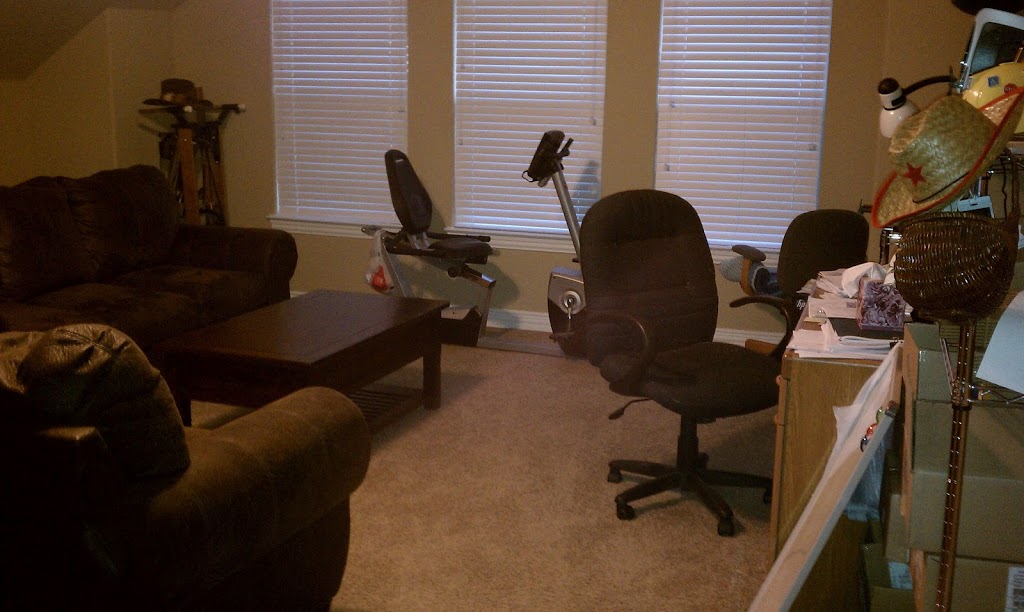
Last Friday we shared some pix of where the TKZ bloggers write. This week, it’s your turn. A number of readers responded to our request with some great photos of their writing spaces. Here we go!
Basil Sands:
Basil is a self-described “on the go, write-where-you-can” kind of guy.
“I have three primary butt parking spots where my literary juices tend to spike highest,” he says.
I vote for #2, the comfy, cozy chair.
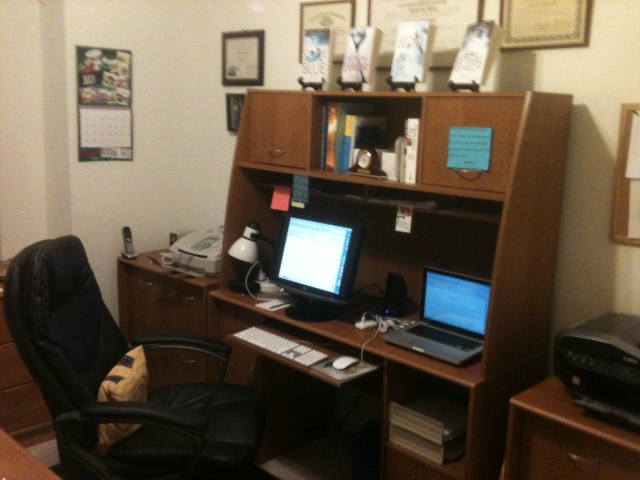
John Gilstrap:
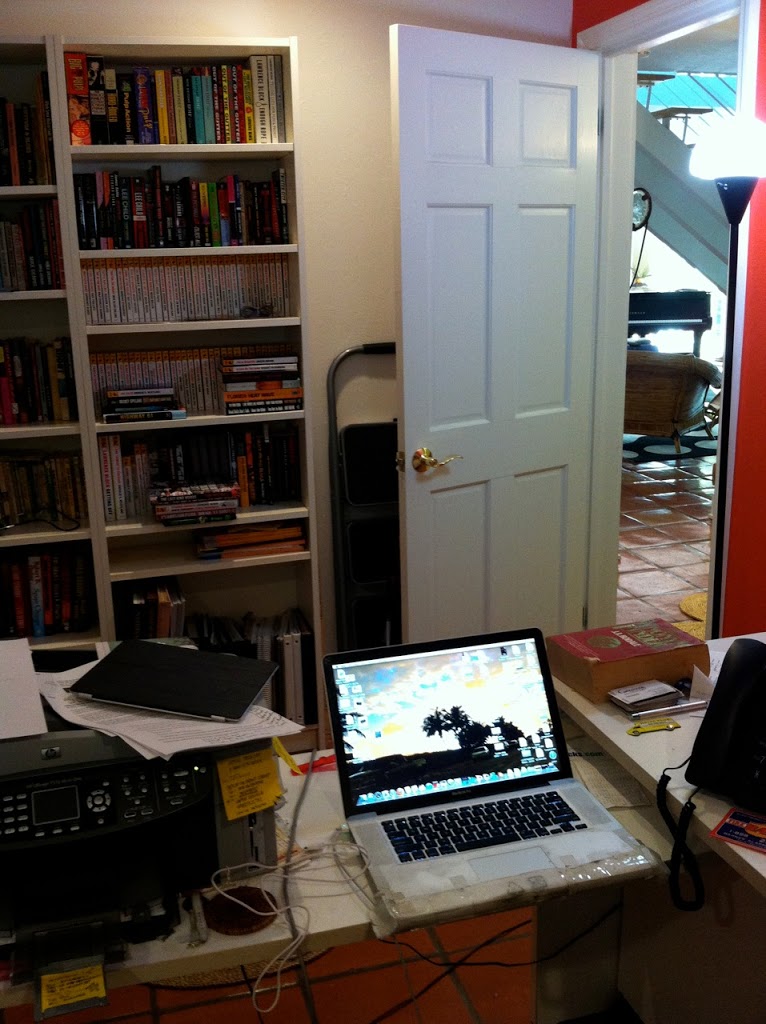
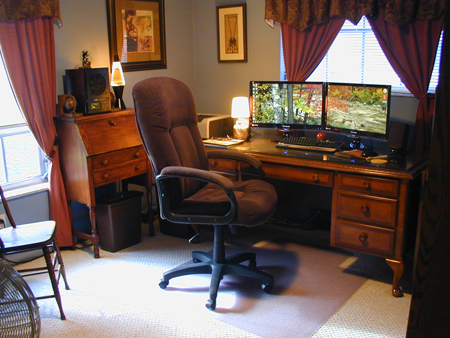
Blogger Emeritus John Gilstrap sent in a view of his office as you come in from the front door. I have to say, John’s writing space comes closest to my ideal vision of a bestselling author’s writing space!
Mike Dennis:
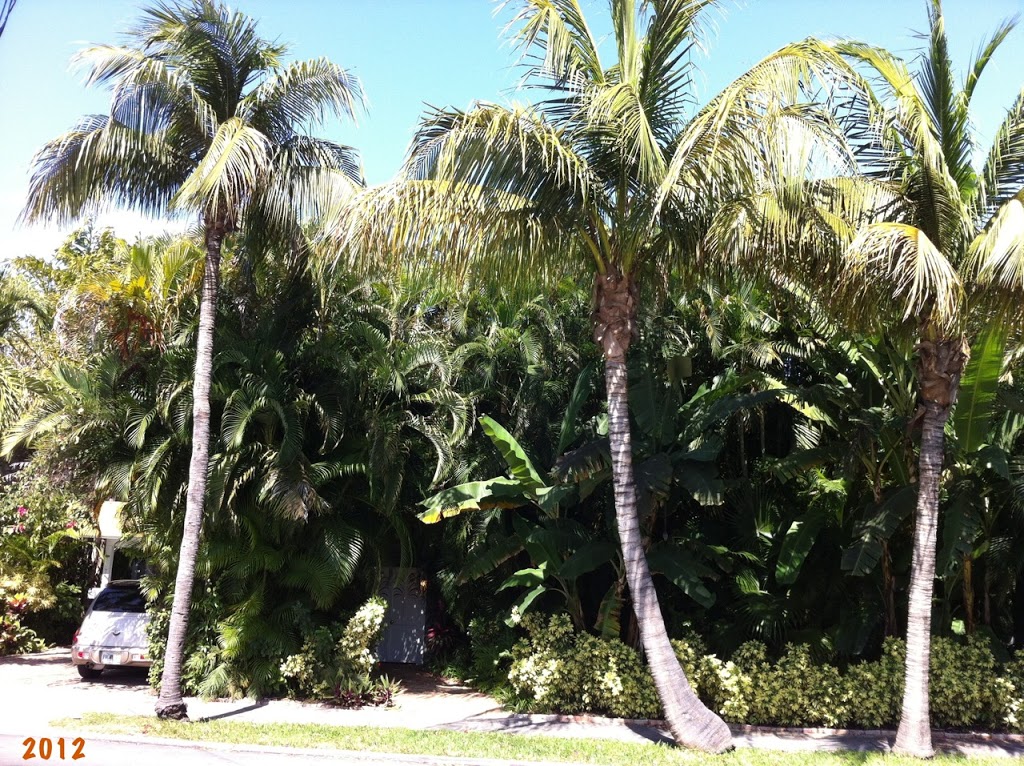
OK, forget the office–just look at Mike Dennis’s place (I think it’s hidden behind the palm trees). It must be great to work in paradise!
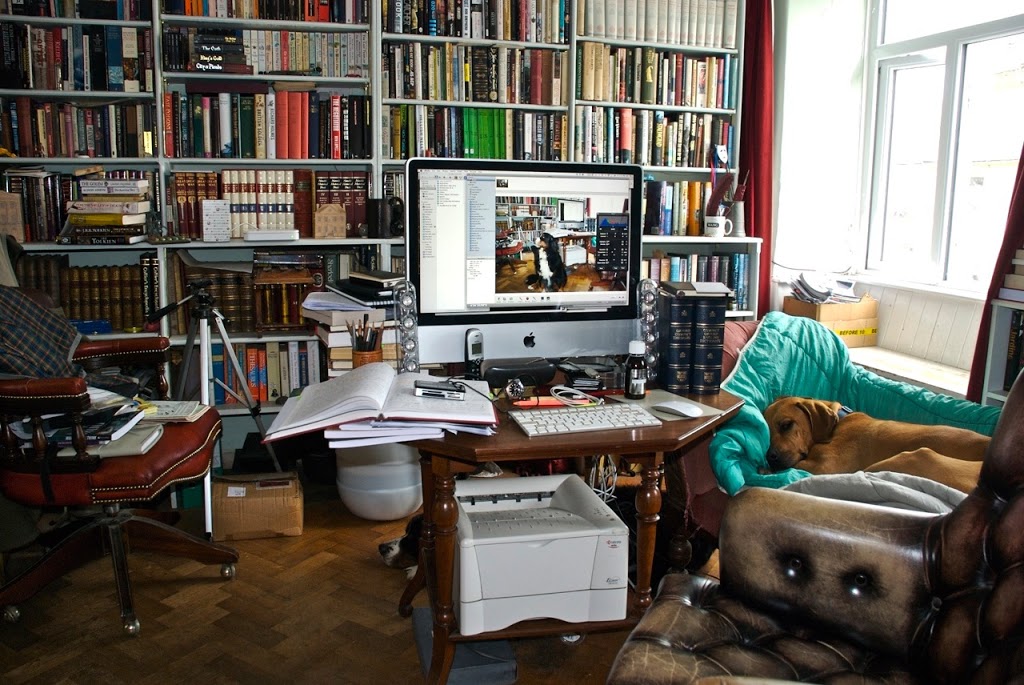
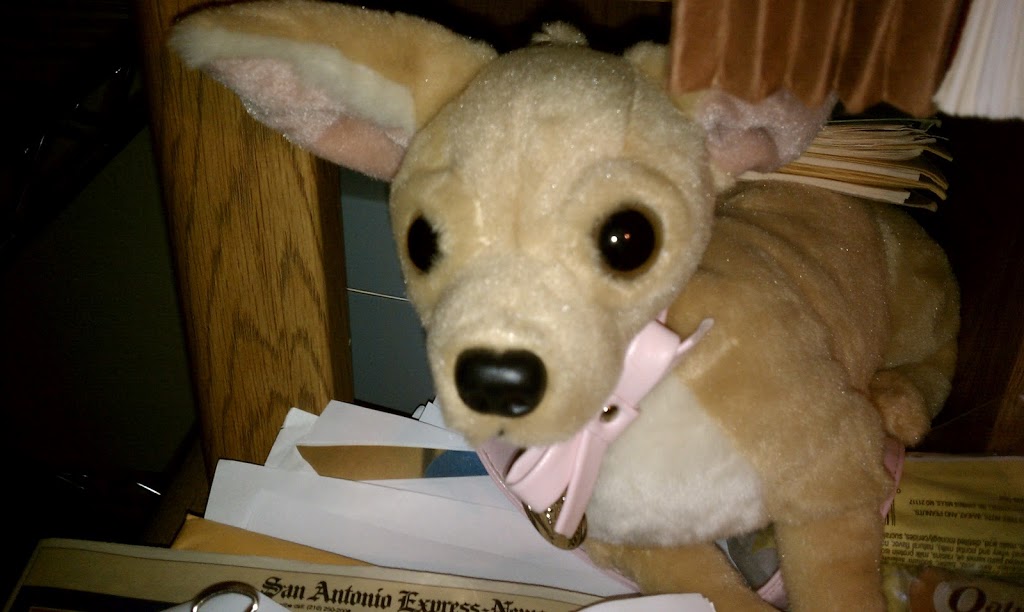
“As you can see, British writers don’t tidy up the desk before wandering off to pointlessly take photos, even leaving both dogs in the shot to prove we’re not idly ambling around the lanes instead of working,” he said, with lovable British sarcasm. “No. We’re sitting indoors pretending to concentrate on the next book, while actually taking photos of the ‘workspace’ instead. Work displacement activities are a wonderful thing! Hope you like the way I took one photo, didn’t like it, so took a second while leaving the first on the screen … yeah, I forgot.”
Oh, and the second dog? If you look under the desk, you’ll spot a nose.
Zoe Sharp:
Zoe gets her creative juices flowing in an unlikely spot–her car.
“I get a lot of productive work done in the car on motorway journeys,” she says.
Seriously, Zoe? Be careful doing that in Southern California–they hand out tickets here for texting and using a cell phone, much less tapping out the Next Great American Novel!
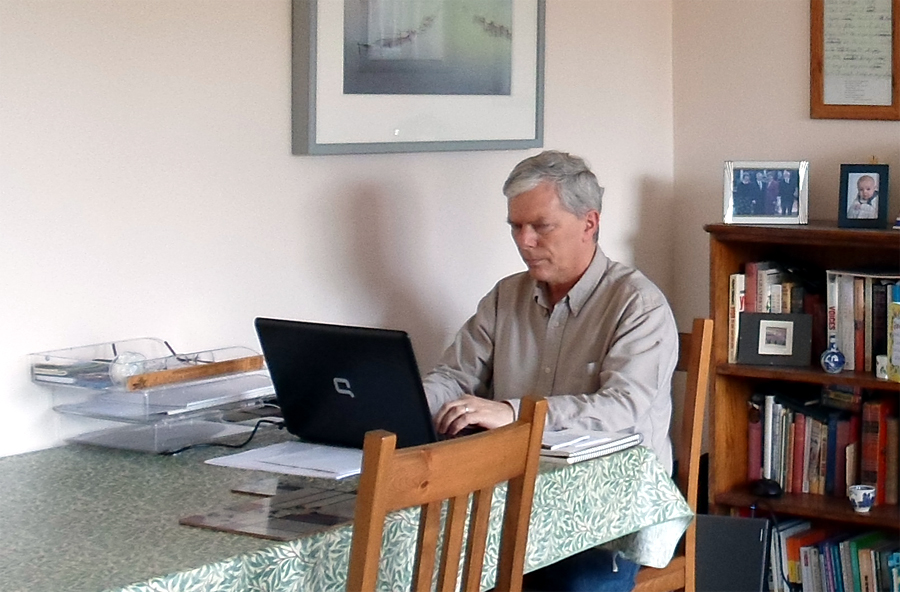
Michael Harling:
Michael is shown working in his office.
“This is me, our dining table and, yes, that is my permanent ‘office.’ It is where I work when I am not writing on the bus or a train,” he says.
I’m a dining room table writer too, Michael. Thanks for sharing!
Richard Mabry:
Richard Mabry sent us a photo of his office from his iPhone. Very cool!
“My office used to be in the basement… and my youngest son wanted to move down there so I switched with him,” Mark says. “I rather liked the solar system hanging from the ceiling, so I left it up.”
The acoustic guitar provides an additional outlet for creative expression.
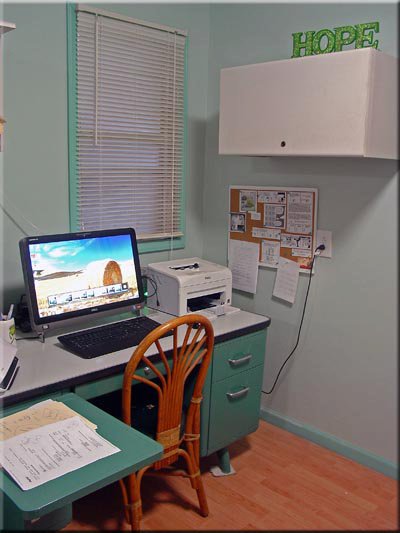
Terri Coop:
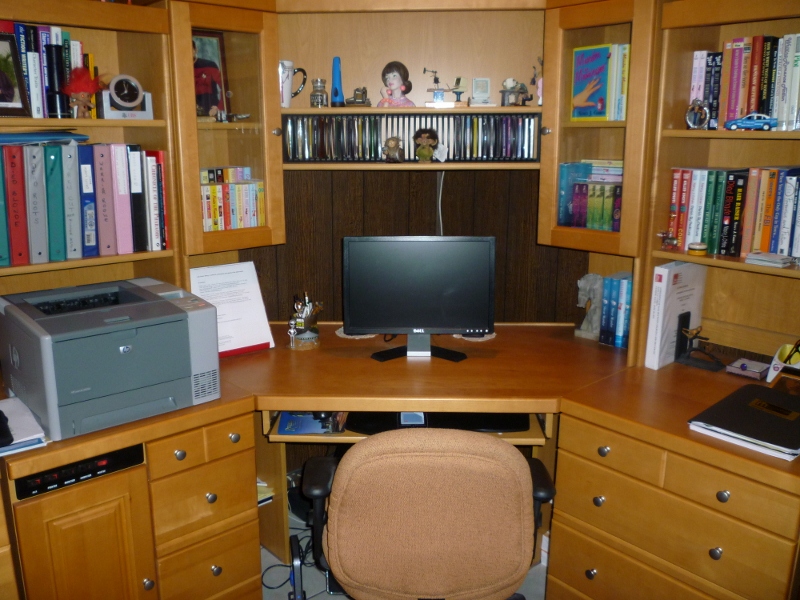
Terri describes her office as “very much my cocoon.”
“This is my little corner of the world where I write and run my business,” she says. “It is in a free-standing apartment built inside my warehouse. I rescued the desks and wall mount cabinets from the alley behind an insurance agency (there is another on just like it to the left holding all my graphic design printers). Then I decorated the office around the desks.”
I love the HOPE sign on top of the cabinet. Every writer needs one of these!
Thank you!
Sending out a big thanks to everyone who shared their pictures and stories about their writing spots this week. Hope we didn’t overlook anyone. Please share your story today in the Comments!
Getting Out of the Protection Racket
by Meg Gardiner
Thrillers toss characters into danger. They force cops to chase maniacs through dark woods. They make covert agents disarm suitcase nukes—while trapped by rising floodwaters and clutching a basket of kittens. The writer’s job is to keep the reader worrying: Who’ll survive? Please let it be the cop. And the kittens… won’t somebody think of the kittens?

But here’s the thing. If your sympathetic characters always survive—the hero, the partner and girlfriend and Fluffy—are you writing a real thriller? Or are you conducting a puppet show?
This raises the question: Should you ever kill a major character?
Michelle Gagnon has done it. George R.R. Martin does it so regularly that readers preemptively cry, “Noooo!” before opening his books. On the other hand, I recently heard Sue Grafton promise that none of the regulars in her Kinsey Millhone series is going to die. And I felt so relieved. I felt happy and grateful.
And I’m not following in her footsteps. Here’s why.
A few years ago, I realized I was protecting my characters. Not in any obvious way—in my novels they faced plenty of peril. The Evan Delaney series opened with a major character critically injured and disabled. Heck, Jo Beckett’s husband was buried before chapter 1 began. But when I sat down to write, I unconsciously assumed that all the characters I liked would make it out alive.
This was a bad thing.
Bad, but natural. It takes me a year to write a novel, and in that time my characters grow on me. I want them to stick around, and to be happy. That’s my problem: I want them to live normal lives and play softball and build loving marriages and have beautiful babies.
And as soon as I think like that, part of me starts to write them as content, easygoing, settled… and wants to keep it that way.
You can see that what works well in real life would take the edge off in a thriller.
And I saw that I was never truly jeopardizing my characters’ lives or relationships. Sure, I’d write scenes where they faced doom, and readers would worry… but I knew they weren’t at risk. In my own mind, I never truly put their fate up for grabs. I kept them safe. During the course of the novel they got scared and maybe beaten up or even shot, but in the end they always got together for margaritas and a good, if rueful, laugh.

But safe leads to static. Safe kills suspense.
One of my favorite books on craft, Stein on Writing, talks about the concept of the crucible, “the container that holds the characters together as things heat up.” It’s a key to successful plotting:
“Characters caught in a crucible won’t declare a truce and quit. They’re in it till the end. The key to the crucible is that the motivation of the characters to continue opposing each other is greater than their motivation to run away. Or they can’t run away because they are in a prison cell, a lifeboat, an army, or a family.”
It’s a great concept, and an excellent way to increase drama. But by promising my favorite characters a safe landing, I was creating a crucible and then providing them with ejector seats and parachutes.
That’s when I reset my mental parameters to imagine: What if anybody can die? What if any and all relationships—family, friends, lovers—can be ripped apart by events and choices? And once I put it all on the table, I saw a more powerful way to write fiction. I opened myself to creating stories that went to the end of the line.
So I got out of the protection racket.
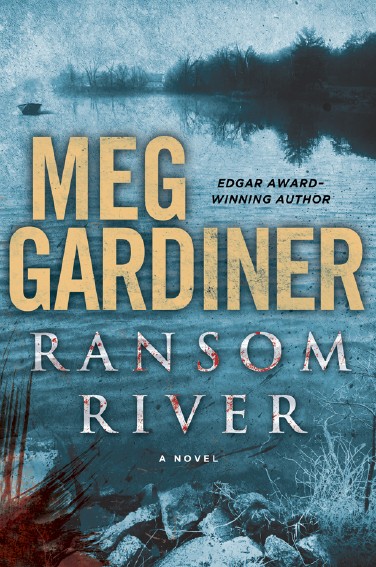
Now I try to write without a net for my characters. My new novel Ransom River throws heroine Rory Mackenzie from the frying pan into the fire. She’s a juror on a murder trial who finds herself fighting for her life when gunmen attack the courthouse. Though she escapes, she lands in a hotter crucible—she discovers that the attack is connected to an old unsolved case, and to dark skeletons in her own family history. Bringing the truth to light might destroy her and the people she loves.
I think I took the story as far as it could go. And part of me still thinks, Yikes, Rory. You’ve got some nasty relatives. Sorry, kid. But I know I shouldn’t change a word.
Here’s my writing advice: Put your characters to the test, and don’t let them get out of it by any means but their own grit and blood and pain.
Don’t let coincidence save them. Don’t let somebody else come to their rescue. Don’t provide a secret fire exit to the sunny side of the street.
Make them act. Make it hard. Force them to sacrifice. If they’re characters that readers care about, you’ll create genuine suspense. You’ll raise the stakes, and write books that readers shove into their friends’ hands, saying, You’ve got to read this.
MegGardiner.com | Visit Meg on Facebook and Twitter | @MegGardiner1
Conference season and the pitch
By Joe Moore
This week, ThrillerFest VII, the annual writer’s conference sponsored by the International Thriller Writers is taking place once again in the heart of the publishing universe, NYC. Like many other major conferences held each year, ThrillerFest is a great opportunity for writers and fans to come together and celebrate their love of the genre. If you’ve attended a conference like ThrillerFest, you already know the benefits. If you haven’t yet experienced a conference, make a goal to do so soon. You won’t regret it.
ThrillerFest is actually a combination of 3 events: CraftFest, AgentFest and ThrillerFest. CraftFest is a 2-day series of workshops taught by some of the most successful mystery and thriller authors on the planet. Names like Berry, Sandford, Gardner, Coulter, Palmer, Morrell, Rule, Child, and TKZ’s own James Scott Bell are just a few of the instructors on staff this year.
ThrillerFest is a 2-day collection of discussion panels and spotlight guest interviews culminating in the naming of this year’s ITW Thriller Awards.
AgentFest is an insanely popular opportunity for writers to pitch their manuscripts to over 50 top New York agents and editors. The pitching exercise is what I want to talk about today.
We all know how important it is to prepare when pitching a manuscript to an agent: look professional, act professional, be able to summarize your premise in a couple of sentences, and know that not every book is right for every agent (most of the time, that’s why they say no).
But what about those things you don’t want to do; those things that could wreck you presentation or turn off the agent? Here are a few pitfalls to avoid:
Never refuse advice or feedback. Even if the agent or editor is not interested in your book, many times they will offer suggestions or advice on making it more marketable. Never have a closed mind and think that it’s your way or the highway. Professional agents know the market and are aware of what the publishing houses are looking for at any given moment. Also remember that just because an agent is not interested in your book doesn’t mean the book is not publishable. It’s just not for them.
Don’t begin your pitch by saying that “everyone loves your book.” Of course they do, because everyone is probably your family and friends, and if per chance they don’t like it, the last thing they want to do is hurt your feelings. If they didn’t like the book and were completely honest with you, it would be like hitting your ego with a sledgehammer. Now on the other hand, if John Grisham, Ken Follett or Stephenie Meyer read your manuscript and loved it, I would mention that somewhere right after "hello".
Don’t be a pest. By that I mean sending the agent multiple emails, phone calls, letters, presents, or anything else that would quickly become annoying. If the agent says no, the likelihood of you turning them around with a box of Godiva chocolates is not good. Send it to me instead.
Don’t suggest that if the agent wants to know all about you they can visit your website or blog. It doesn’t matter if Michelangelo designed your graphics, James Patterson wrote your text, and Lady Gaga composed the music for your book trailer. The agent doesn’t care. All she wants to know is: who are you, what is your idea, and can you present it in a logical, concise and professional manner.
Even if your manuscript has been rejected before, don’t volunteer that information. As far as the agent is concerned, they’re getting the first look at your idea. They’re also realistic and know it’s probably been pitched before. And the fact that you’re standing there means that if it was, it was rejected. Always remember that rejection is as much a part of the publication process as line editing or cover design. It happens to everyone. Move on.
Don’t claim that no one has ever written anything like your book before. If that’s really true, there’s probably a good reason no one has. But trust me, claiming that what you’ve written is a brand new idea is as compelling as claiming you have the winning numbers for tomorrow’s lotto. What you might want to do is suggest that you’ve completed a unique and original treatment of a well-established theme or premise. That will make sense to the agent.
Never say that your book is going to be the next blockbuster or that it should be made into a movie. The top professionals in the publishing and motion picture industries cannot predict with certainty what will be the next blockbuster or bestseller. Neither can you.
In general, always assume that an agent or editor has already heard every variation on a theme there is, because they have. Much of your success in capturing the attention of an agent is you, not your story. Be enthusiastic but not obnoxious, knowledgeable but not condescending, proud but not conceded, prepared but not pushy. And most of all, be friendly and professional. Your presentation is a foreshadowing of what it would be like to work with you. Agents don’t want to spend a year or more in a wrestling match with a jerk.
Remember that literary agents and editors are people, too. Yes, they can have a tremendous impact on your writing career, both positive and negative. But just like the rest of us, they get excited when they hear a great idea. Treat them as people, not gods.
If you practice all these tips and you have a killer idea for a book, there’s a good chance the agent will hand you her business card and ask for a partial. And if by chance, she asks for a full, go celebrate. You’ve accomplished more than most ever will.
Rethinking the “Like” button
![]() |
| Graphic by Scott Beale, Laughing Squid |
Recently I’ve been inundated by “Like” requests from Facebookers. “Like” my page! “Like” my product! “Like” my book! Like me! Like me!
I used to be a promiscuous Liker. Show me your Like button, and I’d press it. Why not? I figured. There’s little enough like in the world, say nothing of love. I was a one-woman sunshine squad, spreading the Like around.
But then I read that if you Like something, your endorsement might turn up in a Facebook ad or Sponsored Story. I started worrying about my lengthy trail of Likes. Egad, what if my mug wound up in an ad for Jello(R) Chocobeasts? I moved quickly to counteract potential damage; first I reset my Privacy options so that my name can’t be used without specific permission. Then I went through the products that were hawking messages in my timeline; I must have liked those products sometime in my glad-handering past. I Unliked all the ones I could track down.
Nowadays I seldom press the “Like” button. Like Sally Field, I have to really, really like you. To “Like” you, I mean. And I’ve started to pine for a “Dislike” button.
It’s not personal. It’s business. But isn’t that what all the Like-mongers are after, after all? Our business?
Am I the only person who has grown wary of the Like button? Have any of you wound up unintentionally in an ad, simply because you Liked something?
What Your E-Reader Knows…
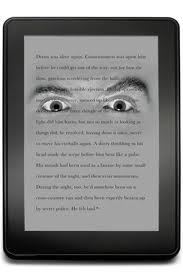
An article in today’s Australian newspaper has prompted me to re-think exactly how much my e-reader knows about me and how little I know about the technology that is used to monitor the book apps I’ve downloaded on my iPad and iPhone.
Today’s article, “Your e-book is reading you” (which I think is a reprint of an article in the WSJ – the link to which is here.) highlights the amazing amount of data these kind of devices can provide not just about what you are reading but how. Gone are the days when no one knew when you skipped the boring bits, abandoned a literary classic or got totally bogged down and bored. Instead (apparently) your e-reader knows:
- How fast you read the book and when you slowed down, skipped bits, or stopped reading it altogether
- Which passages you highlighted or bookmarked
- How many times you opened a book and how long you read it for
- How quickly you purchased/downloaded a sequel after finishing a book
I have to say, I never really thought about my e-reader gathering such data, but now this information is proving invaluable to sellers as well as publishers. They can now use this knowledge to gain insight into your reading habits. They can tell when a reader’s interest tends to drop off, when a series might be flagging and the kinds of books readers consume in one sitting versus those which tend to get read in fits and starts (most non-fiction, apparently gets read this way).
This information can also be very specific and some publishers are even conducting market tests in which readers can customize elements of the book – from the level and intensity of love scenes (!) to which of three potential suitors a female protagonist chooses. At one level this smacks of commercial dilution of the creative process (rather like writing a book by committee!) but obviously this kind of analysis is proving invaluable for publishers (and writers) on exactly what readers want. By looking at the pace with which books are read and the places where readers get bogged down or bored, publishers can also glean when a writer is losing a reader’s interest.
For instance, for Suzanne Collins’ hugely successful Hunger Games trilogy publishers found out:
- It takes the average reader 7 hours to read the final book on the Kobo e-reader (which equates to about 57 pages an hour)
- That 18,000 Kindle readers highlighted the same line in the second book – “because sometimes things happen to people and they’re not equipped to deal with them”
- On Barnes & Noble’s Nook e-reader, the first thing most people did upon finishing the first book in the trilogy was to download the next one.
Obviously this kind of data makes it clear why the series is so popular – readers read it voraciously and then immediately want to read the next installment. But how do you feel about your e-reader knowing that much about your reading habits?
Do you consider it an invasion of privacy? I for one would prefer no one knew which bits I skim over, especially if I’m reading some impressive high-brow literary tome:) As a writer, though, I can imagine this information could provide an amazing insight into what my readers liked and disliked about my books. At the same time this feels kind of scary and, dare I say it, a bit depressing too (knowing Big Brother is watching what everyone is reading in such detail). What do you think, should we be scared or exhilarated by the prospect?
7 Things Writers Need to Do Right Now
James Scott Bell
@jamesscottbell
Heraclitus, that old pre-Socratic philosopher who shuffled along the streets of Athens in 450 B.C. thinking deep thoughts, called reality a river, and famously noted, “You can’t step in the same river twice.”
But look at all the writers with life vests on. And some even shooting the rapids with a whoop and holler. If you want to survive and even thrive in the rush and spray of publishing today, you need to do the following:
1. Elevate your game
Be one of the workers. Write to a quota and set aside at least one hour per week to study the craft. Doing those two things consistently will get you further downstream than anything else. Every now and then go to a writer’s conference, or sign up for a specialized workshop like, ahem, this one. Subscribe to Writer’s Digest and at least scan every article. I always pick up a few things with each issue.
2. Understand publishing contracts
Anything else you would add to the list?
Like Sugar on a Sidewalk
Reader Friday: Where do we write?
Note: Starting today, on Fridays we are going to be running the first of a few special topics. For lack of a better phrase, we’re calling it “Reader Friday.”
The writer’s desk. Sometimes, it’s the place we rush to eagerly in the morning, impatient to spin magic from nothing more than thoughts and dreams. Other times, our desk is Hell on Earth. We’re chained to it, driving to make a deadline. Or struggling to fill a stubbornly blank screen.
One thing is true of all writers: We spend a lot of time at our desks. Where we work may say a lot about who we are as writers.
Here are some of the TKZ gang, as reflected by our desks.
Joe Moore – A picture of serenity
Just looking at the picture of Joe’s office makes me feel relaxed. But Joe, is it always this neat?
James Scott Bell – City View
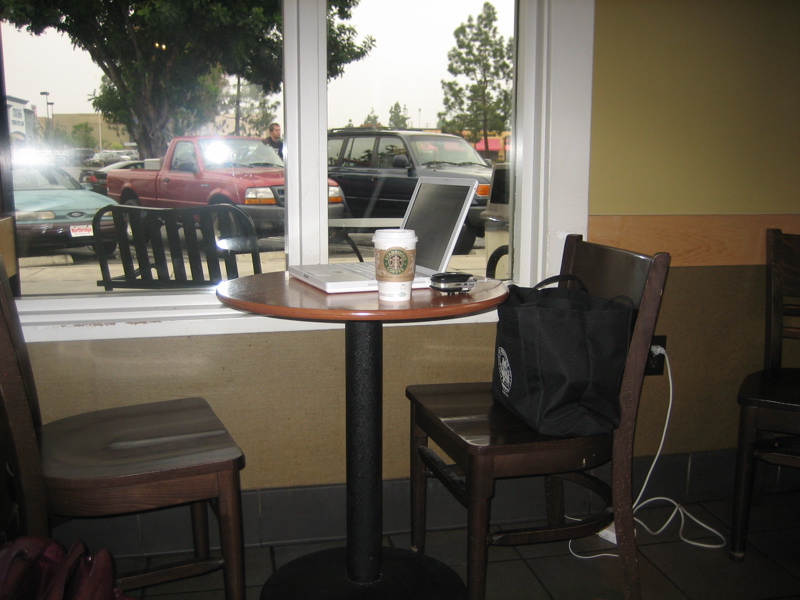
Jim Bell shared a picture of his favorite writing spot–a local coffee shop with a great view of LA street life.
Jordan Dane — Have Diva Dog, will Travel
Jordan’s well-appointed office doubles as home for her Diva Dog, which she takes to signings.
Nancy Cohen — A Writer’s CentCom
Nancy’s writing hub looks like a setting for “War Games II”. Her next thriller?
Michelle Gagnon — Thinking Outside the Box
Michelle is in the middle of a move, so she’s temporarily between offices.
“It’s interesting, because lately I’ve found that I actually work best away from my official “desk”; on airplanes, or other places where there isn’t easy access to the internet so that I don’t get as distracted,” she says. “…I am toying with doing away with a real office in favor of working in different parts of the house depending on my mood.”
Kathryn Lilley — A Terminal Case of Wanderlust
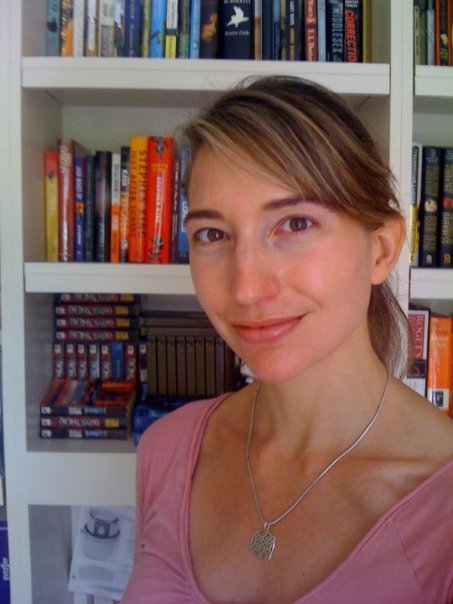
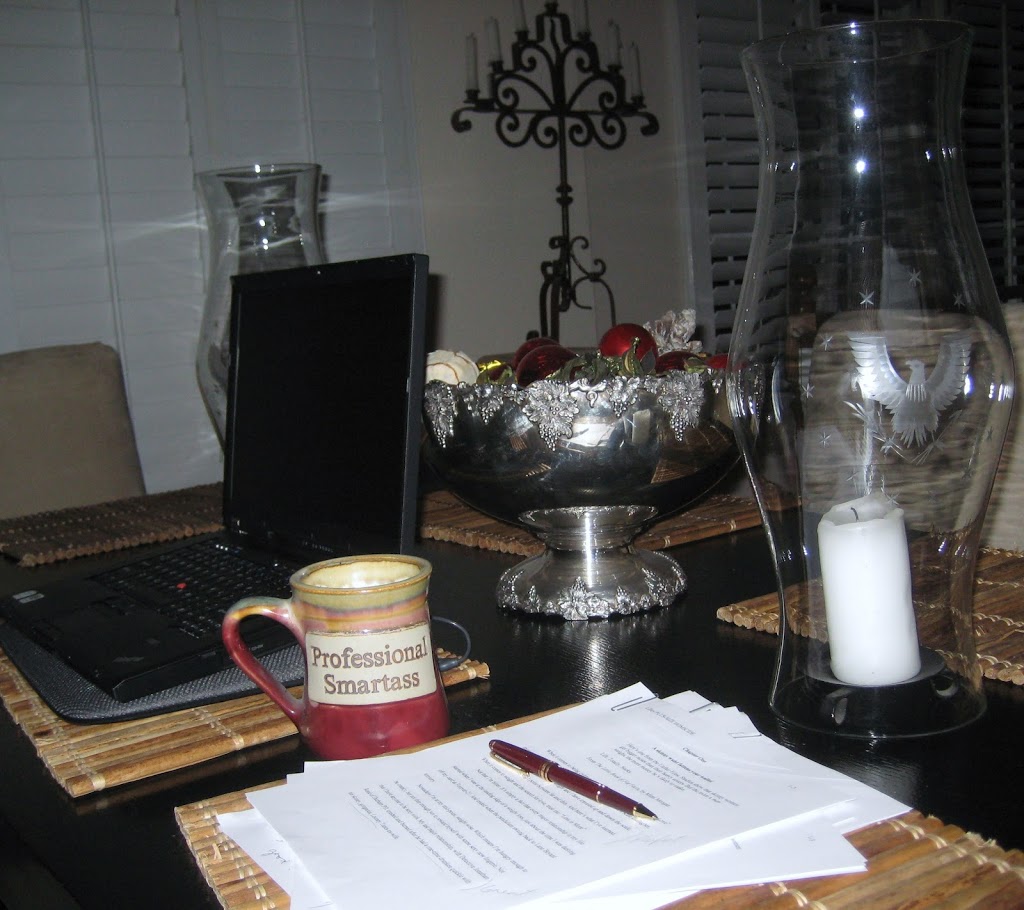
I’m a restless soul, always on the move. I plug in my laptop wherever I happen to land. Yesterday, it was the dining room table. I took this shot as I wrote today’s blog.
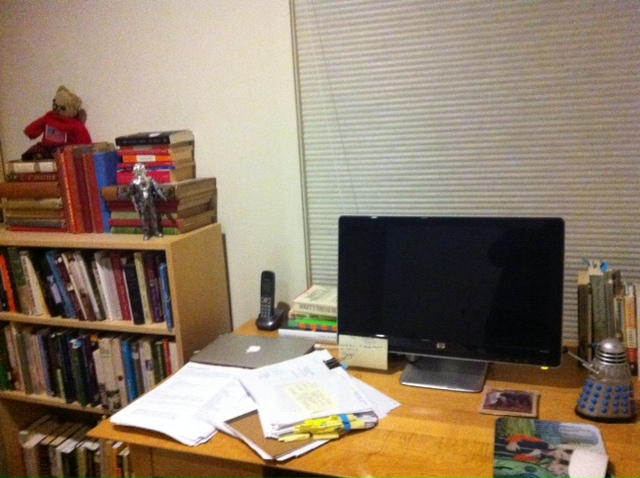
Clare Langley-Hawthorne — The Exterminator
About her office Clare says, “You can see the Dalek on my desk…I can push a button and hear ‘exterminate’ when things aren’t going so well with the manuscript!”
John Ramsey Miller — Blogger Emeritus
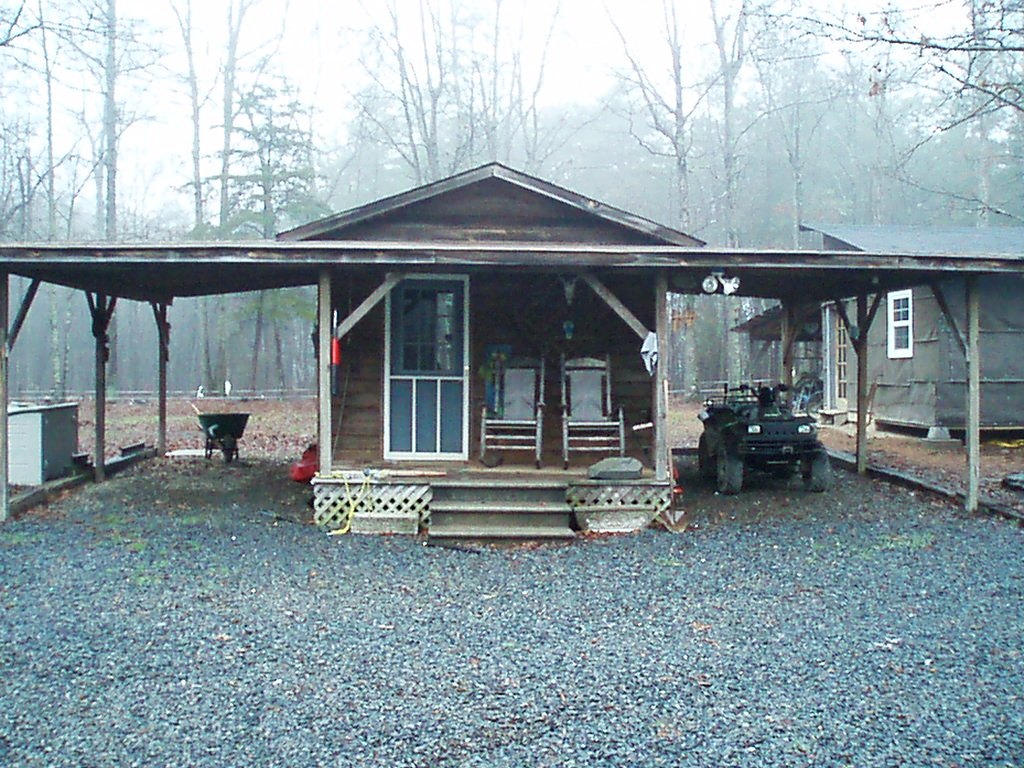
Before he transitioned to his new silk-screening endeavor, John left us with a picture of his writing cabin. Alas, no chickens in sight–the evil fox got ’em!
Next Friday: Let’s see where you write!
For next Friday’s post, we want to hear about where our TKZ readers write! Send us a photo of your desk. You can send it to killzoneblog at gmail dot com.
If you have any thoughts about writing desks, or if you have any writing-related questions, feel free to post them today in the Comments. We’ll all be dropping in from time to time today; we’ll do our best to answer them.