Let’s do a writing round-up: What’s the first sentence you wrote today? The last one?



For your reading pleasure, we have what appears to be the start of a futuristic thriller focused on the military. Enjoy and look for my critique on the flip side. Share your thoughts in a comment that would help this brave author fine tune their intro.
Bastion: The Last Hope
A Web Serial
Chapter 1
Gunnery Sergeant Marianne Beaubien, USMC
Day: E-Day +2
Time: 0300 hrs CST / 0900 hrs GMT
Location: An airfield outside Madison, Wisconsin.
She was cold. Though the weather had been unseasonably warm for December, the temperatures at night still dropped into the forties, or “the singles” as she would have called them back home. Marie wrapped the blanket around herself a little more and refused to open her eyes. To save fuel, they had shut everything down, robbing her of the familiar hum of the engines. After their last close call the decision had been made to forgo putting the plane to bed which, while logical in the circumstances, still left her uneasy. Curled up in bits of survival gear, her cheek against the troop bench of the KC-130J air transport, falling asleep had been hard enough the first time; she had no desire to hamper its return.
She turned her head away from the rough straps and took another long breath of the cold air. The cargo ramp was opening, allowing the northern air to sweep up and down it at will. She forced her eyes shut. Sleep should not be a challenge. In the last two days she had totalled eight hours of rest, catching brief naps in between the mad dash to refuel after landing, and taking off again an hour or so later.
“Gunny.” A firm hand shook her shoulder. The shake was unnecessary. Her eyes snapped open as a surge of anxious energy filled her with the evocation of her rank.
“Sir?” The grim face of Maj. Thompson, the plane’s Aircraft Commander, stared back. He was a serious man, a dyed-in-the-wool-Marine-for-life. She respected him and all he had done for her over the last few years. Even now, she knew that he understood what was going on enough to see the crew through this.
“Wheels up in twenty eight minutes. We’ve got another storm coming.”
He did not say anything else, instead moving up the cargo bay and into the flight deck, presumably to begin preflight. She looked across the aircraft. One of her two crewmen, was wrapped in his poncho liners and completely asleep. Standing, she stretched and resolved to allow him another few minutes of sleep. His name was Cable but everyone called him Larry. She and Frias, who they all knew as Lefty, had managed the ground operations on their own, before she was ordered to get some sleep. It took a bit longer, but the tanks were filled, the fuel truck a fair distance away and all was in order for a quick departure. Frias was sent off to scavenge for parts and she was ordered to bed.
She looked at her watch and stifled a groan. 0300. Two hours of sleep was the longest she had managed since the first wave of meteors had hit.
My Critique:
Generally I am a fan of the intro tag lines that help a reader get an instant time and place setting, but too many lines and too much information (that I’m personally unfamiliar with) could have the potential of a reader skimming over what could be an effective tool to escalate the tension. (This reads like a futuristic setting with the reference to E-day+2, but I’m not sure without a year reference.) One of my favorite books where tag lines played an effective part was Tami Hoag’s NIGHT SINS. In the dead of winter in Minnesota, a child goes missing with the temperature dropping as the hope to find the kid alive diminishes with every passing minute. I found myself reading every tag line, watching the temp drop and the tension ramp up.
In the tag line set up, her name is Marianne, but in the intro, the name Marie is used. I’m not sure which to use in my critique, but I went with Marianne.
The opening sentence (She was cold) is “telling” the reader what she’s feeling, rather than finding a more effective way to “show” it. With Marianne wrapping tighter and shivering in a blanket, unable to get warm, that would say it. She could feel the urgency of needing to sleep, but unable to turn her mind off, waiting for an order she dreaded. (Haven’t we all been there and back.) That would put the focus on her and set the stage for the mystery of what her mission might be and why she’s roughing it, trying to sleep in a plane.
The line about the unseasonal weather is a snippet that took me out of her shivering misery before I really got a feel for her. Plus I was confused by how temps in the forties could be “singles” somewhere else and had to read the line again. She may be from Joe Moore’s neck of the woods, where everyone owns a dock out their back door. Where they drink alcoholic libations with little umbrellas, dress like Jimmy Buffett, have sand in every nook and cranny of their swim trunks, and call the dead of winter, “being in the singles.” (Joe-Don’t disappoint me. Do you have Buffett-wear? Speedos?)
The “to save fuel” line had me wondering what type of engine they had to shut down (the plane engine or a generator of some sort). I’m sure this is my ignorance, but an author needs to provide enough information that any reader can gather the gist of the story, at least in context. The fix would be simple by stating they’d shut down the plane engine. Also, they had shut down the engine, but in the next sentence it’s mentioned that they made the decision to forgo putting the plane to bed. Isn’t that a contradiction?
Also there is a reference to “the last close call” where they had made that decision to forgo putting the plane to bed. Hinting at a back story (that’s still slowing the pace here) without a fuller explanation of the danger they are in, isn’t presented in a satisfying way for me as a reader. I would tend to skim over this part to get at the meat of the situation and what she is all about, but I wouldn’t find those details in this short intro. There’s too many details that take away from what should be the focus of a more dynamic start.
This is a small inconsistency that took me out of the reading. In the first paragraph she “refused to open her eyes” and in the next paragraph, she “forced her eyes shut.” I can understand her being restless, but these statements are emphatic and perhaps should be less so, in order to show she can’t sleep.
The paragraph after she gets the “wheels up” order is again another slow paragraph laden with back story, crew information and nicknames,and functions for departure that are thrown at me. For me, that’s more to skim I’m afraid. It’s not until I see the last line about “first wave of meteors” hitting that I know something about why she is there. The author can savor that choice tidbit and save it as a means to draw the reader into the next action of the crew’s take off, but in my opinion, there needs to be a laser sharp focus on the uncomfortable conditions, the restless tension of her and her crew, the anxiety needs to be there, before the reader learns about the meteors. Instead we get details on sleeping patterns, too many crew member names (with short back stories) who haven’t played a part yet, and military jargon and procedures that slow the pace and distract from the story.
I’m wondering if this is the right place for this book to start. I can see the timing almost there, but the focus needs to be on the human element and the tension that keeps her awake, until she gets the order to move. Then it should be hit the ground running, get the reader into the action as they deploy in a rush.
I would have a hard time turning the page of this story as is, except that the idea of meteors hitting the earth and what the military can do about that, would intrigue the hell out of me. I think this author has a very compelling premise that I would love to read, if this intro could have better pace with more laser focus on the human story of Marianne, her crew, and earth’s peril.
In a nutshell, my advice would be to stick to the action and explain later.
What do you think, TKZers? Comments please.
by Joe Moore
Recently, we received an email from Beth MacKinney, one of a TKZ friends, asking the question: “I’d like to know what guided questions an author can give to her beta readers to get the most helpful feedback from them.” I posted a blog on beta readers back in March, 2011. Below is a revised version of that blog to answer Beth’s question. Since many of my TKZ blog mates also use beta readers, I’m sure they will chime in with additional thoughts and tips.
A lot of writers including myself rely on beta readers to scrub our WIP and find all the plotting holes, mistakes, and general stuff that doesn’t work. So what is a beta reader? Should you go looking for one? How do you find and qualify them? How do they differ from a critique group? What are the things to look for in their feedback?
The term beta comes from software designers who use the term alpha and beta for different stages of program development. Alpha is the rawest stage—incomplete and untested—and beta is still under development but a small number of copies are released to the public for testing. In novel writing, this might be the first completed version of the manuscript where the author has made at least one pass through to edit and tweak.
A beta reader is someone whose opinion you value, who’ll take the time to read your manuscript in a timely manner, and who’ll give you an honest assessment of your work. For starters, I would mark off your list of potential beta readers anyone who is related to you, works with you, or lives in your immediate neighborhood.
Should you utilize a beta reader(s)? It depends on whether you’re working on your first unpublished manuscript or are further along in your writing career. Most beginning authors are searching for anything that will build up their ego and confidence, and keep their hopes alive. And most new authors have manuscripts that are littered with flaws and mistakes—it’s part of the learning process. Weak or unqualified feedback from others can cause a new writer to become confused and/or discouraged. And their hopes and dreams can be crushed by negative feedback. Or their egos are so artificially inflated that negative criticism can cause friendships and relationships to crash.
At the same time, established authors know the value of real, honest, sincere feedback and will react in a professional, business-like manner. Beta readers are a solid tool toward writing a better book.
In recruiting beta readers, try to line up at least three to four that are willing to take the time to not only read your work but give you constructive feedback. It’s also good to mix male and female readers. In general, try to find age-appropriate readers that are familiar with your genre. A female teen may not give you the feedback you’re looking for if your manuscript is male action/adventure. If you write YA, a retired senior citizen might not be the best choice, either.
Try to choose beta readers who are not acquainted with one another. And they don’t have to be your best friends. In fact, casual acquaintances could work better since there might not be a hesitation that they will hurt your feelings if they don’t like what you’ve written. There’s a good chance they’ll take the whole process more seriously than a relative or close friend.
Don’t ask your beta readers to line edit your manuscript. Tell them to ignore the typos and grammar issues. What you’re interested in is: Does the story work? Does it hold together? Are the characters believable? Can you relate to them? Are there plot contradictions and errors?
Beta readers differ from members of a critique group in that they measure the WIP as a whole whereas groups usually get a story in piecemeal fashion and focus in on a chapter at a time. Most critique groups also deal with line editing.
So once you round up your bevy of beta readers and send them your WIP, then what? Start by listening to their feedback. If your beta reader has a problem or issue, chances are others will, too. And most important is when numerous readers raise the same issues. That should be a red flag that there’s a major problem to address.
Other tips: Don’t be defensive. Sure, we all love our words—after all, they’re hard to come by. But comments from your beta readers are meant to be helpful and constructive. Don’t take offense. Take what they say to heart. Think about it for a while. Consider that they have a valid point and are not trying to tear down your writing.
Finally, always remember that it’s not personal. If it is, you chose the wrong beta reader. Regard the feedback as if you were giving input to a fellow writer.
How about the rest of you guys. Do you use beta readers? Are you a beta reader for someone else? Any additional qualifiers to choosing a beta reader?
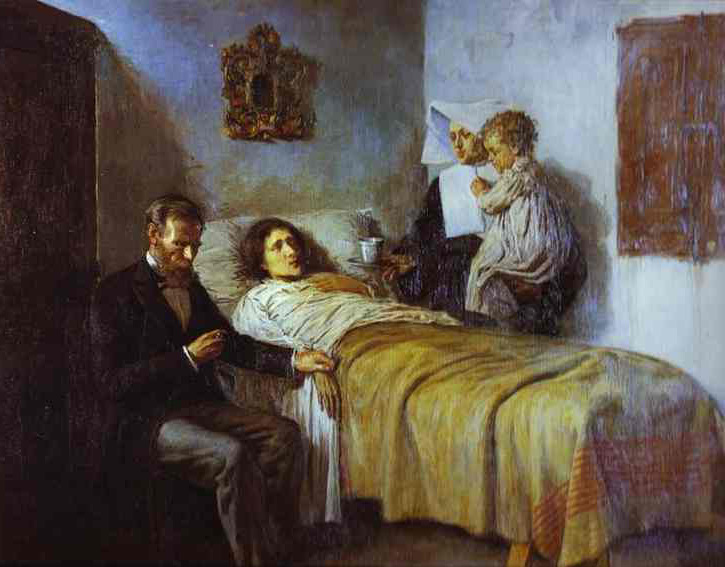

Anybody guess Picasso? Well, he painted both. The first was done when he was sixteen. The second when he was fifty-six. My point is, obviously, that even Picasso mastered all the basic elements of his art, got his craft under firm control, before he was able to find his unique innovative style. When he himself said, “It takes a long time to learn to be young” he was not taking about finding his joie de vivre. He was talking about absorbing the rules and then finding the courage to throw off their shackles.
All artists know this. The great choreographer George Balanchine created traditional story ballets in the style of “Swan Lake” before he developed the plotless style that revolutionized dance. Acting teacher Stella Adler famously said, “Craft makes talent possible.”
I’m nearing the July 1 release of my new book, THE LOCH NESS LEGACY, and the last step was to share the book with a few select beta readers so they could send me any typos they found. I didn’t think they’d find too many considering the book had already been copyedited and proofed by Little, Brown UK, which is publishing the book in the UK, Australia, and New Zealand (I’m self-publishing it in the US, except for Audible’s audiobook version).
My readers didn’t discover one or two typos as I had expected. They found over three dozen. To be fair, Little, Brown UK had already corrected some of them in their final version (I hadn’t transferred those corrections to my self-pubbed edition) . However, there were still a dozen that had escaped notice.
It’s infuriating, but a great lesson that I need to have others find the typos I’m blind to after reading the book over and over. And this isn’t a new problem for me, unfortunately. Check out the blog I wrote on my website four years ago, and then post a comment about your own exasperating typos.
——————————————
I hate typos. Despise them. They are vermin to be wiped from the face of the planet, ranking just below tapeworms and just above spammers trying to sell me herbal V1@gr@.
The irony is that, as I have discovered this past week, typos love me. They can’t get enough of me. Apparently, they get so distraught if they do not appear in my novels that they insert themselves without my knowledge just so they don’t feel left out of the fun.
After I posted my complete, polished novels to my web site and the Kindle, several alert readers notified me that they’d come across a few typos, which I’m grateful to know about so I can go back and fix them. That doesn’t mean I don’t need a moment to gather myself after finding out about them, because my reaction is usually something like this:
ARRRRRRRRRRGGGGGGGGGHHHHHHHHH!
I add in some very bad words if I want to be even more articulate.
The reason for my frustration is that I proofread my books very carefully to make sure they are as error-free as possible. I spend hours reading and rereading the novels until my eyes glaze over and I can’t see straight. I don’t see how that method can fail.
And yet, it does. My most frequent typos are of the mixed-up variety. I type “their” instead of “there” or “your” instead of “you’re.” Of course, this kind of error can lead to some amusing outcomes. A few years ago, when some striking union workers felt they were being taken advantage of by management, they didn’t help their cause by carrying placards saying, “The managers think your stupid!”
But I can see how I might miss something like that. What I can’t understand is how I used a word like “valediction” in place of “valedictorian.” I’ve never used “valediction” in a sentence in my life. In fact, I had to look up what it meant (Val*e*dic*tion: a word Boyd never uses).
The worst typo I found, all by myself, was when I used “astronomist” instead of “astronomer.” Now, “astronomist” is not, technically, a word, so how both I and spellchecker missed it is a mystery, although some other people in the same situation might make wild accusations. For example, I would never start the rumor that Microsoft Word randomly inserts nonsense words into a person’s writing just for the enjoyment of programmers who get hilarious emails every time someone sends out a document with the word “squatful” inserted into it. That would be irresponsible.
Besides, I can’t depend on spellchecker because it’s not always reliable. It hasn’t happened lately, but it used to be that when I typed “Boyd Morrison” into Word, it would underline the words in red, diligently alerting me that I had misspelled my own name. When I asked spellchecker for a better suggestion, it came up with what should have been so obvious to me: “Body Moron.” Perhaps it was suggesting a new pen name for me.
I can take comfort in the fact that even NY Times bestselling authors have books with typos. My friend, James Rollins, whose books are epic action-adventure stories that I gobble down in about a day, wrote The Last Oracle, the cautionary tale of what happens if you stand too close to a molten nuclear reactor (hint: it involves the words “brain” and “tapioca”).
Toward the end of The Last Oracle, I found the sentence, “Her entire form shook as teats spilled in shining streaks of joy.” Jim, of course, meant “tears”, but when I tried to imagine the scene as written, I laughed so hard that the person sitting next to me on the airplane thought I had a medical condition.
When I wrote an email to Jim with praise for the book, I also told him of the typo. He emailed back just one sentence: “I read your kind words with teats in my eyes.”
So I suppose, like Jim, I should keep a sense of humor about typos and their affection for me. I mean, what’s the worst that could happen? It’s not like I could get saddled with some kind of ridiculous nickname just because of typos.
Sincerely,
Body Moron


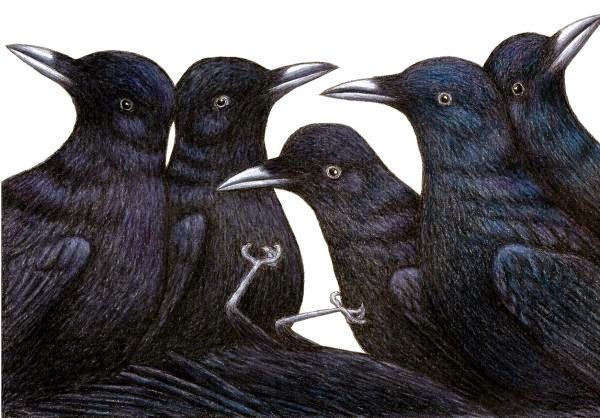
It occurs to us that the world needs a collective noun that refers to a group of writers. (As in, “a murder of crows.”)
What would be your idea for a collective noun for writers? To get the idea ball rolling, check out a list they started over at Quill Cafe.
Cast your vote in the comments!

By Elaine Viets
My condo looked like someone had a frat party in the living room. I’d barely said hello to my husband in a week. But I finished “Final Sail,” my Dead-End Job novel, on time.
Newly married private eyes Helen Hawthorne and Phil Sagemont investigate two cases undercover. Helen works as a stewardess on a 143-foot yacht to find an emerald smuggler. Phil signs on as estate manager for a trophy wife, Blossom, after her 80-something husband, Arthur Zerling, died suddenly. Arthur’s daughter is sure her father was murdered.
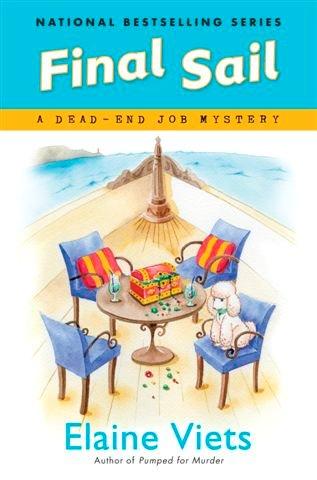
When I turned in “Final Sail,” I knew I’d written the perfect book. All I had to do was wait for the editorial letter to confirm it.
In the novel business, the editorial letter is the in-depth evaluation of your work. You only get one if your editor cares about your work.
Two weeks later, the letter arrived. “As usual you’ve written another fun, witty installment in the Dead-End Job series,” my editor wrote.
Yep, I thought. I’m a pro.
“Even though Helen and Phil have started their own agency, they’re still getting involved in plenty of dead-end jobs. Who would have known stewardesses go through so much on those yachts? Makes me want to cruise myself one day (but certainly not as ‘the help!’).

“Of course, as one of your first readers, I do have a few thoughts/suggestions on revision.”
Uh-oh. I had a sinking feeling.
“As always, take what I say with a grain of salt,” she wrote. “If it doesn’t resonate with you, don’t feel compelled to use it.”
That’s New Yorkese for “fix it.”
I was hit with a boatload of improvements:
Clarify the cause of rich old Arthur Zerling’s death.
Find a better motive for the trophy wife, Blossom, to kill her young lover.
Explain why Blossom killed her old husband in the first place.
Could I also intermingle the two cases? Oh, and that couple on the yacht – the fat, cigar smoking gambler and his blond wife – tone them down and “redefine” their relationship.
Wait! One more thing. Could I “strengthen the end of the book.” Switch the sections so it ends on a happy note?

“So now it’s just a little more revising,” my editor wrote. “I think your readers are so going to enjoy this book!”
She’s served me a love sandwich – two warm, tasty chunks of praise wrapped around really tough meat.
I had two weeks to tear up my perfect book and revise it.
I knew most editors don’t give novels in-depth criticism. I knew I was lucky mine cared.
So how did I react?
Like someone who’s just heard she has a fatal disease. You know Elisabeth Kubler-Ross’s five stages of grief? I went through them all: denial, anger, bargaining, depression, and acceptance.
First, denial. There’s nothing wrong with this book, I told myself. It’s good. No, great. My editor is ruining it. I won’t do it. So there.
I wasted a whole day in denial, before I switched to anger. Now I was furious. What does my editor know? She lives in New York. She doesn’t even know any real people. She hasn’t been to Florida in years. I live here.
Next came depression. I reread her note and realized how much work I was looking at.
After two days of this war raging in my head, I reached acceptance.
Maybe she’s right after all. Better to have her criticize my novel than let the reviewers rip it.
I now had twelve days to rewrite “Final Sail.” The more I worked on the rewrite, the more I saw my editor was right.
I finished the rewrite on deadline.

And the New York Times reviewed it.
“One way for a fugitive to hide in plain sight is to work at low-wage jobs,” Marilyn Stasio wrote, “which is what Helen Hawthorne has been doing in Elaine Viets’ quick-witted mysteries.”
Thanks to my editor, I have this terrific Times quote for the jacket cover. That turned out to be a delicious love sandwich.
Nancy J. Cohen
Lately my mind has been a blank when it comes to writing blogs. It could be due to the influx of out of town visitors we have been hosting this month that makes it difficult to concentrate. Or it could be due to my WIP revisions on a book that’s over 104,000 words long. This might sap my mental energy. Regardless of the reason, it’s a good time for some mindless activity in between polishing the prose or escorting visitors around town. Here are some photos of the activities that have been leading me astray (not to mention gaining another pound).

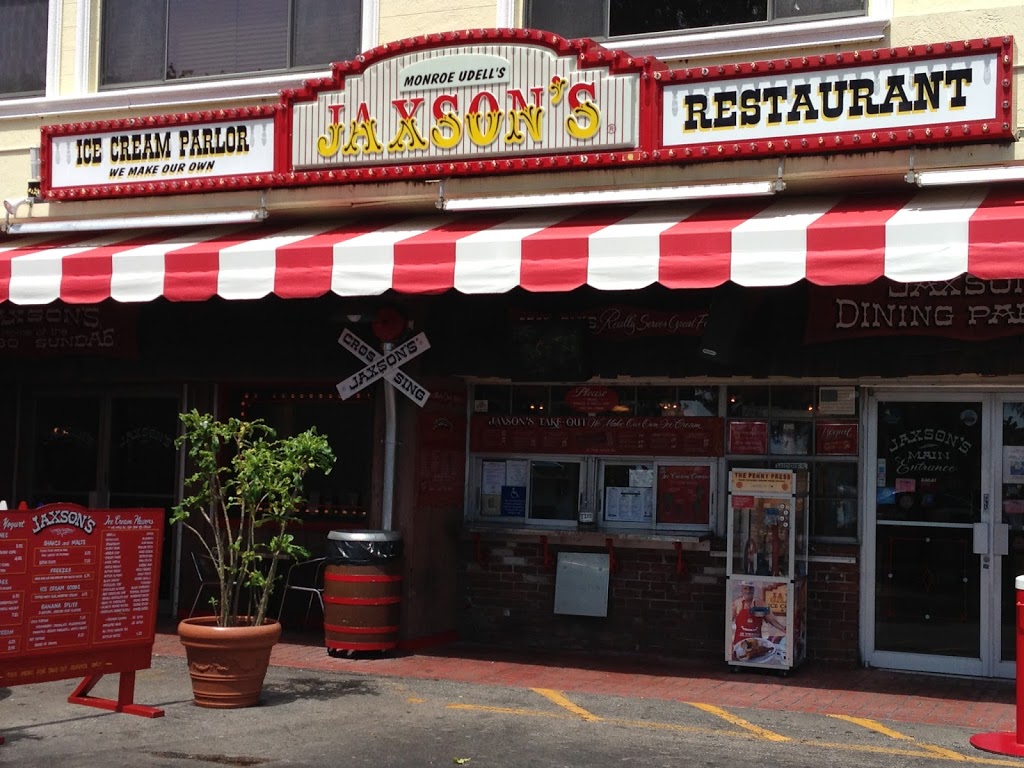
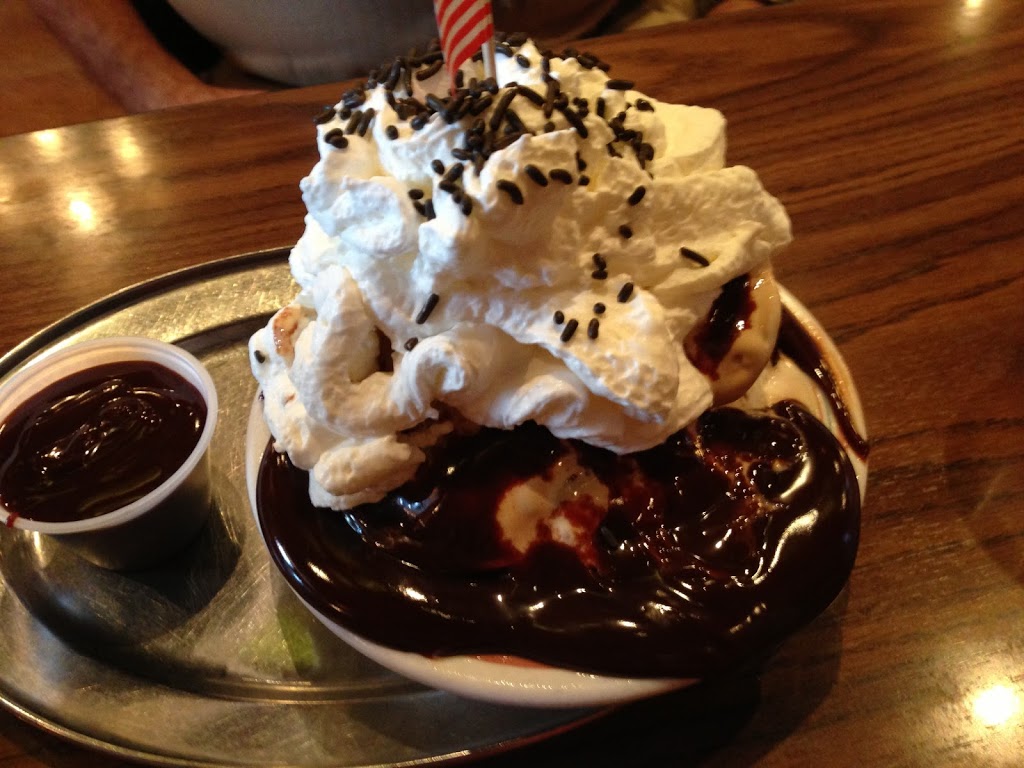
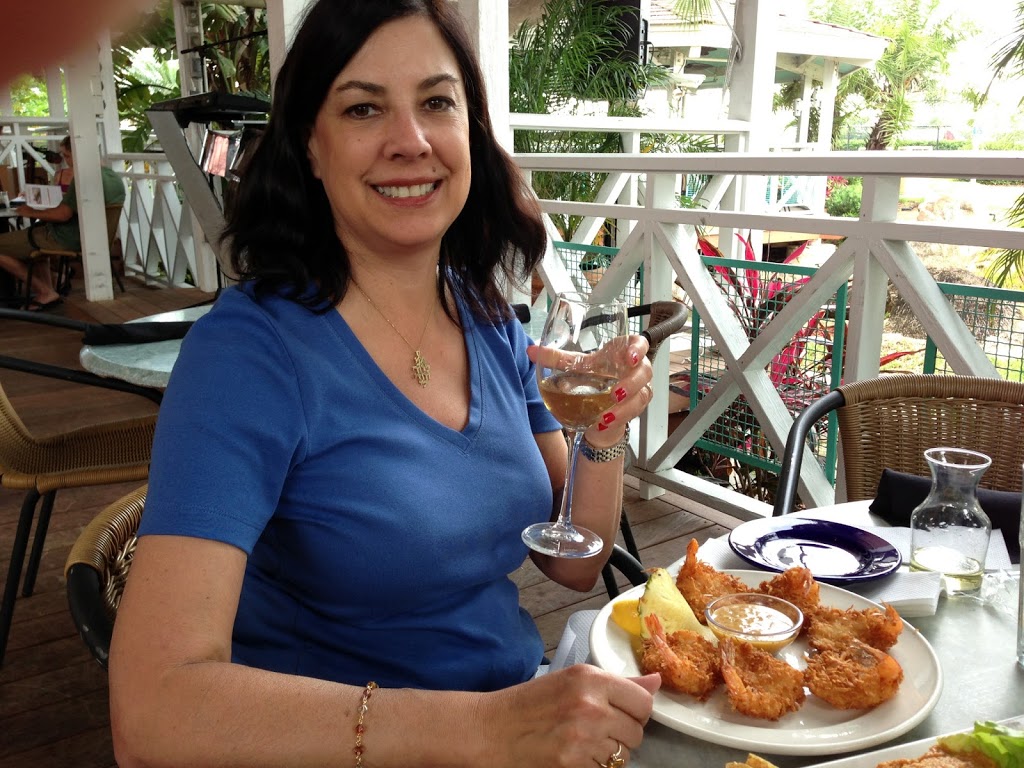
I look a bit too relaxed there, don’t I?
Consider these tasks when you feel brain dead, too distracted or too tired to think straight. Here’s a list of jobs to do when you want to be productive without much mental effort.
• Organize your Internet Bookmarks/Favorites and verify that the links are still active.
• Verify that the links you recommend on your Website and your Blogroll are still valid.
• Update mailing lists and remove bounces and unsubscribes.
• Back up your files to the Cloud or to other media.
• Clean out and sort your files on the computer and in your office drawers.
• Convert old file formats to current ones.
• Delete unnecessary messages from your email Inbox.
• Eliminate duplicate photos stored on your computer.
• Delete old contacts from your address book.
• Unfollow people from Twitter who are no longer following you.
• Delete friends from Facebook who have deactivated their accounts.
• Sort your Twitter friends into Lists.
• Post reviews of books you’ve read to Goodreads, Amazon, Shelfari & Library Thing.
• Get caught up on a tax deduction list for your writing expenses.
• Index your blog posts by date and subject so you have a quick reference.
What else would you add?