Finding Your Writer’s Voice

by James Scott Bell
@jamesscottbell


You hear it every time there’s a panel of agents and/or editors, when they are asked what they’re looking for in a manuscript. Someone always says, “A fresh voice.”

But no one knows how to define it. Over the years I’ve heard some attempts at explanation, and I’ve jotted them down. Here they are:

• A combination of character, setting, page turning.

• A distinctive style, like a Sergio Leone film.

• It’s who you are.

• Personality on the page.

• It’s something written from your deepest truth.

• Your expression as an artist.

Well, okay. I guess. But how do we develop voice? Indeed, is it something that can be developed? Or is it something you’re born with?
What if you write in different genres? Is your voice in a noir thriller going to be the same as your voice in a romance?
Should writers even worry about voice? I counsel my students to be true to the story they’re telling, true to the characters, and not to worry about this elusive thing everyone says they want. If the tale is well told, that’s the main thing.
But I do think there is something to be said for trying to coax out a little more voice, even though you can never quite nail it down to pure technique.
So what is it that does the coaxing? In a word, joy.
“In the great story-tellers, there is a sort of self-enjoyment in the exercise of the sense of narrative; and this, by sheer contagion, communicates enjoyment to the reader. Perhaps it may be called (by analogy with the familiar phrase, “the joy of living”) the joy of telling tales. The joy of telling tales which shines through Treasure Island is perhaps the main reason for the continued popularity of the story. The author is having such a good time in telling his tale that he gives us necessarily a good time in reading it.” – Clayton Meeker Hamilton,A Manual of the Art of Fiction (1919)
I think Professor Hamilton nailed it. When an author is joyous in his telling, it pulses through the words. When you read a Ray Bradbury, for instance, you sense his joy. He was in love with words and his own imagination, and it showed.
I recall a Writer’s Digest fiction column by Lawrence Block, back in the 80’s, and he was telling about being at a book signing with some other authors, one of whom was a guy named Stephen King. And Stephen King’s line was longer by far than for any of the other guys.
Which got Larry to thinking, what was it about King’s stuff? And he decided that it was this joy aspect. When you read Stephen King, you feel like you’re reading an author who loves writing, loves making up tales to creep us out, enjoys the very act of setting words down on paper.
Because when you’re joyful in the writing, the writing is fresher and fuller. Fuller of what? Of you. And that translates to the page and becomes that thing called Voice.
So the question is, how can you get more joy into your writing?
Here are some thoughts:
1. Be excited about your story. If you’re not jazzed about what you’re writing, you can’t be joyful about writing it. Dwight Swain, the great writing teacher, once said that the secret of excitement is to go deeper into your characters. Create more backstory, more secrets, more complexity, and you’ll get excited again.
2. Write at your peak “freshness” time. Find out when you’re most creative and awake and alive. Write for all you’re worth during that time.
3. Take a break when it’s drudgery, and do something else for awhile. I find that if I read a passage by one of my favorite writers, I soon enough get excited about writing and want to go back to my project.
4. Try a dose of Dr. Wicked. This neat little program can be accessed online, or downloaded to your desktop for ten bucks. Basically, it makes you write fast, because if you don’t it will soon emit a terrible sound that will sandpaper your brain. Writing fast, without thinking too much, is fun, and many times you’ll tickle out some of your best stuff that way.
5. Picture the reward. Now and then you need to daydream about your finished book and all the happy readers who are going to enjoy it––and who will put you on their favorite authors list.
For more on voice, please see my book on the subject.
So what about you? Do you find joy in your writing? If not, what are you going to do about it?
 

Loose Lips

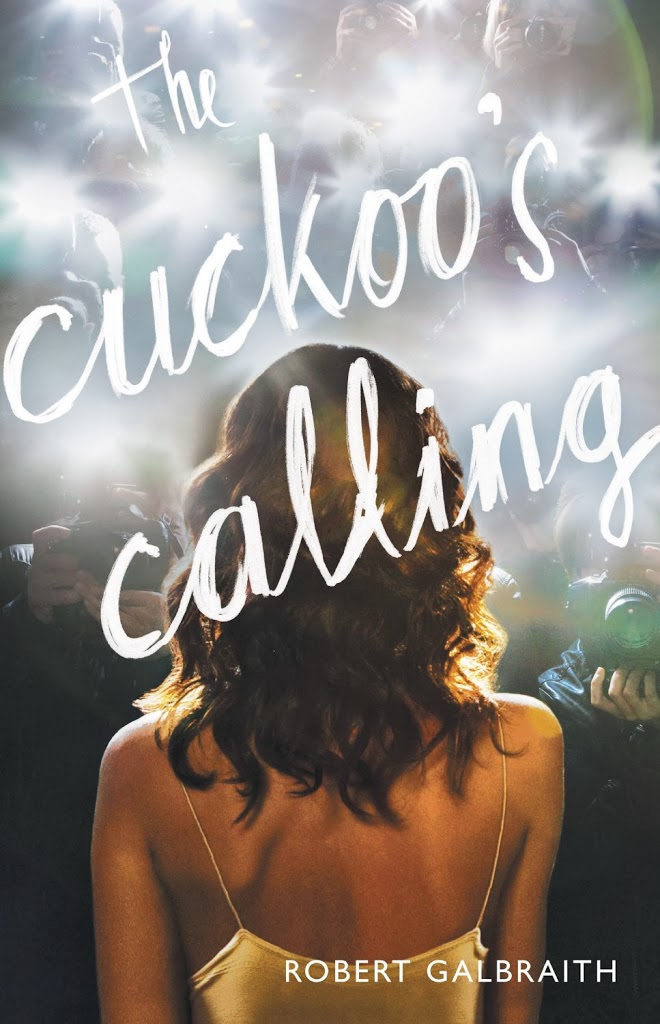
It was revealed this week that a mystery novel titled The Cuckoo’s Calling and written by Robert Galbraith was in fact authored by someone named J.K. Rowling, whose name in the author’s slot on a book has been enough to cause children and their parents to line up in front of bookstores at midnight. The news leaked as the result of a Twitter tweet and spread very quickly. After the dust settled and the smoke cleared a book which had sold a few hundred copies since its publication in late April 2013 suddenly became very much in demand. Rowling, her publicist, and any number of people were accused of having leaked the true identity of the author to the world in an effort to boost sales of the book. It was revealed yesterday, however, that the cause of the leak was an attorney in the employ of the law firm which handles Rowling’s literary business. As an attorney myself, I’m embarrassed.

One of the things that is drummed into young skulls full of mush in law school, and thereafter in countless continuing legal education courses, is something called “client confidentiality.” Most people are familiar with the concept, at least in passing. It’s simple enough: if you tell your attorney something they take it to their grave. Believe me, attorneys hear some very interesting things. Not all of us represent someone on the order of J.K. Rowling, but there are any number of times that someone has told me something within ten minutes after sitting down in front of me that they’ve never told anyone else. What I’m told often comes under the heading of “too much information,” and occasionally I pray for selective amnesia, but that’s the way it goes.  Whatever I’m told,  however, stops with me, even in general terms. For but one example: if one practices family law and the next door neighbor comes to the office to discuss a possible divorce action, one does not go home and tell their spouse, “Guess who came in and talked to me today!” and give the spouse five guesses where the first six don’t count, all the while gesturing toward the house next door. The confidentiality, by the way, belongs to the client; to continue with the example, if the next door neighbor wants to tell the world who they consulted about a divorce, and what was discussed, that is their privilege. It doesn’t release the attorney, however, from the obligation of client confidentiality. Only the client can do that at their discretion and pleasure. Client confidentiality obtains in the state where I practice whether the prospective client ultimately retains the attorney or not. The “give me a dollar and I can’t discuss this with anyone else” is a great device to build suspense in a book, but it doesn’t apply in the real world. This makes sense. A prospective client has to be able to speak freely — spill their guts, as it were — so that the attorney can properly evaluate the case, make recommendations, and decide whether to represent the individual or recommend that they go elsewhere.

In Rowling’s case, the firm handling her legal matters with respect to her publishing — Russells — issued a terse though ultimately self-serving statement to the effect that Chris Gossage, a firm partner, had disclosed the information about Galbraith’s true identity to his “wife’s best friend” who ultimately tweeted her newly found knowledge to the world. Russells additionally stated that Gossage had made the disclosure “in confidence to someone he trusted implicitly.” This is a round-about way of assuming responsibility but not taking blame. It’s nonsense. An attorney receiving knowledge in confidence cannot subsequently disclose that knowledge to a third party in confidence. The information stops within the confines of the four walls of the office.

Rowling I am sure had her reasons for  wishing to preserve her anonymity with respect to her authorship of The Cuckoo’s Calling. I don’t know what they might have been, and though I’m curious, it ultimately makes no difference. She doesn’t even need a reason. If you make a disclosure to your attorney the walls go up. That increase in sales of The Cuckoo’s Calling which occurred after Rowling’s confidentiality was breached is irrelevant. My gut instinct is that Rowling would have been much happier if the sales of the book had remained where they were and the secret of her identity had been preserved.

I’m unhappy about this, for so many reasons. So please. Make me laugh. Tell me the best lawyer joke you know.

The First Step Is the Hardest: Writing Chapter 1

By Elaine Viets

    The first chapter is the hardest – at least for me.
    In one page, I have to catch the reader’s attention, set the scene, and introduce the main characters.
    But I can’t overdo it. Too many characters, and my first chapter has “crowded room syndrome.” The plot can’t move forward and readers lose track of everyone. Also, a mystery has to pass the three-second test: That’s how long bookstore customers supposedly linger over the first page before they decide to buy it or put it back.
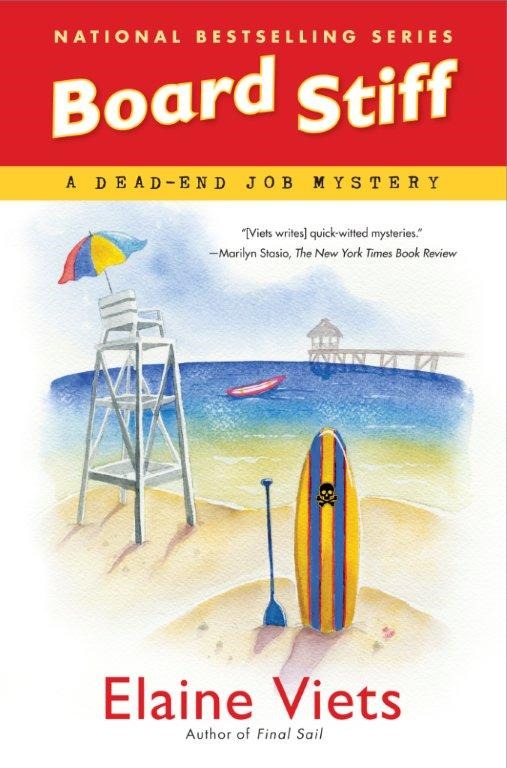
     I’ll spare you the whining, pacing, and time wasting it took to start “Board Stiff,” my new Dead-End Job hardcover. Here’s the condensed version.

     “Board Stiff” is the ultimate beach book.

BoardStiff

I wrote about the cutthroat competition for tourist dollars on Florida beaches. I was inspired by a newspaper story about companies that rented paddleboards, surf boards and other beach toys and sabotaged their competitors. In my book, sabotage naturally became murder.
    Standup paddleboarding is the hot sport.

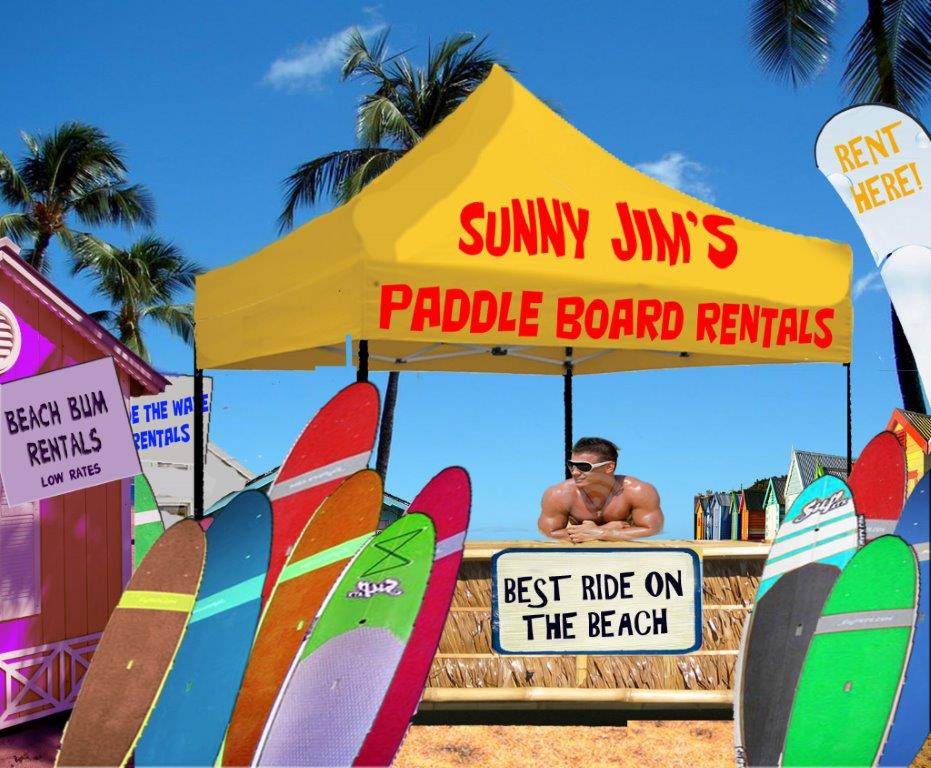
In “Board Stiff,” Sunny Jim Sundusky believes someone is destroying his paddleboard rental business. 
    I started the chapter with this quote:
   “They’re trying to kill me,” Sunny Jim Sundusky said. “They nearly succeeded in March, but I’m a tough old buzzard. I survived. They almost got me in April, but I escaped again.”     That’s a grabber, I decided. But who’s Sunny Jim talking to? And why? Most important, where are they? Some novels have snappy openings, but leave the characters floating in space for pages. I made sure Sunny Jim was securely grounded in the second paragraph:
   Helen Hawthorne and her husband, Phil Sagemont, sat across from Sunny Jim in their black-and-chrome chairs in the Coronado Investigations office. Sunny Jim sat in the yellow client chair, looking anything but sunny.     Now I’d introduced the three principals: Private eyes Helen and Phil, and this Sunny Jim character.
    The Dead-End Job mysteries are told from Helen’s point of view. Here’s her take on Sunny Jim:
    Sun-dried was more like it, Helen thought, as she studied him. His face was red leather. His blond hair was dyed and flash-fried in a crinkly permanent. But he did look tough.       

Helen has more to say more about Sunny Jim’s looks, but I needed to get on with the story. Why is he in their office?
     “They’re gonna keep coming after me until they stop me for good,” he said. “That’s why I wanna hire you two. I hear you’re the best private eyes in South Florida.”     I let Sunny Jim say the couple is the best in South Florida – and also pin the chapter to a place on the map.
    The response is typical Helen and Phil, and reveals something about the PI pair. Phil knows they’re the best detective agency in South Florida. He takes Jim’s praise as his due. Helen is more modest.
    “We were lucky to get good publicity,” Helen said.
    “That wasn’t luck,” Phil said. “That was good detecting.”
    “That’s what I need,” Sunny Jim said. “Detecting. I want you to stop them before they  stop me – permanently.”
     Helen is the observant one. She watches Sunny Jim while he talks, and gives us a better picture of their potential client. 
    He stabbed his chest with a brown callused hand, right in the smiling sun on his yellow SUNNY JIM’S STAND-UP PADDLEBOARD RENTAL T-shirt. His arms and legs were roped with muscle and his chest was a solid slab.
    Helen had seen enough steroid hardbodies to know that Jim built that beef the old-fashioned way. She thought he was attractive in a dated disco style, except he was too young to have caught the seventies’ disco fever. She guessed his age on the shady side of thirty-five.
    My novel’s first page ends with Sunny Jim’s demand for action:
   “So, you gonna save my business or not?” Jim’s eyes were hidden behind expensive shades – Floridians rarely had naked eyes – but his chin jutted in a challenge.   
    I patted myself on the back and kept on writing.


    What did my editor think? She wanted one change: “How can Sunny Jim call himself old if he’s around thirty-five?” she asked.
    Oh, right. I changed that line to read:
    “They nearly succeeded in March, but I’m one tough buzzard.
    “Board Stiff” was launched.
    *******************************************
Check out the “Board Stiff” book trailer: http://tinyurl.com/ljgyzen
Buy it as an e-book and hardcover from bn.com:
http://tinyurl.com/mvzbtfz
Buy it on Amazon: http://tinyurl.com/kqdd8dj


Reflections, I’ve had a few

 I apologize for posting late today–life intervened last week in the form of some surgery that is basically a tweak to some brain rewiring I had done a few years ago. (Anyone interested in the details can click here.)

The surgical tweak I had done last week went fine, but it has imposed a few constraints on my life. For the next few weeks I’m not allowed to drive; turn my head; walk faster than a snail on a hot sidewalk; wear contacts or glasses, which means I’m basically as blind as a cave fish. (I did some research to find which critter is the blindest of the blind in the Animal Kingdom, and it appears to be the cave fish. Let me know if you discover some critter that’s even more myopic than my fishy friend. You never know when that kind of IFNWK (Interesting Fact Not Worth Knowing) might come in handy in your writing.

The upside to this whole experience is that the surgeons have flung open the doors of the locker of Happy Drugs. So my mood is quite cheerful, although my writing seems to have gone on a wee little vacay. I’m thinking I’ll give it 10 days before I call the Writing Police to wrangle that little mongrel called discipline back into my brain.

I just reread that last line, and I suspect the docs have given me just a few too many Happy pills today. So I’ll leave you with a question: Have you ever had a physical issue that brought life to a screeching halt, and did it affect your writing? How did you find the road back, and what helped you the most?

The Wow Factor

by Clare Langley-Hawthorne

Jim provided a great post yesterday on the reasons people abandon reading a book (mainly because, no surprise, it’s slow and boring!) and ways in which an author can make their own work ‘unputdownable’. Today I want to discuss what propels a book to the next level – what I call the ‘wow’ factor – those elements that take a book to a level where not only can you not put it down but you also can’t help but tell everyone about it. 

This is the essence of ‘word of mouth’ marketing, which can turn a book into an instant bestseller. Think about a book like Fifty Shades of Grey. Although I confess I haven’t actually read it, and no matter what you think about its subject matter or literary merit, there’s no disputing it created a buzz which encouraged millions of people to buy it. For me, the Harry Potter and The Hunger Games series have it. But how to define that ‘wow’ factor? Surely if if was that easy, we’d all be bestsellers…but it’s not and yet, it’s the elusive element that every publishing house and indie author longs to create.

For what it’s worth, I think the ‘wow’ factor probably involves a combination of the following:

  • A startling, controversial or shocking take on a conventional topic or genre.  This is what made Fifty Shades of Grey the talk of the town when it was first release. I remember being in a boot camp class and being amazed at how many women were reading it, simply because it was so illicit and controversial (which was really why I didn’t feel in the least compelled to read it!). I think the same can be said for classics such as Lolita and Lady Chatterly’s Lover. If you get people talking about a book because it raises the hackles, insults somebody’s ethics or challenges their notions of propriety it’s probably going to generate buzz (both negative as well as positive). But that is hardly enough (I’m sure there have been thousands of books about controversial topics that have bombed…)
  • An uber-intense relationship between characters that appeals to the inner romantic in us all. Think The Bridges of Madison County or the Twilight series. Despite the writing style (or lack thereof) these books pulled at the heart strings. They managed to capture the yearning for true love and, as anyone whose ever watched The Princess Bride knows, true love conquers all. It’s hard to quantify exactly why these books manage to generate such an overwhelming ‘buzz’ but I think the ‘I will love you forever’  over-the-top romance was addictive.
  • A story that touches our humanity. We’ve all read great satisfying books and recommended them to others but rarely do we rave about a book to strangers, family members and friends unless it something indefinable that captures our heart as well as our attention.  I think if a novel makes people feel good about themselves, or raises our consciousness and humanity we feel compelled to tell others about it. This is certainly what happened to me after I read Schindler’s List and The Alchemist.
  • And finally, a story that totally transcends the ordinary… Which goes to demonstrate how important it is to raise the stakes, take risks and strive to transcend the genre in any book you write.  Think of a book like Life of Pi and you’ll know what I mean.


So what do you think helps create the ‘wow’ factor? What was the last book you couldn’t help talking about with everyone you know? 

How to Write a Novel Readers Won’t Put Down

by James Scott Bell
@jamesscottbell

A friend alerted me this past week to an interesting “infographic” posted on Goodreads. The subject: Why readers abandon a book they’ve started. Among the reasons:

– Weak writing

– Ridiculous plot

– Unlikable main character

But the #1 reason by far was: Slow, boring.

Makes sense, doesn’t it? As I’ve stated here before, there is at least one “rule” for writing a novel, and that is Don’t bore the reader!

So if I may channel my favorite commercial character, The Most Interesting Man in the World:

Find out the things readers don’t like, then . . . don’t do those things.

I thank you.

Okay, let’s have a closer look.

Weak Writing

This probably refers to pedestrian or vanilla-sounding prose. Unremarkable. Without what John D. MacDonald called “unobtrusive poetry.” You have to have a little style, or what agents and editors refer to as “voice.” I’ll have more to say about voice next week. But for now, concentrate on reading outside your genre. Or read poetry, like Ray Bradbury counseled. Simply get good wordsmithing into your head. This will expand your style almost automatically.

Ridiculous Plot

Thriller writers are especially prone to this. I remember picking up a thriller that starts off with some soldiers breaking into a guy’s house. He’s startled! What’s going on? Jackboots! In my house! Why? Because, it turns out, the captain wants him for some sort of secret meeting. But I thought, why send a crack team of trained soldiers to bust into one man’s suburban home and scare the living daylights out of him? Especially when they know he’s no threat to anyone. No weapons. No reason to think he’d resist. And why wake up the entire neighborhood (a plot point conveniently ignored)? Why not simply have a couple of uniforms politely knock on the door and ask the guy to come with them? The only reason I could think of was that the author wanted to start off with a big, cinematic, heart-pounding opening. But the thrills made no sense. I put the book down.

Every plot needs to have some thread of plausibility. The more outrageous it is, the harder you have to work to justify it. So work.

Unlikable Main Character

The trick to writing about a character who is, by and large, unlikable (i.e., does things we generally don’t approve of) is to give the reader something to hang their hat on. Scarlett O’Hara, for example, has grit and determination. Give readers at least one reason to hope the character might be redeemed.

Slow, Boring

The biggie. There is way too much to talk about here. I’ve just concluded a 3-day intensive workshop based, like just about everything I do, on what I call Hitchcock’s Axiom. When asked what makes a compelling story he said that it is “life, with the dull parts taken out.”

If I was forced to put general principles in the form of a telegram, I’d say:

Create a compelling character and put him in a “death match” with an opponent (the death being physical, professional, or psychological) and only write scenes that in some way reflect or impact that battle.

The principle is simple and straightforward. Learning how to do it takes time, practice and study, which you can start right now, today.

So what about you? What makes you put a book down? And related to that, do you feel compelled, most of the time, to finish a book you start? I used to, but now I don’t. Life’s too short, and there are too many books on my TBR list!

ThrillerFest!

By Mark Alpert

This will be a short post because I’m at ThrillerFest this weekend. I’ve gone to the conference every year since 2008, and I always have a great time there. Because I live in New York City, I have no excuse for not going. The conference center at the Grand Hyatt is only a ten-minute subway ride from my apartment.

My favorite part of ThrillerFest is sharing stories with other writers. Making novels is an inherently solitary activity; although I get feedback from my agent and editor and the handful of people in my writing group, it’s nothing like the team effort of putting out a newspaper or magazine. When I edited feature stories every month for Scientific American I was constantly interacting with art directors, copyeditors, fact-checkers and freelancers. It wasn’t always peaceful — I have a bad habit of getting too emotional over stupid things — but every afternoon at three we stopped butting heads and went to a café on 49thstreet for our coffee break. I miss the place, I really do. Life is full of trade-offs: I love having the time to work on my thrillers, but I miss the camaraderie of journalism.

At ThrillerFest, though, you’re completely surrounded by other novelists. You can’t walk five feet in any direction without spilling your drink on some award-winning writer. And you can learn some valuable lessons while comparing notes. For instance, everyonegets at least a few bad Amazon reviews. (You can’t please all the readers all the time.) Everyone bemoans the current state of the publishing industry. Yet, despite all the tribulations of the business, everyone seems to be having a good time. Go figure.

Now I have to get some sleep so I can do it all again tomorrow. As Jackie Gleason used to say, how sweet it is!

Reader Friday: The Price is Right, Or Is It?

The pricing of ebooks is fodder for much discussion these days. I recently read one self-publishing advocate who says a strategy to pursue is writing scads of short stories and pricing them at $2.99 each. Unless your name is Stephen King, I’m not sure I would agree. Since full-length novels can be had for 99 cents and $2.99, wouldn’t most people think that a short story at $2.99 is too pricey? Worse, if the title is not clearly labeled “short story” and they get it and finish it in ten minutes, wouldn’t there be some blowback? 

Maybe I’m wrong. So I’m throwing it open for a little market research. How do you readers feel about $2.99 for a short story?