
Halloween’s a’ comin’, so we want to know: Have you ever read a book that actually scared you? Has a story you read ever left you feeling deeply uneasy, or made you double-check your door locks at night? Let us know!

By Elaine Viets

When I was growing up, men were men and he meant everyone, men and women both. Not any more, bud. Now we want gender neutral writing.
Too bad English lacks a pronoun that includes men and women both.
I believe words have power, and using he to mean both sexes disenfranchises women. I weasel around the dilemma by using they. That works, most of the time. When it doesn’t, I alternate between using he and she, giving separate but equal treatment to the sexes.
I’ve tried to sneak in their as a singular pronoun, but my publisher’s copyeditors put the kabosh on that. Copyeditors put the “cop” in editing, issuing citations for breaking the rules.

Recently, my copyeditor friend Les Weatherford addressed that issue. Most of this blog is stolen from Les.
Les doesn’t like the term sexist. That word “seems a bit harsh, a bit accusatory.” Here are Les’s thoughts on what he calls “a significant hitch in the English language.”
Consider this example: The president said success depended on everyone working as hard as ______ could.

How do you fill in that blank? “You can’t use it,” Les said. “That doesn’t refer to people. They? Grammatically incorrect. The subject of the clause is the singular.”
He proposes these options:
“Recast the sentence to make the clause plural: The president said success depended on everyone working as hard as they could. But the emphasis shifts from the individual to the group, which may not be the president’s intent.
“Use two pronouns: The president said success depended on everyone working as hard as he or she could. That reads fine in a single sentence, but becomes cumbersome when repeated over long passages.
“Follow the rule that many of us were taught in grade school: He equals he or she: The president said success depended on everyone working as hard as he could. Problem: Sexist.” Er, not gender-neutral.
“Be creative: The president said success depended on everyone working as hard as s/he could. Problem: It’s ugly. Says one writer: ‘That’s just god-awful. It might even imply some sort of gender-reassignment surgery has occurred.’

“Rules were made to be broken. Go with the flow: The president said success depended on everyone working as hard as they could. Problem: singular subject, plural pronoun. Purists will beat you to a pulp.
“Persuade the academic authorities to come up with a neuter pronoun. Here is the sentence as it would be written with a pronoun set proposed in 1975 by Christine Elverson: The president said success depended on everyone working as hard as ey could.” Yeah, ey and eir. Look like typos, don’t they?
“Problem: Elverson proposed ey nearly four decades ago. When was the last time you used it in a sentence?” Never!
Les popped the question to writers and editors. He read their responses and came to this conclusion:
“The storytellers like their. Most formal writers prefer he or she or she or he but acknowledge that their probably is going to win and that they can live with that. The universal he hangs on with one vote. Nobody suggested creating a set of neuter pronouns.”
Les believes “their and they eventually will win. Only the people who say ‘It is I’ will stick to the universal he, and they are dying off day by day.”
Thank you for your research, Les. You’ve proved Les is more.
TMZ readers and writers, where are you on this issue?
Today we have the privilege of reading the first page of “PHV.” My critique follows.
“I want out.”
I squared my shoulders and said it louder, “I’m finished. I want out of the firm.” I repeated it three times.
Silence. Then a loud honk from behind let me know the light had turned green. I hit the gas and made the short sprint to the next stoplight. Usually the downtown traffic made me crazy.
However, today I was in no hurry. Today, I planned on telling my dad that I quit. He and the firm could do their deals without me mopping up after billionaire clients and their obnoxious offspring. I was done being his cleaner.
I made a quick right turn the wrong way into an alley and pulled into a trash strewn vacant lot. The garage attached to our office building had been under construction for three months and I’d made a deal with the owner to park here. So far, all he had charged me was getting a nephew out of a marijuana jackpot. Given the price of parking in Dallas, that was cheap.
Practicing my speech one more time in the side view mirror, I grabbed my briefcase and picked my way through the beer bottles and burger wrappers to a hidden door leading to the garage elevator. I’d already ruined on pair of heels in this mess and had no desire to do it again.
Thankfully, the elevator was still running. The construction supervisor told me that until we were out of dutch with the city, it was technically closed down, but they used it anyway. He’d slipped me a maintenance key. The price? One DUI. Again, to avoid walking around the block to the front door, it was well worth a couple of phone calls. I was used to barter. It’s what I did.
The elevator doors slid open at three where my office was located. Since I wasn’t on the letterhead at dad’s law firm; I insisted on being separate from the sixth floor suite. Plus, I didn’t like it up there with the Texas hair and two-thousand dollar boots. I did my best work when I could blend into the background.
To my surprise, the upper floors of the garage were silent. I heard none of the usual jackhammers, concrete saws, and swearing that had greeted me since the building inspector had threatened to condemn the structure. What I did see was the ass end of a black Suburban parked by the landing and I heard voices coming down the stairwell. Something was wrong here. I hadn’t seen a non-construction vehicle on my floor in weeks. Ducking under the plastic chain with the “Out of Order” sign dangling from it, I crossed the short hallway to a window overlooking the front of the building.
MY CRITIQUE FOLLOWS
In case you missed it: We’ve posted the list of TKZ-recommended Indie Publishing Resources as a link in the sidebar (“Indie Publishing Resources We Love”). The list, which was requested by readers during a Reader Friday discussion, includes indie publishing resources that have actually been used by members of the TKZ community. If you would like to add to the list or make corrections, please leave a comment in the list document, or in the Comments following this blog post. Thanks!
I’m excited to announce that editor and award-winning author, Jodie Renner, is joining TKZ. Jodie has made numerous guest appearances here, sharing her wealth of knowledge and experience with everyone. She will be a terrific addition to our team. We look forward to seeing Jodie’s posts as she alternates with Clare on Mondays. Welcome to the Zone, Jodie. – Joe Moore
Thanks so much, Joe! I’m honored to join such a talented, articulate group of writers here on The Kill Zone! – Jodie Renner
BTW, for any of you authors interested in techniques for adding tension, suspense and intrigue to your novels, I have two articles on this topic in the latest two issues of Suspense Magazine.
* * *
State Cause Before Effect, Stimulus before Response
by Jodie Renner
Have you ever been engrossed in a novel, reading along, when you hit a blip that made you go “huh?” or “why?” for a nanosecond? Then you had to reread the sentence to figure out what’s going on?
Often, it’s because actions are written in a jumbled-up or reversed order, rather than the order they occurred. Do this too often, and your readers will start getting annoyed.
For example:
John pulled the Mercedes up and Karen got her brand-new shoes soaking wet when she quickly opened the door and stepped right into a puddle.
First the reader reads: “John pulled the Mercedes up and Karen got her brand-new shoes soaking wet” and goes “Huh?”, then reads the rest and is subliminally irritated that he had to reformulate his original thought-image.
Better: John pulled the Mercedes up and Karen quickly opened the door and stepped out — right into a puddle. Her brand new shoes were soaking wet.
In my blog post here last Wed. on bringing your characters to life by showing their reactions and emotions, I discussed showing immediate, visceral reactions before the delayed, reasoned ones. In other words, showing character reactions in the order they occur, starting with the emotional reaction and automatic reflex, which should occur immediately after the stimulus, just like it does in real life, not with a delay to explain anything.
Along the same vein, when showing actions and reactions in your fiction, it’s important to pay attention to the syntax of the sentence.
In general, state the cause before the effect, the action before the reaction, the stimulus before the response.
This way, the ideas flow more naturally and smoothly, and readers don’t have to skip back in the sentence to figure out what’s going on, which confuses them momentarily and jolts them out of the story.
As Ingermanson and Economy say in Writing Fiction for Dummies, “Here’s a critical rule: Always get the time sequence correct and always put the cause before the effect.”
Similarly, Dwight V. Swain discusses this same issue when he talks about “motivation-reaction units” in his excellent book, Techniques of the Selling Writer.
Here are some “before and after” examples, disguised, from my fiction editing. The “after” examples are just one or two of many possibilities.
~ State little actions in the order they occur:
 Before: David yelled out in pain when the door slammed on his fingers.
After: The door slammed on David’s fingers and he yelled out in pain.
Or: The door slammed on David’s fingers. He leaped back and yelled out in pain.
Before: She pulled her arm away when the man tried to grab her.
After: The man tried to grab her, but she pulled her arm away.
Or: The man tried to grab her arm, but she pulled away.
~ Describe physically sequential actions in the order they occurred:
Before: Jake walked the five hundred yards over to the police station and left his car in front of the restaurant.
After: Jake left his car in front of the restaurant and walked the five hundred yards over to the police station.
Before: Rushing to escape the flames, he turned towards the fire escape as soon as he’d left the room.
After: Rushing to escape the flames, he ran out of the room towards the fire escape.
Before: Boyd jumped out of the car as he reached the parking lot and ran into the building.
After: Boyd drove into the parking lot, jumped out of the car, and ran into the building.
As I said, if you don’t write the actions in the order they occurred, it causes momentary confusion for the reader. Do that enough and they start getting subliminally annoyed.
~ Watch those “ing” verbs:
Also, avoid using the way-too-common “ing” verbs (gerunds) for actions that occur one after the other. Verbs ending in -ing imply simultaneous action, where often, there is none:
Before: She slammed the car door, running up the sidewalk.
After: She slammed the car door, then ran up the sidewalk.
Before: He took out his keys, starting the car.
After: He took out his keys and started the car.
In the “before” examples above, the –ing verbs imply that the actions occurred at the same time, which is impossible — she can’t run up the sidewalk as she’s slamming the door. He can’t start the car while he’s taking out his keys.
Here are a few more disguised examples from my editing:
Before: He disappeared for fifteen years, coming back better dressed and full of stories.
After: He disappeared for fifteen years, then came back better dressed and full of stories
Before: Sarah stood up and stretched, ambling over to the trash can, tossing her empty coffee cup into it.
After: Sarah stood up and stretched, then ambled over to the trash can and tossed her empty coffee cup into it.
~ But break the “stimulus before response” rule occasionally for effect:
To add more suspense and intrigue, show a character’s reaction to something shocking before describing what she is reacting to. This way, you’ll have a moment of suspense between the horrified reaction and the revelation of what’s being seen. Also, it may take a paragraph or more to describe what she’s seeing, so her reaction would be delayed, which can be a bit anticlimactic.
Example:
“…the beam of her flashlight scanned the floor ahead. She stopped and gasped in horror.
Calvin lay on the concrete, his eyes starting unseeing at the ceiling. Blood spattered the floor around him. His throat had been cut from ear to ear.”
Look through your WIP and see if there are places where you’ve put the cart before the horse. To avoid reader confusion and possible annoyance, it’s almost always best to describe events in the order they happened.
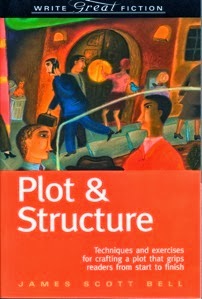
Fiction: Plot & Structure was published by Writer’s Digest Books. I wanted it to be practical and immediately useful, the kind of book I was looking for when I was learning how to write. It was my desire to deliver writers from what I call “The Big Lie,” that good fiction writing technique cannot be learned. Bosh. Piffle. Hooey.
By Mark Alpert
Thirty-one years ago I enrolled in the MFA creative writing program at Columbia University. I don’t have anything useful to say about whether such writing programs are worth the money. I was writing poetry at the time, so the MFA degree didn’t help me launch my career as a novelist (which didn’t start until a quarter-century later). But at least I got one tangible thing in exchange for those two years of tuition fees: a lifelong writing buddy.
I met Neil Davison at the first poetry workshop that September. The professor asked each of us to read one of our poems to the rest of the class. It was excruciating. No one offered any criticism during that first workshop, but the air in the room was thick with intellectual condescension. The only poem I remember from that morning was Neil’s. It was a surrealistic piece about a moose that had the face of Neil’s grandmother. You see, it’s kind of memorable, right?
We went to lunch together after the workshop, and we’ve been friends ever since. We laughed our way through grad school, coining nicknames for all our odd classmates (The Captain of the Thunderbirds, The Second-Story Man, The Spanish-Jewish Girl Who Is Neither Spanish Nor Jewish). After we got our master’s degrees, I became a newspaper reporter while Neil went on to get a Ph.D. and become an English prof at Oregon State University. And over the decades we’ve continued to read and enjoy each other’s writing. Neil’s an expert on James Joyce, and in 2004 he was invited to deliver a paper at a conference in Dublin that commemorated the hundredth anniversary of Bloomsday, the pivotal day of Joyce’s Ulysses. He convinced me to come along, saying the conference was just an excuse for an epic pub-crawl. He was right.
This weekend I’m taking my family to Oregon to attend Neil’s daughter’s bat mitzvah. My kids asked me recently, “If you had to pick just one of your friends to be your companion in a post-apocalyptic zombie world, who would you choose?” (As you can see, the Alperts are mentally preparing themselves for the much-anticipated debut of Walking Dead season four.) The truth is, Neil wouldn’t be the best choice for a zombie-killing wingman. He’s too nice. But he’d feel right at home in a dystopia where the survivors dissect books instead of decapitating the undead.
Writing can be a lonely occupation. So it’s a true gift to have a literary pal, someone who’s eager to share his or her strong opinions about Philip Roth or Susan Sontag. I’m looking forward to seeing Neil again. Perhaps he’ll have another weird poem to show me.
My husband sends me strange links and records off the wall TV programs for me because he knows how I think about story inspiration. Sometimes a news story could fill out a back story of a character or become the main action or mystery behind a book. Recently he sent me this LINK. This story came from Associated Press reporter Sean Murphy. Who doesn’t love a cold case murder mystery?
Especially one that has a double twist.
 |
| Jimmy Williams, Leah Johnson, Michael Rios |
You would think that discovering the skeletal remains of three teens (who were thought to have run away in 1970) in a rusted car at the bottom of a lake would be interesting enough. How did their car end up in the lake? Why weren’t they found until now? Rumors had run rampant. Locals speculated that the three teens had stumbled upon a drug deal at a rural airstrip and been killed with their bodies dumped, never to be found. Some folks thought the kids ran away to California, never to be heard of again. Most people who knew the kids suspected foul play, but leads went nowhere.
Police found a vehicle (a 1969 Camaro believed to belong to one of the missing kids) while conducting a routine diver training exercise at Foss lake, 100 miles west of Oklahoma City. Score one for the home team. But if that wasn’t enough, the over-achievers found a SECOND car, containing two to three more bodies. (Ew, that they don’t know if they have two or three bodies. That doesn’t mean poor math skills. It could mean they only have “parts.”)
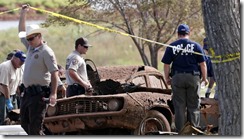 |
| Foss Lake outside OKC – Crime Scene |
All the skeletal remains are likely connected to missing persons reports that are still open and unsolved. Unrelated, presumably. The teens were on their way to a high school football game and went missing in 1970. The second vehicle, thought to belong to John Albert Porter, most probably carries the remains of another man and a woman. The grandson of Porter feels certain the find solves the case of what happened to his grandfather.
Both cars were found submerged in twelve feet of water, fifty feet from the end of a boat ramp near the marina. I’m not sure how both vehicles would have ended up fifty feet from the end of a boat ramp. Talk about taking a wrong turn?! Lakes in Oklahoma can be filled with sediment due to the red clay soils. They would make excellent training cases for police divers, but tough for anyone looking for six missing people, apparently.
The bones were sent to the Medical Examiner’s office for determination of cause of death. You can’t just presume drowning, but without flesh on the bones and with all the abrasive sediment, that can’t be an easy job. If the bodies can be identified, that could give six families closure.

But a writer can conjure all sorts of other explanations for a story like this one. Who would’ve wanted to see the kids dead? What had they witnessed? With two cars in the lake, who was using the red dirt lake for a body dump site? Without the flesh on the bones, what if someone in the area was harvesting organs to sell on the black market?
So what do YOU think happened? How would you spin this emotional gut wrenching story for the two vehicles?
by Jodie Renner, editor, author, & speaker
A novel won’t draw me in unless I start caring  about the protagonist and worrying about what’s going to happen to her – in other words, until I get emotionally engaged in the story. And it’s the same for most readers, I think. For me to warm up to the protagonist, he has to have some warmth and vulnerability and determination, some hopes and insecurities and fears.
As readers, to identify with and bond with the protagonist – and other characters – we need to see and feel their emotions and reactions to people and events around them. When the character feels and reacts, then they come alive for us and we get emotionally invested and start to worry about them and cheer for their small victories. Once you have your readers fretting about your hero and rooting for him, they’re hooked.
As the late, great Jack M. Bickham said, “Fiction characters who only think are dead. It is in their feelings that the readers will understand them, sympathize with them, and care about their plight.”
Show those feelings.
So bring your characters to life by showing their deepest fears, worries, frustrations, hopes and jubilations. If readers see your hero pumped, scared, angry, or worried, they’ll feel that way, too. And a reader who is feeling strong emotions is a reader who is turning the pages.
And engage the readers’ senses, too, so they feel like they’re right there, by showing us not only what the character is seeing, but what they’re hearing, smelling, touching, sensing, and even tasting.
Show their physical reactions, too.
Besides showing us your character’s emotional reactions, show their physical reactions as well to what’s happening to them.
Show the stimulus before the response, and show the reactions in their natural order.
To avoid reader confusion and annoyance, be sure to state the cause before the effect, the stimulus before the response, the action before the reaction.
And to mirror reality, it’s important to show your character’s visceral reaction to a situation first, before an overt action or words. And show involuntary thought-reactions or word-reactions, like a quick “ouch” or swear word, before more reasoned thought processes and decision-making.
As Ingermanson & Economy put it, “Here’s a simple rule to use: Show first whatever happens fastest. Most often, this means you show interior emotion first, followed by various instinctive actions or dialogue, followed by the more rational kinds of action, dialogue, and interior monologue.”
And don’t skip those first steps! Remember, we’re inside that character’s head and body, so you deepen their character and draw us closer to them by showing us what they’re feeling immediately inside – those involuntary physical and thought reactions that come before controlled, civilized outward reactions.
As Bickham points out, it’s important to imitate reality by showing the reactions in the order they occur. You may not show all of these reactions, but whichever ones you choose, show them in this order.
First, show the stimulus that has caused them to react.
Then show some or all of these responses, in this order:
1. The character’s visceral response
– adrenaline surging, pulse racing, stomach clenching, heart pounding, mouth drying, flushing, shivering, cold skin, tense muscles, sweating, blushing, shakiness, etc.
2. Their unconscious knee-jerk physical action – yelling, gasping, crying out, snatching hand or foot away from source of heat or pain, striking out, etc.
3. Their thought processes and decision to act
4. Their conscious action or verbal response
Showing your characters’ feelings and responses will bring them to life on the page for the readers and suck readers deeper into your story world, your fictive dream.
But don’t go overboard with it — you don’t want your protagonist to come across as gushing or hysterical or neurotic. It’s important to strike a balance so the readers want to relate to and empathize with your main character, not get annoyed or disgusted with her and quit reading.
So how do we strike that balance? How do we as writers find the emotions to bring our characters to life, but also find a happy medium between flat, emotionless characters that bore us and hysterical drama queens or raging bulls that make us cringe?
Bickham advises us to consider how we’ve felt in similar circumstances, then overwrite first, and revise down later. “I would much prefer to see you write too much of feeling in your first draft; you can always tone it down a bit later…. On the other hand, a sterile, chill, emotionless story, filled with robot people, will never be accepted by any reader.”
Do you have any techniques that work for bringing out your characters’ reactions and feelings? And for ensuring that you don’t go off the deep end with it?![[Writing-a-Killer-Thriller_May-13_120%255B2%255D.jpg]](https://killzoneblog.com/wp-content/uploads/2013/10/Writing-a-Killer-Thriller_May-13_120-25255B2-25255D-189x300.jpg)
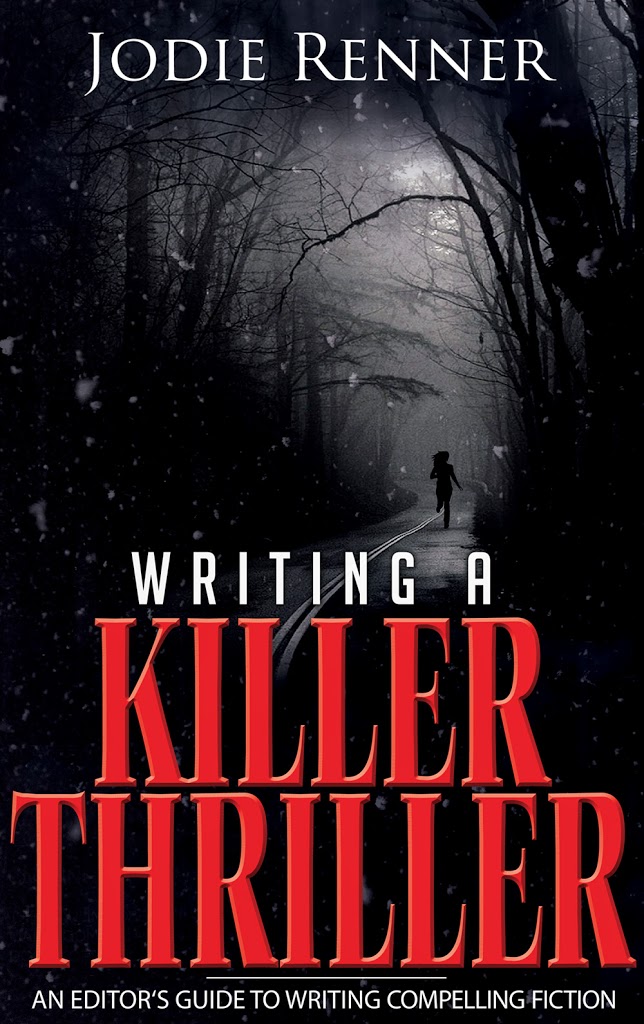
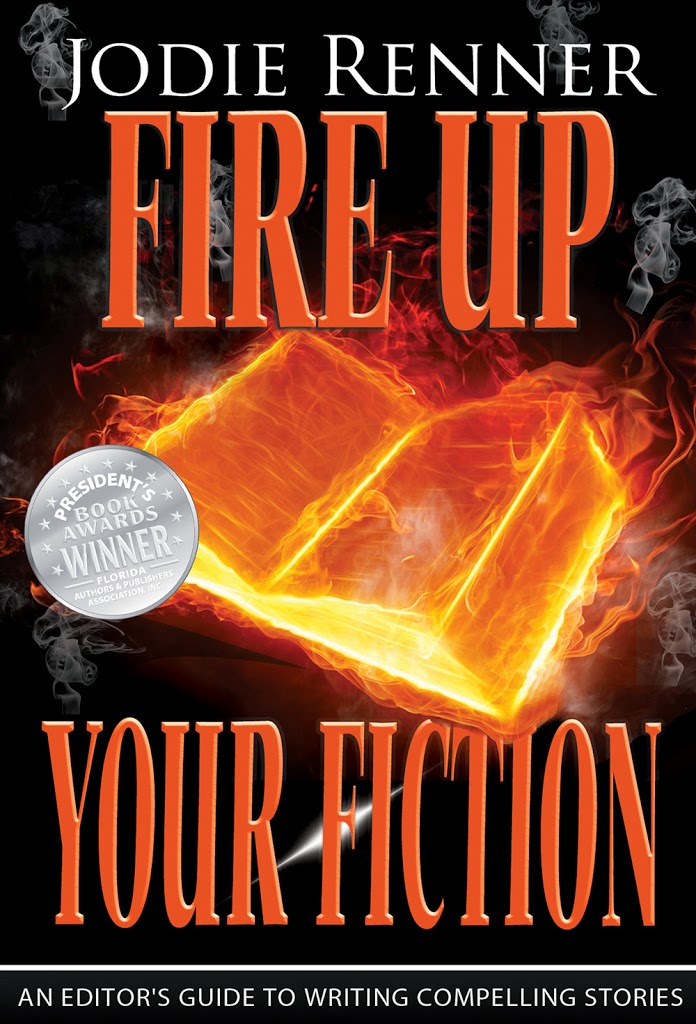
Jodie Renner is a freelance fiction editor and the award-winning author of three craft-of-writing guides in her series An Editor’s Guide to Writing Compelling Fiction: Captivate Your Readers, Fire up Your Fiction, and Writing a Killer Thriller, as well as two clickable time-saving e-resources, Quick Clicks: Spelling List and Quick Clicks: Word Usage. She has also organized two anthologies for charity. You can find Jodie at www.JodieRenner.com, her blog, http://jodierennerediting.blogspot.com/, and on Facebook and Twitter.