By Mark Alpert
It occurs to me that this trip could be the setup for a comic spy thriller by Graham Greene: a bunch of clueless, middle-aged New Yorkers bring their teenage sons to Santo Domingo, bearing gifts of donated baseball gloves and bats. Crazy hijinks ensue, involving Caribbean drug lords, CIA company men and unscrupulous scouts from Major League Baseball.
Working title: Damn Yankees
By Elaine Viets
White meat. When I was growing up, that was the best part of the turkey – and the most unattainable.
In German-American families, children were seen but not heard, and the choicest pieces of Thanksgiving turkey were reserved for the adults. Grandpa carved the turkey because he was the head of the family, but he had a subversive streak. Grandpa would “accidentally” drop little slices of white meat on the kitchen table for us grand kids while he carved.
But not too many. That delicacy was reserved for my mom and my aunt. My dad and my uncle got the turkey legs, Grandpa ate the wings and thighs and Grandma ate the pope’s nose – the tail. She’d grown up poor and “got used to eating it,” she said.
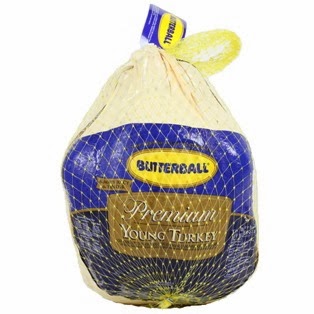
But Grandma was determined that her grandchildren would know the finer things, including white meat on Thanksgiving. One year in the 1960s, when I was ten and still eating at the children’s table, she bought a Butterball turkey.
The big-breasted bird was the talk of the family.
When we visited her the Sunday before Thanksgiving, we went downstairs to the basement freezer to admire the prize. The burly top-heavy bird nested amid bags of the frozen peas.
“Look at the size of that breast,” Grandma said. She never used that b-word except to describe fowl anatomy.
Butterballs boasted more white meat than any other turkey, according to the ads, and we didn’t know about animal rights back then.
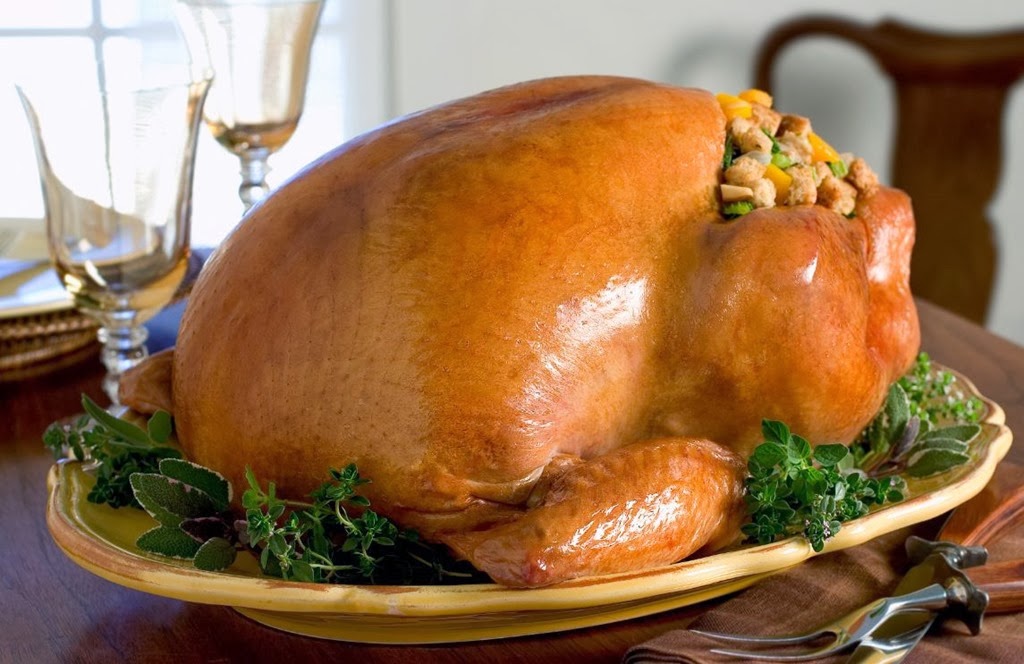
At three o’clock that glorious Thanksgiving, Grandma triumphantly pulled her roasted Butterball turkey out of the oven: a busty golden brown bird.![]()
While the turkey cooled, she put the finishing touches on the rest of the holiday feast: giblet gravy, stuffing, cranberry relish, lima beans in cheese sauce, and Parker House rolls. A stick of real butter was enshrined in a cut-glass dish. Mom brought the screw-top bottle of Mogen David wine out of the fridge and poured everyone a thimbleful.
The table sparkled with the best crystal and dishes, seen only on holidays. Even the kids’ card table got a real tablecloth.
Grandpa started carving. First the legs were set aside on the platter. Next he sliced into the golden breast meat. “Oops, I dropped a piece,” he said, and placed a thick slice on the Formica-topped kitchen table. As the oldest, I grabbed it. (Hey, rank has its privileges, even among kids.) Yum. This was the tenderest white meat I’d ever eaten, a sweet promise of the adult privileges waiting for me.
“Me, Grandpa!”“Me!” my brothers and cousins cried as Grandpa gleefully dropped slice after succulent slice of white meat and we kids scrambled for them like hungry pigeons.
He was still giggling and giving us white meat when Grandma said, “Papa, how’s the turkey coming?”
Uh-oh.
Suddenly we noticed the turkey breast was as bony as a fashion model’s carcass. All the white meat was gone, except for a few scraps.
Guilty, greasy-fingered grand kids slipped away.
Now I can eat all the white meat I want, but it never tastes quite as good.
So what lesson does this teach about writing?
(A) Be on the look out when something special lands front of you – and use it.
(B) Nothing. Have a happy Thanksgiving with delicious memories. ![]()
By Joe Moore
Today’s first-page critique is from a story called HAIR TRIGGER. My comments follow.
They were going to cut my hand off.
When I came to, I was tied to a chair. It was dark in the print shop and, like a character in a 1940s film noir, I could see the distorted silhouettes of a tall man and short man standing in the shadows. I was dizzy and felt sick from the blow to my head. The two figures swam in and out of focus.
Leaning over as far as I could, I barfed on the floor at their feet.
“Feeling better?” the short one asked in a strained high-pitched voice that reminded me of Peter Lorre.
“Please don’t say ‘fuck you’,” the tall one added.
I didn’t. I just vomited again.
After I finished whooshing whatever cookies were left inside me, I noticed my right hand was trapped under the clamping rail of a paper trimmer. This type of machine is commonly called a guillotine and has a razor sharp blade with thousands of pounds of pressure behind it. It can make very neat cuts through thick reams of paper.
The short guy stood next to it but I still couldn’t see him clearly.
“It says here this thing can trim up to a thousand sheets of paper at a time,” he read off the metal tag on the side of the machine. “Apparently, the operator must have a hand on each of the side switches for safety.” He looked straight at me. “Gee, I’d like to see how it works. Wouldn’t you?”
The big guy walked to the wall and pulled down the breaker handle on the electrical panel.
Machines around the shop started to power up. I could feel the vibration of the cutter humming through the metal surface under my hand.
The trimming blade gleamed wickedly.
“Now this is the part of the James Bond movie where I ask you to tell me what I need to know. If I don’t get an answer I like, you’re going to have to learn to jack off southpaw.”
I have very few phobias. One, however, is my fear of dismemberment. I get queasy just thinking about it, let alone imagining what my life would be like without a vital appendage such as my gun hand. In feudal Japan it was considered a sign of dishonor if a samurai lost a limb in battle. It showed everyone that he had failed in his duty as a warrior.
I liked this submission, and would keep reading. It starts, just as we so often suggest here at TKZ, with a life-changing event. The protagonist is in trouble and the author presents the reader with a big question: how is he going to get out of losing his hand? The bigger question, at least so far: what did he do to get into this situation?
The voice is not quite solid but it does take on enough character to intrigue. The scene is cliché – two bad guys, one tall, one short, but it does have forward motion and kept my interest.
A bit of line editing and cleanup would help, but it reads like a decent first draft. Nothing wrong with that.
I’m not sure who said the line starting with, “Now is the part of the James Bond . . .” That need clarification.
I would suggest not using the word “very”. It is meaningless. What’s the difference between few phobias and very few phobias?
There were a couple of places where the story slowed down while the writer explained how an industrial paper cutter works and what it means to lose a hand in feudal Japan hand. I would suggest avoiding those type of speed bumps at this stage of the story.
Lastly, even if it’s appropriate to the story, I recommend not dropping the f-bomb on the first page, or anywhere in the story for that matter.
Overall, not bad. I want to know what happens next. Thanks to the brave writer for submitting.
Now, Zoners, what do you think. Would you keep reading or does this guy losing his hand not grab you by the throat? Hold up your hands.
———————-
“THE BLADE is an absolute thrill ride." — Lisa Gardner
Elephants, it is said, never forget anything.
Readers, not so much.
I’m reminded of this memory gap frequently in my critique group. I’ll be reading a scene from chapter eight of someone’s draft, and suddenly a minor-sounding character pops up from out of nowhere to contribute a bit of dialogue. There’s no description that reminds me who this character is, or where he came from. There’s just a bit of dialogue, and a name. I have no clue who this character is.
Oh, I introduced that character four chapters ago, the writer says, a tad defensively, in response to my sheepish request for a reminder. How could I have forgotten?
I’ve forgotten your character, I want to scream at the writer during these moments, because A) You failed to introduce the character originally in a memorable way, and B) You didn’t re-establish him later in an effective manner.
A Universal Truth of Writing: It’s Never the Reader’s Fault!
It doesn’t work to ignore a character for several chapters, or even one scene, and then sling him back upon the unsuspecting reader without proper re-introduction. To a reader, this type of assault feels a bit like a zombie attack from outer space. Readers need to be reminded about what your character’s been doing the entire time you’ve been focusing attention elsewhere.
Within a scene, the re-introduction of a character who’s been missing in action can be done with a single sentence. For example, let’s say you have a scene with three characters, and two of them have been having a heated argument. Now let’s say you need to re-introduce Character #3, who hasn’t said anything so far in the scene. This is one way you might do it:
Bertram, who’d been listening to us from his unsteady perch on the broken stool, cut in to deliver a verdict. “You’re both wrong,” he said.
If your character’s been missing in action for entire chapters, you’ll need to do a bit more work to re-introduce him. One thing you could do would be to show other characters reacting to your MIA’s re-arrival in the scene.
Best Practice Suggestions:
Don’t lose your reader by ambushing him with improperly introduced details or characters from previous sections.
Do re-establish characters from earlier sections with gentle reminders that help readers stay oriented in the story flow.
How do you re-introduce MIA characters in your work? Have you ever had to go back a few pages to remind yourself who a character is?
We do an ongoing series of first-page critiques here at TKZ and all too often the same set of issues come up when analysing these draft first pages. I thought today’s post could provide a summary of some of the key elements needed to provide a really effective opening to your novel. Most of these elements apply not just to the first page per se but to those all important first few chapters which (lets face it) are the critical ones in terms of enticing and keeping reader’s interest.
On my list, the following are crucial to providing an effective opening:
I usually spend a considerable chunk of time getting the first line, page and chapters more or less right before I move on with drafting the rest of the book. To me the first few chapters provide the all important ‘voice’ and guidepost to the world I’ve created. But it’s important also not get too bogged down in perfecting the first line/page/chapter. I’ve seen too many people write, re-write and re-write the first three chapters only to never move on and actually finish that all important first draft of the novel.
So how do you strike the balance?
What makes an effective opening for you and what items would you add to my list?