 by James Scott Bell
@jamesscottbell
Got an email the other day from TKZ reader Gary Neal Hansen. With his permission, here’s a bit of it:
We’ve not met but I wanted to thank you for your help, so generously offered in the blogosphere. I stumbled across a post you made in 2015 on The Kill Zone about being a prolific writer. You drew the distinction you made between project ideas being on an “optioned” list, with a few moving forward to an “in development” category, and a single project being “greenlighted” as the WIP.
I wanted you to know that this has helped me see how to move toward clarity and self-organization in my newly independent writing life.
For 17 years I was a professor, where the demands of teaching and pursuit of tenure gave structure to my work. I recently left that position when my wife got her first faculty appointment to a really fine university.
Now I’m continuing to write non-fiction, but am (with the help of NaNoWriMo) adding fiction to the mix. Whether I become skilled enough as a storyteller to publish fiction is an open question, but I’m having fun. And your little book on short stories has also been very helpful — so thanks, very much, and I look forward to reading more of your craft books.
Grand! I love hearing about someone turning to fiction for the first time and having fun doing it. It’s also a nice nod toward NaNoWriMo, which has helped countless newbies over the years get into the habit of writing full-length fiction.
Gary then asked a question which he thought might make good fodder for a TKZ post:
Which of the following do you think would be a better strategy to jump start my skills in the craft?
- Pretend it is NaNoWriMo for five successive months and produce five 50,000 word drafts. Then set out to learn the process of editing the best one. Or,
- Edit my first NaNoWriMo for a month or two, then do another pretend NaNoWriMo, and keep repeating the cycle. Or,
- Draft new material in the mornings, and edit the previous manuscript in the afternoons (while, I suspect, quietly losing my mind). Or,
- Something else?
Here is my answer.
I like a combination of #2 and #3. I still recall finishing my first full-length novel. It was around 1990 or so. What I remember most is how much I learned by making myself complete a draft.
My education continued as I did my first self-edit, studying craft issues that came up. The novel was not ready for prime time, but I knew I’d made strides as a writer.
Which is why I’ve counseled new writers to finish that first novel, because it will reveal to you strengths and weaknesses in your craft. I’ve also advised they write first drafts “as fast as you comfortably can,” because it builds the discipline of completing a project.
Now, once finished, let the manuscript sit for three weeks or more. During that time, be at work on you next novel. This project should already have been “in development” as you worked on the previous book. That means you’ve done some thinking about the idea, some planning, some casting, even some writing.
When it comes time to self-edit the first MS, print out a hard copy and read it through, taking minimal notes. You want to experience it as a reader, or better yet as a harried editor or agent reading it on a commuter train, looking for a reason to set it aside!
After that, do a second draft, fixing what you can. Take note of problem areas in your craft so you can study those in more detail.
Show this new draft to beta readers, your critique group, perhaps a freelance editor. (All the while, you are keeping up a word quota on your next novel.) Take all that feedback and re-write once more.
Does that sound like a lot of work? Good. Because it is. And should be.
Now, one does not have to strive to write every novel in NaNo fashion. NaNo is a special speed-writing month, and once a year is quite enough. My guideline for “normal” times: figure out how many words per week you can comfortably write, then up that by 10%. Make that your quota and stick to it for the year. After a year assess and tweak the quota, then hop to it again.
That means that #3 is a good practice. Use your peak creativity time (morning, afternoon or evening, depending on your bio-preference) for the new stuff, and other times for editing. You won’t, as Gary wonders, lose your mind. Going from drafting to editing uses different parts of the brain, and many writers have done it just this way.
My caution: don’t do heavy editing of your WIP at the same time you’re writing it. Do a light edit on the previous day’s work, just to clean things up, then move on.
I’ll mention my “20k Step Back,” however. I found that if I pause to assess my characters and plot at the 20k point, I can save myself a lot of grief by making sure the stakes are truly high, the characters are rightly motivated, and the Lead is pushed through the Doorway of No Return.
Then I push on until I’m finished.
So that’s my advice to Gary an all others starting their the novel-writing journey. Let me offer a few notes on the other two suggestions:
- Pretend it is NaNoWriMo for five successive months and produce five 50,000 word drafts. Then set out to learn the process of editing the best one.
While I love the idea of this pulp-style prolificacy, those writers knew the craft of story first. If you write in this fashion I fear you’ll develop some bad habits that may be hard to break. It’s sort of like telling a new golfer just to go out and play eighteen holes every time without once taking a lesson.
There are better ways to choose what idea to develop (I’ll cover that in a future post). The steady quota, alongside directed craft study, is best.
- Something else?
Kerouac liked Benzedrine and a roll of butcher paper flowing through his typewriter. I don’t recommend this method.
Dean Koontz works on a single page, over and over, before moving on to the next page. That’s why he hasn’t found success yet. But if all you do is write 70 hours a week, I suppose you can do it this way. I’d go mad.
Balzac stimulated his imagination by drinking up to fifty cups of thick, black coffee every day. He was definitely prolific, but since he died at 51 of caffeine poisoning, I cannot give my imprimatur to this practice.
Countless unpublished writers wait for “inspiration” before they write. There’s a term for this: unprofessional.
Some writers steal. Don’t.
So I open it up to you, TKZ community. What’s your preferred practice? What other advice would you give the new novelist?
(I’m in travel mode today, so I’ll try to respond as best I can!)


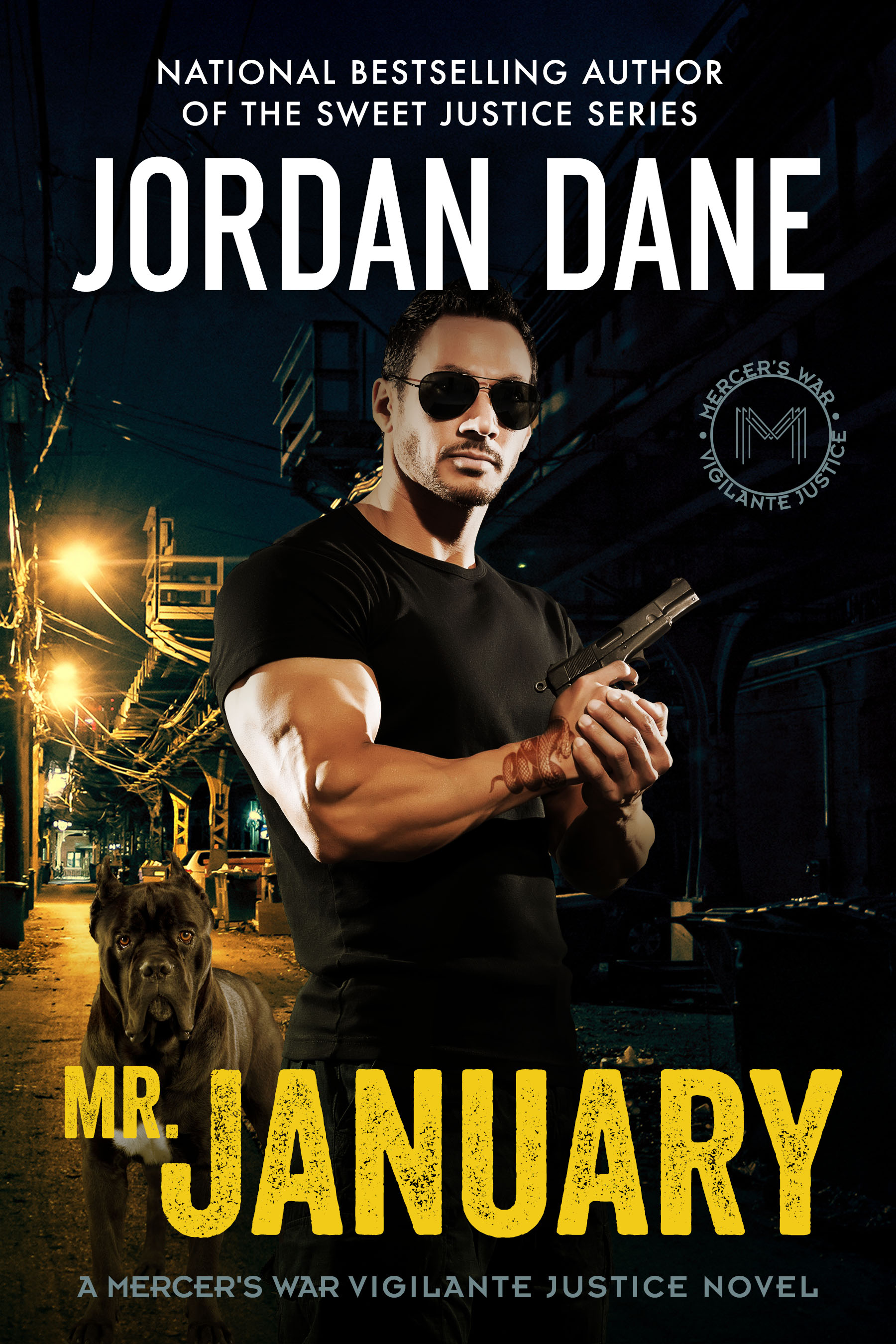
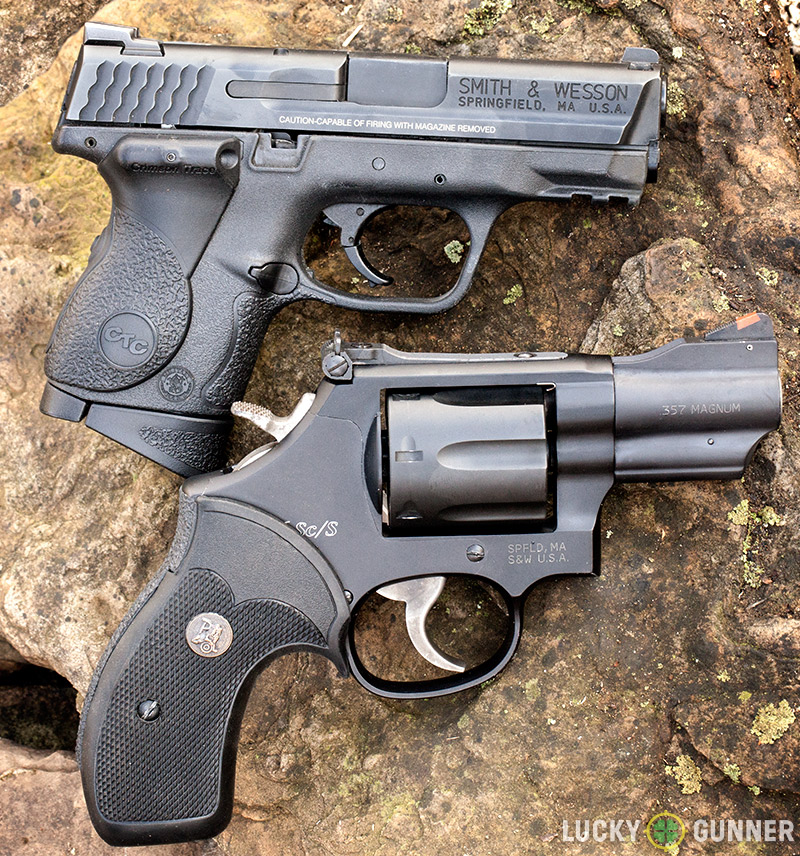 e mutually exclusive. Both are handguns, but they operate under entirely different principles. A revolver, otherwise known as a “wheel gun”, holds its cartridges in a cylinder that rotates as the hammer comes back and prepares for each shot. The revolver in the picture features an external hammer, and can be fired double action (DA) or single action (SA), which makes it a DA/SA revolver. (Double action means that with the hammer down, a single pull of the trigger with bring the hammer back, rotate the cylinder, and then drop the hammer again, firing the gun. Single action would describe the condition where the hammer is manually cocked and remains back–“condition zero”. From this condition, the trigger is more sensitive by a large margin.) Generally, there are no external safeties on a revolver. The fact of the long DA trigger pull functions as a safety. Only a fool would carry a revolver in condition zero.
 Recent years have seen a growth in the popularity of the DAO (double action only) revolver. With no external hammer to cock, every pull of the trigger is double action. The upside of a hammerless revolver is the ease of the draw from concealment (hammers have a way of snagging on clothing).
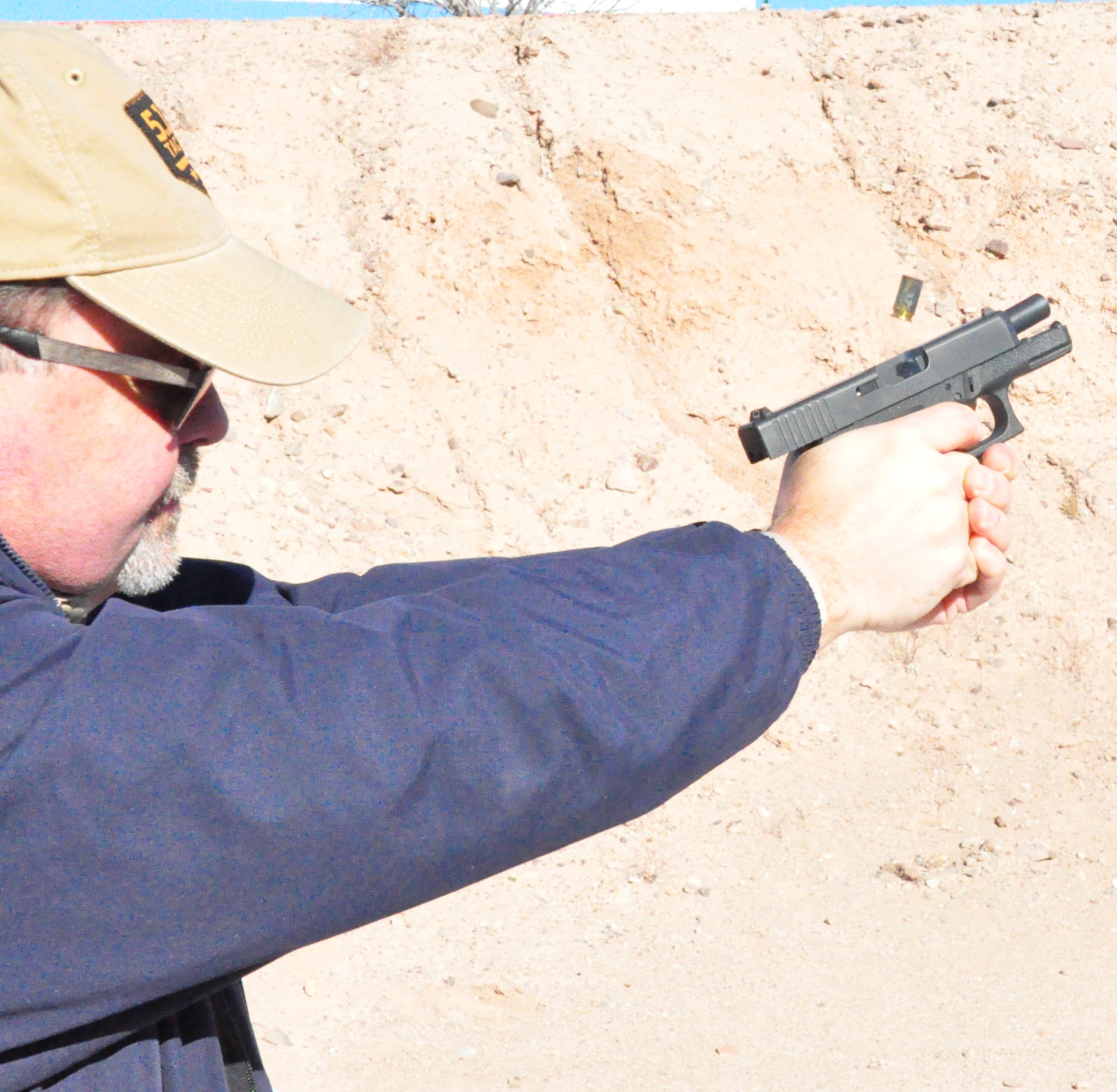
 A pistol, on the other hand, carries its load in a magazine that is inserted in the grip. As the weapon fires, the slide cycles, ejecting the spent shell casing and pushing the next round into battery. The picture at the top of this post of me at the range shows this cycling action of a Glock 36 at 1/4000 of a second–thanks to my son, Chris, for getting the picture.
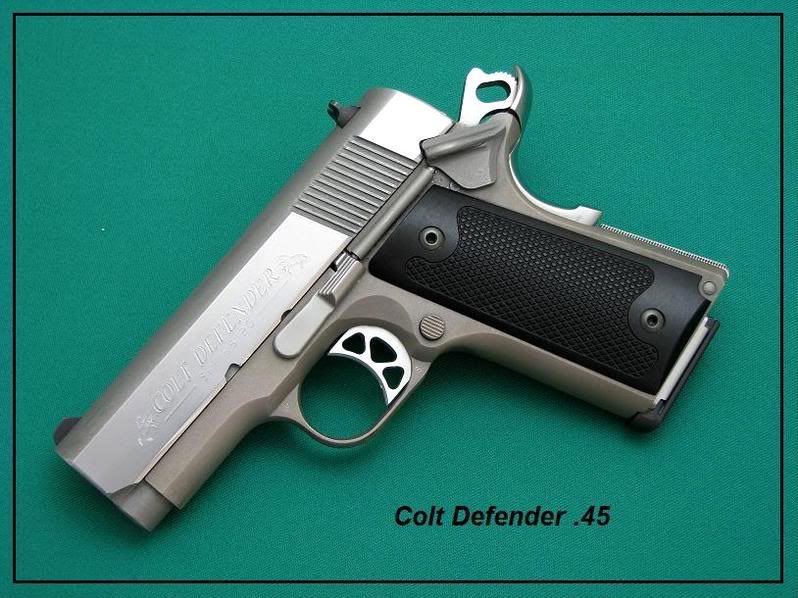
  The pistol in the picture with the revolver has no hammer, but is rather “striker fired”–a distinction that is best left to a future post. Striker fired pistols may or may not have external safeties. Some pistols have external hammers, such as the Colt Defender in the picture. As shown, the Colt is in condition one, which means cartridge in the chamber, hammer back and safety on–otherwise known as “cocked and locked.” In yet another iteration, many manufacturers make DA/SA pistols. The Bersa Thunder in the photo offers a very long, hard DA trigger pull for the first shot, which leaves the hammer back for a SA follow-up shot. For most DA/SA pistols, the “safety” is not a safety at all, but rather a de-cocker, which safely returns the hammer to its DA position.
 If your character is an on-duty cop or active duty military, where sidearms are worn in some kind of duty rig, the sky’s the limit for what they want to carry. You can buy holsters for all kinds of hand cannons. The choices become more limited when it’s important for your character to conceal his or her weapon. As a general rule, the larger the firearm, the harder it is to conceal. The obvious corollary is that bigger people can conceal bigger guns.
 When it comes to carrying a gun on one’s belt, the critical first choice is inside-the-waistband (IWB) vs. outside-the-waistband (OWB), and both mean exactly what the words say. Generally, OWB carry is more detectable,
 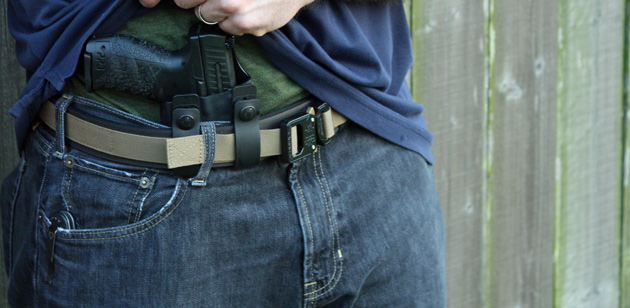 but with the right holster and an effective cover garment, it can be very effective. By contrast, IWB carry allows for concealment by means as simple as an untucked T-shirt. On the downside, the gun takes up waistband real estate that would otherwise be used by the waist.
  If your character wears skinny jeans, IWB could be a problem. IWB carry positions are referred to as positions on a clock face, where one’s navel would be 12 o’clock and the right hip would be 3 o’clock. The IWB position in the picture is referred to as “appendix carry”, and for the life of me, I don’t know how he would be able to sit down. Shoulder rigs are popular in movies and television shows, but I
 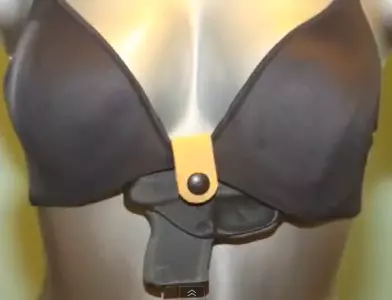 have never met a real person who wore one and didn’t hate it over time. They’re hard on the shoulders, and you can never let your arms hang normally. But the deal breaker for me would be that during the draw stroke, you pretty much have to point the gun at the person behind you, and then subsequently at yourself. That violates the basic tenets of firearm safety–as do many of the specialty retention devices such as the bra holster. ‘Nuff said, can we agree?
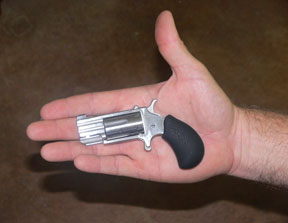 the only concealment option is a vest pocket, or perhaps a boot? Search the Web for specialty guns that are actually well-made and very effective for what they are. North American Arms makes a mini-revolver that easily fits in your fist, and can be chambered in .22 magnum, a round that shows very similar terminal ballistics to a .38 special, un
 der ideal circumstances. The tiny, nearly non-existent barrel is a problem for a shot longer than, say, 10 yards, but as a belly gun, it’s kind of impressive, and since it’s a revolver, your character gets five tries to bring justice to another character.