Not Before Breakfast

Photo by LisaRedfern courtesy pixabay.com

I am not sure if I am actually writing this or not.

You may not understand if you are one of the few people who has not seen the multiplex blockbuster Avengers: Infinity War. The plot basically involves a powerful being named Thanos — think Brock Lesnar in body paint — who (among other things) has to destroy part of the Universe in order to save it. This last gasp measure includes wiping out half of the people on Earth, which he is able to do with a snap of his fingers (I don’t like to do spoilers, but, like, that part of the plot is already out there, and everywhere). The Avengers attempt to stop him, and…anyway, there is a website that you can visit which will tell you whether you are still around or if you were vaporized when Thanos made like Bobby Darin in the interest of preserving all that is, or what is left of it. I checked and it seems that I was expendable and have joined the Hall of Heroes. Of course, no one really stays dead in the Marvel Universe forever so there is going to be some trick that turns things inside out and right side up to set things back to normal at some point down the road.  As for me, I feel like I’m still here, so it looks like I will be able to catch up on this season of Strike Back, keep watching Season Three of Billions, and, of particular importance, write my blog for today, procrastination notwithstanding.

All of this talking and viewing about death, however, got me thinking about mortality. The topic is often the subject of jokes. Abraham Lincoln’s last words, so the joke goes, were “You and your damn theatre tickets.” Bob Hope was asked on his deathbed whether he wanted to be cremated or buried. He reportedly answered, “Surprise me!” I also am fascinated by memento mori in picture form which seems to be a Pinterest topic of interest as well. I hadn’t really thought about the topic until several years ago when I attended a funeral where one of the (adult) grandchildren of the guest of honor was walking around snapping photographs. I was quietly aghast — most of the funerals I had previously been to had been held for Italian relatives and we just don’t do that — but I am sure that the photos will provide fodder for conversation several years and a generation or so down the road (“Who was that?”).

All of the above pales in comparison, however, to what I happened to find recently. I was researching how long a body stuck in a wall would continue to smell (you don’t want to know why I was wondering about that. Really. You don’t want to know) when I came across a term known as “coffin birth.” These don’t happen now (at least in the United States) but they were fairly prevalent here between the seventeenth and nineteenth centuries and around the world before then (and to some degree even now).  A coffin birth would occur when a woman who happened to be pregnant would die and be buried. Her body would later expel the corpse of her unborn child. Archeologists (make that “unlucky” archaeologists) have happened upon this phenomenon with semi-regularity. I find that to be the stuff of nightmare, for reasons I can articulate (but won’t) and for reasons that I can’t. The worst thing, however, is that it’s actually given me an idea for a story. I’m not sure that I want to go there — Poppy Z. Brite, I suspect, wouldn’t have hesitated — but I might.

My story notwithstanding…if horror is your game and you want to fashion something around that unfortunate occurrence, have at it. What I want to know from you, however, falls under the general heading of research. What is the most unusual fact — one that you were not looking for — that you’ve discovered online while researching something for your writing project entirely different? Don’t everybody answer at once. Thank you in advance.

On the Precipice – What New Things are You Doing with Your Writing?

Jordan Dane
@JordanDane

I’m on a precipice with my writing goals this year. All good things to consider. I purposefully left my goals open in 2018 to allow changes. I wanted to back off on the Amazon Kindle World commitments I made, to allow more time to write full novels and start a new series. So far, I’m on target with my goals and it’s exciting.

MY BACK LIST – I loved Laura Benedict’s post yesterday On the Matter of Backlists. I will soon have my YA back list titles returned to me and I’m excited to expand my inventory of books that are under my control. As I have the time, I will reissue them with new covers and have the ability to control pricing and subsidiary rights.

QUESTION – For those of you who have had rights reverted back to you – Have you every considered adding additional scenes or content? Change an ending? Or even continue a series (at least one more book) to conclude a story line? I’d love to hear about that.

RADISH – I also was approved to become a writer for Radish – serialized fiction available on an app for your phone. The approval didn’t take long, after I submitted a project for their consideration. I’ve set up my author profile and financial info for payment, and have my first story (Mr January) split into episodes with cliffhanger endings to entice readers to buy the next installment. It’s been fun to rethink the story as in episodes and adhere to their guidelines on length of ep offerings and marketing suggestions.

Radish is not a publisher. They are only offering a platform to expose your writing to new readers. If you sharpen your skills to create enticing teasers and can break apart your book into serialized fiction episodes that appeal to the reader/subscribers, this is more of a promotional tool. Larger publishing houses are trying out this platform by selecting certain authors in their house to participate.

I’ll report back when I have anything new, but so far, it’s been relatively easy. No special formatting. No cover design. They only want 1-2 images for the book, without text (since they insert font over the image when you upload). They in turn send out email promos to their subscribers that feature your story/series under their guidelines as new episodes are launched. This is free advertising for your work.

NEW PROJECT – I always love it when a new project starts to take hold in my brain. I’ve been inspired by certain well-written TV shows that have a rhythm to the plotting turning points (beats) with key pivots that turn the plot on its ear. I’ve used my “W” plotting method with success, as far as developing proposals and outlines for new books. For someone who started out as a complete “pantser,” I have evolved. My last completed project – The Curse She Wore – hit every beat, turning point, black moment, and mirror. But I am now eager to get back after another project and will start on that this month. Every project is a new opportunity to learn and flex my wings.

PERSONAL GOALS/HEALTH – My regular medical check-ups have me visiting various doctors for different reasons – mostly prevention. I’m taking a healthier approach to my eating and exercise – and am allowing more time with family and friends. It feels really good. For me to control my deadlines is a real bonus.

QUESTION – Do any of you have challenges in balancing your health goals with your writing time?

FOR DISCUSSION

1.) What new things are you doing with your writing? If you’re excited about a project, please share what you can. We love good news at TKZ.

2.) For those of you who have had rights reverted back to you – Have you every considered adding additional scenes or content? Change an ending? Or even continue a series (at least one more book) to conclude a story line? I’d love to hear about that.

3.) Do any of you have challenges in balancing your health goals with your writing time?


On the Matter of Backlists

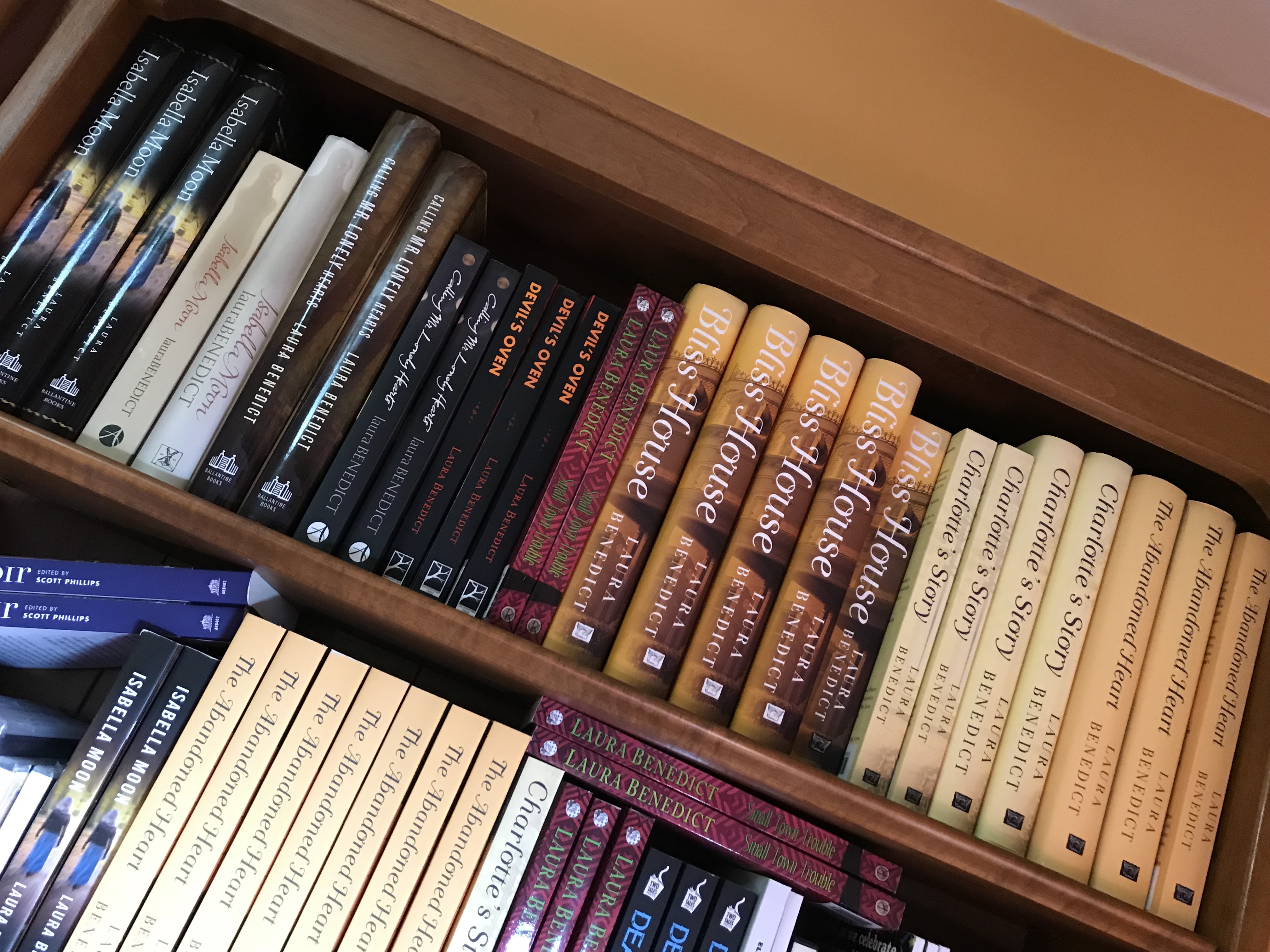
I love my backlist. It’s not a huge backlist, but after seven novels, it feels respectable. It didn’t really become a backlist to me until after books three or four. Before that, the books were just books I’d written.

Backlist means different things to different groups of people:

Publishers–An opportunity to make long-term money, especially when the author has a new book available.

Also Publishers–Let’s pretend those books never happened, okay?!

Readers–A treasure trove of a favorite author’s work to be discovered.

Other Readers–Old stuff the writer wrote before she got good at writing.

Still Other Readers–You wrote other books? Have I heard of them?

Booksellers (used books)–Stock

Booksellers (new books)–Old stock, or the discounted books on wheeled carts in the aisle or at the sidewalk sale. Or books that show up on the computer as “Unavailable,” aka “Out of Print.” (This does not apply to classic books.)

Booksellers (Online, new and/or used)–Stock

Authors– Well, this author, anyway. Pick one or more: 1) That stuff I wrote years ago. 2) Precious words I’ll love forever. 3) Those books I wrote that almost no one mentions. 4) Those books for which I got the rights back. 4.5) Those books the publisher won’t return the rights to because the contract was written poorly or signed long before anyone dreamed of print-on-demand or ebooks. 5) The books I republished after getting the rights back. 6) Proof of my existence. 7) Stock, whether it be ebook, print-on-demand, or all those copies I bought at the author discount before the rest were shredded. 8) That book that has an Amazon Rank of 2,154,982. (Who knew Amazon even had a 2.2 million rank?!)

Libraries–Stock, mostly. Often fodder for book sales.

Of course, all of these descriptions are my personal opinions/observations.

While I very occasionally find myself in the “Old stuff the writer wrote before she got good at writing” trap when it comes to looking at other authors’ backlists, I’m usually pleasantly surprised. I worry most often about quality of writing when I’m looking at the early installments of a series. I can think of a couple of really big series that got off to rocky starts, but then sorted themselves. Often I’ll start a series with the third and fourth book, then go back to the beginning

I feel a sense of true joy when I discover the author of a book I love has several other books already on the shelf. It’s like anticipating a feast.

Writers, how do you feel about your backlist? Do you actively market it, or just let people discover it on their own? Do you ever wish it had more of a life?

Readers, are you wary of backlist books? Or do you plunge right in?

Cadaver Dogs – The Nose Knows

Gruesome warning – The following contains graphic details about cadavers.

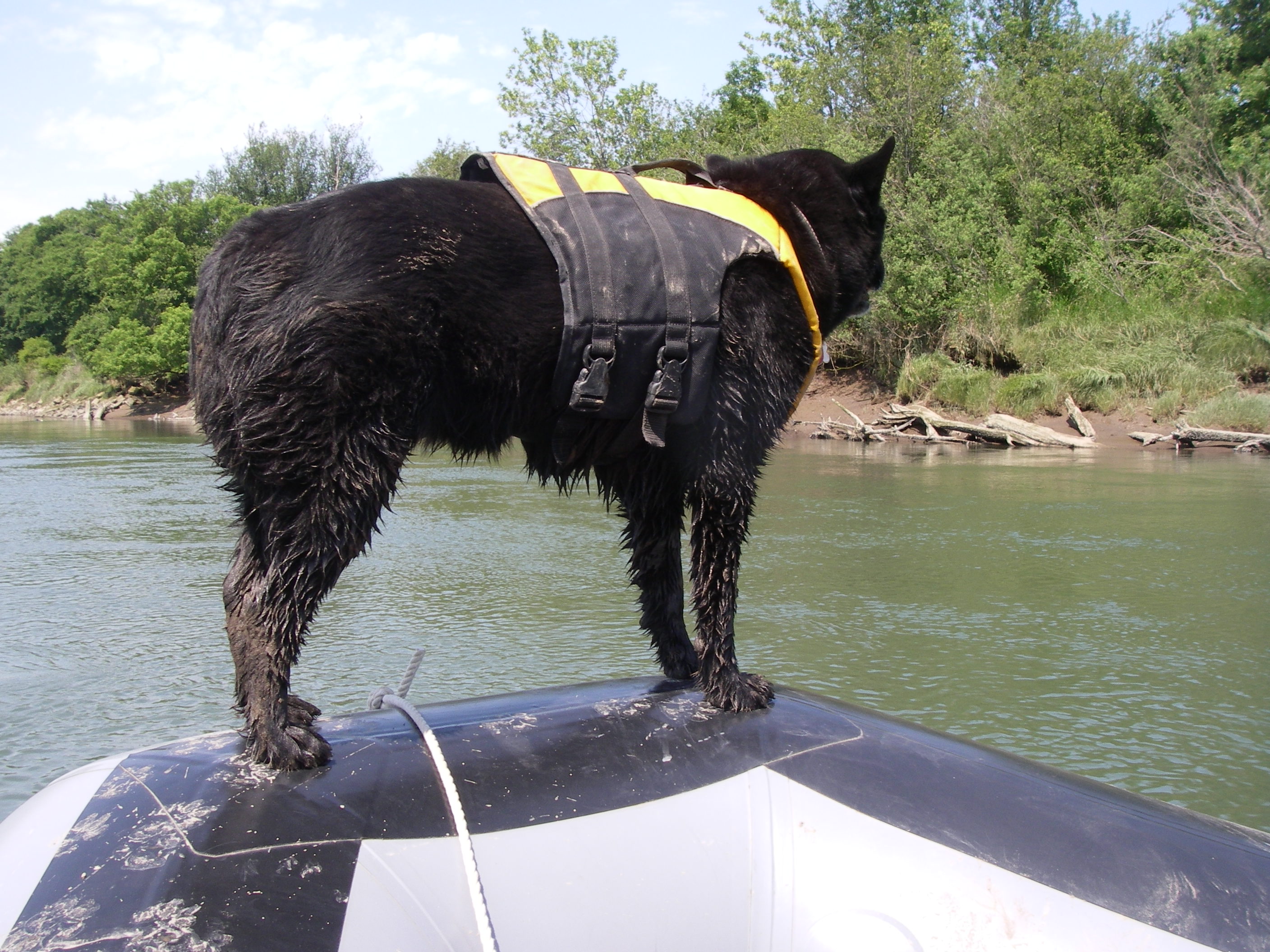
Sage on a water search
Photo courtesy of Stacie Burkhardt

On a bright March day near Anchorage, Alaska, Stacie Burkhardt lifts the lid of a chest freezer in a barn. With gloved hands, she picks up an object wrapped in plastic that’s the size and shape of a deer haunch but it’s not. “This is Revlon,” she says, pointing out perfectly manicured fingernails. Underneath lies a foot which Stacie also grabs. “And this is Tootsie.”

These are not animal parts but human.

The smell from the freezer makes Susan Purvis gasp and pinch her nose, even though she and her search dog Tasha spent a decade in what she calls “finding the stinky”—recovery of bodies.

Their dark humor might sound disrespectful but is necessary to cope in their grim profession.

Their mission: train dogs to help solve crimes and bring closure to grieving families. Both have risked their lives to recover the dead. Whilst the objective may seem somber, it is lovely to see dogs being put to excellent use. Often dogs are left to their own devices by slacking owners invariably resulting in dogs failing to behave accordingly. There is a reason why a dog attack injury attorney is always swamped with cases!

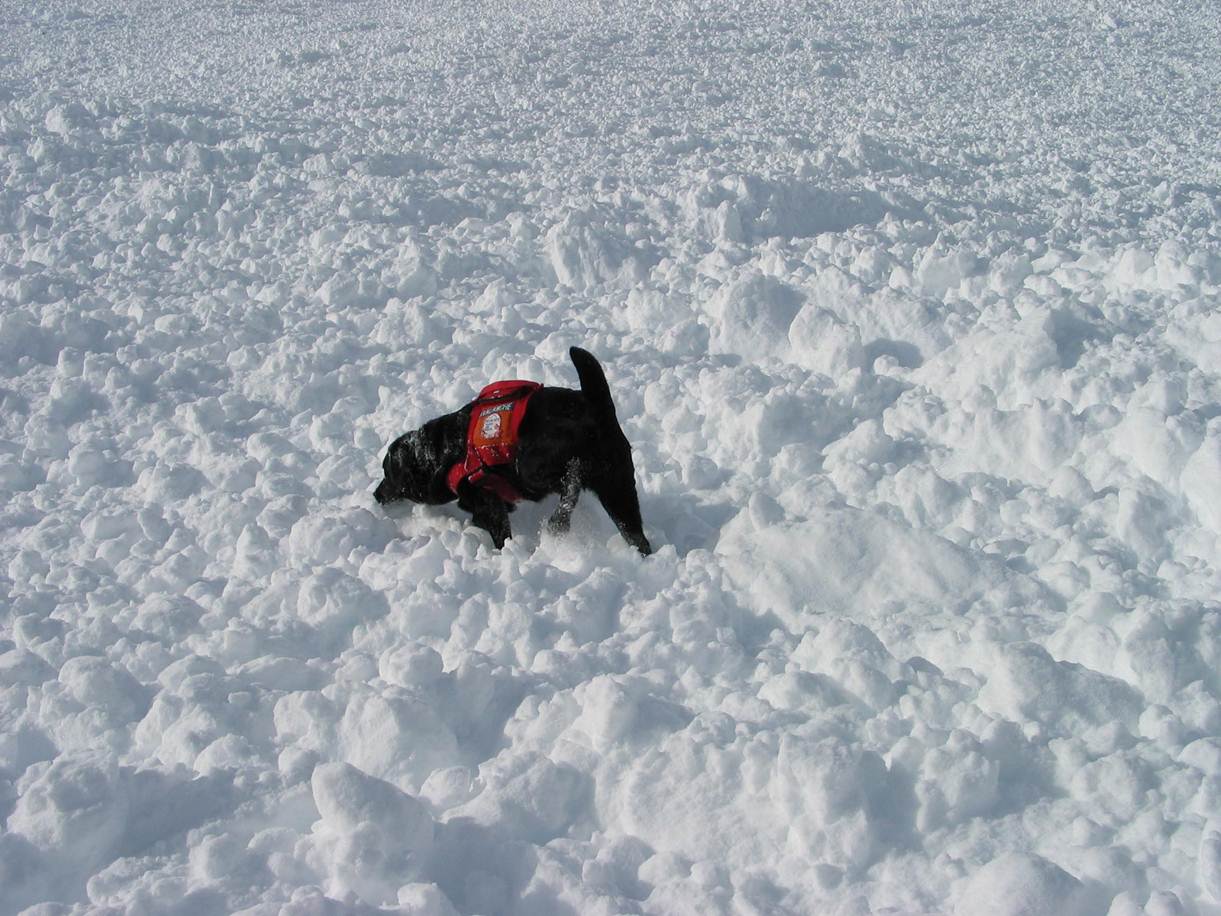
Tasha searches avalanche debris
Photo courtesy of Susan Purvis collection

Susan and Stacie are teaching a two-day specialty course in avalanche rescue and HRD—human remains detection—to twenty teams of search dogs and handlers from as far away as Juneau, Bethel and Fairbanks. All are volunteers and work closely with the Alaskan State Troopers, the law enforcement agency that oversees Search and Rescue missions.

During exercises, Tootsie and Revlon are hidden in the snow in the remote Talkeetna Mountains for the dogs to find and alert their handlers. These dogs are very well trained and dog owners know how hard it is to train a puppy to just come back when called. Some owners resort to using something similar to these pet trackers from JugDog.co.uk in case their little treasures run off and never come back!

Sun dazzles on deep pristine snow while the dogs bark and jump, eager to start the hunt. Their enthusiasm is infectious. Despite the gruesome quest, the search is fun, playful, and adrenaline-fueled as shown in TV coverage.

Twenty-three-years ago, Susan had a goal to train her black Lab puppy Tasha as an avalanche dog to save lives. But reality intervened. Susan recalls, “I didn’t plan to make a career out of finding the dead but that’s how it happened. Missions may start as rescues but most often wind up recoveries. At that point, I just wanted to bring missing family members back home.” Training a dog to undertake jobs like these is very important. Without the right training, the use of a dog in a job like this will not be effective and could potentially lead to failed missions. If you want your dog to follow in similar footsteps, you’ll at least have to have the basic commands sorted. By involving yourself and your dog in private puppy training sessions, this will be the first step in being obedient and being able to follow important instructions. If they can do this, then maybe one day, they could be a great candidate for future rescue missions.

In 2001, Susan and Stacie met at a cadaver dog boot camp led by legendary trainer Andy Rebmann. There, dogs learned to find remains on the ground, hanging aboveground, buried, and hidden in objects. They practiced with samples as small as a tablespoon because, in real-life situations, remains can be scattered and tiny: bone fragments, teeth, blood, and adipocere (the post-mortem waxy tissue formed by anaerobic bacteria).

In her own home freezer, Susan kept “Mr. Nub,” a severed finger, along with his tooth, and blood-soaked rags that were the remains of “Kimmy” (clearly marked “Biohazard”) as training aides for Tasha.

According to Andy, 80% of training is human and 20% is dog. “If you’re having problems with your dog,” he says, “look in the mirror.” He wrote Cadaver Dog Handbook – Forensic Training and Tactics for the Recovery of Human Remains, the definitive reference guide in the profession.

Specific words are used to command the dog, such as Find Fred, Mort, or Decomp. The dog’s alert signal can be: eye contact, bark, or lie down. A passive alert is preferred in crime scenes so the dog doesn’t disturb evidence.

Susan recalls a case she worked where a murder victim had been shot, chopped up, burned, then buried under a ton of landscape stone. Tasha’s avalanche training taught her to dig to uncover victims but, in this situation, digging was prohibited. Susan worried her dog might violate that rule but she alerted to the location without digging.

However, Tasha broke the number one rule—she found a small bone and proudly pranced around with it in her mouth, tail wagging. She was forgiven because she found evidence that professional investigators had missed the day before.

Killers may think they can outsmart a dog by hiding and masking the scent with extreme measures like wrapping the body inside an animal carcass. “But the human body is constantly decomposing,” Susan says, “and the dog always knows. That’s why we train for every situation, under every condition, and with every stage of human decomposition.”

Water search guided by Sage
Photo courtesy of Stacie Burkhardt

Stacie recalls a mission on the Pilchuck River for the remains of a murdered female. In the initial search, a trailing dog was able to follow the victim’s fresh scent and locate her lower extremities. Teams searched for the next few weeks but conditions – “the decomp” – wasn’t right. Finally Sage, Stacie’s cattle dog-Lab, caught a whiff and swam across the river, muscling against the current. Her alert confirmed she wasn’t just taking refuge on a stack of rocks in the river. She was standing on a grave. Even though the victim had been found, the case remains unsolved.

How sensitive is a dog’s nose compared to a human’s? Humans have six million olfactory receptors. Dogs have 300 million receptors. What humans see, the dog smells.

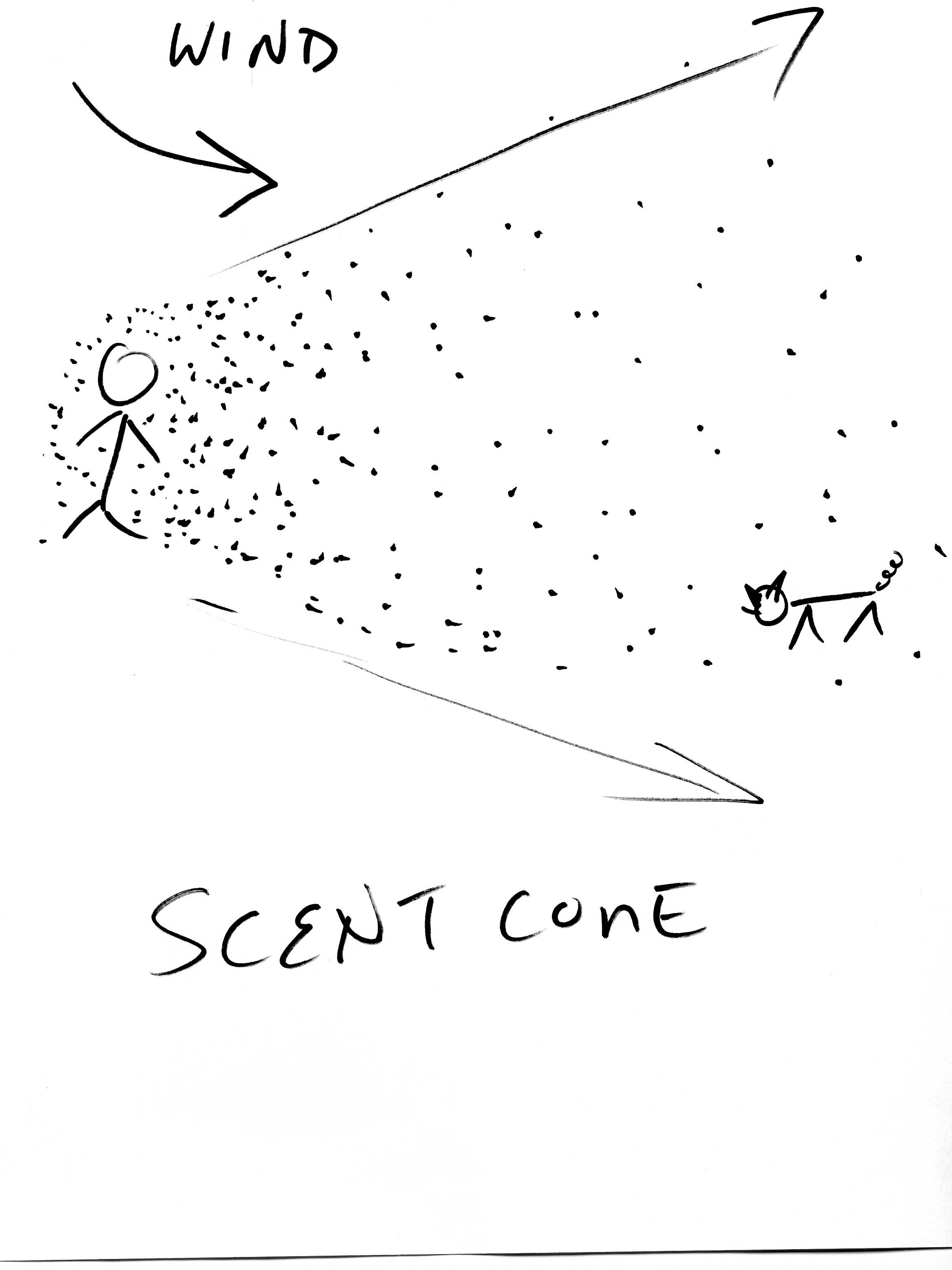
Scent cone

Scent is strongest at the source but water, wind, and terrain move it in a fan shape, called the scent cone. The farther away, the weaker the scent.

Humans shed “rafts,” dead skin cells mixed with bacteria, at the rate of 50 million rafts per second. One-third fall to the ground and two-thirds rise to float in the air. Susan likens it to the character Pig Pen in the Peanuts comic strip, surrounded by a cloud of debris. Each individual gives off a unique scent.

Skin raft

Underwater recoveries are the most difficult. According to Susan, “Currents, temperature gradients, and surface wind can move scent any which way, making it difficult to locate the source.”

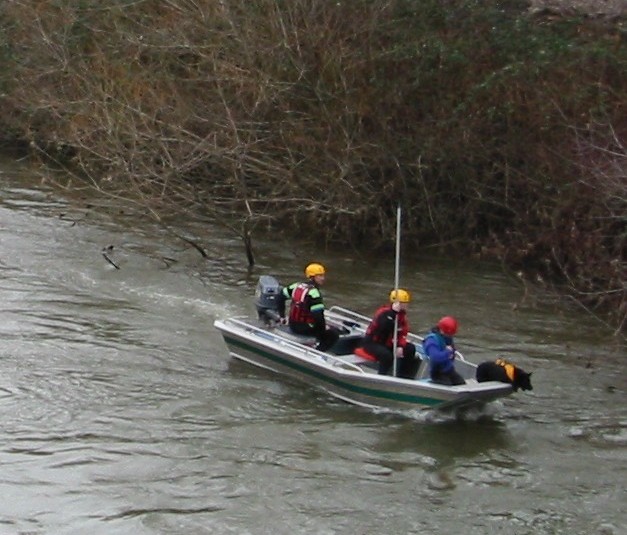
For water work, handlers submerge a cage or weighted PVC pipe containing remains to simulate a drowned victim.

In underwater searches a cage protects human remains.
Photo courtesy of Stacie Burkhardt

“Many people don’t realize a dog can locate the scent of a drowned human,” Stacie explains. “The dogs pick up the rising scent after it breaks the water surface, which can be quite far from the subject depending on the wind and current.” Body oils may also gleam on the surface closer in. The handler reads the dog and the conditions to direct the boat and solve the scent puzzle.

Stacie recounts a search for a missing canoer in a local lake: “A newly-acquired sonar was deployed first but soon after came a request to launch the dogs. The conditions were constantly changing but by marking the dog alerts on the GPS and noting the wind direction each time, we were able to narrow down a location. I chuckle because the divers told me my #1 on the map was right where the victim was found, thirty feet down. Dogs 1, Sonar 0.”

Despite popular lore, no particular breed has a corner on keen noses. Stacie and Susan have worked with Labs, Cattle Dogs, Golden Retrievers, Brittany Spaniels, Standard Poodles, German Shepherds, Duck Tollers, as well as mutts. Temperament is more important than breed.

Qualities to look for in a search dog:

  1. Is it friendly to people and other dogs?
  2. Does it crave human attention and want to please?
  3. Will it retrieve a favorite toy despite barriers, obstacles, and uneven surfaces?
  4. Does it love the hunt?

Drive is a term often used by handlers. Dogs must have a high drive to hunt, search, eat, and play. This doesn’t necessarily translate into a well-mannered pet.

A dog needs to be closely bonded to the trainer but independent enough to follow the scent. Human-canine teams must be tuned in to each other’s signals. Even the slightest nuance in behavior or expression can mean the difference between life and death.

Not all search teams have the temperament to learn HRD. Susan says, “You can screw up a dog if they get confused about the scent of death because of the handler’s negative reaction to it. The process has to be fun for the dog.” The reward is chasing a favorite toy, playing tug of war, or food.

After two days in the Alaskan sun, Stacie lifts the freezer lid and replaces Tootsie and Revlon until next time. Susan and Stacie high-five each other and smile at another successful session—twenty dogs trained, no one injured.

And already there’s another mission poised to launch for a skier in Montana who went missing three months ago….

To read more about Susan’s adventures with her search dog, her memoir Go Find is available for pre-order and will be published in October. www.susanpurvis.com

Emotion Must Be Earned: A First Page Critique

By John Gilstrap

Here we are again, presenting the work of a brave author willing to invite friendly fire.  This one arrived to me untitled, and is presented as such.  The italics are mine, just for the sake of clarity. I’ll see you on the other side.

Quinn Larson slipped into the gallery’s back row, settled on the hard edge of a plastic chair, and waited for the execution to begin. In her nightmares, this room had been a chaotic jumble of torches, pitchforks, and angry words. Instead, she found a handful of stoic men and women holding each other up as they took seats. A few stole curious glances at her with lifeless eyes. The warden entered next, escorting a frail woman starved as much for sanity as food. She picked at the skin on her patchy arms around the fraying sweater cuff as he helped her into a chair near the door. Quinn pulled her own hoodie tighter, the edges going much farther around her body than they used to. She probably should have dressed up, but the act of walking through the door took all her focus. It had been ten years since she’d been to the prison or seen her father. He’d written her, but the letters sat, unopened, in a pile on the back corner of her dresser.

Members of the press filed in, scribbling morbid fascination into their little notebooks. Phones and video cameras had been confiscated at security and Quinn took wicked pleasure that the prison forced them to write things down the old-fashioned way. She had no use for reporters. Not when they’d picked the flesh from her bones after the trial and certainly not after the circus they made of her sister’s death. She still wore the scars of their callous disregard.

Special Agent Dawson swaggered in next, the execution his final moment in the spotlight. He’d hunted down the monster, bringing an end to a gruesome fairy tale. He came up the aisle ahead of Quinn in the center of the row, scoping out the view. Then, he glanced at Quinn.

“Miss Larson.” He inclined his hat before removing it. They were two tiny words, just a few letters each, but they sent a live current through the assembled spectators. Some turned fully in their chairs to get a look at her, their expressions full of contempt, and her skin crawled. She was an infection to their grief, the painful itch of a murderer’s daughter in their midst. The humiliation of it rose up the back of her neck and blossomed across her cheeks. Even in the heavily air-conditioned room, her face flamed.

=

It’s Gilstrap again.  I think the premise here is very strong.  A daughter coming to witness her father’s execution is pretty stuff.  Clearly, Quinn and her soon-to-be dearly departed daddy are not what we’d call close.  I can only imagine the stress of feeling the heat of so many stares when people realize who sits among them.

Alas, I have not choice but to imagine those things because they are not here on the page.  The piece, as submitted, impresses me more as notes for the author than as an actual bit of drama.  It’s the emotional equivalent of bland spaghetti sauce.  It’s the right color, all the elements appear to be there, but it’s missing the spice that makes the offering come alive.

My first thought is that the author has chosen the wrong place to begin the story.  We make much here in TKZ of acting first and explaining later, and for good reason.  But this scene is more emotion than action, and emotion needs to be earned.  That’s a problem here.  I don’t know whether I’m supposed to be in Quinn’s corner, or if I’m supposed to be as appalled by her presence as her fellow spectators are.  Maybe the author should start a few minutes earlier, perhaps with an interaction with the guard at the security station, where a few lines of dialogue would give us a clue as to her status on the observer tree.

I think if there were a quick interaction with Agent Dawson, in which she asks to remain anonymous, his greeting to her in from of the others would pay off as an act of betrayal–if that’s where you’re trying to go.  Have her encounter a reporter and tell him to go to hell.  Lead us into her world.

Bottom line: the author hasn’t triggered empathy from this reader.

At a more granular level, some of the writing gets in its own way.  Take, for example:

“In her nightmares, this room had been a chaotic jumble of torches, pitchforks, and angry words.”  Remember that this is the reader’s first encounter with any of this story.  When you refer to torches, a time frame is set in my head, and even though you counter it in later passages, the contradiction is jarring.

“. . . handful of stoic men and women holding each other up as they took seats.”  I’m not sure this is possible.  One is either sitting or being held up, it can’t be both–unless there’s a robbery involved, in which case the meaning of “held up” changes altogether.

“The warden entered next, escorting a frail woman starved as much for sanity as food.”  How does Quinn know whether the woman is sane?  She can appear stressed (“She picked at the skin on her patchy arms around the fraying sweater cuff” does a nice job of that), but stress and sanity are entirely different things.

“Quinn pulled her own hoodie tighter, the edges going much farther around her body than they used to.”  The first two or three times I read this, the image in my head was of her pulling her hood tighter, and I couldn’t figure out how that would tighten around her body.  Now, I realize that by “hoodie” you really meant “hooded jacket.”  Again, because we have no lead-in to this scene, the obligation to be precise in descriptions is critical.

“She probably should have dressed up, but the act of walking through the door took all her focus.”  I don’t see the contradiction here.

“It had been ten years since she’d been to the prison or seen her father. He’d written her, but the letters sat, unopened, in a pile on the back corner of her dresser.”  This is an intrusive bit of backstory.  Not only does it interrupt the present action, it catapults the reader to a place he’s never seen and has no reason to care about.

“Members of the press filed in, scribbling morbid fascination into their little notebooks.”  Morbid fascination? Really?  Because we have not been brought into Quinn’s close third-person world–where we might understand that she’s pissed at the press for good reason–this feels like a POV violation.  How does she know what they’re writing?

“She had no use for reporters. Not when they’d picked the flesh from her bones after the trial and certainly not after the circus they made of her sister’s death. She still wore the scars of their callous disregard.”  Finally, this is a good bit of business, but, again, it’s not earned.  Put her face-to-face with Reporter Bob and let them interact.  Show, don’t tell.  Let us witness the angst through her eyes.  “Callous disregard” is a facile phrase that ultimately means nothing.

That’s all I’ve got before turning things over to the Killzone denizens.  By way of full disclosure, when this critique posts, I will inaccessible to all things Internet, so y’all behave.

Want to Make Your Scenes Come Alive?
Here’s a Cop’s-Eye View

By PJ Parrish

It’s a weird — but illuminating — exercise to go back and read your early works. My sister Kelly and I have been doing this lately as we prep our backlist for re-issue with new covers and better editing (Click here to read James’s salient and funny post on typos from Sunday.)

Sometimes, when you read your early stuff, you get this hard little nub in your gut and you think, “Good grief, what was I thinking?”  Kelly and I sort of feel this way about our first published Louis Kincaid thriller Dark of the Moon. It’s a solid freshman effort, but could have been better. But our second book Dead of Winter was where we began to digest the lessons of craft and find our stylistic stride.

In Dead of Winter, we began to recognize the power of description and mood. We knew the setting — the deep dark of the northern Michigan winter — was critical as a backdrop for the plot of a sniper picking off the cops in a small town. When I was editing the other day, I got to the scene where Louis and his partner Ollie are called out on New Year’s Eve to check out a trash can fire some kids set in the woods. But of course, it’s a trap set by the killer.  Kelly wrote this chapter, and to this day, I think it contains some of the best descriptive writing she has ever done.  She managed to capture not just the dark, cold loneliness of the setting but the visceral terror Louis feels in it.

In an stroke of synchronicity, that same day she also happened to send me a link to a blog post by our friend Lee Lofland.  Lee is a cop who wrote the Writers Digest bestselling book Police Procedure and Investigation. He’s a Macavity Award nominee for best non-fiction mystery, an Edgar Award judge, and is a nationally acclaimed expert on police procedure and crime-scene investigation, working as a writer’s consultant on TV and film. He runs a terrific conference for writers who want a total immersion in the grit of cop work. (Kelly’s going this year for the first time. Click here for more info about The Writer’s Police Academy.) Lee’s motto for writers is “Just Say No to Cordite.” (If you don’t get that, you really need to go read Lee’s posts and a few of John Gilstraps’)

But Lee’s is also a damn good writer in his own right. I’m a regular at his blog The Graveyard Shift. Recently, he had a post that was so compelling I asked him if I could print it for you here. It is about cops, but it is a master class in the power of using your senses, and finding the telling details, to make any scene or character come to life.

Take it away, Lee:

A Cop’s Nighttime Melody: The Sounds of the Graveyard Shift

Many writers have never, not once, set foot inside a police car, nor have they climbed out of bed at 11 p.m. to swap pajamas for a police uniform, Kevlar vest, gun belt, sidearm, and spit-shined shoes. And they’ve not headed out into the night to spend the next eight to twelve hours dealing with the city’s “worst of the worst,” and worse.

Most people have not left home with their family saying, “Be careful, see you when you get home,” and know they’re saying it because they worry the next time they see their loved one will be at their funeral service. “Killed in the line of duty” is what the bloggers and reporters will say.

Sure, you all know what goes on during a police officer’s shift—fights, domestic calls, shootings, stabbings, drug dealers, rapists, and killers of all shapes and sizes.

But what those of you who’ve never “been there, done that” cannot honestly and accurately know are the sounds heard when someone take a shot at you. No, not the actual gunshot. It’s the other noises that help bring super-cool details to your stories.

To learn about those sounds, let’s pretend we’re the officer who’s just been the target of a bad guy’s gunfire. We’re chasing the suspect through alleys and paths that wind through dark wooded areas, all while knowing the guy has a gun and he’s definitely not afraid to use it.

You can’t see your hand in front of your face, so you stop and listen. And then it happens…

That eerie calm.

It causes the hairs on the back of your neck to stand tall and straight. Goose bumps come to attention on your arms. A lone pea-sized bead of sweat worms its way down your spine, easing through the space between your pants and the bare skin of your waistline. It feels oddly cool against your fear-warmed flesh.

10-4, I’LL TAKE THIS ONE …

The call came in as “Shots Fired. Suspect is armed with a handgun and caller advises he is still at the residence and is threatening to kill responding officers.”

I was working the county alone, so I asked the dispatcher to request backup from a nearby city and from the state police. The trooper in our county was also working alone. Our roles differed, though. He was out on the interstate writing traffic tickets while I responded to the usual plethora of calls. Either way, we were alone when we approached whatever situation was before us, be it stopping a stolen car with dark tinted windows or heading toward a house where I knew a man was waiting to kill me.

The sound of a police radio is far different when it’s heard late at night as opposed to the same radio traffic during daylight hours. Its an unexplained phenomenon. It could be that dark skies and night air create different acoustics. Or that working the graveyard shift forces dispatchers to work really hard to battle “the thing” that comes out at night to squeeze their emotions into submission. They typically lose the fight which results in a manner of speech that’s without feeling, inflection, and dynamics.

Nighttime radio traffic echoes and travels far. It’s weird and out of place among the stars and creamy moonlight. Dispatchers drone on like robots … “Robbery at …” “Wife says husband hit her …” “Lost child …” “Possible drug overdose at …” “Loud music at …” “Peeping Tom at …” “Customer refuses to pay at …” Shoplifter at …” “Dead body in river …” Dead body in park …” “Shots fired …” “Shots fired …” “Man stabbed at …” Shots fired …”

Back to the man who wanted to kill me.

I acknowledged the call with a “10-4, I’m en route.” Then I hooked the radio mic back into the metal “U-shaped” clip on the dashboard. Next, I pushed one of the many red toggle switches mounted into the center console.

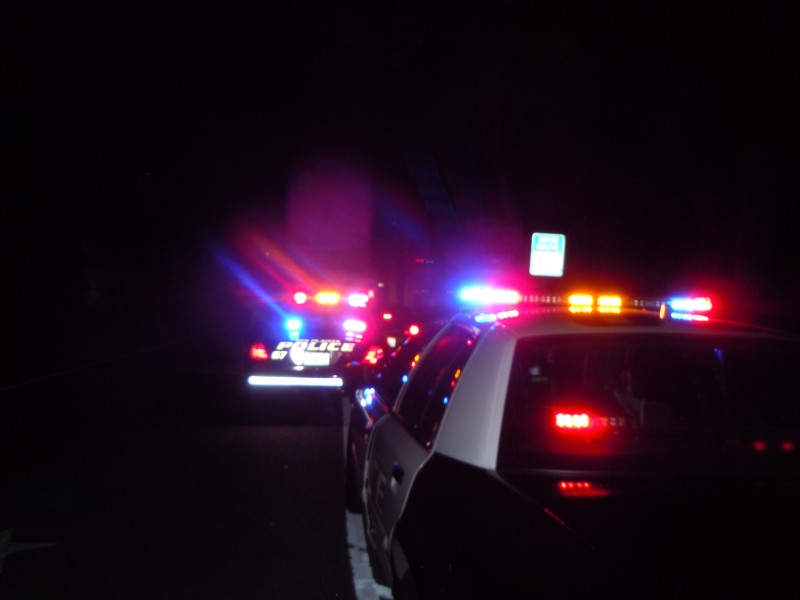
With the push of the button, a faint click occurred simultaneously with the eruption of pulsating blue light. I stepped on the gas and heard the engine come to life. Since I was miles out in the country there was no need for the siren. Not yet.

I pushed the pedal toward the floor until I was cruising along at 70 mph. Believe me, that was pretty fast considering the curvy, hilly road that was before me.

There are no streetlights in the country. It’s super dark. Blue light reflects from trees, shrubbery, houses, mailboxes, passing cars, and telephone poles. It also reflects from the white lines painted on the pavement.

Meanwhile, the radio traffic continues with updates for me and with traffic from city officers and the trooper out on the interstate … “Use caution. Driver of the vehicle is wanted for a homicide in …”

My car radio played in the background. The Oak Ridge Boys went on and on about Bobbie Sue and Elvira while I attempted to straighten the curves by hitting my marks—drive low in the curves, on both sides of the road. Never at the apex. Unless a car is coming in the opposite direction or you cannot see far enough ahead to safely do so.

The blue strobes mounted on top of the car make a clicking sound with the start of each flash. The wig-wag headlamps did the same. The roadway is very uneven with a few cracks and potholes scattered about. They cause the patrol car to dip and roll. The extra pair of handcuffs I and many other cops keep handy by hanging them from the spotlight handle that protrudes from the post between the windshield and driver’s door, sway back and forth and bang together causing a constant click, click, click noise. The sounds are out of sync.

I switched off my lights a ways before reaching the scene—didn’t want to shooter to know I was there—and stopped my car on the shoulder, a bit down the road from the driveway. I called the dispatcher on the phone to let her know I’d arrived. The use of the phone was in case the bad guy was listening to a scanner. I turned down the volume on my police radio. Way down. Remember, the sound travels far. I wished backup didn’t have to do the same (travel far).

I opened my car door slowly to avoid making any noise. The interior light was not operational—disconnected in police cars to prevent illuminating the officer and/or blinding them to goings-on outside the vehicle.

As I slid from the seat my leather gun belt creaked and squeaked and groaned, as leather does when rubbed against other leather or similar material. To me, the sound was as loud as Fourth of July fireworks. My car keys (in my pants pocket) jingled slightly with each step. So I used a hand to hold them against my leg. The other hand was on my pistol.

I walked up to the house to peek into a window before knocking on the door. I wanted to see if I could, well, see anything. But, as I closed in on the side the house a large mixed breed dog stepped into view, showing its teeth and upper gums. The animal with matted-hair and a crooked tail growled one of those slow, easy rumbles that comes from somewhere deep inside. I held out a hand for it to sniff. It backed into the shadows.

A quick peek inside revealed a family of five. A woman with two black eyes and three crying children. Two girls, not quite teenagers, but close, probably, and a wiggling and squirming baby. A man stood near a tattered recliner and tall floor lamp. He held a pump shotgun in his right hand. At the moment, the barrel was aimed toward the floor. He yelled a few obscenities and started to pace. Then he looked straight at me, or at least it seemed like he looked at me.

My heart pounded against the inside of my chest. It bumped so hard I could hear the sound it made with each beat.

Thump. Thump. Thump.

From somewhere deep in the shadows.

Grrrr ……..Growl …..

From inside the home.

A baby crying.

A woman pleads and sobs.

A young girl. “Please, Daddy. No more!”

Sirens wail in the distance, beyond the black tree line that connects sky with earth. Sounds travel further at night, right?

The air-conditioning unit beneath the window snaps on. Its compressor humming and fan whirring. The metal casing rattles slightly. Probably missing a screw or two.

I knew what I had to do and started toward the door with my leather shoes and gun belt squeaking and keys jingling and heart thumping. As I reached for the knob I took a deep breath.

The expansion of my chest pulled at the Velcro that held my vest tightly against my torso.

Crackle. Crackle. Crackle.

Right behind me now.

Grrr …. Growl …

Crying.

Screaming.

Whir.

Thump. Thump. Thump!

Jingle

Squeak.

The door.

Turn and push.

“Drop the gun!”

BANG!

BANG!

Thump. Thump. Thump.

Crying.

And crying.

“10-4. Send the coroner.”

So, my friends, those are the sounds of working the graveyard shift …A Cop’s Nighttime Melody.

Me again. Note Lee’s use of the telling details here: the out of sync jangle of the extra cuffs. The sweep of blue lights on a mailbox in the night. How acoustics seem different in the dark swirl of lethal fear. And notice how he switches his narrative style — slow and legato when the cop is merely driving through the night then moving to a sharp staccato style during the action of t he shooting and take-down. All these are markers of a good novelist. Lee isn’t telling you how much terror a cop feels. He’s showing it to you and making you experience it through your senses.

I’ve never worn a badge, carried a gun or had to go through a door not knowing if I’d make back out alive. But I write about cops every day, so I can only hope to try to live vicariously in the skin of those who do. And then try to make the reader see what I am trying to see. It’s what writers do. It’s what we have to do to make readers feel.

Thanks, Lee. We’re all still learning here.

Postscript: I am traveling to NYC today for Edgar duties, so might be delayed in responding here. Talk amongst yourselves!

Beach Reading

I am in Cancun, hopefully sunning myself (with an appropriately large hat and SPF 100 on),  for today’s blog so wanted to get some beach reading recommendations. I’ve managed to convince my husband to read the excellent Australian mystery by Jane Harper, The Dry, while I indulge in some YA reading and research for my current WIP. I’ve also got James Comey’s  A Higher Loyalty to read – but I’m not sure that qualifies as much of a beach read! On spring break I started to read Sarah Perry’s Essex Serpent but found it was too dark and damp to read at the beach…so that’s been set aside for a rainy day. It’s funny how you need just the right combination of intrigue and atmosphere when you’re trying to relax:)

So TKZers, what are you looking forward to reading this summer? Are there some juicy new mysteries or thrillers you would recommend for by the beach, by the lake, or for up in the mountains? I’m planning on spending quite bit of time up in the mountains this summer while my boys are on Boy Scout and Avid4 camps – so I need some good recommendations for books that can keep me up turning the pages at night. I haven’t had one of those reads in ages!

Thanks in advance! I’m hoping to be able to check in on your recommendations while sipping cocktails beneath a beach umbrella:)


Hang On! First Page Critique: MANNAHATTA

Photo Courtesy Pixabay

Welcome, Anon du jour!  Thank you for joining us this morning by submitting Mannahatta, your work in progress, to First Page Critique. I think you’re off to a great start with what I believe is an adventure novel. Let’s take a look, noting that the original line separation and paragraph breaks were lost in transmission:

Prologue

Winter 1602

The two hunters could see it would not go well.

They sat on the high bank, bundled in skins and eating parched corn, while they watched the canoe approach from the west—from the island.

The rain had stopped, but the gale at their backs was still gusting. Whitecaps roiled the gray, cold waters below them, and there was a continuous roar from both wind and raging sea, not unlike a waterfall.

“Worst time to attempt this passage,” the taller of the two shouted in their Munsee dialect.

The other man grunted agreement while he chewed and pulled his beaver cloak tighter against the north wind.

The tide was turning at this spot they called Monatun, just east of Mannahatta. Here three salt rivers and waterways converged into one channel. Currents from different directions raced and collided. Waves rammed into each other and shot spray high in the air. Deep whirlpools spun and sucked, and a standing wave spanned the treacherous water route.

The hunters could do nothing to change what they knew was coming. They would be silent witnesses.

The man was in front, a woman in back, and in the middle a boy who had seen maybe eight or nine winters. The man paddled furiously and yelled instructions to his woman, eyes wide with fright. The boy remained motionless, as if in his dreaming world, his small hands grasping each side of the canoe.

As soon as they entered the violent stream, the paddler’s efforts had little effect—the canoe was pulled helplessly into the standing wave that blocked its path. The man tried to angle up and over the wave, but it was no good. The heavy canoe flipped like a small twig, its occupants launched into the icy water and swept along with the main current.

The wind then caught the lip of the canoe and sent it sailing against a large boulder that jutted out from the water. It broke into splinters with a loud crash.

The man and woman flailed and tried to swim to shore while being carried on by the chaotic flow. Soon, they disappeared under the water’s choppy surface.

The hunters’ attention went to the boy. He was not helpless like his parents. He was not fearful. He struggled in the water, but with a fixed determination.

He held a rope, and while he bobbed toward the jutting rock, they could see him purposefully . . .


First, last and in between: Anon, you know how to tell a story. Good going. You set a scene and create suspense very well. Even though I was almost certain from their first introduction that the adults were goners and that Sonny Boy was going to make it (and that’s not a sure thing yet) I was wondering how it was going to go down. I wasn’t disappointed at all with what you presented.

It looks like I have made a lot of corrections here. That is no reflection of your storytelling skills. Your work here reminds me in a way of Edgar Rice Burroughs, one of my all-time favorite authors of adventure fiction. He probably wouldn’t even get published now, as he was not a stickler for grammatical rules, but he could tell a story by just picking the reader up and carrying them along, the same as you do. I was swept up by your story which in my opinion matters more than writing a story that follows all the rules in the telling but bores the waste out the reader. Accordingly, please consider the following to be fine detailing rather than a general remodeling.

— They sat on the high bank, bundled in skins and eating parched corn, while they watched the canoe approach from the west—from the island.  I’m thinking, Anon, that this would be a good place and time to hint that there are three people in the canoe. You can say:

They sat on the high bank, bundled in skins and eating parched corn, while watching the canoe with three people aboard approach from the west—from the island.

— The hunters could do nothing to change what they knew was coming. They would be silent witnesses. Since they are already silent witnesses, let’s change the tense and also bring the canoe back into the action to introduce what happens next:

The hunters could do nothing to change what they knew was coming. They were silent witnesses as the surging waves tossed the canoe and its helpless passengers.  

— The man was in front, a woman in back, and in the middle a boy who had seen maybe eight or nine winters. Let’s introduce them in a parallel fashion:

A man was in the front of the canoe,  a woman in the back, and a boy who had seen maybe eight or nine winters was in the middle.

— The other man grunted agreement while he chewed and pulled his beaver cloak tighter against the north wind.  I knew what you were saying here, Anon, but the image lept into my mind, almost unbidden, of the gent chewing on his beaver cloak. Let’s maybe add two little words:

The other man grunted agreement while he chewed his corn and pulled his beaver cloak tighter against the north wind.

— The man paddled furiously and yelled instructions to his woman, eyes wide with fright.

This story is told from the point of view of the hunters who have no way of knowing the relationship, 1602 style, between the man and the woman. It could be the guy’s sister. Let’s make the change from “his woman” to “the woman” until we know for sure if we ever do. Also, tell us whose eyes are wide with fright, Anon. If they’re the woman’s, use:

“…to the woman whose eyes were wide with fright.”

If the man’s, use:

“The man, eyes wide with fright, paddled furiously…”

— The man and woman flailed and tried to swim to shore while being carried on by the chaotic flow. Soon, they disappeared under the water’s choppy surface.  I don’t like the “soon” here. “Soon” for me implies a fifteen minute rest period. Let’s try “quickly” to further convey the urgency of the situation:

The man and woman flailed while trying to swim to shore but were carried on by the chaotic flow. They quickly disappeared under the water’s choppy surface.

— He held a rope, and while he bobbed toward the jutting rock, they could see him purposefully…  I take the sense that the boy is probably not so much holding the rope as hanging on for dear life. I like the sense of urgency you have going overall and want to keep that going, so let’s use a word that does that. For example:

He clung to a rope, and the pair on shore watched him purposefully (tell us what he is purposefully doing) while he bobbed toward the jutting rock.

Just to close…I like that the perspective of the story is from the point of view of the two crusty customers on the bank, who so far are sitting there watching what unfolds. The implication here is that there isn’t anything they can do to avert the catastrophe that is unfolding. They’re not taking any joy in it. They are just stoically watching nature take its course. Fortunately, the boy is not. My guess is that after the Prologue we’ll meet up with the boy as an adult and he’ll be the protagonist of your book. I look forward to finding out.

I will now attempt to remain uncharacteristically and unnaturally quiet as I turn the reins over to our wonderful visitors and commenters. Thank you for joining us, Anon, and good luck with Mannahatta!